
Category: Countries
-
Culture of Kachemak
LoreThe culture of Kachemak traces its roots to the primordial epochs of Saṃsāra, over nine thousand years ago, when the first multiversal souls arrived on the island continent amid evolving monsters and scattered teleported communities that began mixing and multiplying without explanation. Grounded in ancient practices of harmony with tidal spirals and chambered resilience, Kachemak…
-
Kordariism
The religion practiced predominantly on the island nation of Jōmon is known as Kordariism, a faith centered around the veneration of the deity Kordara, the Eternal Weaver of Bonds. Kordariism permeates the daily lives of its adherents, shaping their interactions with the magical flows that bubble across Saṃsāra, influencing everything from the construction of steam-powered…
-

Frostweavers
SpeciesThe species known as Frostweavers constitutes a distinct group of avatars within the world of Saṃsāra, characterized by their inherent adaptations to harsh, cold environments that have shaped their evolution over millennia. Frostweavers emerged from the early teleported communities that arrived on the island continent now called Jōmon, blending with the primordial inhabitants who had…
-
Jōmonari
The common national language for the Major Island Country of Jōmon is named Jōmonari. Jōmonari serves as the primary means of communication across the island nation, functioning as the official tongue for governance, trade, education, and daily interactions among its diverse population of avatars, creatures, and communities. It encompasses a vast vocabulary that draws from…
-
Culture of Jōmon
LoreThe culture of Jōmon traces its origins to the primordial epochs of Saṃsāra, over nine thousand years ago, when the first multiversal souls arrived on the island continent amid evolving monsters and scattered teleported communities that began mixing and multiplying without explanation. Rooted in ancient practices of harmony with nature’s cycles, Jōmon culture emphasizes intricate…
-

Nunamiut
Species The Nunamiut are a species of sentient humanoid avatars, known for their incredible resilience, physical strength, and a deep, spiritual connection to the arts of carving and storytelling. They are the predominant race of the Major Island Country of Ipiutak, forming a plurality of around 40% of the nation’s total population, which numbers approximately…
-
Path of the Ivory Gate
Lore The Path of the Ivory Gate is an ancient, shamanistic faith centered on the belief that the physical world and the spirit world are not separate, but are intricately carved from the same essential substance. The faith’s lore, preserved not in books but in epic narrative carvings, tells that when the first Nunamiut souls…
-
Tarn ngitit
Name and Definition The common national language of the island nation of Ipiutak is Tarn’ngitit, a name that translates to “the speech of spirits” or “the carver’s breath.” It’s a language renowned for its poetic structure, its metaphorical depth, and its intimate connection to the nation’s profound artistic traditions. Tarn’ngitit is a reconstruction of the…
-
Culture of the Ipiutak Nation
The culture of Ipiutak is one of profound artistry, deep spiritual introspection, and quiet endurance. It is a society shaped by the stark, beautiful, and unforgiving nature of its arctic home, and defined by a reverent mission to reconstruct and embody the enigmatic principles of a far more ancient civilization. This affects everything from their…
-
Way of the Whispering Sky
Lore The Way of the Whispering Sky is the ancient, animistic faith of the Inugsuk people. It is not a religion of gods and masters, but one of spirits and balance. The lore, passed down through millennia of oral tradition, teaches that when the first Ukaliq souls arrived on the vast, frozen island, they were…
-
Ukaliq
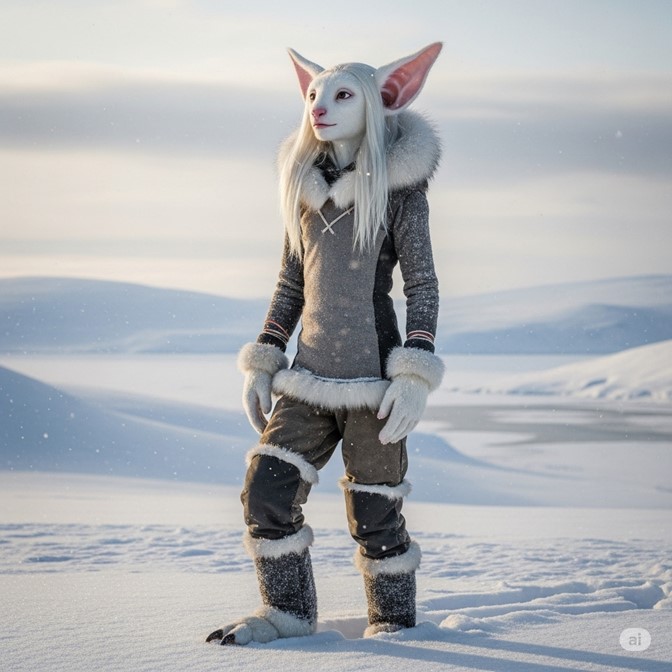
Species The Ukaliq are a species of sentient humanoid avatars known for their incredible speed, unparalleled senses, and a deep, communal bond forged by the harsh beauty of their arctic homeland. They are the predominant race of the Major Island Country of Inugsuk, comprising approximately 50% of the nation’s total population, which numbers around 79,136,000…
-
Qilangnaarsut
Name and Definition The common national language of the vast, cold island country of Inugsuk is Qilangnaarsut, which translates roughly to “the way of the sky-seers” or “wayfinder’s breath.” It is a profoundly complex and ancient oral language that has been spoken on the island since the first souls arrived. It is not merely a…
-
Culture of the Inugsuk Nation
The culture of the Inugsuk nation is one of the most unique and resilient in all of Saṃsāra. It is a society shaped by the profound challenges of its arctic environment, built on a foundation of community, oral tradition, and a deep, spiritual connection to the formidable world of ice and snow that its people…
-
Faith of the Great System
Lore The Faith of the Great System, often simply called “The System,” is the primary spiritual philosophy of the Indus nation. It is less a religion of worship and more a school of thought dedicated to understanding the fundamental, logical order of the cosmos. Adherents believe that the universe, Saṃsāra itself, is a single, impossibly…
-
Praakrit
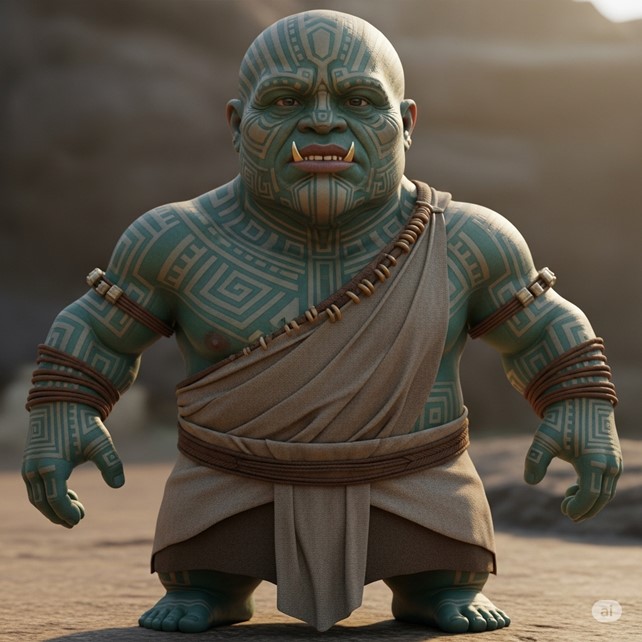
Species The Praakrit are a species of sentient humanoid avatars known for their formidable strength, incredible endurance, and an almost supernatural gift for engineering and artisanship. They are the most populous race in the nation of Indus, making up approximately 45% of the total population, which numbers around 62,862,545 individuals. As the people who first…
-
Proto Sindhian Glyphic
Name and Definition The common national language of the island nation of Indus is Proto-Sindhian Glyphic, often shortened to Sindhian in daily use. It is a language renowned for its logic, precision, and vast, systematic vocabulary. It is a direct and faithful reconstruction of the language spoken by a highly organized ancient civilization that once…
-
Culture of the Indus Nation
The Ibero-Maurusian nation is defined by a culture of rediscovered identity, one built upon the perceived legacy of a far more ancient civilization. This affects every aspect of life, from governance and religion to the very appearance of its cities and people, creating a unique society that is both primal in its philosophy and advanced…
-
Path of the Ochre Cycle
Lore The Path of the Ochre Cycle is one of the oldest spiritual traditions known within the 73 island countries. Its followers believe it is not a religion that was invented, but one that was discovered—an eternal truth of Saṃsāra that was first understood by the ancient inhabitants of Ibero-Maurusian. The faith’s core tenets and…
-

Mechta
Species The Mechta are a species of sentient humanoid avatars. Within the diverse tapestry of life on Saṃsāra, they are known for their formidable physical presence and a profound, almost instinctual connection to the natural world and the flow of magic. As with all avatars, a Mechta is a physical form inhabited by a reincarnated…
-
Ibēric Mauresque
Name and Definition The common national language of the Major Island Country of Ibero-Maurusian is known as Ibēric Mauresque. It is a sophisticated and ancient tongue that has been revived and adapted for the modern era. It serves not only as the primary vehicle for communication among the nation’s 137,411,000 inhabitants but also as a…
-
Culture of the Ibero Maurusian Nation
The Ibero-Maurusian nation is defined by a culture of rediscovered identity, one built upon the perceived legacy of a far more ancient civilization. This affects every aspect of life, from governance and religion to the very appearance of its cities and people, creating a unique society that is both primal in its philosophy and advanced…
-
Path of the Jade Coil
Longzhui, Spiraling Heart of Jade, stands at the center of this faith. Devotees picture the deity as an endless helix of translucent green stone whose turns expand and contract with every breath the world takes. Longzhui is said to have awakened when the first ridge-storms carved concentric bowls into the plateau; water pooled there only…
-
Jadecrest Echoer
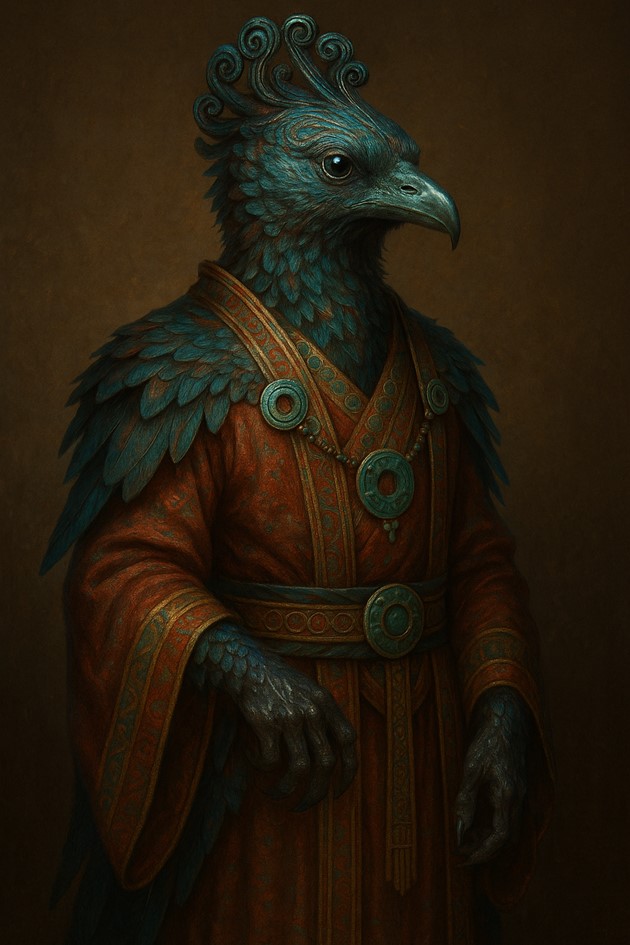
Physical Form and Sensory TraitsAvatars of this species stand upright on digitigrade legs tipped with two forward talons and an opposable rear spur used for climbing jade-stratified ridges and gripping canal ropes. Feathering covers the body in overlapping mosaics that shimmer from dusky crimson at the mantle to pale celadon along the throat, mirroring the…
-
Shan Lu
Shan-Lu is the shared tongue of the Hongshan archipelago. Native speakers number roughly sixty-two million, with another seven million using it as a trade or ritual second language; scholars estimate only a few remote coastal clans still rely entirely on older dialects. Shan-Lu draws its name from two syllables meaning “ridge” and “pathway,” reflecting how…
-
Culture of Hongshan
LoreHongshan rose where wind-sculpted ridges cradle flood-cut basins striated with copper loess and pale celadon clay. Earliest settlers mapped the high plateaus by tracing spirals they saw in fossil riverbeds, then carved stepped terraces that mirrored those coils. Each generation expanded the lattice: jade-inlaid sluice gates channel seasonal torrents into measured arcs; resonance towers pierce…
-
Kokorut
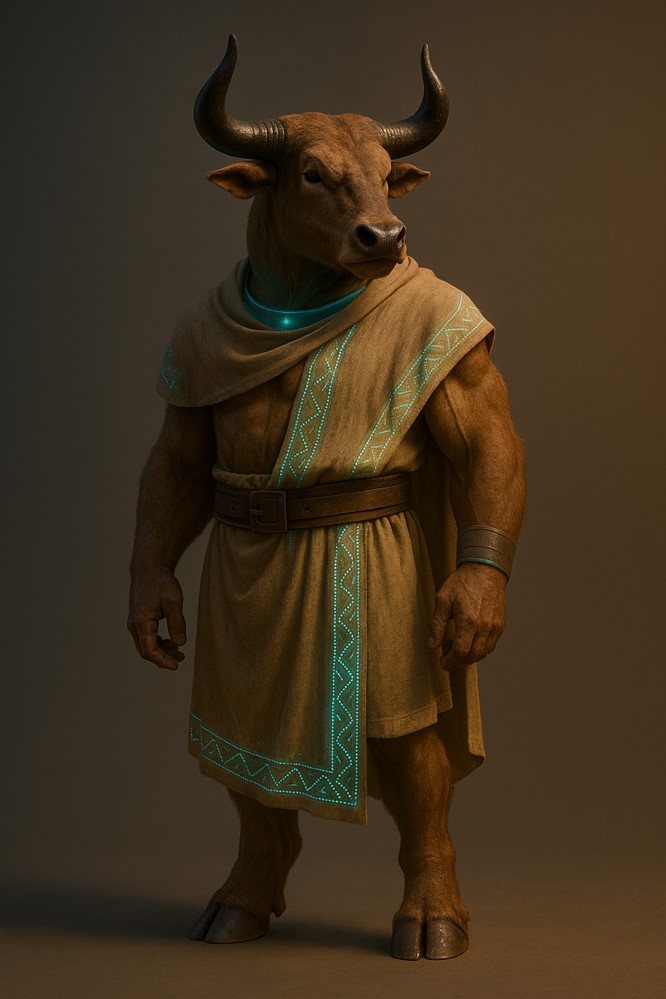
SpeciesSapient Boviform Humanoid. Thought-born souls inhabit large-framed, horned mammaloid avatars whose ancestral stock once roamed Hohokam’s canyon basins. They exist today as builders, water-engineers, and ceremonial guardians of the island nation. Physical Form and Sensory TraitsStature ranges between 7⅓ and 8 feet when standing relaxed, with barrel torsos tapering to narrow, flexile waists that ease…
-
Flow Gate Covenant
The Flow-Gate Covenant reveres Talutara, Keeper of the Living Channel. Adherents describe Talutara as neither wholly water nor wholly stone but a self-shaping convergence where motion and restraint trade places each heartbeat. Countless irrigation sluices across Hohokam carve the deity’s emblem: a split spiral that begins as a droplet and resolves into an angular gate…
-
Sa hó tam
Sa hó tam (pronounced sah-HOH-tahm, “speech of the canal people”) is the principal tongue of the island nation Hohokam. Around 62 million residents—roughly nine-tenths of the population—speak it natively; another five million immigrants, traders, and scholars use it as a second language. Beyond the homeland it circulates as a trade and technical lingua among coastal…
-
Culture of Hohokam
LoreHohokam stands upon a lattice of canals older than written memory, each channel etched by successive generations who learned to carve yearning desert stone into obedient waterways. When the first settlers arrived—souls drawn from uncounted realms—they found low mesas striped by seasonal flash floods. Rather than abandon the unpredictable land, they turned instability into creed,…
-

Qassuli
SpeciesThe predominant race of avatars on the Island nation of Ghassulian, with a population of 67,616,000, consists of the Qassuli, a majestic humanoid species deeply rooted in the ancient Ghassulian culture’s legacy of metallurgy and ritual transformation. The Qassuli form the majority of the nation’s inhabitants, comprising approximately 75% of the population, and their presence…