
Species
The Praakrit are a species of sentient humanoid avatars known for their formidable strength, incredible endurance, and an almost supernatural gift for engineering and artisanship. They are the most populous race in the nation of Indus, making up approximately 45% of the total population, which numbers around 62,862,545 individuals. As the people who first deciphered the ancient glyphs and spearheaded the reconstruction of the nation’s identity, they are the undisputed ruling class, with the current monarch, the Matriarch of the Sargon dynasty, being a Praakrit.
Physical Form
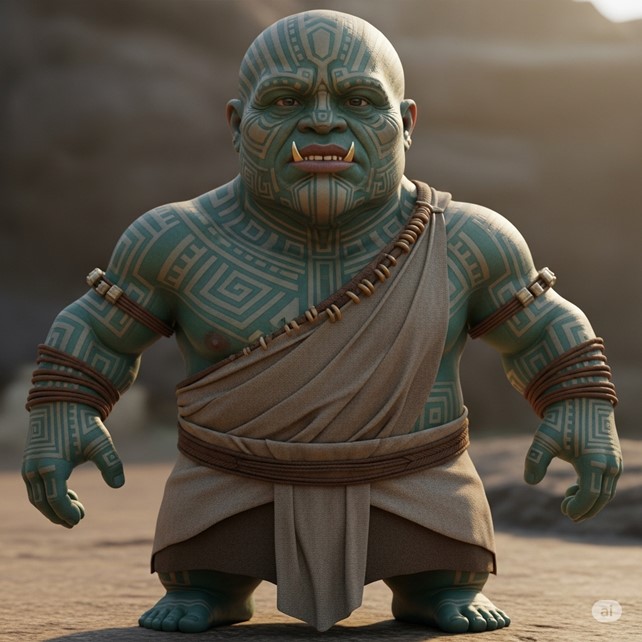
Praakrit are characterized by their short, broad, and powerfully compact builds. They possess a density of muscle and bone that makes them far heavier than their height would suggest, giving them a low center of gravity and immense physical stability. Their skin tones are a range of rich, earthy browns, from the color of teak and baked clay to deep bronze. Their faces are broad, with wide-set eyes and strong jaws. A defining feature is their “khorns,” a pair of small, polished lower canines that curve gently upwards and outwards from the mouth, resembling the horns of a water buffalo. These are not typically used as weapons but are often adorned with precious metal caps or rings as a sign of status. Their hair is thick, straight, and invariably black, usually worn in practical, tight braids or buns held in place by bronze pins or carnelian beads.
Sensory Traits
While their sight and hearing are comparable to other humanoids, the Praakrit possess an exceptionally developed sense of touch and proprioception. They have an uncanny intuitive awareness of weight distribution, pressure, balance, and structural integrity. A Praakrit mason can feel a flaw in a stone block by running her hand over it, and an engineer can sense an imbalance in a complex magi-steam engine through the vibrations in the floor. This “structural sense” makes them unparalleled builders, artisans, and engineers. They also have a keen sense of smell, a trait that evolved from their heritage as master traders, allowing them to easily discern the quality and origin of spices, textiles, and other goods.
General Size
The Praakrit are short in stature but are true heavyweights, reflecting their strength and density.
- Average Male Height: 4 feet 8 inches to 5 feet 4 inches (142 to 163 cm)
- Average Female Height: 4 feet 6 inches to 5 feet 2 inches (137 to 157 cm)
- Average Male Weight: 180 to 250 pounds (82 to 113 kg)
- Average Female Weight: 160 to 220 pounds (73 to 100 kg)
Body Pattern
Praakrit skin is naturally uniform in color. However, their culture places great emphasis on intricate geometric body art. Using temporary pigments like henna for festivals or permanent mineral-based tattoos for significant life achievements, they adorn their skin with complex linear and maze-like patterns that mirror the designs found on ancient Indus pottery. These patterns are not merely decorative; they form a complex visual language that denotes an individual’s guild affiliation, family lineage, professional rank, and social standing.
Life Cycle
Praakrit mature physically at a rate similar to other humanoids, reaching adulthood around the age of 18. Their childhood, however, is structured around a rigorous, compulsory education focused on the practical arts and sciences: advanced mathematics, structural engineering, linguistics of their complex language, and the principles of commerce. Social adulthood is not granted merely by age but by the completion of a formal apprenticeship within one of the nation’s powerful guilds. With their naturally sturdy constitutions, they have a long lifespan, often living 90 to 100 years and remaining productive artisans and leaders well into their final decades.
Potential Positives and Negatives of Physical Form
- Positives: Their dense, compact build gives them incredible strength and stamina for their size, making them tireless laborers and formidable warriors who are extremely difficult to push or knock down. Their unique “structural sense” grants them a natural aptitude for any skill related to building, crafting, or engineering. Their smaller stature is an advantage when working in the cramped engine rooms of airships or within tight mining tunnels.
- Negatives: Their short limbs result in a shorter stride and less reach in combat compared to taller races. They are not built for sprinting over long distances. Their dense bodies also make them poor swimmers, and they tend to avoid deep water when possible.
Tags: Praakrit, Humanoid, Indus, Short Stature, Broad Build, Dense Body, Khorns, Structural Sense, Geometric Tattoos, Matriarchal, Artisan, Engineer, Merchant, Builder, Guild Member, Guild Signet, Ruling Class
Specialized Item Slots Available
The Praakrit culture’s focus on artisanship and trade allows for the use of specialized gear.
- Guild Signets: The ancient Indus culture’s use of seals is reflected in the Praakrit’s affinity for signet rings and pendants. This manifests as a unique item slot for a Guild Signet. These seals are often the mark of a licensed artisan or merchant and can be enchanted to aid in their trade. A jeweler’s signet might be enchanted to spot flawless gems, while a trade master’s could be enchanted to detect magical forgeries in contracts.
- Artisan’s Rigging: Praakrit professionals rarely go anywhere without the tools of their trade. They have developed complex leather belts and harnesses, known as “rigging,” fitted with numerous specialized loops, pouches, and magnetic clasps. This translates to having additional slots for carrying and quickly accessing small enchanted tools, alchemical reagents, or focusing crystals, making them walking workshops.
Environmental Adaptability
The Praakrit are most at home in the hot, humid river valleys and sprawling urban environments of their nation. They are a people of the city, which they view as the ultimate expression of an ordered and tamed environment. Their high endurance also makes them well-suited for labor in the hot environments of mines, quarries, and the massive, steam-belching forges that power the nation’s industry.
Other Information Important to this Race
- Matriarchal Society: The Praakrit social structure is strictly matrilineal. All heredity, including family names, property, guild leadership, and noble titles, is passed from mother to daughter. This makes Praakrit women the primary holders of power, wealth, and authority in the nation, from the ruling Matriarch on the throne to the guildmistresses who command the economy.
- Founders and Rulers: As the race that led the rediscovery of the ancient Indus culture, the Praakrit see themselves as the natural caretakers of the nation’s principles of order, logic, and commerce. This belief, combined with their control of the major guilds and the matrilineal monarchy, solidifies their position as the undisputed ruling class.
Parable of Matriarch and Unruly River
It is told that in the beginning of the new age, when the Praakrit first began to build their great cities, they chose to live in a wide and fertile valley. Through this valley ran a great river, and it was this river that gave the land its richness. But the river had a bad heart. For most of the year, it was a friend, but each spring, it would swell with rain from the mountains and become a monster. It would rise from its bed, its waters brown and angry, and it would wash away the new buildings and turn the planting fields into a great soupy mud. The river brought disorder, and this was a great sorrow to the Praakrit, who loved straight lines and plans that held true.
The people were divided. One group was led by a male named Boru. He was strong of arm and loud of voice. He said, “The river has an angry spirit. We make it angry by putting our square houses on its round land. We must leave this place and go to the hills, and make offerings to the river to soothe it.” Many who were tired and afraid agreed with his words.
Another group looked to a woman named Amara. She was not the strongest of arm, but her hands were clever, and her eyes saw things others did not. She was a master artisan, and her structural sense was very great. Amara said, “The river has no spirit. It has power. It is not angry, it is only unruly. An unruly thing should not be fled from. It should be given order. Its power should be guided, not wasted.”
Boru and his followers moved to the hills to make their offerings. But Amara and those who stayed with her went to the river’s edge. She did not pray. For a full season, she watched. She watched the way the water moved when it was low and calm. She made marks on stakes to measure its height when it rose. She walked the land for many miles, feeling the firmness of the ground with her feet. In her mind, she did not see a monster. She saw a great machine without a proper design. Her mind could see the bones of a plan.
She gathered the people who remained. She drew pictures in the dirt. “Here,” she said, pointing with a stick, “we will dig a great ditch. It will be a new path for the river when it is too full. And here, we will build a great wall of stone to guard the city. And here, we will make a great hole, a reservoir, to hold the extra water. The water will not be our enemy. It will be our servant. It will wait in the reservoir until the dry season, and then we will release it to feed our crops.”
Boru came down from the hills and laughed a great laugh. “You will build a wall against a god? You will tell the water where it must go? This is a fool’s dream.”
Amara looked at him, her face calm. She took a small pot of water and poured it onto a pile of loose sand. The sand washed away into a messy shape. “This is your way,” she said to Boru. “To let the power go where it will.” Then, she built small walls with a few wet stones and carved a tiny channel. She poured the water again. The water flowed neatly in the channel, leaving the rest of the sand dry and firm. “This is my way.”
The people saw this. Their hearts, which understood the nature of building and order, knew her plan was true. They named her their Guildmistress and leader of the Great Work.
The work was long, and it was hard. All the people who stayed with Amara worked as one. They became one hand with many fingers. The stonemasons, with their strong arms, cut great blocks from the hills. The diggers, with their endless stamina, moved mountains of earth. The woodworkers built levers and tools to move the heavy stones. Amara was with them always. Her eyes saw every flaw. Her hands guided every placement. She was the mind that held the great plan together. . From the hills, Boru and his followers watched, certain that the river would destroy the foolish works of the woman.
For three years they worked. At last, the system of dikes, canals, and reservoirs was complete. It was the spring, and the rains came. The river began to swell. The people stood on their new stone dike and watched. The water rose, brown and powerful, and it slammed against their wall. But the wall held firm. The great river, finding its old path blocked by a strength greater than its own, turned and flowed into the new, deep canals they had dug. It flowed without anger, its power now guided. It filled the great reservoir until it was a shining lake of stored wealth. The city was safe. The fields were safe.
The harvest that year was greater than any before. The people had not just saved their city, they had made their whole land richer. Boru and his followers saw this from the hills. They saw the green fields and the full storehouses. Their own bellies were empty and their hearts were full of shame. They came down and asked Amara if they could rejoin the people.
Amara looked at them and said, “A structure is strongest when all its stones are used. Your place is here, if you are willing to support the wall and not stand apart from it.”
And so, the people were united again. Amara became the first Matriarch of the city. To ensure that such a great work could be done again, she organized the people into the first Guilds—the Masons’ Guild, the Engineers’ Guild, the Farmers’ Guild—each with its own leaders and skills, but all working together under one plan for the good of all. This is how the nation of Indus was truly born.
The Moral: A single stone can be washed away, but many stones, placed with wisdom, can guide the greatest river.