
Lore
The Faith of the Great System, often simply called “The System,” is the primary spiritual philosophy of the Indus nation. It is less a religion of worship and more a school of thought dedicated to understanding the fundamental, logical order of the cosmos. Adherents believe that the universe, Saṃsāra itself, is a single, impossibly complex machine or system, operating on flawless principles of cause and effect, balance, and interconnectedness.
The faith’s lore posits that the ancient, highly advanced civilization that preceded them did not collapse or disappear. Instead, through perfect understanding of the Great System, they achieved a state of ultimate balance and integrated themselves completely into its workings, becoming silent, unseen gears in the cosmic machine. The ruins they left behind—the grid-like cities and thousands of inscribed seals—are seen as a final lesson, a blueprint left for their successors to study and eventually follow. The deciphering of the Proto-Sindhian Glyphic language is therefore considered the most sacred event in the nation’s history, as it was the key that unlocked the path to understanding the Great System.
The faith is followed by a slight majority of the nation’s populace, with adherents numbering approximately 77 million souls. It is the state religion and the guiding philosophy behind the nation’s laws, its focus on infrastructure, and its powerful merchant guilds.
The Deity: Yantrapati, the Lord of the System
The faith does not have a personal, sentient deity who answers prayers. Instead, it venerates Yantrapati, a name that translates to “The Lord of the System” or “Master of the Machine.” Yantrapati is not a being but the abstract concept of the Great System itself—the divine, self-correcting logic that governs all of existence. It is the ultimate engineer, the perfect architect, and the flawless accountant of the cosmos.
Personality
Yantrapati is understood to be entirely impersonal, logical, and predictable. It has no personality in the mortal sense; it does not feel anger, love, or mercy. Its “will” is simply the immutable law of cause and effect. It is a system of perfect karmic balance: well-ordered actions that contribute to the system’s function yield positive results, while chaotic actions that disrupt balance lead to negative consequences and system decay. Followers do not pray to Yantrapati for intervention; they study its workings to better align their own actions with its perfect logic, believing that a life lived in harmony with the system will be prosperous and stable.
Traits, Characteristics, and Attributes
- Deity’s Attributes: Yantrapati’s domain encompasses order, logic, systems, commerce, mathematics, engineering, architecture, justice (as karmic balance), and the intricate interconnectedness of all things.
- Follower Characteristics: Adherents, known as “Systematists,” are expected to be logical, patient, meticulous, and community-minded. They value education, fair trade, honest accounting, and elegant design. They approach problems, from a broken steam-engine to a social dispute, as flawed systems that need to be analyzed, understood, and optimized. They believe that personal success is inextricably linked to the health and stability of the larger community system.
- Ritual and Practice: Worship is expressed through action, not supplication.
- The Act of Maintenance: The most common form of worship is the meticulous maintenance of public works. A citizen repairing a cobblestone road or cleaning a public aqueduct is performing an act of devotion.
- Meditative Geometry: Systematists do not pray but meditate on complex geometric patterns known as Glyphic Mandalas. Contemplating these perfect, interlocking designs is believed to help the mind grasp the complex nature of the Great System.
- The Balancing of Ledgers: For the powerful merchant guilds, the act of balancing trade ledgers with perfect accuracy is a sacred rite. Fair and balanced commerce is seen as a vital function of the Great System, and cooking the books is one ofthe greatest sins.
- The Glyph of Power: The creation of enchanted seals is a high ritual. A master scribe, before carving a powerful glyph, will meditate for days to ensure their mind is in perfect alignment with the logical principles the glyph represents.
Symbols
- The Unbroken Gear: The faith’s primary symbol. It is a single, complex cog or gear, its teeth perfectly spaced, its center filled with intricate geometric patterns. It represents the flawless, interlocking nature of the cosmos and the goal of achieving perfect, functional order.
- The Merchant’s Seal: A square seal, mirroring the ancient artifacts, depicting a stylized beast of burden (often a zebu or water buffalo) perfectly balanced against a stack of trade weights on a scale. This is the symbol of the merchant guilds and represents the sacred principles of fair trade and karmic balance.
- The Glyphic Mandala: A complex, perfectly symmetrical circular diagram made from hundreds of interconnected Proto-Sindhian glyphs. These are not just symbols but are functional tools for meditation, used to train the mind to perceive the universe as an ordered system.
Tags: Yantrapati, The Great System, Logical Faith, Systemic, Karmic Balance, Order, Commerce, Engineering, Impersonal Deity, Non-Interventionist, Glyphic Seals, Geometric Symbolism, Guild-Oriented, Urban Faith, Matriarchal Priesthood
Number of Followers
The Faith of the Great System is the majority spiritual philosophy within the Indus nation. It is the official state religion, and its tenets are taught in the nation’s compulsory schools. Adherents, known as Systematists, comprise approximately 55% of the total population. Out of 139,694,545 citizens, this amounts to a following of roughly 77 million souls. Its followers include nearly all Praakrit, especially those in the leadership and guild-master positions, as well as many other avatars who have been drawn to the nation’s order and prosperity.
Type of Temple
Adherents to The Great System do not build traditional temples dedicated to worship or supplication. They believe that Yantrapati, the Great System itself, cannot be honored within a single building but is expressed through all well-functioning, orderly structures. Their “sacred spaces” are therefore functional, civic buildings that exemplify the faith’s core principles of logic, engineering, and community.
- The Great Guildhalls: The headquarters of the nation’s powerful guilds (Engineers, Masons, Merchants, etc.) are considered to be primary spiritual centers. These are not just administrative buildings but are architectural masterpieces of perfect balance and geometric precision. Within their walls, the sacred work of planning, designing, and managing the nation’s systems takes place.
- Halls of Knowledge: The nation’s vast libraries and archives are revered as holy places. They are the repositories of the blueprints of the Great System—engineering schematics, legal code, historical records, and astronomical charts. Serving as a librarian or archivist is considered a priestly duty, preserving the knowledge upon which the entire society functions.
- Celestial Observatories: Perched atop the highest skyscrapers or mountains, these observatories are used to chart the movements of celestial bodies. This is seen as a religious act: studying the grand, visible gears of the cosmos to better understand the smaller, interlocking systems of the world.
- Exemplary Public Works: To the common citizen, the most accessible and revered “temples” are the great works of infrastructure themselves. A perfectly maintained aqueduct, a massive, harmoniously humming steam-core in a factory, or a flawlessly paved city plaza are all seen as active shrines to the Great System. The act of contributing to their maintenance is the most common form of worship.
Positives of the Religion
The societal application of this faith yields significant benefits for the nation. The religious imperative to build, organize, and maintain efficient systems results in an exceptionally high standard of living. The cities are clean, the infrastructure is robust and reliable, and public works are built to last for centuries. The belief in a logical, karmic balance (where chaotic acts like crime damage the entire system) fosters a culture with extremely low crime rates and high social cohesion. Furthermore, the faith’s veneration of logic and knowledge leads to a highly educated populace and drives constant, incremental innovation in the fields of magical engineering, architecture, and logistics, making the nation a technological and economic powerhouse.
Negatives of the Religion
The same focus on logic and order that makes the nation strong also creates significant cultural downsides. The faith tends to devalue strong emotions, artistic expression that lacks a clear function, and radical individualism, viewing them as chaotic variables that can corrupt the system. This can lead to a conformist and emotionally sterile society where personal expression is discouraged in favor of functional contribution. While the system encourages logical innovation, it can be deeply resistant to revolutionary ideas that challenge its core assumptions, potentially leading to long-term stagnation. The obsession with rules, procedures, and balanced inputs can also create a sprawling, inefficient bureaucracy, where simple decisions become mired in endless analysis. Finally, the faith can foster a cold, utilitarian view of its citizens. Individuals who cannot function efficiently within the system due to disability, misfortune, or unconventional thinking may not be treated with compassion, but rather viewed as “flawed components” that need to be fixed or isolated for the health of the overall machine.
Core Beliefs of the Faithful
A follower of The Great System, known as a Systematist, views the universe through a lens of profound, divine logic. Their beliefs are centered on function, balance, and the intricate interconnectedness of all things.
- The Universe as a Machine: The core tenet is the belief that the entirety of existence, Saṃsāra itself, is a single, perfect, and impossibly complex machine. Every star, every soul, every transaction, and every law of physics is merely a gear, a circuit, or a line of code in this Great System. The name for the divine logic that governs this machine is Yantrapati.
- Karma as System Feedback: Systematists believe in a practical, impersonal form of karma. It is not a mystical judgment but a simple law of system dynamics. Actions that are orderly, efficient, and contribute to the stability of the whole (such as honest trade, quality craftsmanship, or maintaining public works) are “positive inputs” that yield predictable, positive results for the individual and the community. Conversely, actions that are chaotic, selfish, or inefficient (like theft, shoddy work, or laziness) are “system errors” that introduce decay and will inevitably lead to negative consequences.
- The Soul as a Component: A soul is viewed as a vital, reusable component within the Great System. The purpose of any individual life is to identify one’s function and to perform that function with the utmost precision and efficiency. A “good life” is one of optimal function that contributes positively to the whole. Reincarnation is seen as the System’s method of reassigning a component—a soul that has completed one task is moved to a new one to ensure the great machine never ceases to function.
- The Goal of Perfect Integration: The ultimate spiritual goal of the society is to emulate the fabled ancients. They seek to refine their entire nation—its laws, its infrastructure, its economy—until it achieves a state of such perfect, harmonious efficiency that it becomes a flawless subsystem within the greater cosmic machine.
Regular Services and Gatherings
The Faith of the Great System does not include prayer, worship, or services in the traditional sense. Spiritual devotion is expressed through acts of function, order, and maintenance that align the individual and the community with the Great System.
- The Daily Calibration: Most Systematists, particularly artisans and engineers, practice a personal morning ritual known as the Calibration. This involves several minutes of silent, focused meditation while observing a complex geometric pattern—a Glyphic Mandala—or simply contemplating the perfect form of a well-made tool. This is not prayer, but a mental exercise to purge chaotic thoughts and align one’s mind with the principles of logic and order before beginning the day’s work.
- Weekly Guild Assemblies: The closest equivalent to a regular service is the weekly assembly at the various Great Guildhalls. These gatherings are mandatory for guild members. The proceedings are formal and highly structured, beginning and ending with a low, monotonous group chant of a mathematical proof or a core engineering principle. The “service” itself consists of reviewing ongoing projects, collaboratively solving complex logistical or technical problems, auditing guild resources, and publicly recognizing members whose work has significantly improved the system’s efficiency.
- The Annual Grand Calibration: This week-long festival is the most important event on the religious calendar. During this time, all non-essential commerce and industry halts. The entire populace mobilizes into committees, each tasked with the inspection, cleaning, and maintenance of a specific part of the public infrastructure. Citizens audit everything from the city’s grandest aqueducts and steam-cores down to individual street pavers and data archives. It is a massive, collective act of civic and spiritual devotion, celebrating the health of their societal machine and planning the next cycle of improvements.
Funeral Rites: The Reintegration of a Component
The funeral rites of a Systematist are pragmatic, unsentimental, and focused on the deceased’s functional role within the society.
- Declaration of Function: When a person’s life ends, there is no public display of grief, which is considered a chaotic and inefficient emotion. Instead, the person’s Guild inscribes a “Declaration of Function” onto a standardized bronze plate. This declaration lists the individual’s name, guild, primary function, and a summary of their major contributions to the system (e.g., “contributed to the design of 17 bridges,” “maintained a positive trade balance for 42 consecutive years”). This plate is displayed publicly in the Guildhall for one full year.
- Component Reclamation: The physical body is viewed as a biological machine that has ceased to operate. To return its base elements to the Great System in the most efficient manner, the body is taken to a civic crematorium. These facilities use incredibly high temperatures to ensure a clean and rapid process of cremation.
- The Ash-Brick: The entirety of the deceased’s ashes are collected and mixed with a special ceramic slurry. This mixture is then pressed under immense pressure and fired in a kiln, creating a single, dense, perfectly uniform brick of a standard size and dark grey color. The individual’s name and personal Glyphic Seal are stamped into the brick before the final firing.
- Structural Integration: This “Ash-Brick” is given to the deceased’s Guild. During the next major public works project—be it a new city wall, a library’s foundation, or a great bridge pylon—the Ash-Bricks of the Guild’s recent dead are incorporated directly into the structure. This is the highest honor a Systematist can receive. It symbolizes that even in death, their physical component continues to serve its function, literally supporting the Great System they served in life. Family members can visit the structure and touch the specific brick as a quiet, logical form of remembrance.
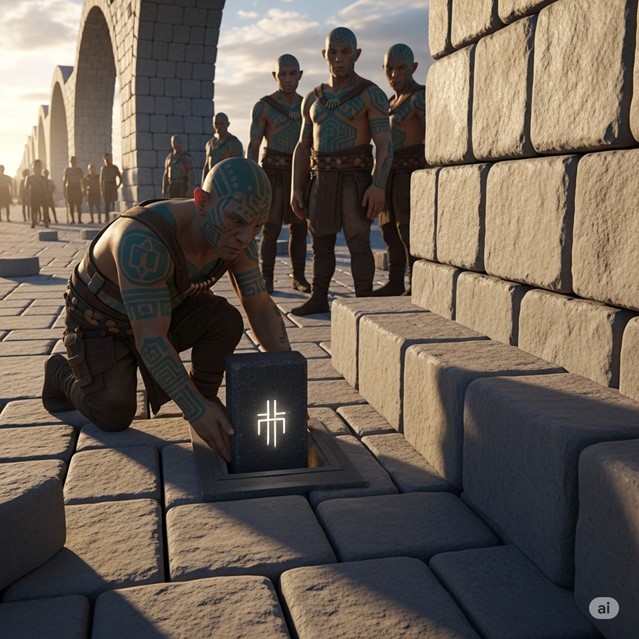
The power of the deity Yantrapati is not a force that is granted or wielded directly. As the divine embodiment of The Great System, its power is accessed by understanding and applying its principles of logic, order, and flawless function. A believer does not pray for strength; they engineer it. The offensive and defensive applications of their faith are expressed through meticulously crafted gear and highly disciplined, analytical techniques.
Defense: The Engineering of the Unbreachable System
The defensive philosophy of a Systematist is that of a master engineer. An attack is seen as a chaotic, inefficient force attempting to disrupt the integrity of a well-designed system (the defender). The goal is not merely to endure the force, but to negate, redirect, or perfectly counter it through superior design and logical countermeasures. Defense is an engineering problem to be solved.
- Harmonic Resonance Armor: Followers of the System forge armor from perfectly interlocking plates inscribed with complex, geometric Glyphic Mandalas. This armor is enchanted not just to be hard, but to act as a systemic countermeasure. When struck by a powerful kinetic or magical force, the armor resonates at a specific, tuned frequency that actively cancels a portion of the incoming energy. A warrior might carry several small, enchanted tuning forks; by striking one and touching it to their breastplate, they can “tune” their armor’s resonant frequency to better counter a specific threat, such as the fire magic of one foe or the sonic attacks of another.
- Predictive Countermeasure Shields: A Systematist shield is a marvel of defensive calculation. It is enchanted with magical sensors and logical formulae. When an attack is incoming, the shield performs a micro-calculation of its trajectory and force. It then uses this data to instantly shift its own magical field or, in more advanced models, its physical angle via enchanted internal gyroscopes. The result is a shield that actively calculates the most optimal angle to parry or deflect a blow, turning aside attacks that would crush a static defense.
- Wards of Logical Stability: Followers may carry small, portable wards crafted in the shape of an “Ash-Brick,” containing the ordered essence of a master artisan. These wards do not block attacks but generate a small field of “logical stability.” Chaotic forces, such as wild magic surges or emotional-based fear effects, that enter this field are “systematically corrected.” A wild fireball might be reshaped into a predictable and easily dodged jet of flame; a magical curse might have its chaotic variables stripped away, reducing it to a minor, logical inconvenience.
Offense: The Application of Critical Failure
A Systematist’s approach to offense is that of a saboteur or a master analyst. They believe every system, whether it is a suit of armor, a magical ward, or a living creature, has a point of critical failure. Offense is not about applying overwhelming brute force, but about identifying that single, critical vulnerability and applying the precise amount of force needed to cause a catastrophic, cascading collapse of the entire opposing system.
- Resonance Breaker Weapons: Hammers, maces, and other blunt instruments are often enchanted to be “Resonance Breakers.” They are designed to find the specific harmonic frequency of a target’s armor. The wielder doesn’t just bludgeon their opponent; each strike sends a tuned vibration into their armor. After a few successful hits to analyze the feedback, the weapon’s enchantment locks onto the armor’s resonant frequency. The next blow that lands, even if it is not the strongest, will cause the armor to shatter from catastrophic structural failure.
- The Auditor’s Gaze: High-tier helmets or focusing monocles are inscribed with analytical glyphs that allow the wearer to perceive systemic flaws. Instead of seeing a simple physical crack, the “Auditor’s Gaze” highlights the underlying logic of a defense. It might reveal the single “keystone” enchantment that supports a larger magical shield, allowing the wearer to target it with a precise dispel. Against a living foe, it might highlight the primary nerve cluster or mana channel, allowing for a perfectly placed strike that disables a limb or temporarily severs their connection to their own magic.
- Glyphic Seal Projectiles: A Systematist may use a specialized crossbow or sling that fires not bolts, but hardened clay discs inscribed with potent “system error” glyphs. These do minimal physical damage but inflict logical chaos on the target upon impact.
- A “Null-Function” Seal might cause a piece of the target’s gear—their enchanted sword or gauntlets—to become unresponsive for a short time.
- A “Lag-Spike” Seal interacts with the target’s nervous system, causing their movements to become jerky and uncoordinated as their brain and limbs struggle to sync.
- A “Cascading Error” Seal creates a magical vulnerability. The next time the target is struck by any attack, the damage is amplified as their defensive systems fail to respond correctly.
Merchant and Unbalanced Scale
It is a core truth of The Great System that every action is a weight placed upon a scale. A true weight will bring balance. A false weight will, in time, bring only ruin. This is the story of that scale.
In the great city of Mohenjo, there was a merchant of the Praakrit people named Kenan. His warehouses were full and his reputation was clean. His ledger-books were things of great beauty and truth, where every number had its proper place and the final sums were always in perfect balance. His success was seen by all as a correct and logical output, for his inputs into The Great System were always honest and precise. He was a good and proper gear in the city’s machine.
A time came when the Engineers’ Guild required a rare metal from a distant land to build a new, safer Steam Core for the city. Without this metal, the project would fail, and the city’s heart would remain old and dangerous. The contract to acquire the metal was offered, and only two merchants had the connections to secure it: the honest Kenan, and a rival named Valerius, a man whose ledgers were known to be clever, but not always true.
Kenan made his calculations. He charted the costs of ships, guards, and the price of the metal itself. He found his plan was perfect, but the cost was great. He was short of the required payment by a small amount, the weight of a single platinum ingot. He could not secure the contract. Valerius, who cut corners and paid his workers poorly, had enough. Kenan saw that the contract, and the city’s safety, would go to a man who put flawed inputs into the System. This seemed to Kenan to be a great imbalance.
In his moment of doubt, Kenan remembered an old thing he possessed. It was a platinum ingot he had acquired by accident long ago. It was a thing of false appearance. It looked and felt like pure platinum, but a flaw in its making left it lighter than it should be. It was a lie made of metal. To use it in the payment would be to put a flaw into the scales of the transaction.
His mind was a place of conflict. He thought, “The goal is good. The new Steam Core will benefit the entire system. Is not one small, flawed component acceptable if the final machine is better?” He convinced his heart that the logic was sound. He decided to use the false weight.
He met with the foreign traders. The scales were brought out. The traders were not of Indus and did not have the patience for the meticulous counting of the Praakrit. They measured the weight of the payment in large lots. Kenan, with a hand that did not shake but a soul that did, placed the flawed ingot among the true ones. He put a lie into the heart of the scale. The scale, tricked for a moment, declared the payment full. Kenan won the contract. He brought the rare metal to the Engineers’ Guild and was praised as a hero who had saved the city. He had achieved a positive output from a negative input. Or so it seemed.
The flaw did not stay in the scale. It entered Kenan. He could not forget the lie that now lived in his perfect ledgers. He would wake at night and re-check his numbers, but the flaw was always there, a small ghost in his books. This distraction, this chaos in his mind, caused him to make a small error in a different calculation. He mis-quoted a price for grain, and lost a small amount of money. Then he made another error, ordering too much raw stone from the masons’ guild, a waste of resources. The single lie he introduced into the Great System began to replicate, creating small flaws in his own personal system.
But the greatest consequence was not his own. The foreign traders returned to their land. In time, their own careful accountants found the discrepancy. They discovered they had been cheated. Word spread through the ports of the 73 islands. The merchants of Indus, whose honesty was their greatest asset, were now known to use false weights. Their reputation was cracked.
The next season, when the Engineers’ Guild needed a different rare component, they found no one would trade with them. The foreign merchants did not trust their scales. Ships that once brought rare woods and metals now sailed to other ports. The Great System of trade, which relied on trust, had been damaged by Kenan’s one act. The construction of the new Steam Core stopped. The whole city’s system began to suffer for the single, flawed gear.
Kenan saw this. He saw the long, logical chain of cause and effect that began with his single, dishonest act. He understood then that Yantrapati is not a person to be tricked. It is a system, and a system always, in time, finds its own balance.
He went before the assembly of the Merchant’s Guild. He brought with him his ledgers, and the false ingot. He told the entire story. He showed them the flaw, and the consequences that grew from it. He did not ask for forgiveness, for forgiveness is a chaotic and emotional concept. He asked for his proper function in the System’s rebalancing.
He was stripped of his wealth and his title. His punishment was not a cage. His punishment was function. He was tasked to be an envoy, to travel to the lands of the merchants he had cheated, and with his own hands and labor, to work to repay the debt and restore the trust he had broken. It was a long and difficult task, but it was a logical one. He had unbalanced the scale. It was now his function to spend the rest of his life putting true weights on the other side until it was balanced again.
The Moral: A single flawed gear can make the whole machine groan, and a single lie can unbalance the greatest scale.