
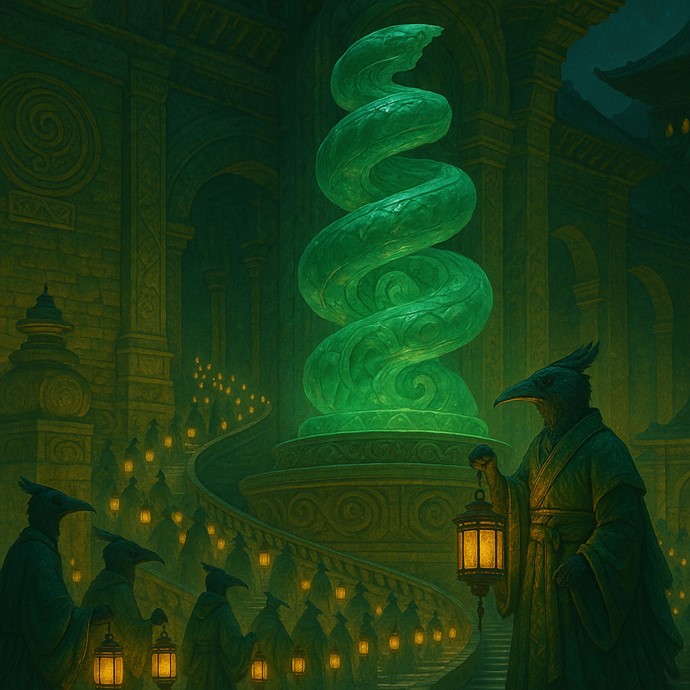
Longzhui, Spiraling Heart of Jade, stands at the center of this faith. Devotees picture the deity as an endless helix of translucent green stone whose turns expand and contract with every breath the world takes. Longzhui is said to have awakened when the first ridge-storms carved concentric bowls into the plateau; water pooled there only briefly, yet the swirling imprint persisted. Observing that persistence, the helix learned to keep memories inside stone and to fold future upon past without letting either one break. When followers recite ritual cadences, they believe the deity listens through jade veins that thread every terrace and canyon of Hongshan.
Longzhui’s mien is measured and deliberate. Stories describe no wrathful tempests or lavish boons—only a patient tilt of the coil, guiding events through barely felt nudges. Petitioners bring silence first, words second; they trust the deity prefers contemplative pauses where echoes settle and reveal hidden angles. The helix scrutinizes intent more than phrasing; an ill-timed request uttered in haste may linger unanswered for seasons, yet a carefully layered chant can prompt a near-immediate shift in wind or stone grain.
Core traits embrace continuity, echo, and incremental shaping. Worship emphasizes layered labor instead of sudden miracles: adding one precisely carved jade ring to a shrine each new moon, scribing spiral glyphs at junctions where terrace channels meet, training voice to deliver braid-tone liturgies that resonate with the rings worn on every crest. Clerical figures—called Coil-Stewards—do not brandish visible power; instead, they maintain meticulous ledgers correlating rainfall, seed germination, and acoustic deviations in canal tunnels. Their authority rests on incremental proof that Longzhui’s pattern holds when the right cadence is kept.
Attributes commonly associated with the deity include jade’s translucence, pig-dragon spiral motifs, copper-tinged dusk light, and the pulse of ridge winds funneled through grated stone vents. Sacred numbers are three (for the initial coil), eight (for the full cycle of sky’s color shift at dawn and dusk), and seventy-two (the count of echo points embedded in the archipelago’s master resonance map). Ritual tools feature hollow jade rings no wider than a thumb, resonance chime rods of red lacquered hardwood, and spiral combs that adjust bone crest feathers so each cantor’s voice harmonizes with terrace acoustics.
Symbolism centers on the Jade Coil glyph—two opposed spirals joined at their narrow throats, capturing the idea that beginning and ending share the same root. When etched into canal buttresses it warns masons to leave silent gaps between stone strata, preventing echo fractures; when worn as pendants it reminds carriers that personal memory should guide present action rather than dominate it.
Public adherence spans roughly forty-six million citizens, concentrated in high-ridge cities and along the Red-Jade escarpment where temple complexes perch above cloudline. Farmers adopt its agricultural timing rites even if they claim other devotions; glider corps pilots murmur spiral cadences before launch to align air currents; jade artisans seek Coil-Steward blessing so sculptures ring true when tapped. Royal family lineage scrolls record direct patronage, but political power flows indirectly—temple treasuries invest tithe silver into maintenance of hillside resonance towers whose warning chimes save entire districts from flash landslides.
Tags: Jade-Coil, Spiral-Memory, Echo-Steward, Helix-Shrine, Resonance-Glyph, Pig-Dragon-Ring, Layered-Chant, Terrace-Warden, Wind-Ledger, Silent-Pause, Copper-Dusk, Red-Jade-Cliff, Rain-Cadence, Stone-Echo,
Shard-Offering, Triple-Helix, Continuity-Lore
Positives
• Predictive Resonance Calendars — Membership grants access to the Coil-Stewards’ metered rainfall charts and echo-barometric ledgers. Farmers, masons, and navigators who consult these scrolls typically avoid crop blight, foundation heave, and ridge-wind shear better than unaffiliated peers.
• Resonance-Tuned Infrastructure — Villages registered with a local sanctum receive priority upkeep on ridge chime-towers and slope-stability vents. The towers broadcast low braid-tones that loosen compacted loess before it liquefies, reducing landslip casualties.
• Voice Discipline — Daily braid-tone recitations strengthen breath control and lend speakers clear projection across stepped terraces. Performers, heralds, and negotiators often find their sentences carry farther and steadier than those of non-initiates.
• Social Credence — Contracts sealed before a sanctum’s jade coil carry informal guarantor status: courts presume the signer intends adherence to gradual, measured fulfillment. Merchants consequently secure lower bond fees when temples notarise their ledgers.
• Incremental Patronage — The faith dispenses support in layered micro-loans rather than lump sums; artisans who complete each spiral milestone on time unlock further jade or copper allotments, keeping debt manageable and fostering long-term craft guild stability.
Negatives
• Cadence Obligations — Every adherent must pause labour at dawn’s eighth chime to chant the triple-spiral litany. Skipping more than three consecutive dawns bars one from sanctum libraries until atonement, inconveniencing workers on tight schedules.
• Ledger Tithes — The faith collects payment not in coin alone but in annotated data: rainfall readings, soil density cores, echo delay timings. Gathering these entries demands hours of meticulous fieldwork each month, a burden for households already stretched.
• Slow Reform — Decisions require three complete resonance cycles through jade-coil consistory boards; urgent petitions can languish, leaving innovative irrigation projects or rapid relief caravans stalled while the coil “turns.”
• Echo-Bound Speech — Unmeasured shouting inside sanctum districts breaches ritual etiquette. Violators face public hush ceremonies wherein voice is restricted to breath tone for five days, an embarrassing handicap for loud traders or performers.
• Crest Strain — Jadecrest Echoers who over-practise spiral chants at incorrect pitch risk crest-feather tremor and migraine-like hum, reducing their natural echo-mapping acuity until they complete a week of silence therapy.
Type of Temple
Devotional sites are called Spiral Jade Sanctums. Each sanctum begins with a hollow column of translucent greenstone bored straight through a ridge buttress. Terraced galleries wind around the shaft in widening coils, creating a walkable helix open to sky at the crown and rooted to an underground echo crypt below. Wind slots carved at precise intervals draw ridge gusts through the column, producing a perpetual soft hum—an audible heartbeat of Longzhui. Lantern alcoves cut into outer walls hold copper mirror-disks; at dusk they catch low sun and bounce flickering rings onto surrounding cliff faces so passers-by can gauge evening wind by ring wobble. Coil-Stewards reside in narrow cells set behind basalt louvre panels designed to modulate their chanting directly into the column’s airflow.
Number of Followers
Temple census slates, updated each solstice, list approximately forty-six million sworn adherents—about two-thirds of Hongshan’s total population. They are complemented by almost fourteen million casual participants who observe public rites without taking the full ledger obligation. Remaining residents either honour ancestor cults, river spirits, or follow foreign faiths introduced by griffon caravans and canal barges.
Believers hold that Longzhui is the living structure of continuity itself, a translucent helix that threads unseen through every ridge, terrace, and canal. Life, from this viewpoint, is not a straight ascent but a sequence of nested revolutions—each breath beginning where a previous exhalation ended. The faithful therefore measure virtue by how gently a person bends circumstance into the next turn of the coil. Sudden breaks, reckless shortcuts, or discarded memories jar the resonance of jade veins beneath the soil and invite structural disharmony: irrigation walls buckle, resonance towers emit sour over-tones, and human quarrels spread like cracks across a kiln face. By contrast, an act performed in steady cadence—whether stone carving, harvest planting, or treaty negotiation—reinforces the hidden spiral and helps the world remember its shape. Scholars phrase the doctrine in four slow axioms: memory must be carried forward, labor must be layered, speech must leave space for echo, and silence must precede intention.
Regular services unfold around these axioms and follow the pulse of ridge winds. At first light Coil-Stewards draw bronze shutters from the sanctum column so the predawn draft can spiral upward. Attendants ring palm-sized jade circles three times, a signal for households across adjoining terraces to pause their own work. Worshippers step onto parapets, align crest feathers or brim hats to the wind’s direction, and exhale three braid-tone syllables: the beginning of the daily Ledger Chant. This chant lists rainfall rates, yield tallies, cracked sluice counts, and any notable disturbances in canal harmony; each entry occupies exactly four breath beats so that data forms a rhythmic lattice. After the communal ledger concludes, individuals voice private micro- petitions—short spiral sentences offered during a prescribed thumb-wide “breath gap” of silence. Those petitions are whispered, never shouted; the doctrine teaches that a request too loud bruises the coil.
At mid-day a smaller gathering assembles inside the sanctum’s wind column. The chamber hums as drafts swirl through the hollow jade, modulating the bass tones of recorded rainfall chimes. Here Coil-Stewards examine collected data tablets, add them to spiral shelves in the echo crypt below, and stamp each with a pig-dragon ring seal dipped in crushed serpentine ink. Lay artisans might present a newly forged tool or a carved building stone for resonance testing; if the object hums in tune with the column’s basal note it is deemed “turned,” fit for public use. Mismatched objects are re-worked until their harmonic “snag” smooths out.
Evening rites begin when the copper dusk paints canyon walls. Rows of lanterns ascend the sanctum ramp, carried by novices who weave slow figure-eights so their flames spiral upward in waves of light. At the summit parapet the high Cantor releases the Day’s Final Coil: a descending five-tone cadence that unspools the latent tension of work. Households reply with a soft murmur rather than applause, allowing echoes to slide down canal corridors and settle the waters for night irrigation release. Most families then share the Spiral Meal—rice or millet served in circular jade bowls etched with the Coil glyph—while recounting incremental achievements of the day, reinforcing the belief that every small turn matters.
Funeral practice mirrors the creed’s layered patience. When a follower dies, kin leave the body undisturbed for one full turn of the night wind so the soul’s final exhale can join the ridge draft. At dawn the Vigil of Quiet Threes commences: family and guildmates circle the body thrice, each pass slower than the last, clicking thumb-rings on jade beads to mark the spiral. The corpse is then anointed with powdered greenstone mixed into canal water taken from three different flow-rates—slow seep, measured spill, and swift surge—symbolising the continuum of life speed. A narrow jade ring carved during the deceased’s naming ceremony fits over the beak, crest root, or tongue-tip depending on lineage custom, sealing personal memory to the coil.
The procession to the sanctum echo crypt follows ridge pathways that already loop in gentle arcs. Pallbearers stop at every eighth terrace, where a Coil- Steward lifts the covering shroud just enough to chant the memory phrase: a single breath-length sentence that summarises the life’s most patient accomplishment, such as “shaped floodgate stone in rhythm with dawn.” Upon reaching the crypt the body is placed on a spiral ramp descending into a chamber lined with concentric jade ribs. Each rib resonates at a slightly different overtone; as the coffin slides downward, it lightly brushes the ribs, releasing a fading chord believed to carry the individual’s final intentions into the deep coil.
Interment ends when the coffin rests at the appropriate spiral depth—higher for those whose lives cycled swiftly in public service, deeper for contemplatives who affected change over long spans. The coffin is packed with loess tinted by red-iron dust, signifying fertile memory awaiting future turn. No tombstone marks the spot; instead a new data tablet is shelved above with the ledger entries, recording the deceased as another harmonic layer. Families may descend annually to add fresh yield data, effectively folding the loved one’s resting place into the living record of rainfall and harvest. Once the final chant fades, mourners exit in silence through a side ramp to avoid crossing the descending path—never retracing the spiral.
Such rites teach survivors that endings do not break the coil but become deeper turns, which in time influence upper layers through resonance. Citizens departing the sanctum often pause at canal walls, press a palm to stone, and listen for a faint, familiar echo buried beneath the ongoing hum: evidence that Longzhui has accepted another memory into the ever-spinning heart of jade.
Longzhui’s influence manifests whenever jade, sound, and patient cadence align. Practitioners do not call lightning or fling fire; instead they coax existing matter and vibration into new spirals that either cushion allies or unspool toward enemies.
Defensive applications
Spiral Jade Lattice Coil-Stewards embed thumb-sized jade rings in walls, shields, or even cloak hems. A slow braid-tone chant unlocks each ring’s micro-echo, causing neighboring rings to pulse in staggered sequence. The overlapping pulses thicken ambient air into an elastic shell that blunts incoming force. Arrows strike and tumble harmlessly; blades lose momentum as if cutting through viscous water. The effect grows sturdier the longer the cadence continues, making prepared fortifications nearly impervious until the chant pauses.
Echo-Blanket Field By staking four resonance chime rods at the corners of an encampment and winding greenstone wire between them, defenders create a low, continuous hum that bends external sound waves around the perimeter. Footfalls, shouted orders, even the clang of metal fade when crossing the boundary, cocooning the site in muffled quiet. Scouts can speak freely within while remaining unheard outside, and enemy sonic divination or ranging calls fail as their echoes slip sideways along the coil.
Memory Ripple Ward A single jade ledger tablet inscribed with the original rainfall record of a given district stores a potent historical imprint. When laid flat and tapped in the correct three-beat pattern, the tablet projects its stored memory into surrounding stone foundations, re-aligning stress fractures to the orientation they held when first quarried. Siege engines striking walls protected by such a tablet find stones flexing rather than cracking, as if time itself momentarily rolls back to the structure’s pristine state.
Breath-Gap Deflection Field chant-leaders train soldiers to exhale the brief silence of the “breath gap” in perfect unison. The combined gap creates a micro-vacuum that disrupts oncoming projectile trajectories; arrows wobble, sling stones drift off course, and spell glyphs that rely on straight-line travel veer away. Master tacticians drill entire phalanxes to alternate breath gaps, producing a rolling front of subtle deflection that advances with the line.
Offensive applications
Spiral Resonance Spike When a jade ring engraved with a target’s true location is dropped into an echo shaft—usually a narrow bore driven into bedrock—chanting the descending five-tone cadence compresses the ring’s pulse downward until the shaft walls vibrate beyond cohesion. At ground level an enemy fortification above the shaft experiences a sudden upward thrust, cracking masonry and lifting supports just enough to collapse load-bearing beams. Because the energy springs from within the earth rather than from an external blast, observers often mistake the attack for natural subsidence.
Jade Shard Coil Artisans fashion razor-thin helices from waste chips left by sculpture carving. Thrown into the air while a Coil-Steward voices an accelerating braid tone, each shard follows the spiral path of the sound wave, whipping outward in tightening loops. The shards do not spin randomly; they weave a corkscrew corridor that can be steered by subtle pitch shifts, carving gaps through infantry ranks or trimming sails from fleeing airships with surgical precision. Once the chant stops, shards fall inert, allowing retrieval if not shattered on impact.
Echo-Rend Chorus Three or more trained chanters standing at specific spiral sector points around a battlefield intone offset frequencies that intersect above an enemy position. Where the waves meet, air pressure fluctuates violently, creating a shredding vortex audible as a deep growl. The vortex tears banners, cracks ribs, and briefly inverts acoustic spells hurled against it—turning an opponent’s shouted command into garbled hiss among their own troops. Misalignment of singers risks backlash along the spiral arms, making discipline paramount.
Pulse of Unfinished Memory By striking an unfinished jade figure—one whose carving halted before the final spiral—practitioners release pent-up resonance not yet tempered by completion. The statue’s dormant echo bursts outward as a jagged, asymmetrical shockwave that ignores conventional barriers but dissipates quickly. It is devastating in tight passages or caverns, flaying flesh and splintering shields, yet it cannot be aimed further than a few dozen paces and leaves the jade core fractured beyond repair. Coil-Stewards reserve this tactic for last stands, acknowledging the philosophical cost of destroying a piece of art frozen mid-creation.
Coil-Inversion Gambit On rare occasions, strategists exploit Longzhui’s patience against foes entrenched behind layered fortifications. Teams of engineers record the daily micro-echo signature of each enemy wall segment over several weeks, building a mirror ledger. When the ledger is complete, Stewards chant the sequence in perfect reverse order, effectively “unwinding” the structural echo that keeps stones settled. Mortar crumbles, dovetails slip, and towers lean without a single ram impact. Because inversion negates months of patient craftsmanship, the Coil doctrine views it as a grave measure—only justified when defenders repeatedly desecrate jade veins or silence shrines.
Practical limits and risks
All these workings rely on incremental layering. Haste weakens coherence; careless cadence introduces dissonance that can ricochet. Spiral Jade Lattice shields may collapse if a chanter skips a pulse, crushing allies with the rebound. Shard coils scatter unpredictably when launched without an exact spiral throw arc, endangering friend and foe alike. Echo-Rend choruses demand seasoned harmony; a single voice out of step redirects pressure back along the sector line. Finally, since Longzhui favors continuity, overuse of destructive inversion risks long-term instability in local stone resonance, causing sinkholes or echo contamination that lingers for generations.
Through measured breath, precise jade geometry, and unwavering tempo, Coil-practitioners turn Longzhui’s subtle helix into both bulwark and blade—always remembering that each aggressive turn must eventually be counter-balanced by an equal act of restoration if the world’s spiral is to remain whole.
Jade Coil that Walks Beneath
In the dusk-red years when ridge and river still quarreled over which should carry the other, there dwelt a stonelore hermit named Kuan-Se, whose only companions were three cracked chime rods and the wind that drummed through their hollows. Kuan-Se believed that every sound born upon the ridges was a child of deeper silence, and so he spent each waking hour carving narrow pits into jade seams, hoping to hear that elder hush. His neighbors laughed, for their canals needed widening and his hands shaped nothing that fed mouths. Yet the hermit listened on.
One evening, when dusk bled green into ochre and ridge shadows draped like unrolled scrolls, a tremor rattled the stone teeth of the plateau. From the earth yawned a gap, not wide but measureless, and through it spiraled a glow the color that lives inside unpolished jade. Kuan-Se leaned close, and the tremor pulled his breath away; thus breathless, he tumbled headlong into the coil of light.
Down he fell past layers of rock remembering storms louder than language. Down again through strata holding the shy footprints of river sprites long dried. At the coil’s deep heart he landed upon a floor that curved endlessly outward, a surface of jade so smooth it seemed poured from moonwater. There hovered Longzhui—the Spiraling Heart—yet the hermit, stunned by wonder, saw not a deity but a vast serpent of clear green stone twisting around itself in patient dreams.
A voice reached him, though no mouth moved: “Why carve holes and steal wind if you fear the space beyond breath?”
Kuan-Se, lacking wind in his own lungs, answered by touching his forehead to the jade. Within that touch he placed every pulse he had hoarded from chime rods, every hush he had heard beneath laughter. The coil absorbed his memories, and in their place offered a single image: water trickling through narrow channels, each groove curved like a quiet smile on mountain’s face. He understood then that his chisel scrapes and wind hum had been half-thought prayers to the spiral he did not yet know.
“Return,” said the silent coil. “Teach stone to curve in patience, teach water to travel the curve, then return again after ten thousand breaths.”
The spiral lifted Kuan-Se upward on a column of sighing air. He emerged beside his cracked chime rods, dawn washing ridges in pale rose. Neighbors gathered, ready to scold his folly, yet paused when they saw his eyes holding the stillness of jade lakes.
He spoke no boast, only set about scratching shallow arcs upon canal walls. The arcs were too slight for others to notice, but he traced them with even strokes, whispering braid-tone syllables so soft they sounded like reed shadows sliding over water. Canal laborers jeered until drought arrived early that year. Fields yellowed like parchment. River mouths receded. Yet the shallow arcs drawn by Kuan-Se began to trickle—a breath, a thread, then a steady hush of flow. Water obeyed curves too patient to rush, filling terraces just enough and never spilling.
Word traveled faster than wind gossip. Ridge villages sent delegations bearing pig-dragon tokens to request mirrors of the humble curve. Kuan-Se obliged under one condition: that each new channel receive its own chime rod tuned to the coil’s hidden rhythm. Workers hammered jade pins along sluice lips, wound copper wire through them, and at dusk the rods thrummed low, balancing day’s bustle with twilight hush.
Years spiraled much like channels. Where Kuan-Se walked, stone bent in gentle arcs; where he slept, children tessellated pebbles into spiral mosaics before huts. In time, the hermit’s skin wrinkled like old parchment, and neighbors petitioned him to carve a final ridge-gate that could relay floodwater past cliff villages during storm season. His shoulders ached, but he remembered Longzhui’s charge: after ten thousand breaths, return.
So he carved one last channel, a grand helix descending the cliffs in sweeping cadence. At first spill, floodwaters whirled in perfect hush down its length, neither torrent nor trickle, feeding parched foothills while leaving heights unbroken. Exhausted, Kuan-Se lay within the gate’s shadow, counted his ten thousandth breath, and let wind claim the next.
That night, ridge spirits watched as a jade-colored mist coiled around the fallen stonelore hermit. It lifted him much like the voice had lifted him years before, carrying memory down through bedrock to the jade floor. In his place remained a hollow chime rod, no longer cracked, fused into a seamless spiral that rang without wind.
The people mourned, yet water kept flowing true. Days later a child discovered the rod’s drone calmed panicking goats and shushed quarrelsome merchants. Elders dubbed it the First Ledger and ordered every terrace to craft its own, each inscribed with rainfall tallies and family deeds. Thus arose the Coil-Stewards and the Path of the Jade Coil: not from thunder shout or sword clash, but from a single breath-gap the hermit dared to cross.
Generations afterward, when ridge towns chant rainfall ledgers at dawn and canal walls glow faint jade under lantern light, listeners claim the underlying hum belongs to Kuan-Se himself, eternally measuring breaths somewhere in the spiral below, guiding stone into new patience.
Moral: The deepest power hides behind smallest curve, and patient breath bends stone where hammer fails.