
The Flow-Gate Covenant reveres Talutara, Keeper of the Living Channel. Adherents describe Talutara as neither wholly water nor wholly stone but a self-shaping convergence where motion and restraint trade places each heartbeat. Countless irrigation sluices across Hohokam carve the deity’s emblem: a split spiral that begins as a droplet and resolves into an angular gate key.
Lore
Accounts claim Talutara first stirred when primordial streams wandered without discipline, drowning seedbeds and abandoning them to salt-white ruin. Hearing the dry cough of corn ghosts, Talutara folded river-skin into jointed stone ribs, forming the earliest controllable canal. From that moment the deity’s spirit resided in every measured gradient and every hand-smoothed plaster wall. Oral epics chant that Talutara taught mortals “patience that cuts deeper than copper,” bidding them score floodplains into mathematically exact terraces. Periodic droughts are framed not as punishment but as reminders to refine those cuts until flow sings correctly.
Personality
Talutara embodies balanced precision. Devotees argue the deity admires incremental correction over drastic upheaval. Ritual stories stress an unhurried cadence: even Talutara’s anger manifests as silent evaporation rather than sudden torrent. Petitioners speak of a calm yet relentless presence, like pressure building behind a gate—unseen until released.
Traits and Characteristics
• Governs equilibrium between abundance and scarcity, ensuring neither flood nor desert claims supremacy.
• Perceives time as graduated segments called “link-spans”; each link-span ends with inspection of all conduits touched by the faithful.
• Accepts offerings of sacrificial labor rather than objects: cleaning silt, recalibrating spill angles, or drafting new contour diagrams.
• Rewards diligence with clear water resonance—subtle vibrations audible only to those who have memorized canal mathematics.
Attributes
Domain: Managed water, structured labor, measured patience
Favored Elements: Turquoise (for living water), ochre clay (for tempered earth), polished horn (for lineage memory)
Sacred Numbers: Two (flow and stopper), seven (gates in the master spillway), ninety-six (ideal angle of a regulation weir)
Manifest Signs: Hairline cracks sealing unassisted, dew collecting on dry stone at dawn, twin echoes in a single hoofbeat
Symbols
• Split Spiral Gate—the droplet-to-key emblem carved above control chambers
• Flow Staves—shoulder-height rods inlaid with thin turquoise channels; striking stone with the base produces a hollow note used to summon inspection crews
• Talutara Rune—an angular ligature in Canalis Script combining the letters for “hold” and “release,” inscribed on horn tips of canal monks
Tags: Hydro-Equilibrium, Canal-Guardian, Spiral-Gate, Labor-Offering, Patience-Doctrine, Resonant-Water, Turquoise-Clay, Balanced-Flood, Link-Span, Flow-Staff, Horn-Rune, Spillway-Ritual, Structured-Harmony, Dual-Echo, Measured-Faith, Terrace-Mystic, Gate-Key
Positives
• Collective water security: membership secures priority access to seasonal allocations, because canal overseers ordained under Talutara schedule flow first for covenant fields.
• Predictable society: covenant calendars coordinate terrace planting, flood-gate maintenance, and even city festivals, reducing waste and surprise scarcity.
• “Resonant Ear” training: adepts learn to hear micro-vibrations in masonry; builders who complete this course rarely suffer catastrophic sluice failure.
• Merit through labor: advancement in the priest-engineer ranks depends on hours logged repairing channels, not birthright, allowing ambitious commoners to rise into technical authority.
• Subtle hydromancy: chants performed at inspection milestones thin water tension so silt settles faster, granting covenant farmers marginally clearer irrigation and better root uptake.
• Community oaths: weekly gate-closing rites gather neighbors along the parapets; disputes are mediated on the spot, lowering violent crime wherever the covenant dominates.
Negatives
• Heavy workload: every adult follower must give at least seven dawns per season to canal clearing—failure invites public rebuke and loss of water allotment.
• Ritual rigidity: crops that thrive on irregular flooding (wild rice, certain lily tubers) struggle under mandated flow cycles, so covenant regions can appear monocultural.
• Slow to innovate: any new pump, siphon, or spillway design requires three link-spans of testing and communal vote; rival guilds call the process stifling.
• Strain on the young: initiates must memorize ninety-six weir angles before age twelve; some drop out, leaving whole families socially adrift.
• Drought austerity: when rainfall fails, high priests order immediate rationing; dissenters accuse them of hoarding or divining false omens to tighten control.
• Conflict with nomads: steppe caravans view covenant water tariffs as extortion, leading to periodic sabotage of outlying feeder ditches.
Type of Temple
Devotional complexes are called Keystone Sanctums. A sanctum begins as a paired spill-gate at a canal fork. Two massive horn-shaped counterweights hang from turquoise-inlaid chains above the water, symbolizing flow and restraint. Surrounding terraces hold roundwork lecture courts where stonemasons recite gradient math. Subterranean echo galleries line the basal walls; initiates stand within these vaulted corridors to practice twin-tone resonance until the ceiling drips condensation in precise rhythms. Central altars are not statues but adjustable bronze weirs that handle pilgrimage offerings: jars of spring water poured through measure-slots into the main channel, reaffirming Talutara’s doctrine that devotion must re-enter the communal flow.
Number of Followers
Rough census scrolls maintained by the Royal Spill-Gate Registry list approximately forty-six million sworn adherents, including eight hundred thousand ordained water-monks, eight thousand high surveyors, and twenty-three luminary gate-sages. Another twelve million residents attend seasonal rituals without oath-binding, treating Talutara as a local guardian rather than a life rule.
Believers hold that each drop of water is a promise offered by Talutara and that every gate or weir is a vow returned to the deity. The covenant’s doctrine teaches three interlocking convictions. First, flow without measure breeds chaos; therefore mortals must shape water through deliberate labor. Second, restraint without release breeds stagnation; gates must open when the ledger of need outweighs the ledger of reserve. Third, personal virtue is proven only through canal work—physical, mathematical, or ritual. Faith is thus expressed as triangles of action: survey, carve, maintain. Spiritual worth is tallied not in prayers uttered but in lengths of silt cleared and in gradients recalibrated.
Regular services occur according to the link-span calendar, a cadence of inspection days spaced at equal intervals through the season. Before dawn, covenant stewards ring low bronze flow-bells whose vibrations travel along water and stone. Congregants gather on the parapet above a spill-gate, facing the rising light reflected off the channel. A senior water-monk intones Sa hó tam verses that name each sluice and each measurable bend upstream; as every name is spoken, acolytes adjust their resonance staves to emit twin-tone harmonics, tuning the masonry itself. The congregation then files in rotation to scrape algae from gate surfaces, record current depth on reed slates, and pour token jars of springwater through the measuring gaps of the altar-weir. When the final jar runs clear, a hush breaks over the crowd, followed by a shared meal of roasted maize and mineral salt to restore electrolytes lost in the dawn heat. Even the meal carries liturgical weight: each handful is dipped once into canal water before eating, signifying acceptance of Talutara’s equilibrium.
Funeral rites unfold in three distinct passages. The Vigil of Still Flow begins at midnight after death is declared; family and guildmates stand silent along the deceased’s home feeder ditch, holding lanterns whose wicks float on thin oil. Water is slowed to a trickle so the surface mirrors the sky, allowing mourners to see both starfield and canal in a single glance, a reminder that Talutara bridges motion and rest. At dawn the Procession of Calibration commences: pallbearers carry the body—or in the case of Kokorut, the polished horns alone if custom dictates cremation—to the nearest Keystone Sanctum while chanting the ninety-six weir angles in ascending order. Each correct recitation is believed to draw minute adjustments from the deity, granting the soul smooth passage into the unseen reservoirs.
Within the sanctum the Rite of Final Release is performed. An adjustable bronze weir is lifted, allowing canal water to sweep through a devotional trough where the remains rest on a lattice of reed mats. As water passes, priests scatter powdered turquoise and ochre clay; the pigments swirl, symbolizing the fusion of living flow with enduring earth. If horns or durable bones are present, they are set into the stone ribs of a new flood-gate arch, permanently integrating the individual’s memory into communal infrastructure. Ashes of other races mix with wet plaster that repairs micro-cracks in spillway walls, ensuring every believer continues to guard the channels even after death.
The ceremony closes when the flow-bells toll twice, generating the distinctive twin echo that signals Talutara’s acceptance. Afterward the family leads a quiet canal walk, listening for subtle vibrations; any resonance heard is taken as the departed soul’s first contribution to balance beyond the gate.
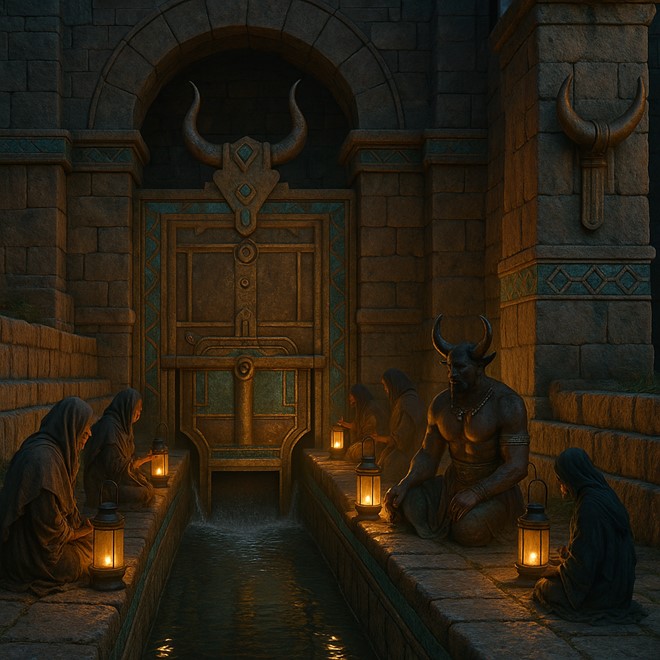
Talutara’s power manifests wherever measured water meets guiding stone, so any practitioner—whether canal-monk, surveyor, or lay follower—must anchor their intent through a physical conduit tied to that union. Acceptable conduits include turquoise-veined flow-staves, bronze weir keys, etched horn caps, or even a handful of canal clay stamped with the split-spiral rune. The wielder channels breath through Sa hó tam cadence, naming the link-spans and weir angles that bind motion and restraint; each correctly spoken gradient sharpens control while every missed syllable bleeds potency or skews targeting.
Defensive Expression
• Flood-Curtain Wall A rapid sequence of high-toned flow words causes water in an open trench or aqueduct to leap upward and congeal into a laminar sheet several paces thick. The inner face retains fluidity, absorbing arrows and softening artillery impact; the outer face calcifies as mineral crust, shrugging off blades and dissipating fire spells. Duration matches the tier of the lead chanter in minutes.
• Canal-Breath Buffer By stamping a resonance staff three times and reciting the ninety-six weir angles in descending order, a practitioner forces ambient moisture to condense around allies, forming a dense, swirling mist that disorganizes enemy sight lines and deflects heat-based projectiles. Anyone wearing a talutaran horn-rune pendant sees through the haze as though it were clear dawn air.
• Equilibrium Pulse When enemy hydromancers attempt tidal attacks, covenant engineers counter with a short downward thrust of a bronze gate key into any water source. This releases a balanced pressure wave that harmlessly equalizes their own channels while collapsing over-pressured enemy streams back upon their origin, preventing canal sabotage or flash-flood offensives.
• Stone Rib Mend Low-level adherents trace the split spiral across fractured masonry and whistle the paired tones of flow-bells. Micro-vibrations draw dissolved carbonate out of seepage, knitting cracks in walls, bridges, or armor plates mid-siege and forestalling structural failure.
Offensive Expression
• Spill-Surge Ram A team of horn-capped Kokorut kneels beside a gate, chant the upper half of the flow-litany, then wrench the sluice wide. Talutara’s resonance accelerates the release, focusing the torrent into a narrow, high-velocity ram able to uproot siege towers or pulverize charging infantry before dispersing into harmless irrigation runoff twenty heartbeats later.
• Detritus Lance Dust, silt, and canal sediment swirl into a spinning auger when a practitioner inverts the flow-staff and speaks the enclosure angles backward. Hurled forward, the hardened clay drill bores through shields or armor, then collapses back to powder on exit, reducing collateral ricochets within friendly lines.
• Desiccant Vortex A higher-tier gate-sage recites the patient half of Talutara’s covenant, drawing water vapor from a targeted radius and locking it into a turquoise filament suspended overhead. The sudden humidity vacuum leaves hostile spellcasters dehydrated, hampers breath control, and disrupts any moisture-dependent magic. Once released, the stored filament can crash down as razor-sharp sleet if the sage reverses the chant.
• Horn-Echo Fault Monastic horn-fluters strike a triad chord directed at canyon walls, using twin-echo resonance to initiate controlled slides. The cascading rockfall pins or scatters enemy formations while leaving pre-scored escape wedges for allied units who know the safe paths mapped during earlier survey rituals.
Dual-Purpose Constructs and Field Logistics
Keystone Sanctums double as arsenals and bunkers: adjustable bronze weirs convert into pressure-launch platforms; echo galleries amplify mist cloaks for courtyard defense; spill-gate counterweights swing out as pivoting horn-blades when channeled water aligns with embedded turquoise tracks. Mobile units carry segmented leather hoses connected to cistern carts; a single flow-staff impulse transforms the stored supply into offensive surge or defensive curtain on demand. Engineers choreograph these effects by drum cadence, each beat corresponding to a specific sluice order.
Constraints and Risks
Talutara’s doctrine forbids unbalanced release. If offensive usage exceeds equivalent acts of measured restraint—such as canal repair or drought mitigation—the deity’s favor wanes, weakening subsequent invocations. Over-channelling can strip moisture from practitioners’ own bodies, leading to dizziness, cracked horn keratin, or resonance deafness. Stone structures not inscribed with the proper spiral-gate sigils may shatter under mismatched vibrational load. Mastery, therefore, lies in maintaining the sacred ledger: every surge paid back with a settled leak, every lance followed by a mended wall, ensuring the Keeper of the Living Channel remains an ally rather than a silent, drying judge.
Kanath’s Shifting Spill-Gate
Long were the sun-hissing seasons when the desert drank rivers whole and left the corn shriveled like birds’ tongues. In that hot age lived the artisan-seer Aru-Kanath, whose horns bore only faint scrolls and whose hoof weight made no echo, for he had yet to carve lineage into bone. He labored beside lesser sluices, patching lime between bricks so water might creep, not tumble. His courage sat quiet as a pebble on dry clay.
One dusk, while canal dust burned red beneath a sky drained of cloud, Kanath heard twin soundings inside his skull. The first was the hush of a sealed gate; the second was a low thrum, same as the throb that rides in vessel walls when floodwater presses for release. Neither noise belonged to wind or insect. Not knowing the Keeper’s voice, Kanath thought himself sun-fevered, so he dipped a palm at the ditch edge to cool thought. Yet the water recoiled, sliding uphill against gravity, tracing a spiral path then locking still, smooth as glass hammered flat. In that frozen sheen he glimpsed a figure neither stone nor ripple: Talutara, whose torso wore water that did not spill, whose limbs glimmered like turquoise veins within mountain ribs.
The vision cracked after one eyeblink; water fell, shattering against its own shape, and Kanath toppled backward, breath scattering as loose grit. Upon rising, he found a memory etched across both horns, though no blade had touched them: a map with no border, a channel curling into itself thrice then vanishing under a sign shaped half like droplet, half like key-tooth. He understood nothing yet felt everything pulling toward a place unnamed.
Word of Kanath’s mark leaked through terraces. Some scoffed, calling it childish scrawl; others whispered of primeval branchways older than record slate. The high surveyors examined but shrugged—no angle, no measure matched any canal ledger. Still, the map tugged. Kanath bound his dewlap with reed cord so sweat might feed throat instead of dust and walked where horns led him.
He crossed seven salt pans where mirage fish swam upon air, each pan gifting him lessons: the first taught thirst, the second taught reflection, the third taught endless horizon. Past the seventh he met a blind mason drumming holes in dry rock for seed-prayers. The mason spoke and unspoke in the same breath, saying, “Gate is a mouth, yet mouth is a gate; feed one and the other answers.” In gratitude Kanath shared water from his travel skin. The mason drank but did not swallow; instead he spat the mouthful upon Kanath’s feet, where it sank and sprouted a single turquoise chip before vanishing underground.
Later the pilgrim climbed a staircase carved into nothingness. Each step appeared only once hoof lifted; to halt spelled falling into wind. At the summit stood a basin as wide as a city plaza, empty yet echoing river roar. Around its lip grew ancient control stones shattered in halves and thirds, their faces bearing unbroken split-spiral seals. Here the horns burned with memory until Kanath knew: this basin awaited final spindle, the prime Flow-Gate that once balanced flood against famine for all Hohokam, long lost beneath drifting dune and king’s forgetfulness.
Kanath explored rubble, seeking lever or pinion, but found merely dried shell of a colossal arthropod whose carapace mimicked sluice sliders. Beneath it lay a bronze cylinder fused by ages of heat but still round. Kanath hammered dust away with resonant hum given by the blind mason’s riddle. Bronze awakened, shedding oxide as steam falls from dawn reed. Glyphs revealed themselves, matching the horn map stroke for stroke.
He rotated the cylinder one-half turn; hidden locks exhaled. With second turn the desert floor trembled, and unseen channels far below groaned like cattle at dawn. On third turn, water erupted beneath the basin, not messy nor mad but rising as a single pillar. At its rim floated turquoise chips—some ancient, some newborn mere hours earlier. They circled before snapping inward, lining the pillar so it hardened into a polished gate bar. Pillar descended again, fitting into cradle slots exactly the width of Kanath’s shoulders.
Talutara’s presence filled the air, tasted like rain before it falls. A whisper rose:
Measure flow and flow will measure you.
Kanath felt horns itch; lineage scrolls lengthened, recording deed as it happened. He understood: a covenant unspoken now bound him caretaker of this resurrected channel. Fingers shook with both fear and triumph. He bled a single drop onto the gate bar. The metal drank thirstily and sighed.
Below, forgotten tributaries stirred. Water tunneled through earth, racing along empty arteries toward villages choking on drought. Farmers gasped as canals once dusty filled to brimming yet never spilled; flood-fields drank precise depths, neither more nor less. Stone ribs long cracked sealed themselves; algae slid away like skin shed by serpents.
Messages flew: horns boomed from parapet, reed birds carried slates, night fires blinked patterns across terraces. Armies of laborers journeyed to witness the Return of Balance. They found Kanath still upon the basin lip, gaze half water, half horizon. He spoke rarely, but when he did, channels reshaped under sound. High surveyors knelt; elders etched his updated spindle formula onto every city gate. The new covenant decreed that each drop released must pair a measured halt, that each drought salvation must match a future restraint. Thus the Keeper’s law renewed.
Years stretched; Kanath’s flesh withered yet horns thickened. When final breath neared, he commanded the flood-gate lowered one last time. As bronze kissed cradle, his body dissolved into mist that settled into mortar seams nation-wide. To this day, engineers who place ear to wall on clear nights swear a heart beats beneath stone, timing flow, reminding hand and spirit to tally both halves of duty.
Moral: Let the builder’s patience travel farther than the flood’s hunger, for water obeys only those who honor both push and pause.