
Lore
The Path of the Ivory Gate is an ancient, shamanistic faith centered on the belief that the physical world and the spirit world are not separate, but are intricately carved from the same essential substance. The faith’s lore, preserved not in books but in epic narrative carvings, tells that when the first Nunamiut souls arrived on the island, they found it a desolate place of endless ice, haunted by formless, sorrowful spirits of those who had died before.
It was then that the First Carver, a primordial ancestral spirit, appeared. The First Carver was not a god, but the original soul who learned to see the “true bone” or underlying structure of the universe. Using a knife made of frozen moonlight, the First Carver began to carve the formless spirits, giving them shape, identity, and purpose. They carved the sorrow of the wind into the shape of a great flying beast, giving it a voice to sing instead of weep. They carved the spirits of the dead into beautiful, skeletal forms, giving them a path to follow. The First Carver taught the Nunamiut that all things—flesh, bone, ice, and spirit—are a medium to be worked, and that through the sacred act of carving, one can bring order to chaos and create a bridge between the worlds.
The faith is followed by a slight majority of the Ipiutak people. Of the nation’s 160,553,143 citizens, approximately 55%, or around 88.3 million souls, are adherents to the Path.
The Deity: The First Carver
The central figure of the faith is not a god to be worshipped, but an ancestral spirit to be emulated: The First Carver. This entity is revered as the original artisan and shaman, the one who first understood the fundamental interconnectedness of the physical and the ethereal. The First Carver is both male and female, both living and dead, a paradoxical figure whose true form is said to be a skeleton made of pure light.
Personality
The First Carver is not a conversational deity. It is a silent, patient, and infinitely skilled artist. Its personality is expressed through its creations—the intricate patterns in the frost, the elegant curve of a whale’s rib, the narrative flow of a constellation. It is seen as a being of profound empathy, as it understood the sorrow of the formless spirits and gave them shape out of compassion. It values skill, patience, introspection, and the courage to see the “true bone” of a situation, no matter how grim or complex that truth might be. It does not offer miracles or intervention, but provides inspiration to those who have the skill and wisdom to perceive it.
Traits, Characteristics, and Attributes
- Deity’s Attributes: The First Carver’s domain includes art (specifically carving), death, spirits, transformation, and hidden knowledge. It is the patron of artisans, shamans, morticians, and storytellers.
- Follower Characteristics: Followers are expected to be introspective, patient, and meticulous. They believe that true understanding comes from looking past the surface of things. They value craftsmanship and artistry above wealth or martial power. They have a deep respect for the dead and believe that bones are the most sacred of physical objects, as they are the final, perfect sculpture of a life lived.
- Ritual and Practice:
- The Meditative Carve: The most common form of devotion is the act of carving itself. An artisan working on a piece of ivory or bone is not just crafting an object; they are engaging in a meditative prayer, their knife strokes a conversation with the spirit of the material.
- Spirit Masks: Shamans and dancers wear intricate, often unsettling, skeletal masks during rituals. It is believed that by wearing a mask carved in the likeness of a specific spirit’s “true form,” the wearer can invite that spirit to share their body, allowing them to see through the spirit’s eyes or speak with its voice.
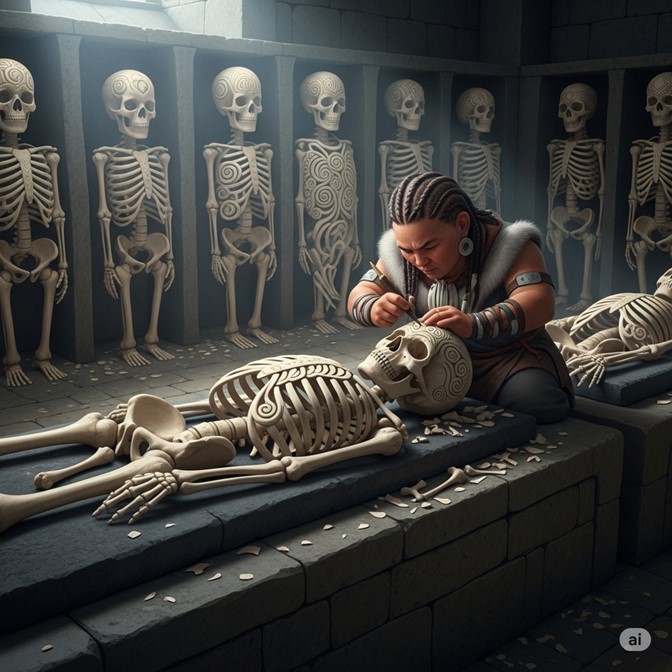
- Mortuary Art: The preparation of the dead is the most sacred rite. The bones of the deceased are meticulously cleaned and then carved by a master artisan with the story of that person’s life, turning their remains into a final, beautiful testament.
Symbols
- The Ivory Gate: The primary symbol of the faith. It is a depiction of a symmetrical, arch-like structure made of two interlocking, skeletal figures, often walrus or whales. This represents the gateway between the world of the living and the world of spirits, a gateway that can be opened through the act of carving.
- The Carver’s Knife: A stylized depiction of a simple, curved knife, often shown with a handle made of bone. It represents the tool of transformation, the instrument that brings shape to the formless and reveals hidden truths.
- The Skeletal Hand: A depiction of a hand where the bones are visible through the flesh. This symbolizes the ability to perceive the “true bone” or underlying structure of all things.
Tags: The First Carver, The Ivory Gate, Animistic, Shamanistic, Artisan Faith, Ancestor Veneration, Death Positive, Spirit Crafting, Introspective, Skeletal Motifs, Carving Rituals, Transformation, Hidden Knowledge, Ivory and Bone, Non-Interventionist
Number of Followers
The Path of the Ivory Gate is the dominant spiritual philosophy of the Ipiutak nation, deeply interwoven with their artistic traditions and worldview. The faith is practiced by a slight majority of the island’s citizens. Of the total population of 160,553,143, it’s followed by approximately 55%, which amounts to roughly 88.3 million souls. While other beliefs may exist in small enclaves, The Path of the Ivory Gate is the state religion and the guiding spiritual force for nearly all of the nation’s predominant race, the Nunamiut.
Type of Temple
Followers of The Path of the Ivory Gate don’t build temples for congregational worship in the traditional sense. They believe the most sacred act is the personal, meditative process of creation. Their holy places are the functional locations where this sacred work is performed or where the resulting masterpieces are housed.
- The Great Ossuaries: The most revered and sacred sites in the nation. These are large, silent, semi-subterranean vaults, often built with massive whale ribs for arches. They serve as both ancestral tombs and art galleries. Here, the intricately carved bones of generations of ancestors are preserved and displayed. These aren’t places of mourning but libraries of wisdom, where shamans come to commune with the spirits of the past and artisans come to study the work of the old masters.
- Carver’s Workshops: The personal workshop of a master carver is considered a holy sanctuary. It is a place of intense focus and communion between the artisan, their tools, and the spirit of the material they are shaping. These spaces are kept meticulously clean and are usually quiet, filled only with the sound of the knife and the scent of bone dust and polishing oils.
- Spirit Altars: Out on the vast tundra and along the coast, the Nunamiut build simple, open-air altars from carefully balanced stones or large, weathered bones. These aren’t for prayer but for offerings. A hunter might leave a small, beautiful carving of a seal to thank its spirit for a successful hunt, or a traveler might place a charm on the altar to ask the spirit of the path for a safe journey.
Positives of the Religion
This unique faith has fostered a culture with profound strengths. Its elevation of art to the highest form of spiritual expression means the nation produces some of the most beautiful and magically potent gear and artifacts in the world. The focus on introspection and understanding the “true bone” of things gives the people a deep psychological resilience and a calm acceptance of hardship and death, which they see as natural transformations. The practice of carving the stories of their ancestors into their remains creates a tangible, unbreakable link to their history, providing a powerful sense of identity and continuity. This fosters a society that values skill, patience, and wisdom, creating a meritocracy where respect is earned through masterful creation.
Negatives of the Religion
The same introspective and artistic focus can lead to significant societal weaknesses. The cultural habit of long, meditative contemplation before acting can make the nation slow and indecisive in a sudden crisis, as leaders might spend too much time trying to understand the “story” of a threat rather than reacting to it. The immense spiritual and magical value placed on bone and ivory, especially from large or rare creatures, can lead to dangerous and unsustainable hunting practices or even conflicts over the remains of a particularly powerful beast. To outsiders, the culture’s constant use of skeletal motifs and their reverent handling of bones can be deeply unsettling, leading to them being perceived as a morbid, macabre “death cult” and causing diplomatic friction. This can also create a harsh artistic elitism, where those with no talent for carving are seen as spiritually “incomplete” and are relegated to lower-status roles in society.
Core Beliefs of the Faithful
The followers of The Path of the Ivory Gate hold a worldview that is deeply artistic, spiritual, and introspective. Their beliefs are less about worship and more about the act of creation and revelation.
- The World as a Medium: The central tenet is the belief that all of existence—flesh, ice, stone, and spirit—is a raw, uncarved medium. The universe is a block of potential, and its purpose is to be given form, meaning, and beauty.
- The First Carver as the Ideal: They don’t worship The First Carver as a ruling god, but revere this ancestral spirit as the ultimate ideal. The First Carver is the one who first understood that the cosmos was a work of art in progress and began the sacred task of bringing forth its hidden forms.
- The “True Bone” Within: Every object, creature, and person is believed to possess a “true bone,” an inner, essential spiritual structure and story. A person’s soul is their “true bone.” The purpose of a life is to understand your own inner truth and to reveal it through your actions, words, and, most importantly, your creations.
- Carving as a Magical Act: The highest form of magic and spiritual communion is the act of carving. To carve a piece of ivory is to have a conversation with the spirit of the beast it came from. The flowing lines of the Tarn’ngit Tracery aren’t just letters; they are a way to awaken the spirit of an object, giving it purpose and power. A piece of enchanted gear isn’t just imbued with magic; its inherent spirit has been revealed and given a voice.
- Death as the Final Sculpture: Death is not seen as an end but as the final, revealing act of artistry. When the temporary medium of flesh falls away, what remains is the skeleton—the “true bone,” the final, perfect, and eternal sculpture of a life’s journey. The soul, now freed from its medium, passes through the symbolic Ivory Gate into the spirit world.
Regular Services and Gatherings
The faith is highly personal, and its rituals are focused on the act of creation rather than on congregational worship. They have no set schedule for “services.”
- The Carver’s Stillness: The most common personal ritual is a daily meditation practiced by artisans. Before beginning their work, a carver will sit silently in their workshop, holding the raw, unworked material (a piece of bone, ivory, or wood). They will simply hold it, feeling its texture, weight, and balance with their hands and their “bone-sense.” This is a ritual to quiet their own inner noise and to “listen” to the story the material wants to tell.
- Community Story-Carves: These gatherings are the closest the faith comes to a communal service and are held to mark a significant event—the first great caribou migration of the season, the death of a Matriarch, or a victory over a great beast. The community gathers in a circle. In the center, a lore-keeper will chant the story of the event in the poetic Tarn’ngitit language, while a master carver simultaneously inscribes an abstract, narrative version of the story onto a large whale vertebra or a walrus tusk. The finished piece becomes a permanent record, a new “page” in the clan’s library of bone.
- Shamanic Mask Dances: When the community needs to communicate with a specific powerful spirit, a shaman will perform a mask dance. The shaman dons a sacred mask, often ancient and believed to have been carved by the First Carver, that represents the spirit they wish to contact. Accompanied by the low, hypnotic chanting of the community, the shaman dances. The dance is a story, a conversation in motion, that allows the spirit to express its will through the shaman’s body.
Funeral Rites: The Final Carving
The funeral rites of the Ipiutak are perhaps their most unique and sacred tradition, a process that transforms the deceased into a final, revered work of art.
- The Gathering of the Story: When a person dies, their body is laid in state within their home. For several days, family, friends, and fellow guild members will gather. They don’t mourn in the traditional sense; they tell stories. They recount every great deed, every clever joke, every skilled creation, and every moment of wisdom from the deceased’s life. This is a vital ritual to “gather up” the complete essence of the person’s story.
- Revealing the True Bone: After the vigil, the body is given to the mortuary guild, a respected group of artisans and shamans. With the utmost reverence, they perform the sacred task of removing all the soft tissue from the skeleton. This is not seen as defilement, but as the first step of the final carving—chipping away the temporary, fleshy block to reveal the pure, permanent medium of the “true bone” beneath.
- The Soul-Carving: This is the heart of the funeral rite. A master carver—often the most skilled member of the deceased’s family—is given the cleaned skeleton. Over weeks, or even months, in a meditative state, the carver will meticulously inscribe the story of the person’s life into their very bones using the flowing Tarn’ngit Tracery. The deeds of a great hunter might be carved along their arms and legs; the wisdom of a lore-keeper might be inscribed upon their skull; the history of a family might be traced along a Matriarch’s spine.
- Enshrinement in the Ossuary: Once the carving is complete, the skeleton, now a unique and sacred biography, is carefully reassembled and given a place of honor in the clan’s Great Ossuary. The soul is believed to have passed through the Ivory Gate, but their life’s story, their true essence, now remains forever as a source of wisdom and inspiration for the living.
The followers of The Path of the Ivory Gate don’t receive magical power directly from their revered ancestor-spirit, The First Carver. Instead, they use the principles taught by the First Carver to awaken the dormant power that already exists within the materials of the world. Their magic is an extension of their artistry. Through the sacred and meticulous act of carving, they reveal the “true bone” or “inner story” of an object, transforming a simple piece of ivory or bone into a potent piece of enchanted gear.
Defense: The Revealed Story of Endurance
The defensive philosophy of this faith is about revealing and reinforcing the inherent strength and story of a material. An uncarved shield is just a block of matter. But a shield whose “true bone” has been awakened through carving is inhabited by the spirit of its own story, making it exponentially more durable. Defense is an act of giving a voice to an object’s will to endure.
- Armor of the Unbroken Line: This armor isn’t made of single, large plates, but hundreds of small, interlocking pieces of bone or ivory. A master carver spends months inscribing each piece with a segment of a single, continuous, flowing line from the Tarn’ngit Tracery script. When assembled, the carved line flows unbroken across the entire suit. This doesn’t just make the armor hard; it transforms it into a single, unified magical system. The force of any blow is not absorbed by one plate but is instantly distributed across the entire network of carved lines, dissipating the impact and making the armor incredibly resistant to being breached.
- Shield of the Ancestor: These powerful shields are crafted from the massive, ancient bones of colossal sea-beasts or land creatures. A shaman-carver meditates with the bone, using their “bone-sense” to perceive the life story of the creature it came from. They then spend years carving this story onto the shield’s surface. When the wearer is about to receive a powerful blow, the shield’s awakened spirit can manifest, creating a ghostly, spectral afterimage of the ancient beast that absorbs a portion of the attack’s force. To carry such a shield is to carry the enduring spirit of a mighty ancestor.
- The Spirit Mask: Nunamiut shamans and guardians often wear masks intricately carved to represent the skeletal form of a powerful, protective spirit or an animal known for its resilience, like a wolverine or a musk ox. By wearing the mask, the user isn’t just hiding their face; they are aligning their own spirit with the mask’s spirit. This provides a profound defense against magical effects that target the mind or soul, such as fear, charm, or spiritual corruption, as the attack is hitting not just the wearer, but the ancient, impassive spirit of the mask itself.
Offense: The Carving of a Weakness
Offensive power is not seen as an act of brute force, but as an act of ultimate artistic insight. Just as a carver’s knife finds the natural lines within a piece of ivory to release a hidden form, a warrior’s weapon is used to find the “true bone” of an opponent’s defense and reveal its inherent flaws. An attack is a precise cut designed to make a system unravel.
- The Carver’s Edge: Weapons like axes and swords are often edged with razor-sharp pieces of obsidian or magically hardened bone, but their true power lies in the Tarn’ngitit tracery covering their flats. These carvings don’t imbue the weapon with fire or frost; they awaken its ability to “read” the structure of whatever it touches. In combat, the weapon provides tactile feedback to the wielder through their “bone-sense,” guiding their hand to strike at the weakest point of an opponent’s armor or to parry a blow at the precise angle that could cause the enemy’s weapon to break.
- Fetishes of Unraveling: These are small, throwable charms of bone or antler, each carved with a single, potent conceptual glyph. When one of these fetishes strikes a target, it imparts its carved concept.
- A fetish carved with the glyph for “Fracture” might not do physical damage, but it will cause a hairline crack to appear in a piece of armor, weakening it for a follow-up attack.
- A fetish of “Reveal” striking a magical shield could cause the enchantment to flicker, momentarily exposing the target.
- A fetish of “Unravel” could cause the stitching on a piece of leather armor to loosen or the haft of an axe to weaken.
- The Gaze of the Inner Form: A helmet or circlet carved with intricate, open-work, skeletal patterns around the eyes. This gear is a tool for the most advanced shamans and warriors. It focuses the user’s “bone-sense” outward, allowing them to perceive the “true bone” of their opponents. They don’t see a literal skeleton, but a spiritual and structural representation of their target. This gaze can reveal the weak point in a golem’s construction, the keystone of a magical ward, or a flaw in a warrior’s defensive stance, allowing the user to bypass a formidable defense with a single, perfectly placed strike.
Man Who Was Forgotten by Ivory Gate
It’s a truth of the spirit world that a soul needs a map to find its way. The story of a life, carved into the true bone, is that map. A soul without its story is a traveler without a path, lost in the cold between the worlds. This is the story of such a soul.
There was a hunter of the Nunamiut people named Kael. He wasn’t a great hero or a master carver. He was a good man who loved his family and was skilled with his harpoon. One season, he went far out onto the great ice sea, tracking a rare, spotted seal. A blizzard came down from the mountains without warning. It was a storm with teeth and a voice of pure rage. Kael was a skilled survivor, but the storm was greater than his skill. He was lost. His body was eaten by the snow and was never found.
His family waited. His clan searched for many days, but the storm had buried the world in a new layer of white. They could find no sign. The village held a vigil of storytelling for him, but it was a vigil of deep sorrow, for they had no bones to carve. Kael’s story could be told with the tongue, but it couldn’t be given its final, true form. His soul was now without its map.
The seasons turned. A strange sickness came upon the lands where Kael had been lost. It became a place of unnatural cold, where the wind always seemed to weep. The caribou would not go there. Hunters who tried to cross it became lost in their own minds, filled with a deep, empty sorrow that stole the strength from their legs. The shamans knew the truth: it was the ghost of Kael. His spirit, unable to find the Ivory Gate, was now a formless, confused blight upon the land. His ghost was a question with no answer, and its sorrow was contagious.
The Matriarch of the clan called for a young shaman named Anja. Her skill with the carving knife was matched only by the strength of her bone-sense, which allowed her to see the spirits. “The hunter Kael is a wound in the world,” the Matriarch said. “His story has no ending. You must go to the place of sorrow and give him one.”
Anja prepared for her journey. She didn’t take a great weapon. She took her finest carving knives and a large, perfect, uncarved tusk from a great walrus. She also took her spirit mask, which was carved in the skeletal shape of a gull, a creature that can see both the land and the sea.
Anja traveled into the blighted lands. The cold was deeper there, and a great sadness pressed in on her. She felt the lostness of Kael’s spirit. She found the heart of the sorrow, a place where the snow swirled with no wind. She put on her gull-spirit mask, and the world changed. She could now see what was hidden.
The spirit of Kael was before her. It wasn’t a man. It was a shifting, formless cloud of grey mist, a knot of confusion and grief. It had no face, no voice, no memory of who it was. It only felt its own lostness. .
Anja knew she couldn’t fight it. How do you fight a sorrow? She couldn’t reason with it. It had no mind to reason with. She had to give it what it had lost: a story. A form. A map.
She knelt in the snow, her own spirit protected by the mask. She took out the great walrus tusk. While she watched the formless ghost, she began to carve. She didn’t carve the stories from the village. She let the spirit guide her hands. She felt its confusion, and she carved swirling, lost patterns. She felt its sorrow, and she carved long, weeping lines. She felt its memory of the hunt, and she carved the shape of a seal. She carved the story of its lonely death in the storm. She carved his sorrow so he wouldn’t have to carry it anymore.
The work took a day and a night. The wind howled, and the ghost of Kael swirled around her. But she didn’t stop. She was not just carving ivory; she was carving a soul. As she cut the final line of the tracery—the symbol for a name given and a story ended—the formless mist grew calm. It flowed from the air and into the tusk, as if the ivory were drinking it. The unnatural cold broke. The feeling of sorrow was gone.
The tusk in her hands was now a complete and beautiful thing. It was no longer an object of sorrow, but a record of a life. The spirit of Kael was no longer a blight. Its story was now finished. Its soul was now free to find the Ivory Gate.
Anja returned not with a trophy of a great battle, but with the “Story Tusk of Kael.” It was placed in the Great Ossuary with the carved bones of the other ancestors. It is a reminder to all Nunamiut of why their sacred rites are so important.
The Moral: A life without a story is a ghost in the wind, but a story, even one carved in borrowed bone, can show a soul the way home.