
Slot: Shoulders
Tags: Reflecting Magic, Demolition, Utility, Tool, Worn Item, Common, Tier 1, Knock-back, Engineering, Mining, Area of Effect, Concussive, Force, Industrial, Structural, Heavy
Lore: In the ever-expanding, vertically-stacked cities of Saṃsāra, creation is only half the battle; demolition is the other. The Demolition and Quarrying Guild needed a tool more precise and less volatile than traditional alchemical explosives for carving new tunnels or safely dismantling old, towering structures. They turned to the volatile principles of Reflecting Magic, seeking not to weaponize it against people, but to turn its raw power against stone and steel. The Unmaking Pauldrons were their solution. This common-grade gear allows a skilled user to deliver precise, controlled, concussive blasts by striking the item themselves. They are now a standard tool for civil engineers, miners, and demolition crews, prized for their ability to turn the force of a simple hammer blow into a structure-shattering shockwave.
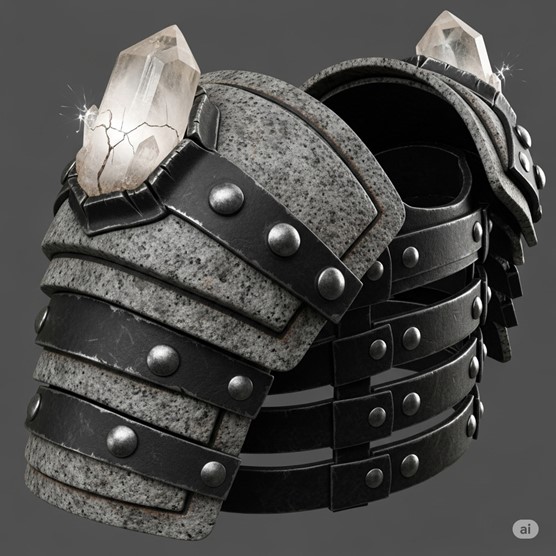
Description: The Unmaking Pauldrons are a pair of heavy, brutally functional shoulder guards. They are not crafted from elegant steel, but from thick, layered plates of compressed, magically treated granite, held together by oversized iron rivets and thick leather straps. The top surface of each pauldron is flat and heavily reinforced, designed explicitly as a striking surface. Set into the center of each is a large, milky quartz crystal, intentionally fractured during its forging to better absorb and redirect kinetic energy. The crystals emanate a very faint, low hum, and the entire apparatus is heavy and cumbersome, clearly a tool rather than armor for a swift warrior.
Detailed Stats
- Tier: 1
- Rarity: Common
- Attunement Requirement: The wearer must strike the pauldron with a hammer or tool, creating a small, controlled blast. This initial shock attunes the item to the user’s energy and their tolerance for the feedback.
- Magic Capacity: The pauldrons do not store energy but act as a magical converter, instantly turning kinetic force into a concussive blast.
- Durability: Very High. The item is designed to be struck repeatedly with heavy tools.
Passive Magic
- Structural Intuition: When the wearer places a hand on an inanimate structure, they get a faint, intuitive sense of its integrity—a subtle feeling for stress points, hidden cracks, or the weakest section of a wall.
- Inertial Dampener: The pauldrons are enchanted to absorb the force of a self-inflicted blow. When the user strikes their own pauldron, they do not take damage. The kinetic energy is instantly and completely channeled into the reflective blast.
- Debris Deflection: A faint, shimmering field of force automatically covers the wearer’s head and torso for a second after a blast, deflecting small shards of stone and other minor shrapnel created by the demolition.
Activable Magic
- Unmaking Blast: This is the core function of the pauldrons, designed for controlled demolition. The user strikes one of their own pauldrons with a tool or weapon (typically a sledgehammer). The item then unleashes a powerful blast of pure concussive force centered on the point of impact.
- Reflective Damage (Force): The blast has no effect on living creatures, passing through them harmlessly. It only affects inanimate objects and structures. The amount of concussive damage dealt to structures is equal to the damage the user would have taken from their own blow.
- Damage Radius: The radius of the destructive wave is equivalent to the amount of damage from the self-inflicted blow. A light 8-damage tap with a small hammer creates an 8-foot radius burst, while a mighty 25-damage blow from a sledgehammer creates a massive 25-foot radius blast.
- Knock-back: The blast has a powerful, integrated knock-back effect that violently shoves loose debris, dust, and unsecured objects away from the blast’s center, helping to clear the area.
- Resonant Frequency Tuning: The user can spend a minute “listening” to a structure by keeping a hand on it and touching the pauldron’s crystal. They can attune the item to the specific resonant frequency of that material. The next Unmaking Blast they create will deal double its normal damage to that specific type of material (e.g., granite, brick, ironwood), allowing for much more efficient demolition of a chosen target.
The Unmaking Pauldrons are not elegant magic items to be found in a wizard’s tower or an adventurer’s emporium. They are heavy, specialized tools of industry and demolition. Their sale is confined to professional outfitters, industrial suppliers, and the occasional black market dealer who has a client with a wall to bring down.
The Demolition & Quarrying Guild Hall
This is the most common and legitimate source for the Unmaking Pauldrons. The “shop” is a fortified warehouse or quartermaster’s office attached to the main guild hall in a major industrial city. The air is thick with the smell of rock dust, machine oil, and the sharp scent of ozone from magical machinery. The space is cavernous, filled with heavy-duty equipment: massive steam-powered drills, carts of raw ore, and reinforced racks holding magical tools. The quartermaster is a no-nonsense, guild-certified foreman who has likely spent decades in the mines or on a demolition crew.
The transaction here is strictly professional. A buyer must present proof of their guild membership or a valid, licensed work contract that necessitates the use of demolition equipment. The pauldrons are treated as a standard-issue tool. The quartermaster would inspect the buyer’s credentials, log the item’s unique serial number, and likely give a stern, mandatory lecture on safety protocols, proper striking technique, and the catastrophic dangers of resonance sickness between two active sets.
Cost: A standardized guild-member price of 25 Gild. They are more interested in resources than currency from outsiders. A non-member with a valid contract might be able to trade for them with a full cart of high-grade iron ore, a rare and durable type of lumber needed for support beams, or several condensed elemental crystals used to power the guild’s heavy machinery.
The Independent Industrial Hardware Supplier
In the districts of a city that service miners, factory workers, and civil engineers, one can find large, independent hardware stores. These establishments are vast and cluttered, with towering shelves packed with everything from simple pickaxes to complex replacement gears for steam engines. In a reinforced section at the back of the store, one could find magical industrial tools, including the Unmaking Pauldrons.
The shop owner is a knowledgeable merchant who understands the technical specifications of their wares. They would likely ask about the buyer’s project—”Are you clearing a rockfall or trying to bring down a reinforced wall? The striking pattern is different.”—to ensure the customer is purchasing the right tool for the job. The pauldrons would be presented as a reliable, powerful piece of equipment for serious professionals.
Cost: A fair market price of around 40 Gild. The price is not typically negotiable, but a discount might be offered for a bulk purchase for a large construction or mining project. The owner would be interested in trading for salvageable, high-grade metal components from decommissioned factories, rare and dense minerals, or schematics for more efficient steam-powered machinery.
The Black Market “Tool” Dealer
For those who need to demolish something without a permit—be it a rival’s warehouse, a sewer wall for a secret entrance, or the side of a vault—there are black market dealers. The transaction takes place in a clandestine, arranged meeting. The dealer is a shadowy figure who specializes in acquiring and reselling industrial tools for unsanctioned purposes. The Unmaking Pauldrons they sell might be stolen guild equipment with the serial numbers filed off, or cruder, unregulated copies.
The deal is quick, quiet, and conducted with an air of paranoia. The dealer would highlight the item’s raw destructive power, praising its ability to “make problems go away” while conveniently omitting any warnings about the resonance risk unless specifically asked. The quality is not guaranteed, and the sale is final the moment the coin is exchanged.
Cost: An inflated price of 60 Gild or more, reflecting the illicit nature of the transaction and the risk to the dealer. Payment is demanded in untraceable currency, raw gemstones, or other contraband of equivalent value, such as illegal alchemical precursors or weapons.
The Frontier Prospector’s Outpost
At the edge of the charted territories, in a rugged outpost that serves as the last point of supply for pioneers and prospectors, is a trading post. This establishment is usually a single, fortified building that is part general store, part workshop, and part tavern. The owner is a grizzled survivalist who trades in practical, durable goods.
A set of Unmaking Pauldrons would be a prize item here, perhaps taken in trade from a prospector who struck a rich vein of ore and had no more use for them. They would be kept securely under the counter, not on public display. The owner would only show them to customers who looked like they had a serious need for heavy-duty mining or excavation equipment and, more importantly, had something valuable to trade.
Cost: The monetary price is highly negotiable, starting around 50 Gild, but the owner would much rather barter. In this remote location, practical goods and services are far more valuable than coin. The owner might trade the pauldrons for a large supply of preserved food and clean water, a critical replacement part for their steam-powered generator, a detailed and accurate map of a newly discovered ore deposit, or a contract for protection against local monsters for a full season.
The Unmaking Pauldrons are explicitly tools of demolition, not direct combat. Their magic is designed to sunder inanimate objects, leaving living creatures unharmed. Therefore, their use in “offense” and “defense” is always indirect, tactical, and reliant on the creative destruction of the environment itself. An avatar using these in a conflict is not fighting the enemy; they are fighting the ground the enemy stands on, the cover they hide behind, and the path they walk.
In a Dense Urban or Interior Environment
Here, the world is made of walls, floors, ceilings, and structures. Every surface is a potential weapon or a potential barrier.
Offensive Roleplay: An avatar is confronting a group of well-armed city guards who have taken cover behind an ornate, massive stone monument in a city plaza. The guards are protected from direct assault. The avatar, wearing the Unmaking Pauldrons, ignores the guards entirely. Using their Structural Intuition, they find a weak point in the plaza’s cobblestone foundation right next to the monument. They take out a heavy sledgehammer, deliver a powerful blow to their own pauldron, and activate the Unmaking Blast. The concussive wave, harmless to the guards, rips through the ground and shatters the monument’s foundation. The massive stone structure groans and collapses into a pile of rubble, destroying the guards’ cover, kicking up a huge cloud of dust, and leaving them exposed and disoriented. The offense was the complete annihilation of the enemy’s defensive position.
Defensive Roleplay: The avatar is being pursued by a relentless group of assassins through the halls of a large stone manor. They are cornered, with the assassins closing in down a long hallway. The avatar ducks through a doorway into a side room, then immediately turns back to face the doorway they just came through. Placing a hand on the stone lintel to “listen” with their Resonant Frequency Tuning, they wait for the pursuers to get close. The moment the assassins appear in the doorway, the avatar smashes their pauldron with a warhammer. The amplified Unmaking Blast pulverizes the stone archway of the door. The entire structure collapses, instantly creating an impassable wall of rubble that completely seals the doorway, ending the chase and trapping the assassins on the other side. The defense was the creation of a brand new wall where a door used to be.
In a Subterranean Cave or Mine System
This environment is inherently unstable. The walls, ceiling, and floor are all composed of rock and earth, and everything is interconnected.
Offensive Roleplay: The avatar and their party are battling a massive, heavily armored, burrowing creature in a large cavern. The creature’s natural armor is too thick for their weapons to reliably pierce. However, the user of the pauldrons looks up and sees the cavern ceiling is covered in huge, heavy stalactites. Waiting for the lumbering creature to position itself underneath the largest cluster, the user takes a deep breath and delivers a mighty blow to their pauldron. The resulting Unmaking Blast radiates upwards in a massive radius. While harmless to the creature directly, the concussive force shatters the anchor points of the stalactites above. Tons of rock rain down, crushing the armored monster under their immense weight and ending the threat without ever needing to penetrate its hide. The offense was turning the cavern’s ceiling into a giant deadfall trap.
Defensive Roleplay: The avatar’s party is deep within an unstable mine shaft when they are ambushed by a horde of swarming, monstrous insects pouring from a side tunnel. The party is being overwhelmed and must retreat. The avatar, taking up the rear, uses their Structural Intuition to identify a key support beam near the intersection. They yell for their allies to run past them. As the last party member gets clear, and with the horde just seconds away, the user strikes their pauldron. The blast splinters the critical support beam. With a great groan, the tunnel behind them collapses in on itself, sealing the horde away in a tomb of rock and earth and securing the party’s escape.
On a Great Bridge or Elevated Viaduct
In this environment, the integrity of the structure is the only thing preventing a fatal fall. The ground itself is a conditional advantage that can be removed.
Offensive Roleplay: The avatar needs to stop an armored steam-wagon carrying enemy reinforcements from crossing a massive stone bridge. The wagon itself is too durable to destroy quickly. The avatar gets onto the bridge ahead of the wagon, places a hand on the central keystone, and uses Resonant Frequency Tuning. They wait until the steam-wagon is in the middle of the span, its great weight stressing the structure. The avatar then delivers a powerful, calculated blow to their pauldron. The amplified Unmaking Blast, tuned specifically to shatter the bridge’s stonework, cracks the keystone. The entire section of the bridge gives way, and the armored vehicle, along with its occupants, plunges into the canyon below. The offense was not attacking the enemy, but destroying the path they were on.
Defensive Roleplay: The avatar finds themself on one side of a long bridge, with a large, superior enemy force preparing to charge them from the other. A direct confrontation would be suicide. The avatar runs to the very center of the bridge, strikes their pauldron with all their might, and then immediately turns and runs back to the side they started on. The massive Unmaking Blast shatters the bridge’s structure, causing a wide section of the span to collapse into rubble. A huge, impassable gap is created in the middle of the bridge. The enemy charge halts at the edge of the chasm, unable to cross. The defense was the strategic destruction of the battlefield itself to prevent the enemy from ever engaging.
Perception of Activation:
Sight
- User’s Perspective: The user sees the head of their hammer or tool make impact. For a fraction of a second, the fractured crystal on the pauldron flashes with a blinding, internal white light. This is immediately followed by the sight of a rapidly expanding sphere of visibly distorted air, like a massive heat-haze, erupting from the point of impact. Their passive Debris Shield creates a faint, shimmering film before their eyes, keeping the subsequent dust cloud from their vision.
- Observer’s Perspective: An observer sees the user deliberately strike their own shoulder guard. The crystal set into the pauldron flashes once with brilliant white light, like a lightning strike at close range. Immediately, a visible shockwave of distorted air erupts outwards, kicking up a massive cloud of dust and debris as it pulverizes any nearby structures.
- Positives: The visual confirmation of the blast radius is clear, allowing the user to precisely gauge the effect of their strike. The spectacle is intimidating and unambiguous.
- Negatives: The initial flash is dazzling to anyone watching, and the immense dust cloud created by the blast obscures vision for everyone in the area, including the user and their allies, for a significant time.
Sound
- User’s Perspective: The user perceives a sharp, powerful CRACK from the physical impact, which is instantly consumed by a deep, resonant BOOM from the magical blast. The sound seems to vibrate through their bones and the ground more than it is heard by their ears, as the pauldrons’ magic dampens the direct concussive force to their head.
- Observer’s Perspective: An observer is struck by an incredibly loud, two-stage explosion. First, the sharp report of the tool striking the pauldron, immediately followed by a ground-shaking, deafening BOOM from the magical shockwave. The sound is physically painful to the ears and sounds less like a spell and more like a catastrophic industrial accident or a large-scale explosive detonation.
- Positives: The sound provides unmistakable feedback of a successful and powerful activation.
- Negatives: The sound is absolutely deafening and will attract attention from a great distance. It will disorient and temporarily deafen anyone nearby, including allies, making verbal communication impossible in the immediate aftermath.
Touch
- User’s Perspective: They feel the solid impact of their tool connecting with the pauldron, but due to the item’s Inertial Dampener, they feel no pain and almost no jarring force. Instead, they feel a massive, thrumming vibration surge through the pauldron and into the ground beneath their feet, a sensation of immense power being safely vented away from their body.
- Observer’s Perspective: An observer feels the ground shake violently, as if from a small, localized earthquake. They are then hit by a powerful wave of pure concussive force, a physical blow from the air itself that can easily knock them off their feet, even if they are outside the primary destructive area.
- Positives: The user is completely protected from the force of their own blow, allowing them to strike with maximum power without fear of self-injury, making it a reliable tool.
- Negatives: The ground shock and concussive wave are indiscriminate and can be dangerous to nearby allies, potentially throwing them off balance, knocking them off ledges, or causing environmental hazards to fall on them.
Smell
- User’s Perspective: The user’s senses are instantly filled with the dry, choking scent of pulverized rock, the sharp smell of hot iron from their tool, and the distinct, electric smell of ozone from the magical energy release.
- Observer’s Perspective: The air in the entire area is instantly saturated with the smell of a demolition site: atomized stone and concrete, hot metal, and a heavy, sharp scent of ozone.
- Positives: The scent is a clear indicator of the type of energy released—raw, physical force and stone-breaking power.
- Negatives: The thick dust associated with the smell is choking and can make breathing difficult for everyone in the area immediately following a blast.
Taste
- User’s ‘s Perspective: A gritty, mineral taste of stone dust immediately coats the user’s mouth and tongue.
- Observer’s Perspective: Anyone near the blast will have the same unpleasant, gritty taste of dust in their mouth.
- Positives: None. It is a direct and unpleasant consequence of being near a demolition blast.
- Negatives: The taste is unpleasant and is a direct result of inhaling pulverized rock and other fine debris, which can lead to coughing fits and respiratory irritation.
Extra-Sensory Perception: Empathic Null
- User’s Perspective: The user feels nothing on an empathic level. The magic is entirely external and physical. There is no intent, no malice, no anger, no life energy involved—only the cold, detached, and clinical application of overwhelming force. It is a moment of profound empathic silence and neutrality.
- Observer’s Perspective: An empathic observer is struck by the complete and utter void of emotion from the blast. It is not an attack born of anger or a defense born of fear. It is a wave of pure, unfeeling, impersonal force, which can be even more terrifying than a rage-fueled attack because it cannot be reasoned with or intimidated. It has the emotional weight of a natural disaster.
- Positives: The lack of emotional feedback allows the user to remain detached and clinical, operating the pauldrons as the tool they are without a sense of aggression or moral conflict.
- Negatives: The sheer impersonality of the force can be deeply unsettling to observers, who are accustomed to magic having some kind of emotional intent or will behind it.
Extra-Sensory Perception: Aura of Sundering
- User’s Perspective: Through their Mind’s Eye, the user sees the kinetic energy of their blow not as a damaging force, but as a “key.” This key is inserted into the crystal, which turns and unlocks a wave of pure, grey, “unmaking” energy. They perceive this wave as something that doesn’t damage auras, but violently disassembles the auric structure of inanimate matter.
- Observer’s Perspective: An observer with Aura Sight witnesses a brutal but fascinating display. The kinetic energy of the user’s hammer strike is visibly drawn into the pauldron’s crystal. The crystal then flashes and releases a massive, expanding sphere of grey, chaotic, grinding energy. This energy wave has no effect on the auras of living creatures, passing through them harmlessly, but it violently shatters and disintegrates the auras of any stone, wood, or metal it touches, causing their physical forms to crumble.
- Positives: Provides a clear visual understanding on a magical level of how the magic works, differentiating between its destructive effect on objects and its non-effect on life.
- Negatives: Witnessing the violent “unmaking” of an object’s essential energetic pattern is a jarring and cacophonous sight on the magical plane.
Extra-Sensory Perception: Kinetic Conversion
- User’s Perspective: The user feels a clean, efficient, and powerful conversion of energy. The kinetic force of their blow is caught by the pauldron and feels like it is “folded” and amplified by the magic before being released. It is a purely physical and mechanical feeling on the magical plane, like operating a massive, perfect machine.
- Observer’s Perspective: A magically-aware individual perceives a unique signature, not of a spell being cast from mana, but of a direct physical-to-magical energy conversion. They sense a massive spike of kinetic energy being consumed at the point of impact, followed by an even larger release of raw, untyped, concussive magical force. It is the signature of a magical amplifier, not a traditional spell.
- Positives: A magically aware user can feel the efficiency of the conversion, allowing them to gauge the power of their strike before the blast even happens by the “feel” of the energy transfer.
- Negatives: The signature is unmistakably industrial and powerful. Any magic-user in the area would instantly know that a powerful piece of demolition magic, not a combat spell, was just used. This clearly reveals the user’s capabilities and role as a demolitions expert, not a standard warrior.
Guild Demolitionist’s Draft: The Sundering Pauldrons
This document outlines the industrial and magical process for crafting a set of Unmaking Pauldrons. The creation is a feat of heavy engineering as much as it is of enchantment, requiring skills in both stonework and the manipulation of raw kinetic force.
Materials Needed
- High-Density Granite Blocks: Several large, flawless blocks of granite, chosen for their ability to withstand immense pressure.
- Unrefined Iron Ingots: A significant quantity of crude iron for forging the rivets and support bands.
- Tanned Basilisk Hide: Strips of thick, cured leather from a basilisk or other stone-hided creature, prized for its extreme durability.
- A Large, Flawed Geode: One large quartz geode, specifically selected for its numerous internal fractures and cloudy imperfections, which help to diffuse and redirect energy.
- A Vial of Stonemason’s Grit: A vial containing the fine stone dust and sweat collected from a master stonemason after a long day’s work, holding the “essence” of shaping stone.
- A Set of Harmonic Resonators: A set of heavy, metallic tuning forks designed to find the resonant frequencies of stone and crystal.
Tools Required
- Heavy-Duty Forge and Power Hammer: A large forge for heating the iron and a steam-powered hammer for shaping it.
- Industrial Stone Saw: A large, magically or steam-powered saw capable of cutting through thick granite blocks.
- Magical-Hydraulic Press: A powerful press used to laminate the stone plates under immense force.
- Rivet Forge and Setter: A specialized forge for heating the rivets and a heavy tool for setting them.
- Kinetic Imbuement Chamber: A reinforced chamber with resonating plates, designed to safely handle the imbuement of powerful kinetic enchantments.
Skill Requirements
- Master Stoneworking: Expert-level skill in cutting, shaping, and laminating stone to create a durable, wearable piece of equipment.
- Industrial Blacksmithing: Proficiency in forging heavy, functional iron components designed for strength over aesthetics.
- Kinetic Conversion Enchanting: The core magical skill. The ability to create an enchantment that absorbs raw kinetic energy, converts it into a concussive magical force, and directs it outwards in a specific, non-living-targeted wave.
- Resonance Analysis: The ability to use magical tools to find and manipulate the resonant frequencies of different materials.
Crafting Steps
- Cutting the Plates: The process begins with the granite. Using the industrial stone saw, the crafter must precisely cut the granite blocks into the layered plates that will form the body of the two pauldrons.
- Forging the Framework: At the forge, the iron ingots are heated and shaped using the power hammer into the thick structural bands that will encase the stone, as well as the oversized rivets that will hold the entire assembly together.
- Laminating the Core: The cut granite plates are stacked in their proper orientation. This stack is then placed into the magical-hydraulic press. The press applies thousands of pounds of force, compressing the layers into a single, incredibly dense and durable composite stone structure.
- Final Assembly: The hot iron bands are fitted around the compressed granite core. The red-hot rivets are driven through pre-drilled holes and set with the rivet setter, permanently binding the stone and iron together. Once cooled, the basilisk hide straps are measured and attached.
- Preparing the Focus: The flawed geode is carefully split open. The crafter uses the set of harmonic resonators, striking them and holding them near the crystal, to find the geode’s natural resonant frequency for absorbing and releasing kinetic force.
- The Imbuement: The assembled pauldron is placed within the Kinetic Imbuement Chamber. The crystal half is anointed with the Stonemason’s Grit and then set into its housing on the pauldron’s striking surface. The crafter then activates the chamber, which begins to hum with power. They must channel their own Reiki energy into the item, weaving two complex enchantments simultaneously: first, the Inertial Dampener to negate the force of impact for the wearer, and second, the Kinetic Conversion spell that creates the Unmaking Blast. This blast must be carefully keyed to only affect the auras of non-living matter.
- Stress Testing and Attunement: The completed pauldron is removed from the chamber. The final step is to “cure” the enchantment. The pauldron is mounted on a testing frame and is repeatedly struck with hammers of increasing size and force. This process settles the complex magic, tempers the item to its purpose, and ensures it will not shatter under the strain of its own activation.
Ballad of the Mountain-Breaker
Hear now the telling of the age when the First People were trapped. Before them stood the Wall of the World, a great range of mountains whose peaks were said to scratch the bellies of the stars. The stone of this mountain was ancient and stubborn; it blunted any pick, it turned aside any drill, and it drank magic as a desert drinks water. The people were confined to a barren land, and their hope was a small and dwindling thing.
Among them was a man named Grak, whose hands knew the language of stone and whose will was a great hammer. He was their Stonemason and their leader. For a generation, Grak led the people in their assault on the mountain. They struck it with all their might, but they only made small scratches upon its skin. The mountain was a stubborn and silent god, and it did not yield.
Grak, seeing the despair in the eyes of his people, did a desperate thing. He journeyed alone to the highest peak, a place of thin air and great silence, to speak to the spirit of the mountain itself. He called out, his voice small in the great emptiness, and the mountain answered. Its voice was the grinding of stone on stone. It said to Grak, “You wish to break my bones. No small creature has ever done so. My strength is my great weight and my stillness.”
Grak pleaded for a path for his people. The mountain spirit considered. It said, “If you would break my stone, you must first bear its weight. If you would move me, you must become me. This is my bargain.”
Grak, whose love for his people was greater than his love for himself, accepted the bargain. He followed the spirit’s instructions. He journeyed deep into the mountain’s heart and found a great, flawed crystal that pulsed with a slow, kinetic energy. He gathered slabs of the densest granite, so heavy they would crush a normal man. He forged great iron rivets in a fire of his own making.
Then the ritual began. Grak laid the slabs of granite upon his own shoulders. He called to the mountain spirit, and the weight of the entire peak descended upon him. The pressure was a thing of agony, but Grak did not break. The granite slabs were compressed and fused to his very form, becoming a part of him. The flawed crystal was set upon these new, stone shoulders. Grak had passed the trial. He now carried the weight of the mountain, and so, he could command its strength. He had become the Mountain-Breaker.
He returned to his people at the base of the Wall of the World. He looked different. Upon his shoulders were great pauldrons of living stone, and they hummed with a low, powerful energy. He told his people to stand back. He faced the great wall of rock, and he did not lift a hammer. He lifted his fist.
He struck the mountain.
The blow should have shattered his arm to splinters. But the pauldron on his shoulder flashed with a brilliant light. The force of his own punch was absorbed, amplified, and unleashed. A great BOOM echoed through the land, and a concussive wave erupted from his point of impact, and a hundred tons of rock were turned to dust and gravel.
He struck the mountain again. And again. Each punch was a great explosion. Each blow was an earthquake. For days he fought the mountain, his own strength turned into a world-breaking force by the pauldrons he now wore. He was a man remaking the world with his bare hands.
At last, with a final, mighty blow, the wall was breached. Grak had carved a new canyon, a great pass through the impassable barrier. His people were free. They walked through the pass he had made, into the fertile lands beyond. Grak watched them go, his task complete. And as the last of his people passed, his body, which had become more stone than flesh, grew still. He became a great granite statue at the mouth of the canyon, a permanent guardian for the path he had created, the Unmaking Pauldrons forever upon his shoulders.
Moral of the Story: To move a mountain, you must be willing to first carry its weight.
Suggested conversions to other systems:
Dungeons & Dragons 5th Edition
Pauldrons of the Stonebreaker Wondrous item, common
This is a pair of heavy, unadorned shoulder guards made of layered plates of dark grey granite. They are heavy and cumbersome, clearly a tool rather than armor for a nimble combatant.
Passive. While wearing these pauldrons, you have advantage on any Strength (Athletics) check made to break or shove a large, inanimate object.
Sundering Blow. As an action, you can strike one of the pauldrons with a melee weapon you are holding or with an unarmed strike. You take no damage from this attack. Instead, a wave of concussive force erupts from you in a 10-foot radius. This wave is harmless to creatures and magical objects. Any nonmagical, unattended object or structure in the area takes 2d6 force damage. This damage is automatically a critical hit (dealing 4d6 force damage) if the object or structure is made of stone, earth, or crystal. Once you use this property, you cannot use it again until you finish a short or long rest.
Call of Cthulhu 7th Edition
The Quarryman’s Harness Industrial Tool
A brutally functional piece of equipment consisting of two massive shoulder plates made of compressed granite, connected by heavy leather straps. Each shoulder plate features a flat, reinforced striking surface. It is a dangerous, magically-infused tool used for heavy demolition and mining, not for combat.
Structural Demolition. To use the harness, the wearer must strike one of the shoulder plates with a heavy tool (such as a sledgehammer). This requires a full round of effort and a successful Hard STR roll. If successful, a concussive blast erupts from the user. This blast will destroy a 5-foot cube of non-reinforced material (earth, brick, simple stone). To destroy reinforced stone or metal requires an Extreme STR roll. The blast is deafeningly loud, creating a huge dust cloud and requiring anyone nearby to make a CON roll to avoid being temporarily deafened.
Unstable Power (The Resonance Risk). This harness is a crude but powerful tool. When the user makes their STR roll to activate it, if they Fumble (roll 96-100), the energy feedback is not properly contained. The user takes 1D6 damage and is thrown 1D10 feet away from their target. The resulting blast will be unpredictable in its size and direction, as determined by the Keeper. There is no Sanity cost for using this item, as its power is one of strange physics, not of mind-bending horror, but the physical danger is immense.
Blades in the Dark
The Breaker’s Mantle Heavy Gear, Magical Tool, Loud, Volatile
A set of heavy, stone-plated pauldrons that hum with contained power. This is a specialized tool for a Wrecker, or anyone with a need to bring down walls, quickly and without subtlety.
Create an Opening. When you need to get through a wall, a barricade, or any other large, inanimate obstacle, you can use the Mantle. You don’t need to roll dice. You just do it. The GM will then tell you what serious consequence occurs due to the immense noise and destructive power you have unleashed. This might be a high level of Heat, the immediate arrival of the City Watch, the structural collapse of the entire building, or all of the above. You get what you want, guaranteed, but at a steep price.
Controlled Demolition. If you want to use the Mantle with more precision, you must make an action roll using Wreck. On a success, you create the opening you wanted cleanly and quietly (or at least, more quietly). On a mixed success, you create the opening, but with a complication: it’s messy, it takes too long, you draw attention, or something collapses on you. On a failure, the power lashes out unpredictably, causing a catastrophic, uncontrolled demolition that puts you and your crew in a Desperate position.
Knave 2nd Edition
Granite Pauldrons of Unmaking Armor, takes up 2 inventory slots (heavy), cumbersome
A pair of heavy, layered granite pauldrons that provide some protection but are primarily a tool. They are difficult to move in quietly.
Armor Defense. Provides an Armor Defense of 14. Any checks related to stealth are made with disadvantage.
Sundering Blow. You can use your action to strike one of the pauldrons with a heavy weapon (such as a warhammer or mace). You take no damage from this attack yourself. A wave of pure force erupts from you in a 15-foot radius. The wave is harmless to creatures. It automatically destroys any non-magical object in the radius that is not made of metal or stone (e.g., wooden doors, furniture, barricades). Against stone or metal objects or structures, it deals 2d6 damage.
Resonance Risk. If you are within 30 feet of another person who is also wearing Granite Pauldrons of Unmaking, there is a 2-in-6 chance each time either of you use the Sundering Blow ability that a resonance cascade occurs. This deals 6d6 damage to everyone and everything in a 60-foot radius.
Fate Core System
The Breaker’s Burden An Extra represented by a pair of massive, cumbersome pauldrons made of layered stone and iron. They are tools first and armor second.
This heavy mantle is a focused tool for demolition, allowing the wearer to bring down structures with raw, concussive force. It grants the wearer a new situational Aspect and the following Stunts.
Character Aspect: A Hammer that Sees Only Nails. This Aspect can be invoked when using the pauldrons to destroy an obstacle or to intimidate someone with a show of destructive force. A GM can compel this Aspect to have a demolition go wrong, causing unintended structural collapse or collateral damage because the user’s only solution is to smash.
Stunts
- Sunder the Obstacle: When you encounter a physical, inanimate obstacle (such as a locked door, a barricade, or a weak wall), you can spend a Fate Point to declare that you automatically Overcome it by smashing it to pieces with your pauldrons. You do not need to roll. The GM will then add a new situational Aspect to the scene reflecting the chaos, such as Deafening Crash and Cloud of Dust.
- Resonant Analysis: You gain a +2 bonus to Crafts or Lore rolls made to assess a structure’s weak points or to understand its material composition before you apply force to it. This represents tuning the pauldrons’ energy to the object’s resonant frequency.
Numenera & Cypher System
The Kinetic Ram Pauldrons This artifact is a pair of heavy shoulder guards made of a composite material that resembles granite but is strangely light for its density. A fractured, milky crystal is set in each shoulder.
Level: 4 Form: A pair of wearable pauldrons Effect: This artifact is designed to absorb and amplify kinetic force, releasing it as a targeted, destructive wave.
- Action: The user strikes one of the pauldrons with a heavy object (this can be part of a standard attack action, but it targets the user’s own armor). A concussive blast erupts in an immediate radius. The blast is harmless to living creatures. It deals 4 points of damage to all inanimate objects in the radius. This damage ignores Armor.
- Action (Attunement): The user can spend their action studying a specific structure or object they are touching. On their next use of the Kinetic Ram pauldrons, the damage dealt to that specific attuned object is doubled to 8. Depletion: — (The item does not deplete in the traditional sense.) Limitation: The internal crystals can only handle so much stress. If the user ever rolls a 1 on their attack roll when striking the pauldron (if a roll is required by the GM for a particularly complex demolition), the crystal cracks and the item becomes non-functional until repaired by a character with the appropriate skills to work with numenera.
Pathfinder 2nd Edition
Stone-Breaker Pauldrons Item 2 [Uncommon] [Evocation] [Magical] Price 30 gp Usage worn shoulders; Bulk 1
These heavy, cumbersome pauldrons are made of magically treated granite plates. They are favored by demolitionists and miners. Wearing them imposes a -5 foot penalty to your Speed.
Activate [two-actions] (manipulate); Frequency once per 10 minutes; Effect You strike one of the pauldrons with a weapon or unarmed attack you are wielding. A shockwave erupts in a 5-foot emanation from you. The shockwave deals 1d12 force damage to unattended objects and structures in the area. It has no effect on creatures.
This activation has the trait of the weapon or unarmed attack you used for the Strike. If your Strike has the forceful trait, the damage to objects and structures increases to 1d12+4.
Savage Worlds Adventure Edition
The Demolition Man’s Mantle A massive set of stone-and-iron pauldrons that are incredibly heavy and awkward. They are a tool for bringing down buildings, not for agile combat.
This magical harness allows a user to create powerful, localized explosions, perfect for industrial demolition.
Requirements: Novice, Strength d8+ Heavy: The wearer’s Pace is reduced by 1 and their running die is limited to a d6. The minimum Strength required to wear this item without penalty is a d10. Sunder: As an action, the wearer can strike the mantle with a heavy object to cast the burst power, using their Strength as their arcane skill die.
- Trapping: The power manifests as a grey, concussive wave of force and a deafening boom.
- Limitation: The power only affects inanimate objects. It deals its normal damage (2d6 in a Medium Blast Template) to structures, barriers, and objects, but passes harmlessly through any living creatures in the template.
- Resonance Risk: If two characters wearing a Demolition Man’s Mantle are within a Large Blast Template of each other, any use of the Sunder ability requires both of them to make a Spirit roll. If either fails, a catastrophic feedback loop occurs. The burst power activates, centered on both users simultaneously.
Shadowrun, Sixth World
The “Breaker” Utility Harness A heavy-duty piece of industrial gear favored by corporate demolition crews and certain rock-themed go-ganger groups. It consists of a reinforced torso harness supporting two massive, composite-ceramic shoulder plates. Each plate houses a kinetic energy converter and a focused sonic projector.
Availability: 7R Cost: 5,000 nuyen Armor Rating: +1 (Adds 1 to the Armor rating of other armor worn)
Structural Demolition. As a Major Action, the user can strike one of the shoulder plates with a melee weapon they are wielding. This requires a Strength + Close Combat test with a threshold equal to the Structure Rating of the target barrier. If successful, the barrier takes damage equal to the user’s Strength attribute + Net Hits. This damage is doubled against structures made of unreinforced stone or concrete. This action is extremely loud and may draw unwanted attention.
Resonance Scan. As a Minor Action, the user can use the harness’s sensors to scan a structure they are touching. They make a Perception + Intuition (2) test to find a structural weak point. If successful, their next use of the Structural Demolition ability against that specific structure gains 2 bonus Edge.
Starfinder
Pauldrons of the Earth-Breaker Level 3 Price 1,500 credits Armor Type Heavy Armor; EAC Bonus +3; KAC Bonus +5 Max Dex Bonus +2; Armor Check Penalty -4; Speed Adjustment -10 ft. Slots 1; Bulk 2
A set of massive pauldrons made of magically treated, compressed stone that functions as a suit of heavy armor. While cumbersome, it offers excellent protection and serves as a powerful demolition tool.
Sundering Blow. Once per minute, as a standard action, the wearer can strike one of the pauldrons with a weapon they are wielding. A concussive wave erupts in a 15-foot cone originating from the wearer. This wave is harmless to creatures but deals 2d10 force damage to any unattended objects and structures in the area. This ability allows the user to make a special Strength check to break an object with a +5 item bonus.
Resonance Risk. If this armor is struck by an effect that has the “force” descriptor, it may create a volatile resonance. The wearer must succeed at a DC 15 Fortitude save or the armor releases a wild, uncontrolled concussive blast, dealing 2d10 force damage to all objects and creatures in a 15-foot radius centered on the wearer.
Traveller (Mongoose 2nd Edition)
The ‘Pulverizer’ Industrial Demolition Rig (TL-10) Cost: Cr 45,000 Mass: 20 kg
A heavy shoulder harness and pauldrons made of reinforced composites. The pauldrons contain sonic resonators and kinetic amplifiers, designed for mining and civil engineering. The rig requires a dedicated power pack to function (included, 2kg mass, brings total mass to 22kg).
Demolition Charge. The user must strike the pauldron with a heavy tool (like a maul or sledgehammer). This requires a Mechanic check to properly align the resonators for a focused blast. The difficulty is Average (8+) for simple materials (rock, concrete) and Difficult (10+) for reinforced materials (plasteel, reinforced bulkheads). If successful, the rig unleashes a powerful, focused sonic blast that deals 4d6 damage to the structure at a single point. This is loud enough to require hearing protection to avoid temporary deafness.
Wide-Field Pulse. Alternatively, the user can set the device to a wide-field pulse (an Average (8+) Electronics (sensors) check). If successful, the subsequent blast deals only 1d6 damage but affects everything in a 5-meter radius, allowing for the clearing of large amounts of loose rubble or weak structures.
Power. The power pack holds enough energy for 10 uses of either function before it needs to be recharged at a standard power station.
Warhammer Fantasy Roleplay, 4th Edition
Dwarf Engineer’s Blasting Pauldrons Encumbrance: 40 Price: 45 GC Availability: Rare, typically only found in Dwarf holds or major Imperial engineering guilds.
A pair of masterfully crafted but brutally functional shoulder guards made of layered gromril and granite plates. In the center of each is a large, flawed crystal that seems to hum with contained pressure. They are incredibly heavy and bear the maker’s mark of a Dwarf Engineer.
Gromril-Braced (Passive). The pauldrons are incredibly tough. They grant the wearer +1 Armour Point on the Body location that cannot be lost to Ablation.
Shattering Blow. As an action, the wearer may strike one of the pauldrons with a weapon from the Two-Handed weapon group (usually a hammer). This requires a Challenging (+0) Strength Test. If successful, a blast of concussive force is released from the pauldron. The blast automatically destroys one section of a normal stone or brick wall (roughly 2 yards square and a foot thick). Against stronger materials like fortress walls or iron doors, the blast deals a single hit with a Damage of +20, ignoring all Armour Points of the structure.
Loud and Unsubtle. Using the Shattering Blow is deafeningly loud. Anyone within 8 yards (including the user) must make a Challenging (+0) Toughness Test or gain one Stunned Condition.
Comments
One response to “Reflecting 8 of the Unmaking Pauldrons”
[…] Reflecting 8 of the Unmaking Pauldrons — industrial demolition pauldrons that convert kinetic self-strikes into concussive Unmaking Blasts. […]