
Slot: Held (Tool)
Tags: Reflecting Magic, Deduction, Investigation, Utility, Tool, Common, Tier 1, Forensic, Informational, Analysis, Revealing, Non-combat, Law, Sensory, Handheld
Lore: True Reflecting Magic is a warrior’s art, chaotic and destructive. But in the great city of Valdris, where political intrigue and murder are as common as the steam rising from the vents, the city’s famous Constabulary found a different use for its principles. They needed a way to solve crimes where the only witness was the victim. They commissioned artisans and mages to create not a shield or armor, but a tool of forensics. The Inquisitor’s Lens was the result. It is an instrument of deduction that uses the foundational principles of Reflecting Magic not to retaliate, but to reveal. By applying a small, controlled burst of energy to a victim’s wound, the Lens forces a magical “echo,” a reflection of the final, fatal blow. This allows an investigator to see the nature and magnitude of the attack, turning the victim’s own body into the key witness. The Lens is now a common, if grim, piece of equipment for constables, private investigators, and inquisitors across many of the great cities.
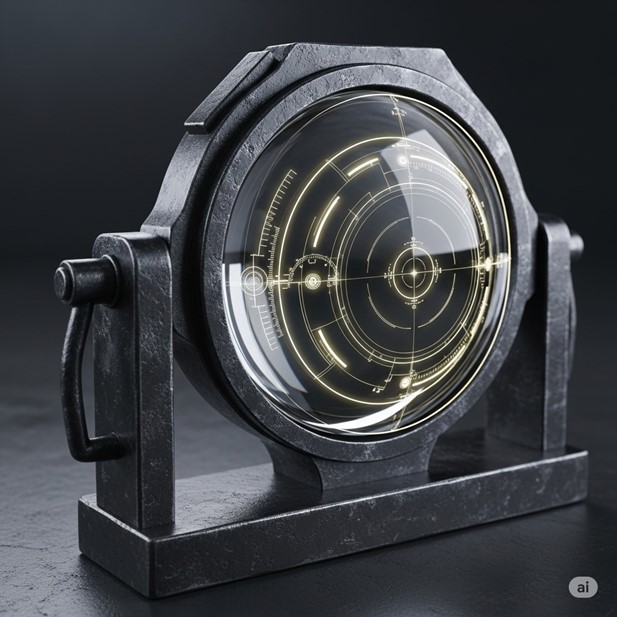
Description: The Inquisitor’s Lens is a single, thick, perfectly ground crystal lens, about the size of a person’s palm. It is housed in a heavy, dark iron frame with a simple, practical handle. The iron is unadorned, cold, and has a slightly pitted texture, designed for grip rather than beauty. When inactive, the item functions as a high-quality magnifying glass. When an avatar channels their energy into it, a series of faint, glowing geometric lines and circles appear within the crystal, like a complex targeting reticle, focusing the user’s magical and deductive senses.
Detailed Stats
- Tier: 1
- Rarity: Common
- Attunement Requirement: The user must spend an hour studying a complex puzzle or cipher through the lens, attuning it to their own analytical patterns of thought.
- Magic Capacity: The Lens does not store energy. It requires the user to channel their own Reiki energy through it to activate its abilities.
- Durability: Moderate. The iron frame is sturdy, but the crystal lens can be shattered by a sharp blow.
Passive Magic
- Detail Focus: When looking through the lens without activating its magic, it functions as a superior magnifying glass. It brings tiny details like clothing fibers, dried specks of fluid, or minute scratches on a surface into sharp, preternatural focus.
- Residual Ki Sense: The lens allows the wearer to perceive the faint, fading traces of life energy (Ki) left on objects by recent touch. This appears as a very faint, shimmering heat-haze that dissipates completely within a minute of being handled.
- Emotional Detachment: The lens has a subtle calming effect on the user, helping them to compartmentalize and distance themselves from the emotional impact of a gruesome scene, allowing for clearer, more logical thought in the face of horror.
Activable Magic
- Echo of the Final Blow: This is the primary function of the Lens, used for forensic deduction. The user must place the lens on or near a wound on a deceased creature. They then channel a small amount of their own Reiki energy through the lens into the wound. This acts as the “strike” that triggers the reflection.
- Reflective Damage (Illusion): The Lens absorbs the user’s energy and the residual energetic signature of the wound, then projects a harmless, holographic illusion of the attack that caused it. The type of damage is revealed by the illusion’s form—a spectral sword slash, a burst of illusory fire, a phantom lightning strike.
- Damage Radius (Measurement): The power of the original attack is revealed by the size of the illusion. The radius of the holographic projection in feet is equal to the amount of damage dealt by the original blow. A 10-damage dagger wound creates a 10-foot radius display of a spectral dagger stabbing the air, while a 40-damage greataxe blow creates a massive 40-foot projection of a spectral axe swing, allowing the user to deduce the scale of the attack.
- Resonance Scan: A secondary, cautionary function. The user can look at a person or object through the lens and channel a tiny amount of energy. The geometric reticle inside the lens will glow with a bright, angry red if it detects the presence of an active Reflecting Magic enchantment. This allows an investigator to identify the “Resonance Risk” from a safe distance before combat, or to know if using the “Echo of the Final Blow” function on a victim is catastrophically dangerous.
The Inquisitor’s Lens is a specialized instrument, a tool of the trade for those who unravel mysteries for a living. As such, it is not typically found in a general magic shop or a common bazaar. Its sale and acquisition are handled through more focused and often restricted channels.
The Constabulary Quartermaster
This is not a shop, but an official supply depot located within the fortified barracks of a major city’s watch or constabulary. The environment is one of strict order and bureaucracy, smelling of polished leather, whetstones, and paperwork. The quartermaster is a civic employee, a logistics officer responsible for issuing and tracking all official equipment. Shelves are neatly lined with standard-issue gear: uniforms, signal horns, masterwork manacles, and a locked case containing specialized investigative tools, including the Inquisitor’s Lens.
Here, the Lens is not bought with currency. It is requisitioned. A licensed constable, detective, or an officially sanctioned inquisitor must submit a formal request, often in triplicate, detailing the reason for needing the item. Upon approval from a superior officer, the avatar is issued a Lens, and its unique serial number is logged against their name. It is an instrument of the state, and its misuse carries severe legal penalties.
Cost: There is no monetary cost. The price is accountability. The user is legally responsible for the tool and how it is used, and they are expected to submit detailed reports on any findings discovered through its use.
The Licensed Private Investigator’s Agency
In the more respectable districts of a metropolis, one might find a discreet office with a sign that reads something like, “The Valdrian Eye: Investigative Solutions & Forensic Sundries.” This establishment caters exclusively to licensed private investigators, inquiry agents, and security consultants. The interior is professional and confidential, resembling a law office more than a shop. The proprietor is often a retired but sharp-witted city detective who saw a market for supplying their former colleagues and rivals.
The Inquisitor’s Lens would be a high-end tool, kept in a locked display case alongside truth-seeking charms, kits for collecting arcane evidence, and cipher-breaking aids. To purchase one, a client must present a valid investigator’s license or be a known and trusted professional in the field. The proprietor would discuss the item’s capabilities, its legal standing in the city, and perhaps share an anecdote about a case that was solved using one.
Cost: A professional market price of around 70 Gild. The price is largely non-negotiable, as it is a tool for professionals. However, the proprietor might be open to a trade for something of equal professional value, such as detailed information on an unsolved crime, a new method for detecting a rare poison, or the location of a wanted fugitive.
The University Department of Arcane Forensics
Within the hallowed halls of a great university or a college of magics, there may be a department dedicated to the study of criminology and its intersection with the arcane. The “shop” here is a supply office for students and faculty, run by a quartermaster or a tenured professor. The air smells of old books, chemical reagents, and the faint hum of ongoing experiments.
The Lens is considered a piece of essential academic equipment for students pursuing a career in magical law or investigation. It might be loaned out from the department’s library of tools for a specific project, or sold at a subsidized price to registered students and accredited researchers. The transaction would involve less coin and more academic currency. The seller would be keenly interested in a full report on how the Lens was used, especially if it was applied to a novel or unique case, as this would further the department’s own research.
Cost: A subsidized academic price of 30-40 Gild. Alternatively, the “cost” might be a contractual obligation to share all findings with the university, effectively making the user a field researcher for the department.
The Black Market Specialist
For every official tool, there is a dark reflection in the black market. In a secret, shifting location—a secluded sewer junction, the back room of a rowdy tavern, a private cabin on a docked ship—one can find specialists who deal in acquiring official equipment. This seller is a criminal who profits by supplying tools to other criminals, perhaps for investigating a rival’s treachery or for understanding how their own associates were killed. The seller may have acquired the Lens from a corrupt constable or by robbing a licensed investigator.
The transaction is tense and anonymous. The Lens would be presented briefly before being concealed again. There is no guarantee of its quality, and it may even have an official serial number that would incriminate the buyer if discovered.
Cost: A highly inflated price of 100 Gild or more. The cost reflects the immense risk the seller undertook to acquire the item. Payment is demanded in untraceable currency, raw gemstones, or bars of precious metal. There is no haggling, and asking too many questions could be a fatal mistake.
The Inquisitor’s Lens is a tool for analysis and deduction, not for combat. Its use in a confrontational role is exceptionally rare and relies entirely on the user’s creativity, environment, and ability to use information as a weapon or a shield. It is an instrument of intellectual leverage, not physical force.
In a Tense Standoff in a Morgue or Laboratory
This environment is defined by its sterile, controlled nature and the presence of evidence—including the bodies of the deceased. Conflict here is often about revealing a truth or concealing one.
Offensive Roleplay (Psychological Attack): An investigator has cornered a murder suspect in the very laboratory where the victim’s body lies upon a slab. The suspect, a powerful avatar, is armed and defiant, sneering at the investigator’s “lack of proof.” The investigator says nothing. They calmly walk to the victim’s body, place the Inquisitor’s Lens over the fatal wound, and channel their energy. The Echo of the Final Blow erupts. A massive, silent, spectral illusion of the suspect’s unique, signature weapon—a flaming greataxe, for instance—materializes in the air and swings down, perfectly recreating the killing blow. The radius of the spectral fire fills half the room, showing the immense force of the attack. The offense is not physical; it is a direct, undeniable accusation made of pure magic. It is designed to shatter the suspect’s composure, bypass their verbal defenses, and force them into a confession or a rash, incriminating action.
Defensive Roleplay (Misdirection): The investigator is ambushed while working late in their laboratory. An assassin drops from the rafters, knife drawn. Outnumbered and with no weapon at hand, the investigator’s eyes dart to a nearby slab holding the corpse of a massive, beast-like creature they had been studying. As the assassin lunges, the investigator grabs the corpse’s arm, slaps the Lens onto a huge claw wound, and activates it. A terrifying, room-sized illusion of a monstrous spectral claw tears through the space between the investigator and the assassin. The assassin, having no idea what is happening, instinctively dodges or parries the spectral attack. This moment of confused hesitation is the defense, giving the investigator the crucial second needed to upend a heavy table for cover or to flee the room.
In a Confrontation Within an Ancient Tomb
This environment is often quiet, filled with magical traps, ancient guardians, and the remains of those who failed to overcome them. Puzzles and esoteric threats are common.
Offensive Roleplay (Puzzle-Solving): An avatar and their party are blocked by a shimmering magical barrier that hums with ancient energy. It is immune to their attacks. Near the barrier lies the desiccated corpse of a long-dead guardian, slain by one of the tomb’s own magical defenses. The avatar, a keen-eyed detective, deduces that the barrier might be deactivated by an overload of the same energy that killed the guardian. They place the Lens on the guardian’s fatal wound and trigger the Echo of the Final Blow. A silent, spectral recreation of a potent, ancient energy bolt erupts from the corpse. The avatar carefully angles the Lens so the harmless illusion washes over the barrier. The barrier’s ancient sensors, unable to distinguish the harmless echo from a real attack, register a massive power surge of the correct energy type and short-circuit, deactivating as a safety precaution. The offense was using a historical echo to trick a magical lock.
Defensive Roleplay (Deterrence through Mutually Assured Destruction): The party is confronted by a powerful, sentient guardian, such as a lich or a spectral warrior, who is immune to their weapons. The guardian threatens to destroy them for their intrusion. The investigator, however, notices the colossal skeleton of a dragon in the center of the chamber, slain ages ago. They calmly take out the Inquisitor’s Lens and activate its Resonance Scan while looking at the dragon’s skeleton. The Lens begins to glow with an intense, angry red light. The investigator holds up the glowing Lens for the guardian to see. The unspoken threat is clear: the dragon was slain while wearing a powerful Reflecting Magic item. If the guardian attacks, the investigator will use the Lens on the dragon’s bones, triggering the Resonance Risk and bringing the entire tomb down on all of them. The defense is a cold-blooded bluff, leveraging the catastrophic potential of the Lens’s core magic to create a tense standoff.
In a Public Debate or Social Conflict
In this environment, reputation, information, and public perception are the weapons. Humiliation can be more damaging than a physical blow.
Offensive Roleplay (Informational Warfare): During a heated public debate, a rival politician, known for his unblemished record and “invulnerable” reputation, scoffs at the avatar’s claims. The avatar knows this politician was recently involved in a secret, bloody duel. The politician is wearing a fine breastplate that has a small, barely-noticeable dent from that duel. The avatar approaches, perhaps under the guise of making a point, and “accidentally” touches the dented spot on the breastplate while holding the Lens. They activate Echo of the Final Blow. A spectral illusion of a poisoned stiletto flashes in the air, recreating the dishonorable attack the politician used in his secret duel. The public display doesn’t hurt anyone, but it reveals the politician’s secret, violent, and dishonorable act to the entire crowd, shattering his reputation. The offense was using the Lens to reflect not a physical blow, but a hidden truth.
Defensive Roleplay (Counter-Espionage): The avatar, an inquisitor, is meeting with an ambassador from a rival nation. They suspect the ambassador is a spy who is using a magical item to scry for information. The ambassador, for their own protection, is known to wear a powerful, real Reflecting Magic shield. During the meeting, the inquisitor activates the Resonance Scan of their Lens. The geometric patterns within it glow red. The inquisitor doesn’t make a grand show of it, but simply places the glowing lens on the table between them, its red light pulsing gently. The ambassador, if they are knowledgeable, will recognize the sign. The inquisitor has just silently communicated: “I know about your shield, I know its specific nature, and I have a tool that interacts with it. Your greatest defense is a liability against me.” This subtle act of counter-intelligence defends the inquisitor from being magically spied upon by revealing their own capability, forcing the ambassador to reconsider their espionage.
Perception of Activation:
Sight
- User’s Perspective: Looking through the lens, the world surrounding the object of focus—a wound, a clue—blurs into an indistinct grey. The focal point itself becomes preternaturally sharp and clear. As the user channels their energy, the faint geometric patterns inside the lens illuminate with a soft, golden light, the lines and circles moving and locking onto their target. When viewing an “echo,” a miniature, silent, holographic replay of the event appears within the confines of the lens itself.
- Observer’s Perspective: An observer sees the user hold the lens, which begins to emit a soft, golden glow that illuminates their face from below. The intricate, geometric reticle inside the crystal becomes clearly visible. When the Echo of the Final Blow is triggered, a large, silent, and translucent holographic image erupts from the front of the lens, replaying a single, ghostly action—a sword swing, a burst of fire, a claw swipe—in the open air before fading away.
- Positives: The visual display is clear, analytical, and provides unambiguous information. To an observer, the projected echo is an impressive and authoritative display of deductive magic.
- Negatives: The holographic projection, while harmless, can be gruesome or shocking, especially to those who knew the victim. The light from the activated lens can easily give away the user’s position in a dark crime scene.
Sound
- User’s Perspective: The user hears a series of soft, precise clicks and a low, steady hum, seemingly emanating from the lens itself as the reticle aligns. When the echo is activated, they hear a faint, spectral replay of the sound associated with the attack, but it sounds distant and hollow, like a memory of a sound rather than the sound itself.
- Observer’s Perspective: An observer hears only the spectral sound that accompanies the holographic projection. A ghostly sword swing has a phantom whoosh; a spectral fire has a phantom crackle. The sound is unnerving because it is clearly not real, and it often occurs in an otherwise silent room, making it stand out.
- Positives: The sound provides another layer of vital forensic data, helping to identify the nature of the weapon or attack used. It is generally quiet enough to not alert individuals in adjacent rooms.
- Negatives: The spectral sounds, especially if they include a replayed scream or cry, can be deeply unsettling to the user and any onlookers.
Touch
- User’s Perspective: The iron handle of the lens becomes noticeably cold, and a steady, low-frequency vibration thrums through their hand. As they channel their own Reiki energy, they feel a gentle, consistent “pull” from the lens, a sensation of their energy being drawn and focused in a controlled, analytical way.
- Observer’s Perspective: There is no direct perception for a nearby observer. They will only see the user holding the lens with a steady, focused grip.
- Positives: The cold and vibration provide clear tactile feedback that the device is active and functioning correctly. For a trained user, the feeling of the energy draw can be centering.
- Negatives: The intense cold can become uncomfortable during prolonged investigations. An untrained user might be unnerved by the sensation of the lens actively drawing their life energy.
Smell
- User’s Perspective: A faint, sterile, and clean scent rises from the lens during activation, like cold ozone or the air in a sealed, clean room.
- Observer’s Perspective: If the original attack involved a strong odor (such as a specific poison, or the sulfur of a hellish creature), a faint, ghostly replica of that smell is generated along with the holographic projection, which can be detected by anyone nearby.
- Positives: The sterile scent helps the user focus and reinforces the clinical nature of their work. The echoed scent can be a crucial clue for identifying a substance or creature.
- Negatives: The echoed scent of something foul, like a potent toxin or rotting flesh, can be nauseating to everyone present.
Taste
- User’s ‘s Perspective: The user experiences a faint, metallic and slightly bitter taste on their tongue, like that of unsweetened tonic water or quinine.
- Observer’s Perspective: An observer has no perception of this sense.
- Positives: It serves as another minor sensory confirmation for the user that the device’s magic is active.
- Negatives: The bitter taste is mildly unpleasant and can be a minor distraction from the details being observed.
Extra-Sensory Perception: Empathic Echo
- User’s Perspective: The user does not feel a living, present emotion. Instead, thanks to the lens’s built-in detachment filter, they perceive a cold “fossil” of the emotion the victim experienced at the moment of the attack—a flash of pure terror, righteous anger, or resigned surprise. It is a detached, analytical echo, like reading a description of an emotion rather than feeling it.
- Observer’s Perspective: An empathic observer perceives a strange and unnerving “replay.” For a moment, a sharp spike of a past emotion (terror, pain, etc.) erupts from the corpse, hangs in the air with chilling clarity, and then vanishes utterly. It feels historical and ghostly, not immediate.
- Positives: This emotional echo provides invaluable context about the circumstances of the attack. Was the victim ambushed? Did they know their attacker?
- Negatives: Even as a cold, detached echo, repeatedly experiencing the final, violent emotions of the deceased is mentally taxing and can lead to psychological wear over time.
Extra-Sensory Perception: Aura Playback
- User’s Perspective: Looking through the lens, the user sees the victim’s damaged and frayed aura in stark detail. When activated, the lens projects a spectral overlay directly onto their view, showing the “ghost” of the attacker’s weapon or energy as it pierces the victim’s aura, revealing its shape, size, and nature.
- Observer’s Perspective: An observer with Aura Sight witnesses the lens draw the residual energy from the wound on the corpse’s aura. It then weaves this energy into a three-dimensional, moving “auric scar” in the air, replaying the exact moment of impact—a spectral sword of energy piercing the aura, a phantom claw of magic tearing it, or a burst of force shattering it.
- Positives: This provides an undeniable visual record of the magical or vital interaction, potentially revealing the specific school of magic or type of creature responsible for the attack.
- Negatives: Watching a soul’s traumatic final moments replayed in such raw, energetic detail is a grim and potentially disturbing experience, even for a hardened investigator.
Extra-Sensory Perception: Signature Analysis
- User’s Perspective: The user feels the lens “listening” to the magical residue in the wound. The vibration in their hand changes in frequency and intensity, matching the “frequency” of the magic used in the attack. This gives the user a deep, intuitive understanding of its signature—not just “fire magic,” but “the chaotic fire magic of an untrained pyromancer” or “the rigid, controlled fire magic of a military battlemage.”
- Observer’s Perspective: A magically-aware individual perceives the lens generating a “negative space” of magic around the wound. It seems to absorb the residual magical signature from the corpse and then projects a “positive” copy of it into the air as part of the hologram. The signature is stable, clear, and can be “read” or analyzed by other magic users present.
- Positives: This allows for an incredibly detailed magical-forensic analysis, capable of identifying not just a school of magic, but potentially the unique casting “fingerprint” of an individual avatar.
- Negatives: Projecting a perfect, stable copy of a magical signature into the air is like shouting the culprit’s arcane name. This could alert the original caster if they have magical wards designed to detect when their signature is being analyzed or replicated.
Inquisitor’s Draft: The Lens of Echoes
This document describes the precise and painstaking method for crafting a forensic tool akin to the Inquisitor’s Lens. The creation process is one of intense focus, blending master craftsmanship with a nuanced and empathetic application of Reiki energy.
Materials Needed
- Flawless Crystal Blank: A single, fist-sized, optically pure crystal blank. It must be completely free of inclusions or fractures, as any flaw will distort the final magical image.
- Dark Iron Ingot: One small ingot of unrefined iron, valued for its density and non-reflective properties.
- Vial of Empathetic Tears: A small vial containing tears shed by the crafter while in a deep state of empathetic meditation, focused on the sorrow and truth of a past event. This emotional component is key to perceiving residual feelings.
- A Pinch of Truth-Seeker’s Dust: Finely powdered pearl or lapis lazuli, consecrated in a place of truth and justice, used as a catalyst for the revealing enchantments.
- Spool of Fine Silver Thread: A small amount of pure silver thread, to be used in the creation of the internal reticle.
Tools Required
- Lens Grinder’s Bench: A specialized workstation equipped with a series of grinding wheels of progressing fineness, designed for shaping optical-grade crystal.
- Small Forge and Frame Mold: A simple forge for heating the iron and a cast for shaping the lens’s frame and handle.
- Jeweler’s Tool Kit: A set of fine pliers, files, and clamps for crafting the frame and setting the finished lens.
- Arcane Scribing Needle: A magical instrument capable of etching glowing, energy-infused patterns onto the surface of a crystal without causing physical damage.
- Meditation Mat and Incense: Items to aid the crafter in achieving the deep, focused meditative state required for the imbuement process.
Skill Requirements
- Master Gemcutting or Lens Grinding: An expert level of skill is required to shape the raw crystal into a perfect, flawless lens. This is the most technically demanding part of the process.
- Functional Metalworking: The ability to cast and shape iron into a simple, durable frame.
- Empathetic Reiki Channeling: The crafter must be able to channel their Reiki energy while in a specific emotional state (empathy or sorrow), imbuing the item with the ability to perceive emotional and energetic residues.
- Enchanting (Divination/Scrying): A proficiency in the school of magic related to seeing what is hidden, analyzing residues, and revealing truths.
Crafting Steps
- Grinding the Lens: This is the longest and most critical step. The crafter must use the lens grinder’s bench, starting with the coarsest wheel and progressing to the finest, to meticulously shape the crystal blank into a thick, perfectly convex lens. The process can take days of careful work, as a single mistake or rushed action can create a flaw that would render the magic useless.
- Forging the Frame: While taking breaks from the grinding, the crafter can work the dark iron. The ingot is heated in the forge and poured into the frame mold. Once set, it is removed and hammered into its final, practical shape, ensuring the setting for the lens is perfectly sized. The handle is then forged and attached.
- The Empathetic Imbuement: Once the lens is perfectly ground and polished, the crafter must prepare for the primary enchantment. Seated on the meditation mat, they must enter a deep trance, focusing on a past tragedy or injustice until a state of true, profound empathy is achieved. The tears shed in this state are collected and carefully applied in a thin layer across the surface of the lens. The crafter then channels their Reiki energy through their hands, suffusing the tear-coated lens with the ability to perceive the echoes of past events.
- Scribing the Reticle: With the imbuement complete, the crafter takes the Arcane Scribing Needle. Using the Truth-Seeker’s Dust as a form of magical ink, they carefully and precisely etch the glowing, geometric patterns of the focusing reticle onto the internal structure of the crystal. This focuses the lens’s broad empathetic sense into a tool of precise analysis.
- Final Assembly: The enchanted and scribed lens is now carefully set into the dark iron frame. The fit must be perfect. Any gaps are sealed. The final item is then cleaned and polished. It will now function as a Lens of Echoes, a powerful tool ready to reveal the hidden truths of the past to a skilled user.
Chronicle of Eyeless Judge
Let it be known that in the time before time, when the world was a new thought, the laws of existence were soft. In this age, a great crime was committed. A being whose name cannot be spoken, for it was made of perfect deceit, performed an act of flawless violence. It did not slay a person, for there were few people to slay. It slew a concept. Some tablets say it was Hope that was killed. Others say it was Trust. The crime was so perfect that it left no wound upon the world, and no memory of the deed. There was only a great and hollow emptiness where something good had once been, and no one knew what was missing.
In this age lived a being whose purpose was to ensure the balance of all things. He was the First Inquisitor, the one whose function was Truth itself. He felt the hollow space in the world, like a missing note in a perfect song. His puzzlement was a great knot, for how does one investigate a crime with no victim, no witness, and no memory? The path of his inquiry began nowhere and ended in the same place.
The First Inquisitor, his way blocked by a perfect lie, journeyed to the Loom of Moments, where the threads of what was, what is, and what will be are woven together by a timeless power known as the Weaver. The Inquisitor stood before the Weaver and said, “A great injustice has been done, but it hides behind the wall of yesterday. I ask for a tool to see a moment that is gone.”
The Weaver, whose eyes see all threads at once, spoke in a voice like fraying silk. “To see what has passed is to break the first law of the loom. A paradox must be paid for with a paradox. To gain a new way of seeing the past, you must give up a part of what you use to see the present. The price is an eye.”
The First Inquisitor, for whom truth was more dear than any part of his own form, did not hesitate. He reached up and took from his own head his left eye, and he offered it, still warm, to the Weaver.
The Weaver accepted the price. It reached out into the cosmos and caught a single, falling tear from a star that was grieving for the very Hope that had been slain. The tear was the sorrow of the universe made manifest. The Weaver let this tear cool and harden in its hand, and it became a flawless crystal, a lens that held starlight and sadness within it. The Weaver then set this crystal into the empty socket of the Inquisitor’s face. And the crystal became his new eye.
The First Inquisitor returned to the world, to the place of the hollow emptiness. He was now the Eyeless Judge, for one of his eyes was of flesh and the other was of crystal truth. He looked upon the emptiness, a space that held no clues, and he channeled his will through his new crystal eye.
The Lens activated. And it saw what could not be seen. It did not see the present, but the deep echo of the past. A great and spectral hologram bloomed in the air. It was a perfect, undeniable record of the crime, showing the being of perfect deceit as it struck down Hope. The lie was broken, for the truth had now been witnessed.
With the truth revealed, the Flawless Lie lost its power of perfection and could be unraveled. The hollow space in the world began to fill once more. The Eyeless Judge, with his one eye of flesh and one eye of crystal, became the ultimate arbiter, the one who could see the indelible scars that all actions, no matter how secret, leave upon the world. The handheld lenses used by mortal inquisitors today are but pale reflections, attempts by artisans to recreate the power of that first, terrible, and necessary sacrifice.
Moral of the Story: No crime is perfect, for the past itself is the greatest witness.
Suggested conversions to other systems:
Dungeons & Dragons 5th Edition
Lens of Final Sight Wondrous item, common
This item is a single, thick crystal lens housed in a heavy, dark iron frame with a handle. While looking through it, you can see fine details with unusual clarity.
Investigative Aid. While looking through the lens, you have advantage on any Intelligence (Investigation) check made to search a crime scene for clues such as hidden compartments, stains, or footprints.
Echo of the Wound. You can use this lens on the corpse of a creature that has died within the last 24 hours from a physical wound. You must spend at least 1 minute concentrating on a single wound. At the end of this time, the lens projects a harmless, silent, spectral illusion in the air above the corpse. The illusion replays the physical action that caused the wound (a sword swing, a monster’s bite, an arrow’s flight). The illusion may reveal the type of weapon or the shape of the creature that made the attack, but not the identity of the attacker. Once you use this property, you cannot use it again until you finish a long rest.
Call of Cthulhu 7th Edition
The Coroner’s Glass Investigative Tool
A heavy, old-fashioned magnifying glass with a flawless crystal lens and a pitted iron frame. It feels cold to the touch and seems to sharpen the details of any gruesome scene viewed through it, focusing the mind on the clinical facts rather than the horror.
Forensic Insight. When examining a crime scene or a body, the user may look through the glass to gain one bonus die on a Spot Hidden or Medicine roll.
Echo of Violence. The Investigator can use the glass on a victim who has died violently. The user must spend 1 Magic Point and make a Hard POW roll while holding the lens over a fatal wound. If successful, they experience a brief, visceral vision of the victim’s final moments from the victim’s own perspective. This provides a crucial clue about the attacker or the method of death (as determined by the Keeper). However, witnessing this traumatic event forces an immediate Sanity roll (1/1d4) on the Investigator. A failed POW roll results in a confusing, nightmarish flash of images, no useful information, and still requires the Sanity roll.
Blades in the Dark
The Whisper-Lens Occult Device, Investigative Tool
A heavy, iron-framed lens with a crystal that seems to ripple and distort the light of the ghost field. When you look through it at a place of death, the residue of the soul’s departure becomes briefly visible as a spectral echo.
Attune to the Echo. You can use this lens to Attune to a corpse or a location where a violent death has recently occurred. Instead of sensing a ghost’s presence, you experience a “vision echo”—a flash of the final, violent moment. You can ask the GM one of the following questions about the death:
- What was the immediate physical cause of death? (e.g., “a whisper’s blade,” “a Skovlander axe,” “a fall from a great height”)
- What was the strongest emotion the victim felt right before they died?
- Was there any noticeable occult energy involved in the death?
Using the lens this way is psychically taxing. You must suffer 1 Stress for each question you ask.
Knave 2nd Edition
The Lens of Scars Inventory Slots: 1
A heavy, iron-framed magnifying lens with a perfectly ground crystal. It feels cold to the touch and smells faintly of sterile, cold air. The lens has 3 uses.
Mortal Gaze. While looking through the lens, you can automatically identify the mundane cause of death for any corpse you are examining, provided the death was from physical trauma or a common poison.
Echo of the Blow. You can expend one use to hold the lens over a specific wound on a corpse. The lens will project a silent, ghostly afterimage of the mundane weapon that made the wound (a sword, an axe, a claw, a fang), which hovers over the body for one minute. This allows you to identify the specific type of weapon or creature responsible.
Recharge. To recharge the lens, it must be left overnight in a place of violent death that has not yet been consecrated (such as a recent battlefield or an undiscovered murder scene). Each night spent in such a location recharges one use.
Fate Core System
The Lens of Inevitable Truth An Extra represented by a heavy, iron-framed crystal lens that feels cold to the touch and seems to sharpen the edges of the world when viewed through it.
This lens is a tool that reveals the echoes of the past, allowing an investigator to uncover truths that time and malice have tried to conceal. It grants access to a new situational Aspect and the following Stunts.
Character Aspect: The Past Leaves a Stain. This Aspect can be invoked when using the lens to discover a clue that would otherwise be impossible to find. A GM can compel this Aspect by having the lens reveal a terrible, inconvenient truth about an ally, a patron, or the user themself.
Stunts
- Echo of Violence: Once per session, you can use the lens on a corpse to Create an Advantage by replaying the moment of their death. You can ask the GM, “What was the immediate cause of death?” or “What was the victim’s final, overwhelming emotion?” Based on the answer, you create a relevant situational Aspect (e.g., Stabbed with a Jagged Blade, Overwhelming Terror) with two free invocations for yourself or your allies.
- Residue Analysis: When you use the Investigate skill to carefully examine a small object or area through the lens, you gain a +2 bonus to your roll, as you are able to perceive minute details and faint energetic traces.
Numenera & Cypher System
The Forensic Chrono-Viewer This artifact is a handheld lens made of a synth-crystal that seems to absorb and analyze light. It is set in a heavy, dark iron frame. Faint, glowing geometric patterns inside the lens shift and realign when it is held by a living creature.
Level: 5 Form: A handheld lens Effect:
- Passive: When looking through the lens, any task involving searching for minute physical clues (such as tiny scratches, chemical stains, or biological residue) is eased by one step.
- Action: The user can place the lens on a creature that has been dead for no more than 28 hours. The user must succeed on an Intellect-based task with a difficulty equal to the artifact’s level (a difficulty 5 task). On a success, the lens projects a harmless, silent, three-dimensional holographic image that replays the five seconds leading up to the creature’s death. The replay shows the action and the type of weapon or creature that delivered the final blow. The attacker appears only as a featureless, humanoid silhouette. Depletion: 1 in 1d20 (On a roll of 1, the internal chronometer fractures and the device becomes a simple, non-functional magnifying glass).
Pathfinder 2nd Edition
The Inquisitor’s Glass Item 3 [Uncommon] [Divination] [Magical] Price 70 gp Usage held in 1 hand; Bulk L
This single, thick crystal lens is set in a heavy iron frame with a simple handle. Looking through it brings small, intricate details into sharp focus.
Passive: While looking through the glass, you gain a +1 item bonus to Perception checks to Seek for clues.
Activate [one-minute] (concentrate, divination, manipulate); Frequency once per hour; Requirements You place the lens upon a corpse that has been dead for no more than 1 hour; Effect You analyze the residual spiritual energy of the final wound. You learn a single, one-word clue about the creature or weapon that killed the victim. The clue is related to the most notable feature of the cause of death (e.g., “Clawed,” “Steel,” “Fire,” “Poison,” “Tall,” “Undead”). The GM determines the most appropriate clue for the situation. This represents the lens piecing together all available forensic evidence into a single, actionable deduction.
Savage Worlds Adventure Edition
The Detective’s Eyeglass A heavy, old-fashioned magnifying glass that seems to make the world clearer and more logical when you look through it. It feels cold and strangely calming to hold.
This enchanted tool aids an investigator by revealing the echoes of past events left behind on the dead.
Requirements: Seasoned, Smarts d8+ Effects:
- Keen Eye (Passive): The wearer gains a +2 bonus to all Notice rolls made to search a stationary area, such as a crime scene, a corpse, or a single small object.
- Reconstruct the Scene (Power-like ability): As an action, the wearer may touch a corpse and make a Smarts roll.
- Success: The user gets a brief, spectral vision of the moment of death. The GM provides one significant clue about the death (e.g., “The weapon was a heavy, bladed axe,” “The killer was much taller than the victim,” “A strange magical energy was present.”).
- Raise: The user gets a more detailed vision. The GM provides two significant clues, and may even show a spectral replay of the final blow, revealing the type of weapon and the direction from which the attack came.
- Psychic Strain: Using the Reconstruct the Scene ability is mentally taxing. Each use causes the Investigator to become Distracted as the grim vision lingers in their mind.
Shadowrun, Sixth World
The “Clarion” Forensic Scanner A piece of high-end investigative hardware from Renraku’s ‘Clarion’ series. The device is a handheld scanner with a large, articulated crystal lens connected to a sophisticated suite of micro-sensors and a dedicated processor with a firewalled connection to the Matrix.
Availability: 12R Cost: 15,000 nuyen Device Rating: 4
Wireless Bonus. When wirelessly connected to the user’s commlink or cyber-eyes, the scanner feeds data directly to their DNI, providing augmented reality overlays of its findings. The user gains +2 dice on Perception tests made to visually scan a crime scene.
Residue Analysis. The scanner can analyze materials at a near-microscopic level. As a Major Action, the user can make an Engineering + Logic (4) test to identify trace elements, chemical compositions, or magical residues on a surface they are scanning.
Psychometric Echo. The device can be used on a corpse that has died within the last 12 hours. The user makes an Electronics + Intuition [Astral] (5) test. This requires 1 minute of uninterrupted scanning. On a success, the scanner’s processor reconstructs the final moments from the victim’s bio-signature and astral residue, playing a silent, ghostly holographic replay of the killing blow. This reveals the type of weapon or attack but not the attacker’s identity. Using this function creates significant Matrix noise, increasing the user’s OverWatch Score by 1.
Starfinder
The Inquisitor’s Truth-Lens Level 4 Price 2,200 credits Hands 1; Bulk L Type Hybrid Item; Category Held Item
A heavy, iron-framed lens with a glowing, crystalline interior that swirls with faint geometric patterns. It is a tool that combines technological sensors with divination magic to perceive truths that are otherwise hidden.
Passive. You gain a +2 insight bonus on Perception checks made to search an area for clues and on Sense Motive checks made to discern if a creature is lying.
Final Moment. Once per day, you can use the lens to peer into the recent past of a deceased creature. You must spend 10 minutes concentrating on a creature that has been dead for no longer than 12 hours. At the end of this time, the lens provides you with a clear, vivid mental image of the last thing the creature saw before it died. This vision is from the creature’s own perspective and lasts for roughly three seconds. This ability does not function on creatures that do not have eyes or were killed in a way that destroyed their head.
Traveller (Mongoose 2nd Edition)
The ‘Echo-Lens’ Forensic Imager (TL-12) Cost: Cr 90,000 Mass: 1 kg
A sophisticated handheld device combining a high-resolution material scanner with a psionically-attuned crystal matrix. It is designed to read and reconstruct residual bio-energetic data from crime scenes, and is typically only available to high-level law enforcement or intelligence agencies.
Micro-Scanner. The lens functions as a high-end laboratory scanner, providing DM+2 to any Investigate or Science (any) checks made to analyze physical evidence at a scene.
Energetic Echo. The device can be used on a body that has been deceased for less than 48 hours. The user must make a Difficult (10+) Electronics (sensors) check, which takes one minute. If successful, the device’s projector renders a 3D holographic image of the victim at the moment of death. The hologram highlights the trajectory and nature of the fatal wound (e.g., showing the path of a laser beam, the impact point of a gauss rifle slug, the cellular damage from a specific poison). It does not show the attacker, only the effect on the victim. The device’s battery can support 3 such reconstructions before needing to be recharged.
Warhammer Fantasy Roleplay, 4th Edition
The Veridian Glass of Morr Encumbrance: 10 Price: 30 GC Availability: Rare, Restricted
A heavy magnifying glass made of dark, unadorned iron, with a lens of polished, smoke-grey quartz. The symbol of the Garden of Morr, a gate wreathed in roses, is etched onto the handle. It is a sacred tool, typically only entrusted to the high priests of Morr or sanctioned Witch Hunters who investigate unnatural deaths.
Eye for Detail. The user gains a +10 bonus to all Perception Tests made to find physical clues when examining a corpse or a gravesite.
Glimpse the Final Passage. The user may hold the glass over a dead body and spend one full round in quiet contemplation or prayer to Morr. At the end of the round, they must make a Challenging (+0) Cool Test. If successful, Morr grants them a single, silent, fleeting image of the moment of death. This vision is often symbolic rather than literal (e.g., seeing a wolf’s head for an Ulrican fanatic, a stylized green skull for a follower of Nurgle, or a specific heraldic device for a noble assassin). The GM provides the symbolic image.
The Grave’s Toll. Using this power is a solemn and draining rite. Each time the Glimpse the Final Passage ability is successfully used, the character gains one Fatigued Condition as they mentally share in the final, grim moments of the deceased.
Comments
One response to “Reflecting 1 of the Inquisitors Lens”
[…] Reflecting 1 of the Inquisitor’s Lens (Tier 1 […]