
Original Life Forms
- Class Mammalia: Honey Badger (Mellivora capensis)
- Class Aves: Shoebill (Balaeniceps rex)
- Class Insecta: Bombardier Beetle (Brachinini tribe)
- Class Cephalopoda: Cuttlefish (Sepia genus)
Appearance: The Mellicepia Brachiniceps is a shockingly robust and unsettling creature. It possesses the low-slung, powerfully built body of a badger, covered in a thick, loose, and incredibly tough hide that seems to ripple and shift with faint, hypnotic patterns of color. Its skin can change in an instant from a mottled brown-and-grey that perfectly matches a muddy riverbank to a startling display of vibrant, threatening stripes when agitated. It moves on four short, thick legs, each ending in long, powerful black claws designed for digging through dense earth and clay. The creature’s head is its most terrifying feature: a massive, disproportionately large head and beak shaped like that of a shoebill stork. The beak is a formidable weapon of bone and keratin, ending in a sharp, curved point. Its eyes are large, pale yellow, and possess an unnerving, forward-facing stare that seems both intelligent and utterly devoid of compassion. At the rear of its abdomen, a small, hardened, nozzle-like gland is visible, the source of its chemical defense.
Size: The creature stands about three feet high at the shoulder and measures four to five feet from its beak to the tip of its short, badger-like tail. Its dense musculature and heavy bone structure give it a significant weight, often exceeding 200 pounds.
Speed: The Mellicepia Brachiniceps is not a creature of sustained speed. It typically moves with a slow, deliberate, and patient waddle, conserving energy as it stalks its prey. However, when it strikes or charges, it can launch itself forward with a deceptive and explosive burst of speed over short distances. Its Cuttlefish-like ability to expel a jet of fluid can also grant it a surprising burst of movement in water.
Stat Modifiers
- High natural damage resistance due to its tough, loose hide.
- Significant bonus to damage with its beak-based attacks.
- Bonus to skills related to intimidation due to its frightening appearance and beak-clattering threat display.
- Bonus to skills related to stealth and hiding when remaining still, due to its active camouflage.
- Penalty to skills related to social interaction with sentient beings.
Skills
- Ambush: Excels at using its camouflage to lie in wait for prey.
- Burrowing: Can rapidly dig through soil, mud, and soft earth to create lairs or to escape threats.
- Intimidation: Its sheer alien appearance, combined with a loud, machine-gun-like clattering of its huge beak, makes it an expert at frightening off potential rivals or threats.
- Perception: Its large, forward-facing eyes give it excellent vision for spotting prey.
Behavior: This is a solitary and highly territorial ambush predator. It spends much of its time standing perfectly still in shallow water or dense undergrowth, its skin camouflaged to match its surroundings, waiting patiently for prey to wander within striking distance. Its attack is a sudden, violent lunge, using its powerful beak to crush or cripple its target in a single blow. When threatened, it will first attempt to intimidate by puffing up its body, flashing startling warning colors on its skin, and producing a loud, rapid clattering noise with its beak. If this fails, it will attack with unmatched ferocity. The chemical spray from its abdomen is a defense of last resort, used only when grappled or cornered, as it takes time to replenish.
Diet: The Mellicepia Brachiniceps is a strict and opportunistic carnivore. Its powerful beak allows it to prey on hard-shelled creatures, and it commonly feeds on large fish, giant swamp turtles, armored rodents, and any birds or smaller avatars that frequent the wetlands. It is not a picky eater and will attempt to kill and consume anything it believes it can overpower.
Emotions: The creature operates on a primal level of territorial aggression, predatory cunning, and sheer tenacity. It does not feel malice as an avatar would, but rather an absolute, instinctual drive to hunt, defend its territory, and survive. It shows a surprising degree of patience (from the shoebill) and cunning (from the cuttlefish) when hunting, but once engaged in a fight, it becomes a furious embodiment of rage and persistence (from the honey badger).
Environment Where Found: The Mellicepia Brachiniceps thrives in wetlands, swamps, murky river deltas, and dense, perpetually damp jungles. It requires an environment with ample cover, soft earth for burrowing, and a steady supply of prey. Its camouflage is most effective in these visually complex and dimly lit habitats.
Tags: Feral, Predator, Solitary, Camouflage, Chemical Defense, Swamp, Jungle, Magical Beast, Territorial, Amphibious, Chimera, Durable, Burrower, Crushing, Caustic, Adaptive Skin, Intimidating
Mellicepia Brachiniceps 7
Age The Mellicepia Brachiniceps has a surprisingly long lifespan for a feral creature, often living for 40 to 50 years. Its behavior and threat level change significantly with age.
- Juvenile (0-3 years): In its youth, the creature is roughly the size of a large dog. It is more reckless and prone to attacking without a clear advantage. Its camouflage ability is not yet perfected, causing its skin to flicker with inconsistent patterns. It relies more heavily on its caustic spray for defense as its beak has not reached its full crushing potential.
- Adult (4-35 years): This is the creature’s prime. It has reached its full size and strength. At this stage, it is a master of its environment, a patient and intelligent ambush predator. It has learned to conserve its energy, relying on its intimidating threat display to ward off rivals and using its caustic spray only when its life is in danger.
- Elder (36+ years): An elder Mellicepia is a rare and truly formidable sight. It is larger, slower, and its hide is a mass of scar tissue, making it even more durable. It has become the absolute apex predator of its territory, having survived decades of challenges. It relies almost exclusively on cunning and its perfectly honed ambush tactics, having learned not to waste a single ounce of energy. Its beak is often chipped and worn but possesses a crushing force built from a lifetime of use.
Tactics The creature’s approach to any encounter is methodical and brutally efficient, blending patience with explosive violence.
- Ambush Predation: Its primary tactic for hunting is to find a strategic location—a narrow game trail, a shallow pool of water—and activate its Adaptive Camouflage. It can remain perfectly motionless for hours, appearing as a mossy log or a water-worn boulder. It waits for prey to come within a few feet before launching its attack.
- Psychological Warfare: If discovered or confronted by a creature it does not immediately see as prey, it uses its Intimidating Clatter. It will stand its ground, flash vibrant, threatening color patterns across its skin, and produce a deafeningly loud, rapid-fire clattering sound with its massive beak. This is designed to frighten off most potential threats without risking a physical confrontation.
- Overwhelming Strike: When it does attack, its goal is to end the fight in a single, decisive moment. It uses its Deceptive Lunge to close the distance instantly, followed by a devastating Beak Crush aimed at a vital area like the head, neck, or a limb, intending to disable its opponent immediately.
- Last Resort Defense: If a fight turns against it, or if it is grappled and cannot bring its beak to bear, it will employ its Caustic Burst. This chemical spray is designed to blind and burn its assailant, creating the opportunity it needs to disengage and retreat, often by digging furiously into the soft earth with its claws to escape underground.
Actions
- Beak Crush: A single, powerful melee attack that inflicts massive crushing and piercing damage. It is capable of shattering bone and punching through armor.
- Intimidating Clatter: The creature rapidly opens and closes its beak, creating a startlingly loud noise. Creatures nearby must resist the urge to flee or become unnerved by the display.
- Adaptive Camouflage: The creature remains motionless and melts into its surroundings, becoming nearly invisible. This allows it to make stealth checks with a significant advantage.
- Deceptive Lunge: The creature launches itself forward in a short, explosive burst of speed to close the distance and make a Beak Crush attack.
- Caustic Burst: The creature unleashes a 15-foot cone of boiling, noxious chemicals from its abdomen. This attack deals immediate chemical damage and creates a lingering cloud of foul-smelling vapor that can cause disorientation. This action can only be performed a few times before the gland is depleted and must be regenerated over several hours.
- Burrow: If on soft ground like mud, clay, or soil, the creature can use its action to rapidly dig itself underground, escaping from view and creating a tunnel.
Other Interesting Information
- Ecological Niche: As an apex predator in its specific wetland habitat, the Mellicepia Brachiniceps plays a vital role in controlling the populations of other large swamp-dwelling creatures. Its abandoned burrows also create new homes for a wide variety of smaller animals.
- Lair: It digs a large, simple den into the side of a riverbank or a small, secluded islet. The entrance to its lair is often located underwater to deter other predators from entering.
- Reproduction: A solitary creature, the Mellicepia only seeks out a mate once every few years. The courtship is an aggressive and loud affair. The female lays a clutch of 2-3 large, leathery eggs in the safety of her burrow and guards them fiercely until they hatch. The young are forced out of the lair to fend for themselves within months of hatching.
- Magical Byproducts: The creature is highly valued by avatars for its components. Its tough, adaptive hide can be crafted into armor that offers both physical protection and a minor camouflage ability. Its beak can be used to create a powerful piercing weapon. The alchemical gland that produces its caustic spray is a highly sought-after component for creating potent acid-based concoctions.
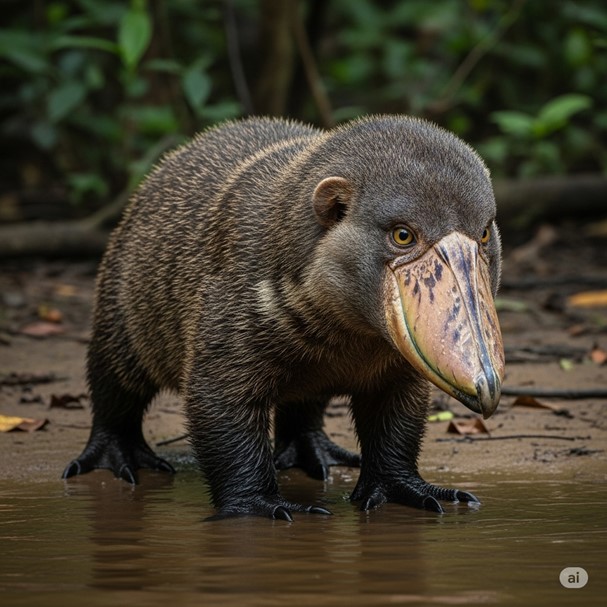
A party of adventurers in the world of Saṃsāra would encounter or be driven to search for a Mellicepia Brachiniceps for a multitude of reasons, ranging from calculated professional hunts to sudden, violent, and unfortunate accidents. These encounters are often memorable due to the creature’s unique and ferocious nature.
Reasons for Deliberately Searching for a Mellicepia Brachiniceps
The deliberate hunt for a Mellicepia is a dangerous but potentially rewarding endeavor, typically undertaken for one of the following reasons:
- Quest for a Rare Alchemical Component: The most frequent motivation for a deliberate hunt is the acquisition of the creature’s unique chemical gland. A master alchemist in a great city might post a lucrative bounty for the gland that produces the “Caustic Burst.” This boiling, noxious substance may be the only known antidote to a magical curse causing petrification, or perhaps it is a necessary reagent to create a powerful acid capable of dissolving the enchanted gates of an ancient ruin. The adventurers would be hired as specialists, venturing into the treacherous swamps with the express purpose of tracking, slaying, and carefully harvesting this volatile organ.
- The Ultimate Light Armor: For an avatar who values resilience and stealth, the hide of an elder Mellicepia is a legendary material. A master armorer could require this hide to fulfill a commission for a high-tier client. Its tough, loose, and adaptive properties can be crafted into a suit of light armor that offers the protection of plate mail while retaining the flexibility of leather and granting the wearer a chameleon-like ability to blend with their surroundings. A party would be hired to hunt a specific, often notoriously large and old, specimen.
- A Weapon of Crushing Power: The massive, dense, and sharp beak of an elder Mellicepia is a formidable natural weapon. A master weaponsmith might believe they can forge it into a unique war pick or hammer that retains some of the creature’s immense crushing force and can punch through armor that would deflect steel. An accomplished warrior-avatar might seek to slay the beast as a personal quest, a rite of passage to prove their strength and to claim its beak as a trophy to be fashioned into a signature weapon.
- An Extermination Contract: While a Mellicepia is a natural part of its ecosystem, its highly territorial nature becomes a serious problem when it overlaps with civilization. If a new mining settlement is established near a swamp, or a trade route requires barges to pass through its river territory, the creature may begin ambushing and killing workers or travelers. A local governor, guild master, or corporate entity would post a substantial bounty for the creature’s head, tasking the adventurers with eliminating the threat to ensure the safety of their people and the security of their investment.
Reasons for an Accidental Encounter
More often than not, an encounter with a Mellicepia Brachiniceps is a terrifying surprise, a consequence of venturing into the wilder, untamed parts of Saṃsāra.
- Unwitting Trespassers: This is the most common cause of an accidental encounter. The adventurers may be traveling through a dense jungle or murky swamp to reach a separate objective, such as a lost city or a hidden ruin. Unbeknownst to them, their path takes them directly through the hunting grounds of a Mellicepia. They might make camp for the night near its underwater lair or attempt to cross the very river where it lies in patient ambush, leading to a sudden and violent confrontation.
- A Case of Mistaken Identity: The creature’s Adaptive Camouflage is preternaturally effective. While lying in wait, it can look almost identical to a moss-covered log or a half-submerged boulder. A party of adventurers, weary from travel, might choose this seemingly safe object to rest against or to use as cover. The moment they get too close, the “log” erupts into a furious, beak-clattering monster, giving them no time to prepare.
- Investigating Another Threat: The party might be on a completely different mission, such as investigating a series of disappearances near a swampy region. They may suspect local bandits, a rival faction, or a more common type of monster. As they follow tracks and gather clues, they might be led to the creature’s well-hidden, subterranean lair, discovering the bones of the previous victims. In doing so, they would find themselves face-to-face with the true culprit, a predator far more dangerous than the one they were equipped to handle.
- Fleeing a Greater Danger: The wilds are full of threats. A party could find themselves fleeing from a different, overwhelming force—perhaps a horde of smaller monsters, a powerful magical beast they cannot defeat, or even the agents of a rival avatar. In their desperate flight through the jungle, they might stumble directly into the territory of a Mellicepia. Their relief at escaping one threat would be short-lived, as they would have inadvertently cornered themselves with a new, unexpected, and highly aggressive predator.
Beyond the most prized components—the adaptive hide, the crushing beak, and the caustic gland—the corpse of a Mellicepia Brachiniceps offers a wealth of other valuable and unique ingredients for a skilled and knowledgeable harvester. The creature’s bizarre, magical biology means that nearly every part of it has a specific, often potent, application.
Harvestable Items and Their Uses:
- The Unnerving Eyes:
- Description: The large, pale yellow eyes of the creature do not lose their unnerving, forward-facing stare even in death. They are large, dense, and contain a complex, crystalline lens structure.
- Use: The lenses can be carefully extracted by a jeweler or a crafter of magical items. When ground down and incorporated into a spyglass or a helmet’s visor, they grant the user a minor form of enhanced perception, making it easier to spot motionless or camouflaged creatures. Alchemists can also render the vitreous humor of the eye into a key ingredient for a “Potion of Unwavering Focus,” which helps the drinker resist fear and intimidation for a short time.
- The Burrowing Claws:
- Description: The thick, black, incredibly durable claws are naturally sharp and resistant to chipping and wear. They are denser than common iron.
- Use: The claws are highly sought after by artisans. A full set can be fashioned into the head of a formidable grappling hook that can find purchase in stone, or they can be used as the tips for high-end mining picks and excavation tools. A single, large claw is often used as the stylus or needle in delicate enchanting work, as its durability allows it to etch magical runes into hard surfaces without breaking.
- The Resilient Tendons:
- Description: The tendons connecting the creature’s powerful muscles, especially around the jaw and legs, are thick, fibrous, and possess an unnatural elasticity.
- Use: These tendons are invaluable to bowyers and the creators of steam-powered machinery. When properly treated and cured, they can be used as a superior bowstring for a composite bow, granting it a higher draw weight and greater power. In the magic-driven industrial world, these elastic tendons are also used as durable, shock-absorbing drive belts in complex machinery that requires the transfer of immense torque.
- The Cuttlefish Ink Sac:
- Description: Separate from its caustic gland, the creature retains the ink sac of its cephalopod ancestor. The ink it produces is a deep, shimmering black that contains chromatophore-like cells, causing it to subtly shift in color when viewed from different angles.
- Use: This is no ordinary ink. It is highly prized by scribes, cartographers, and enchanters who specialize in illusion magic. When used to write or draw, the ink’s shifting, multi-tonal properties make it exceptionally difficult to magically forge or replicate. It is the primary ingredient in creating “Scrolls of Misdirection,” where the words seem to subtly change or rearrange themselves to all but the intended reader.
- The Dense, Heavy Bones:
- Description: The bones of the Mellicepia are not light and hollow like a bird’s, but dense and heavy like a badger’s, yet possess a strange, layered structure.
- Use: When ground into a fine powder, the bone meal is a powerful, if grim, magical fertilizer. A small amount worked into the soil can cause plants to grow with unnatural speed and resilience. More morbidly, some practitioners of fringe magic use the larger bones, particularly the skull, as a focus for earth-based or protective rituals, believing the creature’s immense territorial instinct and tenacity can be bound into a powerful ward.
- The Badger’s Heart:
- Description: The creature’s heart is remarkably large for its body size and beats with a slow, powerful rhythm. It is a symbol of its unrelenting ferocity.
- Use: In some warrior cultures, consuming the cooked heart of a Mellicepia is a ritualistic practice believed to grant the warrior a measure of the beast’s courage and stamina. Alchemists find it more practical; the heart can be rendered down into the base for a “Potion of Unflagging Endurance,” which allows an avatar to push their physical limits, staving off exhaustion for much longer than normal.
King Who Wore Four Souls
It is told that in the age of the first cities, there was a King whose greed was a great and bottomless hunger. His vaults were full of gold, yet he felt poor. His armies were mighty, yet he felt weak. He looked upon the creatures of the world and coveted their virtues.
He desired the courage of the unyielding beast that wears a loose skin and knows no fear. He desired the unblinking stare of the great river bird, whose gaze is a judgment and whose patience is a stone. He desired the skin of the ocean creature that can wear any color it wishes and hide in plain sight. And he desired the burning breath of the small beetle that carries a boiling scourge within its own body as a weapon.
The King, whose impatience was a greater master than his wisdom, summoned to his court four of the greatest magical artisans in the land. To the first, he said, “Bring to me the soul of the fearless beast in a vessel.” To the second, “Capture for me the soul of the patient bird.” To the third, “Distill the soul of the creature of many colors.” And to the fourth, “Bottle the soul of the beetle’s burning scourge.” He promised them riches beyond counting.
The artisans, who were wise in the ways of the world’s spirits, labored for a year and a day. They returned to the King with four separate totems. One was a leather pouch that felt tough and buzzed with a peerless ferocity. One was a statue of a bird’s head whose stone eyes seemed to watch with eternal patience. One was a shimmering pearl that shifted in color. And the last was a hardened gland that was warm to the touch.
They presented these to the King and said, “Majesty, here are the four souls you desired. Absorb them one by one, over many years, and you may learn their virtues.”
But the King was impatient. He looked at the four totems and saw not four lessons, but four ingredients. He commanded the artisans, “I will not learn. I will become. Mix these four souls into a single potion, that I may drink them all at once and possess their strengths tomorrow.”
The artisans were filled with a great fear. “These are four different songs,” they pleaded. “To play them together is to create a terrible noise that will break the instrument.” But the King’s desire was a storm, and their warnings were but small winds against it. He threatened them with death, and so, with heavy hearts, they did as they were commanded.
They built a strange apparatus of crystal and steam. They broke the totems and distilled the four souls into a single, churning potion. It was a vile liquid, the color of swamp water, and it moved in the goblet as if it were four creatures fighting in a sack.
The King seized the goblet. He ignored the warnings in his own heart. He drank the potion in a single, greedy gulp.
A great and terrible war began inside his form. The soul of the fearless beast filled his heart with a rage so hot it burned his reason to ash. The soul of the patient bird stretched his face and bones, pulling them into the shape of a great and terrible beak. The soul of the many-colored creature unwound his skin, making it ripple and flow with patterns of madness. And the soul of the beetle’s scourge built a fire in his gut.
He screamed, but his scream was the clattering of bone. He fell, but his fall was the digging of new claws into the stone floor. When the transformation was done, the King was no more. Where the man of great greed had stood, there was a new thing, a creature of four warring souls. It was filled with a rage it did not understand, a patience it could not use, a cunning it could not control, and a fire it could not quench.
With a cry of confusion and pain, the first Mellicepia Brachiniceps fled the palace. It ran to the deepest swamps, the only place where its four warring souls could find a small measure of quiet, and where it hunts to this day, a lesson in the flesh.
Moral of the Story: A man who desires all virtues at once will end up possessing none of them, and become a monster instead.
Suggested conversions to other systems:
Dungeons & Dragons 5th Edition
Fenland Terror Medium monstrosity, unaligned
Armor Class 15 (natural armor) Hit Points 82 (11d8 + 33) Speed 30 ft., burrow 20 ft., swim 30 ft.
STR 17 (+3) DEX 12 (+1) CON 17 (+3) INT 5 (-3) WIS 14 (+2) CHA 7 (-2)
Skills Perception +5, Stealth +4 Damage Immunities acid Condition Immunities frightened Senses Darkvision 60 ft., passive Perception 15 Challenge 3 (700 XP)
Ambusher. In the first round of a combat, the fenland terror has advantage on attack rolls against any creature it has surprised.
Adaptive Skin. The fenland terror can use a bonus action to change the color and texture of its hide to match its surroundings, granting it advantage on Dexterity (Stealth) checks.
Actions
Beak. Melee Weapon Attack: +5 to hit, reach 5 ft., one target. Hit: 12 (2d8 + 3) piercing damage.
Intimidating Clatter. The fenland terror rapidly clatters its beak. Each creature within 30 feet that can see and hear it must succeed on a DC 11 Wisdom saving throw or become frightened of it for 1 minute. A frightened creature can repeat the saving throw at the end of each of its turns, ending the effect on itself on a success.
Caustic Spray (Recharge 6). The fenland terror unleashes a spray of boiling chemicals in a 15-foot cone. Each creature in that area must make a DC 13 Dexterity saving throw, taking 18 (4d8) acid damage on a failed save, or half as much damage on a successful one.
Call of Cthulhu 7th Edition
The Chromatic Mire-Beast A chimerical predator from the deepest swamps, its skin ripples with shifting colors and its huge, beak-like maw can crush a person’s skull.
STR 70 CON 85 SIZ 75 DEX 50 INT 40 POW 65 HP 16
Damage Bonus: +1D4 Build: 1 Move: 7 / 9 swimming ATTACKS Fighting (Brawl) 60% (30/12), damage 1D3+DB Crushing Maw 50% (25/10), damage 1D10+DB. On a successful hit, the target is grappled. The beast will use its next action to automatically inflict 1D10 damage on a grappled target. Caustic Spew 45% (22/9), affects a 5-yard cone. Damage 1D6+1 acid. Targets may attempt a Dodge roll. A target hit must also make a CON roll or be blinded for 1D4 rounds. Dodge 25% (12/5)
Armor: 2-point tough hide. Skills: Stealth 75% (when motionless), Intimidate 75%, Track 30%. Sanity Loss: 1/1D6 Sanity points to witness this unnatural creature.
Blades in the Dark
The Sump-Gnasher A territorial horror that has made its home in the flooded industrial sump of a forgotten factory. It is drawn to the vibrations of machinery and the scent of desperation.
Threat: A singular, powerful beast. Can be represented as a Tier III threat, with Quality equal to the crew’s Tier +1. Disposition: Patient, guardian-like, and explosively violent when its territory is encroached upon.
GM Moves:
- Appear silently from the sludge: It emerges without a sound to attack the most isolated or vulnerable character.
- Shatter a walkway or piece of cover: It uses its beak to destroy a part of the environment, changing the scene and potentially separating the crew.
- Flash hypnotic patterns on its skin: A mesmerizing display. A character who is focused on the beast must Attune to resist being disoriented and taking 2 Stress.
- Vent a cloud of boiling chemicals: It targets an area, creating a dangerous zone that inflicts Level 2 Harm (“Acid Burns”) to anyone who enters or ends their turn there.
- Stand its ground with furious clattering: A terrifying display of aggression. Any attempt to intimidate it or frighten it off automatically fails; instead, the character attempting it must make a Resolve roll or lose their nerve.
Knave 2nd Edition
The Four-Souled Stalker HP: 10 Armor Defense: 16 (Tough, shifting hide) Attack: Crushing Beak +5 (d10+d6) Morale: 11 (Will fight to the death if cornered)
Patient Predator. If it spends one round taking no action other than hiding, its next attack deals double damage.
Chameleonic Hide. As an action, it can blend into its surroundings. It cannot be targeted by ranged attacks until it moves or attacks. Melee attackers must succeed on a Wisdom save to target it correctly.
Caustic Bombard. Once per day, it can use its action to launch a glob of boiling chemicals at a point within 30 feet. It explodes, and anyone within 10 feet of that point takes d8 damage (Dexterity save for half).
Unyielding. When it makes a morale check, it can roll with advantage.
Fate Core System
The Four-Souled Beast of the Mire This creature is a walking contradiction—a patient stalker with a furious temper, a tough brute with a cunning ability to hide. It is the undisputed apex predator of its swampy domain.
High Concept: Vicious Chimeric Swamp Predator Trouble: Unpredictable, Warring Instincts
Other Aspects: Hide of Shifting Colors, A Gaze of Unblinking Patience, Beak That Shatters Bone
Skills
- Great (+4): Physique
- Good (+3): Fight, Intimidate
- Fair (+2): Athletics, Stealth
- Average (+1): Notice
Stunts
- Caustic Spray: Once per conflict, the Beast can use Fight to attack every target in a single zone. Whether it succeeds or fails, it creates the situational Aspect Noxious Chemical Cloud in that zone.
- Tenacious Ferocity: When the Beast is taken out, it can, at the cost of a Fate Point, remain in the scene for one more exchange. It can take actions as normal during this exchange, ignoring all its consequences. At the end of the exchange, it is removed from the scene.
- Adaptive Camouflage: The Beast gains a +2 bonus to Stealth rolls made to Create an Advantage when it remains motionless in its natural swampy environment.
Stress: [1] [2] [3] [4] Consequences: One mild, one moderate, one severe.
Numenera & Cypher System
The Chromatophore Amalgam This bizarre, bio-engineered predator seems to have been fused together from several different creatures. Its hide ripples with shifting colors, its beak is disproportionately large and powerful, and it exudes an air of intense territoriality.
Level: 4 Motive: To hunt, to defend its territory. Environment: Almost exclusively found in swamps, marshes, and river deltas. Health: 18 Damage: 4 points Armor: 2 Movement: Short; Short when swimming.
Modifications: Stealth tasks are eased by two steps when the creature is motionless. Resists all poison and disease as a level 6 creature.
Combat: The Amalgam’s beak is its primary weapon, capable of crushing armor and bone. On an attack roll of 17 or 18, in addition to dealing damage, it reduces the target’s armor by 1 permanently. On a 19 or 20, it grapples the foe, inflicting automatic damage each round until the foe escapes. Once per day, as its action, it can spray a cloud of boiling chemicals in an immediate area around itself. All creatures in the area must make a Speed defense roll. On a failure, they take 4 points of ambient damage and all tasks they perform are hindered by one step as long as they remain in the cloud, which lingers for one minute.
Interaction: The Chromatophore Amalgam is a wild beast. It will first attempt to intimidate intruders by flashing threatening colors and loudly clattering its beak. This requires any who see it to succeed on an Intellect defense task or be unable to take actions on their next turn due to fear. If this display fails to deter them, it will attack without hesitation.
Pathfinder 2nd Edition
The Mottled Maw Creature 3 [Uncommon] [Beast] This strange, badger-like beast has a disproportionately large, avian beak and skin that shifts in color. It is a ferocious and stubborn predator found in swamps.
Perception +9; darkvision, scent (imprecise) 30 feet Skills Acrobatics +8, Athletics +11, Intimidation +7, Stealth +10 Str +4, Dex +1, Con +3, Int -4, Wis +2, Cha +0
AC 19; Fort +10, Ref +6, Will +9 HP 50; Resistances poison 5
Ferocious Tenacity [reaction] Trigger The mottled maw is reduced to 0 Hit Points. Effect The mottled maw makes a single Jaws Strike before dying.
Speed 25 feet, burrow 15 feet, swim 25 feet Melee [one-action] Jaws, +11 (deadly d10), Damage 1d10+4 piercing plus Grab Melee [one-action] Claw, +11, Damage 1d6+4 slashing
Caustic Spray [two-actions] (acid, evocation, primal) The mottled maw unleashes a 15-foot cone of boiling chemicals. Creatures in the cone take 4d6 acid damage (DC 19 basic Reflex save). The maw cannot use Caustic Spray again for 1d4 rounds.
Adaptive Camouflage The mottled maw can use the Hide action even if it doesn’t have cover or isn’t concealed, as long as it is in swampy or jungle terrain.
Savage Worlds Adventure Edition
The Swamp Devil A chimerical horror that stalks the fetid swamps. It is notoriously stubborn and vicious, with a tough, color-shifting hide and a beak that can snap bones like twigs.
Attributes: Agility d6, Smarts d6(A), Spirit d8, Strength d10, Vigor d10 Skills: Athletics d8, Fighting d8, Intimidation d10, Notice d8, Stealth d10 Pace: 5; Parry: 6; Toughness: 9 (2)
Edges: Brute, Iron Jaw Special Abilities:
- Armor +2: Tough, rubbery hide.
- Bite/Claws: Str+d6.
- Camouflage: The creature has a +4 bonus to Stealth rolls when in swamp or jungle terrain.
- Caustic Spray: As an action, the Swamp Devil can spray a Cone Template. Any targets within the template must make an Agility roll versus the creature’s Athletics roll. Failure results in 2d6 damage and the target is Distracted.
- Fear (-2): The Swamp Devil is a terrifying sight. Anyone who sees it must make a Fear test at a -2 penalty.
- Tenacious: When the Swamp Devil is Incapacitated from Wounds, it can make a Vigor roll at -2. If successful, it removes one Wound and is no longer Incapacitated. It can only attempt this once per encounter.
Shadowrun, Sixth World
The “Gnasher” Paracritter A highly aggressive, territorial paracritter found in polluted swamps and overgrown urban canals. It is a bizarre chimerical beast, prized by some criminal elements for its tenacity and natural weapons.
Attributes Body: 6 Agility: 4 Reaction: 4 Strength: 5 Willpower: 4 Logic: 2(A) Intuition: 4 Charisma: 3 Edge: 2 Magic: 6
Initiative: 8 + 2D6 Matrix Initiative: N/A Astral Initiative: 8 + 2D6
Skills: Athletics 4, Close Combat 5, Intimidation 4, Perception 4, Stealth 5
Powers
- Armor: 6
- Camouflage: As a Minor Action, the Gnasher can make a Stealth + Intuition (4) test to blend into its surroundings.
- Corrosive Spit: As a Major Action, the Gnasher can make a Close Combat + Agility attack against a target at Near range. If successful, the attack deals 6P damage and has the Acid effect (reduces armor). This power can be used 3 times before needing a short rest to recharge.
- Hardened Beak: The Gnasher has a Natural Weapon attack with a DV of (Strength + 2)P and an AP of -2.
- Fear: When the Gnasher clatters its beak as a threat display, any character who sees it must make a Composure (3) test or be intimidated, suffering a -1 dice pool penalty on their next action.
Starfinder
The Bog-Stalker Amalgam CR 3 XP 800 N Medium magical beast Initiative +5; Senses darkvision 60 ft.; Perception +8
Defense EAC 14; KAC 16 HP 45 Fort +7; Ref +7; Will +4 Resistances acid 5
Offense Speed 30 ft., burrow 20 ft., swim 30 ft. Melee crushing mandible +11 (damage 1d6+5 B & P) Ranged caustic spray +8 (damage 1d4+3 A; critical bleed 1d4)
Statistics Str +2; Dex +1; Con +3; Int -3; Wis +1; Cha +0 Skills Athletics +8, Intimidate +13, Stealth +8
Special Abilities
- Adaptive Camouflage: When the bog-stalker has not moved during its turn, it has concealment (20% miss chance).
- Ferocious Charge: If the bog-stalker moves at least 10 feet in a straight line before attacking with its crushing mandible, it can attempt a free combat maneuver to knock the target prone on a successful hit.
- Caustic Spray: The bog-stalker’s ranged attack is a special cone-shaped spray with a range of 15 feet.
Traveller (Mongoose 2nd Edition)
The ‘Badger-Bird’ (Mellivorarex horridus) A notoriously ill-tempered predator found on worlds with dense, swamp-like biomes. It is a chimerical creature that combines traits of multiple Terran animals into a brutally efficient hunter.
UPP: 8A9766-0 Type: Carnivore, Stalker Skills: Stealth 2, Recon 1, Melee (natural) 2 Pace: 4m Attacks: Crushing Beak (2D+2), 2 x Claws (2D) Armor: 3 (Tough hide) Traits:
- Camouflage (Chameleonic): The creature gains DM+2 on any Stealth check when motionless in its natural habitat (swamps, jungles).
- Chemical Spray (Caustic): Once per day, the creature can spray a target within 5m. The target must make a DEX 8+ check or take 2D damage that ignores armor.
- Territorial: The creature will attack any character that approaches within 50m of its lair without provocation.
- Tenacious: The creature ignores the first point of damage from any attack.
Warhammer Fantasy Roleplay, 4th Edition
The Fen-Beak Horror A monstrous beast of the deep fens and marshes, the Fen-Beak is a foul temperament given physical form. The scholars of Altdorf claim it is a result of unchecked Chaos energy, while the simple folk of the marshes know it only as a reason to avoid the water’s edge after dark.
Main Profile WS 45, BS —, S 45, T 50, I 30, Ag 25, Dex —, Int 15, WP 40, Fel —
Secondary Profile A 2, W 18, M 4, Mag —, P —, IP —
Traits:
- Armour: 2 (Tough, Layered Hide)
- Fear 1: Its unnatural appearance is deeply unsettling.
- Swamp-Strider: The Fen-Beak ignores all movement penalties for moving through mud, bog, or shallow water.
- Weapon (Beak): +9, Damage: S+4, Qualities: Armour-Piercing, Vicious
- Weapon (Claws): +9, Damage: S+2
- Chameleonic Skin: The Fen-Beak gains a +20 bonus to all Stealth Tests when attempting to hide in vegetation or murky water.
- Caustic Spew: As an action, the Fen-Beak can spray a cone-shaped area in front of it. Any targets in the cone must succeed on a Challenging (+0) Dodge Test or take a hit with a Damage of 10 that has the Ablating and Poison (Challenging) Qualities. The Fen-Beak can use this ability once per encounter.