
Lore: When the first souls found themselves in the vast, ancient forests of Saṃsāra, they quickly learned that the trees were more than just wood. Each possessed a spirit, and the forest itself had a great, slumbering consciousness. The traditions of Tunguska shamanism, which focused on communicating with natural forces, proved essential for survival. These early foresters learned that to take from the forest, one must first ask permission.
They began to craft axes that were not merely tools for felling trees, but conduits for speaking with them. The Whisper-Bark Axe is the most common result of this tradition. By binding a sliver of a nature spirit into the axe’s haft, they created a tool that could communicate with the “will” of the woods. A forester carrying one of these doesn’t just see a forest; they feel its mood, see its hidden paths, and can ask for its cooperation. It is an essential tool for any ranger, hunter, or woodsman who seeks to live in harmony with the wild, rather than just conquer it.
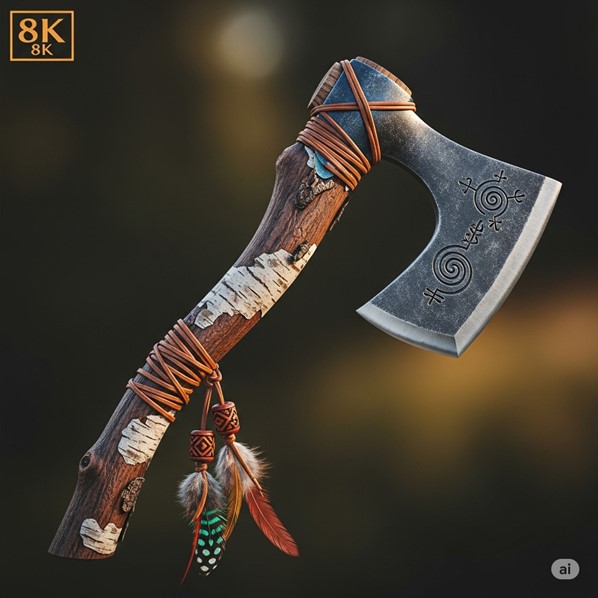
Description: This is a well-balanced, rustic hand-axe. The axe head itself is simple, crafted from sharpened stone or dark, unadorned iron, though it is etched with faint, spiraling shamanic symbols. The true magic lies in the handle, which is fashioned from a single, gnarled branch of an ancient rowan or birch tree, with patches of its original, papery bark left intact. Small, brightly colored feathers and wooden beads are tied to the base of the handle with sinew cords. The axe feels warm and strangely light in the hand, and it smells perpetually of damp earth and sap.
Detailed Stats
- As a Weapon: This item can be used as a standard hand-axe in combat.
- As a Tool: This item can be used for chopping wood and other mundane forestry tasks.
- Bonus: If the wearer has trained the Survival skill, this axe grants a +1 bonus to all attempts to navigate wilderness, build shelters, or track animals.
- Bonus: If the wearer has trained the Nature Knowledge skill, this axe grants a +1 bonus when identifying plants, animals, or natural spirits.
Passive Magics
- Voice of the Wood: The axe acts as a translator for the non-verbal language of the forest. The wielder can perceive the “mood” of the woods around them. The creaking of branches, the rustle of leaves, and the scent of the air are imbued with simple, understandable meaning: the forest might feel calm, agitated, sick, or fearful.
- Spirit Trails: While holding the axe in a forest, the wielder can see faint, shimmering green trails on the ground. These are the spiritual paths that animals and nature spirits use to travel. Following these trails makes navigation through even the densest undergrowth easier and helps the user avoid natural hazards like thorns and deep mud.
Activable Magics
- Mark of Passage (Normal Casting): The user can gently tap a large tree or ancient rock with the flat of the axe’s head while chanting a brief, respectful request for passage. For the next hour, the undergrowth in a 30-foot radius around the wielder will subtly shift and part, creating a clear and quiet path for them and their companions, making movement faster and stealthier.
- Ask the Elder (Ritual Casting): By finding a truly ancient tree (one that is noticeably older and larger than any other in the area), the user can perform a 10-minute ritual. This involves striking the tree with the axe in a slow, rhythmic pattern that mimics a heartbeat, while chanting a formal entreaty. At the end of the ritual, the user may ask the tree’s spirit a single, simple question about its immediate surroundings (e.g., “Where is the nearest source of clean water?”, “What great predator has passed this way today?”, “Is there unnatural corruption in this part of the forest?”). The answer comes as a sudden rush of instinctual knowledge or a single, clear mental image.
Gear Slot: Held (One-Handed Tool/Weapon)
Tags: Common, Held, Tier 1, Tool, Weapon, Axe, Forestry, Shamanic, Nature, Divination, Wood, Spiritual, Utility, Communication, Navigation, Melee, Etched, Primal
The Tunguska 411 of the Whisper-Bark Axe is both a practical tool and a shamanic fetish. Its commerce reflects this duality, being found in places of rugged frontier survival as well as in communities that hold deep spiritual respect for the natural world.
The Frontier Trading Post
At the edge of civilization, where sprawling cities give way to vast, untamed forests, these trading posts are the last bastion of supply for woodsmen, trappers, and explorers. These are sturdy, practical log buildings smelling of sawdust, cured pelts, and coffee. They sell essential, durable goods: iron nails, flour, salt, rope, and well-made tools. The Whisper-Bark Axe is a standard, if respected, piece of inventory, usually kept behind the counter with the compasses and finer knives.
The transaction is typically a straightforward, no-nonsense affair. The proprietor is a pragmatist who has seen many would-be adventurers vanish into the woods. They sell the axe as a reliable tool, understanding its value in navigation and survival. They might offer some gruff, practical advice but won’t speak of its deeper magic unless prompted by a knowledgeable customer. Haggling is common, and trades for valuable forest goods (like pristine furs or rare medicinal herbs) are often preferred over coin.
Cost: A fair but firm price of 8 Silver, or a trade of goods of equivalent value.
The Druidic Grove
This is not a shop, but a community. Deep within ancient forests, hidden druidic or shamanistic communes live in harmony with the trees. Their homes are woven from living wood, and they have no storefronts. Here, the Whisper-Bark Axe is crafted not for sale, but for use by members of their order. To acquire one is to be accepted by the community.
An outsider cannot simply buy one. They must be guided to the grove and prove their worth and their respect for the natural world. They must demonstrate that their heart is aligned with the well-being of the forest. The “transaction” is a ritual in which the elders of the grove decide if the avatar is worthy. If so, an artisan will present them with an axe, not as a sale, but as a gift that carries a heavy responsibility.
Cost: Coin is worthless here. The cost is a pledge of service. The avatar might be tasked with cleansing a corrupted section of the forest, driving off poachers, or swearing an oath to protect the grove and its secrets. The axe is earned through deeds, not purchase.
The Woodworkers’ Guildhall
In major cities, the Woodworkers’ Guild is a powerful and respected institution. Their halls are massive workshops filled with the scent of a thousand different types of wood. While they primarily create fine furniture and architectural marvels, they have a specialized section for Forester’s Tools. Master artisans who work with rare or magically resonant woods value the Whisper-Bark Axe for its ability to “speak” to the material, allowing them to know its grain, its flaws, and its inner strength before making a single cut.
The transaction is formal and professional. The Guild sells primarily to its own members, but will occasionally take on commissions from wealthy patrons. The seller, likely a Guild Master, will speak of the axe not in terms of magic, but of craftsmanship—the perfect balance, the unique properties of the rowan-wood haft, the quality of the etching. They appreciate it as a master tool.
Cost: Reflecting the Guild’s reputation and guarantee of quality, the price is high: 1 Gold and 5 Silver. The price is non-negotiable for non-members.
The Ranger’s Lodge
In secluded lodges that serve as regional headquarters for rangers, trackers, and wardens of the wild, gear is often traded and bartered among members. Once a season, they might hold a “swap meet” where they trade equipment, share information, and tell stories. The Whisper-Bark Axe is a common and respected item in this circle.
The transaction is an informal barter between peers. An avatar would need to be a member of the organization or a trusted guest to participate. The “sale” would happen over a mug of ale, with two rangers discussing the history of their respective items. A trade is made based on need and the story of the item. An axe that has “guided a hunter through the Murkwood” might be considered more valuable than a new one.
Cost: No coin is used. An axe might be traded for a fine bow, a set of detailed maps for an unexplored region, a pouch of rare healing herbs, or a simple promise of aid on a future expedition.
The Tunguska 411 of the Whisper-Bark Axe is a forester’s companion, a tool that is part steel, part spirit. Its role in conflict is not that of a greatsword, but of the forest itself: patient, subtle, and deceptively dangerous. It excels at turning the environment into the user’s greatest ally, for both defense and offense.
Defensive Roleplaying Applications
Defense with the Whisper-Bark Axe is about using the forest as a shield, an early-warning system, and an escape route. It allows the avatar to evade, obstruct, and anticipate threats with supernatural grace.
Scenario: A Pursuit Through a Dense Thicket An avatar and their companions are being pursued by a heavily armed but slow-moving patrol. On open ground, they would be caught, but they flee into a forest so dense with thorny undergrowth that it seems impassable.
The avatar takes the lead, holding the Whisper-Bark Axe. They use the Mark of Passage ability. As they move, they chant softly, and the tangled, thorny vines part before them as if bowing, creating a clear, silent path. The avatar’s party moves through at a swift pace. Once they are through the thicket, the avatar ceases the chant, and the path closes behind them, the thorny branches snapping back into place. Their pursuers, encased in heavy armor, now face a formidable natural barrier that will take them a great deal of time and effort to bypass, allowing the avatar and their party to escape.
Scenario: Anticipating a Silent Ambush The avatar is guiding a caravan through a seemingly peaceful stretch of woods. They suspect they are being stalked by silent, stealthy predators or enemy scouts.
While walking, the avatar holds the axe and focuses on its Voice of the Wood passive. For hours, they feel the calm, peaceful “hum” of the healthy forest. Suddenly, the feeling changes. The background rustling of leaves becomes hushed, the creaking of branches takes on a tone of fear, and the air feels still and expectant. The forest itself is holding its breath. The avatar immediately knows that a significant, hostile presence is nearby, causing the local spirits to become agitated. They halt the caravan and alert the guards, moving from a state of travel to one of high alert. The ambush is foiled before it can be sprung, as the attackers have lost the crucial element of surprise.
Offensive Roleplaying Applications
Offense with the Whisper-Bark Axe is about environmental manipulation and tactical intelligence. It allows the user to turn the forest into a weapon, setting traps and ambushes with an uncanny understanding of the terrain.
Scenario: Setting the Perfect Trap An avatar is tasked with hunting a cunning, dangerous beast, such as a Displacer Beast or a Phase Spider, that is too elusive to confront directly. They need to set a trap, but the creature’s territory is vast.
The avatar finds the oldest, most gnarled tree in the area and performs the Ask the Elder ritual. After ten minutes of rhythmic chanting and tapping the tree with the axe, they ask the ancient tree spirit a single question: “Where does the beast feel safest to sleep?” The tree responds with a clear mental image of a small, hidden cave behind a waterfall. The avatar now knows the location of the creature’s lair—the one place it will always return to. They can now set their trap in this perfect, inescapable location, ensuring the beast will walk right into it. The axe provides the critical intelligence needed to guarantee the success of the hunt.
Scenario: A Guerrilla-Style Harassment The avatar needs to delay and weaken a larger enemy force moving through a forest.
The Whisper-Bark Axe becomes the ultimate tool for guerrilla tactics. The avatar uses the Spirit Trails passive to move silently and swiftly through the woods, flanking the enemy force without being seen. They find a high ridge overlooking the path and use the axe to fell a small tree, creating a roadblock. When a scout is sent to investigate, the avatar uses Mark of Passage to burst from an impassable thicket, strike with the axe as a weapon, and then retreat back into the undergrowth, their path vanishing behind them. By using the axe to navigate, create obstructions, and launch surprise attacks from unexpected angles, a single avatar can make the enemy feel as though they are being hunted by the entire forest.
Perception of Activation:
User’s Perspective
When an avatar performs a ritual such as “Ask the Elder” with the Whisper-Bark Axe, they are not commanding nature, but entering into a respectful communion with an ancient and powerful consciousness.
- Sight: As the user chants and rhythmically taps the ancient tree with the axe, the faint shamanic symbols etched on the axe head begin to pulse with a soft, gentle, green light. The surrounding world remains clear, but the user’s perception of the tree itself deepens. They can see the flow of life within it as pulsing lines of light under the bark, all connected to a great, slow-burning core of energy deep within the trunk.
- Sound: The user’s own chanting and the steady thump-thump of the axe against the bark are the only sounds they can perceive. All other ambient noise from the forest—the wind, the calls of birds, the buzzing of insects—fades into a deep and respectful silence. The answer from the tree spirit does not come as a voice, but as a sudden, clear, and silent wave of pure understanding or a single, vivid mental image that blossoms in their mind.
- Smell: The air becomes thick and rich with the smells of the deep forest: the scent of ancient, damp earth, the sharp fragrance of fresh sap, and the clean aroma of moss after a rain.
- Touch: The axe handle grows pleasantly warm in the user’s hands, and it vibrates with a slow, powerful, and steady rhythm that matches the chanting. It feels as if they are holding the hand of a living thing, feeling its ancient, slumbering heartbeat through the wood.
- Taste: A clean, woody taste fills the user’s mouth, like chewing on a fresh birch twig or drinking pure spring water.
- Extra-Sensory Perception (Communion of Ages): The user feels their own, fleeting consciousness gently touch the vast, slow, and immeasurably patient consciousness of the elder tree. It is a humbling experience, like a child asking a question of a grandparent who has silently watched the world for a thousand years. The user is filled with a sense of immense calm, stability, and deep time.
- Extra-Sensory Perception (Forest-Mind): For a moment, the user feels their awareness expand beyond their own body, connected to the tree. They can feel the sunlight on the leaves high above, the pull of water from the roots deep below, and the gentle weight of a bird nesting in the branches, all at once.
Positives: The experience is profoundly peaceful, centering, and spiritually restorative. The user gains access to the deep, truthful knowledge of the forest from a reliable and ancient source. The feeling of connection can banish feelings of fear and loneliness.
Negatives: The user is completely lost to the outside world and utterly vulnerable for the full duration of the ten-minute ritual. The sheer scale and age of the tree’s consciousness can be overwhelming, causing the user’s own sense of time to become distorted. After the ritual, the fast-paced world of mortals can feel jarring and chaotic.
Observer’s Perspective
To an observer, the activation of the axe’s ritual is a quiet, eerie, and deeply magical event that seems to command the respect of the entire forest.
- Sight: The observer sees the user chanting and tapping the ancient tree in a steady, rhythmic pattern. The only overt magical sign is a soft, pulsing green glow that emanates from the shamanic symbols etched on the axe head. The light seems to be absorbed by the tree’s bark, leaving no afterimage.
- Sound: The most noticeable effect is the creation of a pocket of profound silence. As the user’s low, monotonous chant and the rhythmic tapping begin, all other sounds in the immediate vicinity of the ritual fade away. Birds stop singing, insects fall quiet, and even the sound of the wind in the canopy seems to die down, leaving only the sounds of the ritual itself.
- Smell: A strong, pleasant scent of fresh sap and damp earth emanates from the ritual site, a smell that is much richer than that of the surrounding woods.
- Touch: An observer would feel the air around the ritual become unnaturally still and heavy with a feeling of reverence or great age.
- Taste: There is no perception of taste for an observer.
- Extra-Sensory Perception (The Mind’s Eye): A magically-attuned observer would see the user’s magic acting as a gentle, respectful invitation. They would perceive faint, green, root-like tendrils of energy extending from the axe and connecting with the massive, deep green aura of the ancient tree. They would feel the tree’s powerful, slumbering spirit slowly stir and grant the user a small portion of its awareness, not as a command, but as a willing gift.
Positives: The ritual is a peaceful and non-threatening display of magic. It clearly demonstrates the user’s deep respect for and connection with the natural world, which could be reassuring to nature spirits or druidic onlookers.
Negatives: The user is completely defenseless and oblivious for the full ten minutes. The unnatural cone of silence that envelops the ritual is eerie and can be deeply unsettling to those unfamiliar with this type of magic, clearly signaling that a powerful supernatural event is in progress.
The Rite of the Whispering Haft
This document details the shamanic rite and crafting process for creating a Whisper-Bark Axe. The creation of this tool is a pact made with the forest itself. It cannot be forged with fire and steel alone, but must be coaxed into being with respect, ritual, and an understanding of the spirits that reside in the wood.
Materials Needed
- A Willing Branch (The Haft): A single, live, arm-length branch from an ancient tree (typically a rowan, birch, or willow). The branch cannot be simply cut; the artisan must perform a ritual of request, and the branch must be “given” by the tree—often by snapping in a wind after the ritual is complete.
- A River Stone or Bog Iron (The Head): A piece of dark, heavy stone, worn smooth by a river, or a lump of iron ore harvested from a deep bog. The material should be natural and unprocessed by industrial means.
- The Messenger’s Ink: A thick ink made from a mixture of powdered raven feathers, charcoal from a lightning-struck tree, and a few drops of clean, running water.
- King-Stag Sinew (The Bindings): Long, durable strands of sinew taken from a great stag that was the undisputed leader of its herd.
- Whisper Feathers: A small handful of brightly colored feathers from a species of bird known for its complex calls and mimicry, such as a jay or lyrebird.
Tools Required
- A Flint Knapping and Carving Kit: A set of sharp-edged flint flakes, stone hammers, and bone chisels used to shape the axe head and carve the wooden haft.
- A Ritual Drum: A small, hand-held drum with a hide surface. The steady, rhythmic beat is essential for entering the proper trance state during the rituals.
- A Mortar and Pestle: Carved from stone, used to grind the feathers and charcoal for the ink.
- Bone Needles: Thick, sharp needles crafted from bone, used for stitching the sinew bindings.
Skill Requirements
- Artisan (Wood & Stone Working): Requires the skill to shape a stone or piece of bog iron into a functional axe head and to fit it to a haft using primitive tools.
- Survival: The artisan must be able to track and find the specific animals and trees required for the components, and to identify a lightning-struck tree.
- Ritualist Knowledge: The artisan must know the specific chants and drum-rhythms to communicate with tree spirits and bind the axe’s magic.
- Attunement (Nature Spirits): The ability to feel and interpret the responses of the natural world is paramount. Without it, the artisan will not know if a tree has “given” its branch, or if the final ritual was successful.
Crafting Steps
- The Supplication: The artisan must first find a suitable ancient tree. For a full day, they must tend to the tree, clearing away choking vines and bringing it water. At dusk, they must beat a slow, respectful rhythm on their drum and chant a formal request, asking the tree for a branch to serve as a voice for the forest. They then leave. They must return the next day; if a suitable branch has fallen naturally, the request has been granted.
- Shaping the Head: Using the flint knapping kit, the artisan carefully shapes the river stone or bog iron into a sharp, balanced axe head. This is a slow, patient process, and with every chip of stone, the artisan must focus their intent for the axe to be a tool of understanding, not just destruction.
- Preparing the Ink of Whispers: The artisan grinds the raven feathers and lightning-struck charcoal into a fine powder in the mortar. They mix it with a few drops of water, chanting softly to call upon the spirits of messengers and the power of the storm, asking that the ink give the axe a voice.
- Etching the Spirals: The artisan uses a sharp piece of flint to carefully etch the spiraling shamanic symbols onto both faces of the axe head. As they carve the grooves, they fill them with the Messenger’s Ink, permanently sealing the magic of communication into the head.
- The Sacred Union: The living branch is carefully fitted with the axe head. The artisan then uses the King-Stag Sinew and bone needles to bind the two pieces together with intricate, powerful knots. This act symbolizes the union of the forest’s wisdom (the tree) and the vitality of its creatures (the stag). The Whisper Feathers are tied to the base of the handle during this binding process.
- The Awakening Chant: The final step must be performed in the heart of a forest at dawn. The artisan holds the completed axe aloft and begins a long, complex chant, accompanied by a powerful, echoing beat on the ritual drum. The chant introduces the axe to the forest, declaring its purpose as a friend and a listener. The artisan must continue until the forest itself responds—a specific gust of wind, a sudden chorus of birdsong, or the appearance of a stag at the edge of the clearing. This response signifies that the forest has accepted the axe and awakened the spirit within its haft.
Man Who Asked for a Path
There was a man named He-Who-Lost-The-Sun, because he was lost. He was in the Great Forest, a forest that was very old and did not like men. The forest was a trickster. It would change its paths when a man was not looking. Its trees would whisper lies on the wind to lead a man in circles. Its streams would flow one way in the morning and another way in the evening. Many hunters and woodsmen had walked into this forest. They did not walk out again.
He-Who-Lost-The-Sun was lost for many days. He was hungry and full of fear. He had an axe made of iron, but it was a bad axe for this place. When he tried to mark a tree, the tree would bleed a black sap that made him sick and dizzy. The iron axe was an enemy to the forest, and so the forest was his enemy. The trees watched him with their thousand knot-holes, and they hated him and his loud iron.
Finally, his heart became too heavy. He took his iron axe and threw it into a deep pool of water. He sat down under a great, old birch tree whose bark was like paper. He put his head in his hands and he spoke to the ground. He said, “Great Forest, I am sorry. I did not mean to be your enemy. My iron is gone. I am small and lost. I only wish to see the sun again.” And because he was so tired, he fell asleep.
In his sleep, a dream came to him. A man made of leaves and moss stood before him. The man’s voice was the sound of rustling leaves. The leaf-man said, “You are right. Your iron was loud and angry. The forest does not like it. You cannot cut a path through this forest, for the forest is its own path. If you wish to leave, you must not cut. You must ask.”
The dream ended. When He-Who-Lost-The-Sun woke up, he felt a branch across his lap. It was a gnarled branch, strong and old, and it had fallen from the great birch tree while he slept. The tree had given him a gift. He remembered the words of the leaf-man. He needed a new axe.
He went to a stream and found a flat, hard stone, dark and sharp at one edge. He took the birch branch for a handle. He had no rope, so he took a knife and cut his own long hair and braided it into a strong cord. He tied the stone head to the branch handle with his own hair. It was a strange axe. It was an axe made of the forest itself.
He stood up. He did not know which way to go. North looked like south, and east looked like west. The trees whispered lies to him. He held his new axe, but he did not hold it to chop. He walked to the nearest great oak tree, and he tapped its trunk gently with the stone of his axe. He said, “Great Oak, I am a small man, and I am lost. I do not wish to harm your children. I wish only to find the way out. Can you show me a path?”
The forest became very quiet. The lying whispers of the trees stopped. A strange thing happened. The axe handle grew warm in the man’s hand. He looked down, and on the ground before him, a faint green light began to glow. It was a path, a winding path made of this soft light. It was a path he had not seen before. It went between the trees where there was no trail.
He trusted the light. He walked the glowing path. When the path would fade, he would find another old tree and tap it with his axe and ask again, very politely. And the path would appear again. The forest was no longer his enemy. The trees did not lie to him. They showed him the secret ways that the animals used. He ate berries the path showed him. He drank from springs the path showed him.
He walked for many days, always following the glowing trail given to him by the trees. Finally, the path went up a great hill, and when he got to the top, he saw the edge of the forest. He could see the open plains, and the sun was bright. The path had led him home. He was no longer He-Who-Lost-The-Sun. He was now He-Who-Asks-The-Path, and his axe was a key, not a weapon.
The Moral of the Story: A man with an iron axe can shout at the forest, and the forest will shout back with a confusing voice. A man with a wooden axe can whisper his request, and the forest will whisper back a true path. It is wiser to ask for the way than to demand it.
Suggested conversions to other systems:
Call of Cthulhu (7th Edition)
Axe of the Whispering Wood
A shamanic tool that allows an Investigator to commune with the ancient, non-human consciousness of a forest. It can provide guidance and safe passage, but such contact can be unsettling for a modern mind.
Game Mechanics:
- Description: A rustic hand-axe with a stone head and a branch handle. As a weapon, it functions as a Small Axe (1d6+db damage).
- Forest Empathy: While in a forest, the bearer can make a Listen or Natural World roll with one Bonus Die to interpret the “mood” of the forest (e.g., calm, fearful, hostile).
- Ask for Passage: By performing a 10-minute ritual and spending 2 Magic Points, the Investigator can ask the forest for safe passage. For the next hour, they cannot become lost and will be subtly guided around natural hazards. Witnessing the forest actively shift to accommodate them costs 0/1 SAN.
- Seek Counsel: Once per day, the Investigator can perform a 30-minute ritual to ask a single question of an ancient tree. This requires a successful POW x 5 roll. A success grants a cryptic but truthful answer, while a failure angers the local spirits, imposing one Penalty Die on all skill rolls until the Investigator leaves that specific forest. This attempt costs 1/1d4 SAN.
Blades in the Dark
The Ironwood Heart-Axe
An artifact infused with the spirit of the Ironwood forests from before the cataclysm. It allows a Whisper or a Leech to navigate and commune with the strange flora of the deathlands and the city’s hidden green spaces.
Game Mechanics:
- Item Type: Artifact; Mystic, Nature, Ancient. Functions as a fine hand-weapon in combat.
- Listen to the Green: When you Survey a natural or overgrown area, you can attune to the axe to “listen” to the plants. You can ask the GM a specific question about the area’s layout, natural hazards, or recent history.
- Forge a Path: When you need to create a path or find a hidden one in an overgrown area (like the Lost District or a forgotten canal), you can take 1 Stress. Describe how you ask the axe for guidance, and a clear route opens for you, allowing you to bypass one environmental obstacle without a roll.
Dungeons & Dragons (5th Edition)
Warden’s Branch-Axe
A common magic weapon that grants its wielder a minor druidic connection to the forest, aiding in navigation and survival.
Game Mechanics:
- Weapon (handaxe), common
- Magic Weapon. You have a +1 bonus to attack and damage rolls made with this magic axe.
- Woodland Guide. While holding this axe within a forest, you cannot become lost except by magical means. You also have advantage on Wisdom (Survival) checks to forage.
- Speak with Plants. This axe has 3 charges, and it regains 1d3 expended charges daily at dawn. As an action, you can expend 1 charge to cast the speak with plants spell from it.
Knave
Witchwood Axe
A magical hand-axe that serves as a tool for communicating with and navigating through natural environments.
Game Mechanics:
- Description: A hand-axe (d6 damage) that takes up 1 inventory slot.
- Forest Sense: While holding the axe in a forest, you always know which way is north and can sense the general direction of the nearest source of fresh water within a mile.
- Path-finder: Once per day, you can tap a tree with the axe. For the next hour, you and your group can move through difficult natural terrain (thorns, undergrowth) without penalty to your movement speed.
- Tree-Talk: Once per day, you can spend 10 minutes meditating with the axe held against a large tree. You can ask the tree one simple question about who or what has passed by recently. The GM will give a one or two-word truthful answer (e.g., “Armored men,” “Large wolf,” “Great sorrow.”).
Fate Core System
The Verdant Key
An Extra that represents a character’s deep connection to the natural world. It grants them narrative permissions and mechanical bonuses related to forestry and survival, represented by an Aspect and related Stunts.
Game Mechanics:
- Item Aspect: Voice of the Elder Trees.
- Invoke: For a +2 on Lore checks about nature, or to Create an Advantage when navigating a forest (e.g., Hidden Game Trail, Whispering Leaves Warn of Danger).
- Compel: The character feels the forest’s pain or anger, forcing them to confront a perceived threat to the woods (like loggers or a spreading blight) even when it’s against their immediate interests.
- Stunt – Path-Whisperer: Because I carry The Verdant Key, I have narrative permission to always find a passable route through any mundane, natural forest. I cannot become hopelessly lost.
- Stunt – Ask the Oak: Because I carry The Verdant Key, once per session, I can use my Rapport skill to ask a question of an ancient tree. On a success, the GM will provide a truthful, one-sentence answer to a simple question about events in the immediate area.
Numenera & Cypher System
Geomorphic Resonance Axe
A terraforming tool from a prior world that uses sonic resonance and psychic feedback to interface with and subtly manipulate local flora.
Game Mechanics:
- Artifact: Level 3.
- Form: A hand-axe with a haft made of petrified, bio-resonant wood. Functions as a light weapon.
- Effect (Passive): The user is trained in all tasks related to wilderness survival and navigation. (This eases such tasks by one step).
- Effect (Active): Action. The user touches the axe to a tree or the ground and activates it. For the next minute, a clear path opens before them through dense undergrowth up to a short distance away.
- Effect (Active): Action to initiate. The user strikes a large tree in a rhythmic pattern for one minute. The axe translates the tree’s bio-signals into a single, coherent mental image that answers a simple question about the immediate area (e.g., “Where is water?”, “What creature passed here?”). Depletion: 1 in 1d20.
Pathfinder (2nd Edition)
Wood-Warden’s Hatchet
A magical hatchet that serves as both a serviceable weapon and a powerful tool for any character attuned to the primal magic of the wilderness.
Game Mechanics:
- Item 2
- Uncommon, Divination, Primal, Transmutation
- Price 40 GP
- Usage held in 1 hand; Bulk 1
- As a Weapon: This is a +1 striking hatchet.
- Passive: While holding the hatchet in a forest, you cannot become lost by non-magical means and you gain a +1 item bonus to Survival checks.
- Activate [two-actions] command, envision; Frequency once per hour; Effect You cast a 1st-level pass without trace spell on yourself.
- Activate [10 minutes] envision, interact; Frequency once per day; Effect You perform a ritual to ask a question of a tree or large plant. This functions as the commune with nature ritual, but you may only ask one question and only about the immediate area (within 1 mile).
Savage Worlds Adventure Edition (SWADE)
The Forester’s Friend
A magical axe that makes its wielder a master of the forest, able to find their way, speak with nature, and move without a trace.
Game Mechanics:
- Description: A magical hand axe (deals Str+d6 damage). The wielder gains a +2 bonus to all Survival rolls made while within a forest environment.
- Never Lost: The wielder cannot become lost in any mundane forest. The GM should simply tell them the correct path when a roll would normally be required.
- Power (Speak with Nature): The axe allows the bearer to cast Speak with Animals, but with the trapping of speaking to plants and trees instead. This requires an arcane skill roll and Power Points as normal.
- Power (Vanish): The axe holds the Invisibility power. It can be activated as a free action but only works while the user is in a forest and they do not move after activating it. This use does not cost Power Points but can only be used once per encounter.
Shadowrun, Sixth World
Siberian Grove-Warden Axe
A shamanic weapon focus that also serves as a tool for woodcraft and communing with the spirits of nature. It is favored by shamans following nature-oriented traditions and eco-terrorist groups.
Game Mechanics:
- Focus Type: Weapon Focus (Axe), Rating 2. Also functions as a Sustenance Focus (Forestry).
- Availability: 8R
- Cost: 10,000 nuyen
- As a Weapon: It is a magical axe (Damage 4P, AP -1). When active as a focus, it adds its Rating (2) to attack rolls.
- As a Tool: When active, the focus adds its Rating (2) to any Outdoors skill test related to forestry, tracking, or navigation in a wilderness environment.
- Spirit Guide: Once per day, the user can make a Summoning + Magic [Social] test to ask a local nature spirit a single question about the immediate area. The spirit will answer truthfully but is not obligated to help further.
Starfinder
Wood-Singer’s Survival Axe
A hybrid item that combines a low-tech but effective vibro-axe with nature-attuned magical sensors, making it a valuable tool for xenobotanists, planetary surveyors, and members of the Xenowardens.
Game Mechanics:
- System: One-handed advanced melee weapon
- Level 2; Price 800 credits; Damage 1d6 S; Critical —; Bulk 1; Special Analog, vibro
- Natural Navigator: While holding the axe on a planet with flora, you cannot become lost in natural terrain and gain a +2 insight bonus to Survival checks made to live off the land.
- Speak with Plants (Sp): Once per day, you can touch the axe to a plant and activate the axe’s magic to cast speak with plants.
Traveller (Mongoose 2nd Edition)
Type-F ‘Forester’ Multi-Tool
A durable survival axe with an integrated biosensor and cartographic suite designed for planetary survey teams operating in dense forests or alien jungles.
Game Mechanics:
- Tech Level: 10
- Mass: 1.5 kg
- Cost: Cr 5,000
- As a tool: It is a high-quality survival axe.
- Biosensor: The handle contains a sensor that can analyze plant life. Placing it against a tree allows the user to make an Electronics (sensors) 8+ check to determine the general health of the plant, its species (if in a linked database), and whether it is emitting any unusual chemicals.
- Cartographic Link: The axe contains a short-range transmitter linked to the user’s personal comms. While in a forest, it constantly scans the terrain, providing a real-time topographical map of the immediate area and granting DM+1 on all Navigation (wilderness) checks.
Warhammer Fantasy Roleplay (4th Edition)
The Axe of the Laurelorn Wood-Wight
A magical hand axe crafted by the Wood Elves of Laurelorn. It allows the wielder to communicate with the deep woods and move through them with an unnatural, ghost-like stealth. It is rarely seen in the hands of humans.
Game Mechanics:
- Encumbrance: 1
- Qualities: Magical, Defensive, Practical.
- As a Weapon: A magical Hand Axe (deals Damage +SB).
- Voice of the Trees: The wielder can understand the general emotional state of a forest (calm, angry, sick, etc.). They may add +1 Success Level to any successful Outdoor Survival or Track Test made within a forest.
- Path-Warden: Once per day, the character can ask the axe to guide them. For the next hour, they can move through any difficult natural terrain as if it were open ground without penalty.
- Whisper to the Oak: The character can use the Animal Friendship spell from the Lore of Beasts, but may only target trees, as if they were animals. A successful casting allows them to ask the tree a simple question or make a simple request.
Comments
One response to “Tunguska 411 of the Whisper Bark Axe”
[…] Tunguska 411 of the Whisper Bark Axe […]