
Lore: When the first souls of the Nenets tradition arrived on Saṃsāra, they found themselves in a world teeming with spirits far different from their own. They discovered that violent actions and powerful emotions did not simply fade; they left a stain, a spiritual residue on the physical world. While a powerful shaman could enter a deep trance to perceive these echoes, the process was dangerous and time-consuming.
To allow their hunters and lore-keepers to investigate events without the risks of a full trance, they developed the Echo-Drinker’s Lenses. These tools are crafted from materials that are sensitive to spiritual vibrations, such as smoked quartz and the antlers of the great reindeer that roam Saṃsāra’s tundras. By chanting and focusing their will through the lens, even a novice can learn to perceive the echoes of the recent past, making the lens an invaluable tool for trackers, investigators, and those who seek to understand the truth of a violent event.
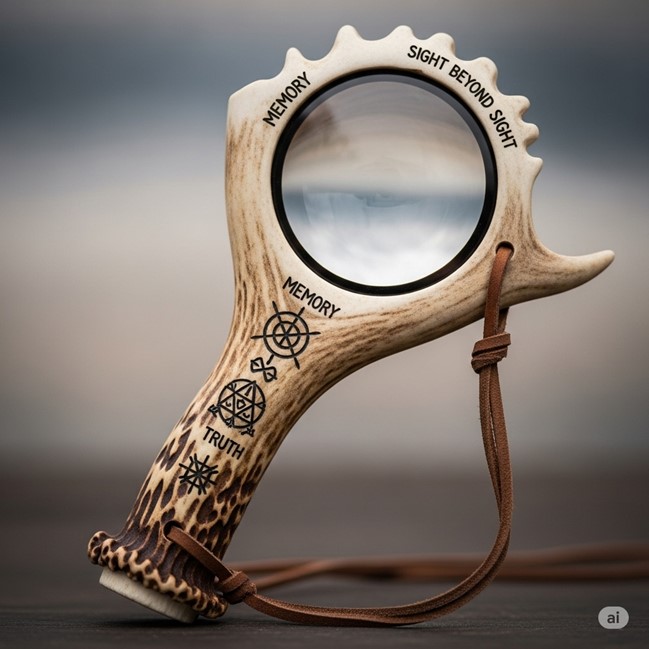
Description: This item is a single, hand-held lens, roughly the size of a person’s palm. The lens itself is a disc of expertly polished smoky quartz, which makes the world appear hazy and grey when looked through. This lens is set in a frame carved from the dense, pale antler of a great reindeer. The antler is etched with fine, black, shamanic symbols representing concepts like “memory,” “truth,” and “sight beyond sight.” A simple, tough leather cord is attached to the handle, allowing it to be worn around the neck. The item is cool to the touch and smells faintly of woodsmoke and cold air.
Stats
- Bonus: If the wearer has trained the Investigation skill, this lens grants a +1 bonus to all attempts to search a location for physical clues.
- Bonus: If the wearer has trained the Perception skill, this lens grants a +1 bonus when looking for things that are hidden, out of place, or supernaturally concealed.
Passive Magics
- Residue Gaze: When viewing the world through the lens, areas or objects saturated with strong, recent emotional or magical energy are visible as faint, colored stains. The site of a violent murder might leave a deep crimson stain on the ground, an object held by someone in deep sorrow might have a faint blue aura, and the lingering energy of a powerful spell might be visible as a shimmering, silvery haze. The lens reveals that something significant occurred, but not what it was.
- Spirit-Sight: Ethereal or spiritual beings are easier to perceive through the lens. Ghosts, nature spirits, and other incorporeal entities that would appear translucent or invisible to the naked eye become solid and clearly defined when viewed through the smoked quartz, though they remain out of phase with the physical world.
Activable Magics
- Trace the Echo (Normal Casting): The user can focus on a specific spiritual residue they can see through the lens (such as a bloodstain or a magical scorch mark). By holding the lens and beginning a low, rhythmic chant, they can coax a faint, shimmering trail of the same color to appear. This trail will follow the path the source of the residue took after the event for up to one hundred feet before fading. The trail lasts for only a few minutes.
- Drink the Echo (Ritual Casting): This is the lens’s primary forensic function and requires at least one minute of uninterrupted ritual chanting over a single, significant object from a scene (e.g., a murder weapon, a dropped personal item, a blood-stained piece of cloth). After the chant is complete, the user looks at the object through the lens. They will receive a single, fleeting sensory impression from the object’s perspective—an echo of the last, most powerful event it witnessed. Looking at a dagger might grant a flash of the killer’s rage, a feeling of the victim’s pain, or the sound of their last words. The clue is powerful, but brief and often symbolic.
Gear Slot: Eye
Tags: Common, Eye, Tier 1, Divination, Investigation, Forensics, Shamanic, Ritual, Quartz, Antler, Spiritual, Hand-held, Detection, Tracking, Information
The Tunguska 1908 of the Echo-Drinker’s Lens is a highly specialized tool. It holds little value for a common adventurer or soldier, but it is an invaluable instrument for those who deal in secrets, truths, and the lingering whispers of the past. As such, it is bought and sold in niche markets that cater to investigators, shamans, and information brokers.
The Shamanic Supply Outpost
In settlements with strong shamanistic traditions, or in dedicated cultural districts within larger cities, one can find shops that cater to the needs of spiritual practitioners. These places smell of woodsmoke, burning sage, and drying herbs. They are filled with ritual components: ceremonial drums, carved bone fetishes, bundles of rare feathers, and sacred minerals. The Echo-Drinker’s Lens is sold here not merely as a tool, but as a sacred object used to commune with the spirits and bring truth to light.
The transaction is a solemn and respectful process. The proprietor, often a practicing shaman or a community elder, will not sell such an item to just anyone. They will speak with the potential buyer to gauge their character and their reasons for wanting the lens. A buyer seeking justice for the dead or understanding of a great tragedy would be deemed worthy. A buyer seeking only to exploit the secrets of others would be refused.
Cost: The price reflects the item’s spiritual importance. It would be sold for a firm 9 Silver. The seller is not interested in haggling, but in finding a worthy keeper for the artifact.
The Private Investigator’s Supply Co.
Tucked away on a quiet side street in a major metropolis is the kind of discreet establishment that caters to private investigators, information brokers, and spies. The storefront is unassuming, perhaps disguised as a dusty old bookstore or a notary’s office. Inside, the shop is meticulously organized, selling specialized equipment for surveillance, disguise, and magical forensics. The Echo-Drinker’s Lens is a prize here, valued for its unique ability to uncover clues that no mundane or technological method could ever reveal.
The shopkeeper is a professional who values privacy above all else. The transaction is quiet and discreet. The lens’s function would be described in practical terms: “It allows you to see the psychic residue of violent or emotional events.” The clientele is trusted, and the prices are high, reflecting the specialized nature of the inventory and the guarantee of silence.
Cost: 2 Gold. The price is non-negotiable, as it is a professional expense for those whose livelihood depends on such tools.
The City Watch Evidence Auction
In the bowels of a City Watch precinct house lies a cluttered evidence locker, filled with items from closed cases, confiscated goods, and things left unclaimed. Periodically, to clear space and raise funds, the Watch will hold a quiet, unadvertised auction or sale of these items. An Echo-Drinker’s Lens could easily end up here—confiscated from a criminal shaman, dropped by a victim at a crime scene, or simply logged as a “strange piece of glass” and forgotten.
The process is impersonal and bureaucratic. A grizzled, overworked Watch sergeant runs the sale. Items are sold “as-is,” often in bundled lots, with no explanation of their function. The sellers do not know or care that the lens is magical. A shrewd buyer who recognizes the lens for what it is can acquire it for a pittance.
Cost: Extremely low. It might be part of a box of miscellaneous trinkets sold for 3 Silver, or even acquired for a handful of copper coins if no one else bids.
The Tundra Caravan Merchant
Vast, cold tundras are home to nomadic peoples who trade via traveling caravans. These merchants move from one encampment to another in large, fur-lined wagons drawn by great, shaggy beasts. They trade in goods essential for survival in the cold: warm furs, preserved meats, bone tools, and the shamanic crafts of the local tribes. The Echo-Drinker’s Lens is a common, locally made tool for them, used to track game and understand the stories left behind in the snow.
The transaction is a practical one. The caravan merchant is a hardy survivor who understands the value of a good tool. They would see the lens as a useful, but not priceless, object. They are often more interested in bartering for goods they cannot easily acquire themselves, such as strong metal tools, woven cloth from the south, or potent alcoholic spirits.
Cost: To an outsider, the price in coin would be 1 Gold and 5 Silver. However, the trader would much prefer a barter. A good quality steel hatchet, a bolt of wool cloth, or a small barrel of whiskey would be considered a more than fair trade.
The Tunguska 1908 of the Echo-Drinker’s Lens is an instrument of truth, not violence. It cannot block a sword or fire a magical bolt. Its role in a conflict is entirely informational. “Defense” is the art of knowing a blow is coming before it is thrown, and “offense” is the art of using an enemy’s hidden secrets as a weapon against them.
Defensive Roleplaying Applications
Defense with the Echo-Drinker’s Lens is about pre-emption and awareness. It allows the user to see the unseen dangers of the past and present, and to navigate the world with a caution born of supernatural insight.
Scenario: Navigating a Trapped Corridor in an Ancient Tomb An avatar must proceed down a long, silent hallway in a ruin known to be filled with deadly traps. There are no visible triggers or mechanisms.
The avatar raises the lens to their eye. Using the Residue Gaze passive, the mundane corridor is transformed into a ghostly tableau. They see faint, dark red stains on the floor where previous explorers bled out. They see streaks of shimmering silver on the walls where magical wards once discharged. They see a particularly large, blue-white stain of pure terror frozen in the air in front of a featureless wall, indicating where someone was frightened to death. The avatar cannot see the traps themselves, but by treating the stains as a map of past failures, they can carefully plot a course through the corridor that avoids the sites of these long-dead echoes, dramatically increasing their chances of survival.
Scenario: A Tense Negotiation with a Hidden Threat The avatar is in a parley with a rival guild master, who is flanked by two large bodyguards. The guild master seems calm, but the situation is tense.
Suspecting treachery, the avatar casually lifts the lens as if to inspect it for smudges. Looking through it with the Spirit-Sight passive active, they survey the room. The two visible bodyguards appear as normal, but standing in the corner behind a curtain, the avatar sees a third figure—a clear, solid-looking ethereal shape holding a spectral crossbow. It’s a hired assassin from the spirit world, completely invisible to everyone else. Armed with this knowledge, the avatar’s defensive strategy changes entirely. They know the negotiation is a sham. They can preemptively move out of the spirit’s line of sight, or even speak directly to it—”I see you in the corner. Your employer won’t pay you if he’s dead”—to the utter shock and confusion of everyone else in the room.
Offensive Roleplaying Applications
Offense with the Echo-Drinker’s Lens is about wielding information like a blade. It is about uncovering an opponent’s weaknesses, tracking the untrackable, and exposing the truth to devastating effect.
Scenario: Tracking an Elusive Bounty The avatar is hunting a bounty who is a master of disguise and an expert at covering their tracks. The trail has gone cold in a crowded city square.
The avatar finds the last confirmed location of their quarry—a food stall where the bounty bought a piece of fruit. The avatar pulls out the discarded fruit core from a refuse bin. They begin the Drink the Echo ritual, chanting softly while holding the lens over the core. They receive a brief, powerful vision: not the bounty’s face, but the overwhelming feeling of paranoia and the scent of the sewers. They now know their quarry is not hiding in plain sight, but is fleeing underground. The avatar then finds a nearby sewer grate. Using Trace the Echo on the ground where the bounty stood, a faint trail of the quarry’s anxious energy leads directly to that grate, confirming the path. The hunt is back on.
Scenario: Exposing a Corrupt Official A powerful magistrate is suspected of taking bribes, but he is too careful to leave a trail of evidence. The avatar needs to expose him during a public tribunal.
The avatar manages to gain access to the magistrate’s courtroom beforehand. They take out the wooden gavel that the magistrate uses to pass judgment. They perform the Drink the Echo ritual on it. They receive a flash of sensory information from the gavel’s “perspective”: the feeling of smug satisfaction, the sight of a heavy bag of gold coins being placed on the desk next to it, and the sound of a guilty party’s name being whispered in a promise of leniency. At the tribunal, the avatar does not just make an accusation; they use this knowledge offensively. They look the magistrate in the eye and say, “Tell us, magistrate, did this gavel feel as smugly satisfied when you acquitted the smuggler as it did when you accepted his gold?” This detail, a secret emotional truth made public, shatters the magistrate’s composure and turns the tribunal against him.
Perception of Activation:
User’s Perspective
When an avatar performs a ritual such as “Drink the Echo” with the lens, they are not unleashing power, but rather attuning themselves to the echoes of a past event. The experience is one of sensory deprivation followed by a brief, overwhelming sensory flood.
- Sight: As the user holds the lens and begins the ritual chant, the world seen through the quartz becomes progressively desaturated. Colors fade to grey, and the edges of objects grow hazy and indistinct. The only object that remains clear is the target of the ritual, which seems to pulse with a faint, sickly light. At the ritual’s climax, the user’s vision is completely replaced by a brief, first-person flash of a past memory—often blurry, disjointed, and viewed from an unnatural angle, as if seeing through the “eyes” of the object itself.
- Sound: The user’s own chanting voice sounds distant and hollow. All other ambient noise in the present fades to absolute silence, replaced by a low, steady hum that seems to emanate from the lens and vibrate directly in the user’s skull. During the final vision, this hum is pierced by a single, perfectly clear sound from the past: a victim’s scream, the unsheathing of a blade, a whispered promise.
- Smell: A powerful and distinct scent profile overwhelms all others. The air becomes cold and sharp, smelling of ozone, ancient dust, and the faint, unmistakable scent of woodsmoke on a winter night.
- Touch: The antler frame of the lens becomes unnaturally cold, feeling like a piece of ice against the user’s hand. The air around the user grows heavy and still, and they may feel a profound physical coldness seep into their bones.
- Taste: The user’s mouth fills with the taste of cold, metallic water, with a dry aftertaste of ash.
- Extra-Sensory Perception (Temporal Disconnect): The user feels a profound detachment from their own body and the present moment. It is a feeling of sinking backwards through time, of becoming an immaterial observer to an event that is already immutable and unchangeable.
- Extra-Sensory Perception (Empathic Imprint): The final vision is not merely sensory; it is a direct, unfiltered transfer of the dominant emotion tied to the event. The user feels the raw, undiluted rage of the attacker, the stark terror of the victim, or the deep sorrow of the bereaved as if it were their own. This emotional impact is often more powerful and memorable than the visual itself.
Positives: The user gains access to a direct, undeniable piece of truth from the past. The information is pure and free from the bias of a living witness, providing a powerful advantage in any investigation.
Negatives: The process is mentally and emotionally exhausting. Experiencing the raw emotions tied to a violent or tragic event can be deeply traumatic and may “stain” the user’s own emotional state for hours or days. The user is completely vulnerable during the ritual.
Observer’s Perspective
To an observer, the activation of the lens is a quiet, eerie, and unsettling ritual that seems to deaden the surrounding environment.
- Sight: The user appears to enter a deep state of concentration as they chant. The smoky quartz lens itself begins to emit a faint, cold, grey light that seems to absorb the color from its immediate surroundings, making the user and the ritual object appear strangely monochrome. At the ritual’s climax, the user’s eyes will often roll back or glaze over with a milky white film for a single, unnerving second.
- Sound: The user’s rhythmic, monotonous chant is the most prominent sound. All other ambient noise in the immediate area seems to become muffled and distant, creating a pocket of unnatural silence. A person standing very close might also hear the faint, low hum emanating from the lens.
- Smell: A noticeable, localized scent of cold air and old smoke will emanate from the user’s position, a smell that is often out of place with the surrounding environment.
- Touch: The temperature in the immediate vicinity of the ritual will drop by several degrees. The air will feel heavy, still, and charged with static.
- Taste: There is no perception of taste for an observer.
- Extra-Sensory Perception (The Mind’s Eye): A magically-attuned observer would see the user’s magic acting like a subtle vortex. They would perceive faint, smoke-like tendrils of spiritual and temporal energy being drawn from the ritual object and siphoned into the lens. At the ritual’s conclusion, they would see a flash of this concentrated “grey” energy transfer from the lens directly into the user’s head in a single, silent psychic pulse.
Positives: The ritual is quiet and contained, unlikely to attract unwanted attention from a distance. For allies, it is a clear sign that a deep, truth-seeking magic is being performed.
Negatives: The user is completely helpless and unaware of their surroundings for the duration of the ritual. The unnatural silence, the drop in temperature, and the user’s blank-eyed trance at the end are deeply unsettling to witness and can easily be mistaken for a dangerous necromantic rite.
The Rite of the Unblinking Witness
This document describes the solemn ritual for crafting an Echo-Drinker’s Lens. The process is a meditation on truth and time, requiring the artisan to act as a bridge between the present and the lingering sorrows of the past. It is a craft of patience, reverence, and immense spiritual focus.
Materials Needed
- A River-Worn Quartz (The Eye): A palm-sized, naturally smooth stone of smoky quartz. It must be found in the bed of a slow-moving, silent river that flows through a land with a long and tragic history (such as an ancient battlefield or a forgotten, ruined city). The water’s slow passage over the stone is believed to polish away falsehoods, leaving only a core of truth.
- Antler of the Old Bull (The Frame): A single, shed antler from a great reindeer bull that was at least twenty winters old. An antler taken from a killed animal will not work; it must be one that was freely given up by the cycle of seasons, symbolizing a memory willingly let go.
- Soot of a Story-Fire (The Ink): A small amount of fine, black soot collected from the stones of a hearth where the same story has been told by the same family for at least three generations. This soot is saturated with the echoes of oral tradition.
- Tears of the Mountain (The Polish): A flask of water collected from the slow melt of ancient, high-mountain ice. This water is considered pure and free from the chaotic memories of the lower world.
- Binding Sinew: A single, long strand of sinew taken from the same reindeer whose antler is being used, ensuring a unified spirit within the frame.
Tools Required
- Flint Knives and Scrapers: A set of sharp-edged flint tools for the delicate carving of the antler. Metal is considered too loud and aggressive, and would frighten the subtle spirits of memory.
- Sand and Leather Polishing Kit: A series of leather pads and pouches of sand collected from different environments (fine desert sand, coarse river sand) used to grind and polish the quartz lens.
- A Diviner’s Bowl: A shallow, dark stone bowl, perfectly smooth on the inside, used for the polishing and final awakening ritual.
- A single, hollow bird bone: Used as a stylus to apply the soot-ink.
Skill Requirements
- Artisan (Lapidary/Carving): Requires immense patience and a delicate touch to shape and polish the quartz and carve the intricate antler frame without tools of modern precision.
- Investigation: The crafter must be skilled enough to find the specific, historically significant locations required to gather the quartz and the soot.
- Ritualist Knowledge: The crafter must know the low, monotonous chants that attune the mind to the vibrations of the past.
- A Quiet Soul: The artisan must possess a calm, contemplative, and empathetic nature. A person filled with their own “noise” cannot hear the whispers of the past needed to imbue the lens.
Crafting Steps
- The Polishing of the Eye: The artisan places the river-worn quartz into the Diviner’s Bowl and adds a small amount of the coarse sand and mountain-tear water. For one full day, from sunrise to sunrise, they must polish the stone in slow, circular motions. As they polish, they must not speak, but hum a single, low note, focusing their mind on the concept of clarity and revealing what is hidden. The process is repeated with finer and finer sand until the quartz is perfectly transparent, yet still smoky.
- Carving the Frame of Memory: The artisan takes the Old Bull’s antler and begins to carve it into the frame using the flint tools. They must carve not just a shape to hold the lens, but a story. The handle should represent the past, the circular frame the present, and the tines pointing forward the future. This is a meditative process where the artisan must reflect on the nature of time and consequence.
- Inscribing the Truth: The artisan mixes the Soot of a Story-Fire with a few drops of the mountain-tear water to create a simple, black ink. Using the hollow bird bone as a stylus, they carefully etch the shamanic symbols for “truth,” “memory,” and “sight” into the antler frame. With each symbol, they must whisper the story that was told over the fire from which the soot was gathered, binding the power of oral history into the frame.
- Setting the Eye: The polished quartz lens is carefully fitted into the antler frame. The Binding Sinew is then meticulously wrapped in grooves carved into the frame and lens, securing it in place without the use of any glue or artificial adhesive. The spirit of the reindeer is now whole again, holding the Eye of Truth.
- The Rite of Stillness: This final step awakens the lens. At twilight, the artisan takes the completed lens to a place of absolute silence, such as a deep cave or a windless forest clearing. They fill the Diviner’s Bowl with the remaining mountain-tear water and submerge the lens. The artisan then enters a trance state, staring into the bowl. They do not cast a spell, but rather “drink” the silence of the location through the lens. They must remain this way until the first light of dawn. As the first ray of sun strikes the bowl, the lens will absorb the silence and the light, becoming a perfect, empty vessel, now ready to be filled with the echoes of the past. It is now complete.
Shaman Who Saw Last Cry
In the great, cold lands, there was a tribe of people who followed the reindeer. Their chief had a son, a great hunter named First Spear. He was strong and brave. One day, he did not return from his hunt. The people searched. They found him on the ice, his face to the sky. He was dead, with a wound in his back. This was a sad thing, for the people of the tribe did not kill each other.
Near the body was nothing. But the chief saw that another hunter, named Second Spear, now walked with no spear. First Spear and Second Spear were rivals. They were both great hunters and they both loved the same woman. The chief’s heart was full of a great sadness, and the sadness turned to anger. He pointed his finger at Second Spear and said, “You have done this thing! Your spear is gone because it is in my son’s back! You will be cast out into the cold, to be eaten by the wind.”
Second Spear was afraid. He said, “No, great chief. I did not kill him. My spear was lost in the last hunt. A spirit of the ice must have done this deed.” But his words were weak, and the chief’s anger was strong. No one believed him.
Only one man was not sure. He was the shaman, He-Who-Hears-The-Ice-Melt. He was very old. His eyes were like clouded ice and his hearing was poor. But his spirit-sight was still strong. He went to the chief and said, “A man’s anger and a spirit’s anger do not leave the same mark on the world. The cry of a man who is killed and the cry of a beast who kills are different sounds in the spirit-world. Let me look at the place where First Spear fell. The ice remembers.”
The shaman went to the place on the great ice field. He carried his tool, a lens he had made from the smoky heart of a river stone, held in the antler of a reindeer that had seen a hundred winters. He knelt by the dark stain of frozen blood. He held the lens to his eye. The world turned grey and quiet when seen through the stone.
He looked first at the blood. It was a stain of violence, yes, a dark red echo. But inside the red, he saw also a faint color of blue, which was the color of great sorrow and regret. This was strange. A rival who killed in anger would not leave a stain of sorrow.
He then saw First Spear’s own hunting knife, fallen near his hand. The shaman held his lens over the knife. He began his low, sad chant. He chanted for a long time. He was asking the knife to tell him its last memory. He was drinking the echo.
The world went away. The shaman saw a vision. He saw through the knife’s memory. He saw the world from First Spear’s hip. He saw the great, white plains of snow. He saw a shape rise from the blowing snow. It was not a man. It was a great white bear, a spirit-bear, tall as two men. First Spear shouted and threw his spear. The spear hit the bear in the shoulder. The bear roared, a sound of great pain and anger. It charged. The shaman saw the great white claws come down. He felt the pain of First Spear as the bear struck him down. Then, the bear, wounded and crying its own pain, pulled the spear from its own shoulder. In its rage, it turned and pushed the spear into the back of the man who had hurt it. Then it limped away, leaving the man and the knife on the ice.
The shaman opened his eyes. The vision was gone. He now knew the truth.
He went back to the chief. He said, “Second Spear is not the killer. Your son, First Spear, died a warrior’s death. He fought a spirit-bear of the great ice. He wounded it, but it killed him. The sorrow in the blood-stain was the bear’s sorrow for its own wound.”
The chief said, “How can you know this thing?”
The shaman held up his lens. “The knife he carried told me what it saw. Its memory is true.”
The chief sent out his best hunters. He did not tell them to look for a man. He told them to look for the tracks of a great white bear, a bear that was wounded in the shoulder. Two days later, the hunters found the great bear, dead from its wound. And in its shoulder was the lost spear of First Spear. The truth was now known to all, and Second Spear was not cast out.
The Moral of the Story: A man’s eye can see a thing and be wrong. A man’s ear can hear a thing and be wrong. But the memory of wood and stone and blood cannot tell a lie, for it only knows what it felt. A wise man listens to the things that cannot speak.
Suggested conversions to other systems:
Call of Cthulhu (7th Edition)
The Psychometricist’s Lens
A shamanistic artifact that allows an Investigator to perceive psychometric echoes and spiritual residues left at scenes of great violence or emotion, at a considerable risk to their own sanity.
Game Mechanics:
- Description: A handheld lens of smoked quartz set in an antler frame.
- Echo-Sight: When looking through the lens, the Investigator can see faint, colored stains on objects or locations where powerful emotions were felt or potent magic was used within the last week. Interpreting these stains may require a successful Occult or Spot Hidden roll for very old or subtle traces.
- Object Reading: By spending 1d4 Sanity Points and 4 Magic Points, the Investigator can perform a 10-minute ritual focusing on a single object. Upon completion, they receive a brief and symbolic vision of the last person to handle the object and the dominant emotion they were feeling at the time. Using this ability may require a Cthulhu Mythos roll at the Keeper’s discretion.
Blades in the Dark
The Echo-Glass
A strange artifact, possibly from before the cataclysm, that allows a Whisper or Leech to perceive and interpret the echoes of the ghost field with greater clarity than their own senses allow.
Game mechanics:
- Item Type: Artifact; Mystic, Divination, Weird.
- Survey the Echoes: When you Survey the scene of a recent violent or emotional event, you can look through the glass to ask a specific, direct question about what happened here. The GM will answer truthfully but with a single, cryptic detail that others would miss.
- Attune to the Past: When you perform a downtime activity to Attune to the ghost field to witness a past event, you may use the Echo-Glass as a focus. If you do, you get +1d to your roll. On a result of 1-3, however, you are haunted by a specific echo from the scene, taking a level of Harm (e.g., Grieving, Enraged, Terrified).
Dungeons & Dragons (5th Edition)
Lens of Lingering Emotions
A common wondrous item that acts as a shamanistic focus for divining clues from the spiritual residue left by significant events.
Game Mechanics:
- Wondrous item, common
- Description: A handheld lens of smoky quartz in an antler frame.
- Echo Sight. While looking through the lens, you have advantage on Wisdom (Perception) and Intelligence (Investigation) checks made to find clues at the scene of a death or a powerful magical event that occurred within the last 24 hours.
- Object Reading. You can perform a 10-minute ritual focusing on a single object. At the end of the ritual, you receive a fleeting, symbolic mental image of the last creature to hold the object and the most powerful emotion it felt while doing so. Once you use this property, you can’t use it again until you finish a long rest.
Knave
Sooth-Glass
A shaman’s tool that allows the user to see things that are normally invisible, such as emotional stains and ghostly apparitions.
Game Mechanics:
- Description: A handheld lens of dark crystal in a bone frame. Takes up 1 inventory slot.
- Stain-Sight: When looking through the glass, you can see significant emotional residues from the last 24 hours. A place of violence is stained red, a place of sorrow is blue, and a place of great fear is stained white. The glass does not explain the stain.
- Ghost-Sight: When looking through the glass, invisible or ethereal creatures (like ghosts and spirits) appear as solid, visible forms to you, though you cannot touch them.
- Object’s Feeling: Once per day, you can hold the glass over an item and meditate for a full turn. The GM will tell you the last strong emotion the item’s previous owner felt while holding it (e.g., “rage,” “fear,” “love”).
Fate Core System
The Shaman’s Truth-Glass
An Extra that grants the character narrative permissions to perceive spiritual residue and gain insight into past events. It is represented by an item Aspect and a related Stunt.
Game Mechanics:
- Item Aspect: The Past Is Never Truly Gone.
- Invoke: For a +2 on Investigate rolls when examining a crime scene or analyzing a clue.
- Compel: The character gets lost in a distracting or horrifying vision of the past at an inopportune moment, or misinterprets an emotional echo, causing them to act on false assumptions.
- Stunt – Drink the Echo: Because I possess The Shaman’s Truth-Glass, once per session, I can perform a short ritual on an object to ask the GM one question about the last person who held it. The GM will answer, but the answer will be a single, symbolic feeling or image (e.g., “overwhelming rage,” “the scent of saltwater,” “the sound of a breaking promise”).
Numenera & Cypher System
Chronon-Echo Lens
A datasphere device from a prior world that can scan for and interpret the temporal and psychic residue left on objects and locations by living creatures.
Game Mechanics:
- Artifact: Level 4.
- Form: A handheld lens of crystal set in a polished, antler-like frame.
- Effect (Passive): The user is trained in all tasks involving the perception and investigation of crime scenes or unusual phenomena. (This eases such tasks by one step).
- Effect (Active): Action. The user scans an area within short range. For the next minute, they can see faint, shimmering after-images of any creature that performed a significant action there within the last hour.
- Effect (Active): Action to initiate. The user scans a single object for one minute. The lens provides a one-sentence summary of the object’s most recent, emotionally charged interaction (e.g., “This knife was used in an act of betrayal against a friend.”). Depletion: 1 in 1d20.
Pathfinder (2nd Edition)
Lens of the Unseen
A low-level magical item that aids in investigation by revealing spiritual traces and providing cryptic insights into an object’s recent history.
Game Mechanics:
- Item 2
- Uncommon, Divination, Magical
- Price 35 GP
- Usage held in 1 hand; Bulk L
- Passive: While looking through the lens, you can see the lingering auras of strong emotions from the past 24 hours as faint, colored light. This grants you a +1 item bonus to Perception checks to Sense Motive and to Survival checks to Track creatures that have left a strong emotional trail.
- Activate [10 minutes] envision, concentrate; Frequency once per day; Effect You focus on a single object you are holding. The lens grants you a brief vision of the last person to hold it, functioning as the object reading psychic cantrip, even if you are not a psychic.
Savage Worlds Adventure Edition (SWADE)
The Seer’s Eyeglass
A shamanistic fetish that allows the user to see things normally unseen, such as spirits and the emotional echoes of the past, making it a powerful tool for any investigator.
Game Mechanics:
- Description: A handheld lens of dark glass in a bone frame.
- Spirit Sight: The bearer can see invisible or ethereal beings (like ghosts) while looking through the lens. They are visible but cannot be harmed unless the bearer has a magical weapon or power.
- Psychometry: The bearer gains the Object Reading Power and may only activate it by using the lens as an arcane focus. This requires an arcane skill roll and Power Points as normal.
- Follow the Echo: Once per day, the user can focus on a spot where a significant event occurred. They may make a Notice roll to follow a trail of spiritual residue left by a person involved. A success allows them to follow the trail for up to one hour or one mile. With a raise, the trail is exceptionally clear, granting a bonus to any subsequent Tracking roll.
Shadowrun, Sixth World
Siberian Psychometric Focimeter
A rare shamanic focus, typically originating from secluded magical traditions in the Siberian wastes. It allows the user to perceive and interpret astral signatures and emotional residue left on objects and locations, making it a valuable tool for magical investigation.
Game Mechanics:
- Focus Type: Divination Focus, Rating 3
- Availability: 9R
- Cost: 12,000 nuyen
- Echo-Sight: The focus adds its Rating (3) as a dice pool bonus to any Assensing test made to read the astral signature of an object or location.
- Ritual Divination: The focimeter can be used as the primary material link for the Psychometry ritual. When used this way, the ritual leader gains 1 point of Edge before the ritual casting test is made.
- Drawback: The lens shows glimpses of traumatic events. After successfully using the focus to read an echo of a violent death, the user must resist 3 Stun damage (Willpower + Firewall) from psychic feedback.
Starfinder
Lens of the Soul-Reader
A hybrid item that uses a combination of low-level divination magic and psychic-resonance technology to analyze crime scenes and uncover clues invisible to the naked eye.
Game Mechanics:
- System: Hybrid Item, held
- Level 2; Price 850 credits; Bulk L
- Scene Analysis: As a standard action, you can scan a 10-foot square area. The lens highlights faint traces of blood, magical energy, and other specific residues, granting you a +2 insight bonus on Perception checks to search the area for one minute.
- Object Reading (Sp): Once per day, you can perform a 1-minute ritual focusing on a single object. At the end of the ritual, you gain a brief, symbolic mental image related to the last creature that held the object. This functions as the psychopomp’s insight witchwarper spell.
Traveller (Mongoose 2nd Edition)
Zhodani ‘Olam’ Viewer
An advanced Zhodani psionic device that can detect and interpret lingering telepathic impressions left on objects and places by significant emotional events. Possession of this item is highly illegal outside the Zhodani Consulate.
Game Mechanics:
- Tech Level: 13 (Alien, Psionic)
- Mass: 0.2 kg
- Cost: MCr 0.5+
- Echo Detection: A character with the Psionics (Telepathy) skill can use the viewer to scan an area. This allows them to make a Psionics (Telepathy) 8+ check to detect the location of any significant psionic or emotional events that occurred there within the last 24 hours.
- Object Reading: By focusing on a single object for one minute, a psion can make a Psionics (Telepathy) 10+ check. On a success, they receive a single, strong emotional imprint (e.g., rage, fear, sorrow) from the last person to handle the object. An Exceptional success may reveal a fleeting visual image.
- Risk: A failure on any check made with the viewer inflicts 1d6 damage on the user due to uncontrolled psychic feedback.
Warhammer Fantasy Roleplay (4th Edition)
The Dowser’s Eye
A magical artifact, possibly of Elven or Hedge Wizard make, that allows the user to see the “spirit-stains” left by powerful events and commune with the lingering echoes of the recently departed.
Game Mechanics:
- Encumbrance: 0
- Qualities: Magical, Divination.
- Aethyric Sight: When looking through the lens, the character can perceive the ambient Winds of Magic. They may make a Challenging (+0) Channelling Test to identify which Wind is strongest in a particular location, providing clues to the type of magic used there recently.
- Corpse-Whispers: If used to examine a dead body that has been deceased for less than a day, the character can make a Challenging (+0) Intuition Test. If successful, the GM gives them a one or two-word clue about the cause of death or the killer’s identity (e.g., “Betrayal,” “Green Robe,” “Sharp Pain”). Each use of this ability, successful or not, causes the user to gain 1 Fatigued Condition as they are drained by the spiritual contact.