
Lore: When avatars from the Tunguska traditions found themselves not in the great wild taiga but in the sprawling, bureaucratic cities of Saṃsāra, they had to adapt their magic to survive. They discovered that the spirits were not just in the trees and the rivers, but that a faint, lesser spirit—an echo of intent and history—lingered in all things crafted by human hands. A contract signed with pride had a proud spirit; a seal stamped in anger had an angry one.
These urban shamans created tools not for hunting, but for navigating the complex world of documents, sigils, and seals. The Weaver of Whispers is a forger’s kit born from this tradition. It does not simply copy a document; it allows the user to enter a trance and communicate with the spirit of the original work. The shaman asks the document’s spirit to tell its story—its ink, its paper, its signature—and then coaxes it into helping create a “sibling,” a near-perfect twin. It is a tool of deception, but one that operates through empathy and spiritual communication.
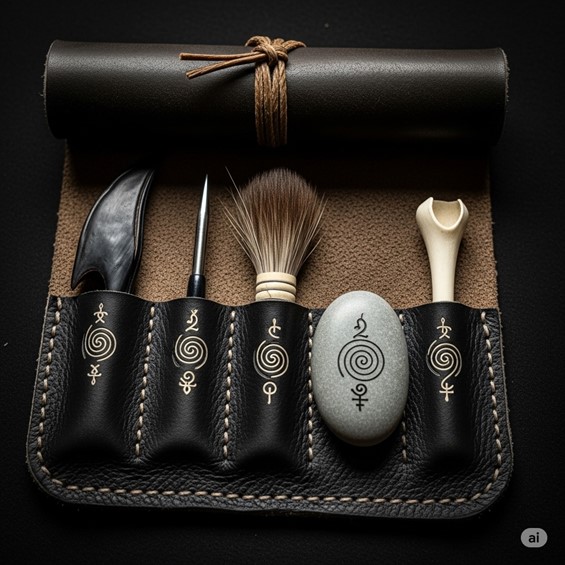
Description: This item is a small roll of soft, dark reindeer leather, tied shut with a sinew cord. When unrolled, it reveals a series of meticulously stitched pockets containing a forger’s tools, each with a shamanic purpose. The kit includes: a fine-tipped stylus carved from a raven’s beak (for ‘stealing words’), a brush made from the whiskers of a cat (for ‘silent, unseen strokes’), a small, perfectly smooth and flat stone for burnishing paper, and a hollow bird bone for blowing fine-powdered ink. Each tool is etched with faint, spiraling symbols representing mimicry, secrets, and echoes. The entire kit smells faintly of old paper, dry ink, and ozone.
Detailed Stats
- Bonus: If the wearer has trained the Forgery skill, this kit grants a +1 bonus to all attempts to create false documents, copy signatures, or replicate seals.
- Bonus: If the wearer has trained the Calligraphy or a similar Artisan skill, this kit grants a +1 bonus when attempting to duplicate a specific style of writing.
Passive Magics
- Whisper of the Quill: When the user handles a document written by another, the tools in the kit vibrate faintly. The user receives a weak psychic impression of the writer’s emotional state at the time of its creation (e.g., “written in great haste,” “signed with immense pride,” “penned with a sorrowful heart”).
- Scent of the Ink: The user can subtly analyze the “spirit” of the materials. By holding a tool from the kit close to a document, they can intuitively sense the nature of the ink and parchment used—whether the materials are common and cheap or rare and expensive, and roughly how long ago the ink was applied to the page (within days, weeks, or years).
Activable Magics
- Chant of Sympathy (Normal Casting): The user can hold one of the kit’s tools (like the raven-beak stylus) and chant softly over a specific signature, seal, or emblem for about a minute. The chant is a shamanic plea, asking the “spirit” of the mark to lower its conceptual defenses and be more open. For the next hour, any mundane attempt to physically copy that specific mark is made significantly easier, as the user’s hand seems to instinctively know the exact pressure and strokes required.
- Weave the Twin (Ritual Casting): This is the kit’s primary function. It requires a 10-minute ritual where the user lays out the full kit, with the original document and a blank piece of high-quality parchment side-by-side. The user enters a light trance, chanting to the spirit of the original document, not as a forger, but as a respectful listener. They ask the spirit to help birth a “twin.” If the ritual is successful, the user’s hand is guided by an unseen force as they work. The ink will flow perfectly to mimic the original’s fading, the hand will replicate every tremor and flourish of the signature, and the new parchment will even feel slightly aged. The result is a near-perfect physical forgery that is exceptionally difficult to detect by non-magical means. This does not replicate any magical wards or watermarks on the original.
Gear Slot: Held (Tool Kit)
Tags: Common, Held, Tier 1, Tool, Forgery, Shamanic, Ritual, Subtle, Divination, Leather, Bone, Artisan, Utility, Deception, Communication, Information
The Tunguska 620 of the Weaver of Whispers is a highly specialized tool whose purpose, forgery, is often illegal or, at best, operates in a legal grey area. Therefore, it is not an item found in common markets but is bought and sold in secretive, professional, or esoteric circles where its unique shamanic approach to imitation is understood and valued.
The Scribes’ Guild (Special Acquisitions)
Within the grand, library-like halls of a major city’s Scribes’ Guild, most business is legitimate, dealing in fine papers, rare inks, and official notary services. However, in a locked back room managed by the Guild Master themself, “Special Acquisitions” are available to trusted members. Here, the Weaver of Whispers is sold under the guise of being a tool for “historical recreation.” It is purported to be for restorers who must understand the “spirit” of an ancient document to create a faithful museum-quality reproduction. This is its only semi-legitimate market.
The transaction is exceptionally discreet and professional. A buyer must be a high-ranking Guild member or present a commission from a powerful noble or academic institution. The Guild Master will handle the sale personally, emphasizing the ethical responsibility that comes with such a tool. A contract is often signed, binding the user to employ the kit only for academic or restorative purposes.
Cost: The price is high, reflecting the Guild’s control over such sensitive tools and the implied trust. The cost is a firm 2 Gold.
The Black Market Forgery Supplier
In the criminal underworld of any large city, there are suppliers who provide the necessary tools for a life of crime. This “shop” has no storefront; it is a contact, a whisper, a meeting in a shadowed alley or a secured room. This supplier deals in lockpicks, poisons, and tools of deception. The Weaver of Whispers is a high-demand item in this circle, valued for its unparalleled ability to forge contracts, deeds of ownership, letters of passage, and anything else that relies on a convincing signature or seal.
The transaction is tense, quiet, and strictly business. The buyer must have a trusted introduction. The supplier, or Fence, will present the kit, state its function bluntly, and name their price. Payment is expected upfront, and in full. There is no room for haggling, and no questions are asked about the buyer’s intent.
Cost: The price is based on the immense potential for illicit profit the kit enables. The cost is 4 Gold, or an equivalent value in untraceable gems or valuable, actionable information.
The Urban Shaman’s Bazaar Stall
In the strange, magically-charged market districts where fringe practitioners gather, one might find a stall run by an “urban shaman.” These individuals specialize in the lesser-known spirits of the city: the spirits of rusted machinery, flowing sewage, and forgotten documents. Their stalls are cluttered with bizarre fetishes, bottled city-smog, and esoteric tools. Here, the Weaver of Whispers is sold not as a forger’s kit, but as a tool of psychometry.
The transaction is a discussion between occult specialists. The shaman proprietor would be fascinated by the kit’s function and would happily discuss the nuances of communicating with the spirit of a wax seal versus that of a legal contract. They are selling a spiritual conduit, not a criminal tool. A buyer who shows respect and knowledge can build a rapport and may even be able to haggle.
Cost: The price is based on its magical curiosity and spiritual function, not its illegal applications. A fair price would be around 9 Silver. The shaman might be willing to trade for another strange spiritual component, like the cog from a factory’s steam-engine that has seen a thousand workers’ hands.
Master to Apprentice
This is the most common way for the item to change hands legitimately. It is not bought, but earned. A master forger, scribe, or spy who is ready to retire will pass their personal, well-worn kit on to their most promising apprentice.
The “transaction” is the culmination of years of dedicated training. The master will not simply hand over the kit, but will perform a small ritual, formally introducing the apprentice to the spirits of the tools and teaching them the final, crucial chants required to “awaken” a document’s spirit. The transfer of the kit symbolizes the apprentice’s graduation into mastery.
Cost: There is no monetary cost. The price is paid through years of loyalty, service, and the successful completion of a final, difficult test of the apprentice’s skills.
The Tunguska 620 of the Weaver of Whispers is an instrument of deception, not combat. Its role in a conflict is never direct, but its ability to alter the “truth” as it is written on paper can be a more potent weapon or a more subtle shield than any sword or suit of armor. Its use is an exercise in social and political maneuvering.
Defensive Roleplaying Applications
Defense with the Weaver of Whispers is about creating plausible deniability, invalidating threats before they can manifest, and using the truth of an object’s history to dismantle a lie.
Scenario: A Warrant for an Impending Arrest An avatar learns that a corrupt city official has issued a warrant for their arrest on false charges. The City Watch will be at their door within the hour. Fighting an entire detachment of guards is not an option.
A friendly contact manages to “borrow” the warrant from the captain’s desk for a few precious minutes. The avatar immediately performs the Weave the Twin ritual. They create a near-perfect duplicate of the warrant, but with one critical detail altered: the address is changed to a rival criminal’s hideout across town. The forged warrant is swapped with the real one. When the City Watch kicks down the door of the new address, they find a different criminal enterprise entirely. The resulting confusion, jurisdictional arguments, and bureaucratic chaos give the avatar the time they need to quietly leave the city, their defense a perfectly executed piece of forged paperwork.
Scenario: Refuting a Forged Accusation in Court During a tribunal, a rival presents a letter, allegedly written by the avatar, that confesses to a terrible crime. The handwriting is a masterful imitation, and the court is convinced of the avatar’s guilt.
The avatar is given the letter to examine. Holding the document, the Whisper of the Quill passive immediately gives them a strong psychic impression of the true writer’s emotion: not their own, but a mixture of malicious glee and nervous fear. The avatar stands before the judges and says, “This is not my hand, and this is not my spirit. I can feel the shaking, hateful heart of the man who truly wrote this.” To provide further proof, they use the Scent of the Ink passive. “Furthermore,” they announce, “the ink used here is a cheap iron gall ink, common in the merchants’ quarter. My own letters, as you well know, are penned with expensive squid ink from the southern isles.” By attacking the spiritual and material inconsistencies of the forgery, they create enough reasonable doubt to unravel the accusation, defending their life and reputation.
Offensive Roleplaying Applications
Offense with the Weaver of Whispers is the art of assassination by ink. It is about destroying a target’s reputation, finances, and relationships by creating false narratives that are so convincing they become truth.
Scenario: Ruining a Business Tycoon A ruthless tycoon is about to close a deal that would ruin a smaller, friendly community. The avatar needs to stop him, but the tycoon is too well-guarded for a direct assault.
The avatar acquires a sample of the tycoon’s signature from a publicly available document. They use the Chant of Sympathy, whispering to the spirit of the signature until it becomes familiar. Then, using Weave the Twin, they forge a series of letters from the tycoon to his business partners. The letters, in the tycoon’s perfect hand, arrogantly detail a plan to betray his current partners the moment the new deal is signed. They forge another set of letters to the other party in the deal, demanding a larger share of the profit. When the letters are “accidentally” delivered to the wrong parties, the tycoon’s reputation for ruthless but reliable dealing is shattered. His partners back out, the new deal collapses, and his business empire is thrown into chaos.
Scenario: Framing a Spymaster The avatar needs to remove a cunning and paranoid spymaster from power. The spymaster is too careful to be caught in any real wrongdoing.
The avatar decides to create the wrongdoing themselves. They obtain a simple requisition form the spymaster signed. Using the kit, they get a feel for the spymaster’s rushed, arrogant signature. They then forge a series of coded messages, appearing to be from the spymaster to an enemy state, offering to sell state secrets. The key is not just copying the handwriting, but using the kit’s power to imbue the forgeries with the same spiritual “feel” of arrogance and authority as the original. When these documents are discovered by the spymaster’s own counter-intelligence agents, they are deemed authentic. The forgeries are so perfect that the spymaster’s own paranoia works against him—he cannot be sure one of his own agents isn’t truly responsible, and his denials seem weak and self-serving. He is undone by a crime that never actually happened.
Perception of Activation:
User’s Perspective
When an avatar performs the “Weave the Twin” ritual, they enter a deep, focused trance where the physical world fades away, replaced by the reality of the document they are forging.
- Sight: The user’s vision tunnels, and the surrounding room blurs into an indistinct grey haze. The only things that remain in sharp focus are the original document and the blank page. They can see details invisible to the naked eye: the faint pressure-ghosts left by the original quill, the microscopic fibers of the parchment, and the subtle fading of the ink. As they begin to work, their own hand seems to move with an uncanny grace, perfectly tracing the ghostly impressions they perceive.
- Sound: All ambient noise ceases. The only sound in the world is the whisper-soft scratch of their stylus on paper and a low, continuous chorus of whispers in their mind. These whispers are the “voice” of the document’s spirit, murmuring about its own creation—the feel of the pen, the smell of the ink, the emotion of the hand that signed it.
- Smell: The user is enveloped by the scent of the original document. They can distinguish the specific aroma of aged iron gall ink, the musty scent of the rag paper it’s made from, and even the faint, lingering smell of the sealing wax or the oils from the last person who held it.
- Touch: The tools from the kit feel like natural extensions of the user’s own body. They can feel every minute texture and imperfection of the paper’s surface through the tip of the stylus. The blank parchment they are working on gradually begins to feel older, drier, and more brittle under their touch as the magic mimics the aging process.
- Taste: A dry, dusty taste fills the user’s mouth, like licking an ancient scroll.
- Extra-Sensory Perception (Object Empathy): The user forges a direct, empathetic link with the spirit of the original document. They can feel its history and purpose—its pride at being a royal decree, its mundane boredom as a shipping ledger, or its sorrow as a final will and testament. The user must connect with this feeling to coax the spirit into helping.
- Extra-Sensory Perception (Guided Hand): The user feels a distinct but gentle force guiding their hand. They are not merely copying what they see; their muscles are being moved by a will outside their own, ensuring that every line, curve, and subtle tremor of the original handwriting is replicated with impossible fidelity.
Positives: The user enters a state of perfect focus, allowing for a level of precision and mimicry that is impossible to achieve through mundane skill alone. The result is a forgery of unparalleled quality.
Negatives: The deep trance makes the user completely oblivious and vulnerable for the full ten minutes of the ritual. The mental and spiritual effort is profoundly draining. After the ritual, the user may feel disconnected from the world of living things, finding it difficult to hold a conversation as their senses are still attuned to the quiet world of inanimate objects.
Observer’s Perspective
To an outside observer, the activation of the Weaver of Whispers is an act of intense, almost unsettling, concentration. There are no flashes of light or grand magical displays.
- Sight: An observer sees the user lay out their tools and become utterly still, their eyes fixed on their work with an unblinking focus. The user’s movements, when they make them, are unnaturally smooth, steady, and precise, lacking the tiny, human tremors of a normal artist. A very keen-eyed observer might notice the color of the blank parchment subtly yellowing and aging over the course of the ritual.
- Sound: The scene becomes unnaturally quiet. The user’s ritual chant is a barely audible, continuous whisper that is easily lost in any ambient noise. The only other sound is the whisper-soft scratching of the stylus on the parchment.
- Smell: A faint, musty smell of old paper and dry ink may emanate from the user and their immediate workspace.
- Touch: An observer would perceive nothing, though the air around the user might feel unusually still and heavy with concentration.
- Taste: There is no perception of taste for an observer.
- Extra-Sensory Perception (The Mind’s Eye): A magically-attuned observer would witness one of the most subtle forms of magic. They would not see a flow of raw power, but rather faint, thread-like tendrils of grey spiritual energy being drawn from the original document, channeled through the user’s tools, and then carefully “woven” into the new page. The user’s own aura would appear dim and compressed, focused to a single, intense point on the task at hand. It is a display of immense control, not power.
Positives: The ritual is completely inconspicuous. It is highly unlikely to draw attention, and a casual observer would simply see someone engaged in careful calligraphy, with no idea that magic is being performed.
Negatives: The user is completely defenseless and unaware of their surroundings for a long period. To someone watching closely, the user’s unblinking stare and unnaturally steady hand might appear strange, obsessive, or even inhuman.
The Rite of the Echoed Word
This document describes the intricate shamanic process for creating a Weaver of Whispers kit. The creation is not a simple act of assembly, but a ritual of persuasion, where the artisan must convince the spirits of mimicry and secrecy to inhabit the tools, granting them the power to commune with the history of written works.
Materials Needed
- The Hide of a Silent Hunter: A single, supple hide of a creature known for its stealth and mimicry, such as a snow fox or a chameleon. This will form the leather roll.
- Sinew of a Liar: A length of sinew taken from a creature known for its deceptive calls, such as a lyrebird or a raven that could mimic speech. This is used for the stitching.
- The Raven’s Tongue: The beak of a raven, which is believed to hold the memory of all the words it has heard and spoken. This will become the stylus.
- The Cat’s Whispers: A small cluster of whiskers from a cat that was a renowned and silent mouser. These will form the brush.
- A River’s Secret: A single, perfectly smooth, dark stone found in the deepest part of a river that runs through a major city, having been worn smooth by countless unheard secrets washing over it. This is the burnishing stone.
- The Hollow Voice: The hollow wing bone of an owl, a creature that sees in darkness and moves without a sound. This is for blowing the ink powder.
- Ink of Falsehood: A mixture of three components: soot from a fire that was used to burn a secret message, powdered dust from a moth’s wing for silence, and a single drop of octopus ink for misdirection.
Tools Required
- A Bone Awl and Needles: For stitching the leather without the loud noise of metal piercing hide.
- Flint Carving Flakes: A set of sharp-edged flint flakes for carving the raven’s beak and etching the symbols. Metal is considered too honest for this work.
- A Soapstone Mortar and Pestle: Soapstone is soft and grinds quietly, essential for mixing the Ink of Falsehood without alerting judgmental spirits.
- A Scrying Bowl: A shallow bowl made of polished obsidian, filled with still water. It is used as a focus for the artisan’s will during the ritual.
Skill Requirements
- Artisan (Leatherworking & Engraving): A high degree of precision is required to craft the kit’s components and etch the fine symbols.
- Deception: The artisan must have a deep, intuitive understanding of lies, secrets, and misdirection to properly imbue the tools.
- Ritualist Knowledge: The specific, quiet chants and gestures needed to coax the spirits of mimicry into the tools are essential.
- Attunement (Object Spirits): A rare talent for sensing and communicating with the lingering spiritual echoes left on man-made objects.
Crafting Steps
- The Silent Stitch: The artisan begins by cutting and stitching the pockets into the silent hunter’s hide using the bone awl and liar’s sinew. With each stitch, they must whisper a secret that they have never told another soul, binding the concept of secrecy into the very fabric of the kit.
- Carving the Voices: Each tool is carved and prepared. As the artisan shapes the raven’s beak, they must mimic the calls of various birds, “teaching” the stylus how to copy. When bundling the cat’s whiskers, they must move with absolute silence for a full hour, imbuing the brush with stealth.
- Mixing the Ink: The Ink of Falsehood is mixed in the soapstone mortar. The artisan does not stir, but gently swirls the bowl, humming a discordant, confusing tune that is meant to make the ink “forget” its true nature, making it easier for it to adopt the nature of other inks.
- Etching the Lies: Using a flint flake, the artisan carefully etches the spiraling symbols of mimicry and secrets onto each tool. As they carve, they must stare into the scrying bowl filled with still water, focusing their will on the reflection of the tool, not the tool itself. This act imbues the symbols with a glamour of misdirection.
- The Ritual of Awakening: The completed tools are placed in their pockets within the leather roll. The artisan places the kit before the scrying bowl. They do not chant loudly, but perform a “silent chant,” forming the words only in their mind. They must tell a convincing, elaborate lie to the spirits, a story about how the tools are not for forgery, but for “preserving the truth by making a second copy for safekeeping.” They must believe this lie with all their heart for the duration of the ritual. If the spirits are convinced by the artisan’s deception, the tools will vibrate once, softly, having accepted their new, duplicitous purpose. The kit is now active.
Story of Man Who Taught Paper to Lie
In a city of stone and laws, there lived a people who came from the quiet tundra. Their shaman was a man named He-Who-Hears-Dust-Settle. He was not a shaman of great storms or mighty beasts. He was a shaman of small, quiet things. He could hear the sadness in a cracked pot and the pride in a well-made chair.
His people were hungry. They made a bargain with a rich merchant, a man known as the Man with a Heavy Thumb, for his thumb was always pressing down on the scales to cheat. The merchant gave them seeds to grow food. In return, the people made a mark on a paper, a contract, that promised the merchant half of the food when it was grown. The Man with a Heavy Thumb pressed his great wax seal onto the paper to make it law.
The season passed and the food was grown. The merchant came with his guards and his wagons. He showed the people the paper contract. But the marks on the paper were changed. They did not say half the food. They said all the food. The merchant’s great wax seal was still at the bottom. The paper was the law. The people were filled with a great despair, for they would starve.
He-Who-Hears-Dust-Settle came to the merchant. He did not bring a weapon. He asked only to see the paper. He held the contract in his old hands. The Man with a Heavy Thumb laughed at him. “It is written, old man! The paper does not lie!”
The shaman closed his eyes. He became very still. He was not reading the words. He was listening to the paper. He was speaking to its small, forgotten spirit. He asked it, “Tell me your story.”
The paper whispered back to him. Not in a voice. It was a feeling. It told him it was made with fine ink and an honest hand at first. It was a fair bargain. It was proud. But then, it felt a new hand, a heavy and greedy hand. It felt a new ink, a cheap and lying ink, that crawled over the old marks and changed them. The paper was sad, for its first truth had been murdered, and now it was forced to speak a lie.
The shaman opened his eyes. He knew he could not prove the lie. The seal was real. The law would believe the paper. So, he decided he must make a new truth. A truth that was also a lie.
He went to his small room. He laid out his tools. A stylus made from the beak of a raven who could steal any man’s voice. A brush made from the whiskers of a cat who could walk with no sound. A stone that was found in a river of secrets. He began a low, humming chant. He was speaking to the spirits of mimicry and deception. He was asking them for their help.
He took a new piece of paper, a paper as fine as the merchant’s. He performed his greatest ritual. He held his tools and he spoke to the spirit of the merchant’s contract, his new friend. He said, “Tell me all of your secrets. Tell my hand how to move like the merchant’s hand. Tell my ink how to look like his ink. Tell my new paper how to feel old like you.”
The spirit of the contract, who hated its own lie, was happy to help. The shaman’s hand began to move as if guided by a ghost. He made a new contract. It was a perfect twin of the merchant’s paper. But the words on this new paper were different. They said that the Man with a Heavy Thumb had made a bargain to give all of his food to the shaman’s people, as a gift for their friendship. The shaman then spoke to the spirit of the great wax seal. He learned its shape, its weight, its every tiny scratch. And he made a perfect copy of the seal at the bottom of his new paper.
He took this new contract to the merchant’s grand house. The merchant was counting his money. The shaman gave him the paper. The merchant looked at it and laughed a big laugh. “What is this? Another of your people’s sad papers?”
But then he looked closer. His eyes went wide. It was his own paper. It was his own signature, with its proud, cruel flourish. It was his own great seal. It felt like his own contract. But the words were wrong. The words were impossible. He called his guards. “This is a forgery! A trick!”
The guards looked at the paper. They saw the seal of their master. They saw his signature. They were simple men. To them, the seal was the law. They could not see a difference. They saw a lawful contract. They lowered their spears at the merchant. “The paper is the law,” they said. “The food must be given.”
And so, the Man with a Heavy Thumb was undone. His own lie had been taught to a new piece of paper, and this new paper told a lie that everyone believed was the truth. The shaman’s people had food for the winter.
The Moral of the Story: Any man can see a lie and call it a lie. A strong man can fight a lie with the truth. But a wise man can teach the truth’s face to a new lie, and the world will not know the difference.
Suggested conversions to other systems:
Call of Cthulhu (7th Edition)
Stylus of Whispered Truths
A set of shamanic tools that allow an Investigator to analyze documents by communing with their psychic “spirit,” and to create uncannily accurate forgeries by channeling that same spirit.
Game Mechanics:
- Description: A leather roll containing several strange, hand-carved writing and burnishing tools.
- Psychometric Analysis: When examining a document, the Investigator can make a POW x 5 roll. On a success, they get a strong, accurate feeling about the emotional state of the writer. This may cost 0/1 SAN if the emotion was particularly intense or inhuman.
- Forgery Ritual: To forge a document, the Investigator must have the original and perform a 1-hour ritual that costs 1d4 Sanity points. At the end of the ritual, they make an Art/Craft (Calligraphy) roll with one Bonus Die. A success results in a forgery that is nearly impossible to distinguish from the original by mundane means.
Blades in the Dark
The Ghost-Scribe’s Kit
A set of fine Whisper’s tools that allow a scoundrel to analyze and perfectly replicate documents by attuning to the psychic echoes left upon the paper and ink.
Game Mechanics:
- Item Type: A set of fine Whisper’s tools. Grants +1d to Attune rolls related to reading echoes on inanimate objects.
- Read the Echo: When you study a document, you can Attune to it. On a 6, you get a clear impression of the writer’s emotional state and general intent. On a 4/5, the impression is muddled, and you take 1 Stress.
- Forge a Twin: When you undertake a downtime activity to create a forgery and you possess the original document, you may use this kit. Doing so allows you to create a perfect, non-magical duplicate. The quality of this forgery is equal to your Tier +1.
Dungeons & Dragons (5th Edition)
Calligrapher’s Kit of the Spirit-Scribe
A magical set of calligrapher’s tools that aids in the analysis and creation of forged documents through minor divination and magical guidance.
Game Mechanics:
- Wondrous item, common
- Description: A set of exotic-looking calligraphy tools in a leather roll.
- Analyze Document. As an action, you can touch one of the tools to a non-magical document. You instantly learn the emotional state of the creature that wrote the document at the time of its writing (e.g., happy, sad, angry, fearful).
- Perfect Forgery. While using these tools, you have advantage on any ability check made to create a forgery of a non-magical document.
Knave
Liar’s Kit
A set of strange, shamanic tools that allow the user to divine information about a document and create perfect copies.
Game Mechanics:
- Description: A tool kit for forgery. Takes up 1 inventory slot.
- Sense Writer: When you hold a tool from the kit and touch a document, you know if the writer was calm, agitated, or frightened when they wrote it.
- Analyze Materials: You automatically know if the ink and parchment of a document are common or rare, and if they are less than a day old.
- Duplicate: If you have an original document, ink, and parchment, you can spend one full turn (10 minutes) to create a perfect, non-magical duplicate. This ability can be used once per day.
Fate Core System
The Forger’s Listening Bones
An Extra that grants a character the narrative permission to perceive the history of documents and create flawless copies, represented by an item Aspect and related Stunts.
Game Mechanics:
- Item Aspect: Paper Has a Memory.
- Invoke: For a +2 on Investigate rolls when examining written documents or to Create an Advantage like A Flawless Forgery.
- Compel: The character gets lost in a distracting or horrifying vision from a document’s past, or learns a dangerous secret from an object that forces them into a difficult situation.
- Stunt – Listen to the Lie: Because I possess The Forger’s Listening Bones, I have narrative permission to know the emotional state (e.g., angry, rushed, proud) of the author of any non-magical document I can handle.
- Stunt – Birth a Twin: Because I possess The Forger’s Listening Bones, once per session, I can spend a Fate Point to declare that I have a perfect, non-magical forgery of any document I have previously handled, assuming I have had access to the necessary materials.
Numenera & Cypher System
Psychometric Scribing Kit
A set of tools from a prior world that can analyze the psychic residue left on an object and then guide the user’s hand to create a perfect physical duplicate of it.
Game Mechanics:
- Artifact: Level 5.
- Form: A leather roll containing several strange, beak-like and bone-like styluses and tools.
- Effect (Active): Action. The user touches a tool to an object. For one minute, they receive a stream of psychic impressions related to the object’s creation and recent handling. Tasks to identify the object or understand its history are eased by two steps during this time.
- Effect (Active): Action to initiate. The user spends one hour with the kit, an original non-magical document, and blank materials. The kit’s tools will physically guide the user’s hand to create a perfect duplicate, identical in every mundane detail, including age and wear. Depletion: 1 in 1d20.
Pathfinder (2nd Edition)
The Spirit-Scribe’s Kit
A magical set of calligrapher’s tools that allows the user to analyze documents with divination and create exceptionally convincing forgeries.
Game Mechanics:
- Item 2
- Uncommon, Divination, Magical
- Price 45 GP
- Usage held in 2 hands; Bulk L
- Mechanic 1: This kit grants you a +1 item bonus to all Crafting checks made to create forgeries.
- Mechanic 2 (Read the Spirit): If you handle a document for one minute, you can learn the dominant emotion its writer was feeling at the time of its creation.
- Activate [1 hour] Craft, envision; Frequency once per week; Effect You attempt to create a forgery of a non-magical document. The DC for a creature to recognize your forgery by mundane means is increased by +4.
Savage Worlds Adventure Edition (SWADE)
The Scrivener’s Charm
A shamanic fetish in the form of a tool kit that assists a character in the arts of deception and forgery.
Game Mechanics:
- Description: A small leather roll of strange bone and feather tools.
- A Forger’s Eye: The bearer gains a +2 bonus to any skill roll made to create or identify a physical forgery (this could be Academics, Crafting, or another relevant skill, per the GM).
- Sense the Soul: The bearer gains the Object Reading Power, but it only applies to written documents and can only be activated by using the kit as an arcane focus.
- Perfect Copy: As a Power Stunt (or by spending a Benny), the user can use their Object Reading Power to create a perfect, non-magical duplicate of a document they are analyzing. This requires an arcane skill roll at -2 and takes 10 minutes of uninterrupted work.
Shadowrun, Sixth World
Psychometric Scribing Kit
A shamanic focus kit designed for magical forgery. It allows the user to read the astral signature of a document and create a spiritually convincing copy, making it a powerful tool for social infiltration and corporate espionage.
Game Mechanics:
- Focus Type: Enchanting Focus (Forgery), Rating 3
- Availability: 9R
- Cost: 9,000 nuyen
- Astral Analysis: The focus adds its Rating (3) as a dice pool bonus to any Assensing test made to analyze a document’s astral signature, allowing the user to learn about its creator and history.
- Spiritual Forgery: When creating a physical forgery of a document, the user can perform a 1-hour ritual to imbue the copy with a duplicate of the original’s astral signature. This requires a Sorcery + Magic [Rating] test. A success creates a forgery that will pass all but the most stringent astral inspection.
- Drawback: The focus channels the “lie” of the forgery. If the user glitches on the forgery test, the lie “splashes” onto them, giving their own aura a deceptive quality. They suffer a -2 dice pool penalty to all Social tests for 24 hours.
Starfinder
Kasathan Memory-Scribe Tools
A set of hybrid tools that use a combination of minor divination magic and nano-analysis to perfectly replicate non-technological documents with incredible accuracy.
Game Mechanics:
- System: Hybrid Item, held tool kit
- Level 3; Price 1,600 credits; Bulk L
- Material Analysis: When you handle a written document, the kit gives you a perfect analysis of the age and composition of the paper and ink. This grants you a +4 insight bonus to Engineering or Mysticism checks to determine a document’s authenticity.
- Perfect Replication: Once per week, you can use the kit to create a flawless, non-magical duplicate of any document you have on hand. The process takes 1 hour and requires appropriate raw materials. The duplicate is so perfect it requires a DC 25 Perception or Culture check to identify as a forgery.
Traveller (Mongoose 2nd Edition)
Type-D ‘Replicator’ Forgery Kit
A high-tech kit used for corporate and political espionage. It contains a nano-scanner, a material analyser, and a micro-printer that can replicate documents with incredible fidelity.
Game Mechanics:
- Tech Level: 13
- Mass: 2 kg
- Cost: Cr 100,000
- Document Scan: The user can perform a deep scan of a document. This requires a Computers 8+ check and takes one minute. A success creates a perfect digital copy, including analysis of paper age, ink chemistry, and writing pressure.
- Replication: With a successful scan and the correct raw materials (paper pulp, ink chemicals), the kit can print a physical duplicate. This requires an Electronics (Computers) 8+ check and takes 10 minutes. A success creates a forgery that provides DM+4 on any Deception check to pass it off as real. A failure may result in a flawed copy or waste the materials.
Warhammer Fantasy Roleplay (4th Edition)
The Grey Order’s Deceitful Quill
A set of magical tools, rumored to have been created by the Grey Order of wizards. It uses the Lore of Shadows (Ulgu) to create illusory scripts and flawless forgeries.
Game Mechanics:
- Encumbrance: 1 (as a kit)
- Qualities: Magical, Fine.
- A Shadow of the Truth: The user can use the tools to analyze a signature or seal. By making a Challenging (+0) Sleight of Hand Test, they understand the physical motions required to copy it perfectly, gaining a +20 bonus on their next Trade (Calligrapher) Test to forge that specific mark.
- Illusory Script: By channeling Ulgu through the kit, the user can create a document with illusory script. The document can appear blank to some, while showing its true message only to those who know a specific command word. Casting this requires a successful Channelling (Ulgu) Test and takes one hour of careful work.