
- Lore: This weathered copper monocle was discovered within a sunken library near the Kelemus archipelago. It is imbued with the Huna principle of Ike—the idea that the world is what you think it is. By peering through its cracked lens, an avatar does not see the decay of age, but the pristine intent of the original maker. It is a prized tool for those who seek the “Truth of the Object” in the vast “Buyer Beware” markets of Saṃsāra.
- Slot: Eye Slot
- Rarity: Common
- Tier: 1
- Resilience: 10
- Armor Check (AC): 0
- Hit Points (HP): 30 (Avatar Max HP + 10)
Passive Magic
- Echoes of the Artisan: When examining an antique or aged object, the avatar automatically perceives the “Originally Made By” tag, even if it has been intentionally obscured or falsified by later owners.
- Structural Integrity Intuition: The avatar can instantly identify the current Hit Points (HP) of any non-magical item they are holding. They gain a sense of exactly how much “Resilience” the item has left before it reaches the “Broken” state.
Activable Magic
- Restoration Glimpse: (1 Action) By focusing their “Mind’s Eye” through the monocle, the avatar can see a translucent, glowing image of what a broken or decayed object looked like when it was first crafted. This lasts for one minute and provides an advantage on any roleplay rolls made to repair the item or determine its true historical value.
- Identify Provenance: (1 Action) The avatar concentrates for a few minutes to dive deeper into the object’s history. This functions as the “Active Activation” of the Mind’s Eye, revealing the full lineage or deeds associated with an antique. This action includes the retrieval of the monocle to the eye and its return to a pocket or pouch.
Tags
Hawaii, Huna, Antiques, History, Identification, Monocle, Tier 1, Common, Lore, Preservation, Relics, Appraisal, Provenance, Restoration, Curio, Investigation, Ike, Ancestry, Copper-Wrought, Chronology, Insight
Discovery and Trade of the Huna 419
The acquisition of the Huna 419 of the Ancestral Vessel is often a matter of patience and a keen eye for historical significance. In the world of Saṃsāra, where 9000 years of history are buried in ruins and scattered across 73 island nations, this item is frequently unearthed by those who value the past over the immediate power of modern gear.
- Methods of Acquisition
- Excavation and Ruin Diving: Many of these monocles are found in the “forgotten areas” mentioned in the world’s lore. They are often tucked into the pockets of long-dead scholars or hidden within the desk drawers of abandoned administrative skyscrapers in cave systems.
- Inheritance and Rebirth: A Reborn Soul reaching puberty might suddenly recall the location of their previous life’s personal effects, leading them back to a dusty attic where this heirloom waits.
- Possession Rewards: If a character possesses an avatar that was a historian, a high-ranking guild clerk, or an antique appraiser, the Huna 419 may already be in their starting inventory as part of their previous life’s profession.
- Antique Dealers and Curio Emporiums
- These shops are usually located in the “Renaissance” styled districts of major island cities. They are filled with the scent of old parchment and the mechanical ticking of magic-powered clocks.
- Because the Huna 419 is a Tier 1 Common item, a standard antique dealer might sell it for 1,100 gold.
- If an avatar attempts to sell a Huna 419 to such a dealer, the “Sellers’ Market” rule applies. The dealer may point out the cracked lens (even though it doesn’t affect the magic) to justify a low offer of 350 gold.
- Guild Halls and Archivist Societies
- Specialized sub-guilds dedicated to archaeology or genealogy often keep these in stock for their field agents.
- Members in good standing might be able to buy one for a “suggested value” of 900 gold, provided they roleplay their intent to use it for the guild’s benefit.
- Selling to a guild is often more profitable than a private shop, with a buy-back rate of approximately 550 gold, as they recognize the utility of the “Echoes of the Artisan” passive for their records.
- The “Buyer Beware” Open Markets
- In the bustling street markets of a port city, a merchant who lacks the Mind’s Eye or the proper identification skills might mistake the Huna 419 for a mundane, broken piece of copper.
- A lucky avatar might find it in a “bargain bin” for as little as 150 gold.
- Conversely, a predatory merchant might recognize the avatar’s desperation to identify a high-tier artifact and inflate the price of the monocle to 3,000 gold, claiming it once belonged to a legendary hero of the Elemental Age.
- Rural and Estate Sales
- In rural areas where the Monarchy is liquidating the assets of a deceased minor noble, these items can be found at estate auctions.
- The cost is highly variable here; if no one else knows what it is, it could go for 5 silver pieces. If a competing “Multi-Timer” character is present, the price could escalate quickly beyond 2,000 gold.
Strategic Utility of the Huna 419 in Roleplay
The Huna 419 of the Ancestral Vessel is a tool of perception and historical reclamation. While it does not strike with the force of a steam-powered hammer, its ability to bypass deception and identify structural weaknesses makes it a subtle but potent asset in both defensive and offensive roleplay scenarios across Saṃsāra.
Defensive Applications and Environmental Roleplay
- Safe and Guarded Areas (Urban Centers and Museums):
- In a Designated Safe Area where AC is tripled, the Huna 419 acts as a proactive shield against fraud. An avatar can use Echoes of the Artisan to detect if a “legendary” relic being used as a peace offering is actually a mundane forgery, preventing a diplomatic trap.
- In a Somewhat Safe Area like a walled city, the avatar can use the Structural Integrity Intuition to inspect the city gates or the walls of a rented room. If the monocle reveals the HP is below 50% (the “Broken” state), the avatar knows the location is compromised and can move to a more secure area before an attack occurs.
- Unsafe and Deathly Areas (Ruins and Caves):
- When navigating a Deathly Area where every hit lands, knowing the exact HP and Resilience of your own gear is a vital defense. The avatar can roleplay a moment of panic as they see their primary shield’s HP ticking toward zero, allowing them to switch to a backup before the item is destroyed and its component parts are scattered.
- In dark cave systems, the Restoration Glimpse can highlight the original path of a collapsed stone staircase. By seeing the “pristine intent” of the original architect, the avatar can find stable footholds that are invisible to the naked eye, avoiding a fatal fall into the void.
Offense and Tactical Roleplay
- Targeting Item Weaknesses:
- An avatar can use their Action to perform a Targeted Item attack. By first using the Huna 419 to identify the current HP and Resilience of a foe’s weapon or armor, the avatar can strike the exact point where the item is most decayed.
- If the monocle reveals a foe’s Tier 1 sword has only 2 HP remaining, the avatar can prioritize an attack to deactivate and break that specific item, removing the foe’s ability to deal damage without having to deplete their entire health pool.
- Psychological and Social Offense:
- In the high-stakes political intrigue of a Royal Court, the Identify Provenance ability is a devastating social weapon. An avatar can publicly reveal that a rival diplomat’s “Ancestral Blade” was actually modified by a disgraced artisan three years ago, destroying the rival’s Renown Points and social influence in a single turn.
- By knowing the “Deeds” associated with a cursed item, the avatar can threaten to invoke the True Name of the spirit bound within it, doubling their potential damage and forcing a “Hard” Saving Throw from a superstitious foe.
- Environmental Sabotage:
- In an Industrial Age factory environment, an avatar can use Restoration Glimpse to see the “intended” flow of steam through a complex mechanical power transmission system.
- They can then offensively target a specific gear or pulley that is under the most stress. By striking a component with low Resilience, they can cause a catastrophic failure in the factory’s steam lines, creating a “Wild Magic” style explosion of elemental fire and water to provide cover or damage multiple foes at once.
- Counter-Deception:
- When a foe uses a False Name or a shielded item to mislead the Mind’s Eye, the Huna 419 provides a second layer of scrutiny. The avatar can roleplay the “Ike” principle—insisting that the world is what they think it is—to pierce through magical misdirection and see the item for what it truly is, negating the foe’s advantage.
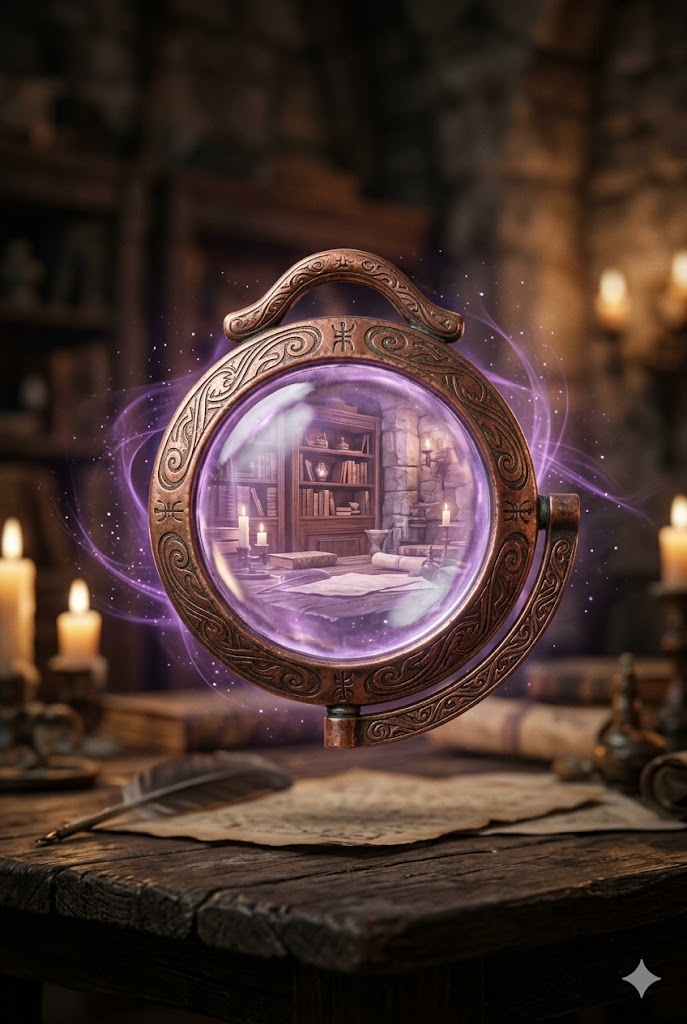
Perception of Activation: Huna 419 of the Ancestral Vessel
- User’s Perspective
- The moment the copper frame touches the skin around the eye, the avatar feels a sharp, cool sensation that clarifies their vision.
- The world through the lens shifts; colors become more saturated, and the “fuzziness” of decay on objects is replaced by a sharp, spectral blueprint of their original form.
- The avatar hears a faint, rhythmic sound—like the distant scratching of a quill or the steady strike of a blacksmith’s hammer—providing a subconscious tempo for their investigation.
- Observer’s Perspective
- The cracked lens of the monocle begins to pulse with a deep purple luminescence that casts a circular glow onto the avatar’s cheek.
- If the avatar is focused on a specific object, that object is briefly bathed in a thin, ultraviolet mist that seems to “fill in” cracks or missing pieces for anyone watching.
- The avatar’s pupil behind the lens appears to dilate and contract rapidly, reflecting the rapid intake of historical data and deeds.
- Extra-Sensory Perceptions
- True Sight: An observer sees a steady flow of ultraviolet “data-streams” traveling from the object into the lens. The glow is categorized under the school of Divination.
- Mind’s Eye: The Mind’s Eye of the user perceives a translucent “scroll” overlaying the object, detailing its HP, Resilience, and the specific names of its creators.
- Soul Sight: The object being viewed appears to have a “memory-echo”—a faint, lingering presence of the soul that last owned or crafted it.
- Radar: Constructs or avatars using active pings perceive the area around the monocle as being highly dense with information, as if the air itself has become “thick” with history.
- Positives
- Truth-Seeking: The avatar cannot be fooled by mundane disguises on items; they see the “Ike” (reality) of the object regardless of its current state.
- Mechanical Advantage: Knowing the exact HP of an item allows the user to repair it before it shatters, or to strike a foe’s item at its weakest structural point.
- Historical Renown: Having access to a full lineage provides the avatar with leverage in social and political negotiations.
- Negatives
- Sensory Overload: If used in a room full of thousands of antiques, the avatar may experience a “dull headache” as the Mind’s Eye attempts to process too many deeds and lineages at once.
- Tunnel Vision: While the monocle is activated, the avatar’s perception of movement in their peripheral vision is “cut in half” because they are hyper-focused on the object.
- The Weight of Truth: Seeing the pristine intent of an object makes the current, decayed reality feel more depressing, sometimes causing a brief “Disorientation” debuff when the lens is removed.
The Alchemical Synthesis of the Ike-Lens
- Materials Needed
- 1 Tier 1 Magic Crystal: A coin-sized crystal required to store the “Memory Retention” of the Mind’s Eye.
- 1 Ounce of Weathered Copper: Salvaged from a structure at least 100 years old to ensure a sympathetic connection to “Antiques.”
- 1 Vial of Refined Sand: Harvested from a beach where the tide ebbs and flows, symbolizing the passage of time.
- 1 Drop of Scholar’s Ink: Infused with the magical virus that allows for the “Reading of Stats.”
- 1 Small Leather Strap: To secure the monocle to the avatar’s head or clothing.
- Tools Required
- Precision Jeweler’s Loupe: A mechanical aid for viewing the microscopic “Magic Circuits” within the crystal.
- Miniature Steam-Forge: A small, tabletop furnace used for the delicate shaping of the copper frame.
- Glass-Grinding Wheel: A hand-cranked or steam-driven wheel used to polish the refined sand into a lens.
- Engraving Burin: A sharp tool for inscribing the Huna sigils of Ike and the “Made By” metadata tags.
- Skill Requirements
- Mechanical Crafting (Trained): Minimum 1 point of skill to assemble the frame and lens housing.
- Magical Crafting (Trained): Minimum 1 point of skill to properly infuse the scholar’s ink and the Tier 1 crystal.
- Appraisal or History (Trained): Minimum 1 point of skill to ensure the “Provenance” sensors are correctly calibrated.
- Crafting Steps
- Frame Forging: Melt the weathered copper in the miniature steam-forge. Cast it into a circular frame with a small handle. The copper must remain slightly “rough” to maintain its affinity for historical objects.
- Lens Polishing: Grind the refined sand into a thin, convex lens. During the final polish, add the drop of scholar’s ink to the surface, allowing the magical virus to permeate the glass.
- Crystal Integration: Carefully etch the Huna sigil for Ike into the Tier 1 Magic Crystal. Place the crystal into a small housing at the base of the copper frame so that it sits flush against the lens.
- Circuit Alignment: Using the precision jeweler’s loupe, align the “Magic Flow” from the crystal through the ink-infused lens. This creates the “Mind’s Eye” bridge necessary for identifying HP and lineages.
- Deliberate Weathering: Once assembled, the item must be “aged” for 24 hours in a dark, dusty environment. This allows the item to “settle” into its role as an antiquity-focused tool.
- Calibration Ritual: The crafter must hold the monocle and examine a known object. If the monocle correctly displays the “Originally Made By” tag and the HP of the object, the synthesis is complete.
- Final Attunement: Perform a Simple Attunement (1 minute). The item should emit a soft purple glow when it successfully identifies its first antique.
Eye-Stone and Glimpse of First Hand
A Fragment of the Sundered Glass
Before the nine thousand years of the People-Who-Return, in the cycles when the Goddess Gaialilith first breathed the magic-smoke into the clay of the moon, there was a great city of the “High-Reaches” built within a cave so deep it did not know the Helios. This place was called “The Chamber of All-Memories,” for in that age, the things made by the hand did not rot, but instead, they grew a skin of story. Every hammer, every spoon, and every gear-shaft remembered the name of the artisan who had birthed it from the steam and the fire.
There lived a seeker of the “Ike-Knowing,” whose name is lost to the crumbling of the vellum, but the echoes call him “He of the Clear-Sight.” He was a gatherer of the “Old-Dust.” He walked the dark corridors of the city and saw that when the people looked upon an object, they saw only its use—to cut, to carry, to hold. They did not see the “Primal-Thought” that lived inside the copper and the glass.
“Why,” asked He of the Clear-Sight of the Earth-Elementals who slumbered in the walls, “does the eye see only the rust of the now, while the truth of the then is hidden in the shadow?”
The Earth-Elemental, being a creature of great weight and many centuries, groaned with a sound of grinding stones: “The eye is a liar of the surface. It sees the death of the item. To see the life of the item, one must look through a window that does not believe in the passing of the hours.”
Thus, the seeker began his Great Sifting of the Sands. For many weeks of the Warming and the Blooming, he sat within the deepest library, where the magic-viruses were so thick they tasted like ink upon the tongue. He took a circle of weathered copper from a steam-pipe that had served the city since the Age of Microscopic Life. He took a shard of a Tier 1 Magic Crystal that had been polished by the footsteps of a thousand generations.
With hands that were stained by the “Scholar’s Ink,” he began the Ritual of the Grinding-Glass. He did not use a wheel of iron, for iron is a material that looks only toward the future-war. Instead, he used a wheel of refined sand, turning it with the mechanical power of his own “Mind’s Eye.” As the hours turned into the Ritual of the Singing-Time, his voice became a Shouting-Ritual that lasted for more than 11:00 (noon) until the Helios-down-time had passed seven times.
He etched the Huna sigil of Ike into the crystal, whispering to it: “You are the witness of the First-Hand. You are the enemy of the Deceiver-Artisan. You are the memory of the forge.”
When the monocle was finished, it did not reflect the light of the candles. Instead, it drank the light, showing within its lens a vision of the city as it was when the first stone was laid. He of the Clear-Sight reached out and performed the Handheld Attunement, and instantly, the world became a map of names. He looked at a broken chair, and he did not see firewood; he saw the “Originally Made By” tag of a carpenter who had been dead for a thousand years. He saw the “Resilience” of the city walls, noting where the steam-press had weakened the stone.
However, the story tells of a Great Deception. A “Rule Breaker” of the Evolved-Mind, a merchant of many lies and false-lineages, came to the city. He carried a sword that he claimed was the “Heart-Striker,” a Tier 5 Legendary item from the Elemental Age. He sought to sell it to the Monarchy for a mountain of Rhodium coins. This merchant had used a “False Name” and had shielded the sword with magic so that no Mind’s Eye could pierce its stats.
The King and the Royal Court were dazzled by the glow of the sword. But He of the Clear-Sight stepped forward. He did not look at the merchant’s face; he looked through the Huna 419. Through the lens, the “Heart-Striker” did not glow with the fire of the gods. Instead, it appeared as a translucent, spectral image of a common kitchen knife, modified with a cheap “Runes of Glow” by a failed apprentice only three days prior.
“This item is a lie of the surface!” cried the seeker. “Its Resilience is but 2, and its HP is near the Broken-state. It was ‘Originally Made By’ a boy in the port-slums, not the smiths of the heavens!”
The merchant fled, for he could not stand against a man who saw the “Truth of the Object.” The sword, when struck against the floor, shattered into its original mundane component parts—a bit of scrap iron and a drop of counterfeit ink. The King offered the seeker a Title of Power, but He of the Clear-Sight declined, for he already possessed the greatest power of all: the ability to see the world as Gaialilith intended it to be seen.
The original Huna 419 is said to be buried in the “forgotten ruins” of the High-Reaches, or perhaps it sits on the shelf of a rural merchant who thinks it is merely a broken eye-glass. But the recipe remains for those who seek the “Provenance” of the world. It is taught to every apprentice on Saṃsāra that while a seller may lie about the tier of their goods, the copper and the crystal do not have the breath to tell a falsehood.
Moral of the Story: The value of a thing is not in the shine of its polish, but in the truth of the hand that fashioned its soul.
Suggested conversions to other systems:
Call of Cthulhu (7th Edition)
Name: The Monocle of Ike’s Revelation
This artifact is an Occult curiosity likely recovered from a Pnakotic cache or a forgotten Lemurian archive, allowing the investigator to pierce the veil of time surrounding physical objects.
- Item Type: Artifact / Occult Relic
- Sanity Cost: 1 point of Sanity to activate the “Restoration Glimpse” for the first time in a day.
- Game Mechanics:
- Echoes of the Artisan (Passive): The user receives a Bonus Die on all Appraise and History rolls. Additionally, any attempt to use Art/Craft to forge an object viewed through the lens suffers a Penalty Die as the user becomes hyper-aware of their own lack of skill compared to the original master.
- Structural Integrity (Passive): By spending 1 minute examining a mechanical device or structure, the user can identify its current “HP” or structural flaws, granting a Bonus Die to any subsequent Repair or Demolitions rolls.
- Identify Provenance (Active): Spend 4 Magic Points and succeed on a Hard POW check to see the “Deeds” of an object. This reveals if the item was used in a murder, a ritual, or if it is a modern forgery.
- Syntax Note: Uses “Bonus Die” and “Hard Success” thresholds common in 7th Edition.
Blades in the Dark
Name: The Archivist’s Copper Lens
A piece of “Spark-Craft” or “Whisper-Tech” used by those who delve into the death-lands to recover lost treasures of the pre-cataclysm era.
- Item Type: Arcane Implement (1 Load)
- Game Mechanics:
- Echoes of the Artisan (Passive): When you Study an ancient object or architecture, you count as having +1 Scale or Greater Effect regarding its history and origin.
- Restoration Glimpse (Active): Spend 1 Stress to see the “spectral blueprint” of a broken machine or lock. This provides +1d to a Tinker roll made to repair or bypass the object.
- Identify Provenance (Active): Spend 1 Stress to see the “deeds” of a weapon or relic. You gain a +1d to a Gather Information roll regarding the item’s former owners.
- Syntax Note: This item is of “Fine” quality for the purpose of Tier and Effect level calculations.
Dungeons & Dragons (5th Edition)
Name: Huna 419 Monocle of the Ancestral Vessel
Wondrous Item, Common (Requires Attunement)
- Item Type: Wondrous Item / Eye Slot
- Game Mechanics:
- Echoes of the Artisan: While wearing this monocle, you have advantage on Intelligence (History) and Intelligence (Investigation) checks made to determine the origin, age, or authenticity of an object.
- Structural Integrity: As a bonus action, you can see the current hit points and damage threshold of any non-magical object within 30 feet.
- Identify Provenance: You can cast the Identify spell as a ritual using the monocle as the material component. When cast this way, the spell also reveals the names of any previous owners of the item from the last 100 years.
- Syntax Note: Uses “Advantage” and “Ritual” economy consistent with Tier 1 (Levels 1-4) balance.
Knave (2nd Edition)
Name: The Ike-Stone Eye
Item, 1 Slot
- Item Type: Magical Gear
- Game Mechanics:
- Passive: The wearer can instantly tell if an item is a forgery or a genuine antique. They always know the current “Quality” or “HP” of any item they are holding.
- Restoration Glimpse: Once per day, the wearer may look through the lens to see a “ghost” of a broken item’s former shape. This grants Advantage on the next roll made to repair that item.
- Identify Provenance: By concentrating for 1 turn (10 minutes), the wearer learns the “True Name” of the person who crafted the object, if it was made within the last 9000 years.
- Syntax Note: Adheres to the “1 Slot” inventory limit and uses “1 Turn” (10-minute) dungeon crawling time increments.
Fate (Core/Condensed)
Name: The Ancestral Eye of Ike
This item is treated as a Stunt or a specialized Extra.
- Item Type: Personal Extra / Enchanted Trinket
- Game Mechanics:
- Aspect: I See the Artisan’s Intent. You can invoke this aspect to gain a +2 bonus or a reroll when searching for clues in ancient ruins or attempting to spot a forgery.
- Echoes of the Artisan (Stunt): Because I have the Ancestral Eye of Ike, I gain a +2 bonus to Investigate rolls when I am examining an antique or aged object to determine its origin or previous owners.
- Structural Integrity (Passive): Once per scene, you may use Notice to instantly discover a physical weakness or the current “Stress/Consequences” of a non-magical object.
- Syntax Note: Costs 1 Refresh if selected as a permanent character stunt.
Numenera & Cypher System
Name: Huna 419 Chrono-Lens
In the Cypher System, this is categorized as an Artifact (Level 1d6).
- Item Type: Artifact
- Level: 1d6
- Form: A cracked copper monocle that hums with historical data.
- Depletion: 1 in 1d20 (Check when using “Identify Provenance”).
- Game Mechanics:
- Echoes of the Artisan (Passive): All tasks involving identifying, appraising, or researching the history of an object are Eased by one step.
- Structural Integrity (Passive): The user can see the “Level” and “Health” of any non-living object within short range.
- Restoration Glimpse (Active): (2 Intellect Points) The user views a broken object through the lens; for the next hour, any task to repair that object is Eased by two steps.
- Identify Provenance (Active): (3 Intellect Points) The user learns the name of the creator and the most significant event in the item’s history.
- Syntax Note: Uses “Assets” and “Easing” steps for mechanical resolution.
Pathfinder (2nd Edition)
Name: Huna 419 Ancestral Monocle
Item 1, Rare, Divination, Invested, Magical
- Item Type: Wondrous Item / Eye Slot
- Price: 20 gp (Suggested Tier 1 Value)
- Game Mechanics:
- Echoes of the Artisan (Passive): You gain a +1 item bonus to Society checks to Recall Knowledge about items and Perception checks to Seek out hidden features or forgeries in antiques.
- Structural Integrity (Passive): When you use the Craft skill to Repair an item, you automatically know its current Hit Points and Hardness.
- Identify Provenance (Activate): [Two-Actions] (Envision); Effect: You target one object. You gain the effects of an Identify spell, but you also learn the “True Name” of the person who crafted it if they lived within the last 9000 years.
- Syntax Note: Uses “Item Bonus” and “Recall Knowledge” syntax compatible with Level 1-4 play.
Savage Worlds (Adventure Edition)
Name: Huna 419 Relic-Glass
- Item Type: Arcane Item / Minor Artifact
- Game Mechanics:
- Echoes of the Artisan (Passive): The wearer gains a +2 bonus to Research and Notice rolls when dealing with antiques, relics, or historical documents.
- Structural Integrity (Passive): With a successful Notice roll (Free Action), the wearer identifies the Toughness and current Wounds of any non-living object.
- Restoration Glimpse (Active): As a Limited Action, the wearer views a broken object. This grants a +2 bonus to the next Repair roll made on that specific item.
- Identify Provenance (Active): By spending 10 minutes (a Narrative Action), the wearer learns the “Deeds” of an item, granting them a +2 to Persuasion or Intimidation rolls against NPCs who value that item’s history.
- Syntax Note: Uses “Situational Modifiers” (+2) and “Toughness” consistent with SWADE core rules.
Shadowrun (6th World Edition)
Name: Huna-Integrated Archaic Monocle
In the 6th World, this item is a specialized “Vision Enhancement” focus, blending mana-sensitive optics with an internal database of Awakened history.
- Item Type: Magic Focus (Detection)
- Availability: 3
- Price: 2,000¥
- Game Mechanics:
- Echoes of the Artisan (Passive): The user gains a +1 dice pool bonus to all Architecture, History, and Engineering Knowledge tests. It also provides a +1 bonus to Perception tests to identify forgeries or tampered gear.
- Structural Integrity (Passive): When viewing a non-living object, the user can see a digital/astral overlay of its current Structure and Armor ratings.
- Identify Provenance (Active): (Minor Action) By spending 1 point of Edge, the user can see the “Astral Signature” of the object’s creator, revealing their name or tradition if the item was crafted with magical intent.
- Syntax Note: Uses “Dice Pool” and “Edge” mechanics consistent with the 6th World ruleset.
Starfinder (2nd Edition / Playtest)
Name: Aloalo Ancestral Lens
A hybrid item merging ancient Huna-woven copper with a miniaturized chronal-sensor array.
- Item Type: Magic/Technological Hybrid Item
- Level: 1
- Price: 150 Credits
- Bulk: L (Light)
- Game Mechanics:
- Echoes of the Artisan (Passive): You gain a +1 item bonus to Perception checks to Seek and to Skill Stationery tasks involving identifying antiques or artifacts.
- Structural Integrity (Passive): You can spend a Move action to observe an object; you learn its current Hit Points and Hardness.
- Identify Provenance (Activate): (A) (Envision, Project); Frequency: Once per 10 minutes; Effect: You target one object within 30 feet. You learn the name of its original creator and gain a +1 status bonus to your next check to interact with or repair that object.
- Syntax Note: Uses “Bulk” and “Action” economy to maintain compatibility with the 2nd Edition framework.
Traveller (Mongoose 2nd Edition)
Name: Precursor Ike-Monocle
A rare piece of high-TL optical gear often salvaged from “Ancient” sites, capable of reading the molecular stress and atomic history of manufactured goods.
- Item Type: TL 13 Optical Gear
- Price: Cr 8,000 (Black Market)
- Game Mechanics:
- Echoes of the Artisan (Passive): The user receives a DM+2 on all Science (History), Science (Archaeology), and Broker checks when evaluating the authenticity of trade goods or relics.
- Structural Integrity (Passive): By examining a vehicle, ship component, or piece of equipment for one round, the user identifies its current “Hull” or “Structure” points and any critical hits it has sustained.
- Restoration Glimpse (Active): When performing a Repair task, using the monocle grants a DM+1 to the check as it projects a holographic “as-new” schematic over the damaged area.
- Syntax Note: Uses “DM” (Dice Modifier) and “TL” (Tech Level) consistent with Mongoose Traveller.
Warhammer (Fantasy Roleplay 4th Edition)
Name: The Antique-Seeker’s Copper Glass
Believed to be a relic from the Southlands or a discarded tool of the Dwarfen Lorekeepers, this monocle is highly sought after by collectors in Altdorf.
- Item Type: Talisman / Tool
- Price: 6 Gold Crowns
- Game Mechanics:
- Echoes of the Artisan (Passive): The wearer adds +10 to their Evaluate and Lore (History) tests. They gain +1 SL on any test to determine if an item is a counterfeit.
- Structural Integrity (Passive): With a successful Perception test, the user knows the current Wounds of an object and its AP (Armor Points).
- Identify Provenance (Active): Once per day, the user may perform a Chant (Routine +20) to see the “deeds” of the item. This grants a +10 bonus to any Gossip tests made to find information regarding the item’s former owners.
- Syntax Note: Adheres to “Success Levels” (SL) and “Armor Points” (AP) logic common in WFRP 4E.