
From: Lineage 4172 of Akkad Kuri
- Type: Hammer (melee)
- Slot: Held in one hand, carried on a backpack weapon slot
- Rank: Tier 1, Common
- Attack bonus: +0
- Base damage: 4 bludgeoning
- Range: Melee
- Attunement: Handheld, instant when held
- Weight: 3 pounds
- Item health points: Resilience 12
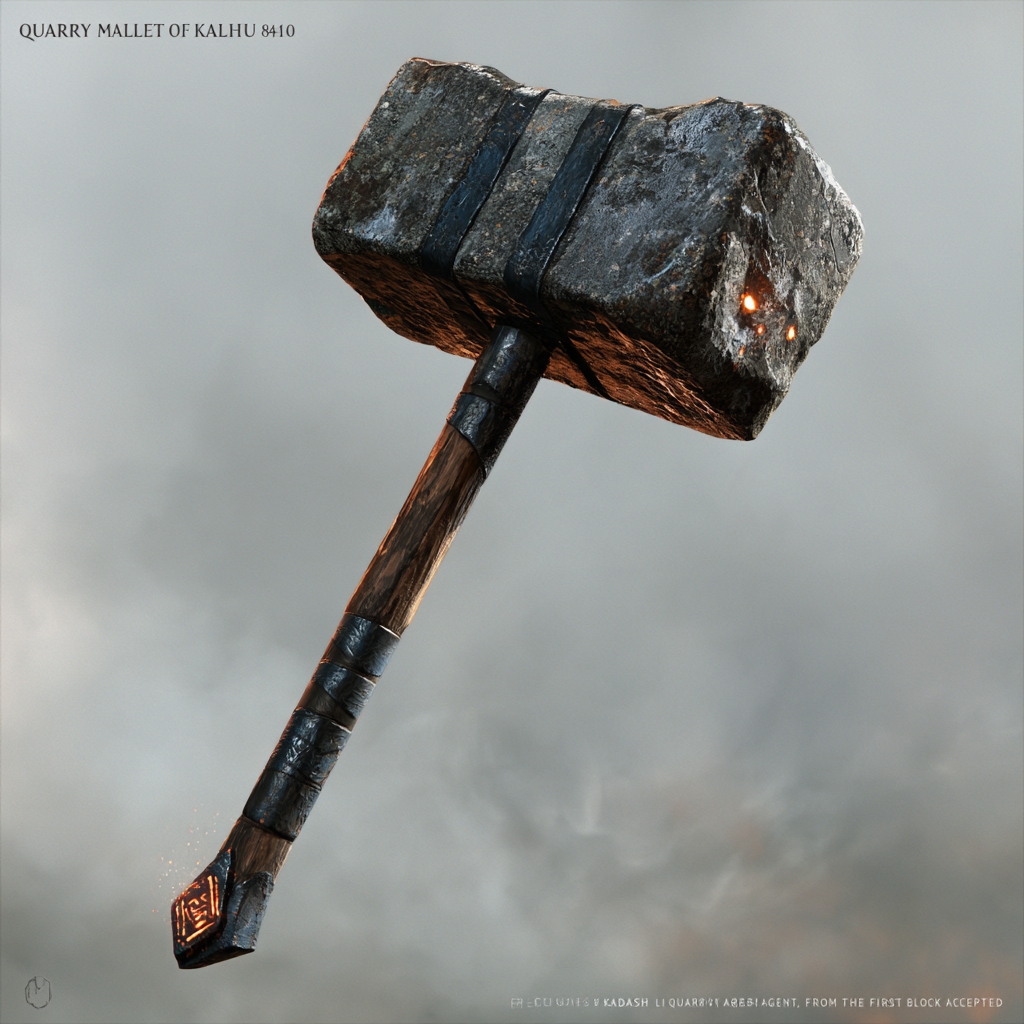
- Description: A short-hafted stonemason’s mallet with a head of grey Kalhu granite banded in iron. The haft is ash wood, darkened by years of handling, and the mason’s mark of Balawat is cut into the butt. It belonged to her grandfather, a quarry agent of the matriline.
- Abilities:
- Mason’s Tool: The mallet counts as a tool for Stonework and is attuned when held for that work.
- Breaking Stroke: When used against an unattended object of stone, clay, or ceramic, the mallet deals double base damage.
- Ringing Blow: Once per day, when an attack with this weapon hits, the target must make a save or be Dazed until the end of its next turn.
- Suggested value: 30 silver
Lore
The Tuppi-Sharrat matriline sends its daughters to the copying bench and its sons to the stone. A son of the house who shows a steady eye is made a quarry agent, and his work is to stand at the granite faces of the Southern Highlands and accept or refuse each block on behalf of the archive hall. Shelving, lintels, vault doors, and the slabs on which wet tablets are laid to dry all pass under an agent’s hand before they go down the mountain. A block with a hidden flaw can crack years later under a full shelf, so the agent’s judgment is trusted as far as a verifying scribe’s.
An agent judges stone by sound. He strikes the block once with his mallet and listens. Sound granite answers with a clear note that hangs in the air. Flawed granite answers dull, or with a note that breaks in two. Agents call this “asking the stone,” and they say that a man who talks while the stone is answering does not deserve to be told. The mallet used for the asking is made from the quarry itself. Its head is cut from a block the agent has accepted, so that the tool and the work share a grain, and the stonecutters’ lodge of Balawat bands the head in iron and cuts its mark into the butt of the haft.
The mallet has a second duty that ties the quarry to the bench. A tablet condemned with a strike mark must be broken before the day ends, and by old custom the scribe who made the error does not break it herself. A quarry agent does, when one is in the hall, with the same mallet he uses to ask the stone. The house holds that an error should be ended by someone who bears it no grudge. Agents are known for breaking a tablet with a single stroke and no comment.
This mallet belonged to Kadash-Ili, Nin-Tuppi’s grandfather, who kept tally at the Balawat granite works for more than two hundred years. He cut its head himself from the first block he ever accepted, a piece of grey stone from the east face. The haft is the third it has carried. He replaced the first when it split in a hard winter and the second when a nephew borrowed the mallet and returned it scorched. The present haft is ash wood, and his grip has darkened it in the shape of a hand somewhat larger than his granddaughter’s.
Nin-Tuppi knew the mallet before she could read. He let her strike blocks with it when she was small and told her to shut her eyes and say what she heard. He was also the one who broke her first condemned tablet, in her first year at the bench. She remembers that he looked at the error, said it was a good one, and broke it cleanly in half so that she could keep the piece without the mistake on it. She still has that piece.
When Kadash-Ili died, in her fortieth year, the mallet should have passed to another agent of the house. Her mother asked for it instead, which the bench-mother allowed with some surprise, since a scribe has no need to ask the stone. Ama-Sharrat gave no reason. She set it on her daughter’s side of the bench the morning after the Flame Return and went back to her copying.
Nin-Tuppi carries it on her pack when she travels. She uses it to break her own struck tablets, which the custom does not strictly permit, and she has found that it answers her hand as well as it answered his.
Assigned Values
- Specific slot: Held in one hand (carried on one of the backpack’s two weapon slots when not in use)
- Tier one stats:
- Attack bonus: +0
- Base damage: 4 bludgeoning
- Range: Melee
- Strength: +1 while held
- Item health points: 12 plus the wielder’s maximum health points
- Charges: 2, regaining 1 at each Helios up
- Skills gained while held:
- Stonework: +1 temporary skill point
- Hammers: +1 temporary skill point
- Quarry Appraisal (judging the soundness and value of stone): +1 temporary skill point
Passive Magics
- Mason’s Tool: The mallet counts as a tool for Stonework and is attuned when held for that work.
- Breaking Stroke: When used against an unattended object of stone, clay, or ceramic, the mallet deals double base damage.
- Asking the Stone: When the wielder strikes a single block, wall, or stone object once and listens, she learns whether it is sound or flawed and roughly where the flaw lies. She has advantage on Stonework and Quarry Appraisal checks made on that stone.
- Clean Break: An object the wielder breaks with the mallet splits along a line of her choosing, with no shards or dust thrown at her or at bystanders.
- Break What Is Struck: An attack with the mallet against a target that bears the wielder’s own Marking Wedge deals 1 additional point of damage.
Activatable Magics
- Ringing Blow (free action on a hit, 1 charge): The target must make a save or be Dazed until the end of its next turn. The mallet head rings like a struck bell.
- Split the Block (action, 1 charge): The wielder strikes an unattended object of stone, clay, or ceramic along its grain. The blow deals triple base damage in place of double. Against a construct or creature made of stone or clay, it deals double base damage.
- Tally Knock (action, no charge, once per hour): The wielder strikes a stone floor, wall, or rock face once. She learns how many creatures of at least the size of a cat are standing on or touching that same continuous stone within 30 feet. She learns the count only, and nothing of where they stand.
- End the Error (action, no charge): The wielder breaks a single clay tablet, ceramic vessel, or similar small object that she holds or that lies before her. It breaks in two clean pieces, and any writing or rune on it is ended, so that a rune so broken does not discharge.
Tags
Hammer, Tier 1, Common, Mason’s Mallet, Kalhu Granite, Ash Haft, Bludgeoning, Stonework Tool, Heirloom, Quarry Agent, Balawat, Iron-Banded, Lodge Mark, Breaking Stroke, Dazing Blow, Stone Sounding, Clean Break, Construct Bane, Tally Knock, Charged Item, Assyria, Renaissance
Obtaining, Buying, and Selling the Quarry Mallet of Kalhu 8410
How the item might be obtained
- Made by the agent: A quarry agent of the Tuppi-Sharrat matriline cuts the head of his own mallet from the first block he accepts. The stonecutters’ lodge of Balawat bands it in iron and cuts its mark into the haft. The agent pays for the iron and the banding only.
- Inherited: On an agent’s death the mallet passes to another agent of the house, or, by the bench-mother’s leave, to a relative who asks for it. This is how the present mallet came to its bearer.
- Gift of the lodge: The stonecutters’ lodge may present a lodge-marked mallet to an outsider who has served the quarries well, such as by clearing a dangerous creature from a working face or recovering a lost shipment of dressed stone.
- Quest reward: A quarry master, the archive hall, or the guild of Balawat may offer a mallet as payment for escort duty on the Zab road or for work in the Southern Highlands.
- Possession of an avatar: A character who possesses a quarry agent, mason, or other bearer acquires the mallet with the avatar’s other belongings.
- Combat or salvage: A mallet may be taken from a fallen mason, dug from a rockfall, or found among tools stolen from a quarry camp.
- Commission: A mason and a blacksmith working together can make one. Only a lodge member may cut the mason’s mark of Balawat into the haft.
Shops where the item might be bought and sold
All prices are suggested amounts based on a value of 30 silver. Sellers set their own prices, and the amounts change with distance from Balawat and with what the buyer appears willing to pay.
- Stonecutters’ lodge workshop in Balawat:
- What it is: A family-run cutting shed beside the lodge hall, with a small forge at the back for banding and tool repair.
- Buying: A new lodge-marked mallet costs about 30 silver and takes four days, since the buyer is expected to choose the stone for the head. A member of the lodge or the local guild pays about 27 silver. An ordinary mason’s mallet with no magic costs about 4 silver.
- Selling: The workshop pays about 15 to 18 silver for a sound mallet. An agent’s own mallet, known by its head, is refused. The lodge will ask how the seller came by it.
- How: Coin or World Bank transfer. The lodge records each haft it marks.
- Toolsmith and ironmonger in a Kalhu quarry town:
- What it is: A small forge and shopfront selling picks, wedges, chisels, and hammers to miners and quarry crews.
- Buying: About 28 to 33 silver when one is in stock. Rehafting costs about 2 silver, and rebanding a loosened head about 5 silver.
- Selling: About 15 to 17 silver. The smith rings the head on an anvil and listens before making an offer.
- How: Coin is usual. Haggling of around 10% either way is expected.
- Guildhall quartermaster in Balawat:
- What it is: The supply counter in the town’s guildhall, stocked with gear that members have turned in or traded.
- Buying: About 27 silver for a guild member and 30 silver for a non-member.
- Selling: About 18 silver. The quartermaster logs the seller’s name and the mark on the haft.
- How: World Bank transfer, with the 1% bank fee paid by the account holder.
- Builder’s supplier in the capital:
- What it is: A family yard near the masons’ quarter that sells dressed stone, lime, and tools for the city’s construction works.
- Buying: About 35 to 40 silver, which includes the 3% tax on goods sold in the city. City masons value the Asking the Stone property for checking delivered blocks.
- Selling: About 16 to 20 silver, with a few silver more for a lodge-marked haft.
- How: World Bank transfer preferred.
- Black-market dealer in Ashur Dock:
- What it is: A back room behind a ropewalk, dealing in tools and goods taken from quarry shipments and naval stores.
- Buying: About 30 to 45 silver. Buyers here want it for breaking masonry, strongbox lids, and ceramic seals quietly and cleanly, and for ending runes without setting them off.
- Selling: About 15 silver, and up to 25 silver if the dealer has a buyer who needs a wall opened.
- How: Coin only, with no World Bank transfer and no record kept.
- Import stall on another island nation:
- What it is: A dockside family stall selling foreign tools and weapons.
- Buying: About 35 to 55 silver. Kalhu granite is prized abroad, and the seller may offer it as a weapon against stone and clay constructs.
- Selling: About 20 to 30 silver, depending on whether the stall keeper has need of a mason’s tool.
- How: Local coinage or World Bank transfer. Assyrian citizens pay double the local taxes and fees as foreigners.
Roleplay of the Quarry Mallet of Kalhu 8410 in Defense and Offense
Archive vaults and stone passages
- Defense:
- Nin-Tuppi uses Tally Knock at a vault door before she enters. One strike on the floor tells her how many are standing on the same stone within 30 feet, and she decides whether to go in or call the keepers.
- If a ward-rune on a tablet or doorway begins to discharge, she uses End the Error to break it cleanly before it goes off.
- She will not swing the mallet near shelves of unfired tablets unless she has no choice. In a guarded archive, a designated safe area, her Armor Check is tripled, and she relies on that first.
- Offense:
- Against an intruder she marks the foe with the Wedge-Stylus on her first action and follows with the mallet on a later turn, gaining the extra point from Break What Is Struck.
- She spends a charge on Ringing Blow when a hit lands, hoping to leave the target Dazed so that she can withdraw or an ally can close.
- A second attack in the same turn deals half damage, so she usually strikes once and uses her other action to move or to mark.
Quarries and mountain roads of Kalhu
- Defense:
- Asking the Stone tells her which ledge will hold and which block is ready to fall. She stands on sound rock and leaves the flawed ground to others.
- She uses Split the Block on an unattended boulder or a loose face to drop rubble across a path and close it behind her.
- Offense:
- This is the mallet’s home ground. She breaks the stone a foe is standing on, or the prop beneath a stacked load, with Breaking Stroke or Split the Block, and lets the fall do the harm.
- Against bandits on open road it is a plain hammer with 4 base damage. She fights beside a cart or wall so she has something to break if she needs it.
Against constructs of stone and clay
- Defense:
- Clean Break keeps shards from flying back at her or her allies when a construct’s limb is shattered at close quarters.
- Offense:
- Split the Block deals double base damage to a creature of stone or clay. She saves her charges for this and describes listening for the dull note that shows where the construct is weakest.
- She uses Asking the Stone on a motionless statue or sealed door first, when there is time, to learn whether it is flawed and where.
Forge halls, workshops, and rune benches
- Defense:
- End the Error is her answer to a mis-cut rune, a cracked crystal housing made of ceramic, or a tablet that has been trapped. She breaks it in two before it can discharge.
- She keeps the mallet on the bench beside her when she cuts runes for others, as her grandfather kept it beside the tally board.
- Offense:
- She breaks the clay or ceramic parts of an enemy’s device, such as a seal, a casing, or an inscribed plate, and does not waste blows on the metal.
- Ringing Blow is loud in an enclosed forge hall, and she describes the note carrying over the noise of the hammers.
City streets and markets
- Defense:
- A mason’s mallet on a pack draws no attention in any Assyrian town. Inside the walls, a somewhat safe area, her Armor Check is doubled, and she seldom needs to take it down.
- If cornered in an alley she breaks a clay drainpipe, a stack of roof tiles, or a ceramic jar to make noise and block the way.
- Offense:
- She does not start fights in town. If one is forced on her, a single Ringing Blow and a quick exit is her habit.
Wetlands, river travel, and wooden places
- Defense:
- Asking the Stone, Tally Knock, Breaking Stroke, and Split the Block have nothing to work on among reeds, mud, and timber. She says the mallet has nothing to ask.
- Offense:
- It is a hammer with 4 base damage and Ringing Blow. She uses it as such and wishes for dry ground.
Low-magic and dangerous places
- Defense:
- Charges return slowly or not at all at the GM’s discretion. The passive properties may be muffled, and she describes the stone’s answer as faint. In an unsafe area her Armor Check is halved, and in a deathly area every attack hits, so she keeps both charges for Ringing Blow to buy time.
- Offense:
- She strikes only to break a way out, such as a door lintel, a wall seam she has asked, or a floor slab over a lower passage.
Social encounters
- Defense:
- Among masons and quarry crews the mallet marks her as kin to a known agent. Old hands recognize the head and ask after her grandfather before they ask her business.
- Offense:
- Setting the mallet on the table beside a disputed tablet is a statement any scribe or mason of Balawat understands. It means the matter can be ended, cleanly and without grudge, if the other party insists on the error.
- Asking the Stone in front of a seller, and repeating aloud what the block answered, has ended more than one attempt to pass off flawed granite.
Perception of Activation:
User’s Perspective
- Sight: The wielder sees a ring of pale light spread from each tap or strike. When she asks a stone, a thin dark line shows her where a flaw lies. Before Split the Block she sees a bright line along the grain where the stone will part. After Tally Knock she sees small strokes rise along the haft.
- Sound: Sound stone answers her with a clear, sustained note. Flawed stone answers dull or with a note that breaks in two. Ringing Blow sounds like a bell struck close beside her. End the Error makes almost no sound, only a soft dry snap.
- Touch: The ash haft is warm and fits her fingers a little loosely, since it was worn to a larger hand. Each blow sends an answer back up the haft into her wrist. She feels sound stone as a firm push and flawed stone as a slight give, like pressing on a loose tooth.
- Smell: Fresh-split granite, sharp and faintly sulfurous, and the linseed smell of the oiled haft.
- Taste: Stone dust on the tongue, even when Clean Break leaves none in the air.
- Extra-sensory perceptions:
- Stone hearing: She perceives the answer of the stone as more than sound. It comes to her as a sense of the block’s whole shape and where it is weak, held for a moment and then gone.
- Count sense: After Tally Knock she knows a number without having counted. It arrives the way a tally-keeper knows the total at the foot of a column.
- Aetheric Scrutiny: She tastes the mallet’s magic as slow, cold, and steady, an earth-aligned flavor with none of the fire she knows from the Flamecitadel.
- Mind’s Eye: She knows how many charges remain and is aware of her grandfather’s name on the head.
- Hand memory: When she asks a stone with her eyes shut, she sometimes knows what he would have said of it, in his phrasing and not her own.
Observer’s Perspective
- Sight: An observer sees a scribe strike stone with a mason’s mallet and a ring of pale light run across the surface. Objects she breaks open along straight clean lines without dust. Ringing Blow shows as ripples of light in the air around the mallet’s head.
- Sound: The note of a tapped block carries across a quarry floor. Ringing Blow is loud enough to turn heads in the next room. Breaking Stroke and Split the Block give a sharp crack, shorter and cleaner than breaking stone usually sounds.
- Touch: Someone standing on the same stone feels a single pulse through their feet at Tally Knock. A target of Ringing Blow feels the note in its skull and teeth.
- Smell: Fresh-broken stone near the place of the blow.
- Taste: None, since no dust is thrown.
- Extra-sensory perceptions:
- Tremorsense: Every use sends a clear pulse through the ground. Tally Knock in particular reveals the wielder’s exact position to anything that senses vibration.
- True sight: The head gives off a dim ultraviolet glow that flares at each strike. The line shown before Split the Block is visible as a bright seam on the target.
- Aetheric Scrutiny (other Akkad-Kuri): Nearby Akkad-Kuri taste a pulse of earth-aligned magic, unusual among Assyrian gear, and can tell its direction.
- Blind sight: The ring of the mallet gives a strong, clean echo that outlines the whole room for a moment, for the wielder’s allies and enemies alike.
- Mind’s Eye: An observer who examines the mallet sees its name, the lodge mark, and the notation naming Kadash-Ili.
Positives
- The wielder learns the condition of stone at a single tap, before trusting her weight or her allies’ to it.
- The count from Tally Knock comes at once and needs no line of sight.
- Clean Break keeps her eyes and lungs clear and leaves no shards to injure bystanders.
- End the Error is nearly silent and gives no flash.
- The ring of the mallet can serve as a signal to allies, and masons within hearing recognize an agent asking the stone.
- The hand memory steadies her judgment and is a comfort in unfamiliar country.
Negatives
- Every strike is loud and sends a pulse through the ground. The mallet cannot be used quietly, except for End the Error.
- Tally Knock tells those standing on the stone that someone has struck it, and tells vibration-sensing creatures exactly where.
- The count gives a number only. A cat-sized animal, an ally, and an enemy each count as one.
- The mallet has nothing to answer it on mud, timber, water, or sand.
- The earth-aligned magic stands out to Firelords and other Akkad-Kuri who expect fire.
- The hand memory can bring grief at a poor moment, and the haft worn to a larger hand reminds her whose tool it was.
Recipe: Granite-Headed Mallet in the Manner of the Kalhu Quarry Agents
Materials Needed
- Stone:
- 1 block of fine-grained grey Kalhu granite, about the size of two fists, cut from a larger block that the crafter has personally tested and found sound
- A head cut from the first block a crafter ever accepted is traditional. Any block the crafter has asked and trusts will serve.
- Wood:
- 1 billet of straight-grained ash, seasoned at least one year, long enough for a short haft
- 2 small hardwood wedges for seating the head
- Iron:
- 2 strips of wrought iron, each long enough to band the head once
- 4 iron rivets
- Magical components:
- 2 tier 1 magic crystals, each about the size of a coin, as catalysts (one for each charge)
- 1 pinch of dust from a stone that has been broken cleanly in two
- 1 fragment of a condemned clay tablet or cracked ceramic, crushed fine
- Finishing:
- 1 small measure of linseed oil for the haft
- 1 lump of beeswax
- Fuel:
- Charcoal sufficient for heating and shrinking the iron bands
Tools Required
- A stone saw and a set of mason’s chisels
- A second mallet or hammer for the cutting work
- A stone drill or boring bar for the haft socket
- A grinding stone and polishing slate
- A drawknife, spokeshave, and rasp for shaping the haft
- A small forge with tongs, a hammer, and an anvil for the bands
- A quenching trough
- A graver for cutting the maker’s mark into the butt of the haft
- A reading lens or other identification focus for checking the finished work through the Mind’s Eye
Skill Requirements
- Stonework: 4 or higher
- Blacksmithing: 2 or higher, for the banding
- Woodworking: 2 or higher, for the haft
- Rune Cutting: 1 or higher, for the mark
- Quarry Appraisal: 1 or higher, since the crafter must be able to judge the stone by its sound
- Two crafters may share the work, provided each required skill is met by the one performing that step. The one who chooses and tests the stone should be the one who will carry the mallet, if possible.
- Time: About 4 days of downtime.
- Standing: Only a member of the stonecutters’ lodge may cut the mason’s mark of Balawat. A crafter outside the lodge cuts a personal mark.
Crafting Steps
- Ask the stone:
- Strike the chosen block once with an ordinary mallet and listen with eyes closed. Proceed only if the note is clear and sustained. A dull or broken note means the block is refused and another must be found.
- Rough out the head:
- Saw and chisel the block to a squat cylinder with two flat striking faces. Work with the grain running from face to face, so the head will not split across its width.
- Bore the socket:
- Drill the haft socket through the middle of the head, slightly wider at the top than the bottom. Go slowly and keep the bore wet.
- Seat the crystals:
- Cut a shallow pocket in the wall of the socket on each side. Set one tier 1 crystal in each pocket and pack it with the stone dust and crushed tablet mixed into warm beeswax.
- Dress the faces:
- Grind both striking faces flat and polish them on the slate until the mica shows.
- Forge the bands:
- Forge each iron strip into a ring a hair smaller than the head. Heat the rings to a dull red, drop them over the head near each face, and quench. The iron shrinks tight as it cools. Rivet the ends.
- Shape the haft:
- Shape the ash billet with drawknife and spokeshave to fit the bearer’s hand, with a slight swell at the butt. Cut a slot in the top end for the wedges.
- Join head and haft:
- Drive the haft up through the socket, then drive the two hardwood wedges into the slot until the head is locked. Trim the top flush.
- Mark and oil:
- Cut the maker’s mark into the butt of the haft with the graver. Rub linseed oil into the wood and let it dry overnight.
- First asking:
- As a ritual of at least 10 minutes, the crafter carries the mallet to a standing face of living rock or a wall of dressed stone. She strikes it once, lightly, and listens in silence until the note has wholly faded. She repeats this nine times, at nine places. The mica on the striking face begins to shine if the work is sound.
- Roll for the result:
- The crafter rolls a d20. On a 1 the head cracks across its grain at the ninth stroke, the crystals shatter into shards, and the materials are lost. On a 20 the mallet gains one extra capability chosen by the GM, such as a third charge. Any other result produces a working mallet.
- Check and carry:
- Examine the mallet through the identification focus to confirm its abilities. It attunes when held.
Quarry-Saying of Zikru Ear, Who Asked Stone and Would Not Be Answered For
This is a saying of the men who stand at the grey faces above Balawat. It is from the first speech of the high country, which was more whistle than word, and it was set in writing long after by a clerk of the lowlands who had never held a hammer. He admits this in his first line. He says also: “They have one word that means to strike, to ask, and to listen, all three. I have had to choose each time. I have surely chosen wrongly.”
In the days when the house of the Wedge-Keepers first sent its sons up to the stone, there was a son named Zikru. He had no gift for the bench. His mother had tried him at the clay and his wedges were like the tracks of a drunken bird. So he was sent to the quarry to count blocks, which is work for one who can do nothing else, and for forty years he counted blocks and was content.
Now counting is dull, and Zikru had a habit to pass the time. As each block came off the face he would knock on it with his knuckles, as a man knocks at a door, and bend his head. The cutters laughed at this. They asked, “Who is at home, clay-son?” And he would say, “This one, a good family. This one, nobody. This one, they are quarreling inside.” The cutters laughed more. But it came to be noticed, over the forty years, that the blocks he said were quarreling were the ones that cracked in the frost.
So they stopped laughing and gave him a mallet, that he might knock louder. He would not take theirs. He cut a head for himself from a block he trusted, and hafted it in ash, and with this he went along the rows each morning, striking once, and bending his head. They called him the Ear. And the saying has here its first rule, which the translator gives with a hook beside it: “While the stone is speaking the man is silent. He who talks over the answer has not asked.”
Hear now the matter of the Queen’s lintel.
In a certain year the Queen ordered a house of records built in her city, and for the great door of it she required a lintel of Kalhu granite, of one piece, six paces long, without seam or stain. The master of the cutters in that day was a dwarf of long experience named Garun Deep-Vein, proud, and with reason. He chose the place on the east face himself. He cut for a whole season. And he brought out such a stone as had not been seen: grey as a dove, straight as a rule, six paces and a hand, and not a mark upon it. The cutters wept to see it. A wagon of twelve oxen was built for it alone. The Queen’s steward came up the mountain in a litter to receive it.
And it was the custom, by then, that no stone went down to the house of clay or to the Queen without the Ear had asked it. So Zikru was sent for, as a form, and he came with his mallet, and the steward waited, and Garun stood with his arms folded, smiling.
Zikru struck the stone once, near the middle. He bent his head.
The saying tells that the note was beautiful. Every man there heard it, clear, high, long. They began to cheer. And Zikru held up his hand, and they stopped, and he stood with his head bent a long time after they could hear nothing at all. Then he straightened and said: “No.”
Garun’s smile did not go; it only stopped moving. He said, “You heard it sing.”
Zikru said: “I heard it sing. And under the singing, at the very end, when you had all begun shouting, there is a second voice, very small, a little flat of the first. They are not the same stone, master. There are two in there, and they have agreed for a thousand years, and they will not agree under a wall.”
“There is no seam. Look at it. Put your eye to it. Put your tongue to it. There is no seam.”
“There is none on the outside,” said Zikru. “I did not ask the outside.”
Then there was great anger. The steward said the Queen would not wait another season for the hearing of a counter of blocks. The cutters, who had laughed at him and then honored him, now cursed him, for it was their season’s work. And Garun, who was not a bad man, came close and said low: “Clay-son. I have cut stone two hundred years. You will shame me before the steward on the word of a noise no one heard but you?”
And Zikru said the thing the agents repeat. He said: “I do not shame you. I did not make the stone. I only asked it. If you want a different answer, do not be angry at the one who listened. Be angry at the stone, and see what that mends.”
The steward, being a man of courts, proposed a court’s remedy. “Let it be proved. If it is flawed, show the flaw.”
“The only showing is to break it,” said Zikru. “If I am wrong, I have destroyed the finest lintel in the world and I will give my right hand to the lodge, for what else have I worth a season? If I am right, I have saved the Queen’s door from falling on her clerks in some year when none of us is alive to be thanked.”
The translator writes: “Here they argue for a long passage about the hand. I gather it was a serious offer and that the lodge accepted it in writing. I have left the argument out.”
So it was agreed. And Zikru did not strike at once. He walked the length of the stone, six paces and a hand, tapping lightly, lightly, as a healer taps a chest, with his eyes shut. Up, and back. And at a place a little past the middle he stopped and laid his palm flat, and said, “Here they meet.” There was nothing there to see. He took a piece of charcoal and drew a line across the perfect grey, slantwise, and the cutters groaned as if he had drawn it on their own skins.
Then he lifted the mallet that he had cut from a block he trusted, and he said to the stone, not loud, “Forgive it; someone must,” and he struck upon the line, once, and not hard.
The saying does not say it shattered. It says: “It opened like a book.”
The great lintel parted along the charcoal as cleanly as bread under a wire, and the two halves leaned away from each other and stood. And on the fresh faces, for all to see, there ran a film no thicker than the skin of an onion, white, soft, of some other stuff, where long ages ago the rock had cracked in the deep and healed itself over. On the outside, nothing. On the inside, a door already half open, waiting only for weight.
No one spoke. Garun Deep-Vein went to the broken face and put his thumbnail to the white, and it crumbled. He stood a while. Then he turned to the steward and said, in a voice that all could hear: “Tell the Queen her lintel will be a season late, and will be sound. And tell her the lodge of Balawat cuts no stone henceforth that the clay-son has not asked.” And to Zikru he said, more quietly, “Keep your hand. I have a use for the ear.”
That is the first half of the saying, and the cutters like it best. The agents like the second half, and it is shorter.
Zikru had a sister at the ninth bench, named Tashme, and she was all that he was not: her rows were a wonder. That same year she was given the Queen’s dedication for the house of records to press, forty rows, the finest work the bench had ever sent down. She pressed it in nine days. And on the tenth day, reading it over before the firing, she found in the thirty-first row a single wedge turned the wrong way, which made the Queen’s grandmother’s name into a word for a kind of goat.
By the law of the bench she must press the strike mark in its corner and see it broken by evening. She pressed the mark. But she could not break it. She set it at the back of the drying rack behind the others, and she told herself she would mend the one wedge with a wet thumb, and no one need know. And for three days she did neither thing, and did not sleep.
Zikru came down from the quarry on the third evening with dust in his hair, and found her sitting before the rack. He asked nothing. He looked where she was looking, and reached behind, and brought out the tablet, and saw the mark in the corner, and read it through slowly, he who could barely press his own name. At the thirty-first row he made a small sound. The translator insists the word is “laughed.”
“It is a good one,” he said. “A goat. She would have had us all skinned.”
“It is the best thing I have ever made,” said Tashme, “and it is false in one place, and I cannot.”
“No,” he said. “You cannot. You love it and you hate it, and a hand that does both will smash it to powder or will not strike at all. That is why it should not be your hand.” And he took the mallet from his belt, the same, and he laid the tablet on the bench. He did not break it across the middle. He set the edge of the mallet’s face just below the thirtieth row, above the goat, and tapped.
It opened like a book. Thirty rows, whole and perfect, in one piece. Ten rows and a goat in the other.
He gave her the thirty. “This part was true,” he said. “Keep it. Press the last ten again tomorrow, when you have slept.” The other piece he put in the breaking-basket with no more ceremony than a man shelling a nut, and he went to find his supper.
From that evening it has been the custom that a struck tablet is broken by a son of the quarry, who bears it no grudge, with the mallet he asks the stone with; and that he breaks it so the true part may be kept. And from that year no stone goes down the mountain unasked.
The moral of the story is that a thing may sing and still be unsound, and the one who hears the second voice must say so though the whole quarry shout; and that an error should be ended cleanly, by a hand that neither loves nor hates it, and the true part kept. The agents add the first rule again, because they say it is the whole of the craft: when you have asked, be quiet until the answer is finished.
Suggested conversions to other systems:
Call of Cthulhu (7th Edition)
The Agent’s Asking-Mallet
- Type: Enchanted tool and weapon (artifact)
- Origin: A short-hafted stonemason’s mallet with a head of grey granite banded in iron and a haft of dark ash wood, from the quarries of Kalhu in Assyria on the world of Saṃsāra. A mason’s mark is cut into the butt of the haft.
- Weapon profile:
- Skill: Fighting (Brawl)
- Damage: 1D6 + DB
- Impale: No
- Base Range: Touch
- Uses per Round: 1
- Malfunction: —
- Bonding: The wielder strikes nine different stones once each, listening in silence until every note has faded, and makes a POW roll. On a success the mallet is bonded and its powers can be used.
- Passive effects while bonded and held:
- Bonus die on Art/Craft (Masonry) and Science (Geology) rolls made on stone the wielder has struck.
- Asking the Stone: One tap on a block, wall, or stone object tells the wielder whether it is sound or flawed and roughly where the flaw lies. No roll is needed.
- Breaking Stroke: Against an unattended object of stone, clay, or ceramic, the mallet deals double damage. Objects it breaks part along a line of the wielder’s choosing and throw no fragments.
- Powers (the mallet draws on the wielder’s magic points):
- Ringing Blow: Cost 2 magic points, spent when an attack hits. The target must succeed at a CON roll or lose its next action.
- Split the Block: Cost 3 magic points. One blow against an unattended object of stone, clay, or ceramic deals triple damage. Against a being whose body is stone or clay, it deals double damage.
- Tally Knock: Cost 1 magic point. The wielder strikes a stone floor or wall once and learns how many living creatures of at least cat size are touching that same continuous stone within 10 yards. She learns only the number.
- End the Error: No cost. The wielder breaks one small object of clay or ceramic cleanly in two. A minor ward or charm inscribed on it ends without taking effect. Objects of true Mythos power are unaffected unless the Keeper rules otherwise.
- Sanity:
- First bonding: 0/1 Sanity points, as the wielder briefly knows a stone’s whole inner shape.
- Hearing, through the mallet, the judgment of a previous owner in that owner’s own words: 0/1 Sanity points.
- Investigation:
- A Science (Geology) roll identifies the head as fine-grained granite of no known quarry.
- An Occult roll connects it with builders’ customs of sounding stone before it is set.
- Cthulhu Mythos: None gained. The mallet is not of the Mythos.
Blades in the Dark (current edition)
The Tally-Man’s Knocker
- Type: Fine arcane tool and weapon (unique item)
- Load: 1
- Quality: 2
- Origin: A short stonemason’s mallet with a granite head banded in iron and an ash haft, from the quarries of Kalhu in Assyria on the world of Saṃsāra.
- Features:
- Fine hand weapon: It serves as a fine bludgeon in close quarters.
- Breaking Stroke: When you Wreck stone, brick, clay, or ceramic, gain +1 effect. What you break parts along a line you choose and throws no debris.
- Asking the Stone: Tap a wall, floor, or block once. When you Study or Survey that structure, gain +1 effect, and the GM tells you its weakest point.
- Tally Knock: Strike a stone floor or wall. The GM tells you how many people are standing on that same stonework nearby. You learn the number and nothing more.
- Ringing Blow: Take 1 stress when you strike someone. They are stunned by the note, and you or a teammate gain +1 effect on the next action against them.
- End the Error: Break one small clay or ceramic object cleanly. If it carries a ward, rune, or inscribed charm, that working ends without going off.
- Drawbacks:
- Loud: Every use except End the Error rings out and sends a tremor through the floor. Using it during a quiet operation alerts anyone within earshot.
- Known Tool: Masons and builders recognize a mallet of this make and will ask where you got it.
- Crafting a copy: Invent the formula as a long-term project, then Tinker during downtime. Arcane, minimum quality 2, with the Loud drawback. The head must be cut from a stone the maker has personally tested and trusts.
Dungeons & Dragons (2024 rules)
Mallet of the Second Voice
- Weapon (Light Hammer), Uncommon (Requires Attunement)
- Properties: Light, Thrown (Range 20/60)
- Mastery: Nick
- Damage: 1d4 Bludgeoning
- Weight: 3 lb.
- Description: This short-hafted stonemason’s mallet has a head of grey granite banded in iron and a haft of dark ash wood. It comes from the quarries of Kalhu in Assyria, on the world of Saṃsāra, and a mason’s mark is cut into the butt of the haft.
- Mason’s Tool: The mallet can be used in place of Mason’s Tools, and you have proficiency with it for that purpose.
- Breaking Stroke: The mallet deals double damage to objects and structures made of stone, clay, or ceramic. An object you destroy with it breaks along a line you choose and scatters no fragments.
- Asking the Stone: As a Utilize action, you tap a stone object or surface within reach. You learn whether it is sound or flawed and where its weakest point lies, and you have Advantage on ability checks made with Mason’s Tools on that stone for 1 hour.
- Charges: The mallet has 2 charges and regains 1 expended charge daily at dawn.
- Ringing Blow (1 charge): When you hit a creature with the mallet, you can force it to make a DC 13 Constitution saving throw. On a failed save, its Speed is halved and it can’t take Bonus Actions or Reactions until the end of its next turn.
- Split the Block (1 charge): When you hit an object made of stone, clay, or ceramic that isn’t being worn or carried, the mallet deals triple damage in place of double. When you hit a creature whose body is made of stone or clay, the attack deals an extra 2d6 Bludgeoning damage.
- Tally Knock: As a Magic action, you strike a stone floor, wall, or rock face. You learn the number of Tiny or larger creatures touching that same continuous stone within 30 feet of you. Once you use this property, you can’t use it again until you finish a Short or Long Rest.
- End the Error: As a Utilize action, you break one Tiny nonmagical object of clay or ceramic that you hold or that lies before you. If the object bears a magical inscription created by a spell of level 3 or lower, such as a Glyph of Warding, the inscription is destroyed without being triggered.
Knave (Second Edition)
Quarry Agent’s Granite Mallet
- Type: Relic weapon, one-handed
- Slots: 1
- Damage: d6
- Range: Melee
- Value: Seldom for sale. Copies fetch whatever a buyer will pay.
- Description: A short stonemason’s mallet with a head of grey granite banded in iron and a haft of dark ash, from the quarries of Kalhu in Assyria on the world of Saṃsāra. A mason’s mark is cut into the butt.
- Always in effect while held:
- Tap any block, wall, or stone object once to learn whether it is sound or flawed and where.
- Against unattended stone, clay, or ceramic the mallet deals double damage. What it breaks parts along a line the wielder chooses and throws no shards.
- Checks to cut, dress, or judge stone are made with advantage (+5).
- Charges: 2. One charge returns each morning.
- Ringing Blow (1 charge): On a hit, the target must pass a CON check or lose its next turn’s action.
- Split the Block (1 charge): One blow deals triple damage to unattended stone, clay, or ceramic, or double damage to a creature made of stone or clay.
- Tally Knock: Once per watch, strike a stone floor or wall. Learn how many creatures of cat size or larger are touching that same stone within 30 feet. The number is all that is learned.
- End the Error: At will, break one small clay or ceramic object cleanly in two. Any rune or ward written on it ends without going off.
- Limit: On an attack roll of natural 1, the head loosens on its haft. The mallet still strikes for d6, and its powers are lost until a mason spends a day reseating and rebanding it.
Fate (Fate Condensed)
The Mallet That Asks First
- Type: Extra (tool and weapon)
- Origin: A short-hafted stonemason’s mallet with a head of grey granite banded in iron and a haft of dark ash, from the quarries of Kalhu in Assyria on the world of Saṃsāra. A mason’s mark is cut into the butt of the haft.
- Permission: A character aspect showing training among masons or quarry agents, or an inheritance from one.
- Cost: 2 refresh
- Weapon rating: Weapon:1, if the table uses weapon ratings
- Item aspect: Heirloom Mallet of a Quarry Agent
- Invoke: To judge stone at a tap, to break what must be broken cleanly, or to be known among masons as kin to the trade.
- Compel: Every stroke rings out and shakes the floor, it has nothing to say to mud or timber, and it carries the memory of the hand that owned it before.
- Stunts granted while held:
- Asking the Stone: Once per scene, when you strike a stone object or structure and listen, create an advantage with Crafts without rolling. Place one aspect such as Flawed Through the Middle or Sound to the Core with a free invoke.
- Breaking Stroke: +2 to Fight or Physique when overcoming an obstacle made of stone, clay, or ceramic. What you break parts along a line you choose and harms no bystander.
- Ringing Blow: Once per session, when you succeed on an attack with the mallet, also place Head Still Ringing on the target with one free invoke. The target cannot use that aspect’s presence to its benefit, and it lasts until the end of the next exchange.
- Tally Knock: Once per scene, strike a stone floor or wall and ask the GM how many people are standing on that same stonework in your zone and adjacent zones. The GM answers with a number only.
Numenera and Cypher System (Numenera Discovery and the Cypher System Rulebook)
Sounding Mallet of the Grey Face
- Type: Artifact
- Level: 1d6
- Form: A short stonemason’s mallet with a head of grey granite banded in iron and a haft of dark ash, from the quarries of Kalhu in Assyria on the world of Saṃsāra. A mason’s mark is cut into the butt.
- Effect:
- The mallet functions as a medium weapon (4 points of damage).
- The wielder has an asset on tasks to cut, dress, or judge stone.
- Asking the Stone (action): The wielder taps a block, wall, or stone object and learns whether it is sound or flawed and where its weakest point lies. No depletion roll is needed.
- Breaking Stroke (enabler): Against an unattended object of stone, clay, or ceramic, the mallet’s damage is doubled and the object’s level is treated as one lower for the purpose of breaking it. What it breaks parts along a line of the wielder’s choosing. No depletion roll is needed.
- Ringing Blow (enabler): When the wielder hits a creature, the target is dazed for one round, and all its tasks are hindered. Roll for depletion.
- Split the Block (action): One blow against an unattended object of stone, clay, or ceramic breaks it outright if its level is equal to or lower than the artifact level. Against a creature or automaton made of stone or clay, the blow inflicts additional damage equal to the artifact level. Roll for depletion.
- Tally Knock (action): The wielder strikes a stone floor or wall and learns how many creatures of at least cat size are touching that same continuous stone within short range. This can be used once per hour and requires no depletion roll.
- End the Error (action): The wielder breaks one small clay or ceramic object cleanly in two. Any inscribed ward or stored effect on it of a level equal to or lower than the artifact level ends without activating. No depletion roll is needed.
- Depletion: 1 in 1d20. A depleted mallet remains a medium weapon and a mason’s tool and loses all other effects.
Pathfinder (Second Edition, Remaster)
Quarry-Agent’s Sounding Hammer — Item 4
- Traits: Earth, Magical
- Price: 100 gp
- Usage: held in 1 hand
- Bulk: L
- Base Weapon: Light hammer (agile, thrown 20 ft.)
- Description: This light hammer takes the form of a short-hafted stonemason’s mallet with a head of grey granite banded in iron and a haft of dark ash. It comes from the quarries of Kalhu in Assyria, on the world of Saṃsāra, and a mason’s mark is cut into the butt of the haft. It can be used as a mason’s tool, and you gain a +1 item bonus to Crafting checks to work or assess stone. Strikes with the hammer ignore the first 5 points of Hardness of objects made of stone, clay, or ceramic, and an object you break with it parts along a line you choose.
- Activate—Asking the Stone [one-action] (manipulate)
- Effect: You tap a stone object or surface within reach. You learn whether it is sound or flawed and where its weakest point lies.
- Activate—Ringing Blow [free-action] (auditory)
- Frequency: once per day
- Trigger: You hit a creature with a Strike using the hammer.
- Effect: The target must attempt a DC 19 Fortitude save.
- Success: The creature is unaffected.
- Failure: The creature is stunned 1.
- Critical Failure: The creature is stunned 2.
- Activate—Split the Block [two-actions] (manipulate)
- Frequency: once per day
- Effect: Make a Strike with the hammer. Against an unattended object of stone, clay, or ceramic, the Strike ignores all Hardness and deals double damage. Against a creature with the earth trait or a construct made of stone or clay, the Strike deals an extra 2d6 bludgeoning damage on a hit.
- Activate—Tally Knock [one-action] (manipulate)
- Frequency: once per hour
- Effect: You strike a stone floor, wall, or rock face. You learn the number of Tiny or larger creatures touching that same continuous stone within 30 feet.
- Activate—End the Error [one-action] (manipulate)
- Effect: You break one unattended clay or ceramic object of light Bulk or less cleanly in two. If the object bears a magical rune or an inscribed spell of 2nd rank or lower, that magic ends without being triggered.
Savage Worlds (Adventure Edition)
Grandfather’s Stone-Asker
- Type: Arcane device (weapon)
- Damage: Str+d6
- Range: Melee
- Minimum Strength: d6
- Weight: 3
- Cost: Seldom for sale. Copies sell for whatever the market bears.
- Description: A short stonemason’s mallet with a head of grey granite banded in iron and a haft of dark ash, from the quarries of Kalhu in Assyria on the world of Saṃsāra. A mason’s mark is cut into the butt.
- Passive effects while held:
- +1 to Repair rolls and other rolls made to cut, dress, or judge stone.
- Asking the Stone: As an action, the wielder taps a block, wall, or stone object and learns whether it is sound or flawed and where.
- Breaking Stroke: When breaking an unattended object of stone, clay, or ceramic, the mallet adds +4 damage. What it breaks parts along a line the wielder chooses and throws no shards.
- Power Points: 4. The mallet regains 2 Power Points each dawn and cannot be recharged by other means.
- Activation: No roll is needed. The wielder spends the Power Points listed.
- Ringing Blow (2 Power Points, free action on a hit): The target must make a Vigor roll or be Distracted and Vulnerable until the end of its next turn. On a critical failure it is Stunned.
- Split the Block (2 Power Points, as part of an attack): Against an unattended object of stone, clay, or ceramic, the damage bonus from Breaking Stroke becomes +8. Against a creature made of stone or clay, the attack gains +d6 damage.
- Tally Knock (no cost, action, once per hour): The wielder strikes a stone floor or wall and learns how many creatures of cat size or larger are touching that same continuous stone within 5″ (10 yards). She learns only the number.
- End the Error (no cost, action): The wielder breaks one small clay or ceramic object cleanly in two. Any rune or ward written on it ends without going off.
Shadowrun (Sixth World Edition)
Kalhu Sounding Mallet Focus
- Type: Melee weapon (club) and bonded weapon focus
- Damage Value: 3S
- Attack Ratings: 6/—/—/—/—
- Force: 1
- Bonding cost: 3 Karma
- Availability: 4(L)
- Cost: 7,500¥ for a copy. The original is seldom for sale.
- Description: A short-hafted stonemason’s mallet with a head of grey granite banded in iron and a haft of dark ash, from the quarries of Kalhu in Assyria on the world of Saṃsāra. A mason’s mark is cut into the butt of the haft. It contains no electronics and has no wireless bonus.
- Passive effects while bonded and held:
- +1 die on Close Combat tests with the mallet. As a weapon focus it can strike astral forms that are manifest or dual-natured.
- +1 die on tests to cut, dress, or assess stone and concrete.
- Asking the Stone (Minor Action): The wielder taps a block, wall, or slab and learns whether it is sound or flawed and where its weakest point lies.
- Breaking Stroke: Against barriers and unattended objects of stone, concrete, brick, or ceramic, the mallet’s Damage Value is doubled. What it breaks parts along a line the wielder chooses and throws no fragments.
- Charges: 2. One charge returns at each sunrise.
- Ringing Blow (1 charge, spent on a hit): The target must succeed at a Body + Willpower (3) test or gain the Dazed status until the end of its next turn.
- Split the Block (1 charge, as part of an attack): Against a barrier or unattended object of stone, concrete, brick, or ceramic, the Damage Value is tripled in place of doubled. Against a spirit of earth or a creature made of stone or clay, the attack gains +2 DV and deals Physical damage.
- Tally Knock (no charge, Major Action, once per hour): The wielder strikes a stone or concrete floor or wall and learns how many creatures of cat size or larger are touching that same continuous slab within 10 meters. She learns only the number.
- End the Error (no charge, Major Action): The wielder breaks one small clay or ceramic object cleanly in two. A ward anchor, preparation, or inscribed formula of Force 2 or less on it ends without triggering.
- Astral signature: Each activation leaves an earth-aspected signature that lasts for Force hours.
Starfinder (Second Edition)
Lodge-Banded Sounding Mallet — Item 4
- Traits: Analog, Earth, Magical
- Price: 1,000 credits
- Usage: held in 1 hand
- Bulk: L
- Base Weapon: Club (thrown 10 ft.)
- Description: This club takes the form of a short-hafted stonemason’s mallet with a head of grey granite banded in iron and a haft of dark ash. It comes from the quarries of Kalhu in Assyria, on the world of Saṃsāra, and a mason’s mark is cut into the butt of the haft. It can be used as a mason’s tool, and you gain a +1 item bonus to Crafting checks to work or assess stone, concrete, and ceramics. Strikes with the mallet ignore the first 5 points of Hardness of objects made of those materials, and an object you break with it parts along a line you choose.
- Activate—Asking the Stone [one-action] (manipulate)
- Effect: You tap a stone, concrete, or ceramic object or surface within reach. You learn whether it is sound or flawed and where its weakest point lies.
- Activate—Ringing Blow [free-action] (auditory)
- Frequency: once per day
- Trigger: You hit a creature with a Strike using the mallet.
- Effect: The target must attempt a DC 19 Fortitude save.
- Success: The creature is unaffected.
- Failure: The creature is stunned 1.
- Critical Failure: The creature is stunned 2.
- Activate—Split the Block [two-actions] (manipulate)
- Frequency: once per day
- Effect: Make a Strike with the mallet. Against an unattended object of stone, concrete, or ceramic, the Strike ignores all Hardness and deals double damage. Against a creature with the earth trait or a construct made of stone or ceramic, the Strike deals an extra 2d6 bludgeoning damage on a hit.
- Activate—Tally Knock [one-action] (manipulate)
- Frequency: once per hour
- Effect: You strike a stone or concrete floor, wall, or rock face. You learn the number of Tiny or larger creatures touching that same continuous surface within 30 feet. The effect does not carry through metal decking.
- Activate—End the Error [one-action] (manipulate)
- Effect: You break one unattended clay or ceramic object of light Bulk or less cleanly in two. If the object bears a magical rune or an inscribed spell of 2nd rank or lower, that magic ends without being triggered.
Traveller (Mongoose Second Edition, 2022 Update)
Relic Quarry Mallet of Kalhu
- Weapon: Relic mallet (anomalous artefact)
- TL: 1 in manufacture. Its effects cannot be reproduced at any known TL.
- Range: Melee
- Damage: 2D
- Kg: 1.5
- Cost: Seldom for sale. A collector might pay Cr3000 or more.
- Magazine: —
- Traits: None
- Skill: Melee (bludgeon)
- Description: A short stonemason’s mallet with a head of grey granite banded in iron and a haft of dark ash, from the quarries of Kalhu in Assyria on the world of Saṃsāra. A mason’s mark is cut into the butt.
- Passive effects while held:
- DM+1 to Profession or Science checks to cut, dress, or assess stone and concrete.
- Asking the Stone (Minor Action): The wielder taps a block, wall, or slab and learns whether it is sound or flawed and where its weakest point lies.
- Breaking Stroke: Against unattended objects and structures of stone, concrete, or ceramic, the mallet’s damage is doubled. What it breaks parts along a line the wielder chooses and throws no fragments.
- Charges: 2. One charge returns each local dawn.
- Ringing Blow (1 charge, spent on a hit): The target must succeed at an END check (Average 8+) or lose its next Significant Action.
- Split the Block (1 charge, as part of an attack): Against an unattended object or structure of stone, concrete, or ceramic, the damage is tripled in place of doubled. Against a creature or machine whose body is stone or ceramic, the attack gains +1D damage.
- Tally Knock (no charge, Significant Action, once per hour): The wielder strikes a stone or concrete floor or wall and learns how many creatures of cat size or larger are touching that same continuous surface within 10 metres. She learns only the number.
- End the Error (no charge, Minor Action): The wielder breaks one small clay or ceramic object cleanly in two.
- Analysis: Sensors detect only granite, iron, and wood. A Science check (Formidable 14+) finds no mechanism for its effects.
Warhammer (Warhammer Fantasy Roleplay, Fourth Edition)
The Stone-Asker of the Grey Face
- Type: Magical weapon
- Weapon Group: Basic
- Price: N/A
- Encumbrance: 1
- Availability: Unique
- Reach: Short
- Damage: +SB+3
- Qualities: Pummel
- Flaws: None
- Description: A short stonemason’s mallet with a head of grey granite banded in iron and a haft of dark ash, from the quarries of Kalhu in Assyria on the world of Saṃsāra. A mason’s mark is cut into the butt. To those with the Second Sight Talent, the head holds a slow grey-brown glow.
- Passive effects while held:
- +10 to Trade (Stoneworker) Tests and to Evaluate Tests made on stone.
- Asking the Stone (Free Action, once per Round): The wielder taps a block, wall, or stone object and learns whether it is sound or flawed and where its weakest point lies.
- Breaking Stroke: Against unattended objects of stone, clay, or ceramic, the mallet gains +4 Damage. What it breaks parts along a line the wielder chooses and throws no shards.
- Charges: 2. One charge returns at each sunrise.
- Ringing Blow (1 charge, spent on a hit): The target must pass a Challenging (+0) Endurance Test or gain 1 Stunned Condition.
- Split the Block (1 charge, as part of an attack): Against an unattended object of stone, clay, or ceramic, the bonus from Breaking Stroke becomes +8 Damage. Against a creature made of stone or clay, the attack gains +4 Damage.
- Tally Knock (no charge, Action, once per hour): The wielder strikes a stone floor or wall and learns how many creatures of cat size or larger are touching that same continuous stone within 10 yards. She learns only the number.
- End the Error (no charge, Action): The wielder breaks one small clay or ceramic object cleanly in two. Any rune or petty ward inscribed on it ends without going off.
- Notice: Dwarfs and trained masons recognize the practice of sounding stone and treat a bearer who does it well with respect.