
From: Lineage 4172 of Akkad Kuri
- Type: Spell conduit (ranged)
- Slot: Held in one hand, stored in the tablet case on her belt
- Rank: Tier 1, Common
- Attack bonus: +1
- Base damage: 3 fire
- Range: Complex (30 feet, -2)
- Attunement: Handheld, instant when held
- Weight: 1 pound
- Item health points: Resilience 8
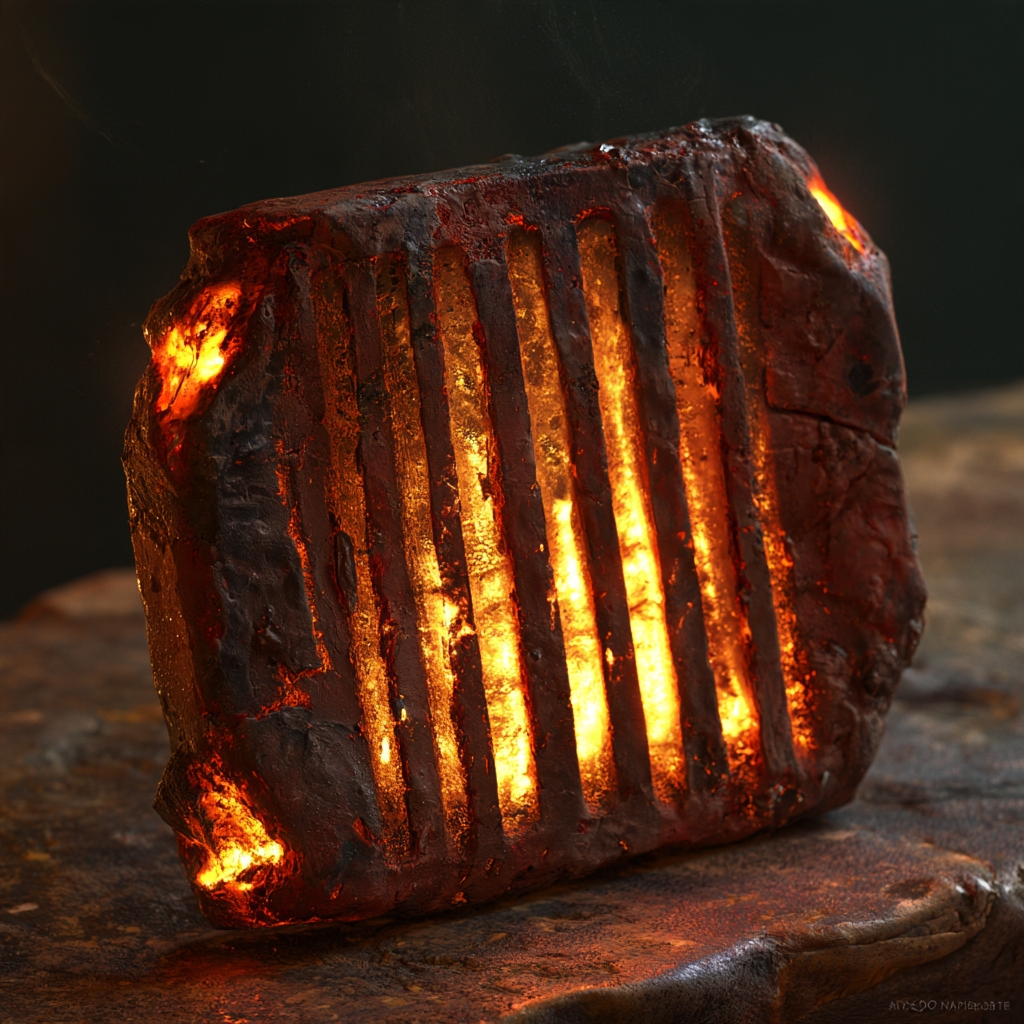
- Description: A palm-sized tablet of fired red clay, its face covered in five rows of ceremonial Sar-Wedge and its back smoothed by her thumb. When a decree is spoken over it in Akkad-Sar, the wedges glow like embers and the tablet grows warm.
- Abilities:
- Kiln Spark (spell): The wielder speaks a short decree and a dart of ember-bright fire leaps from the tablet at one target in range. This uses the attack bonus, base damage, and range listed above. It requires no ammunition.
- Chanted Decree: The spell follows the rules for Silent, Normal, and Ritual casting. A Silent casting deals 25% less damage, and a Ritual casting of more than 6 seconds deals up to 25% more.
- Warm Clay: The tablet gives off enough heat to dry wet ink or clay in one minute and enough glow to read by within 5 feet.
- Brittle: If the tablet is reduced to half its item health points or less, Kiln Spark does not function until the tablet is repaired.
- Suggested value: 45 silver
Lore
Every kiln in the archive hall of Balawat has a tablet set into the brickwork above its mouth. The tablets are small, red, and blackened by generations of smoke, and each carries the same five rows of ceremonial Sar-Wedge. Scribes call the text the Kiln Decree. It is the oldest working example in the house of a Sar-Akkad, a Decree of Dominion, in which the stress and order of spoken Akkad-Sar give an instruction that magic obeys.
The decree was composed after the fire at the ninth bench that crippled the hand of Sharrat-Ili. The bench-mother of that time made the robes to protect her daughters, and she also turned to the fire itself. Her reasoning, as the house records it, was that a scribe spends her life telling clay what to say, and that fire in a kiln is a servant of the bench like any other and should be given its orders in writing. She wrote five rows. The first names the fire. The second names the one who sends it. The third names the road it is to take. The fourth names the mark it is to reach. The fifth names its end and tells it to go out. A fire so instructed was meant to stay in the firing chamber, do its work, and die when told.
For many years the decree was only read aloud at the lighting and banking of the kilns. The discovery that it could do more is credited to an apprentice whose name the house did not keep, perhaps on purpose. She is said to have recited the decree over a spare copy while pointing in irritation at a wasp on the far wall, and to have named the wasp in the fourth row. The wasp was not found afterward. The bench-mothers spent a generation deciding whether this was a scandal or a resource. They settled on allowing every senior apprentice to carry a copy for the road, on the grounds that a decree which keeps fire in its place may also send it to one.
A scribe must make her own. The tablet is the proof piece for the rank of senior apprentice. She digs the red clay herself from the seam below the east quarry face, presses the five rows in ceremonial script without a single correction, and fires the tablet in her bench’s kiln beneath the old decree. A tablet with a wandering row sends a wandering spark, and a tablet with an error in the fifth row may not go out when told, so the verifying scribe breaks every attempt that is less than exact.
Nin-Tuppi made hers in her fortieth year, the same year her grandfather died. Her first attempt cracked in the kiln. Her second was perfect to her own eye, and her mother set it in front of her without a word, one finger resting beside the third row, where a single wedge sat a hair too deep. The third attempt passed. She pressed it in the weeks after the Flame Return, with clay taken from the seam beside the face he used to tally, and she has never been sure whether the timing steadied her hand or only left her with nothing else to think about.
The back of the tablet is smooth where her thumb rests when she speaks over it. Scribes say you can tell how often a sister has had to use her decree by how deep the hollow is. Hers is shallow.
Assigned Values
- Specific slot: Held in one hand (stored in the tablet case on the belt, which fills one of the belt’s four slots)
- Tier one stats:
- Attack bonus: +1
- Base damage: 3 fire
- Range: Complex (30 feet, -2)
- Intellect: +1 while held
- Item health points: 8 plus the wielder’s maximum health points
- Charges: 2, regaining 1 at each Helios up, or 2 if the tablet rests overnight beside a lit kiln or forge
- Skills gained while held:
- Decree Chanting (speaking Sar-Akkad to effect): +1 temporary skill point
- Spell Conduits (weapon type): +1 temporary skill point
- Kiln Work: +1 temporary skill point
Passive Magics
- Kiln Spark (spell): The wielder speaks a short decree and a dart of ember-bright fire leaps from the tablet at one target in range. This uses the attack bonus, base damage, and range listed above. It requires no ammunition.
- Chanted Decree: The spell follows the rules for Silent, Normal, and Ritual casting. A Silent casting deals 25% less damage, and a Ritual casting of more than 6 seconds deals up to 25% more. If the target’s true name is spoken in the fourth row, the damage is doubled.
- Obedient Fire: The spark burns only the mark named. It does not set light to paper, cloth, tablets, or anything else it passes or strikes beyond its target.
- Warm Clay: The tablet gives off enough heat to dry wet ink or clay in one minute and enough glow to read by within 5 feet.
- Brittle: If the tablet is reduced to half its item health points or less, Kiln Spark and all activatable magics do not function until the tablet is repaired.
Activatable Magics
- Name the End (action, 1 charge): The wielder speaks only the fifth row. All non-magical flames of campfire size or smaller within 30 feet go out, and one creature within range that is burning stops burning.
- Held Decree (action, 1 charge): The wielder speaks the first four rows and stops. The spark waits in the tablet for up to one minute. She may release it as a reaction to a trigger she names when she begins, and it is treated as a Ritual casting.
- Split Spark (action, 1 charge): The wielder names two marks within 10 feet of each other. She makes one attack roll against each, and each spark that hits deals the base damage of 3 fire with no tier die added.
- Fire the Seal (action, no charge, once per hour): The wielder presses the tablet’s face against a wet clay seal, a lump of soft clay, or a wax seal no larger than her palm. The clay hardens at once as if kiln-fired, and wax sets with the faint print of five rows. Any later tampering with that seal shows as a visible crack.
Tags
Spell Conduit, Tier 1, Common, Clay Tablet, Fire Damage, Ranged, Sar-Wedge, Kiln Decree, Proof Piece, Tuppi-Sharrat, Balawat, Red Clay, Sar-Akkad, Chanted Spell, Kiln Spark, Obedient Fire, Flame Quenching, Held Spell, Brittle, Charged Item, Assyria, Renaissance
Obtaining, Buying, and Selling the Decree Tablet of the Kiln 6075
How the item might be obtained
- Made as a proof piece: A scribe of the Tuppi-Sharrat matriline makes her own tablet to earn the rank of senior apprentice. She digs the red clay herself, presses the five rows without correction, and fires it in her bench’s kiln. No coin changes hands, and attempts that fall short are broken.
- Gift of a bench: A verifying scribe may press a tablet for an outsider who has done the bench a service, such as carrying a decree safely down the mountain or putting out a fire in the archive hall. A tablet made for another answers to that person once the second row is recited with the new bearer’s name.
- Quest reward: A Flamecitadel, a kiln master, or the guild of Balawat may offer a kiln decree as payment for work in the forge halls or along the mountain road.
- Possession of an avatar: A character who possesses a senior apprentice or verifying scribe of the house acquires her tablet with her other belongings.
- Combat or salvage: A tablet may be taken from a fallen scribe or found in a looted satchel. Many such finds are cracked, and a tablet at half its item health points or less does nothing until it is repaired.
- Commission: A scribe skilled in ceremonial Sar-Wedge and a kiln worker can make one to order. The decree must be pressed without a single error, so failed attempts are common and add to the cost.
- Purchase: Copies, commissioned tablets, and those sold by scribes who have left the house reach the market through the shops below.
Shops where the item might be bought and sold
All prices are suggested amounts based on a value of 45 silver. Sellers set their own prices, and the amounts change with distance from Balawat and with what the buyer appears willing to pay.
- Potter and tablet maker in Balawat:
- What it is: A family pottery on the lower street with one large kiln, where a retired scribe of a lesser bench presses decrees to order at a table by the window.
- Buying: A new tablet costs about 45 silver and takes six days, including drying and firing. A member of the local guild or of the matriline pays about 40 to 41 silver. A blank fired tablet of red clay costs about 1 silver.
- Selling: The pottery pays about 22 to 27 silver for a sound tablet and about 5 silver for a cracked one, which it grinds for temper. It will not buy a tablet that is plainly a house proof piece.
- How: Coin or World Bank transfer. Half is paid before the pressing, since a failed firing still costs clay and fuel.
- Flamecitadel workshop:
- What it is: A bench inside a temple where Firelords and lay artisans make fire-aligned gear as offerings to Ashurak.
- Buying: About 40 silver as a temple offering, with a further offering of metal for the forge. The Firelord examines the buyer and may refuse someone judged careless with fire.
- Selling: The temple does not buy tablets. It accepts a sound one as an offering and may grant a small favor in return.
- How: Coin placed in the offering bowl. Tablets are fired during the days between Flamevows.
- Scribe and stationery supplier in the capital:
- What it is: A narrow family shop selling styluses, clay, wax tablets, seal blanks, and inks to clerks and students.
- Buying: About 52 to 58 silver, which includes the 3% tax on goods sold in the city. The owner keeps tablets wrapped in straw in a locked chest and demonstrates Warm Clay, never Kiln Spark, inside the shop.
- Selling: About 23 to 28 silver. The owner checks each row through a lens and refuses any tablet with a flaw in the fifth.
- How: World Bank transfer preferred.
- Guildhall quartermaster in Balawat:
- What it is: The supply counter in the town’s guildhall, stocked with gear that members have turned in or traded.
- Buying: About 40 to 41 silver for a guild member and 45 silver for a non-member.
- Selling: About 27 silver. The quartermaster logs the seller’s name and has the tablet tested in the yard before paying.
- How: World Bank transfer, with the 1% bank fee paid by the account holder.
- Black-market dealer in Ashur Dock:
- What it is: A back room behind a ship chandler’s shop, supplying those who want a weapon that passes for a clerk’s keepsake.
- Buying: About 55 to 80 silver. Tablets sold here are often pressed by unlicensed hands. The GM may have such a tablet misfire on a roll of 1 or fail to go out when Name the End is spoken.
- Selling: About 22 silver for a sound tablet. A dealer with a buyer waiting may pay up to 45 silver.
- How: Coin only, with no World Bank transfer and no record kept.
- Curio and import dealer on another island nation:
- What it is: A family shop in a foreign port selling Assyrian goods to collectors and scholars.
- Buying: About 70 silver to 1 gold and 2 silver. Few abroad can speak the decree in Akkad-Sar, so most buyers want it as a curiosity or a hand-warmer. To one who can speak the language it is worth the higher price.
- Selling: About 30 to 45 silver, depending on whether the dealer knows that it is more than an inscribed keepsake.
- How: Local coinage or World Bank transfer. Assyrian citizens pay double the local taxes and fees as foreigners.
Roleplay of the Decree Tablet of the Kiln 6075 in Defense and Offense
Archive vaults and libraries
- Defense:
- Fire among tablets, scrolls, and shelving is the thing a scribe fears most, and Name the End is the tablet’s first use here. Nin-Tuppi speaks the fifth row and every lamp, torch, and small blaze within 30 feet goes out.
- Obedient Fire lets her use Kiln Spark in a room full of records without risk to them. She says so aloud to nervous keepers before she speaks the decree.
- In a guarded archive, a designated safe area, her Armor Check is tripled. She is slow to cast and prefers to put out an intruder’s light and let the dark work for her.
- Offense:
- She marks an intruder with the Wedge-Stylus, then names that mark in the fourth row from behind a shelf. She can see the Marking Wedge through the shelving, though she still needs a clear path for the spark.
- With time to prepare she uses Held Decree at a doorway, naming as her trigger the first person to step through who is not a keeper.
Forge halls, kilns, and Flamecitadels
- Defense:
- Name the End stops a spreading fire from spilled oil or a toppled brazier. It does nothing to a lit forge or kiln larger than a campfire, and she knows better than to try.
- Both charges return overnight beside a lit kiln, so she spends them more freely here.
- Offense:
- The tablet was made for these rooms. She speaks a full Ritual casting over the roar of the forge for the added damage, with no concern about being heard.
- Many foes in such places wear fire-resistant gear. She uses the Mind’s Eye first and switches to the Quarry Mallet when the spark will do little.
Roads and open country of Kalhu
- Defense:
- Kiln Spark gives her reach. She keeps 30 feet between herself and a bandit and extends the range when she must, taking 2 from her attack for each further 30 feet.
- She uses Held Decree when she hears movement ahead, naming the first person to show a weapon. The reaction does not use one of her two actions that turn.
- Offense:
- Split Spark answers two attackers standing close together. It adds no tier die, so she uses it to make a point more than to finish a fight.
- In dry brush she takes care to name her mark exactly. Obedient Fire keeps the spark from spreading, and she describes it striking and vanishing without so much as scorching the grass.
City streets, courts, and guildhalls
- Defense:
- Inside a walled town, a somewhat safe area, her Armor Check is doubled. Casting fire in a street draws guards, so she uses Name the End far more than Kiln Spark, putting out a thrown torch or a set fire.
- A Silent casting, at 25% less damage, is her choice if she must cast unnoticed. The wedges still glow, and she cups the tablet in her palm to hide them.
- Offense:
- Fire the Seal is her weapon in a dispute. She hardens the seal on a contract or evidence box in front of witnesses, so that any later tampering shows as a crack.
- Reciting the first row of the decree aloud with the tablet in her hand is a threat any Assyrian understands. She has never needed to reach the fourth.
Rain, wetlands, and river travel
- Defense:
- Warm Clay dries her hands, her papers, and a patch of kindling. The tablet itself is fired clay and does not mind the wet.
- Rain puts out ordinary flames for her, so Name the End is seldom needed.
- Offense:
- Kiln Spark works in rain, though the GM may rule that heavy downpour shortens its range or reduces its damage. Targets standing in water or soaked through are harder to keep burning.
Darkness, smoke, and ash
- Defense:
- The tablet glows enough to read by within 5 feet. This is useful, and it also shows where she is. She keeps it in its case until she means to use it.
- Offense:
- Inside her own Ember Shed, she can still see a foe who carries her Marking Wedge and can name that mark for a spark through the ash.
- Name the End puts out an enemy’s torches and leaves them blind, while her low-light vision still serves.
Low-magic and dangerous places
- Defense:
- Charges return slowly or not at all at the GM’s discretion, and the glow of the wedges is dim. In an unsafe area her Armor Check is halved, and in a deathly area every attack hits. She keeps the tablet in its case, since at 8 resilience it is the most fragile thing she carries and a targeted hit can leave it Brittle.
- Offense:
- She casts only to end a fight quickly, with a full Ritual casting if she has the seconds to spare.
Against a foe whose true name she knows
- Defense:
- She is careful about who hears her speak a true name, and about the ethics of using it without consent.
- Offense:
- Speaking the target’s true name in the fourth row doubles the damage. She treats this as a grave act, since a scribe who names a person in a decree has, in the eyes of her house, written a judgment.
Perception of Activation:
User’s Perspective
- Sight: The wielder sees the rows on the tablet light one after another as she speaks them, and the spark lift from the clay and fly where she has sent it. With Name the End she sees every small flame around her lean toward her hand and wink out.
- Sound: Her own voice sounds deeper and more exact to her as she speaks the decree, each stressed syllable landing like a stylus in clay. The spark leaves with a short hiss, like a drop of water on a hot kiln shelf. Name the End is followed by a sudden quiet where the crackle of flames had been.
- Touch: The tablet warms in her palm, row by row, from the top edge down. At the release she feels a small push against her hand, like a breath. The hollow under her thumb grows hot and then cools at once. During Held Decree the tablet thrums faintly, as if something were pacing inside it.
- Smell: Hot fired clay and kiln smoke. After the spark there is a brief, clean scorched smell.
- Taste: Dry ash at the back of the throat, stronger after a Ritual casting.
- Extra-sensory perceptions:
- Aetheric Scrutiny: She tastes the magic gather as bright, clean fire, sharpening through the first four rows and going flat and cool at the fifth. A held spark tastes like a word left unsaid.
- Decree sense: She feels each row as a step taken in order: the fire named, herself named, the road, the mark, the end. A row spoken with the wrong stress feels like a missed stair.
- Mark sense: Between the fourth row and the release, she is aware of the named target as a point of attention, as when she knows where her stylus will land before it touches clay.
- Mind’s Eye: She knows how many charges remain and whether the tablet is whole or nearing the point of being Brittle.
- Maker’s sense: Because she pressed it herself, she feels each of the five rows as her own handwriting, and she is briefly aware of the one wedge in the third row that she pressed three times before it passed.
Observer’s Perspective
- Sight: An observer sees a scribe holding a small red tablet whose writing lights up line by line as she speaks, and a dart of fire that leaps from it to strike one target and vanish. With Name the End, they see nearby flames bend toward her and die. With Held Decree, they see a single spark sitting on the tablet’s face.
- Sound: A short phrase in Akkad-Sar, clipped and heavily stressed, then a hiss. A Ritual casting is longer and chanted and carries well. A Silent casting gives no words, only the hiss.
- Touch: Those within arm’s reach feel a wave of dry warmth. A target that is struck feels a sharp, small burn that does not spread.
- Smell: Kiln smoke near the wielder and a brief scorched smell at the target.
- Taste: None, though those close by during a Ritual casting may taste ash.
- Extra-sensory perceptions:
- True sight: The rows give off a bright ultraviolet glow that climbs with each row spoken. The spark shows as a vivid streak, and a held spark shows as a steady point on the tablet.
- Aetheric Scrutiny (other Akkad-Kuri): Nearby Akkad-Kuri taste clean fire magic shaped by speech and recognize a Sar-Akkad. They can tell a Ritual casting from a Normal one by its strength.
- Mind’s Eye: An observer who examines the tablet sees its name and the name of the scribe who pressed it. A target may briefly see a notation that it has been named in a decree.
- Blind sight and tremorsense: These senses catch the spoken words and the hiss, and nothing of the spark itself.
- Soul sight: At the moment of the fourth row, a thin bright thread seems to join the wielder’s outline to the target’s and then snaps.
Positives
- The wielder knows the state of the casting at every step through warmth, taste, and the decree sense, and she can stop before the fourth row without loosing anything.
- The mark sense makes her aim feel certain, and Obedient Fire lets her cast without fear for what lies around the target.
- The sudden quiet after Name the End tells her at once that it has worked.
- The maker’s sense gives her confidence in the tablet and warns her early if it has been damaged.
- The glow serves as a reading light and a hand-warmer when she is not casting.
- Allies can follow her progress through a decree by watching the rows and can time their own actions to the release.
Negatives
- A Normal or Ritual casting is spoken aloud and lit from her hand. Everyone nearby knows who cast and at whom.
- The rows lighting in order give an alert foe a moment’s warning before the spark flies.
- Disruption during the chant, from a blow or a distraction, can break the decree before it is finished.
- A held spark glows visibly and hums in her hand for up to a minute, which is hard to conceal.
- True sight, soul sight, and Aetheric Scrutiny reveal the casting plainly, including the thread to the target.
- The maker’s sense reminds her of every flaw she corrected, and the memory of the year she pressed it comes with it.
- The tablet is fragile. She is aware of that each time she draws it, and a foe who has seen it glow knows what to strike.
Recipe: Kiln Decree Tablet in the Manner of the Ninth Bench
Materials Needed
- Clay:
- 2 pounds of red clay dug by the crafter’s own hand, enough for three attempts
- The seam below the east quarry face at Balawat is traditional. Any iron-rich red clay will serve if the one who will press the decree is the one who digs it.
- 1 handful of fine volcanic ash or ground fired clay as temper
- Clean water
- Magical components:
- 2 tier 1 magic crystals, each about the size of a coin, ground to powder as the catalyst (one for each charge)
- 1 pinch of ash taken from a kiln or forge that has been properly banked and let go out, never one that was doused in haste
- 1 small measure of resinous tree sap drawn with a fluid collector, to carry the fire aspect
- Text:
- The five rows of the Kiln Decree in ceremonial Sar-Wedge, committed to memory: the fire named, the sender named, the road, the mark, and the end
- A crafter outside the scribe houses must compose or obtain a decree of the same five parts. The GM decides whether a composed decree is sound.
- Fuel:
- Charcoal or peat sufficient for one full kiln firing of six hours
- Carrying:
- 1 scrap of leather and thread for a padded belt case
Tools Required
- A digging trowel and a clay sieve
- A wedging board and a wire clay cutter
- A wooden mold or pair of guide sticks for a palm-sized tablet
- A wedge stylus for ceremonial Sar-Wedge
- A smoothing rib of bone or wood
- A flat drying rack kept away from the kiln mouth
- A pottery kiln able to hold a steady firing heat for six hours
- A mortar and pestle for the crystals
- A magnifying lens for checking the rows
- A reading lens or other identification focus for checking the finished work through the Mind’s Eye
Skill Requirements
- Scribing (Sar-Wedge): 4 or higher, since the rows must be pressed without a single correction
- Kiln Work: 3 or higher
- Decree Chanting: 2 or higher, to speak the decree with the correct stress
- Rune Cutting: 1 or higher, for the two charge wedges
- The one who presses the decree must also be the one who dug the clay. A second crafter may tend the kiln.
- Time: About 6 days of downtime for one attempt, most of it drying. Failed attempts add four days each.
- Language: The crafter must speak Akkad-Sar well enough to place its stress correctly.
Crafting Steps
- Dig and clean the clay:
- Dig the red clay yourself. Dry it, crush it, and pass it through the sieve to remove grit and roots.
- Temper and wedge:
- Mix in the ash temper, the ground crystals, the pinch of banked-kiln ash, and a few drops of sap. Add water and wedge the clay on the board until it is even in color and free of air.
- Form the tablet:
- Cut a piece to fit the mold and press it into a tablet the size of a palm and the thickness of a finger. Smooth both faces with the rib. Let it firm for one hour.
- Press the decree:
- Press the five rows in ceremonial Sar-Wedge on the face, in one sitting, without lifting a wedge to correct it. Speak each row aloud as it is pressed. A single slip ends the attempt, and the tablet goes back into the clay bin.
- Press the charge wedges:
- Press one small wedge at each lower corner of the face.
- Inspect:
- Examine every wedge under the magnifying lens for even depth. Pay particular attention to the fifth row. If any wedge is doubtful, break the tablet and begin again.
- Dry:
- Lay the tablet on the rack for three full days, turning it once each day. A tablet that warps or cracks is broken and the attempt restarted.
- Fire:
- Fire the tablet for six hours. If an older kiln decree hangs above the kiln mouth, fire beneath it. Bank the kiln and let it cool on its own overnight. Do not open it early and do not douse it.
- Smooth the back:
- When the tablet is cool, rub the back with a thumb and a little fine ash until it is comfortable in the hand.
- Speak the proof:
- As a ritual of at least 10 minutes, the crafter stands in an open yard with a clay target set 30 feet away. She speaks the whole decree slowly, naming the target in the fourth row, and then speaks the fifth row alone over a lit candle. The spark strikes the target and the candle goes out if the work is sound.
- Roll for the result:
- The crafter rolls a d20. On a 1 the tablet cracks across its rows at the first word, and the materials for that attempt are lost. On a 20 the tablet gains one extra capability chosen by the GM, such as a third charge. Any other result produces a working tablet.
- Check and case:
- Examine the tablet through the identification focus to confirm its abilities. Stitch a padded leather case to fit and hang it on the belt.
Daughter Without a Name, Who Loved Fourth Row and Forgot Fifth
This is told by those who tend the fire-houses of clay at Balawat, and they tell it to every apprentice on the night before she presses her proof. It is from the mountain speech that is lost. The one who carried it over into the temple-writing was, by his own account, a keeper of grain-tallies who had been asked as a favor. He writes at the top: “I do not understand fire or women or scribes. I have done what I can.” His notes are kept where they are honest.
After the burning at the ninth bench, when the hand of the best daughter was taken, the mother of that bench made two things. She made the robe, and of that there is another telling. And she made the Five Rows.
She said: “We tell the clay what to say, and it says it for a thousand years. The fire is in our house also, and eats at our table. Why has no one told it its duties?” And she sat nine nights and wrote the fire its orders, in the high script, in five rows, and she set them above the mouth of the kiln where the fire could read them.
The first row names the fire, that it may know it is addressed. The second names the one who sends it, that it may know its mistress. The third names its road, that it may not wander. The fourth names its mark, the thing it is to burn and no other. And the fifth names its end. The translator has a note at this place, and it is the longest in his copy. He writes: “The word in the fifth row I have given as ‘end.’ But the old woman who recited it to me used for it a word that the hill people also use for ‘mercy,’ and for the closing of a door at night, and for what a mother says to a child who has cried enough. I asked her which she meant. She said, ‘Yes.’”
For a generation the Five Rows were read aloud at the lighting of the kiln and at its banking, and the kilns of the house were quiet and did their work, and no daughter was burned.
Now there came to the ninth bench an apprentice whose name is not kept. This is the only telling of the house in which the name is not kept, and the reason comes at the end. The tenders call her only the Daughter. She was quick. She was the quickest hand in three benches, and she knew it, and she was bored. The telling says of her: “She finished her row and looked out the window, and finished her row and looked out the window, and the window was the trouble.”
On a hot day in the week of Buzzing, when the insects of the mountain are loud, she was set to copy the Five Rows for a new kiln. She had the copy before her, still soft. And a wasp came in at the window and went round her head, and round, and settled on the far wall and came again. She waved her stylus. It came again. And in a temper, to mock it, she held up the soft tablet and read the Rows at the wasp as a magistrate reads a sentence. She named the fire. She named herself. She named the road, from her hand to the wall. And in the fourth row, where the kiln’s fire is told “the clay within the chamber,” she said instead: “that wasp.”
There was a small sound. There was a mark on the wall like the print of a thumb in soot. The wasp was not found.
The Daughter sat very still. Then she looked at the door, and no one was there. And she did the first of her three wrong things, which was that she told no one.
She made a copy for herself, in secret, and fired it at night at the back of the kiln among the bench’s work. The clay was the bench’s and the fuel was the bench’s, and she did not ask. The tenders say plainly: “She took it.” Remember that they say so.
For a season it was a delight to her. She named a rat in the grain store. She named a knot in a beam that she had always disliked. She lit her lamp from across the room. She learned that the spark went farther if she chanted, and stronger if she took her time, and she walked alone on the hill and named dead trees. She loved the fourth row. It is the row where the power is, where one says that one, and it is so. The translator writes: “I am told every apprentice loves the fourth row. I am told this is the point of the telling.”
Then she did the second wrong thing. The Rows are long to say. Five rows, with the high stresses, is the space of several breaths, and she was quick and bored. She thought: the fire knows by now that it is fire. So she left off the first row, and the spark came all the same, a little wild. She thought: the fire knows by now whose it is. So she left off the second, and the spark came, and she did not notice that it no longer warmed her hand as it went, as a dog no longer looks back at one who has stopped calling it by name.
And the fifth row she had never much said. It seemed to her a thing for kilns. Her sparks struck and were gone; what was there to end? She let it go. She went about with two rows only: the road, and the mark. Here to there. That one. It was very fast.
Now the third wrong thing, and the night of it.
There was in that year a taking of small things in the hall: a seal-blank, a pot of ink, a silver cup from the bench-mother’s shelf. The daughters whispered. And the Daughter, who liked to be the one who knew, resolved to catch the taker. She sat up in the dark of the lower passage with her secret tablet in her hand. And toward the gray hour she heard a step, and saw a shape go by with something under its arm.
She did not know who it was. She could not name it by its name. So she named it by its deed. She raised the tablet, and said the road, quickly, and in the fourth row she said: “the one who takes from this house what is not hers.”
The spark went. It struck the shape in the shoulder, and there was a cry, and a thing fell and rang on the stones. It was the silver cup. And the Daughter laughed aloud, for she had done it.
But the spark did not go out.
It had not been told it was fire, and so it did not know its nature. It had not been told who sent it, and so it had no mistress. And it had not been told its end. It had been told only a road and a mark; and the road was spent, but the mark, the tenders say, “was wider than she knew.” It hung in the passage a moment, small and red, as if reading the fourth row over again. The one who takes from this house what is not hers.
Then it turned in the air and came back up the passage toward the Daughter. For in her hand was a tablet made of the bench’s clay, fired with the bench’s fuel, in the bench’s kiln, without asking.
She ran. The telling does not make this noble. She ran up the passage and up the stair, and the spark came behind her at the pace of a walking man, and it did not hurry, for it had no end and therefore all the time there was. She threw the tablet from her and it broke, and the spark passed over the pieces and came on, because the breaking of a tablet does not unsay what was said. She came into the ninth bench with her sleeve alight. She fell among the stools. And the spark stood over her, and behind it down the stair other small fires had begun where it had brushed a doorpost, a basket, a rack. They too had no end.
The bench-mother of that day was called Ama-Nuska, and she slept lightly, as bench-mothers do. She came in her night-robe with a lamp. She saw the girl on the floor and the red thing over her and the glow in the stair. She did not ask one question. She turned her back on the girl, which the girl remembered all her life, and she walked to the kiln, and she looked up at the old tablet in the brick above its mouth, black with a generation of smoke, and she read aloud the fifth row. Only the fifth. Slowly, with every stress in its place.
The translator writes: “Here my old woman stopped telling and said the row itself, in the old speech. I do not have it. I can say that the lamp in my room went out, and that I did not mind.”
The spark over the Daughter leaned toward the kiln, as a child leans toward a voice. It thinned. It went out. And down the stair, one after another, the small fires went out, and there was the smell of smoke and no flame anywhere in the hall.
In the morning the taker of the cup was found to be a kitchen boy with a burn on his shoulder, and he was sent home to his mother with a salve and no more said. The Daughter stood before the mothers of all the benches.
They asked her to recite the Five Rows. She recited them without fault. They asked her which she had been using. She said, “The third and fourth.” They asked her why she had left off the fifth. And she said the thing that the tenders say is the truest in the telling. She said: “Because nothing happened when I said it.”
Ama-Nuska answered: “That is what it is for.”
Then the mothers argued a day and a night over whether the thing the girl had found should be buried. And it was Ama-Nuska, who had put the fire out in her night-robe, who spoke for keeping it. She said: “It is our own decree. It will be found again by the next bored child at the next window. Better they find it from us, whole, than by themselves in pieces.” So it was made law in the house that a daughter may carry the Rows upon the road. But she must dig her own clay, and ask for her own fuel, and press all five without one fault, and it is the fifth row that the verifier reads first. And every apprentice learns the fifth row before she is taught the fourth. The tenders say, “First learn the door. Then you may have the room.”
As for the Daughter, she was not put out. She pressed tablets at the ninth bench for three hundred years, slowly, and looked out the window less. But the mothers took her name from the telling. Some say it was her punishment. The tenders say otherwise. They say Ama-Nuska ordered it, with these words: “She named a thing too widely and it turned on her. We will not make the same error. If we tell this with her name in the fourth row, it will follow her forever. Leave the name out. Let it have an end.”
The moral of the story is that the power to say “that one” is no power at all in the mouth of one who cannot also say “enough”; and that every order given must carry within it the word that stops it. The kiln-tenders add: learn the door before the room. And the old ones add after that, more quietly: name narrowly, for you are inside more words than you think.
Suggested conversions to other systems:
Call of Cthulhu (7th Edition)
The Five-Row Fire Tablet
- Type: Enchanted object (artifact)
- Origin: A palm-sized tablet of fired red clay bearing five rows of ceremonial wedge-script, from the ninth copying bench of Balawat in Assyria on the world of Saṃsāra. The back is worn smooth where a thumb rests.
- Durability: 4 hit points. At 2 hit points or fewer the tablet is cracked and inert until repaired by a skilled potter with a successful Art/Craft (Pottery) roll.
- Requirement: The wielder must be able to speak the decree aloud in its original tongue, which calls for Language (Akkad-Sar) of at least 20%, or a full week of coaching by one who has it.
- Bonding: The wielder recites all five rows without error over the tablet and makes a POW roll. On a success the tablet is bonded and its powers can be used.
- Passive effects while bonded and held:
- The tablet stays warm. It dries wet ink or clay in one minute and gives light enough to read by within 2 yards.
- Fire sent from the tablet burns only the named target and sets nothing else alight.
- Powers (the tablet draws on the wielder’s magic points):
- Kiln Spark: Cost 2 magic points and one round of speech. The wielder names one target within 10 yards and makes a POW roll. On a success a dart of fire strikes for 1D6 damage unless the target succeeds at a Dodge roll. Each further 10 yards of range adds a penalty die.
- Silent casting: No words are spoken. Damage is reduced by 2.
- Ritual casting: The wielder chants for two full rounds. Damage is increased by 2.
- True name: If the wielder speaks the target’s true name in the fourth row, damage is doubled.
- Name the End: Cost 2 magic points. The wielder speaks only the fifth row. All ordinary flames of campfire size or smaller within 10 yards go out, and one burning person or creature stops burning.
- Held Decree: Cost 3 magic points. The wielder speaks four rows and stops. For up to one minute she may release the spark instantly in answer to an event she named beforehand. It counts as a Ritual casting.
- Split Spark: Cost 3 magic points. Two targets within 3 yards of each other are named. Roll once for each. Each spark that hits deals 1D3 damage.
- Fire the Seal: Cost 1 magic point. A clay or wax seal touched by the tablet hardens at once. Any later tampering shows as a visible crack.
- Kiln Spark: Cost 2 magic points and one round of speech. The wielder names one target within 10 yards and makes a POW roll. On a success a dart of fire strikes for 1D6 damage unless the target succeeds at a Dodge roll. Each further 10 yards of range adds a penalty die.
- Sanity:
- First casting of Kiln Spark: 0/1 Sanity points for the wielder.
- Witnessing flames bend toward the tablet and die: 0/1 Sanity points.
- Naming a person by true name in the decree: 1/1D3 Sanity points for the wielder, who knows she has passed a sentence.
- Investigation:
- An Archaeology roll identifies it as an inscribed votive or legal tablet of unknown origin.
- An Occult roll recognizes the five-part form of a binding address: thing named, sender, path, object, and release.
- Cthulhu Mythos: None gained. The tablet is not of the Mythos.
Blades in the Dark (current edition)
The Clerk’s Ember Writ
- Type: Fine arcane implement (unique item)
- Load: 1
- Quality: 2
- Origin: A palm-sized tablet of fired red clay bearing five rows of wedge-script, from the ninth copying bench of Balawat in Assyria on the world of Saṃsāra.
- Features:
- Kiln Spark: Speak the writ and name a target you can see. A dart of fire strikes it. Roll Attune to use it as a fine ranged weapon at close range. It makes no gunshot, though the words and the light are plain.
- Obedient Fire: The spark burns only what you name. It never starts a blaze or harms a bystander, and consequences involving spreading fire do not arise from it.
- Name the End: Take 1 stress and speak only the last row. Every lamp, candle, torch, and small fire nearby goes out at once.
- Held Decree: Take 1 stress to have spoken the first four rows beforehand. You may loose the spark instantly when a trigger you name occurs, with +1 effect.
- True Name: If you know and speak your target’s true name in the writ, gain +1 effect. The GM may offer this as a devil’s bargain with consequences of its own.
- Fire the Seal: Press the tablet to a clay or wax seal. It hardens at once, and any later tampering shows as a crack.
- Drawbacks:
- Fragile: When you suffer physical harm of level 2 or worse, the GM may rule that the tablet cracks. A cracked tablet does nothing until it is repaired with a downtime Tinker action.
- Spoken: The writ must be said aloud to work at full strength. Whispered or unspoken, it has reduced effect.
- Crafting a copy: Invent the formula as a long-term project, then Tinker during downtime. Arcane, minimum quality 2, with the Fragile drawback. The maker must dig the clay personally and press all five rows without one correction.
Dungeons & Dragons (2024 rules)
Tablet of the Kiln Decree
- Wondrous Item, Uncommon (Requires Attunement)
- Weight: 1 lb.
- Description: This palm-sized tablet of fired red clay bears five rows of ceremonial wedge script and comes from the ninth copying bench of Balawat in Assyria, on the world of Saṃsāra. Its back is worn smooth where a thumb rests. The tablet is a Tiny object with AC 13 and 8 Hit Points. If it has 4 Hit Points or fewer, its properties don’t function until it is repaired, such as with the Mending spell.
- Warm Clay: The tablet sheds Bright Light in a 5-foot radius and Dim Light for an additional 5 feet while you hold it, and it dries wet ink or clay it touches in 1 minute.
- Kiln Spark: While holding the tablet, you can take a Magic action to speak its decree and make a ranged spell attack against one creature or object within 60 feet. The attack uses your spell attack bonus or +5, whichever is higher. On a hit, the target takes 1d8 Fire damage. The spark ignites nothing.
- Silent: You can use Kiln Spark without speaking. If you do, the damage die becomes 1d6.
- True Name: If you know the target’s true name and speak it as part of the decree, the attack deals an extra 1d8 Fire damage on a hit.
- Charges: The tablet has 2 charges and regains 1 expended charge daily at dawn.
- Name the End (1 charge): As a Magic action, you speak only the last row. Nonmagical flames of campfire size or smaller within 30 feet of you are extinguished, and one creature of your choice within that range that is burning stops burning.
- Held Decree (1 charge): As a Magic action, you speak the first four rows and choose a trigger. For 1 minute, you can take a Reaction when the trigger occurs to use Kiln Spark, which deals an extra 1d8 Fire damage on a hit.
- Split Spark (1 charge): As a Magic action, you choose two targets within 60 feet of you and within 10 feet of each other. Make a separate Kiln Spark attack against each. Each hit deals 1d6 Fire damage.
- Fire the Seal: As a Utilize action, you press the tablet against a clay or wax seal no larger than your palm. It hardens instantly, and any later tampering with it is visible as a crack. Once you use this property, you can’t use it again until you finish a Short or Long Rest.
Knave (Second Edition)
Kiln-Writ Tablet
- Type: Relic, held in one hand
- Slots: 1
- Value: Seldom for sale. Copies fetch whatever a buyer will pay.
- Description: A palm-sized tablet of fired red clay with five rows of wedge-script on its face, from Balawat in Assyria on the world of Saṃsāra. It is warm to the touch.
- Always in effect while held:
- The tablet gives light to read by within 5 feet and dries wet ink or clay in a minute.
- Kiln Spark: Speak the writ and name one target within 30 feet. Make a ranged attack using INT. On a hit the target takes d6 fire damage. The spark burns only the target and sets nothing else alight. Unspoken, it deals d4.
- If the wielder speaks the target’s true name in the writ, the damage is doubled.
- Charges: 2. One charge returns each morning.
- Name the End (1 charge): Speak only the last row. Every flame of campfire size or smaller within 30 feet goes out, and one burning creature stops burning.
- Held Decree (1 charge): Speak four rows and wait. Within the next turn, loose the spark instantly when a trigger named beforehand occurs. It deals d8 in place of d6.
- Split Spark (1 charge): Name two targets standing close together. Attack each separately for d4 fire damage.
- Fire the Seal: Once per watch, press the tablet to a clay or wax seal. It hardens at once, and any later tampering shows as a crack.
- Limit: The tablet is brittle. On an attack roll of natural 1, or if the wielder takes a wound that fills this item’s slot, it cracks and does nothing until a potter spends two days mending and refiring it.
Fate (Fate Condensed)
The Decree With an End
- Type: Extra (inscribed spell conduit)
- Origin: A palm-sized tablet of fired red clay bearing five rows of ceremonial wedge-script, from the ninth copying bench of Balawat in Assyria on the world of Saṃsāra. The back is worn smooth where a thumb rests.
- Permission: A character aspect showing fluency in Akkad-Sar and training as a scribe, or a tablet pressed for the character by one who has both.
- Cost: 2 refresh
- Item aspect: Five Rows of Obedient Fire
- Invoke: To send fire exactly where it is named, to put a fire out, or to speak with the weight of a written judgment.
- Compel: The decree must be spoken aloud and takes time to say, the clay is brittle, and naming a mark too broadly or too personally has consequences.
- Stunts granted while held:
- Kiln Spark: You may attack with Lore at a target in your zone or an adjacent zone by speaking the decree. The fire harms only the named target and never creates fire-related situation aspects unless you wish it.
- Name the End: Once per scene, speak the last row. Remove one situation aspect that represents fire, flame, or burning from your zone, or put out every lamp and torch in it, without rolling.
- Held Decree: Once per session, declare that you spoke four rows beforehand. When a trigger you name occurs, attack with Kiln Spark immediately, outside the normal turn order, at +2.
- True Name: When you attack with Kiln Spark and speak the target’s true name, the attack gains +2 shifts on a hit. The GM may compel the item aspect afterward to reflect what it means to have passed sentence.
Numenera and Cypher System (Numenera Discovery and the Cypher System Rulebook)
Tablet of the Ordered Flame
- Type: Artifact
- Level: 1d6
- Form: A palm-sized tablet of fired red ceramic with five rows of wedge-shaped characters on its face, from Balawat in Assyria on the world of Saṃsāra. It is warm to the touch and glows faintly when its text is spoken.
- Effect:
- The tablet sheds light within immediate range and dries wet ink or clay it touches in one minute.
- The wielder must speak the tablet’s text aloud in its own language to use the effects below, except where noted.
- Kiln Spark (action): The wielder names one target within short range. A dart of fire inflicts damage equal to the artifact level. The fire harms only the named target and ignites nothing. Used without speaking, it inflicts 1 less point of damage. If the wielder speaks the target’s true name, the damage is doubled. No depletion roll is needed.
- Name the End (action): The wielder speaks only the last row. All flames of campfire size or smaller within short range go out, and one burning creature stops burning. Roll for depletion.
- Held Decree (action): The wielder speaks the first four rows and names a trigger. Within the next minute, the wielder can release Kiln Spark as a reaction to that trigger, inflicting 2 additional points of damage. Roll for depletion.
- Split Spark (action): The wielder names two targets within immediate range of each other and attacks each separately. Each spark inflicts damage equal to half the artifact level, rounded up. Roll for depletion.
- Fire the Seal (action): A clay or wax seal touched by the tablet hardens at once, and any later tampering shows as a crack. This can be used once per hour and requires no depletion roll.
- Fragility: The tablet is treated as an object two levels lower than the artifact level for the purpose of being damaged. A cracked tablet does nothing until repaired.
- Depletion: 1 in 1d20. A depleted tablet stays warm and gives light, and loses all other effects.
Pathfinder (Second Edition, Remaster)
Kiln-Decree Tablet — Item 4
- Traits: Fire, Magical
- Price: 100 gp
- Usage: held in 1 hand
- Bulk: L
- Description: This palm-sized tablet of fired red clay bears five rows of ceremonial wedge script and comes from the ninth copying bench of Balawat in Assyria, on the world of Saṃsāra. It sheds dim light in a 5-foot radius while held and dries wet ink or clay it touches in 1 minute. The tablet has Hardness 3, 8 Hit Points, and a Broken Threshold of 4. While broken, it can’t be activated.
- Activate—Kiln Spark [two-actions] (auditory, concentrate)
- Effect: You speak the decree and name one creature or object within 30 feet. The target takes 2d4 fire damage (DC 19 basic Reflex save). The fire affects only the named target and ignites nothing. You can activate this ability without speaking, removing the auditory trait, in which case the damage is 1d4. If you know the target’s true name and speak it as part of the decree, the target takes a –2 circumstance penalty to its save.
- Activate—Name the End [two-actions] (auditory, concentrate)
- Frequency: once per day
- Effect: You speak only the last row. Nonmagical fires of campfire size or smaller within 30 feet are extinguished, and one creature of your choice within that range ends any persistent fire damage it is taking.
- Activate—Held Decree [two-actions] (auditory, concentrate)
- Frequency: once per day
- Effect: You speak the first four rows and choose a trigger. For 1 minute, you can use the following reaction once.
- Reaction: [reaction] Trigger: The chosen trigger occurs. Effect: You activate Kiln Spark against a target within 30 feet, and it deals 3d4 fire damage in place of 2d4.
- Activate—Split Spark [two-actions] (auditory, concentrate)
- Frequency: once per day
- Effect: You name two targets within 30 feet of you and within 10 feet of each other. Each takes 2d4 fire damage (DC 19 basic Reflex save).
- Activate—Fire the Seal [one-action] (manipulate)
- Frequency: once per hour
- Effect: You press the tablet against a clay or wax seal no larger than your palm. It hardens instantly, and any later tampering with it is visible as a crack.
Savage Worlds (Adventure Edition)
The Bench-Mother’s Fire Writ
- Type: Arcane device
- Weight: 1
- Toughness: 4. If the tablet takes damage equal to or greater than its Toughness, it cracks and does nothing until repaired with a Repair roll and four hours of work.
- Cost: Seldom for sale. Copies sell for whatever the market bears.
- Description: A palm-sized tablet of fired red clay with five rows of wedge-script on its face, from Balawat in Assyria on the world of Saṃsāra. It is warm to the touch.
- Passive effects while held:
- The tablet gives light to read by within 1″ and dries wet ink or clay in a minute.
- Kiln Spark (action, no cost): The wielder speaks the writ and names one target. Range 5/10/20. She attacks with her arcane skill, or with Smarts at −1 if she has none. Damage is 2d4 fire. The spark burns only the named target and has no chance to set anything alight. Unspoken, damage is 1d4.
- If the wielder speaks the target’s true name in the writ, the damage gains +1d6.
- Power Points: 4. The tablet regains 2 Power Points each dawn, or all 4 if it rests overnight beside a lit kiln or forge. It cannot be recharged by other means.
- Activation: No roll is needed beyond any attack. The wielder spends the Power Points listed.
- Name the End (2 Power Points, action): The wielder speaks only the last row. All flames of campfire size or smaller within a Large Blast Template centered on her go out, and one burning character in that area stops burning.
- Held Decree (2 Power Points, action): The wielder speaks four rows and names a trigger. Within the next minute she may loose Kiln Spark as a free action when the trigger occurs, even on another’s turn, at +2 damage.
- Split Spark (2 Power Points, action): The wielder names two targets within 2″ of each other and attacks each separately with no multi-action penalty. Each spark deals 1d4 fire damage.
- Fire the Seal (no cost, action, once per hour): A clay or wax seal touched by the tablet hardens at once, and any later tampering shows as a crack.
Shadowrun (Sixth World Edition)
Kiln-Decree Tablet Focus
- Type: Bonded enchanted item (single-spell focus)
- Force: 2
- Bonding cost: 4 Karma
- Availability: 5(L)
- Cost: 10,000¥ for a copy. The original is seldom for sale.
- Structure: 2. If the tablet takes 2 or more boxes of damage, it cracks and is inert until repaired with an extended Enchanting test.
- Description: A palm-sized tablet of fired red clay bearing five rows of ceremonial wedge-script, from the ninth copying bench of Balawat in Assyria on the world of Saṃsāra. It contains no electronics and has no wireless bonus.
- Requirement: The wielder must speak the decree aloud in Akkad-Sar. She needs the language as a knowledge skill, or a week of coaching by one who has it.
- Passive effects while bonded and held:
- The tablet is warm, gives light to read by within 2 meters, and dries wet ink or clay in one minute.
- Kiln Spark (Major Action): The wielder names one target within 30 meters. Roll Force × 2 + Sorcery (if any) dice against the target’s Reaction + Intuition. On a hit the spark deals 3P fire damage plus net hits, resisted with Body. The wielder suffers no Drain. The spark never applies the Burning status and ignites nothing. Used without speaking, it loses 2 dice.
- If the wielder speaks the target’s true name in the decree, add +2 DV.
- Charges: 2. One charge returns at each sunrise, or both if the tablet rests overnight beside a lit forge or kiln.
- Name the End (1 charge, Major Action): The wielder speaks only the last row. All mundane flames of campfire size or smaller within 10 meters go out, and one character in range loses the Burning status.
- Held Decree (1 charge, Major Action): The wielder speaks four rows and names a trigger. Within the next minute she may loose Kiln Spark when the trigger occurs without spending an action, with +2 dice.
- Split Spark (1 charge, Major Action): The wielder names two targets within 3 meters of each other and rolls separately against each. Each spark deals 2P fire damage plus net hits.
- Fire the Seal (no charge, Minor Action, once per hour): A clay or wax seal touched by the tablet hardens at once. Any later tampering shows as a crack.
- Astral signature: Each activation leaves a fire-aspected signature that lasts for Force hours.
Starfinder (Second Edition)
Five-Row Ember Tablet — Item 4
- Traits: Analog, Fire, Magical
- Price: 1,000 credits
- Usage: held in 1 hand
- Bulk: L
- Description: This palm-sized tablet of fired red clay bears five rows of ceremonial wedge script and comes from the ninth copying bench of Balawat in Assyria, on the world of Saṃsāra. It sheds dim light in a 5-foot radius while held and dries wet ink or clay it touches in 1 minute. The tablet has Hardness 3, 8 Hit Points, and a Broken Threshold of 4. While broken, it can’t be activated.
- Activate—Kiln Spark [two-actions] (auditory, concentrate)
- Effect: You speak the decree and name one creature or object within 30 feet. The target takes 2d4 fire damage (DC 19 basic Reflex save). The fire affects only the named target and ignites nothing, including volatile atmosphere and fuel. You can activate this ability without speaking, removing the auditory trait, in which case the damage is 1d4. If you know the target’s true name and speak it as part of the decree, the target takes a –2 circumstance penalty to its save.
- Activate—Name the End [two-actions] (auditory, concentrate)
- Frequency: once per day
- Effect: You speak only the last row. Nonmagical fires of campfire size or smaller within 30 feet are extinguished, and one creature of your choice within that range ends any persistent fire damage it is taking.
- Activate—Held Decree [two-actions] (auditory, concentrate)
- Frequency: once per day
- Effect: You speak the first four rows and choose a trigger. For 1 minute, you can use the following reaction once.
- Reaction: [reaction] Trigger: The chosen trigger occurs. Effect: You activate Kiln Spark against a target within 30 feet, and it deals 3d4 fire damage in place of 2d4.
- Activate—Split Spark [two-actions] (auditory, concentrate)
- Frequency: once per day
- Effect: You name two targets within 30 feet of you and within 10 feet of each other. Each takes 2d4 fire damage (DC 19 basic Reflex save).
- Activate—Fire the Seal [one-action] (manipulate)
- Frequency: once per hour
- Effect: You press the tablet against a clay, wax, or polymer seal no larger than your palm. It hardens instantly, and any later tampering with it is visible as a crack.
Traveller (Mongoose Second Edition, 2022 Update)
Relic Decree Tablet of Balawat
- Weapon: Relic tablet (anomalous artefact)
- TL: 1 in manufacture. Its effects cannot be reproduced at any known TL.
- Range: 10 metres
- Damage: 2D
- Kg: 0.5
- Cost: Seldom for sale. A collector might pay Cr4000 or more.
- Magazine: —
- Traits: None
- Skill: Language (Akkad-Sar) 0 or better is required to speak the decree. The attack roll is 2D + INT DM + Language (Akkad-Sar).
- Description: A palm-sized tablet of fired red clay with five rows of wedge-shaped script on its face, from Balawat in Assyria on the world of Saṃsāra. It is warm to the touch.
- Fragility: The tablet has 4 points of structure. At 2 or fewer it is cracked and does nothing until repaired.
- Passive effects while held:
- The tablet gives light to read by within 1.5 metres and dries wet ink or clay in one minute.
- Kiln Spark (Significant Action): The wielder speaks the decree and names one target within range. On a hit a dart of fire deals 2D damage. The fire burns only the named target and never sets it or its surroundings alight. Beyond 10 metres, the attack takes DM−2 for each further 10 metres. Used without speaking, the damage is 1D.
- If the wielder speaks the target’s true name in the decree, the damage is doubled.
- Charges: 2. One charge returns each local dawn.
- Name the End (1 charge, Significant Action): The wielder speaks only the last row. All flames of campfire size or smaller within 10 metres go out, and one burning creature stops burning.
- Held Decree (1 charge, Significant Action): The wielder speaks four rows and names a trigger. Within the next minute she may loose Kiln Spark as a reaction when the trigger occurs, with a Boon on the attack roll.
- Split Spark (1 charge, Significant Action): The wielder names two targets within 3 metres of each other and attacks each separately. Each spark deals 1D damage.
- Fire the Seal (no charge, Minor Action, once per hour): A clay or wax seal touched by the tablet hardens at once. Any later tampering shows as a crack.
- Analysis: Sensors detect only fired clay. A Science check (Formidable 14+) finds no mechanism for its effects, and thermal sensors register the dart of fire as a brief point source with no origin.
Warhammer (Warhammer Fantasy Roleplay, Fourth Edition)
The Red Writ of the Obedient Flame
- Type: Magical item
- Price: N/A
- Encumbrance: 0
- Availability: Unique
- Description: A palm-sized tablet of fired red clay with five rows of wedge-script on its face, from Balawat in Assyria on the world of Saṃsāra. It is warm to the touch. To those with the Second Sight Talent, the rows hold a bright red glow, as of the Wind of Aqshy.
- Requirement: The bearer must speak the writ aloud in its own tongue. She needs Language (Akkad-Sar), or a week of instruction from one who has it.
- Fragility: If the bearer suffers a Critical Wound to the arm holding the tablet, or the tablet is struck directly for 4 or more Damage, it cracks and does nothing until mended by a potter with a successful Trade (Potter) Test and a day’s work.
- Passive effects while held:
- The tablet gives light to read by within 2 yards and dries wet ink or clay in a minute.
- Kiln Spark (Action): The bearer speaks the writ and makes a Language (Akkad-Sar) Test. On a success one target within 20 yards is struck by a magic missile with Damage +3, which ignores Armour Points that are not fireproof. The fire burns only the named target and never causes the Ablaze Condition. Spoken silently, the Test is Hard (−20).
- If the bearer speaks the target’s true name in the writ, add +2 SL to a successful Test.
- On a Fumble, the tablet cracks.
- Charges: 2. One charge returns at each sunrise.
- Name the End (1 charge, Action): The bearer speaks only the last row. All flames of campfire size or smaller within 10 yards go out, and one character in range loses all Ablaze Conditions.
- Held Decree (1 charge, Action): The bearer speaks four rows and names a trigger. Within the next minute she may loose Kiln Spark as a Free Action when the trigger occurs, with +20 to the Test.
- Split Spark (1 charge, Action): The bearer names two targets within 2 yards of each other and Tests separately for each. Each spark is a magic missile with Damage +1.
- Fire the Seal (no charge, Action, once per hour): A clay or wax seal touched by the tablet hardens at once. Any later tampering shows as a crack.
- Notice: Speaking fire from a clay tablet in an unknown tongue is likely to be taken for witchcraft by those who see it.