
From: Lineage 4172 of Akkad Kuri
- Type: Small blade (melee, thrown)
- Slot: Held in one hand, stored in the stylus sheath on her belt
- Rank: Tier 1, Common
- Attack bonus: +1
- Base damage: 2 piercing
- Range: Melee, or thrown at Extended (15/30 feet)
- Attunement: Handheld, instant when held
- Weight: Half a pound
- Item health points: Resilience 10
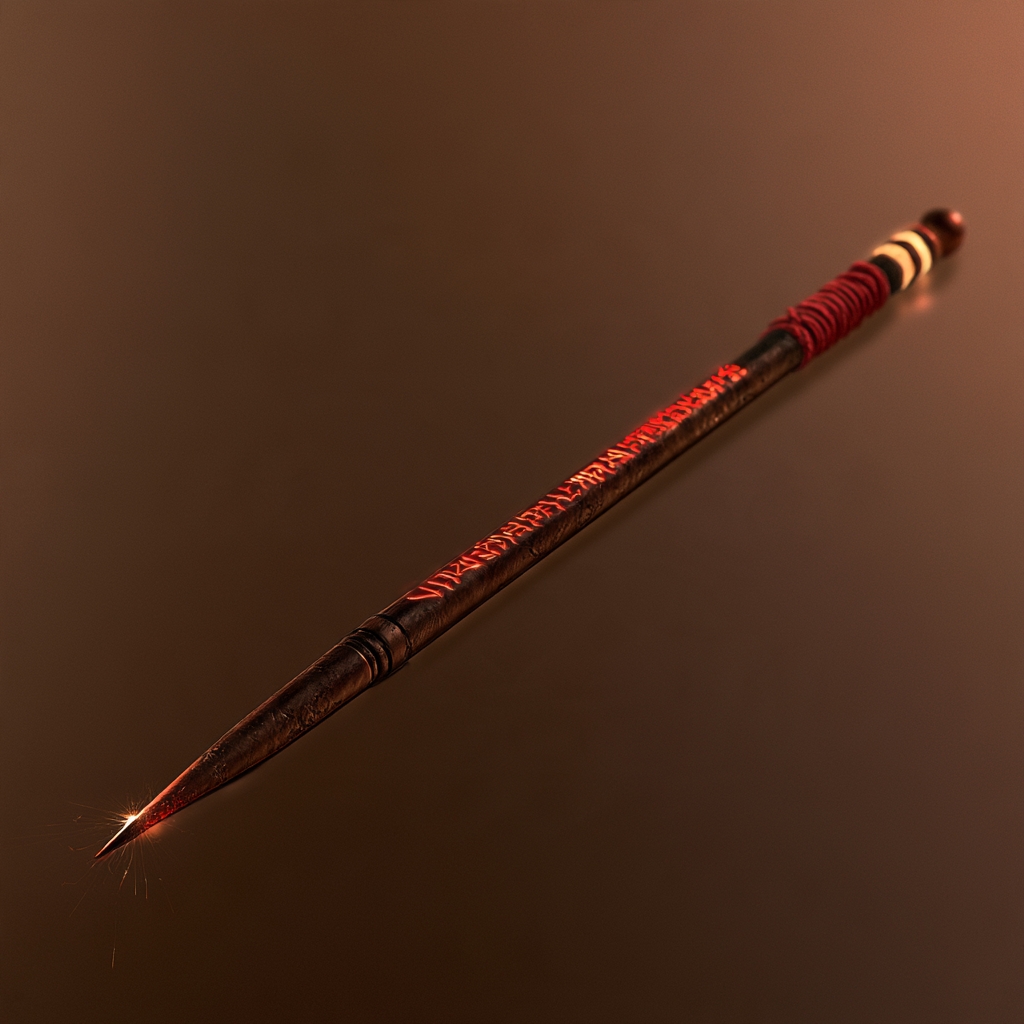
- Description: A bronze stylus as long as a hand, triangular in cross-section, with one end ground to a hard point for pressing wedges into clay and the other flattened into a narrow blade for trimming tablets. The grip is wrapped in dark red cord, and a single row of Sar-Wedge along the shaft names her mother’s bench.
- Abilities:
- Scribe’s Tool: The stylus counts as a tool for Scribing and Rune Cutting and is attuned when held for that work.
- Marking Wedge: When an attack with this weapon hits, the wielder may leave a small glowing wedge mark on the target. The mark is visible to the wielder for one hour through walls and darkness within 60 feet. Only one mark may exist at a time.
- Suggested value: 25 silver
Lore
A scribe of Assyria may not carry a sword into an archive, a court, or a Flamecitadel. The rule is old and has a plain purpose. Those who copy the laws are meant to stand apart from those who enforce them, and a clerk with a blade at her hip is no longer only a clerk. The same rule has never forbidden a stylus. No one can copy without one, and no guard has ever been willing to take a scribe’s tools at the door.
The Keepers of the Wedge made use of that gap early. In the first generations of the house, daughters who carried decrees along the mountain road were robbed and sometimes killed, since a sealed tablet was worth money to anyone who wished to know the Queen’s mind ahead of time. The bench-mothers could not arm their couriers, so they changed the tool. The trimming end of the stylus, a flat edge used for cutting tablets square, was ground longer and sharper. The pressing point was hardened. The whole was cast heavier, in good bronze, balanced so that it would fly straight for a short distance. It remained a stylus in every legal sense. It was also something a courier could put through a hand that reached for her satchel.
The magic in it comes from a habit of the copying bench. When a scribe finds a tablet with an error, she presses a single wedge into its upper corner. This is the strike mark, and it means the tablet is condemned and will be broken before the day ends. A struck tablet set back on a crowded drying rack can be lost among the good ones, so the house’s styluses were made to leave a strike mark that the scribe who pressed it could always find again. The glow shows to her alone, through a stack of tablets or a closed cupboard. In time the couriers found that the same mark could be left on a thief.
Each bench casts its own styluses, and the ninth bench pours them once in a generation. The pour that produced this one was made in the year Ama-Sharrat became a verifying scribe. She cast twelve, kept one, and laid the rest aside in a clay jar for daughters and apprentices not yet born. The row of Sar-Wedge on each shaft names the ninth bench and the year of the pour. Nin-Tuppi was handed hers in her twenty-second year, on the morning she first sat at the bench as a junior apprentice. Her sister Nin-Kalla holds another from the same jar. Seven remain.
The dark red cord on the grip is the wearer’s own work. A scribe rewraps it each year on the anniversary of her seating, and the old cord is burned in the bench’s kiln. Nin-Tuppi has wrapped hers forty times. The bronze beneath has worn to the shape of her fingers, and the pressing point has been reground so often that the stylus is a finger’s width shorter than her sister’s.
There is a saying at the ninth bench that a scribe has three uses for her stylus: to write what is true, to strike what is false, and to remind the forgetful that she is not unarmed. Bench-mothers add that a daughter who needs the third use often has usually neglected the first two.
Assigned Values
- Specific slot: Held in one hand (stored in the stylus sheath on the belt, which fills one of the belt’s four slots)
- Tier one stats:
- Attack bonus: +1
- Base damage: 2 piercing
- Range: Melee, or thrown at Extended (15/30 feet)
- Agility: +1 while held
- Item health points: 10 plus the wielder’s maximum health points
- Charges: 2, regaining 1 at each Helios up
- Skills gained while held:
- Scribing: +1 temporary skill point
- Rune Cutting: +1 temporary skill point
- Small Blades: +1 temporary skill point
Passive Magics
- Scribe’s Tool: The stylus counts as a tool for Scribing and Rune Cutting and is attuned when held for that work.
- Marking Wedge: When an attack with this weapon hits, the wielder may leave a small glowing wedge mark on the target. The mark is visible to the wielder for one hour through walls and darkness within 60 feet. Only one mark may exist at a time.
- Even Press: Every wedge the wielder presses with the point comes out at the same depth. She has advantage on checks to make an exact copy of an inscription.
- Snag of the False: When the wielder draws the point lightly across an inscription in clay, stone, or metal, she feels a slight catch wherever the surface has been smoothed, recut, or pressed a second time. She has advantage on checks to detect forgery or alteration.
- Tool at the Door: Viewed through the Mind’s Eye by passive examination, the stylus shows only as “scribe’s stylus.” Its weapon properties appear only to an active identify.
Activatable Magics
- Condemning Stroke (free action, 1 charge): While a Marking Wedge is on a target, the wielder declares it struck. The next attack made against that target by the wielder or an ally before the end of the wielder’s next turn has advantage.
- Pinning Throw (action, 1 charge): The wielder throws the stylus at a target within 15 feet. On a hit, in place of leaving a mark, the stylus pins a sleeve, cloak, strap, or foot to a wall, floor, or other solid surface behind it. The target has the Anchored condition, with movement limited to 5 feet from that point, until it uses an action to pull free.
- Press the Sign (action, no charge): The wielder presses a single wedge into any non-living surface. The wedge glows for one day and is visible only to her, within 60 feet and through walls and darkness. Up to three such signs may exist at a time. They do not count as the Marking Wedge.
- Return to Sheath (free action, no charge, once per turn): If the stylus lies within 30 feet and is not held by another creature, it returns to the wielder’s sheath.
Tags
Small Blade, Tier 1, Common, Stylus, Bronze, Thrown Weapon, Scribe’s Tool, Marking Wedge, Ninth Bench, Tuppi-Sharrat, Balawat, Piercing, Red Cord Grip, Sar-Wedge, Rune Cutting, Forgery Detection, Tracking Mark, Pinning Throw, Returning, Charged Item, Assyria, Renaissance
Obtaining, Buying, and Selling the Wedge-Stylus of the Ninth Bench 2937
How the item might be obtained
- Given at the bench: A daughter of the Tuppi-Sharrat matriline receives a stylus from her bench-mother or her own mother on the morning she is first seated as an apprentice. It comes from the bench’s stored pour, and no coin changes hands.
- From the jar: Seven styluses of the same pour remain in a clay jar at the ninth bench. The verifying scribe may give one to an outsider who has rendered the bench a service, such as returning a stolen decree or exposing a forged seal.
- Quest reward: A bench-mother, a vault keeper, or the guild of Balawat may offer a house stylus or a good copy as payment for courier work on the mountain road.
- Possession of an avatar: A character who possesses a scribe of the house acquires her stylus with her other belongings.
- Combat or salvage: A stylus may be taken from a fallen scribe or courier, found in a robber’s cache along the road out of Kalhu, or recovered from a looted satchel.
- Commission: A bronze founder and a rune cutter working together can cast a copy. A copy bears the maker’s own row on the shaft, since only a bench of the house may name itself there.
- Purchase: Copies, lost styluses, and those sold by scribes who have left the house reach the market through the shops below.
Shops where the item might be bought and sold
All prices are suggested amounts based on a value of 25 silver. Sellers set their own prices, and the amounts change with distance from Balawat and with what the buyer appears willing to pay.
- Bronze founder’s shop in Balawat:
- What it is: A family foundry on the lower street that casts bells, clasps, and scribe’s tools, with a rune cutter working at a side bench.
- Buying: A new copy costs about 25 silver and takes three days. A member of the local guild or of the matriline pays about 22 to 23 silver. A plain bronze stylus with no magic costs about 3 silver.
- Selling: The founder pays about 13 to 15 silver for a sound copy. A stylus bearing a bench’s row is refused and reported to the archive hall.
- How: Coin or World Bank transfer. The founder keeps a tally of each casting and its buyer.
- Scribe and stationery supplier in the capital:
- What it is: A narrow family shop selling styluses, clay, wax tablets, seal blanks, and inks to clerks and students.
- Buying: About 29 to 32 silver, which includes the 3% tax on goods sold in the city. It is sold from the tool case as a stylus, and the shopkeeper does not describe it as a weapon.
- Selling: About 13 to 16 silver. The owner tests the point on a clay blank and checks the shaft through the Mind’s Eye.
- How: World Bank transfer preferred.
- Cutler and small-arms seller in a Kalhu market town:
- What it is: A stall selling knives, razors, awls, and throwing blades to travelers and tradespeople.
- Buying: About 24 to 30 silver when one is in stock. The cutler sells it openly as a throwing blade and values the balance more than the script.
- Selling: About 12 to 15 silver.
- How: Coin is usual. Haggling of around 10% either way is expected.
- Guildhall quartermaster in Balawat:
- What it is: The supply counter in the town’s guildhall, stocked with gear that members have turned in or traded.
- Buying: About 22 to 23 silver for a guild member and 25 silver for a non-member.
- Selling: About 15 silver. The quartermaster logs the seller’s name and the row on the shaft.
- How: World Bank transfer, with the 1% bank fee paid by the account holder.
- Black-market dealer in Nimrod Quay:
- What it is: A back room behind a wine merchant’s cellar, supplying those who need a weapon that passes for something else.
- Buying: About 35 to 50 silver for a copy, since it can be carried past guards who would take a knife. A genuine house stylus with a bench’s row runs 1 gold and 5 silver to 3 gold, since it supports a false claim to be a scribe of the house.
- Selling: About 12 silver for a copy and up to 1 gold and 5 silver for a genuine one.
- How: Coin only, with no World Bank transfer and no record kept.
- Curio and import dealer on another island nation:
- What it is: A family shop in a foreign port selling Assyrian goods to collectors and scholars.
- Buying: About 40 to 70 silver. Sar-Wedge writing tools are uncommon abroad, and scholars of the language pay well for one that works.
- Selling: About 18 to 30 silver, depending on whether the dealer can read the row on the shaft.
- How: Local coinage or World Bank transfer. Assyrian citizens pay double the local taxes and fees as foreigners.
Roleplay of the Wedge-Stylus of the Ninth Bench 2937 in Defense and Offense
Archive vaults and narrow passages
- Defense:
- Nin-Tuppi keeps the stylus in its sheath until the moment she needs it, since an attack includes the draw and the return. A foe who closes with her in an aisle sees empty hands, then a short thrust, then empty hands again.
- She uses Pinning Throw on a pursuer’s cloak or sleeve against a shelf post, then walks away while they spend an action tearing free.
- She uses Press the Sign at each turning as she retreats, so she can find her way back through unlit vaults.
- Offense:
- Her first strike is meant to leave a Marking Wedge more than to wound. Once the mark is on an intruder, she follows them through walls and shelving with her eyes and directs the keepers to them.
- With an ally present she spends a charge on Condemning Stroke, calls out that the target is struck, and lets the stronger arm make the next attack with advantage.
- Her second action in a turn deals half damage, so she often uses it for Press the Sign or to move instead of a second thrust.
Courts, guildhalls, and guarded places
- Defense:
- Tool at the Door lets her carry the stylus where blades are forbidden. A guard who looks her over sees a scribe’s stylus and waves her through.
- In a designated safe area or a walled town her Armor Check is tripled or doubled, and she is slow to draw. Using a tool as a weapon in a court would end her standing with the house.
- Offense:
- Snag of the False is her weapon here. She draws the point across a disputed tablet in front of witnesses and names the row that has been pressed twice.
- If violence breaks out, she marks the instigator with a quick thrust and lets the guards do the rest, pointing them to the mark’s position.
Roads and open country of Kalhu
- Defense:
- This is the use the stylus was shaped for. When a hand reaches for her satchel, she puts the point through it and steps back.
- She uses Pinning Throw to fix a bandit’s foot or strap to a cart, tree, or the ground, and then keeps her distance. Return to Sheath brings the stylus back before her next turn.
- Offense:
- She throws at up to 15 feet without penalty, or to 30 feet with her attack roll halved. Beyond that she switches to the Decree Tablet.
- A marked bandit who runs can be followed for an hour within 60 feet, through brush and darkness, which lets her party track a fleeing scout back toward a camp.
Quarries, forge halls, and workshops
- Defense:
- Among crates, machinery, and stacked stone she has many surfaces to pin an attacker against.
- She presses signs on machinery as she passes so she can tell later whether anything has been moved.
- Offense:
- The stylus does little against stone constructs or armored foes, and she knows it. She marks such a foe for Condemning Stroke and leaves the heavy blows to the Quarry Mallet or to allies.
- Against a steam-powered device, she uses the point as a rune-cutting tool between blows, scoring a disrupting wedge across a visible rune where the GM allows it.
Darkness, smoke, and ash
- Defense:
- Her own Ember Shed blinds everyone but does not hide a Marking Wedge from her. She marks a foe first, then releases the ash, and she alone knows where they stand.
- Signs pressed before the smoke rose guide her to the exit.
- Offense:
- She attacks the marked target from within the cloud, and uses Condemning Stroke to give an ally advantage that offsets the poor visibility.
Wetlands, rain, and river travel
- Defense:
- Wet hands and the red cord grip serve well together, and the stylus does not slip. A thrown stylus that falls into water still returns to its sheath if it is within 30 feet.
- Offense:
- Soft mud and water offer nothing solid to pin against, so Pinning Throw needs a boat’s hull, a walkway post, or a tree.
Low-magic and dangerous places
- Defense:
- The glow of the Marking Wedge and the pressed signs is dimmer and may reach less far, at the GM’s discretion. Charges return slowly. She uses the stylus as a plain blade and keeps both charges for a Pinning Throw to cover a retreat.
- Offense:
- She avoids offense and marks only what she needs to keep track of.
Social encounters
- Defense:
- Holding the stylus loosely in her fingers while she listens is a habit of the bench. Those who know the Keepers read it as attention. Those who know the stylus read it as a warning.
- Offense:
- Pressing a single wedge into the corner of someone’s document, in the manner of a strike mark, is a deliberate insult among scribes. It says the work is condemned. She has done it once and does not intend to do it lightly again.
Perception of Activation:
User’s Perspective
- Sight: The wielder sees the row on the shaft glow ember-red and a single bright wedge appear where she strikes. That wedge stays in her sight wherever the target goes, showing through walls and darkness like a lamp behind paper. Pressed signs show as steadier amber points.
- Sound: A soft tick, like a wedge pressed into firm clay, sounds at each mark or sign. Pinning Throw ends with a short ringing note of bronze in wood or stone. Return to Sheath gives a quiet click at her hip.
- Touch: The red cord warms in her palm. She feels a small, satisfying give at the moment a mark takes, as when a point sinks to the right depth in a tablet. When the point crosses an altered inscription she feels a catch, like a nail on a rough seam.
- Smell: Warm bronze and a trace of damp clay, though no clay is present.
- Taste: None beyond a faint metallic note when a charge is spent.
- Extra-sensory perceptions:
- Mark sense: Even with her eyes closed she knows the direction and rough distance of her Marking Wedge, as one knows where one’s own hand is. Each pressed sign gives a fainter, steadier pull.
- Aetheric Scrutiny: She tastes the stylus as a thin, precise line of fire-aligned magic. A fresh mark tastes sharp, and it mellows as the hour runs out.
- Mind’s Eye: She knows how many charges remain and how long the current mark has left.
- Error sense: Through Snag of the False she perceives an altered row as wrong before she can say why, in the way a scribe hears a misspoken word.
- Bench sense: Holding the stylus for work, she has a brief awareness of the other styluses of the same pour, as a sense that her sister’s and her mother’s are in use or at rest.
Observer’s Perspective
- Sight: An observer sees a scribe’s hand move to her belt, a short bronze flash, and the hand returning empty. The target shows a small puncture or scratch. No mark is visible, except for the single white pulse of Condemning Stroke. Pinning Throw shows as a thin red line in the air and a ring of small glowing wedges around the stuck stylus.
- Sound: The tick of a mark is audible only at close range. The ring of a pinned stylus carries across a room.
- Touch: The marked target feels a brief warmth at the spot, easily mistaken for the sting of the wound. A pinned target feels its sleeve or strap held as if nailed.
- Smell: A faint scent of hot bronze near the wielder’s hand.
- Taste: None.
- Extra-sensory perceptions:
- True sight: The Marking Wedge and the pressed signs are visible as small ultraviolet wedges. A creature with true sight can see that it has been marked.
- Aetheric Scrutiny (other Akkad-Kuri): Nearby Akkad-Kuri taste a pinpoint of fire-aligned magic on the target and can tell that a scribe’s strike mark has been placed.
- Mind’s Eye: An observer who passively examines the stylus sees only “scribe’s stylus.” A target who examines itself may see a temporary notation reading “struck.”
- Soul sight: The mark shows as a tiny bright fleck on the target’s outline.
- Tremorsense and blind sight: These senses perceive the thrust or the impact of a throw and nothing of the mark itself.
Positives
- The mark and signs are visible only to the wielder under ordinary sight, so the target usually does not know it is being tracked.
- The mark sense works with eyes closed, in smoke, ash, and darkness.
- The stylus draws little notice. Its sounds are small, and its glow in the hand looks like lamplight on bronze.
- The error sense makes forged or altered writing apparent at a touch.
- Condemning Stroke gives allies a clear, brief signal of which foe to strike.
- The bench sense is a quiet comfort when she is far from Balawat.
Negatives
- Creatures with true sight, soul sight, or Aetheric Scrutiny can see or taste the mark and may realize they are being followed.
- A target that examines itself through the Mind’s Eye may find the notation and know who struck it.
- Only one Marking Wedge can exist, and the pull of an old mark vanishes the instant a new one is made.
- The mark sense reaches 60 feet and no farther. Losing it suddenly is disorienting.
- The ring of a Pinning Throw and the pulse of Condemning Stroke reveal that the stylus is more than a tool, which ends the benefit of Tool at the Door for anyone who witnessed it.
- The bench sense tells her when her mother’s stylus has lain unused for an unusual time, which can be a source of worry.
Recipe: Bronze Wedge-Stylus in the Manner of the Ninth Bench
Materials Needed
- Metal:
- 6 ounces of copper
- 1 ounce of tin, for a hard bronze that holds a point
- 1 small scrap of bronze cut from an older stylus, if one can be had, so that the new pour carries something of an earlier one
- Mold:
- 1 pound of fine casting clay mixed with sand
- 1 lump of beeswax for carving the pattern
- Magical components:
- 2 tier 1 magic crystals, each about the size of a coin, ground to powder as the catalyst (one for each charge)
- 1 struck tablet, meaning a clay tablet that bears an error and has been condemned with a strike mark, crushed to dust
- 1 pinch of kiln ash
- Grip and finish:
- 2 yards of dark red waxed cord
- 1 small measure of oil for quenching and polishing
- 1 scrap of leather for a belt sheath
- Fuel:
- Charcoal sufficient for one melt
Tools Required
- A small crucible furnace with bellows
- A crucible, tongs, and a skimming rod
- A carving knife and modeling tools for the wax pattern
- A set of files, from coarse to fine
- A whetstone and a polishing slate
- A fine chisel or graver for cutting the row on the shaft
- A quenching trough
- A block of damp clay and a wooden target board for testing
- A reading lens or other identification focus for checking the finished work through the Mind’s Eye
Skill Requirements
- Metalworking (bronze casting): 3 or higher
- Rune Cutting: 3 or higher, for the row on the shaft
- Scribing (Sar-Wedge): 2 or higher, since the crafter must know what a true wedge looks like in clay
- Small Blades: 1 or higher, to judge the balance for throwing
- Two crafters may share the work, provided each required skill is met by the one performing that step.
- Time: About 3 days of downtime.
- Standing: Only a bench of a scribe house may cut its own name on the shaft. A crafter outside such a house cuts a personal row naming the maker and the year.
Crafting Steps
- Carve the pattern:
- Shape the wax into a stylus as long as a hand, triangular in cross-section, with one end drawn to a point and the other flattened to a narrow blade. Leave the middle third round for the grip.
- Make the mold:
- Pack the casting clay around the wax, leaving a pouring channel at the blade end. Dry the mold for one day, then heat it to melt out the wax.
- Prepare the charge:
- Mix the crystal powder, the dust of the struck tablet, and the kiln ash in a dish. This is added to the melt in the next step.
- Melt and pour:
- Melt the copper in the crucible, add the tin and the scrap of older bronze, and skim the surface. Stir in the prepared powder at the last moment, and pour in one steady stream. Let the mold cool on its own.
- Break out and file:
- Break the mold. File the casting true along all three faces, keeping the cross-section even from point to grip.
- Harden the ends:
- Hammer the point and the blade edge lightly while cold to harden them. Grind the point to a clean three-sided tip and the blade to a sharp trimming edge on the whetstone.
- Balance:
- Rest the stylus across one finger. It should balance just forward of the grip, toward the point. File the blade end until it does.
- Cut the row:
- With the graver, cut a single row of Sar-Wedge along one face of the shaft, naming the bench or the maker and the year. Cut two small notches just above the grip to hold the charges.
- Polish and wrap:
- Oil and polish the bronze on the slate. Wrap the grip tightly with the red cord and seal the end with a drop of wax.
- Prove the point:
- As a ritual of at least 10 minutes, the crafter presses one hundred wedges into the block of damp clay, each as even as the last, and then throws the stylus three times into the target board. The row on the shaft begins to glow if the work is sound.
- Roll for the result:
- The crafter rolls a d20. On a 1 a flaw opens in the shaft, the stylus snaps at the grip, and the materials are lost. On a 20 the stylus gains one extra capability chosen by the GM, such as a third charge. Any other result produces a working stylus.
- Check and sheath:
- Examine the stylus through the identification focus to confirm its abilities. Stitch the leather sheath to fit, and hang it on the belt.
Ishme Courier, Who Was Refused a Sword and Given a Longer Pen
This is told by the carriers of sealed clay, on the mountain road, at night, when the fire is low. It is very old. It was told first in a speech that had no word for “ink,” and was carried into the temple-writing by a man who complains that it had eleven words for “road” and that he has used the same one for all of them. Where he was uncertain he wrote a small hook in the margin. There are many hooks.
In the time of the fourth mothers, when the house of the Wedge-Keepers was still poor and the road down from Balawat was a goat-path with opinions, there was a daughter of the ninth bench named Ishme. She was not a great copyist. Her rows wandered. But she had long legs and no fear of heights, and so she was made a carrier, and she took the Queen’s sealed words down the mountain to the river towns and brought the answers up.
Now a sealed tablet is a small thing to hold and a great thing to know. If the Queen has written, “The timber of the south bank goes to this house and not to that,” then that house and the other will each pay well to learn it a week before the seal is broken. This was understood on the road. In one year three carriers of the Keepers were stopped. Two were beaten. One did not come home, and her satchel was found in the river with the strap cut.
Ishme went to the mother of her bench, who in that day was called Ama-Geshtu. And Ishme said, as plainly as she said everything: “Give me a sword.”
And the bench-mother said: “No.”
“A knife, then. A long one.”
“No. Listen, long-legs. We are the ones who write down what the swords have decided. If we carry swords, we are one more house of swords, and a small one, and the first to be cut. The day a Keeper wears a blade into a court, every word she has ever copied is a soldier’s word and not a scribe’s. I will not sell two hundred years for one sharp edge.”
Ishme said: “Then I will die on the road like Dadu, with nothing in my hand.”
The telling says the old woman was quiet for a time. The translator writes: “It says ‘for the length of a pressing,’ which I am told is short.” Then she said: “What is in your hand now?”
Ishme looked. It was her stylus. She had carried it in from the bench without thinking, as scribes do.
“No guard has ever taken that from you,” said Ama-Geshtu. “Not at the temple door, not at the palace, not at the worst gate on the river. They take the knives of generals and they wave you through with that. Why?”
“Because it is a tool.”
“Because they have decided it is a tool. Give it to me.”
She kept it nine days. She took it down to the bronze-pourer, and it was melted, and poured again with more metal, heavier, the length of a hand and not a finger. One end she had drawn to a point as hard as a tooth. The other she had ground flat and keen, as for trimming a tablet, only longer than any tablet needs. And it was weighted so that it wished to fly point-first. Then she put it back in Ishme’s hand, and she said the three sayings, which every carrier still learns:
“It is to write what is true. It is to strike what is false. And it is to remind the forgetful. If you need the third, you have been slow with the first two.”
Ishme weighed it and said: “This is a sword that is ashamed of itself.” And the bench-mother said: “No. It is a pen that is not.”
There was one thing more, and Ishme did not understand it then. The bench-mother said: “You know the strike mark. One wedge in the corner of a bad tablet, and it is broken by evening. This will leave a strike mark you can find again. On anything.”
So Ishme went down the road with the timber-decree, which was the very matter all the houses wished to know. At the place called the Elbow, where the path turns under a leaning rock, three men stepped out. Two had clubs. The third, who stood back, wore a good cloak with the hood up, and good boots, and he did not speak.
The telling does not pretend she won. She was one, and a copyist. The two with clubs struck her on the shoulder and the knee, and she went down in the stones. And the third came forward then, quickly, as one who does not like the work but wants it done, and he put his hand to the strap of her satchel.
And Ishme, on the ground, drew her pen, and drove the point through the back of that hand, between the bones.
He cried out and tore free. One of the others kicked her in the head, and the road went dark. When she woke, the satchel was gone, and the men were gone, and her pen lay by her face where it had fallen. And she lay there and wept, for she thought: now I am Dadu, only alive, which is worse, for I must go up and say it.
Here the translator writes: “The next lines are damaged. I give what can be read. It says: ‘Then she saw the ember that was not in the fire.’”
For it was dusk, and down the mountain, far below at the first bend, small as a seed, there was a red light. It had the shape of a wedge. It moved as a man moves who is walking fast and holding one hand in the other. And when it passed behind a spur of rock she saw it still, through the rock, as one sees a lamp through a hand held before it.
Then she understood what the old woman had put in the bronze. She had struck him. He was a bad tablet now, marked in the corner, and he could be found again.
She could not see it from far for long. The telling is careful here; it says the ember showed only “within a stone’s long throw.” Beyond that she followed by the blood on the path, and then the boot-marks, and wherever she came near again, there it was ahead, red, through tree and wall. With her knee as it was, she walked the night. At the gray hour she came to the river town of the timber houses, and the ember went in at a gate, and she after it.
It led her to no robbers’ den. It led her to the hall of the town’s judge, a good stone house with guards. And through the wall of the upper room she saw the red wedge resting at the height of a table.
The guards stopped her. She was dirt and blood to the hair. They searched her, as they must, and found a carrier’s badge and a stylus, and one said, “A scribe,” and they let her up, for it was the law that a scribe of the Queen’s hall may not be barred from a court. The translator’s hook is here, with the note: “They truly did not take it. I have checked the word three times.”
In the upper room sat the judge at his morning business. And beside him, a man in a good cloak, the factor of the largest timber house on the river, laying before the judge a sealed tablet. “Come this hour from Balawat,” he was saying. “The carrier was set upon, alas. My men found the satchel by the road. I bring it in duty.” His right hand was wrapped in clean linen. And through the linen, plain as a coal, Ishme saw her wedge.
She did not accuse him. This is the heart of it, and the carriers slow their voices. She bowed to the judge, though her knee near failed, and she said: “I am the carrier. I thank this good man. By the custom, the scribe who carried a decree reads it out. May I?”
The judge broke the seal himself and gave it to her. And she did not read. She set the tablet on the table, and drew her pen, and laid the point upon the first row, and drew it slowly along.
The factor said, “What is she doing?” And the judge, who was no fool, said, “Be still.”
On the first row the point ran smooth. On the second, smooth. On the third row, where the name of the house was written that should have the south-bank timber, the point caught. It caught, and ran, and caught again. The clay had been wetted there, and rubbed flat, and pressed anew, and dried in a night by a fire. The seal had been lifted with a hot wire and set back. It was well done. An eye would not have found it. The pen found it as a tongue finds a chipped tooth.
Ishme said: “This row has been pressed twice.” And she turned her pen, and in the upper corner of the Queen’s own decree, before the judge, she pressed one wedge. The strike mark. Condemned.
There was a great silence. To strike a royal tablet is a thing for which a scribe may lose her hands, if she is wrong.
Then she said, to the factor, gently: “Sir, you have hurt your hand in your duty. Will you show the judge the wound?”
He would not. The guards unwound the linen. And there in the back of his hand was a hole, three-sided, the shape that no knife makes and no arrow, the shape of a single wedge.
“My house strikes what is false,” said Ishme. “Tablets in the corner. Men where we can reach.”
The true wording was read out from the bench’s own copy within the week, and the timber went where the Queen had sent it. The factor’s house paid a fine that the telling calls “a forest.” Ishme’s knee never mended straight, and she carried no more, but sat at the ninth bench as a striker of errors until she was old, which suited her, her own rows being what they were.
And when she came home up the mountain, limping, she went to Ama-Geshtu and laid the pen on the bench between them and said: “I was slow with the first two. I needed the third.”
The old woman said: “You needed the third once. With the point through one hand. And then you won the matter with the second, standing in a court where no sword is let in. Tell me now you wanted the sword.”
Ishme is said to have thought about it honestly, as she did everything. Then she said: “I would have liked both.”
“Yes,” said the bench-mother. “That is why I am the one who decides.”
The moral of the story is that the one who is not permitted a weapon should sharpen what she is permitted, and learn its every use; and that a mark placed truly will carry farther than a blow. The carriers add, when the fire is nearly out: strike the hand if you must, but win in the room where they let you keep your pen.
Suggested conversions to other systems:
Call of Cthulhu (7th Edition)
The Carrier’s Three-Sided Pen
- Type: Enchanted implement and weapon (artifact)
- Origin: A bronze stylus as long as a hand, triangular in cross-section, with a hardened point at one end and a narrow trimming blade at the other, from the ninth copying bench of Balawat in Assyria on the world of Saṃsāra. The grip is wrapped in dark red cord, and a row of wedge-script runs along the shaft.
- Weapon profile:
- Skill: Fighting (Brawl), or Throw when thrown
- Damage: 1D4 + DB in hand, 1D4 + half DB thrown
- Impale: Yes
- Base Range: Touch, or STR/5 yards thrown
- Uses per Round: 1
- Malfunction: —
- Bonding: The wielder presses one hundred even marks into wet clay and makes a POW roll. On a success the stylus is bonded and its powers can be used.
- Passive effects while bonded and held:
- Bonus die on Art/Craft (Calligraphy) and Art/Craft (Engraving) rolls.
- Bonus die on Appraise or Spot Hidden rolls to detect forgery or alteration in any inscription the point is drawn across.
- The stylus passes as a writing tool. No roll is needed to carry it past a search for weapons unless the searcher has seen it used as one.
- Powers (the stylus draws on the wielder’s magic points):
- Marking Wedge: Cost 1 magic point. When an attack with the stylus hits, a small glowing mark is left on the target. For one hour the wielder sees it through walls and darkness within 20 yards. Only one mark can exist at a time.
- Condemning Stroke: Cost 2 magic points. The next attack against the marked target, by the wielder or an ally, gains a bonus die.
- Pinning Throw: Cost 2 magic points. On a successful Throw at a target within 5 yards, the stylus pins clothing or a strap to a solid surface in place of dealing damage. The target cannot move from the spot until it spends a round pulling free.
- Press the Sign: No cost. The wielder presses a mark into any surface. It glows for one day to her eyes alone within 20 yards. Up to three may exist.
- Return: No cost, once per round. If the stylus lies within 10 yards and is not held by another, it returns to its sheath.
- Sanity:
- First bonding: 0/1 Sanity points, as the wielder becomes aware of other pens of the same casting in distant hands.
- A marked target who discovers the glowing wound through unnatural sight: 0/1 Sanity points.
- Investigation:
- An Archaeology roll identifies it as a stylus for wedge-writing, far heavier than any known example.
- A Medicine roll on a wound it has made notes a three-sided puncture that matches no common weapon.
- Cthulhu Mythos: None gained. The stylus is not of the Mythos.
Blades in the Dark (current edition)
The Clerk’s Honest Spike
- Type: Fine arcane weapon and tool (unique item)
- Load: 1
- Quality: 2
- Origin: A heavy bronze stylus, three-sided, with a hardened point and a trimming edge, from the ninth copying bench of Balawat in Assyria on the world of Saṃsāra.
- Features:
- Concealed: It is a writing tool to anyone who searches you. It is not taken at doors where weapons are surrendered, unless someone present has seen it used as one.
- Fine small blade: It serves as a fine dagger in close quarters and can be thrown a short distance.
- Marking Wedge: When you harm or touch a target with the point, you may leave a mark only you can see. For the rest of the score you know where that target is when it is nearby, even through walls. Gain +1 effect when you Hunt or tail it. Only one mark can exist.
- Condemning Stroke: Take 1 stress and call out the marked target. The next teammate to act against it gains +1 effect.
- Pinning Throw: Take 1 stress when you throw the stylus. In place of harm, it pins the target’s clothing or gear to a solid surface. The target is held in place until it spends an action tearing free.
- Snag of the False: When you Study a document, seal, or inscription with the point, gain +1 effect to detect forgery or tampering.
- Return: Once thrown, it finds its way back to your sheath by the next beat of the action if it is not being held.
- Drawbacks:
- Signature Wound: The puncture it leaves is three-sided and unlike any other. A victim or body found with that wound points to you. Take +1 heat on any score where it draws blood and the victim or body is found.
- Crafting a copy: Invent the formula as a long-term project, then Tinker during downtime. Arcane, minimum quality 2, with the Signature Wound drawback. Requires bronze and the dust of a document condemned for error.
Dungeons & Dragons (2024 rules)
Stylus of the Strike Mark
- Weapon (Dagger), Uncommon (Requires Attunement)
- Properties: Finesse, Light, Thrown (Range 20/60)
- Mastery: Nick
- Damage: 1d4 Piercing
- Weight: 1/2 lb.
- Description: This heavy bronze stylus is triangular in cross-section, with a hardened point at one end and a narrow trimming blade at the other. It comes from the ninth copying bench of Balawat in Assyria, on the world of Saṃsāra. Its grip is wrapped in dark red cord, and a row of wedge script runs along the shaft.
- Magic Weapon: You gain a +1 bonus to attack rolls and damage rolls made with this weapon.
- Scribe’s Tool: The stylus can be used in place of Calligrapher’s Supplies for inscribing clay, wax, stone, or metal. You have Advantage on Intelligence (Investigation) checks made to detect forgery or alteration in an inscription you draw its point across.
- Tool at the Door: To casual inspection the stylus appears to be a nonmagical writing tool. The Identify spell or a successful DC 15 Intelligence (Arcana) check made while handling it reveals its nature.
- Marking Wedge: When you hit a creature with this weapon, you can mark it. For 1 hour, you know the marked creature’s location while it is within 60 feet of you, even if it is behind Total Cover or has the Invisible condition. Only one creature can be marked at a time.
- Returning: Immediately after you make a ranged attack with this weapon, it returns to your hand or its sheath, your choice.
- Charges: The stylus has 2 charges and regains 1 expended charge daily at dawn.
- Condemning Stroke (1 charge): As a Bonus Action, you declare the marked creature struck. The next attack roll made against it by you or an ally before the end of your next turn has Advantage.
- Pinning Throw (1 charge): When you hit a Large or smaller creature with a ranged attack using this weapon and the creature is within 5 feet of a wall or standing on a solid surface, you can forgo the returning property to pin it. The creature’s Speed becomes 0 until a creature within reach takes an action to pull the stylus free. The stylus then returns to you at the start of your next turn.
- Press the Sign: As a Utilize action, you press a mark into a nonliving surface. It lasts 24 hours and is visible only to you, within 60 feet and through Total Cover. Up to three such marks can exist at a time.
Knave (Second Edition)
Bench-Cast Strike Stylus
- Type: Relic weapon, one-handed, may be thrown
- Slots: 1
- Damage: d6
- Range: Melee, or thrown to near range
- Value: Seldom for sale. Copies fetch whatever a buyer will pay.
- Description: A heavy bronze stylus, three-sided, with a hardened point and a trimming edge, from Balawat in Assyria on the world of Saṃsāra. The grip is wrapped in dark red cord, and a row of wedge-script runs along the shaft.
- Always in effect while carried:
- It passes as a writing tool wherever weapons are forbidden, unless someone there has seen it used.
- Checks to copy an inscription exactly, or to detect a forged or altered one by drawing the point across it, are made with advantage (+5).
- Marking Wedge: On a hit, the wielder may leave a mark only she can see. For one hour she knows where the target is within 60 feet, through walls and darkness. Only one mark at a time.
- After being thrown, the stylus returns to its sheath at the end of the round if no one is holding it.
- Charges: 2. One charge returns each morning.
- Condemning Stroke (1 charge): Call out the marked target. The next attack against it by the wielder or an ally is made with advantage (+5).
- Pinning Throw (1 charge): On a thrown hit, deal no damage and pin the target’s clothing or gear to a solid surface. The target cannot move from the spot until it spends its action pulling free.
- Press the Sign: At will, press a mark into any surface. It lasts a day and only the wielder can see it, within 60 feet. Up to three at a time.
- Limit: On an attack roll of natural 1, the point bends. The stylus still writes and wounds, and its powers are lost until a smith spends a day regrinding it.
Fate (Fate Condensed)
The Pen That Is Not Ashamed
- Type: Extra (tool and concealed weapon)
- Origin: A heavy bronze stylus, triangular in cross-section, with a hardened point and a narrow trimming blade, from the ninth copying bench of Balawat in Assyria on the world of Saṃsāra. The grip is wrapped in dark red cord, and a row of wedge-script runs along the shaft.
- Permission: A character aspect showing training at a scribe’s bench or service as a courier of sealed documents.
- Cost: 2 refresh
- Weapon rating: Weapon:1, if the table uses weapon ratings
- Item aspect: A Scribe’s Stylus With a Second Use
- Invoke: To carry it where blades are forbidden, to write or copy with perfect evenness, or to strike quickly from an empty-looking hand.
- Compel: It is short and light against armor, its wound is three-sided and recognizable, and using it as a weapon in a court or archive costs a scribe her standing.
- Stunts granted while carried:
- Marking Wedge: When you succeed on an attack with the stylus, you may place the aspect Struck and Marked on the target with one free invoke. For the rest of the scene you know where that target is within the zone and adjacent zones, through walls and darkness. Only one target can be marked.
- Condemning Stroke: Once per scene, pass the free invoke on Struck and Marked to an ally and add a second free invoke for that ally’s next attack on the target.
- Pinning Throw: Once per session, when you attack by throwing the stylus, you may forgo stress to place Pinned to the Wall on the target with two free invokes. The target cannot leave its zone until it overcomes against Fair (+2) opposition. The stylus returns to your sheath afterward.
- Snag of the False: +2 to Investigate or Lore when detecting forgery or alteration in any inscription you draw the point across.
Numenera and Cypher System (Numenera Discovery and the Cypher System Rulebook)
Three-Sided Marking Stylus
- Type: Artifact
- Level: 1d6
- Form: A heavy bronze stylus as long as a hand, three-sided, with a hardened point and a narrow trimming edge, from Balawat in Assyria on the world of Saṃsāra. The grip is wrapped in dark red cord, and a row of wedge-shaped marks runs along the shaft.
- Effect:
- The stylus functions as a light weapon (2 points of damage, attacks eased) that can be used in melee or thrown to short range. After being thrown it returns to the wielder’s sheath at the end of the round if no one holds it.
- It passes as a writing tool to anyone who does not know otherwise.
- The wielder has an asset on tasks to copy an inscription exactly and on tasks to detect forgery or alteration in an inscription the point is drawn across.
- Marking Wedge (enabler): When the wielder hits a target, they can leave a mark only they can see. For one hour the wielder knows the target’s position within short range, through walls and darkness. Only one mark can exist. No depletion roll is needed.
- Condemning Stroke (action): The wielder declares the marked target struck. The next attack against it by the wielder or an ally is eased by two steps. Roll for depletion.
- Pinning Throw (action): The wielder throws the stylus at a target within immediate range that is beside a solid surface. On a hit it inflicts no damage and holds the target in place until the target uses an action and succeeds on a Might task against the artifact level. Roll for depletion.
- Press the Sign (action): The wielder presses a mark into any surface. It lasts one day and is visible only to the wielder within short range. Up to three can exist. No depletion roll is needed.
- Depletion: 1 in 1d20. A depleted stylus remains a light weapon and a writing tool and loses all other effects.
Pathfinder (Second Edition, Remaster)
Strike-Mark Stylus — Item 5
- Traits: Magical
- Price: 150 gp
- Usage: held in 1 hand
- Bulk: L
- Base Weapon: Dagger (agile, finesse, thrown 10 ft., versatile S)
- Description: This +1 dagger takes the form of a heavy bronze stylus, triangular in cross-section, with a hardened point and a narrow trimming blade. It comes from the ninth copying bench of Balawat in Assyria, on the world of Saṃsāra. After you make a thrown Strike with it, the stylus flies back to your hand or its sheath. It can be used as a writing tool for inscribing clay, wax, stone, or metal, and you gain a +1 item bonus to Crafting checks to inscribe and to Society or Perception checks to detect a forgery in an inscription you draw its point across. A creature that examines the stylus without handling it must succeed at a DC 20 Perception check to recognize it as a weapon.
- Activate—Marking Wedge [free-action] (concentrate)
- Trigger: You damage a creature with a Strike using the stylus.
- Effect: You leave a mark only you can see. For 1 hour, while the creature is within 60 feet, it can’t be undetected or unnoticed by you, even through walls or darkness. Only one creature can be marked at a time.
- Activate—Condemning Stroke [one-action] (auditory, concentrate)
- Frequency: once per day
- Effect: You declare the marked creature struck. It is off-guard against the next Strike made against it by you or an ally before the end of your next turn.
- Activate—Pinning Throw [two-actions] (manipulate)
- Frequency: once per day
- Effect: Make a thrown Strike with the stylus against a creature adjacent to a wall or standing on a solid surface. On a hit, the Strike deals no damage and the creature is immobilized until it Escapes (DC 20) or a creature Interacts to pull the stylus free. The stylus returns to you once it is freed.
- Activate—Press the Sign [one-action] (manipulate)
- Effect: You press a mark into a nonliving surface. It lasts 24 hours and is visible only to you, within 60 feet and through walls. Up to three such marks can exist at a time.
Savage Worlds (Adventure Edition)
The Wedge-Keeper’s Road Pen
- Type: Arcane device (weapon)
- Damage: Str+d4
- Range: 3/6/12 when thrown
- RoF: 1
- Minimum Strength: d4
- Weight: 0.5
- Cost: Seldom for sale. Copies sell for whatever the market bears.
- Description: A heavy bronze stylus, three-sided, with a hardened point and a trimming edge, from Balawat in Assyria on the world of Saṃsāra. The grip is wrapped in dark red cord, and a row of wedge-script runs along the shaft.
- Passive effects while carried:
- It passes as a writing tool. Notice rolls to recognize it as a weapon are made at −2 unless the observer has seen it used.
- +1 to rolls to copy an inscription exactly, and +2 to Notice or Research rolls to detect forgery or alteration in an inscription the point is drawn across.
- Marking Wedge: When the wielder hits with the stylus, she may leave a mark only she can see. For one hour she knows where the target is within 12″, through walls and darkness. Only one mark can exist.
- After being thrown, the stylus returns to its sheath at the end of the round if no one is holding it.
- Power Points: 4. The stylus regains 2 Power Points each dawn and cannot be recharged by other means.
- Activation: No roll is needed. The wielder spends the Power Points listed.
- Condemning Stroke (2 Power Points, free action): The next attack against the marked target by the wielder or an ally before the end of the wielder’s next turn is made at +2.
- Pinning Throw (2 Power Points, as part of a thrown attack): On a hit against a target beside a solid surface, the stylus deals no damage and the target is Entangled. On a raise the target is Bound. The target breaks free as normal.
- Press the Sign (no cost, action): The wielder presses a mark into any surface. It lasts one day and is visible only to her, within 12″. Up to three can exist.
Shadowrun (Sixth World Edition)
Strike-Wedge Stylus Focus
- Type: Melee weapon (blade), throwable, and bonded weapon focus
- Damage Value: 2P
- Attack Ratings: 6/2*/—/—/— (the Near rating applies when thrown)
- Force: 1
- Bonding cost: 3 Karma
- Availability: 4(L)
- Cost: 7,500¥ for a copy. The original is seldom for sale.
- Description: A heavy bronze stylus as long as a hand, triangular in cross-section, with a hardened point and a narrow trimming blade, from the ninth copying bench of Balawat in Assyria on the world of Saṃsāra. The grip is wrapped in dark red cord, and a row of wedge-script runs along the shaft. It contains no electronics and has no wireless bonus.
- Passive effects while bonded and held:
- +1 die on Close Combat tests with the stylus. As a weapon focus it can strike astral forms that are manifest or dual-natured.
- It passes as a writing tool. Perception tests to recognize it as a weapon suffer −2 dice unless the observer has seen it used.
- +1 die on tests to engrave or inscribe, and +2 dice on tests to detect forgery or alteration in an inscription the point is drawn across.
- Marking Wedge: When the wielder hits with the stylus, she may leave a mark only she can see. For one hour she knows the target’s position within 20 meters, through walls and darkness. Only one mark can exist. The mark is visible on the astral plane.
- After being thrown, the stylus returns to its sheath at the end of the combat round if no one is holding it.
- Charges: 2. One charge returns at each sunrise.
- Condemning Stroke (1 charge, Minor Action): The next attack against the marked target by the wielder or an ally before the end of the wielder’s next turn gains +2 dice.
- Pinning Throw (1 charge, as part of a thrown attack): On a hit against a target beside a solid surface, the stylus deals no damage and the target gains the Immobilized status until it spends a Major Action to pull free.
- Press the Sign (no charge, Minor Action): The wielder presses a mark into any surface. It lasts 24 hours and is visible only to her, within 20 meters, and on the astral plane. Up to three can exist.
- Astral signature: Each mark and activation leaves a signature that lasts for Force hours.
Starfinder (Second Edition)
Archivist’s Marking Stylus — Item 5
- Traits: Analog, Magical
- Price: 1,500 credits
- Usage: held in 1 hand
- Bulk: L
- Base Weapon: Knife (agile, finesse, thrown 10 ft.)
- Description: This knife takes the form of a heavy bronze stylus, triangular in cross-section, with a hardened point and a narrow trimming blade. It comes from the ninth copying bench of Balawat in Assyria, on the world of Saṃsāra. It grants a +1 item bonus to attack rolls. After you make a thrown Strike with it, the stylus flies back to your hand or its sheath. It can be used as a tool for inscribing clay, wax, stone, or metal, and you gain a +1 item bonus to Crafting checks to inscribe and to Society or Perception checks to detect a forgery in an inscription you draw its point across. A creature that examines the stylus without handling it must succeed at a DC 20 Perception check to recognize it as a weapon, and weapon scanners that look for powered arms do not register it.
- Activate—Marking Wedge [free-action] (concentrate)
- Trigger: You damage a creature with a Strike using the stylus.
- Effect: You leave a mark only you can see. For 1 hour, while the creature is within 60 feet, it can’t be undetected or unnoticed by you, even through walls or darkness. Only one creature can be marked at a time.
- Activate—Condemning Stroke [one-action] (auditory, concentrate)
- Frequency: once per day
- Effect: You declare the marked creature struck. It is off-guard against the next Strike made against it by you or an ally before the end of your next turn.
- Activate—Pinning Throw [two-actions] (manipulate)
- Frequency: once per day
- Effect: Make a thrown Strike with the stylus against a creature adjacent to a wall or standing on a solid surface. On a hit, the Strike deals no damage and the creature is immobilized until it Escapes (DC 20) or a creature Interacts to pull the stylus free. The stylus returns to you once it is freed.
- Activate—Press the Sign [one-action] (manipulate)
- Effect: You press a mark into a nonliving surface. It lasts 24 hours and is visible only to you, within 60 feet and through walls. Up to three such marks can exist at a time.
Traveller (Mongoose Second Edition, 2022 Update)
Relic Stylus of the Ninth Bench
- Weapon: Relic stylus (anomalous artefact)
- TL: 1 in manufacture. Its effects cannot be reproduced at any known TL.
- Range: Melee, or thrown to 10 metres
- Damage: 1D+1
- Kg: 0.25
- Cost: Seldom for sale. A collector might pay Cr2500 or more.
- Magazine: —
- Traits: None
- Skill: Melee (blade), or Athletics (dexterity) when thrown
- Description: A heavy bronze stylus as long as a hand, three-sided, with a hardened point and a trimming edge, from Balawat in Assyria on the world of Saṃsāra. The grip is wrapped in dark red cord, and a row of wedge-shaped marks runs along the shaft.
- Passive effects while carried:
- It passes as a writing instrument. Checks to recognize it as a weapon suffer DM−2, and it carries no power signature for a scanner to find.
- DM+1 to checks to copy an inscription exactly, and DM+2 to Investigate checks to detect forgery or alteration in an inscription the point is drawn across.
- Marking Wedge: When the wielder hits with the stylus, she may leave a mark only she can see. For one hour she knows the target’s position within 20 metres, through walls and darkness. Only one mark can exist.
- After being thrown, the stylus returns to its sheath at the end of the round if no one is holding it.
- Charges: 2. One charge returns each local dawn.
- Condemning Stroke (1 charge, Minor Action): The next attack against the marked target by the wielder or an ally before the end of the wielder’s next turn gains a Boon.
- Pinning Throw (1 charge, as part of a thrown attack): On a hit against a target beside a solid surface, the stylus deals no damage and the target cannot move from its position until it spends a Significant Action and succeeds at a STR check (Average 8+).
- Press the Sign (no charge, Minor Action): The wielder presses a mark into any surface. It lasts one day and is visible only to her, within 20 metres. Up to three can exist.
- Analysis: Sensors detect only bronze and waxed cord. A Science check (Formidable 14+) finds no mechanism for its effects.
Warhammer (Warhammer Fantasy Roleplay, Fourth Edition)
The Strike-Mark Pen of the Road Clerks
- Type: Magical weapon
- Weapon Group: Basic in melee, Throwing when thrown
- Price: N/A
- Encumbrance: 0
- Availability: Unique
- Reach: Very Short
- Range: 6 when thrown
- Damage: +SB+1 in melee, +SB−1 thrown
- Qualities: Precise
- Flaws: Undamaging
- Description: A heavy bronze stylus as long as a hand, three-sided, with a hardened point and a trimming edge, from Balawat in Assyria on the world of Saṃsāra. The grip is wrapped in dark red cord, and a row of wedge-script runs along the shaft. To those with the Second Sight Talent, the point holds a small ember-red spark.
- Passive effects while carried:
- It passes as a writing tool. Perception Tests to recognize it as a weapon are Hard (−20) unless the observer has seen it used.
- +10 to Art (Calligraphy) and Trade (Engraver) Tests, and +20 to Tests to detect forgery or alteration in an inscription the point is drawn across.
- Marking Wedge: When the wielder hits with the stylus, she may leave a mark only she can see. For one hour she knows where the target is within 20 yards, through walls and darkness. Only one mark can exist.
- After being thrown, the stylus returns to its sheath at the end of the Round if no one is holding it.
- Charges: 2. One charge returns at each sunrise.
- Condemning Stroke (1 charge, Free Action): The next attack against the marked target by the wielder or an ally before the end of the wielder’s next turn gains +20.
- Pinning Throw (1 charge, as part of a thrown attack): On a hit against a target beside a solid surface, the stylus deals no Damage and the target gains 1 Entangled Condition, resisted against a Strength of 40.
- Press the Sign (no charge, Action): The wielder presses a mark into any surface. It lasts one day and is visible only to her, within 20 yards. Up to three can exist.
- Notice: The three-sided wound it leaves is unlike that of any common blade and may be remembered by those who see it.