
From: Lineage 4172 of Akkad Kuri
- Slot: Dermal Weave (Akkad-Kuri only)
- Rank: Tier 1, Common
- Armor Check: +1
- Attunement: Ritual, at least 10 minutes
- Weight: None
- Item health points: Not listed
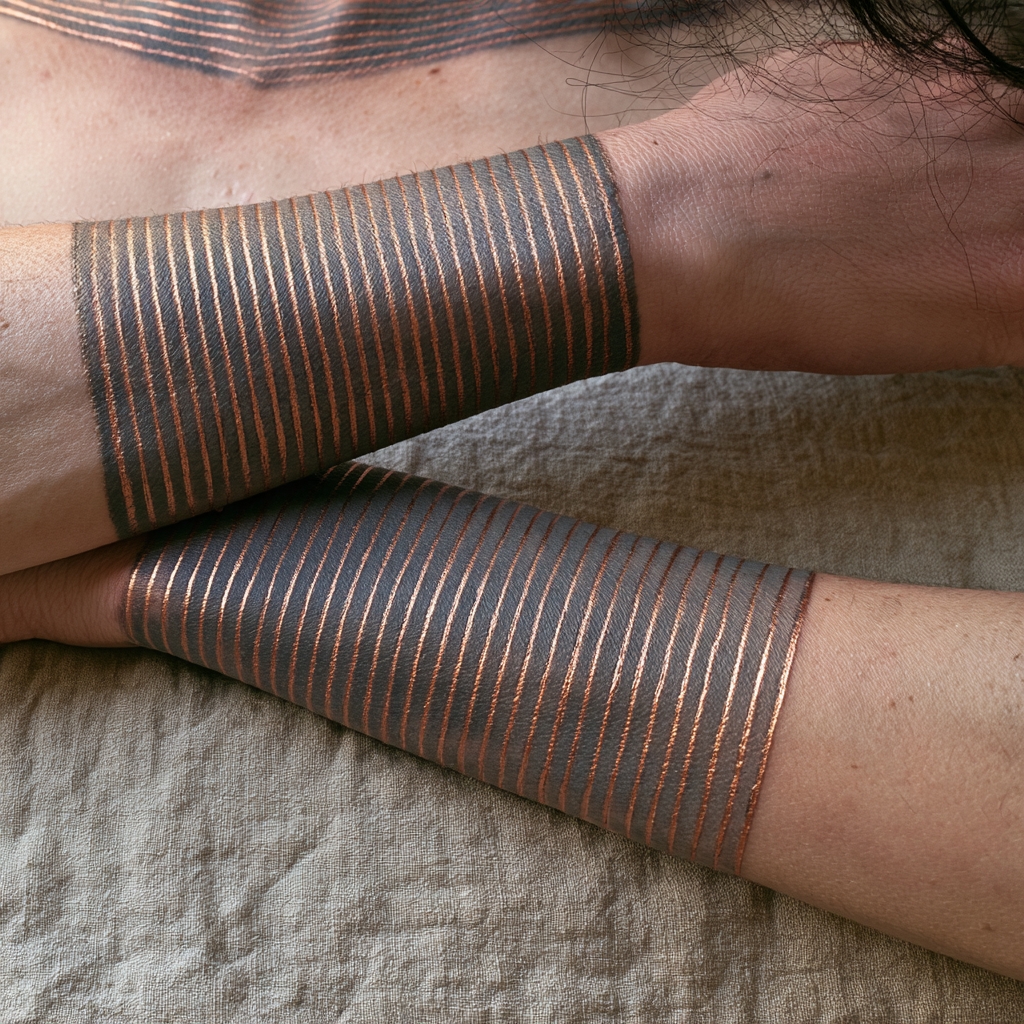
- Description: Alchemical ink mixed with fine copper dust, worked by an artisan into the grooves of the script-like patterns on both forearms and across the collarbones. In lamplight the rows show a faint copper line, matching the sheen of her eyes.
- Abilities:
- Steady Draw: While attuned and with the forearm patterns exposed, the weave regulates the wearer’s absorption of ambient magic. In an area of low ambient magic, the onset of weakness is delayed by one day.
- Conductive Rows: While attuned, the wearer gains 1 temporary skill point in Rune Cutting.
- Covered Loss: If the forearm patterns are covered by clothing or armor, the abilities and Armor Check of this weave are suppressed until they are exposed again.
- Suggested value: 60 silver
Lore
Dermal Weave is the one craft the Akkad-Kuri keep wholly to themselves, since no other race has the patterned skin to hold it. The ruling lines wear gold, which carries command. The generals wear flame-resistant alloys. For many generations the scribes wore nothing in their patterns at all, because the bench-mothers of the Tuppi-Sharrat matriline held that a copyist’s skin should be as plain as an unpressed tablet.
That changed with a problem of the hands. The archive hall of Balawat lies directly over a ley line, and the Flamecitadel above it draws heavily on that line during each Flamevow. Scribes at the benches below felt the surge as a tightness in the forearms, where their script-like rows run closest together. On Flamevow days their wedges came out a hair too deep. For ordinary copying this did not matter. For rune cutting it did. A rune cut too deep on a steam gauge or a blade can fail or do something unintended, and during the early renaissance the house lost several commissions and one apprentice’s eye to work that was cut on the wrong day.
The remedy came from a weave-artisan named Kuri-Zamat, a woman of the capital who had spent a century laying gold into the skin of courtiers and had grown tired of it. She came to Balawat to study old inscriptions and stayed. Watching the scribes shake out their wrists after a Flamevow, she observed that their patterns were taking in more magic than their work could use and had nowhere to send the excess. She proposed copper. It was cheap, it carried magic readily, and it would not hold a charge the way gold does. Worked into the rows as fine dust in alchemical ink, it would let surplus magic run along the script and bleed off evenly, the way a gutter carries rain off a roof.
The bench-mothers refused for eleven years. A scribe’s skin, they said, was not a courtier’s. Kuri-Zamat applied the first copper weave to her own forearms and then cut a set of test runes on a Flamevow day, in front of the ninth bench, with a hand that did not waver. The house allowed its rune cutters to take the weave after that, on two conditions that still hold. The copper must be plain, with no gold or silver blended in, so that no scribe carries a ruler’s metal. And the first ink must be mixed with filings from a tool belonging to the wearer’s own mother, so that the line of the bench runs in the skin as it does in the hem of the robe.
Nin-Tuppi received her weave in her fortieth year, when she began cutting runes for the Balawat sawmills. The filings came from her mother’s seal-cutting burin. Ama-Sharrat handed over the tool without comment and took it back the same evening, a little shorter. The artisan who laid the ink was a great-granddaughter of Kuri-Zamat’s own apprentice, and she worked for three days with a needle finer than a hair, following each row from the collarbone to the wrist.
A weave is never finished. The patterns of an Akkad-Kuri keep growing through life, and each new row must be inked or it will draw unevenly beside the old ones. Nin-Tuppi’s rows are still sparse at 62, and she returns to the artisan every few years. Old scribes of the house, with forearms dense as a full tablet, are said to shine like a copper kettle under lamplight, and it is considered poor manners to remark on it.
The weave works only while it can be seen. Scribes of the ninth bench say that copper must breathe, and they fasten back their sleeves before they pick up a stylus.
Assigned Values
- Specific slot: Dermal Weave (Akkad-Kuri only, worked into the patterns of both forearms and the collarbones, and counted as one worn item)
- Tier one stats:
- Armor Check: +1
- Perception: +1 while attuned and exposed
- Mana boost: The wearer may hold 1 mana boost point above the normal maximum for her tier
- Item health points: Not listed. The weave cannot be damaged but can be unattuned by a targeted hit.
- Charges: 2, regaining 1 at each Helios up, or 2 if the wearer spends the night within a Flamecitadel or directly over a ley line
- Skills gained while openly worn:
- Rune Cutting: +1 temporary skill point
- Magic Circuits (reading and repairing magic flow in gear and machinery): +1 temporary skill point
- Ley Reading (judging the strength and direction of ambient magic): +1 temporary skill point
Passive Magics
- Steady Draw: In an area of low ambient magic, the onset of the wearer’s weakness is delayed by one day.
- Conductive Rows: The wearer gains the Rune Cutting point listed above, and her hands do not tremble from ley line surges or magic storms.
- Taste of Copper: The wearer’s Aetheric Scrutiny is sharpened. She has advantage on checks to tell what kind of magic she senses within 30 feet, such as fire, earth, or illusion.
- Warning Gleam: The rows brighten on their own when a powerful spell is being gathered or a wild magic surge is building within 60 feet, a moment before it is released.
- Covered Loss: If the forearm patterns are covered by clothing or armor, all abilities, skills, stats, and the Armor Check of this weave are suppressed until they are exposed again.
Activatable Magics
- Ground the Surge (reaction, 1 charge): When the wearer is hit by a spell or other magical attack, the copper carries part of it away along the rows. Reduce the damage by 1d4 plus 1. This does not apply to physical attacks.
- Lend the Row (free action, 1 charge): The wearer powers one ability of another attuned item she is wearing or holding that would cost 1 charge, using a charge from the weave instead.
- Close the Circuit (action, no charge, once per hour): The wearer lays a bare forearm against a magic circuit, rune, or crystal-powered device. For one minute she senses where its flow is broken, weak, or tampered with, and has advantage on Rune Cutting and Magic Circuits checks to repair it.
- Banked Draw (action, 2 charges): The wearer releases magic the weave has held back. For one hour she ignores the lethargy and weakness of a low-magic area, and the Fatigued condition is removed if she has it.
Tags
Dermal Weave, Tier 1, Common, Akkad-Kuri Only, Copper Ink, Skin Etching, Rune Cutting, Magic Regulation, Must Be Exposed, Tuppi-Sharrat, Balawat, Forearm Script, Spell Grounding, Charge Sharing, Circuit Sense, Ley Reading, Aetheric Scrutiny, Weightless, Ritual Attunement, Matrilineal, Assyria, Renaissance
Obtaining, Buying, and Selling the Dermal Weave of Copper Script 1648
How the item might be obtained
- Applied by a weave-artisan: The weave is a service more than an object. An Akkad-Kuri visits a weave-artisan, who works copper-dusted alchemical ink into the wearer’s dermal patterns over about three days. An artist is required, and the wearer cannot apply it to herself.
- Sponsored by the house: The Tuppi-Sharrat matriline pays for the first weave of any daughter who is assigned to rune cutting. The wearer’s mother supplies filings from one of her own tools for the ink.
- Quest reward: A Flamecitadel, a bench-mother, or a grateful artisan may offer a weave as payment to an Akkad-Kuri who has served them, with the ink prepared in advance.
- Possession of an avatar: A character who possesses an Akkad-Kuri who already bears the weave acquires it with the avatar. The weave must be attuned again by ritual.
- Not by combat or salvage: A weave cannot be taken from a fallen wearer. When an Akkad-Kuri dies, the patterns fade and the copper remains only as a faint stain. What can be looted or found is a sealed vial of prepared ink, which still requires an artisan.
- Renewal: As new rows of pattern grow, the wearer returns for further inking every few years at a fraction of the first cost.
- Only for Akkad-Kuri: Members of other races have no dermal patterns to hold the weave. Ink applied to other skin is an ordinary tattoo, with its abilities rolled at the time of application.
Shops where the item might be bought and sold
All prices are suggested amounts based on a value of 60 silver for a full first application. Sellers set their own prices, and the amounts change with distance from Balawat and with what the buyer appears willing to pay. A weave that has been applied cannot be resold, so selling refers to prepared ink, copper dust, and the wearer’s custom.
- Weave-artisan’s studio in Balawat:
- What it is: A two-room family studio near the archive hall, run by descendants of the apprentice of Kuri-Zamat. One room holds the needles, lamps, and couch. The other holds the ink bench.
- Buying: A full first application costs about 60 silver and takes three days. A member of the local guild or of the matriline pays about 54 silver. Renewal of new rows costs about 10 to 15 silver.
- Selling: The studio buys clean copper dust at about 2 silver a pinch and sealed vials of sound ink at about 20 to 25 silver. It will not buy ink of unknown making.
- How: Coin or World Bank transfer, half before the work and half after. The studio keeps a drawing of each client’s patterns.
- Court weave-artisan in the capital:
- What it is: An elegant family studio serving noble houses, where most work is in gold and silver filament.
- Buying: About 80 to 100 silver for copper script, which includes the 3% city tax. The artisans consider copper a tradesman’s metal and charge for the inconvenience. Gold work begins at many times this price and is not offered to those without rank.
- Selling: About 18 to 22 silver for a vial of copper ink. They buy it mainly to resell to scribes.
- How: World Bank transfer and an appointment arranged days ahead.
- Flamecitadel workshop:
- What it is: An artisan’s bench within a temple, where weaves are applied as a devotional act under a Firelord’s eye.
- Buying: About 50 silver as a temple offering, with a further offering of metal for the forge. The Firelord may ask for a service to the temple in place of part of the cost.
- Selling: The temple does not buy ink. It accepts copper dust as an offering.
- How: Coin placed in the offering bowl. The application is done during the days between Flamevows.
- Alchemist and ink maker in a Kalhu market town:
- What it is: A small shop selling inks, resins, and dyes to scribes and tattooists.
- Buying: A sealed vial of prepared copper ink costs about 25 to 30 silver. The alchemist does not apply it, so the buyer must still find and pay an artisan, usually another 30 to 35 silver.
- Selling: About 12 to 15 silver for a vial, and about 2 silver for a pinch of copper dust.
- How: Coin is usual. Haggling of around 10% either way is expected.
- Back-room inker in Ashur Dock:
- What it is: A tattooist working behind a sailmaker’s loft, who serves sailors, exiles, and Akkad-Kuri who have left their houses.
- Buying: About 40 to 70 silver, with no questions about family or rank. The inker will blend other metals into the copper for an added fee, which the scribe houses forbid. The work is less certain, and the GM may have the wearer roll for its abilities at the time of application.
- Selling: About 12 silver for a vial of ink and up to 30 silver for ink taken from a court studio.
- How: Coin only, with no World Bank transfer and no record kept.
- Curio dealer on another island nation:
- What it is: A family shop in a foreign port selling Assyrian goods to collectors.
- Buying: A vial of copper ink costs about 50 to 80 silver as a curiosity. No one there can apply it as a Dermal Weave, so it has no practical use unless the buyer carries it back to an artisan.
- Selling: About 15 to 25 silver for a vial.
- How: Local coinage or World Bank transfer. Assyrian citizens pay double the local taxes and fees as foreigners.
Roleplay of the Dermal Weave of Copper Script 1648 in Defense and Offense
Archive vaults and rune benches
- Defense:
- Nin-Tuppi keeps her sleeves fastened back whenever she works. Warning Gleam gives her a moment’s notice when a ward on an old tablet or a mis-cut rune is about to discharge, and she pulls her hands clear.
- She uses Close the Circuit on an unfamiliar inscribed object before touching it further, to learn whether its flow has been tampered with.
- In a guarded archive, a designated safe area, the weave’s Armor Check of 1 counts as 3.
- Offense:
- Against an intruder she spends a charge on Lend the Row to power the Bench-Robe’s Ember Shed or Plate Ward when the robe’s own charges are spent.
- Taste of Copper tells her what kind of magic an opponent’s gear carries, and she chooses her ground accordingly.
Flamecitadels, forge halls, and ley line sites
- Defense:
- This is where the weave is strongest. Ambient magic is rich, the rows run bright, and both charges return overnight. She describes the copper as warm and humming.
- Ground the Surge serves well against fire spells and discharging steam-circuits. The rows flare and the excess runs down her arms into the floor.
- Conductive Rows keeps her hands steady during a Flamevow, when others at the bench feel the surge.
- Offense:
- She uses Close the Circuit on an enemy’s steam-powered device or construct to find its weak joint, then strikes that point with the Wedge-Stylus or cuts a disrupting rune.
- With charges plentiful, she lends rows freely to her other gear and fights longer than her items alone would allow.
Quarries, roads, and open country
- Defense:
- Ambient magic is ordinary here and the weave behaves plainly. She keeps one charge for Ground the Surge in case of a spellcaster among bandits. Against clubs and blades the weave offers only its Armor Check of 1.
- Warning Gleam alerts her to a gathering magic storm, and she seeks shelter before it breaks.
- Offense:
- The weave contributes little directly. She uses Lend the Row to give the Decree Tablet or another item one more use.
Cities, courts, and crowds
- Defense:
- Inside a walled town, a somewhat safe area, the Armor Check counts as 2. She must choose between covered sleeves, which hide her identifying patterns and suppress the weave, and bare forearms, which keep the weave active and make her easy to describe.
- At court she bares her arms as a matter of form. Plain copper tells every onlooker that she is a working scribe with no claim to rank, which keeps her out of quarrels between gold-wearers.
- Offense:
- Taste of Copper and Warning Gleam let her notice a concealed charm, a glamour, or a spell being readied across a room. She describes glancing at her wrist and then quietly warning her allies.
Rain, wetlands, and cold weather
- Defense:
- Cold and rain push her to cover her arms, and Covered Loss then suppresses everything. She describes the choice aloud: warm and dull, or cold and ready.
- Water does not harm the copper. Mud caked over the forearms counts as a covering until it is wiped away.
- Offense:
- None of note. She bares her arms only when a fight is certain.
Low-magic and magic-dampened places
- Defense:
- Steady Draw gives her one more day before weakness sets in. She watches the rows grow dim and counts the hours.
- Banked Draw is her last reserve. She spends both charges to clear her head and limbs for one hour, and she uses that hour to leave.
- Charges return slowly or not at all in such places, at the GM’s discretion. In an unsafe area the Armor Check is halved, and in a deathly area it gives none.
- Offense:
- She does not attack unless the hour of Banked Draw is the only chance she will have.
Against spellcasters and magical foes
- Defense:
- Ground the Surge is her main protection against magical attacks. She raises a bare forearm toward the spell, and the copper takes part of it.
- Warning Gleam often lets her act before the spell lands, by moving behind cover or calling a warning.
- Offense:
- She reads the kind of magic used through Taste of Copper and tells her party what to expect next.
- A targeted hit on the weave unattunes it, and it needs a ritual of at least 10 minutes to restore. She keeps her forearms turned away from a foe who seems to know this.
Perception of Activation:
User’s Perspective
- Sight: The wearer sees the copper lines on her own forearms brighten, pulse, or flicker. During Ground the Surge she watches colored threads of the incoming spell run down her arm and spark off the elbow. During Close the Circuit she sees one of her own rows go dark where the device is faulty.
- Sound: A thin, high hum, like a wire drawn tight, rises when a charge is spent. Ground the Surge adds a sharp crackle at the elbow. Banked Draw gives a low, steady drone that she hears inside her head more than with her ears.
- Touch: Warmth runs along the rows in the direction the magic travels. Warning Gleam feels like a sudden prickle from wrist to collarbone. Ground the Surge stings like a hand held too near a forge and leaves the forearm tender. Lend the Row feels like a thread being pulled gently out through the skin.
- Smell: Hot copper and a trace of the alchemical ink, sharp and slightly sweet.
- Taste: A strong metallic tang, like a coin on the tongue. After Banked Draw the taste lingers for the whole hour.
- Extra-sensory perceptions:
- Aetheric Scrutiny: The flavor of the ambient magic becomes distinct and layered. She can tell fire from earth from illusion as easily as salt from sweet. A spell passing through Ground the Surge leaves its flavor on her for several minutes.
- Flow sense: She feels the magic in her own body as a current with a direction, entering at the collarbones and leaving at the wrists. During Close the Circuit she feels the device’s flow as an extension of her own, with a cold gap at the fault.
- Reserve sense: She knows how many charges remain as a feeling of fullness or thinness in the forearms.
- Mind’s Eye: She is aware of the weave’s name and of her mother’s filings in the ink, which comes to her as a brief sense of her mother’s hand guiding the stylus.
- Hunger sense: In a low-magic place she feels the weave holding back her body’s need as a tight band around each wrist, and she knows roughly how long it will hold.
Observer’s Perspective
- Sight: An observer sees lines of copper light along the scribe’s bare forearms and collarbones. Warning Gleam shows as a quick flash running up one arm. Ground the Surge shows the spell bending toward her arm and sparks leaping from her elbow to the floor. Banked Draw makes her arms and eyes shine brightly for an hour.
- Sound: A faint hum can be heard within a few feet. The crackle of Ground the Surge carries across a room.
- Touch: Someone holding her forearm feels warmth and a slight buzz. A person touching her at the moment of Ground the Surge feels a small harmless jolt.
- Smell: Hot metal, noticeable at arm’s length.
- Taste: None, though those very close during Ground the Surge may notice a metallic taste in the air.
- Extra-sensory perceptions:
- True sight: The rows give off a clear ultraviolet glow with a visible direction of flow, from collarbone to wrist. A lent row shows as a bright thread reaching to the powered item. Ground the Surge shows the spell’s color passing along her arm.
- Aetheric Scrutiny (other Akkad-Kuri): Nearby Akkad-Kuri taste clean copper and can tell that she wears a scribe’s weave. They sense Banked Draw as a sudden strong flavor in a place that should have little.
- Mind’s Eye: An observer who examines her forearms sees the weave’s name and the studio’s mark. During activation the name of the ability used appears briefly.
- Soul sight: Her soul appears with fine bright lines along the arms, like veins of light.
- Tremorsense and blind sight: The weave gives nothing to these senses beyond the small crackle and spark of Ground the Surge.
Positives
- The wearer always knows the state of the weave through warmth, taste, and the feeling in her forearms.
- Warning Gleam and the sharpened Aetheric Scrutiny tell her about nearby magic before others notice it.
- The flow sense during Close the Circuit makes faults in runes and devices plain to her.
- The sense of her mother’s hand steadies her at careful work.
- The glow gives enough light to read or work by at arm’s length.
- Allies who see the flash of Warning Gleam can take it as a signal.
Negatives
- Every activation shows as light on bare skin and cannot be hidden without covering the arms, which suppresses the weave.
- The glow marks her position in darkness and identifies her as an Akkad-Kuri scribe to anyone who knows the custom.
- Ground the Surge stings and leaves the forearm sore, and the spell’s flavor lingers unpleasantly.
- The metallic taste dulls her enjoyment of food for a time after heavy use.
- Banked Draw shines for a full hour and draws the attention of anything that hunts by sight or senses magic.
- The hunger sense in low-magic places is a constant reminder of her dependence and wears on her nerves.
- A foe who sees the rows light knows where to aim a targeted hit to unattune the weave.
Recipe: Copper Script Weave in the Manner of the Balawat Studio
Materials Needed
- Ink base:
- 1 vial of clear alchemical binding ink, or a base cooked from oak-gall extract and gum
- 1 small measure of tree sap drawn with a fluid collector, to keep the ink supple in the skin
- 1 measure of clean spring or ley-warmed water
- Metal:
- 2 pinches of pure copper dust, ground as fine as flour, with no gold, silver, or tin blended in
- 1 small pinch of filings from a tool belonging to the wearer’s mother, or to the eldest woman of the wearer’s line if the mother is not living
- Magical components:
- 2 tier 1 magic crystals, each about the size of a coin, ground to powder as the catalyst (one for each charge)
- 1 pinch of ash from a Flamecitadel forge or from a hearth that stands over a ley line
- Preparation and care:
- 1 flask of distilled spirit for cleaning the skin and needles
- 1 pot of soothing salve for the days after application
- Clean linen cloths
- The wearer:
- One adult Akkad-Kuri whose dermal patterns have appeared on the forearms and collarbones. The weave cannot be made without a wearer, and it cannot be made for a member of another race.
Tools Required
- A set of weave-artisan’s needles, the finest thinner than a hair
- A small stone mortar and pestle for the copper and crystal
- A glass mixing dish and a bone stirring rod
- A bright, steady lamp and a magnifying lens
- A couch or padded bench where the wearer can lie still
- A fine file for taking the filings
- A drawing board and charcoal for recording the wearer’s patterns
- A reading lens or other identification focus for checking the finished work through the Mind’s Eye
Skill Requirements
- Dermal Weaving (or Tattooing and Etching, at the GM’s discretion): 4 or higher
- Alchemical Crafting: 3 or higher, for the ink
- Rune Cutting: 2 or higher, to follow the script-like rows without breaking their order
- Ley Reading: 1 or higher, to judge when the ink has taken
- The artisan and the ink maker may be different people, provided each required skill is met by the one performing that step.
- Time: About 4 days of downtime, with three days of needlework and one day of rest before attunement.
- Limits: An artist is required, and the wearer cannot apply the weave to herself. The forearm patterns must be left uncovered during the work and for the day of rest.
Crafting Steps
- Record the patterns:
- Draw every row on both forearms and across the collarbones on the board. Number them in order from the collarbone down to each wrist. This drawing is kept for later renewals.
- Take the filings:
- File a small pinch from the mother’s tool. Custom holds that the mother hands over the tool herself and that nothing is said.
- Grind the metal:
- Grind the copper dust, the filings, and the two crystals together in the mortar until the powder is even in color and leaves no grit between the fingers.
- Mix the ink:
- Warm the binding ink and sap in the glass dish over the lamp. Stir in the powder a little at a time with the bone rod, then the pinch of forge ash. Thin with water until a drop holds its shape on a fingernail. Let it stand for one hour.
- Prepare the skin:
- Clean both forearms and the collarbones with spirit. The wearer lies still with arms turned outward.
- Lay the collarbone rows:
- On the first day, work the ink into the grooves across the collarbones with the finest needle, one row at a time, always moving from the center outward. This is where magic enters the weave.
- Lay the forearm rows:
- On the second and third days, work down each forearm from elbow to wrist, following the numbered order. Never skip a row and never work a row out of order, or the flow will run unevenly. Mark the two rows nearest each wrist with a slightly heavier line. These hold the charges.
- Rest:
- Dress the skin with salve and leave it uncovered for one full day. The wearer should stay in a magically rich place if one is available.
- Wake the rows:
- The wearer performs the attunement ritual of at least 10 minutes, seated over a ley line, beside a forge, or beneath a Flamecitadel if possible. She breathes slowly while the artisan traces each row in order with a dry needle. The copper lines begin to pulse with her breathing if the work is sound.
- Roll for the result:
- The artisan rolls a d20. On a 1 the ink does not take, the copper fades to a dull stain within a day, and the materials are lost. The skin must rest for a month before another attempt. On a 20 the weave gains one extra capability chosen by the GM, such as a third charge. Any other result produces a working weave.
- Check:
- Examine the forearms through the identification focus to confirm the weave’s abilities.
- Renew:
- As new rows of pattern grow, return every few years with a small batch of the same ink. The artisan adds the new rows to the drawing and inks them in order.
Kuri-Zamat Who Was Weary of Gold, and of Eleven Refusals
This is the telling as the needle-women tell it, they who lay metal in the skin of the marked people. It came to them from a speech older than the benches, by way of one who wrote it over into the temple-tongue and did not love his task. He has left complaints in the margins. I give them where they help.
There was in the Queen’s city a woman named Kuri-Zamat, and her craft was the needle. For a hundred winters she laid gold into the arms of the high ones. She laid it in the arms of generals, that their orders might carry. She laid it in the arms of the Queen’s sisters, that their smiles might carry. She was the best of her time, and her couch was never empty, and she was rich, and she was weary to the bone.
The telling gives her weariness in a saying which the translator could not carry whole. He writes: “It says, ‘She had made a hundred mouths louder and not one of them wiser.’ I think this is rude to the court. I have softened it. This is the softened one.”
So she put down her gold needles, and she said she would go and look at old carvings, which is what the weary of that people say when they mean to leave. She went south up the stone road to Balawat, where the hall of tablets is, under the fire-temple. She took a room on the lower street. She meant to stay a month.
Now in the hall, at the ninth bench, they cut not only words but binding-marks, the runes that go on gauges and blades and the lids of steam-vessels, to hold the power in its road. This is hair-work. A wedge too deep by the width of an eyelash, and the mark holds too much, and the vessel does what it will. And the hall stands on a great vein of the world’s fire, and above it the priests draw on that vein at every seventh day, at the Flamevow, as a smith draws on a bellows.
On those days the clay-daughters felt it in their arms. Their skin is written, as you know, and the writing of the scribes runs close-set on the forearm like lines on a tablet. When the vein surged, their rows drank more than their work could spend. It had nowhere to go. It pooled in the wrist, and the hand, which was a perfect hand, moved the width of an eyelash.
They knew this. They had a rule: no rune is cut on the seventh day. But the Queen’s work does not count days. In a certain year a vessel-lid was wanted in haste for the mills, and an apprentice of the ninth bench, a girl named Belit-Sunu, sixty winters old and proud to be asked, cut its binding-mark on the evening of a Flamevow. Her wedge went deep by an eyelash. She did not see it. No one saw it. And when she woke the mark with her word to test it, as one must, the mark held too much, and then held nothing, and gave it all back at once into her face.
She lived. She kept her hands. She lost her left eye, and the telling says “the eye became as fired clay, white and without writing.” And she was put to sweeping, for a cutter with one eye cannot judge the depth of a wedge.
Kuri-Zamat saw this girl. She saw her in the street outside the hall on a seventh-day evening, with a broom, shaking her wrists as one shakes off water. And she saw the other daughters come out behind her, all shaking their wrists the same. And the needle-woman, who had looked at forearms for a hundred years, stopped in the road.
She went to the girl and said, “Give me your arm.” And she turned it to the lamp, and laid two fingers on the rows, and she felt them full, and tight, like a water-skin tied at the neck. And she said the thing for which the needle-women remember her. She said: “Child, you are a roof with no gutter.”
Then Kuri-Zamat went to the mother of the ninth bench. This was Ama-Durri, called the Lintel by her daughters, though not to her face. And the needle-woman said: “I can mend this. Not with gold. Gold keeps what it is given, and your daughters keep too much already. Copper. Copper keeps nothing. It will carry the surplus down the row and let it go, and the hand will be still.”
And Ama-Durri said: “No.”
Here is the first refusal, and there are eleven, one for each year, and the needle-women recite them all. The translator writes: “I will not. I give four.”
The first year she said: “A scribe’s skin is a blank tablet. We do not ornament the clay.”
The fourth year she said: “You come from the court. You have put metal in the arms of every liar in the capital. You will not put it in my daughters.”
The seventh year she said: “If the hand shakes, let them not cut on the seventh day. It is the rule. The rule is enough.” And Kuri-Zamat said, “The rule cost a child her eye.” And Ama-Durri said, “The child broke the rule.” And both of them knew who had given the child the work, and neither said it.
The tenth year she said only: “You are still here.”
For Kuri-Zamat had not gone back. The month had become ten winters. She had spent her gold-money on copper and ground it and mixed it and tried it in ink upon leather, upon clay, upon the hides of goats. She needed skin that was written, and she had only her own. And this is the hinge of the telling: no needle-woman can lay metal in her own arms. The hand cannot work upon the arm that guides it. It is like trying to lift the stool one sits on.
So she went to the girl with the broom. She said: “You have one eye. For depth, one eye is no use; you know this, it is why you sweep. But I do not need you to judge depth. The groove is already there. It was put there when you were made. You need only follow it. Can you follow a line?” And Belit-Sunu said, “I followed lines for forty years.” And Kuri-Zamat put the needle in her hand, and lay down on her own couch, and turned up her arms.
It took the girl twenty days to do what the needle-woman would have done in three. She wept the first day, for her hand shook, it being a seventh-day. Kuri-Zamat said, “Good. Now you see the trouble from the outside. Go on.” Row by row, from the collarbone to the wrist, the one-eyed sweeper laid copper into the best needle-woman in the land. And when it was done, the rows of Kuri-Zamat shone under the lamp like fine wire, and she sat up and flexed her hands, and she said, “Now we wait for a seventh day.”
On the next Flamevow, when the priests drew hard on the vein and the floor of the hall hummed, Kuri-Zamat walked into the ninth bench unasked. Eleven daughters were sitting on their hands, as was the custom of that day. Ama-Durri stood up. And the needle-woman said nothing to her. She bared her arms to the elbow. She took up a stylus that was not hers, and a blank of fired clay, and there, on the seventh day, with the vein at full surge and every scribe’s wrist in the room aching, she cut a binding-mark.
She was no scribe. Her wedges were ugly. The telling is honest about this; it says “like the scratching of a hen.” But they were all of one depth. Every one. And as she cut, the daughters saw the copper in her rows go bright, and saw a thing none had seen: small sparks dropping from her elbows to the floor, quietly, like water from an eave. The gutter was running.
She laid the tablet before Ama-Durri and said: “Wake it.” And the bench-mother spoke the word, and the mark held exactly what it should, and no more.
No one spoke. Then Ama-Durri looked past the needle-woman, to the door, where Belit-Sunu stood with her broom, and she said: “Who laid it in you?” And Kuri-Zamat said: “Your sweeper. With one eye. On a seventh day.”
The telling says the Lintel sat down. It says she was silent for the space of a kiln-cooling, which the translator notes “is either an hour or a night; they are vague.” Then she gave the eleventh answer, and it was not a refusal, though it began like one.
She said: “No gold. No silver. Nothing a queen wears. My daughters are not courtiers, and I will not have them shine like courtiers. Plain copper, the metal of pots.” And Kuri-Zamat said, “It was never to be anything else.”
And she said: “And not your copper alone. If my daughters are to carry metal under their skin all their lives, it will not be a stranger’s.” And she took from her own belt her burin, the tool with which she had cut seals for two hundred years, and a file, and she drew the file across it, once, hard, so that the daughters winced to hear it. She swept the filings into her palm and held them out. “Mine goes in first,” she said. “Into her.” And she pointed at the girl with the broom.
So the first scribe to wear the copper script was the one who had lost her eye for want of it. And when her arms were done and the seventh day came, Belit-Sunu sat at the bench and cut a binding-mark with one eye, by the feel of the groove and the stillness of her hand. It was true. She cut for the ninth bench two hundred years more, and they called her the Gutter, and she allowed it.
Kuri-Zamat never went back to the Queen’s city. She took the girl’s younger cousin as apprentice, and that line holds the studio on the lower street yet. Asked in her age why she had waited eleven years on one stubborn woman, she is said to have answered: “For a hundred years they said yes to me before I finished asking. I had forgotten what a no was worth.”
The moral of the story is that a gift which only holds will overflow, and a way must be made for what is too much to run off; and that a remedy is not refused forever by one who is honest, only until it has been shown on the right day. The needle-women add: let the one who was harmed hold the needle.
Suggested conversions to other systems:
Call of Cthulhu (7th Edition)
The Copper Script Beneath the Skin
- Type: Enchanted marking (artifact borne on the body)
- Origin: Fine lines of copper-dusted ink worked into the patterned skin of both forearms and across the collarbones, in the manner of the weave-artisans of Balawat in Assyria, on the world of Saṃsāra. On an investigator without such patterns, it appears as rows of wedge-shaped tattooing.
- Armor: None against physical harm
- Weight: None
- Bonding: The marking is applied by a skilled hand over three days. The bearer then spends ten minutes in quiet concentration and makes a POW roll. On a success the marking is bonded.
- Condition: The forearms must be bare. If they are covered by sleeves, gloves, or bandages, every effect below is suppressed.
- Passive effects while bonded and bare:
- Bonus die on Art/Craft (Engraving) rolls and on any roll for fine, steady handwork.
- The lines brighten when a spell is being cast or an enchanted object is active within 20 yards. The bearer may make a POW roll to sense the general nature of that magic.
- The marking holds 2 magic points of its own, which return at dawn. They may be spent on the powers below in place of the bearer’s own.
- Powers:
- Ground the Surge: Cost 2 magic points. Used when the bearer is harmed by a spell or supernatural force. Reduce the damage by 1D4+1, or gain a bonus die on an opposed POW roll against that spell. Sparks leap from the bearer’s elbows.
- Lend the Row: The bearer may spend the marking’s stored magic points to power another artifact she carries, or toward the cost of a spell she casts.
- Close the Circuit: Cost 1 magic point. The bearer lays a bare forearm on a device or enchanted object. For one minute she gains a bonus die on Mechanical Repair, Electrical Repair, or Occult rolls to find what is wrong with it.
- Banked Draw: Cost 3 magic points. For one hour the bearer ignores penalties from exhaustion and lack of sleep. Her arms and eyes shine for the whole hour.
- Sanity:
- First bonding: 0/1 Sanity points, as the bearer feels a current running through her own body.
- First use of Ground the Surge: 0/1D2 Sanity points, for the bearer and for witnesses.
- Investigation:
- A Medicine roll finds metallic copper in the skin with no sign of poisoning.
- An Occult roll suggests the marking is meant to drain off excess power.
- Cthulhu Mythos: None gained. The marking is not of the Mythos.
Blades in the Dark (current edition)
The Gutter-Rows
- Type: Fine arcane marking (unique, inked into the skin)
- Load: 0
- Quality: 2
- Origin: Copper-dusted ink worked into the forearms and collarbones in wedge-shaped rows, in the manner of the weave-artisans of Balawat in Assyria, on the world of Saṃsāra.
- Condition: Your forearms must be bare. Covered, the marking does nothing.
- Features:
- Taste of Copper: When you Attune to sense or identify supernatural forces nearby, gain +1 effect.
- Warning Gleam: The rows flare a moment before an arcane or spirit effect is unleashed near you. You cannot be caught unaware by such an effect, and you may act before it lands if you declare a response at once.
- Ground the Surge: When you resist a supernatural or electroplasmic consequence, take 1 less stress from the resistance roll (minimum 0). Sparks drop from your elbows.
- Close the Circuit: When you Tinker with or Study an arcane or spark-craft device with a bare forearm laid against it, gain +1 effect.
- Banked Draw: Take 2 stress. For the rest of the scene, ignore the penalty from level 1 harm caused by exhaustion, cold, or drain.
- Drawbacks:
- Conspicuous: The rows glow copper whenever they work. In darkness you are seen, and any witness can describe your arms.
- Marked: The marking cannot be removed or handed to another. Those who know the craft can tell who inked it.
- Crafting a copy: Invent the formula as a long-term project, then Tinker during downtime with a willing subject. Arcane, minimum quality 2, with the Conspicuous drawback. You cannot ink it into your own arms.
Dungeons & Dragons (2024 rules)
Copper Script of the Steady Hand
- Wondrous Item (Tattoo), Uncommon (Requires Attunement)
- Weight: —
- Description: This marking is made of copper-dusted ink worked into both forearms and across the collarbones in rows of wedge-shaped script, in the manner of the weave-artisans of Balawat in Assyria, on the world of Saṃsāra. It must be applied by another creature over three days. Its properties function only while your forearms are uncovered. Your attunement ends if the marking is removed.
- Taste of Copper: You have Advantage on Intelligence (Arcana) checks made to identify a spell as it is cast or to determine the school of a magical effect you can perceive within 30 feet.
- Warning Gleam: The rows glow when a creature within 60 feet of you casts a spell of level 1 or higher, even if you can’t see that creature.
- Steady Rows: You have proficiency with Jeweler’s Tools and Calligrapher’s Supplies for the purpose of engraving or inscribing.
- Charges: The marking has 2 charges and regains 1 expended charge daily at dawn.
- Ground the Surge (1 charge): When you take damage from a spell or other magical effect, you can take a Reaction to reduce that damage by 1d4 plus your Proficiency Bonus. Sparks leap from your elbows to the ground.
- Lend the Row (1 charge): When you would expend 1 charge from another magic item you are attuned to, you can expend 1 charge from the marking instead. This requires no action.
- Banked Draw (2 charges): As a Magic action, you ignore the effects of 1 Exhaustion level for 1 hour. Your forearms and eyes shed Dim Light in a 5-foot radius for the duration.
- Close the Circuit: As a Magic action, you lay a bare forearm against a magic item, rune, or magical device. For 1 minute you have Advantage on Intelligence (Arcana) checks and tool checks made to find faults in it or repair it. Once you use this property, you can’t use it again until you finish a Short or Long Rest.
Knave (Second Edition)
Copper-Inked Forearm Script
- Type: Relic marking, inked into the skin
- Slots: 1 (the marking draws on the body and fills a slot as a carried item would)
- Armor: None
- Value: Cannot be sold once applied. A vial of the ink fetches whatever a buyer will pay.
- Description: Rows of wedge-shaped script in copper-dusted ink along both forearms and the collarbones, in the manner of Balawat in Assyria on the world of Saṃsāra. It must be inked by another person over three days.
- Condition: The forearms must be bare. Covered, the marking does nothing.
- Always in effect while bare:
- Checks to engrave, inscribe, or do fine handwork are made with advantage (+5).
- The rows glow when a spell is cast or a relic is used nearby, a moment before it takes effect.
- The bearer can tell the general kind of magic at work within 30 feet.
- Charges: 2. One charge returns each morning.
- Ground the Surge (1 charge): When harmed by a spell or relic, reduce the damage by d4+1. Sparks drop from the elbows.
- Lend the Row (1 charge): Use one power of another relic you carry without spending that relic’s own charge or daily use.
- Banked Draw (2 charges): Clear one slot of fatigue for 6 turns (one hour). The arms shine like a lantern for that time.
- Close the Circuit: Once per watch, lay a bare forearm on a relic or magical device. For the rest of the turn, checks to find its faults or repair it are made with advantage (+5).
- Limit: If the bearer takes a wound that fills this item’s slot, the rows are scarred through. The marking is dead until it is re-inked over three days.
Fate (Fate Condensed)
The Rows That Carry Off the Rain
- Type: Extra (marking borne in the skin)
- Origin: Copper-dusted ink worked into both forearms and across the collarbones in wedge-shaped rows, in the manner of the weave-artisans of Balawat in Assyria, on the world of Saṃsāra.
- Permission: A character aspect establishing patterned skin able to hold a weave, or a tie to an artisan who can ink it. The marking is applied by another hand during a milestone.
- Cost: 2 refresh
- Item aspect: Copper Script Under the Skin
- Invoke: To keep a steady hand, to sense magic at work, or to let a surge of power pass through without harm.
- Compel: It works only on bare forearms, it lights up whenever it is used, and anyone who knows the craft can name the house you belong to.
- Stunts granted while the forearms are bare:
- Taste of Copper: +2 to Lore or Notice when identifying the kind of magic at work nearby. The rows flare a moment before a spell is released, so you are never surprised by one.
- Ground the Surge: Once per session, when you take a hit from magic, reduce its shifts by 2 before absorbing stress. Sparks leap from your elbows.
- Close the Circuit: +2 to Crafts when finding faults in or repairing a rune, enchanted object, or magical device while your bare forearm rests against it.
- Lend the Row: Once per session, use a once-per-session or once-per-scene stunt belonging to another extra you carry without counting it as used.
Numenera and Cypher System (Numenera Discovery and the Cypher System Rulebook)
Conductive Dermal Script
- Type: Artifact (bonded to the body)
- Level: 1d6
- Form: Hair-thin copper lines following rows of wedge-shaped markings along both forearms and across the collarbones, in the manner of Balawat in Assyria on the world of Saṃsāra. It is applied by another person over three days and cannot be transferred.
- Effect:
- The artifact functions only while the bearer’s forearms are uncovered.
- The bearer has an asset on tasks requiring fine, steady handwork such as engraving and inscription.
- The bearer has an asset on tasks to identify or understand a magical, psychic, or energy effect within short range. The lines flare a moment before such an effect is released, so the bearer cannot be surprised by one.
- Ground the Surge (enabler): When the bearer takes damage from an energy, magical, or other non-physical source, they can reduce that damage by a number of points equal to the artifact level. Roll for depletion.
- Lend the Row (enabler): When another artifact the bearer carries would require a depletion roll, the bearer can choose to roll for this artifact’s depletion instead.
- Close the Circuit (action): The bearer lays a bare forearm against a device or powered object. For one minute, tasks to find its faults or repair it are eased by two steps. This can be used once per hour and requires no depletion roll.
- Banked Draw (action): For one hour the bearer ignores the effects of being impaired on the damage track due to exhaustion or environmental drain. Roll for depletion twice.
- Depletion: 1 in 1d20. A depleted script fades to a dull stain and keeps only the handwork asset until it is re-inked.
Pathfinder (Second Edition, Remaster)
Copper Rune-Row Tattoo — Item 4
- Traits: Invested, Magical, Tattoo
- Price: 100 gp
- Usage: tattooed on the body
- Bulk: —
- Description: This tattoo is made of copper-dusted ink laid in rows of wedge-shaped script along both forearms and across the collarbones, in the manner of the weave-artisans of Balawat in Assyria, on the world of Saṃsāra. It functions only while your forearms are uncovered. While invested, you gain a +1 item bonus to Arcana checks to Identify Magic and to Crafting checks to engrave or inscribe. The rows glow when a creature within 60 feet Casts a Spell, and you are not off-guard to that spell’s attack because of being surprised.
- Activate—Ground the Surge [reaction] (manipulate)
- Frequency: once per day
- Trigger: You take damage from a spell or magical effect.
- Effect: Sparks leap from your elbows to the ground. You gain resistance 4 against the triggering damage.
- Activate—Lend the Row [free-action] (concentrate)
- Frequency: once per day
- Trigger: You Activate another invested item of 4th level or lower that has a limited frequency.
- Effect: The triggering activation doesn’t count against that item’s frequency.
- Activate—Close the Circuit [two-actions] (concentrate, manipulate)
- Frequency: once per hour
- Effect: You lay a bare forearm against a magic item, rune, or magical device. For 1 minute, you gain a +2 item bonus to checks to Identify Magic on it and to checks to Repair it or find faults in it.
- Activate—Banked Draw [two-actions] (concentrate)
- Frequency: once per day
- Effect: For 1 hour, you suppress the fatigued condition if you have it. Your forearms shed dim light in a 5-foot radius for the duration.
Savage Worlds (Adventure Edition)
Scribe’s Copper Lines
- Type: Arcane device (marking in the skin)
- Armor: None
- Weight: —
- Cost: Cannot be sold once applied. A vial of prepared ink sells for whatever the market bears.
- Description: Copper-dusted ink laid in rows of wedge-shaped script along both forearms and across the collarbones, in the manner of Balawat in Assyria on the world of Saṃsāra. It must be inked by another person over three days.
- Condition: The forearms must be bare. Covered, the marking does nothing.
- Passive effects while bare:
- +1 to Repair rolls and to any roll involving engraving, inscription, or fine handwork.
- +2 to Notice rolls to sense a power being activated within 12″ and to Occult rolls to identify it. The bearer cannot be surprised by an arcane power.
- Power Points: 4. The marking regains 2 Power Points each dawn, or all 4 if the bearer sleeps at a site of strong arcane energy. It cannot be recharged by other means.
- Activation: No roll is needed. The bearer spends the Power Points listed.
- Ground the Surge (2 Power Points, free action): When the bearer suffers Wounds from an arcane power or magical effect, she may make a Soak roll without spending a Benny. Sparks leap from her elbows.
- Lend the Row (1 or 2 Power Points, free action): Transfer the spent Power Points into another arcane device the bearer carries, or toward the cost of a power she activates herself.
- Banked Draw (4 Power Points, action): For one hour the bearer ignores one level of Fatigue. Her arms and eyes shine for the duration.
- Close the Circuit (no cost, action, once per hour): The bearer lays a bare forearm against an arcane device or enchanted object. For one minute she gains +2 to Repair and Occult rolls to find its faults or mend it.
Shadowrun (Sixth World Edition)
Copper-Script Tattoo Focus
- Type: Tattoo focus (bonded, inked into the skin)
- Force: 2
- Bonding cost: 4 Karma
- Essence cost: None
- Availability: 5(L)
- Cost: 6,000¥ for the inking. It cannot be resold once applied.
- Description: Copper-dusted alchemical ink laid in rows of wedge-shaped script along both forearms and across the collarbones, in the manner of the weave-artisans of Balawat in Assyria on the world of Saṃsāra. It must be inked by another person over three days. It contains no electronics and has no wireless bonus.
- Condition: The forearms must be bare. Covered, the focus is inactive.
- Passive effects while bonded and bare:
- +1 die on Enchanting tests to inscribe or engrave, and on any test requiring fine, steady handwork.
- +1 die on Assensing tests to identify the type of a spell, ritual, or focus within 10 meters.
- The rows flare a moment before a spell is cast within 20 meters. The bearer cannot be surprised by spellcasting.
- Reduce the penalty from a background count by 1 for the bearer.
- Charges: 2. One charge returns at each sunrise, or both if the bearer sleeps on a mana line or at a site with an aspected background count that favors her.
- Ground the Surge (1 charge, used when struck by a spell): Add +3 dice to the test to resist that spell’s damage or effect. Sparks jump from the bearer’s elbows.
- Lend the Row (1 charge, no action): Power one use of another bonded focus or enchanted item the bearer carries that has limited uses, without expending that item’s own use.
- Banked Draw (2 charges, Major Action): For one hour the bearer ignores dice pool penalties from Stun damage and from the Fatigued status. Her forearms and eyes glow for the duration.
- Close the Circuit (no charge, Major Action, once per hour): The bearer lays a bare forearm against a focus, ward anchor, or enchanted device. For one minute she adds +2 dice to Enchanting, Engineering, or Assensing tests to find its faults or repair it.
- Astral signature: The tattoo is visible on the astral plane as bright flowing lines. Each activation leaves a signature that lasts for Force hours.
Starfinder (Second Edition)
Conductive Wedge-Script Tattoo — Item 4
- Traits: Invested, Magical, Tattoo
- Price: 1,000 credits
- Usage: tattooed on the body
- Bulk: —
- Description: This tattoo is made of copper-dusted ink laid in rows of wedge-shaped script along both forearms and across the collarbones, in the manner of the weave-artisans of Balawat in Assyria, on the world of Saṃsāra. It functions only while your forearms are uncovered or covered only by transparent material. While invested, you gain a +1 item bonus to Arcana checks to Identify Magic and to Crafting checks to engrave, inscribe, or do fine handwork. The rows glow when a creature within 60 feet Casts a Spell, and you are not off-guard to that spell’s attack because of being surprised.
- Activate—Ground the Surge [reaction] (manipulate)
- Frequency: once per day
- Trigger: You take damage from a spell or magical effect.
- Effect: Sparks leap from your elbows to the deck. You gain resistance 4 against the triggering damage.
- Activate—Lend the Row [free-action] (concentrate)
- Frequency: once per day
- Trigger: You Activate another invested item of 4th level or lower that has a limited frequency.
- Effect: The triggering activation doesn’t count against that item’s frequency.
- Activate—Close the Circuit [two-actions] (concentrate, manipulate)
- Frequency: once per hour
- Effect: You lay a bare forearm against a magic item, hybrid device, or rune. For 1 minute, you gain a +2 item bonus to checks to Identify Magic on it and to checks to Repair it or find faults in it.
- Activate—Banked Draw [two-actions] (concentrate)
- Frequency: once per day
- Effect: For 1 hour, you suppress the fatigued condition if you have it. Your forearms shed dim light in a 5-foot radius for the duration.
Traveller (Mongoose Second Edition, 2022 Update)
Relic Dermal Script of Balawat
- Item Type: Relic marking (anomalous artefact, borne in the skin)
- Protection: +0
- TL: 2 in manufacture. Its effects cannot be reproduced at any known TL.
- Kg: —
- Cost: Cannot be sold once applied. A sealed vial of the ink might bring Cr2000 from a collector.
- Required Skill: None
- Description: Copper-dusted ink laid in rows of wedge-shaped script along both forearms and across the collarbones, in the manner of Balawat in Assyria on the world of Saṃsāra. It must be applied by another person over three days.
- Condition: The forearms must be bare or covered only by transparent material. Otherwise the marking does nothing.
- Passive effects while bare:
- DM+1 to checks requiring fine, steady handwork, such as engraving, delicate Electronics repairs, and Art (visual media).
- The rows flare when a psionic talent or anomalous artefact is used within 20 metres. The bearer cannot be surprised by such an effect and may make an INT check (Average 8+) to judge its general nature.
- Charges: 2. One charge returns each local dawn.
- Ground the Surge (1 charge, reaction): When the bearer takes damage from a psionic attack or anomalous effect, reduce the damage by 1D+1. Sparks jump from her elbows.
- Lend the Row (1 charge, no action): Power one use of another relic the bearer carries without expending that relic’s own charge.
- Banked Draw (2 charges, Significant Action): For one hour the bearer ignores the effects of fatigue. Her forearms and eyes glow for the duration.
- Close the Circuit (no charge, Significant Action, once per hour): The bearer lays a bare forearm against a device. For one minute she gains a Boon on Electronics, Mechanic, or Science checks to find its faults.
- Analysis: A Medic check (Average 8+) finds metallic copper in the skin with no toxic effect. A Science check (Formidable 14+) finds no mechanism for its effects.
Warhammer (Warhammer Fantasy Roleplay, Fourth Edition)
The Copper-Wedge Skin Script
- Type: Magical marking
- Price: N/A
- Encumbrance: 0
- Availability: Unique
- Armour Points: 0
- Description: Copper-dusted ink laid in rows of wedge-shaped script along both forearms and across the collarbones, in the manner of the weave-artisans of Balawat in Assyria on the world of Saṃsāra. It must be inked by another person over three days. To those with the Second Sight Talent, the rows shine with a steady yellow-gold light.
- Condition: The forearms must be bare. Covered, the marking does nothing.
- Passive effects while bare:
- +10 to Trade (Engraver) and Art (Engraving) Tests, and to any Test requiring fine, steady handwork.
- The rows flare when a spell is cast within a number of yards equal to the bearer’s Willpower. The bearer is never Surprised by spellcasting and may attempt a Challenging (+0) Intuition Test to judge which kind of magic is at work.
- Charges: 2. One charge returns at each sunrise.
- Ground the Surge (1 charge, used when struck by a spell): Reduce the Damage of that spell by 3. Sparks leap from the bearer’s elbows.
- Lend the Row (1 charge, no Action): Power one use of another magical item the bearer carries without expending that item’s own charge.
- Banked Draw (2 charges, Action): For one hour the bearer ignores 1 Fatigued Condition. Her forearms and eyes glow for the duration.
- Close the Circuit (no charge, Action, once per hour): The bearer lays a bare forearm against a magical item or mechanism. For one minute she gains +20 to Tests to find its faults or repair it.
- Notice: Glowing script on bare skin is hard to explain. Witnesses may take the bearer for an unsanctioned spellcaster.