
Definition: Startulon is a unique language in the TTRPG world, with a primary emphasis on conveying alarm, fear, and heightened alertness. It is a language designed to express a state of being alarmed and to share urgent messages of danger or distress. Startulon can be expressed through tense vocalizations, telepathic alarms, and frantic body movements.
Linguistic Attributes and Characteristics:
- Tense Vocalizations: Startulon employs tense and urgent vocal sounds, resembling rapid gasps, quick breaths, and high-pitched cries. These sounds convey a sense of heightened alertness and fear.
- Telepathic Alarms: Skilled users of Startulon can telepathically project their alarmed state of mind and urgent messages to others. This telepathic link allows for swift and precise communication of alarming situations.
- Frantic Body Movements: Startulon emphasizes frantic and exaggerated body movements, including quick gestures, nervous pacing, and fidgeting. These non-verbal cues accentuate the alarmed nature of the language.
Cultural Identity and Users:
- Guardians and Sentinels: Startulon is often practiced by guardians, sentinels, and protectors who use the language to alert their companions or communities to potential threats.
- Explorers and Adventurers: In some adventurous societies, explorers and adventurers learn Startulon as a means of communicating danger and calling for aid during their perilous journeys.
Rarity, Type, Script, Source, and History:
- Rarity: Startulon is relatively common among communities or groups that face frequent dangers or threats. Many individuals may have a basic understanding of it, while proficiency may vary.
- Type: Startulon is primarily a language of alarm and heightened alertness. It is not used for general communication but rather as a tool to convey and share alarming situations.
- Script: Startulon does not rely on a traditional written script. Instead, it emphasizes vocalizations and frantic body movements to express alarm.
- Source and History: The origins of Startulon can be traced back to ancient times when communities needed a way to quickly and effectively communicate danger. It evolved through generations of guardians and adventurers, becoming a practical language for survival.
Sensory Experience: Learning and using Startulon can be an emotionally charged experience. Practitioners must tap into their sense of fear and heightened awareness to convey and interpret alarmed signals accurately. When Startulon is directed at others, they may experience a surge of adrenaline and a sense of urgency, as if they are sharing in the alarm and fear of the speaker.
Tags: Alarming, Urgent, Fearful, Alerting, Tense, Telepathic, Gestural, Frantic, Primal, Survival, Common, Protective, Non-Scripted, High-Pitched, Rapid, Adrenal, Distress
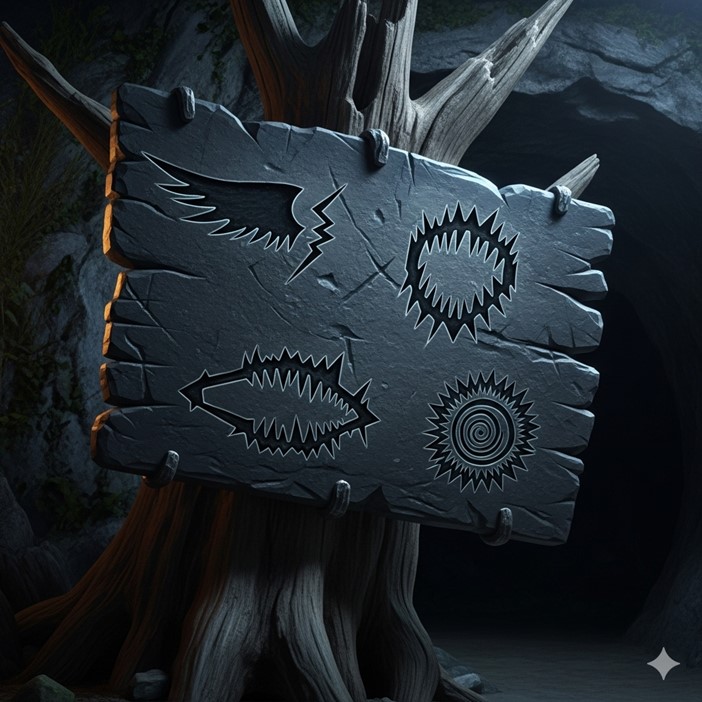
Inscriptions (Ritualized Warnings)
These are not written words but are instead hasty glyphs, fetish objects, or magically imbued marks that convey an urgent, often telepathic, warning to those who approach. The “sound” is the mental or emotional jolt they are designed to produce.
- (A sharp, mental clicking) – This ground is false.
- (A sudden feeling of being watched) – The eyes of the predator are upon this place.
- (A high-pitched inner whine) – Magic that twists the mind is active here.
- (A phantom gasp for air) – The air itself is poison.
- (The mental image of a broken wing) – Danger from above.
- (A feeling of cold dread from the shadows) – Do not trust the darkness.
- (A sudden, imagined shriek) – A sound that lures to doom was heard here.
- (A wave of frantic energy) – Flee this place without delay.
- (The telepathic sensation of sticky threads) – Entrapping creature lairs here.
- (An abrupt, deafening mental silence) – Something here hunts by sound; be still.
- (A phantom sensation of teeth on your neck) – It is already behind you.
Political Oaths (Oaths of the Guardian)
These are not sworn in quiet halls of state but are instead rapid, tense call-and-response pledges made by sentinels, guardians, and war-leaders in the face of imminent or constant threat.
- (A sharp gasp) – I am the first to see!
- (A frantic hand signal) – My hand will raise the alarm!
- (A rapid, tense whisper) – My watch never ends!
- (A hard stomp on the ground) – I am the wall that does not yield!
- (A quick glance over the shoulder) – I will watch the back of my kin!
- (A high-pitched cry) – My voice will be the warning cry!
- (The hiss of a drawn blade) – My steel will answer the threat!
- (A rapid series of breaths) – My fear will not silence me!
- (A hand placed over the heart) – My life before the community’s!
- (A sharp clap) – I will break the silence of the enemy!
- (A steady, wide-eyed stare) – My vigil is eternal!
Cultural Ceremonies (Rites of Survival)
These are not festive occasions but are instead grim, practical rituals focused on survival, remembrance of danger, and the passing on of vigilance to the next generation.
- (A frantic pointing gesture at a scar) – Remember the tooth that marked us!
- (A sudden, controlled flinch) – Fear is the lesson.
- (A quick, shared intake of breath) – We breathe in the vigilance of our ancestors.
- (A ritual of staring into darkness without blinking) – The eye is now open to the night.
- (A low, urgent hum) – The warding is set.
- (A sharp exhalation of relief) – The shadow has passed, but it will return.
- (A moment of frantic, exaggerated listening) – Hear the warning that saved us.
- (Rapidly touching the shoulders of a new sentinel) – This burden is now yours.
- (A final, piercing shriek at a funeral) – This was his final alarm; we now carry it.
- (Throwing a torch into a chasm) – May the threat stay in the deeps.
- (A shared, adrenaline-fueled tremor) – We survive to be afraid another day.
People Who Lived in Silence
It is told, from a time before the written word, that there was a people who dwelled in a great and terrible quiet. The forest where they made their homes was a place where the air was thick, and sound did not travel, but was instead swallowed by the moss and the mist. To make a loud noise, to snap a twig, to cry out—this was to invite death. For in this Great Silence lived the predators that are named in the old tongue the Un-Heard. They were as silence given legs and hunger given teeth. They hunted by sound, and so the people learned to live without it. They spoke with slow hands and soft eyes, a language of gesture that was deliberate and calm, for any quick movement might also betray them. They lived in a state of constant, held-breath alertness, a fear so common it was like the air itself.
In this land of tense quiet, there was a young sentinel, whose name is translated as Lyra. It was her duty to sit at the edge of the settlement and watch the trees, her eyes tracing the patterns of shadow and light. One evening, as the light began to fail, she saw a wrongness in the pattern. A patch of shadow detached itself from other shadows, and she knew it for what it was: an Un-Heard, moving with impossible stillness toward the place where the children played.
Her heart seized in her chest. The slow language of the hands was too slow; by the time she formed the sign for “predator” and “danger,” it would be too late. A scream would doom them all. She was frozen, trapped between the need to warn and the law of silence.
In that moment of pure, selfless terror, a new thing was born in the world. From her heart, or a place deeper still, a cry was made that used no throat. It was the shape of her fear, a frantic and desperate need for her people to know. This feeling erupted from her mind and stabbed into the minds of everyone in the village. It was not a word, but a pure, jagged-edged feeling: DANGER NOW HERE. This was the first telepathic alarm.
As her mind screamed, her body followed. The air she had been holding in her lungs burst from her in a sharp, high-pitched gasp, a sound so tense and sudden it was like a string snapping. And her hands, forgetting the slow, careful signs, flew up in a frantic, exaggerated gesture of warning, her eyes wide, her whole body a frantic dance of pure alarm.
The Un-Heard, which knew only the slow movements of its prey, was startled. This sudden explosion of silent, mental noise, this sharp gasp and frantic flailing, was alien to its experience. It paused for a single, vital heartbeat.
It was enough.
The villagers, jolted by the mental shriek and seeing Lyra’s frantic gestures, reacted without thought. They scattered, grabbing children, melting back into their homes. The moment was broken. The hunt was spoiled. The Un-Heard, its advantage lost, faded back into the shadows.
That day, the people learned a new language, one born not of thought, but of the body’s reaction to terror. They began to practice what Lyra had done. They learned to project their fear as a warning. They honed the tense, sharp gasps and cries into a vocabulary of alarm. The frantic gestures were given meaning: a quick flutter of the hands for danger from the sky, a nervous stomp for threats from below the ground. They called this language Startulon, the Tongue of the Startled Heart. It was a language they prayed they would never need, but one their guardians and explorers practiced daily. It was never written, for it was not a language for stories or histories. It was a language for the single, terrifying moment of now.
Moral of the story: The most important warnings are not spoken with the mouth, but with the heart.