
Original Life Forms Referenced:
Mammalia: Aardvark
Reptilia: Frilled Lizard
Amphibia: Axolotl
Insecta: Goliath Beetle
Appearance
The Velocoraphid 612 is a bizarrely striking creature. Its core body structure resembles a stocky, quadrupedal mammal with the muscular torso and hindquarters of an aardvark. Its head is elongated, blending the axolotl’s fringed external gills into the neck, which are brightly colored and bioluminescent at night. Around the shoulders and head spreads a vast, retractable frilled lizard-like membrane, edged in chitinous plating derived from the Goliath Beetle, gleaming with metallic iridescence. Its forelimbs end in clawed, digging hands suited for tearing into soil or splitting open logs. The beetle influence provides a hardened carapace over the back, mottled bronze and green, giving both protection and a dazzling sheen in the sun.
Size
- Length: 6–7 feet (including tail)
- Height: 3 feet at the shoulder
- Weight: 300–350 lbs
Speed
- Ground: Moderate (30 ft movement speed equivalent)
- Burrowing: Fast (able to tunnel at 20 ft movement equivalent per round)
- Burst Run: When startled, can lunge forward at nearly 45 ft speed, using its powerful hindquarters.
Stat Modifiers
- Strength: +2 (muscular forelimbs and beetle plating power)
- Dexterity: -1 (bulk and frill make it slightly clumsy in tight spaces)
- Constitution: +3 (hard carapace and durable mammalian core)
- Intelligence: -2 (feral instincts, not cunning)
- Wisdom: +0 (keen senses but aloof)
- Charisma: -1 (frightening or alien appearance)
Skills
- Burrow: Exceptional digger, able to create dens or sudden ambush pits.
- Intimidation Display: Can flare its frill and bioluminescent gills, creating an awe-inspiring and fear-inducing display to ward predators or rivals.
- Camouflage: Carapace shifts in sheen subtly to blend with damp forest floor or underground burrows.
- Aquatic Endurance: Amphibian gills allow survival in stagnant water or marshes.
Behavior
The Velocoraphid 612 is solitary and highly territorial. It spends much of its time tunneling or resting within damp burrows near rivers or swamps. At dusk it emerges to forage, patrolling a wide range. Its intimidation displays are used more often than actual combat, but if pressed, it will lunge with claws and tail strikes, reinforced by its carapace armor.
Diet
Omnivorous opportunist. Eats burrowing insects, roots, fungi, and carrion. Uses its aardvark-like snout to sniff out colonies of ants or beetles, but will also consume amphibians and fish caught in shallow pools.
Emotions
- Baseline demeanor: aloof and feral, avoiding contact unless disturbed.
- When threatened: shows defensive intimidation, accompanied by loud croaking bellows.
- During foraging: almost docile, slow and deliberate.
- During mating: brightens gill-fringe colors and performs rhythmic frill-flaring displays.
Environment Where Found
Dense jungle margins, swampy lowlands, marshes, and damp underground tunnel systems near water sources. Most common in humid, temperate zones of Saṃsāra.
Tags: feral, burrower, amphibious, carapace, frilled, bioluminescent, omnivore, solitary, territorial, swamp-dweller, jungle, insectivore, intimidation, armored, alien, burrowing predator, nocturnal
Life Cycle
- Hatchling Stage:
Velocoraphid 612 begins as leathery-shelled eggs laid in shallow, damp burrows near swamp edges. The clutch averages 3–5 eggs. Hatchlings resemble smooth-bodied axolotls with rudimentary frill-folds and soft carapace ridges that darken as they age. They are highly vulnerable to predators in this stage and rely on damp leaf litter and burrows for concealment. - Juvenile Stage:
At around 6 months, the frill begins to expand, showing pale colors. The carapace hardens into a protective shell. Juveniles are playful diggers, practicing burrow-collapsing techniques and learning to intimidate through mock frill displays. - Adult Stage:
Full maturity is reached at 4 years. Adults weigh over 300 lbs and their frill membranes become fully functional, edged with chitin plates. They now dominate small territories (about a square mile each) and rarely tolerate rivals. - Longevity:
Life expectancy is about 40 years in the wild, with older Velocoraphids becoming slower but thicker-shelled. Elders often become “den lords,” with massive tunnel systems used by multiple species for refuge.
Mating
- Occurs in the wettest season when water levels rise. Males flare their frills in luminous displays, pulsing bioluminescent gills in rhythmic patterns that echo through swamps at night.
- Females choose based on stamina and consistency of the display, which can last hours.
- Battles between males are more about intimidation than injury: frills collide in thunderous slaps, and guttural bellows echo through the marsh. Actual lethal fights are rare, but torn frills and fractured plates can occur.
- After fertilization, females dig deep, humid chambers and guard their eggs until hatching, fasting for weeks.
Tactics
- Defensive Tactics: The Velocoraphid 612 prefers to avoid combat by intimidation—flaring its frill, hissing, and rattling its plated carapace. If this fails, it digs a sudden pit or flees into water.
- Ambush Tactics: When pressed to hunt, it lies in shallow mud with only its gills above water. Once prey wanders close, it lunges with surprising speed, claws first.
- Pack Tactics: Though solitary, rare seasonal gatherings see several working loosely together to dig out flooded prey burrows. These events are temporary and end with the rainy season.
Actions
- Frill Flare: Expands the membrane in a rapid snap, creating a thunderclap sound. This startles most mid-level predators and confuses aerial attackers.
- Carapace Slam: Uses its hardened back as a weapon, rearing and smashing down upon threats.
- Claw Rend: Sharp digging claws rake through soft tissue or roots alike.
- Burrow Escape: Instinctively dives underground or into mud, leaving only collapsing tunnels as obstacles for pursuers.
- Aquatic Croak: A resonant, booming sound created by water passing over its gill-frills, used both for communication and disorientation of threats in marshes.
Other Interesting Information
- Burrow Networks: Over decades, Velocoraphids can create complex underground tunnel systems, often repurposed by other creatures after abandonment. Entire swamp ecologies benefit from their earth-turning.
- Symbiotic Species: Smaller amphibians and insects often follow Velocoraphids, feeding on insects exposed by its digging. Some fish even swim into its burrows during floods, creating strange mixed communities.
- Bioluminescent Displays: The gill-frills pulse with shifting colors—calm blues when resting, violent reds when angered, soft greens during courtship. Locals in Saṃsāra believe the light serves as a “truth mirror,” revealing intentions of those who gaze upon it.
- Feral Reputation: Many villages consider it an omen of change. Sightings often precede floods, migrations, or even political upheaval, so Velocoraphid 612 has a place in myth as a “Harbinger of Shifts.”
- Harvested Materials: Its chitin plates are prized in crafting lightweight shields, while its frill membranes are sometimes preserved as glowing charms. However, hunting one is perilous and often seen as a reckless act.
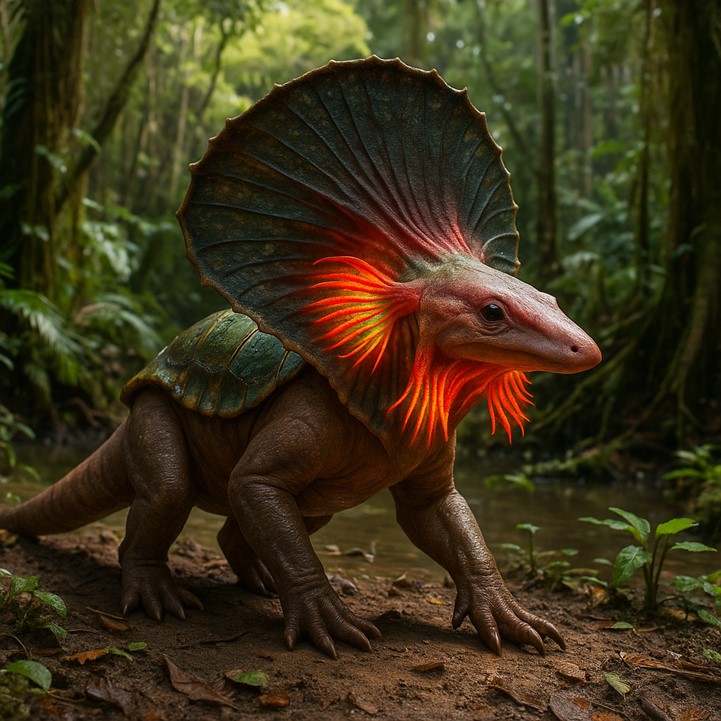
Adventurers in the world of Saṃsāra would encounter or actively seek out the Velocoraphid 612 for many reasons, both practical and narrative. This feral species is not merely a danger lurking in swamps—it is a resource, omen, and challenge interwoven with the world’s ecology and culture.
Ecological Role and Accidental Encounters
- Burrow Collapse Hazards: Parties traveling through swampy lowlands or dense jungles may stumble upon collapsing ground where Velocoraphid burrows weaken the soil. An adventurer might fall into an active den, provoking a territorial attack.
- Nighttime Bioluminescence: The creature’s glowing gills and frill are visible at dusk, drawing curious adventurers or alarming them when spotted across the marsh. Mistaking the glow for a campfire or magical artifact could lead them directly into its hunting grounds.
- Predator Interference: While generally defensive, a starving Velocoraphid may ambush intruders in its range, especially if its usual food sources (ants, beetles, amphibians) are scarce.
Resources and Harvesting
- Carapace Armor: The mottled bronze-and-green beetle-derived plating is highly valued by armor-smiths and magical crafters. It can be turned into lightweight yet resilient shields, breastplates, or enchanted talismans.
- Frill Membrane: Preserved sections of its frill retain faint bioluminescence and are sought after as glowing charms, ritual banners, or arcane focus materials. Some enchanters weave the frill edges into wards against fear.
- Gills: The bioluminescent axolotl-gills can be dried and powdered into reagents used for light-based magic or potions that induce vivid visions.
- Burrow Spoils: The tunnels of Velocoraphids often unearth buried relics, gems, or magical roots. Adventurers may risk confrontation in hopes of salvaging treasures disturbed by the beast’s constant digging.
Quest Hooks and Cultural Motives
- Omen of Change: In Saṃsāran folklore, sightings of Velocoraphid 612 herald political upheaval, shifting weather, or migrations. A ruler may send adventurers to track or verify sightings, believing the fate of their nation depends on interpreting the beast’s movements.
- Ritual Hunts: Some warrior cultures test their strength against these creatures in rites of passage. Adventurers may be hired to accompany, observe, or interfere with such ceremonies.
- Scholarly Curiosity: Naturalists and magical academies may task a party with capturing or studying one alive, seeking to understand its hybrid traits or magical glow.
- Defensive Measures: Villages near swamp margins may commission adventurers to clear a Velocoraphid if it has dug too close to crops, homes, or water sources.
Tactics and Challenges for Adventurers
- Burrow Ambush: Adventurers might find themselves attacked from beneath, the ground giving way as the Velocoraphid bursts upward.
- Intimidation Displays: Its frill and booming croaks can frighten mounts or lesser-trained companions, creating chaos in a battle.
- Environmental Hazards: Fighting near waterlogged ground, collapsing tunnels, or thick swamp mist puts adventurers at disadvantage while the Velocoraphid thrives.
- Durability: Its carapace and natural constitution make it a prolonged challenge—ideal for testing a party’s endurance, coordination, and creativity.
Narrative Appeal
The Velocoraphid 612 is not simply “a monster to kill”—it embodies themes of feral majesty, ecological disruption, and cultural significance. Adventurers may encounter it as an obstacle, a resource, or even a harbinger of greater events. Whether they battle, harvest, avoid, or even revere it depends on their motives—and the role it plays in the ongoing story of Saṃsāra.
The Velocoraphid 612 offers a wealth of unusual and valuable materials when harvested, as nearly every part of its body is imbued with unique traits from its hybrid origins. Below is a detailed list of items and ingredients, along with their uses in crafting, alchemy, or magical practice:
Harvestable Items & Ingredients
- Carapace Plates (Beetle Influence)
- Use: Forged into lightweight armor, shields, or weapon plating. The iridescent bronze-green sheen can be polished to act as a reflective surface, sometimes used against light-based attacks.
- Alchemy/Magic: Powdered carapace can be mixed into protective wards or potions granting temporary resistance to physical harm.
- Frilled Membrane (Lizard Influence)
- Use: Preserved as ceremonial banners, glowing wall hangings, or components in bardic instruments that flare light when played.
- Alchemy/Magic: Retains faint luminescence; burned in rituals, it enhances spells of intimidation, awe, or fear.
- Bioluminescent Gills (Axolotl Influence)
- Use: Alchemical ingredient in potions of darkvision, water breathing, or dreamwalking, as the glow carries ethereal resonance.
- Alchemy/Magic: Dried gills can be ground into powder to create inks that glow faintly in darkness—favored by scholars for hidden texts and by mages for scrolls of enchantment.
- Gill Mucus Secretions
- Use: Sticky secretion collected from fresh kills can act as an adhesive in crafting exotic gear.
- Alchemy/Magic: Key component in potions of resilience or brews granting temporary immunity to swamp-borne disease.
- Claws (Aardvark Influence)
- Use: Forged into farming or excavation tools; also fashioned into serrated daggers that can pierce soil, wood, or flesh with ease.
- Alchemy/Magic: Powdered claws are ground into dust for alchemical potions that aid with digging, tunneling, or enhancing strength in miners and adventurers.
- Tail Vertebrae
- Use: Carved into charms or grips for weapons. The natural bone ridges give superb grip and strength.
- Alchemy/Magic: When ground, adds stability to potions of balance or rituals requiring endurance.
- Internal Organs (Heart, Liver, Stomach Lining)
- Use: The stomach lining is harvested to create waterskins resistant to rot and acid. The heart is prized by shamans, who believe it retains the creature’s territorial essence.
- Alchemy/Magic:
- Heart: Used in rituals of dominance and territorial warding.
- Liver: Ground into paste, acts as a neutralizer for certain poisons.
- Stomach Lining: Infused in potions for resistance to toxins and environmental hazards.
- Blood
- Use: Thick and iron-rich, it stains permanently. Hunters smear it on armor as a mark of survival.
- Alchemy/Magic: Essential for inks used in binding contracts, intimidation wards, and curses. A reagent that carries feral energy, often enhancing ferocity spells.
- Teeth & Jawbone
- Use: Teeth are carved into arrowheads or piercing darts; the jawbone sometimes reforged into exotic war-clubs.
- Alchemy/Magic: Dust from the teeth strengthens potions of tenacity and enhances animal-companion summoning rituals.
- Hide & Flesh
- Use: Its hide, though not as tough as the carapace, is waterproof and resistant to fungal rot—perfect for boots, gloves, or cloaks used by swamp explorers.
- Alchemy/Magic: Boiled into tallow, it produces a base for oils that increase resistance to damp or marsh-born ailments.
- Eyes
- Use: Dark, moist, and glassy; preserved in jars for study. Some believe they show reflections of other worlds when steeped in certain alchemical fluids.
- Alchemy/Magic: Eye fluid used in potions of perception, truth-seeing, or night-vision.
- Burrow Soil (Indirect Harvest)
- Use: Soil clumped in its claws and burrows is highly aerated and nutrient-rich, often transplanted for agriculture.
- Alchemy/Magic: Burrow dirt mixed with blood acts as a reagent for earth-shaping rituals and golem-making.
Tale of Frilled Shadow-Beast
There is an old story, carried on cracked stone and whispered through the reeds, about a creature that lived between earth, water, and light. It is told differently in every village, the words bent and broken like driftwood, but always the same bones remain. They call it the Frilled Shadow-Beast, though some say its true name was Velocoraphid, a sound half-forgotten by the tongues of men.
Long ago, when the swamps were deeper and the stars closer, the people feared the ground beneath their feet, for it sometimes opened without warning. They spoke of pits that swallowed cattle, hunters, even children. The elders said these were not holes of accident, but the mouths of the Shadow-Beast, who tunneled unseen beneath the marsh. When it rose, the earth shuddered, and its body shone like wet bronze under the sun.
Its head was long, with gills that glowed like lanterns in the night, drawing wanderers to the water’s edge. Around its neck hung a frill wide as a man’s outstretched arms, flashing with strange lights as though the creature had stolen colors from the sky. Its back was clad in plates harder than ironwood, and its claws could split soil or bone alike. When it bellowed, the swamps trembled, and men said the sound was not only in the ears but in the bones, like thunder living in the marrow.
The story tells of a season when rains would not stop, and the rivers drowned the fields. The villagers feared the storm, but more they feared the Shadow-Beast, for it came closer with each flood, its glow moving in the waters like a ghost. Some claimed it dug tunnels to guide the waters, others that it sought the villages themselves. The hunters gathered to slay it, but when they found its den, the earth collapsed and swallowed half their number.
One hunter, said to be brave but also foolish, stood alone before the beast. Instead of striking, he raised his arms and mirrored its frill, spreading his cloak wide. He did not move, and neither did it. For a long time the swamp was silent, the rain falling heavy, until at last the creature turned and burrowed back into the earth. The hunter returned, though his hair had turned white from the terror of that stare.
Some versions say he became a great chief after, others say he never spoke again. The creature was not killed, only driven away, and it is said it still roams the hidden places of Saṃsāra. Those who glimpse its glow believe it to be a sign: of floods, of migrations, or of great changes yet unseen. The Shadow-Beast is not merely a monster but a herald, a reminder that the earth itself can shift beneath us, and that awe is stronger than the sword.
Moral of the Story: Not all battles are won with blood; some are survived by standing firm before the terror and letting wonder be stronger than fear.
Suggested conversions to other systems:
Call of Cthulhu (7th Edition)
Name: The Frilled Shadow-Beast (Velocoraphid 612)
Characteristics:
- STR 110 (5d6+30)
- CON 90 (4d6+20)
- SIZ 100 (4d6+30)
- DEX 40 (2d6+10)
- INT 20 (2d6)
- POW 60 (3d6+20)
Hit Points: 19
Move: 8 (ground), 5 (burrow)
Build: 3
Damage Bonus: +1d6
Attacks:
- Claw Rend (60%): 1d8+db slashing
- Carapace Slam (40%): 1d6+db bludgeoning, knockdown
- Frill Intimidation (POW vs. POW contest): Foes who fail flee for 1d4 rounds or suffer a -20% penalty to attacks.
Armor: Chitinous carapace provides 4 points of armor.
Skills: Stealth 45%, Intimidate 60%, Listen 40%, Survival (Swamp) 50%.
Sanity Loss: 0/1d6 from seeing it emerge in full frill display.
Blades in the Dark
Name: Burrowshade Velocoraphid (Velocoraphid 612)
Type: Wild Ferox Threat (Tier III, Strong Hold)
Description: A hulking, frilled and plated burrow-beast. Its glow unsettles even hardened scoundrels, and its tunnels disrupt entire districts of marshland.
Scale: Large beast (as a heavy gang).
Threat: III (Comparable to a small crew of Tier III).
Quality: Tier III claws, frill, and armor.
Special Abilities:
- Frill of Dread: When it flares, anyone nearby must resist (Resolve) or flee in panic.
- Burrower: Ignores barriers of soil, mud, and loose stone, surfacing anywhere within a district.
- Living Carapace: Heavy armor that resists harm unless destroyed with fire or explosives.
Clock Example (Hunt It): 6-segment progress clock to locate its lair, 8-segment clock to subdue or drive off the beast.
Devil’s Bargain: Involving it in any score draws attention from factions who revere or fear the beast as an omen.
Dungeons & Dragons (5e)
Name: Velocoraphid 612
Large monstrosity, unaligned
Armor Class: 16 (natural armor)
Hit Points: 147 (14d10+70)
Speed: 30 ft., burrow 20 ft., swim 20 ft.
STR 20 (+5) | DEX 9 (-1) | CON 20 (+5) | INT 2 (-4) | WIS 12 (+1) | CHA 6 (-2)
Saving Throws: Con +8, Wis +4
Skills: Perception +3, Stealth +4 (in swamp/mud)
Damage Resistances: nonmagical bludgeoning, piercing
Senses: darkvision 60 ft., tremorsense 30 ft., passive Perception 13
Languages: —
Challenge: 7 (2,900 XP)
Traits:
- Bioluminescent Display (Recharge 5–6): As an action, the Velocoraphid flares its frill and gills. All creatures within 30 ft. must make a DC 15 Wisdom saving throw or be frightened until the end of their next turn.
- Burrower’s Escape: As a bonus action, it can burrow up to half its speed, leaving collapsing ground behind.
- Swamp Camouflage: Advantage on Stealth checks made in swampy terrain.
Actions:
- Multiattack: The Velocoraphid makes two claw attacks.
- Claw Rend: Melee Weapon Attack, +7 to hit, reach 5 ft., one target. Hit: 15 (2d8+6) slashing damage.
- Carapace Slam: Melee Weapon Attack, +7 to hit, reach 5 ft., one target. Hit: 13 (2d6+6) bludgeoning damage. Target must succeed on a DC 15 Strength save or be knocked prone.
Legendary Action (Optional Variant): After another creature’s turn, the Velocoraphid may use 1 legendary action to Burrow 10 ft. or Flare Frill (DC 12 Intimidation check vs. nearby enemies).
Knave (2nd Edition)
Name: Velocoraphid 612, the Frilled Shadow-Beast
HD: 9
AC: 17 (carapace)
Attacks: Claw (d8+d6), Slam (d6+d6, knockdown)
Move: 40 ft. (burrow 20 ft.)
Morale: 9
Saves: STR +4, DEX -1, CON +4, INT -2, WIS +0, CHA -1
Special:
- Frill Display: 1/day, all who see must Save (WIS) or flee for 1d4 rounds.
- Burrow Collapse: Creates unstable ground; Save (DEX) or fall prone into mud.
- Bioluminescent Aura: At night, glows faintly. Can be tracked or mistaken for magical lights.
- Tough Carapace: Ignores first 2 damage per attack from nonmagical weapons.
Behavior: Solitary, territorial, avoids combat unless provoked. Seeks to intimidate before fighting.
Fate Core
Name: Velocoraphid 612, the Frilled Shadow-Beast
High Concept: Bioluminescent, Frilled, Burrowing Predator
Trouble: Territorial Feral Beast
Aspects:
- “Awe is my weapon”
- “The swamp is my shield”
- “Glow of the Harbinger”
Skills:
- +4: Physique
- +3: Fight, Provoke
- +2: Athletics, Stealth
- +1: Notice, Survival
Stunts:
- Frill Display: Once per scene, use Provoke against all targets in view; on success, they gain the Frightened aspect with one free invoke.
- Burrow Escape: Gain +2 to Athletics when creating an advantage by escaping through soil, mud, or swamp terrain.
- Carapace Armor: Reduce incoming physical stress by 2 once per exchange.
Stress: 4 boxes
Consequences: Mild, Moderate, Severe
Refresh: 1
Numenera & Cypher System
Name: Velocoraphid 612, Feral Burrower of Bioluminescence
Level: 6 (18 target number)
Motive: Defend territory, intimidate intruders
Environment: Swamps, marshlands, underground burrows
Health: 30
Damage Inflicted: 8 points
Armor: 3 (natural carapace)
Movement: Short, burrow short, swim short
Modifications:
- Stealth in swamp +2
- Intimidation +3
- Speed defense -1 (due to bulk)
Combat:
- Claw Rend: 8 points slashing damage.
- Carapace Slam: 6 points bludgeoning; target knocked prone unless they succeed on a Might defense roll (difficulty 5).
- Bioluminescent Frill: Once per encounter, creates dazzling aura; all creatures within immediate range must succeed on an Intellect defense roll (difficulty 6) or flee for 1d6 rounds.
Use: Wandering threat, territorial guardian, omen beast tied to cultural myths.
Loot: Carapace shards (level 5 armor components), frill membranes (level 5 light or intimidation devices), bioluminescent gill powder (level 6 crafting component for potions or cyphers).
Pathfinder 2e
Name: Velocoraphid 612
Creature 8
XP: 480
N Large Animal
Perception +16; darkvision, tremorsense 30 ft.
Languages —
Skills Athletics +18, Stealth +14, Survival +12
Str +6, Dex +0, Con +5, Int -4, Wis +2, Cha -1
AC 26; Fort +17, Ref +12, Will +14
HP 135
Immunities fear (natural)
Speed 30 ft., burrow 20 ft., swim 20 ft.
Melee [one-action] Claw +18 (agile), Damage 2d10+6 slashing
Melee [one-action] Carapace Slam +18, Damage 2d8+6 bludgeoning plus Knockdown
Ranged (special) Frill Intimidation [two-actions] (aura, auditory, visual, emotion, mental) The Velocoraphid flares its frill and gills. All creatures in a 30-foot cone must attempt a DC 24 Will save:
- Critical Success: Unaffected.
- Success: Frightened 1.
- Failure: Frightened 2.
- Critical Failure: Frightened 2 and fleeing for 1 round.
Burrow Escape [one-action]: The Velocoraphid burrows 10 ft. into soft ground, leaving behind difficult terrain.
Ecology: Solitary, swamp-dwelling, considered an omen-beast.
Savage Worlds (Adventure Edition)
Name: Velocoraphid 612, the Frilled Shadow-Beast
Wild Card: No
Rank: Veteran Threat
Attributes: Agility d6, Smarts d4(A), Spirit d6, Strength d12, Vigor d10
Skills: Athletics d8, Fighting d10, Intimidation d10, Notice d6, Stealth d6, Survival d6
Pace: 6; Parry: 7; Toughness: 13 (3 armor)
Size: Large (Size +3)
Special Abilities:
- Armor +3: Hardened beetle carapace.
- Claws: Str+d8 damage.
- Carapace Slam: Str+d6, target must make a Strength roll vs. 12 or be knocked prone.
- Frightening Frill: As an action, the beast may flare its frill and bioluminescent gills; all creatures within a Large Burst Template must make a Spirit roll at -2 or become Shaken.
- Burrower: Moves through earth, mud, or swamp at half Pace.
- Bioluminescence: In darkness, its glowing frills impose a -2 penalty on Stealth attempts to avoid being noticed.
Edges/Flaws: Territorial, Feral Instincts.
Shadowrun (6th Edition)
Name: Velocoraphid 612 (a.k.a. Frilled Shadow-Beast)
Type: Paracritter
Attributes:
- Body 9
- Agility 3
- Reaction 3
- Strength 8
- Willpower 4
- Logic 1
- Intuition 3
- Charisma 2
Initiative: 6 + 1d6
Movement: 10/20 (Ground), 6/12 (Burrow)
Condition Monitor: 13 (Physical), 9 (Stun)
Armor: 6 (natural carapace)
Skills:
- Unarmed Combat 6
- Intimidation 5
- Perception 4
- Sneaking 3
Powers:
- Natural Weapon (Claws): DV 7P, AP -2
- Carapace Slam: DV 6P, knockdown effect on failed Body + Strength test.
- Fear (Frill Display): Opposed Willpower + Logic vs. critter’s Intimidation. Victims flee or freeze for 1d3 rounds.
- Enhanced Senses (Low-Light Vision, Thermographic, Tremorsense 15m).
- Digging: Burrow speed 6/12 through soil, mud, or soft stone.
Weaknesses: Territorial (always attacks if den threatened).
Starfinder (latest edition)
Name: Velocoraphid 612
CR: 8
XP: 4,800
Type: Large Magical Beast (swamp, subterranean)
Init: +3; Senses: darkvision 60 ft., low-light vision, tremorsense 30 ft.; Perception +16
DEFENSE
HP 150
EAC 20; KAC 22
Fort +13, Ref +10, Will +9
Immunities: fear effects (natural)
OFFENSE
Speed 30 ft., burrow 20 ft., swim 20 ft.
Melee: Claw +18 (2d10+9 slashing)
Melee: Carapace Slam +18 (2d8+9 bludgeoning, knockdown)
Special Abilities:
- Frightening Frill (Ex, 1/day): Cone 30 ft.; Will save DC 18 or become shaken for 1d4 rounds (frightened on a critical fail).
- Burrow Collapse (Ex): Creates a 10-ft. square of difficult terrain as it burrows.
STATISTICS
Str +6, Dex +1, Con +5, Int -4, Wis +2, Cha -1
Skills: Stealth +13 (+18 in swamp), Survival +14
Feats: Multiattack, Powerful Charge
Environment: warm swamps, jungles, or underground flood caves
Organization: solitary
Traveller (Mongoose 2e)
Name: Velocoraphid 612, Frilled Shadow-Beast
Animal Type: Swimmer/Burrower
Size: Large (200–300 kg)
STR: 15 (DM +2)
DEX: 5 (DM -1)
END: 14 (DM +2)
INT: 2 (Animal)
Hit Points: 29
Armor: 10 (hardened carapace)
Speed: 20 m (ground), 10 m (burrow), 10 m (swim)
Attacks:
- Claw Rend: 2D damage, AP -2
- Carapace Slam: 2D damage, knockdown (opposed Athletics).
- Frill Display (Fear): Targets must make an INT or END check (8+) or flee/be stunned for 1D rounds.
Traits:
- Burrower: Can tunnel through soil/loose stone.
- Bioluminescent Gills: Provides dim light, used for intimidation or mating.
- Territorial: Aggressive when approached in lair.
Behavior: Solitary hunter, ambush predator, uses intimidation before combat.
Warhammer Fantasy Roleplay (4th Edition)
Name: Velocoraphid 612, the Harbinger Beast
Species: Monstrous Creature
Size: Large
Characteristics:
- WS 45
- BS —
- S 55
- T 50
- Ag 25
- Int 15
- WP 35
- Fel 10
Wounds: 48
Move: 6 (Ground), 4 (Burrow), 4 (Swim)
Armor: 3 (Chitinous Carapace, Body Only)
Skills: Intimidate 55, Stealth (Swamps) 40, Perception 35, Survival 40
Traits:
- Armour (3): Hard beetle-like shell.
- Fear (2): Frill Display causes Terror Tests (WP).
- Night Vision, Swim, Burrower.
- Territorial: Automatically attacks intruders near its den.
- Bestial: Lacks complex reasoning, acts only on instinct.
Attacks:
- Claws: Damage = S+6 (tearing swipe).
- Carapace Slam: Damage = S+4, target must make Athletics vs. 55 or be knocked Prone.
- Bioluminescent Display (Special Action): Emits eerie light; all within 20 yards must take a Cool Test or gain 1 Fear condition.
Motivation: Swamp guardian, omen of upheaval, feared by villagers.