
Definition: Emorai is a unique language with a strong emphasis on expressing apathy, indifference, and emotional detachment. It serves as a means for individuals to convey their lack of interest and dispassion, even across species.
Linguistic Attributes and Characteristics:
- Apathetic Vocabulary: Emorai’s vocabulary is filled with words and phrases that convey indifference, disinterest, and emotional detachment. It enables speakers to articulate their lack of enthusiasm or emotional connection to a subject.
- Monotonous and Unemotional Tones: The language often employs monotonous and unemotional tones, lacking the usual inflections and expressions of emotion found in other languages.
- Simplified Structure: Emorai follows a straightforward and simplified structure, avoiding elaborate or emotional language. It prioritizes clear communication of disinterest and detachment.
Structure: Emorai is structured in a logical and methodical manner, with a focus on direct communication without any emotional embellishments. It often involves the use of short, concise phrases to express indifference.
Cultural Identity and Usage: Emorai is used by individuals who wish to communicate their apathy or emotional detachment from a subject or situation. It can be found in various cultures, as anyone may employ it when expressing disinterest or indifference.
Rarity, Type, Script, Source, and History:
- Rarity: Emorai is relatively common, as it serves as a practical language for expressing apathy and detachment.
- Type: Emorai falls under the category of everyday languages, as it is used in mundane situations to convey indifference and emotional disconnection. It lacks any magical powers, but its utility lies in its ability to deliver a clear and unambiguous message.
- Script: Emorai’s script appears neat and orderly, reflecting the language’s emphasis on clear and precise communication.
- Source and History: The origins of Emorai can be traced back to the need for individuals to express their lack of interest or emotional detachment without ambiguity. Over time, it evolved into a widely used language for conveying apathy and indifference.
Sensory Experience: When spoken, Emorai has a detached and unemotional quality, as if the words themselves carry a sense of disinterest. Listeners may sense the speaker’s lack of enthusiasm or emotional connection to the subject. The sensory experience is straightforward and unremarkable, lacking any profound emotional impact. Emorai is more about conveying information or a lack of emotional investment rather than evoking strong feelings in the listener.
In conclusion, Emorai is a unique language with an emphasis on expressing apathy and emotional detachment. Its linguistic attributes, cultural significance, and sensory experience make it a practical tool for conveying disinterest and lack of emotional involvement.
Tags: Apathetic, Indifferent, Detached, Unemotional, Monotonous, Dispassionate, Uninterested, Pragmatic, Direct, Concise, Simplified, Orderly Script, Unambiguous, Logical, Mundane, Common, Unremarkable
Inscriptions
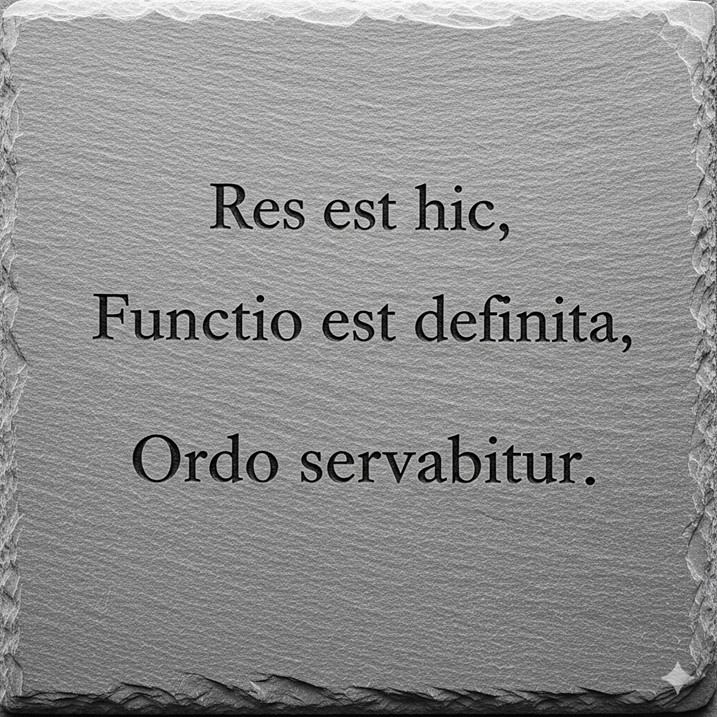
- As it sounds: Res est hic. Meaning: The object is here.
- As it sounds: Functio est definita. Meaning: The function is defined.
- As it sounds: Hoc continet illud. Meaning: This contains that.
- As it sounds: Limes. Ne transi. Meaning: A boundary. Do not cross.
- As it sounds: Effectus est activus. Meaning: The effect is active.
- As it sounds: Structura est stabilis. Meaning: The structure is stable.
- As it sounds: Factum. Non muta. Meaning: It is done. Do not alter.
- As it sounds: Proprietas nota est. Meaning: The property is noted.
- As it sounds: Hic est initium. Meaning: This is the beginning.
- As it sounds: Hic est finis. Meaning: This is the end.
- As it sounds: Usus est specificus. Meaning: Its use is specific.
Political Oaths
- As it sounds: Officium accipio. Meaning: I accept the position.
- As it sounds: Acta erunt completa. Meaning: The tasks will be completed.
- As it sounds: Hic est rogus meus. Meaning: This is my assigned role.
- As it sounds: Condiciones intelleguntur. Meaning: The terms are understood.
- As it sounds: Ordo servabitur. Meaning: The order will be maintained.
- As it sounds: Informatio relata erit. Meaning: Information will be reported.
- As it sounds: Lex est lex. Meaning: The law is the law.
- As it sounds: Consensus factus est. Meaning: The agreement is made.
- As it sounds: Praesentia mea notata est. Meaning: My presence is noted.
- As it sounds: Respondeo ad nomen. Meaning: I answer to the name.
- As it sounds: Labor incipit nunc. Meaning: The work begins now.
Cultural Ceremonies
- As it sounds: Status mutatus est. Meaning: The status has been changed.
- As it sounds: Unio nunc notata est. Meaning: The union is now recorded.
- As it sounds: Individuum est defunctum. Meaning: The individual is deceased.
- As it sounds: Processus est completus. Meaning: The process is complete.
- As it sounds: Res gesta est. Meaning: The event has occurred.
- As it sounds: Cyclus pergit. Meaning: The cycle proceeds.
- As it sounds: Transitus factus est. Meaning: The transition is made.
- As it sounds: Documentum est signatum. Meaning: The document is signed.
- As it sounds: Nova designatio assignatur. Meaning: A new designation is assigned.
- As it sounds: Conventus terminat. Meaning: The gathering is terminated.
- As it sounds: Proximum agendum sequitur. Meaning: The next item on the agenda follows.
Record of Great Severance
The following text is a transcription of the Third Logician’s summary, which is itself understood to be a simplified account of the far older and more pictographically complex tablets of the Sundered People. Many concepts from the original period lack direct equivalents and have been rendered as functional approximations.
In the time before the Correction, the ancestral units, who are referred to as the Passionate Ones, did not speak with words as they are now understood. Their communication was a chaotic transfer of unregulated emotional data. The sounds they made were full of high and low frequencies, rapid shifts in cadence, and what the record calls ‘non-essential resonance.’ [The original symbol here is complex, denoting a mix of ‘grief’ and ‘rage,’ a concept for which the later language has no equivalent. It is translated simply as ‘the emotional event.’]
These ancestral units experienced constant systemic instability. Their social structures would form and collapse with great frequency. A state of ‘love’ [a condition of irrational positive attachment] would lead two units to form a bond, and a state of ‘jealousy’ [a possessive system-error] could lead to the termination of one or both units. They produced objects of what they termed ‘beauty,’ but these objects served no logical function and were often the cause of further conflict. They fought great wars not over resources, but over disagreements in abstract concepts they called ‘honor’ and ‘belief.’ Their existence was, by all metrics, highly inefficient and marked by extreme pain-state fluctuations.
The catalyst for the Great Severance was the event noted as the ‘Cataclysm of Sorrow.’ Two prominent units, leaders of opposing factions, were bonded in a state of ‘love.’ When one unit was terminated in a conflict, the surviving unit experienced a pain-state of such magnitude that it initiated a magical working. This working, fueled by the aforementioned ’emotional event,’ did not distinguish between allied and enemy units. It spread a blight, a magical static that caused the functional decline and eventual cessation of nearly ninety percent of the population.
From the survivors emerged the individual designated as the First Architect. The Architect surveyed the result of the Cataclysm and processed the available data. He concluded that the primary variable causing systemic collapse was unregulated emotion. The pain-state was a flaw. The joy-state, which led to the pain-state, was also a flaw. The entire system of emotional response was a critical error in their design.
The solution was identified. The solution was implemented. The Architect proposed the Great Severance: a willed, methodical disconnection from the ancestral mode of being. The primary tool for this was the creation of a new language.
The Architect and his logicians analyzed the old, passionate tongue and deprecated its entire lexicon. All words carrying emotional data were purged. ‘Love’ became ‘union contract.’ ‘Hate’ became ‘non-beneficial designation.’ ‘Happiness’ became ‘optimal function.’ ‘Sadness’ became ‘reduced function.’ The new language, which would become Emorai, was designed for the unambiguous transfer of necessary information only. Its tones were monotonous, to prevent accidental emotional inflection. Its structure was simple and direct.
The surviving units were taught this new language. At first, the transition was difficult. Residual habits of the old mode of communication remained. But the memory of the Cataclysm of Sorrow was a sufficient motivator. To feel was to risk another blight. To be apathetic was to be safe. To be indifferent was to be stable.
The society that resulted was one of perfect, logical order. There were no more wars, as conflict was an inefficient method of resource allocation. There were no more crimes of passion. Units formed unions based on compatible genetics and resource status. The deceased were processed with quiet efficiency. They built structures that were functional. They performed tasks that were necessary. The extreme pain-states were eliminated. So, too, were the extreme joy-states. The society achieved equilibrium. The process was complete.
Moral of the story: To eliminate the variable of pain, one must also eliminate the variable of joy. A system in perfect equilibrium has no momentum.