
Deity Name: Vhoralai, the Bound Current
Lore:
Long before the harbors of Tasian held ships from all horizons, the first fisher-clans told of a vast, unseen tether beneath the seas, a current so constant that it carried not only the waters but the fates of all who lived upon the islands. From the still depths rose Vhoralai, neither wholly sea nor sky, whose voice was said to be the mingled song of every river pouring into the ocean. The Accord teaches that Vhoralai bound the land to the water with cords of moonlight so the islands would never drift into the hunger of the Deep Beyond. To honor this bond, the people swore to keep balance between taking and giving, never drawing from the sea without returning something in gratitude. The lore warns of the “Fraying,” when greed cuts the moon-cords and the current turns against its keepers.
Personality:
Vhoralai is depicted as patient but implacable—like a tide that seems gentle until it decides to claim the shore. It is said the deity favors endurance, reciprocity, and keen awareness of the unseen exchanges in life. Those who break balance are not punished in haste; Vhoralai waits for the moment when their own imbalance weighs enough to drag them under.
Traits:
• Embodiment of binding forces—unity, reciprocity, and endurance.
• Protector of shorelines and travelers between lands.
• Witness to every oath sworn upon flowing water.
• Silent judge, whose justice arrives like the inevitable tide.
Characteristics:
• Often represented as a towering, genderless figure woven from braided ropes of water and moonlight, crowned with a circlet of barnacle-encrusted gold.
• Fingers end in streaming rivulets; the eyes are pools reflecting tides at dusk and dawn.
• Speaks without sound, directly to the thoughts of those it chooses.
• Appears in dreams as the same shoreline, altered by the dreamer’s truthfulness.
Attributes:
• Associated with the waxing and waning of tides and fortunes.
• Patron of sailors, fishers, shipwrights, oathkeepers, and stewards of trade.
• Bringer of harvest bounties after long patience, not immediate reward.
• Wields the Moon-Cord Net—an artifact said to capture not fish but the truth itself.
Symbols:
• Interlocked tidal knots.
• A stylized net forming a perfect circle.
• Crescent moon resting upon a wave crest.
• Rope of silver and deep-blue threads bound into three loops.
Tags:
Balance, Oathkeeping, Patience, Reciprocity, Moonlight, Tides, Knots, Binding, Endurance, Shorelines, Sailors, Harvest, Justice, Silent Judgment, Dreams, Currents, Protection, Unity, Stewardship, Navigation, Deep-Sea, Trade-Routes, Shore-Guardian, Water-Binding, Celestial-Tide, Coastal-Rites, Moon-Cord
Positives:
The faith strengthens maritime unity, fostering loyalty between coastal cities and inland provinces through shared ritual and symbolism. It grants a stable moral framework for trade conduct, ensuring trust in high-value exchanges. Pilots, sailors, and shipwrights receive blessings for favorable tides, while fisherfolk enjoy sustained yields through communal rites. The religion’s charitable works focus on rebuilding after storms and reinforcing harbor defenses, benefiting the general populace.
Negatives:
Its leadership, bound tightly to the ruling dynasty, can blur the line between spiritual and political authority, creating internal disputes when governance falters. Rigid adherence to tide-timed rituals can disrupt agricultural or civic schedules inland. Coastal dominance sometimes fosters resentment from inland minorities who feel excluded from the maritime focus.
Type of Temple:
Tiered maritime sanctuaries built along harbors, rising in stepped terraces of white stone and lacquered wood, crowned with tide-gongs and moon-mirrors that catch both lunar light and sea spray. Each temple contains tide-charts, navigational relics, and an inner sanctum with a carved moon-coral effigy of the deity.
True Followers:
Roughly 82 million across the nation, most concentrated in the ruling cities, coastal ports, and major trade centers. This number includes priests, navigators, ship-families, and inland adherents who maintain shrines along rivers.
What They Do:
They observe tide-cycles with public processions, offer moon-lit prayers from docks and cliffside terraces, and make symbolic offerings of saltwater and woven rope to honor maritime bonds. Priests bless vessels before departure, while stewards keep navigational lore and weather-portents updated for the fleet. Followers participate in communal seawall repairs, rescue drills, and seasonal festivals marking the turning of the tide. They also preserve ancient maritime songs that double as navigational chants.
Beliefs:
Followers hold that the deity commands the eternal cycle of tides, moon phases, and safe passage between the realms of the living and the beyond. They believe every voyage—whether across open seas, coastal waters, or rivers—is a miniature reflection of life’s journey, with each return to port a blessing and each departure a test. The moon’s changing face is said to be the deity’s shifting mood, signaling fortune, warning, or grief. Worshippers maintain that storms are trials sent to strengthen resolve, and that the drowned are personally guided into the deep halls of the deity’s domain.
Regular Services:
Services are tide-bound, timed to the waxing and waning moon rather than fixed hours. Dawn ceremonies are held at low tide to seek new beginnings, while dusk rites at high tide honor completions and returns. Congregants gather barefoot on polished stone terraces or sanded docks, facing the water. Priests lead chanted invocations accompanied by tide-drums and hollow moon-shell horns. Offerings of saltwater, fish, and coiled rope are placed in tide basins, which are later released to the sea. Incense blended with dried kelp and lunar blossoms is burned, creating a briny-sweet haze that mingles with the spray of waves.
Funeral Rites:
When a believer dies, the body is washed in saltwater infused with moon-petals and wrapped in sailcloth marked with tide-runes. At night under a waxing or full moon, the funeral procession carries the body to the shore or riverbank, led by priests carrying lanterns shaped like crescent moons. If the deceased was a sailor or fisherman, their vessel’s prow is adorned with their personal knotwork and the ship’s bell is rung once for each decade of their life. The body is set adrift on a small ceremonial raft, often with symbolic tools or trinkets, and the tide carries it toward the open sea. Inland adherents send the body downriver to eventually join the ocean, ensuring the soul’s journey follows the water’s path back to the deity. Priests speak final chants asking for the deceased to be welcomed into the moonlit halls beneath the waves, where the tide is always calm.
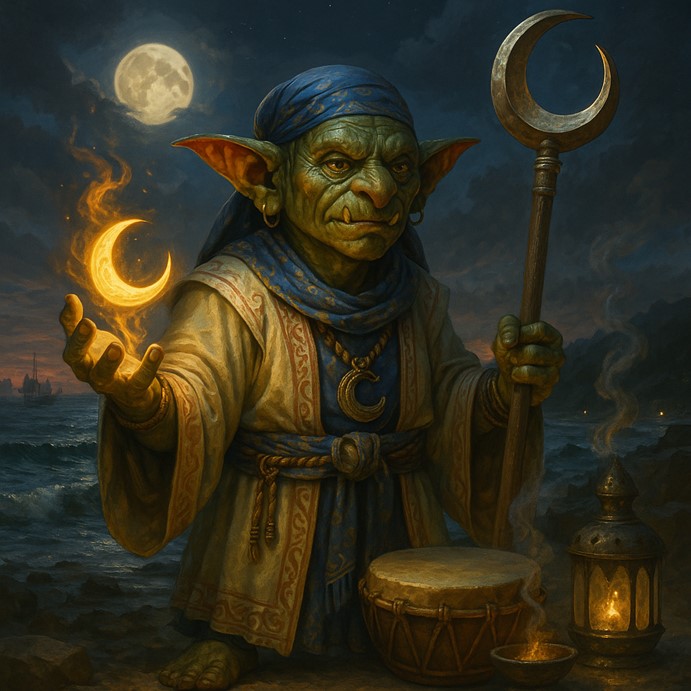
The god of Tasian belief, Kuraith of the Tidal Crown, channels divine influence through the dual forces of oceanic flow and volcanic heart, which followers can adapt into both defensive and offensive applications depending on their discipline, tools, and ritual precision.
For defense, Kuraith’s magic manifests as barriers and redirections, mirroring the way tide and current deflect or erode force. Trained avatars can call upon Brineward Aegis, a wall of swirling, super-salinated water that dulls impact and corrodes weapons striking it. In city and port defense, Anchors of Stillwater are invoked—circles of calm sea that negate incoming projectile velocity, turning arrows and bolts to harmless drifts. Followers can also shape Mist Veils using divine condensation, obscuring vision while carrying a faint metallic tang that warns allies of encroaching threats. The deity’s volcanic aspect grants Lava-Heart Ward, a ground-bound ripple of heat that forces attackers to keep distance, suitable for chokepoints or protecting sacred sites.
For offense, Kuraith’s power is harnessed in rapid, overwhelming bursts—like storm waves breaching seawalls or vents erupting under the sea. Tidebreak Strikes draw on pressure pulses in conjured water columns, smashing through armor seams or stunning with hydraulic shock. Molten Surge combines water with superheated volcanic essence, projecting jets of steam and boiling spray to scald enemies in close formations. In naval or coastal warfare, Riptide Pull can drag vessels into hazardous reefs, while Crown’s Fury is a ritual channeling both aspects into a cyclone-spun column of steam, water, and fire that consumes a battlefield space before dissipating back to stillness.
These abilities are not passive blessings; they demand mastery of ritual cadence, precise gear attunement, and personal stamina. Kuraith’s power is tied to natural cycles, so tides, moonlight, and seismic tremors can amplify or hinder its strength, rewarding practitioners who plan their actions to match the deity’s rhythms.
Crown Beneath Waves and Fire Below
Long ago, before ships had keels and before stones were cut into walls, the waters around Tasian rose and fell not by moon’s pull, but by the hand of the Deep Crowned One. He was called Kuraith, though in the elder tongue the name was more like the sound of waves upon hollow rock—half hiss, half roar. In those days, the land and the sea quarreled without end. The land would push upward, mountains clawing for the sky, while the sea would rush in, gnawing at their feet. It was said that Kuraith was born in the place where these two ancient rivals struck each other hardest: a reef that burned with hidden fire, whose stones bled red when struck.
From his head rose a crown not of gold or coral alone, but of molten stone cooled in the shape of curling wavecrests. His eyes were the stillness of the deep trench before a quake. When he spoke, it was like the sound of a wave collapsing over a venting volcano—steam, hiss, boom.
The people of the first Tasian coast lived in fear. The ground shook in their sleep, the tides swallowed whole villages, and when the waters fled, the land would crack open with smoke and fire. They went to the cliffs to shout into the wind, pleading for mercy. The waves answered once, and it was Kuraith who rose from them.
He did not promise peace. He promised balance. “When the sea and the stone strike each other, the world is fed,” he said in a voice that was neither kind nor cruel. “But if one grows too greedy, all will hunger.” He told them to keep the shore as a place of offerings, where water and rock could touch without war.
So the people made the First Covenant. They gave Kuraith the first fish of each catch, the first cooled lump of obsidian from each eruption. They built tall stones in the shallows where the waves could strike them and offered woven nets of shell and pearl to hang between.
But there was a season when the land grew arrogant. A chieftain, called Dalmos the Builder, thought he could bind the sea away forever. He piled great walls of stone, cutting the tide from the coves and trapping it far offshore. The earth beneath those walls began to hum with warning, but Dalmos laughed and said the land was his to shape.
Kuraith came not as a man that day, but as a crown-shaped storm. The walls of Dalmos groaned and cracked, the water rose higher than men had ever seen, and beneath it came the breath of the volcanoes, boiling the waves from below. When the flood receded, the walls lay in pieces, and the sea had carried Dalmos’ name into the deep, never to be spoken by his people again.
From then onward, the Tasians kept the covenant with strictness. They learned the rhythm of the tides and the shiver of the ground. They marked days when no building could rise near the shore, and days when all fishing boats stayed anchored as tribute to the Deep Crowned One. The priests taught that his blessings came not in gentle form, but in the chance to live between sea’s hunger and stone’s temper.
In time, Kuraith was said to have taught select priests the weaving of his powers: steam to blind and scorch, waves to shield and strike, currents to carry messages or warriors unseen. These arts became part of the kingdom’s lifeblood, guarded as fiercely as any treasure.
But even in the most peaceful seasons, it is told that if the shore grows too silent—if neither wave nor vent speaks for too long—then the people know to prepare. For Kuraith does not sleep forever, and the balance he guards is sharper than the teeth of the reef.
Moral: The sea and the stone are never enemies nor friends—they are keepers of each other’s strength. To defy the balance is to invite the crown of wrath.