
Physical Form and Sensory Traits:
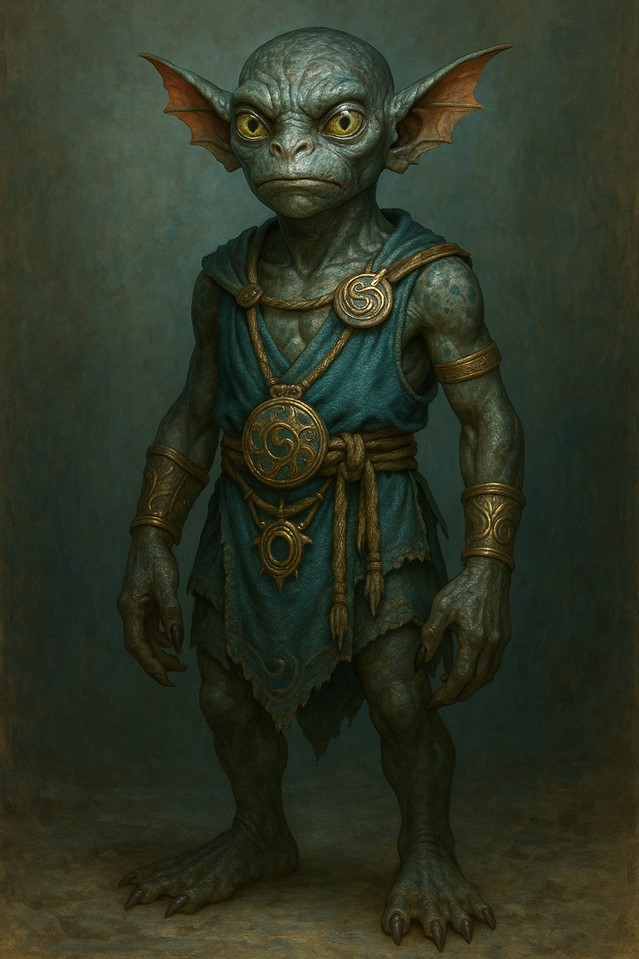
The Kithrak are small to medium-sized humanoids with fluid, angular features that seem sculpted by centuries of wind, spray, and stone. Their skin ranges from storm-gray to seaweed green, often patterned with faint, irregular striping that resembles the play of sunlight under shallow water. Their eyes are disproportionately large and slightly bulging, with horizontally split pupils and reflective corneas that allow for excellent low-light and underwater vision. Ears are long and fin-edged, able to swivel and flatten against the skull to block wind or water entry. Nostrils are narrow slits that can close entirely when submerged. The teeth are sharp and slightly uneven, better for tearing than grinding, though molars are present. Hands and feet are long-fingered and webbed, granting them precise dexterity in watercraft construction, fishing gear, and delicate magical devices.
Their sense of smell is sharper than most humanoids, particularly for detecting brine, rotting organic matter, or chemical changes in water. Hearing is acute enough to discern the difference between calm and storm-tossed surf even at great distance. Their vision is polarized in daylight, allowing them to cut glare on open water, though sudden bright light changes can disorient them for a moment.
General Size:
Adults average 4’6″ to 5’2″ in height and weigh 90 to 130 pounds. They are light-boned yet wiry, able to swim or climb for hours without fatigue.
Body Pattern:
Kithrak skin patterns are inherited along maternal lines, often serving as clan identifiers. These patterns, from fine wave-like tracery to bold bands, intensify in coloration during strong magical ebbs or when the individual is under emotional stress. The ruling line exhibits an especially rare pattern called the Deepcurrent Mark—a spiraling vortex pattern across the chest and back, signifying ancient magical lineage.
Life Cycle:
Kithrak mature quickly, reaching physical adulthood by 14 years of age, though cultural adulthood is recognized at 16 after passing the Tidebound Trial—a test of seamanship, diplomacy, and survival skill. They remain physically capable into their mid-70s, with rare individuals living beyond a century. Breeding is seasonal, aligned with certain lunar phases believed to bless children with favorable sea spirits. Child-rearing is communal within extended matrilineal households, and maternal ancestry dictates both property inheritance and social rank.
Potential Positives Due to Physical Form:
- Exceptional swimmers and climbers.
- Highly dexterous in wet or slippery conditions.
- Low-light and underwater vision grants strong advantage in coastal environments.
- Natural resistance to saltwater corrosion on skin and equipment they carry regularly.
- Webbed digits make them adept at aquatic foraging and underwater construction.
Potential Negatives Due to Physical Form:
- Reduced tolerance for arid or extremely cold inland climates; skin cracks without regular moisture.
- Sudden bright light changes can temporarily impair vision.
- Smaller body mass makes them more susceptible to blunt-force trauma.
- Slightly reduced stamina in prolonged high-altitude conditions.
Tags: Humanoid, Nocturnal, Cunning, Cultural-Elite, Predator,l Shadow-Lore, Magically-Aware, Hierarchical, Ritualist, Stealth-Adaptive, Urban-Dweller, Night-Vision, Adaptive-Climate, Territorial, Artisan, Ceremonial-Gear, War-Trained
Specialized Item Slots Available:
- Fin Bracers: Lightweight limb wraps or armored guards designed to enhance or channel aquatic magic.
- Gill Veil Slot: A specialized throat or neck slot for magical filtration gear, allowing extended underwater breathing.
- Tide Sash: Waist-mounted slot unique to Kithrak, functioning as both a harness for small tools and a ceremonial status display.
- Webbed Grip Gloves: Magical gloves fitted to their finger-webbing, improving tactile feedback and grip.
Environmental Adaptability:
Kithrak thrive in coastal, tidal, and estuarine environments, as well as floating cities. They adapt quickly to humid jungles and warm river deltas but struggle in desert or frozen regions without constant water access. Their physiology allows them to dive for several minutes without gear, and they can drink brackish water with minimal ill effect. Storm seasons bring out their competitive spirit, and many volunteer for rescue or salvage duties when others seek shelter.
Other Information Important to This Race:
The Kithrak’s political structure, especially in Tasian, is built on a monarchy that claims divine right through both magical lineage and ancestral pact with the seas. The ruling family is known not just for governance but also for personally captaining the nation’s largest ceremonial and war fleets. Clan allegiance is central to identity, and disputes are often settled in public “wave courts,” where argument and evidence are presented before both peers and the sea itself, sometimes literally on floating platforms. The Kithrak see themselves as stewards of Tasian’s shores and deep waters, believing their magic-tinged bloodline ties them to the ancient, unseen currents that shape their island nation.
Night When the Moon Hid Twice
In the days when the sea’s breath was warmer and the mountains leaned closer to the shore, there lived the High Ear of the Eastern Roof, whose shadow stretched longer than the tallest mast in the Tasian harbors. He was of the Moon-Cloaked Kindred, who walked with the hush of falling ash and whose eyes saw the silver threads that bind thought to deed. It is told that he spoke rarely, for each word carried weight enough to tilt a ship.
The land in that age was bright but restless. Waves of outsiders came with sails of stranger-cloth and promises of copper that bent in the hand. The High Ear was patient, yet he watched, and in watching he learned the names of the winds that carried deceit. In the market of Long-Tooth Pier, a merchant of ten tongues came, offering glass that sang in the night. The people marveled, but the High Ear felt the hum within the glass was not the song of stone, but the hunger of unseen teeth.
He called to him the Seven Whisperers—those of his blood who could walk among the breath of men unseen—and gave them masks carved from the bones of river beasts. “Go,” he told them, “where the merchant sleeps, and listen with your skins, for the truth will wear no shoes.” They went, crossing roof and rope, slipping into the place where the merchant’s dreams lay open. There they saw shapes like dripping iron, pouring from the glass jars, sliding into the merchant’s mouth as he slept, leaving behind hollow laughter.
When the Seven returned, the High Ear bound his arms in red silk and spoke the Calling-Without-Light. The moon, hearing its old name, hid itself behind the mountains, though it was not its time. In that darkness, the High Ear and his kin took every piece of singing glass and set them upon the tide, sending them to the cold current where the sea keeps what it does not return.
Yet the merchant was not gone. Stripped of his wares, he begged for passage, claiming no harm was meant. The High Ear gave him a boat with no oars, a sail stitched from eel-skin, and a jug of sweet water. “If the winds are honest, you will see land,” he said, “and if they are not, you will learn the shape of the sky beneath the waves.” The merchant was never seen again, but the people say that in storms you can hear glass singing under the foam.
From that day, the Moon-Cloaked Kindred wore upon their belts a shard of dull glass, as a sign that they had stood watch when the moon hid twice. And when strangers come to Tasian shores, they are met not with the open palm but with the weighing gaze, for the lesson was passed to every child: even gifts may have teeth.
Moral: Trust is not in the giving, but in the seeing of what lies beneath the gift’s shadow.