
Original Life Forms:
• Mammalia – Pangolin (Manis temminckii)
• Reptilia – Thorny Devil (Moloch horridus)
• Insecta – Antarctic Krill (Euphausia superba)
• Cephalopoda – Dumbo Octopus (Grimpoteuthis spp.)
Appearance
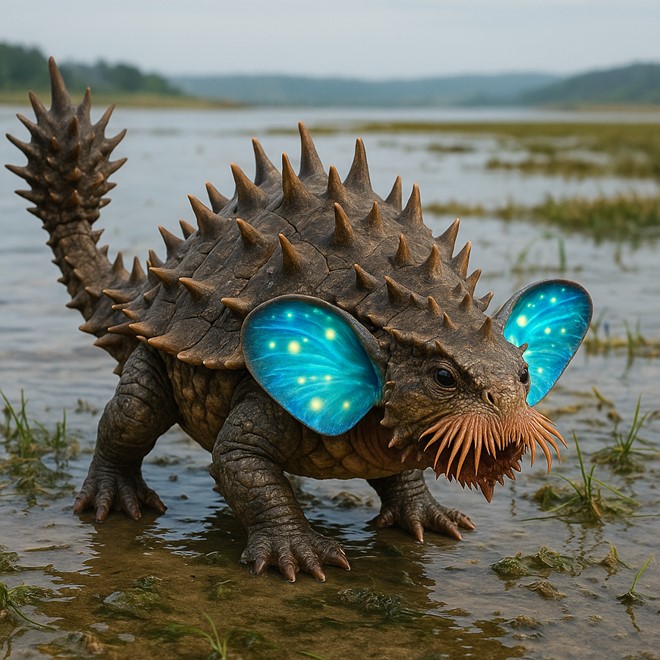
The Thornkrillurdon 619 has a low-slung, armored body covered in overlapping keratin plates reminiscent of a pangolin, each plate bristling with the spiny protrusions of a thorny devil. Its head is broad and flat with a dumbo octopus’s ear-like fins protruding from behind the eyes, which ripple with faint bioluminescence. The forelimbs are heavy and clawed for digging, while the rear limbs are webbed for swimming. Its underbelly is a translucent, chitinous membrane through which faint pulses of krill-pink light can be seen, hinting at the dense filter-feeding apparatus within. A segmented tail ends in a crown of hardened spikes, which can fan outward defensively.
Size
• Length: 2.4 meters from snout to tail tip
• Height at shoulder: 0.9 meters
• Weight: ~165 kg
Speed
• Land: 20 ft per round (burrowing 10 ft per round)
• Water: 30 ft per round (burst 50 ft for short durations)
Stat Modifiers
• Strength: +2 (armored digging limbs)
• Dexterity: –1 (bulk and armor limit agility)
• Constitution: +3 (resilient metabolism, extreme temperature tolerance)
• Intelligence: –2 (feral instinct-driven behavior)
• Wisdom: +1 (high environmental awareness)
• Charisma: –2 (alien and unsettling appearance)
Skills
• Burrowcraft – Exceptional digging and tunneling ability in sand, loose soil, or volcanic ash.
• Aquatic Foraging – Skilled at filtering plankton and small life from water.
• Camouflage – Shifts dorsal plate color to match rocky or coral environments.
• Threat Display – Flares tail crown and puffs out thorny plates when cornered.
Behavior
The Thornkrillurdon is primarily solitary, except during short mating seasons. It spends much of its time burrowed near tidal estuaries or partially submerged in shallow waters, emerging at dawn and dusk to forage. It uses slow, methodical movements on land, relying on its armor and spines for defense, but in water it becomes surprisingly graceful, propelled by a combination of webbed kicks and gentle fin undulation.
Diet
Omnivorous filter-feeder and opportunistic predator. It consumes plankton, small fish, aquatic vegetation, and occasionally scavenged carrion. Its krill-derived feeding apparatus allows it to strain vast quantities of water, while its claws can tear apart mollusks and crustaceans.
Emotions
Generally placid unless provoked. Displays contentment by slowly undulating its ear-fins, agitation by rattling its dorsal plates, and aggression by spreading its tail crown while releasing a low, resonant growl.
Environment Where Found
Brackish tidal flats, mangrove shallows, volcanic coastal pools, and reef-shadowed bays. Particularly common in transitional zones where freshwater streams meet saltwater estuaries.
Tags
Armored, Aquatic, Burrower, Thorned, Bioluminescent, Defensive, Filter-Feeder, Semi-Aquatic, Estuary-Dweller, Solitary, Territorial, Planktonic-Feeder, Camouflaged, Omnivore, Heat-Tolerant, Spiny, Magical-Feral
Life Cycle
The Thornkrillurdon 619’s life begins in a gelatinous clutch of eggs laid in shallow, sheltered tidal pools during the hottest part of the year, when plankton blooms are at their peak. Each female deposits 10–18 eggs in a burrow dug into the pool’s sandy floor, covering them with a layer of loose sediment for camouflage. Incubation lasts around 12 weeks, after which soft-shelled hatchlings emerge at a size of roughly 20 cm, bearing only faint thorn nubs and translucent plates. These juveniles remain in the estuary shallows for their first year, gradually developing the hardened keratin armor and fully functional tail crown by their third year. Sexual maturity is reached at approximately 8 years, with a natural lifespan of 40–50 years in the wild.
Mating
Mating occurs during a brief seasonal period tied to lunar cycles and tidal surges. Males compete through non-lethal “plate shoving” contests in which they push against each other with armored backs, attempting to dislodge their rival into the water. Females select mates based on tail crown symmetry and the intensity of bioluminescent fin patterns, which serve as a health indicator. Courtship involves slow, synchronized swimming in shallow moonlit waters, ear-fins spread wide, before the pair burrows together into a mating den to copulate.
Tactics
• Defensive: When threatened on land, the Thornkrillurdon curls into a spiny ball, locking its plates and presenting a near-impenetrable barrier of thorn-tipped armor. In water, it uses sudden bursts of speed to retreat into deeper channels, releasing a cloudy plume of silt to obscure pursuit.
• Offensive: While not typically aggressive, a cornered adult will swing its tail crown in wide arcs to deter attackers, the hardened spines capable of breaking bone. In shallow water, it can lash out with its claws to rake soft tissue.
• Ambush: If hunting larger prey in tidal flats, it will bury itself with only its bioluminescent ear-fins visible, luring curious fish or small amphibious creatures within striking range.
Actions
• Burrow Collapse: Can undermine loose terrain beneath opponents to cause sudden footing loss.
• Tail Whip: Delivers a wide, sweeping attack that can knock back or trip multiple assailants.
• Silt Screen: In aquatic environments, kicks up dense particulate clouds to blind predators or prey.
• Filter Surge: Opens its krill-like feeding apparatus to suddenly vacuum small prey from the water column.
Other Interesting Information
• The Thornkrillurdon’s keratin plates are patterned with micro-grooves that channel rainwater and dew toward its mouth, allowing it to hydrate in arid coastal seasons without traveling inland.
• Its thorny protrusions are not static; they can be partially retracted when navigating coral reefs to prevent snagging.
• Juveniles have a higher bioluminescence output than adults, possibly as a deterrent to predators that associate the glow with unpleasant taste.
• The species’ burrows often become microhabitats for small crustaceans, mollusks, and algae, which in turn attract other creatures—sometimes used as a passive “bait farm” by experienced adults.
• Coastal communities in Saṃsāra sometimes treat Thornkrillurdon sightings as a sign of shifting tides and good fishing seasons, leading to both superstition and regulated hunting rights.
Adventurers on Saṃsāra might encounter or deliberately seek the Grakthoryn 947 for several reasons tied to its rarity, resources, and the dangers it poses:
- Rare Crafting Materials –
The segmented crystal carapace of the Grakthoryn can be worked into magically conductive armor plating or ground into a fine dust for alchemical catalysts. Its chitin-bone blend is prized by weaponsmiths for creating lightweight, mana-channeling polearms, and the iridescent pectoral frills fetch high prices as visual glamour components for illusion gear. - Alchemical and Medicinal Harvests –
The creature’s venom, delivered through its paired rostral spines, is a potent paralytic with layered properties—properly diluted, it becomes a numbing agent for surgery; concentrated, it is a high-grade disabling toxin for assassin’s tools. The viscous oil from its hind-limb glands is a rare stabilizer in volatile potion mixtures. - Quest-Driven Hunting –
The Grakthoryn is known to burrow into old ruins, particularly those near leyline fractures. Many factions—monarchies, guilds, or private collectors—commission adventurers to clear them from these sites to recover hidden relics, maps, or magical devices. - Environmental Threat Removal –
In its favored tidal cave environments, a mature Grakthoryn can collapse sea tunnels and cause rockfalls by burrowing into load-bearing stone. Fishing villages and coastal trade routes may hire mercenaries to eradicate them when one takes up residence near populated areas. - Ritual and Superstition –
Certain coastal religions or folk traditions believe the Grakthoryn embodies “the sea’s deep grudge.” Its heartstone—a calcified organ of swirling blue-white mineral—is considered an omen of protection against storm spirits, leading temple orders to sponsor hunting expeditions. - Challenge and Glory –
The Grakthoryn’s agility, powerful digging strikes, and uncanny ability to blend into wet stone make it a difficult hunt even for seasoned trackers. Some warrior orders or mage-knight academies require a successful hunt as a rite of passage for advancement.
From the corpse of a Grakthoryn 947, skilled harvesters, alchemists, and artificers can extract a range of unique resources, each with practical, magical, or economic value:
- Segmented Crystal Carapace Plates –
Dense yet slightly flexible layers of mineralized chitin, ideal for reforging into armor components, bucklers, or structural reinforcement for siege devices. Properly polished, the plates can channel runic inscriptions to amplify defensive enchantments. - Pectoral Frill Membranes –
Translucent and iridescent, these fine, layered tissues can be rendered into illusion-weave cloth, used in cloaks or hoods that help the wearer blend into stone or surf environments. They also serve as rare glamour components for theatrical magic. - Rostral Spine Venom –
A two-phase paralytic/toxin harvested from the dual stabbing spines. In small, diluted doses, it functions as a surgical anesthetic or in pain-numbing salves. In concentrated form, it becomes a potent paralytic poison for weapon coatings or specialized traps. - Hind-Limb Oil Glands –
The secretions act as a powerful alchemical stabilizer, preventing volatile mixtures from separating or detonating prematurely. Commonly used in high-grade explosive charges, steady-burning lantern oils, and temperature-resistant enchantment inks. - Heartstone –
A swirling, semi-luminous organ of calcified minerals and condensed mana. When set into a staff, shield, or ship’s figurehead, it can serve as a storm-warding focus or as a resonance core for water-manipulation gear. - Ocular Lenses –
The creature’s compound eyes are made of a highly refractive mineral. Ground into powders, they enhance the precision of scrying lenses and surveying tools; intact lenses are sometimes used in magnification or low-light optics. - Gill Filament Clusters –
Located deep along the neck plates, these fibrous organs can be dried and powdered into “breathing draught” components—potions that temporarily allow air or water breathing. When fresh, they serve as reagents for underwater camouflage spells. - Burrower’s Claws –
Hardened, stone-cutting foreclaws that, when reforged or set into tools, retain a magical affinity for earth and rock, allowing miners or builders to work through dense stone with reduced effort. - Mana-Infused Blood Residue –
A thick, iron-rich fluid carrying minute particulate crystals. Used by scrollwrights and runesmiths as a rare ink additive for enchantments tied to water pressure, crushing resistance, or subterranean survival.
Stone-Spine That Waited Too Long
In the days before the rivers remembered their way to the sea, there was a valley of salt wind and black sand where fish grew wings and stones learned to whisper. In that valley lived the Great Stone-Spine, a creature neither fully of water nor of land, whose body was made from the fragments of a thousand forgotten shells, whose eyes were like the moon broken into dust. It slept in the shadow of its own rostrum, the long spined spear that jutted from its head, and dreamed of a meal that would make it remember the first tide.
The people of the shore, who wore the skins of waves and spoke with hands instead of tongues when the wind was too strong, told each other the Stone-Spine was older than the mountains, that it had once been a river god who lost a game of riddles to the sea. They said its back carried not just armor, but the memory of storms, and that if you struck it wrong the storm would return in your lungs.
One dry season, a young fisher-hunter named Rallin came down from the basalt cliffs to find the Stone-Spine. He sought it not for meat, but for the frill it carried behind its jaw—woven into a sail, it was said, the frill could call wind from any direction. Rallin’s village had been becalmed for many days, and without wind their fishing rafts rotted on the beach. He brought no spear, for he was told the creature would wake only for those who bled the water, and Rallin feared blood might bind it to him forever.
For seven nights he camped by the salt lake where the Stone-Spine was said to drink. On the eighth, the water trembled though the wind was still. From the silt, the creature rose, pulling the night around it like a cloak, eyes lit with pale hunger. It did not strike at Rallin. Instead, it circled, dragging its claws in the sand, tracing a shape older than letters. The young hunter realized the marks were a path—a winding trail through reef and cavern that led far from the village.
Rallin followed. Days passed. He learned the Stone-Spine would vanish in the shallows and appear again ahead, as though it walked between moments. He saw it pin great reef-beasts beneath its rostrum and feed without tearing the flesh, drawing instead the breath from their bodies. At last, deep in a hollow where water pressed from all sides, he found the truth. The creature guarded a nest—not of eggs, but of stones carved into the likeness of its own shape, each humming with a faint heartbeat.
The Stone-Spine lowered its head so the rostrum’s tip touched Rallin’s chest. In the tremor of that touch he understood: the creature’s frill did not call wind; it held the voices of its young, unborn until the sea was safe again. The winds that would come from such a sail were not for travel—they were cries for help.
Rallin left the hollow, empty-handed but not empty-hearted. He told the villagers the wind would return when the sea forgave the sky, and until then they must learn to fish from the cliffs. Years later, when the wind did come, it brought with it a great tide, and some swore they saw many small Stone-Spines riding the waves toward the open ocean.
Moral: The oldest guardians defend more than their lives; they defend the memory of what is yet to live. To take from them without knowing is to steal from tomorrow.
Suggested conversions to other systems:
Call of Cthulhu (7th Edition) — Stone-Spine Sentinel
STR 140 (70%), CON 130 (65%), SIZ 180 (90%), DEX 60 (30%), INT 45 (22%), POW 85 (42%), APP —
Hit Points 31, Move 7 on land, 10 in water
Damage Bonus +2D6, Build 4
Armor: 10-point chitin shell; ignores impaling damage from mundane weapons unless made of Mythos-grade materials.
Attacks:
- Rostrum Strike: 60% (30%), damage 2D10+db, impaling.
- Breath-Steal: 50% (25%), opposed POW vs POW; target loses 1D6 CON on success, asphyxiates if reduced to zero.
- Claw Rake: 55% (27%), damage 1D8+db.
Skills: Listen 60%, Track 55%, Swim 80%, Stealth (aquatic) 75%.
Powers:
- Tidal Memory: Once per day, forces all living creatures within 30 yards to make a SAN roll (1D4/1D10 loss) as visions of primordial tides overwhelm them.
- Between Moments: Vanishes and reappears after 1D3 combat rounds, re-entering within 30 yards.
Sanity Loss: 1D4/1D10 upon first encountering the Stone-Spine Sentinel.
Blades in the Dark — Salt-Rimed Spinebeast
Type: Threat (3), Leviathan-Spawn.
Description: A hybrid of reef and predator, its armored rostrum pierces prey while its frill hums with unborn tides.
Scale: Large (as a small barge)
Quality: Exceptional (+2 effect versus standard opposition)
Threat: 3 (dangerous even to veteran crews)
Edges:
- Breath-Steal: Inflicts Level 3 harm (“Drowning Breath”) unless resisted; ignores mundane armor.
- Tide-Step: Can vanish in one area and reappear in another nearby, bypassing barriers.
Clocks:
- “Break the Spine” — 6-segment clock to pierce or disable shell defenses.
- “Summon the Storm” — 4-segment clock; when full, the area is lashed by wind and current, increasing all water hazard effect rolls by +1 tier for the Spinebeast.
Special: Harvesting the frill requires a Risky–Desperate engagement roll; doing so awakens any nearby young.
Dungeons & Dragons (5e) — Elder Reef Guardian
Large monstrosity, unaligned.
Armor Class 18 (natural armor).
Hit Points 210 (20d10+100).
Speed 30 feet, swim 50 feet.
Strength 22 (+6), Dexterity 12 (+1), Constitution 20 (+5), Intelligence 6 (-2), Wisdom 14 (+2), Charisma 8 (-1).
Saving Throws: Constitution +9, Wisdom +6.
Skills: Perception +6, Stealth (aquatic) +7.
Damage Resistances: bludgeoning, piercing, and slashing from nonmagical weapons.
Condition Immunities: frightened, paralyzed.
Senses: darkvision 60 feet, passive Perception 16.
Languages: understands Aquan but cannot speak.
Challenge Rating: 12 (8,400 XP).
Traits:
- Amphibious: Can breathe air and water.
- Shell Defenses: While motionless, has advantage on Stealth checks and can only be detected on a DC 18 Perception check.
- Breath-Steal (Recharge 5–6): One creature within 10 feet must succeed on a DC 17 Constitution saving throw or lose 21 (6d6) hit points and be incapacitated until the start of the guardian’s next turn.
Actions:
- Multiattack: The guardian makes two rostrum attacks.
- Rostrum: Melee Weapon Attack, +10 to hit, reach 10 feet, one target, hit deals 26 (4d8+8) piercing damage.
- Tidal Memory (Recharge 6): All creatures in a 30-foot radius must succeed on a DC 16 Wisdom saving throw or be stunned until the end of their next turn, as visions of ancient oceans overwhelm them.
Knave (2nd Edition) — Stone-Spine Lurker
Hit Dice 10 (45 HP).
Armor Class 18 (natural shell).
Move 30 feet on land, 50 feet swimming.
Strength +4, Dexterity +0, Constitution +4, Intelligence -1, Wisdom +2, Charisma -1.
Attacks:
- Rostrum Strike: deals 1d10+4 damage.
- Breath-Steal: forces a Constitution save or causes the target to lose 1d6 HP per round until the save succeeds; unconscious targets risk drowning.
Special Abilities:
- Shell Armor: Immune to damage from nonmagical weapons unless they score a critical hit; magical weapons deal normal damage.
- Tide-Step: Can disappear and reappear within 30 feet after 1 round, ignoring obstacles.
- Harvested Relic: Killing the lurker without damaging its frill yields a relic worth 500 silver pieces. When worn, it grants +2 to all sailing and wind-related checks but may attract aquatic predators.
Fate Core — Stonecurrent Leviathan
High Concept: Armored tidal predator born of reef and deep-ocean magic.
Trouble: Driven by ancient tidal instincts.
Aspects:
- Living Reef Fortress
- Breath of the Drowning Tide
- Between Moments, Between Currents
Skills:
- Great (+4): Physique, Fight
- Good (+3): Athletics, Notice
- Fair (+2): Stealth (Aquatic), Will
- Average (+1): Provoke, Lore (Ancient Seas)
Stunts:
- Rostrum Impale: Gain +2 to Fight when making an attack that would pierce armor or hulls.
- Breath-Steal: Once per scene, force an opponent in close range to defend with Physique vs your Physique; failure leaves them choking and unable to act for one exchange.
- Tide-Step: Spend a Fate Point to vanish and reappear within two zones, ignoring barriers.
Stress: 4 boxes (Physical), 3 boxes (Mental)
Consequences: Mild (2), Moderate (4), Severe (6)
Numenera & Cypher System — Shellback Riptide
Level: 7 (Target Number 21)
Health: 35
Damage Inflicted: 9 points
Armor: 4 (natural shell)
Movement: Short on land, long in water.
Modifications: Perception as level 8, Stealth in water as level 8, Might defense as level 8.
Combat: Prefers to ambush prey from concealment. Strikes with its rostrum for massive damage or attempts to drown targets using its Breath-Steal attack.
Special Abilities:
- Breath-Steal: A creature within immediate range must succeed on a Might defense roll (difficulty 7) or lose their next action and begin drowning, losing 5 points from their Might Pool each round until they succeed on a defense roll.
- Tide-Step: Can instantly move to a location within short range once every three rounds, ignoring intervening terrain.
- Tidal Memory: Once per hour, forces all creatures within immediate range to make an Intellect defense roll (difficulty 6) or lose their next turn, stunned by visions of ancient oceans.
Loot: A harvested spine from the Shellback Riptide is worth 1d6×50 shins and can be crafted into a weapon that ignores 2 points of armor.
Pathfinder 2e — Reefpiercer Guardian
Creature 11
Unaligned, Huge Animal, Aquatic
Perception +22; darkvision, wavesense 60 feet
Languages Aquan (understands only)
Skills Athletics +26, Stealth +20 (aquatic), Survival +21
Str +7, Dex +2, Con +6, Int -2, Wis +4, Cha +0
AC 31; Fort +24, Ref +18, Will +20
HP 230; Immunities paralyzed, frightened; Resistances physical 10 (except magical)
Speed 30 feet, swim 60 feet
Melee [one-action] Rostrum +24 (reach 15 feet), Damage 3d12+10 piercing plus Knockdown
Melee [one-action] Claw +22, Damage 3d8+10 slashing
Breath-Steal [two-actions] (attack, incapacitation, primal) The guardian targets one creature within 10 feet. The target must attempt a DC 32 Fortitude save. On a failure, the creature is slowed 2 for 1 round and takes 4d6 bludgeoning damage. On a critical failure, the creature also begins to suffocate.
Tidal Memory [three-actions] (auditory, emotion, primal) The guardian releases a subsonic hum, forcing all creatures within 30 feet to attempt a DC 30 Will save or be stunned 1 (stunned 2 on a critical failure) as visions of ancient seas overwhelm them.
Tide-Step [one-action] (teleportation, primal) The guardian disappears in a burst of foam and reappears in a location within 30 feet.
Savage Worlds (Adventure Edition) — Coralback Mauler
Attributes: Agility d6, Smarts d4, Spirit d8, Strength d12+2, Vigor d10
Skills: Athletics d8, Fighting d10, Notice d8, Stealth d8 (aquatic +2), Survival d6
Pace: 6; Swimming Pace: 10; Parry: 7; Toughness: 14 (4)
Edges: Ambush Predator (Deals +2 damage when attacking from surprise)
Special Abilities:
- Armor +4: Thick chitinous shell.
- Aquatic: Pace 10 in water; cannot drown.
- Rostrum Strike: Str+d10 damage; counts as Armor Piercing 4.
- Breath-Steal: Spirit vs Vigor; failure causes Fatigue each round until a Vigor roll succeeds. If Fatigue exceeds 3 levels, target is incapacitated.
- Tide-Step: Once per combat, may vanish and reappear within 12” as a free action.
- Tidal Memory: Spirit vs Spirit in a Medium Burst Template; failure leaves target Distracted and Vulnerable for 1 round.
Size: Huge (+4)
Treasure: Coralback spines can be sold for 2d6×100 credits or used as AP4 weapon material.
Shadowrun 6E — Deepcurrent Shellmaw
Metatype: Critter
Movement: 10/25 (land/swim)
Attributes: BOD 12, AGI 5, REA 4, STR 11, WIL 5, LOG 2, INT 4, CHA 2
Initiative: 8 + 1D6 (Physical)
Armor: 8 (natural shell)
Condition Monitor: Physical 13, Stun 10
Skills: Unarmed Combat 12, Perception 8, Sneaking 8 (Aquatic +2), Survival 7
Powers:
- Natural Weapon (Rostrum Strike, DV 13P, AP –4)
- Engulf (Aquatic Variant) — Can trap a target in its maw; opposed Strength + Unarmed vs target’s Reaction + Athletics. Engulfed targets must resist 6P damage per round and begin drowning if submerged.
- Enhanced Senses (Low-Light Vision, Sonar)
- Concealment 4 (only in aquatic environments)
- Movement (Water only)
Weaknesses:
- Creature takes a –2 penalty to all tests in low-humidity or dry environments.
Typical Behavior: Ambush predator; prefers to target the slowest in a group.
Loot: Rostrum plates fetch 2D6×100¥; bioluminescent fluid worth 500¥ per dose as a magical reagent.
Starfinder — Tidepiercer Leviathan
CR 10
XP 9,600
N Huge magical beast (aquatic)
Init +5; Senses darkvision 60 ft., low-light vision, blindsense (vibration) 30 ft.; Perception +20
DEFENSE
HP 170; RP 4
EAC 24; KAC 26
Fort +16; Ref +12; Will +11
Immunities: paralyzed, staggered
DR 5/magic; Resistances cold 10
OFFENSE
Speed 30 ft., swim 60 ft.
Melee rostrum +23 (4d10+14 P; AP 5)
Melee claw +23 (3d8+14 S)
Offensive Abilities Breath-Steal (Fort DC 21 negates; 4d6 bludgeoning and target begins to suffocate on fail), Tide-Step (30 ft. teleport as move action, 1/1d4 rounds), Tidal Memory (Will DC 20; stun 1 round on fail)
STATISTICS
Str +7, Dex +3, Con +6, Int –2, Wis +4, Cha +0
Skills Athletics +25, Stealth (aquatic) +20, Survival +20
ECOLOGY
Environment warm oceans and coastal reefs
Organization solitary or pair
Loot: Rostrum shards (craft AP5 weapons), mana-rich gland (used in hybrid magic tech for +1 item level bonus).
Traveller (Mongoose 2E) — Reefclad Dreadmaw
Type: Large Predator
STR 15 (+2), DEX 8 (+0), END 14 (+2), INT 4 (–2), EDU 0 (–3), SOC 0 (–3)
Hits: 19
Armor: 8 (natural chitinous shell)
Traits: Aquatic, Natural Weapon (Rostrum 3D+2, AP 4), Camouflage (+2 Stealth in water), Enhanced Senses (Sonar equivalent to RADAR), Sudden Lunge (once per combat, automatic initiative on first attack), Breath-Steal (END check, DM –2 or lose next turn, begins drowning if submerged).
Skills: Athletics 2, Stealth 2, Recon 1, Melee (Natural) 3
Speed: 12 m swim, 6 m land
Behavior: Ambushes from concealment; will attempt to disable prey with Breath-Steal before delivering killing blow.
Value: Rostrum shards worth Cr 2,000 each; glands for alchemical brews (Cr 500).
Warhammer Fantasy Roleplay 4E — Coralback Drownfang
Species: Monster (Aquatic)
M WS 48, BS 00, S 65, T 65, I 40, Ag 33, Dex 30, Int 20, WP 45, Fel 05
Wounds: 54
Traits: Armour (4) [Natural Shell], Aquatic, Night Vision, Weapon (Rostrum 9), Weapon (Claw 7), Swim 8, Stealthy (Aquatic +20), Immunity (Psychology), Size (Enormous), Terrifying (2), Amphibious.
Special Rules:
- Rostrum Strike: SB+9 Damage, Impale Quality, AP –4 equivalent.
- Breath-Steal: Opposed Strength vs target’s Toughness. Failure means target is Stunned for 1 Round and begins to drown if underwater.
- Tide-Step: May move up to twice M as a Free Action once per encounter, ignoring terrain.
- Tidal Memory: All living creatures within 20 yards must pass a Cool Test or become Stunned 1 round from psychic visions.
Corruption: 0–2 (magical creature)
Psychology: Never breaks due to fear; fights to defend territory.
Treasure: Rostrum plates usable as weapons; alchemical gland worth 50 gc.