
Deity Name: Zhenmu (“True Mother of the Boundless Rim”)
Lore:
The Way of the Vessel and Horizon teaches that all life is a journey contained within a sacred vessel, set upon an endless shore that stretches between the seen and the unseen. Zhenmu, the True Mother, is said to have shaped the first vessels from the clay of a river that flowed in both directions at once—one current carrying the past, the other the future. Into each vessel she placed a spark of horizon-light, which would guide the soul to seek balance between what is held and what is reached for.
According to the earliest Qijian temple tablets, Zhenmu appeared to mortals in the form of a towering figure with fur patterned like flowing water, eyes the color of kiln flame, and a robe made from woven dawn mist. She spoke in phrases that looped back upon themselves, each ending also a beginning. Worshippers believe she walks the narrow rim where the land meets the sky, carrying an unbroken pot that holds the breath of all who have lived and will live.
Her temples, known as Rim Sanctuaries, are often built at the highest accessible point in a city, with wide terraces open to both wind and light. In the center rests the Mother’s Vessel, a great earthen urn glazed in deep red and ivory spirals. Each equinox, the faithful bring water from their homes to pour into this urn, symbolizing the return of life’s experiences to the source.
Personality & Traits of Zhenmu:
- Patient but Unyielding: She waits without hurry for growth, but once a course is set, she refuses to allow it to drift without cause.
- Protector of Journeys: Whether the voyage is across seas, through mountains, or within the heart, Zhenmu guards travelers from losing their path.
- Holder of Memory: She is believed to store the true forms of all things in her eternal vessel, untouched by decay or falsehood.
- Teacher of Balance: Her lessons often come as contradictions, requiring reflection to resolve—balancing containment with openness, tradition with change.
Attributes:
- Domain: Transitions, safe passage, memory, vessel-craft, balanced fate.
- Animal Association: Crane—symbolizing grace in motion and vigilance in stillness.
- Elemental Association: Clay shaped by water and fire.
- Seasonal Association: Equinoxes, when day and night hold equal sway.
- Sacred Color Pairing: Deep red (clay, life) and pale ivory (light, guidance).
Symbols:
- The Horizon Line: A horizontal stroke dividing a circle, representing the meeting of vessel and sky.
- The Spiral Urn: Denoting the soul’s path inward to truth and outward to the world.
- Paired Cranes: Facing opposite directions, wings slightly lifted, standing upon a pot’s rim.
Tags:
Zhenmu, Way of the Vessel and Horizon, Qijia, Horizon Line, Spiral Urn, Crane Symbolism, Equinox Worship, Vessel Craft, Transitional Guidance, Memory Keeper, Fur Pattern Lore, Sacred Clay, Maritime Blessing, Temple Terraces, Dual Currents, Patience and Balance, Pilgrim Protection
Positives of the Faith:
- Provides strong communal identity and stability, especially among seafaring and artisan communities.
- Encourages reflection, balance, and patience in decision-making.
- Blessings and rites for safe travel are highly regarded and sought after by sailors, traders, and migrants.
- Preservation of historical and familial memory through ritual offerings, story-keeping, and symbolic vessel-making.
- Integrates art and craft into worship, strengthening Qijia’s ceramic, textile, and architectural traditions.
Negatives of the Faith:
- Conservative in doctrine; changes to rituals are slow to be accepted, causing friction with reformist or modernist factions.
- The emphasis on patience and slow progress can frustrate more ambitious or urgent-minded individuals.
- Interpretations of Zhenmu’s “balancing” principles have occasionally been used to justify inaction or avoid moral responsibility.
- The importance of crafted vessels in ceremonies can be financially burdensome for poorer worshippers.
- Insular tendencies; devout communities sometimes hesitate to integrate with those of very different beliefs.
Type of Temple:
- Rim Sanctuaries: Open-air, tiered structures built at the city’s highest point or cliffside location, designed to catch wind and sunlight throughout the day.
- Central courtyard houses the Mother’s Vessel, a massive ceremonial urn into which offerings are poured.
- Peripheral halls contain workshops for pottery, weaving, and calligraphy, ensuring that art remains part of worship.
- Gardens and water channels encircle the temple to represent the flowing currents of life and the stillness of containment.
Number of Followers:
- Approximately 38,920,000 adherents within Qijia (just over half the nation’s population).
- Additional followers and sympathetic practitioners are scattered across major trade ports in other island nations.
What They Do (Practices and Rituals):
- Equinox Water Offering: Every household brings water from their dwelling to pour into the Mother’s Vessel, symbolizing the return of life’s experiences to the divine source.
- Horizon Vigils: At dawn or dusk, worshippers gather to stand facing the horizon in silence for one hundred breaths, contemplating balance.
- Vessel Crafting: Pottery-making is both devotional art and sacred duty; many families keep a “life vessel” that is added to each year with symbolic carvings.
- Pilgrim Blessings: Travelers departing by land or sea seek blessings from the temple, often in the form of a small clay token impressed with the Horizon Line symbol.
- Story-Offering Nights: Elders recite personal or communal histories, committing them to both the living memory of the people and symbolically to Zhenmu’s eternal vessel.
- Crane Dance Ceremonies: Ritual performances using masks and garments shaped like cranes, honoring Zhenmu’s vigilance and guidance.
What the Believers Believe:
Followers of the Way of the Vessel and Horizon hold that each soul is a vessel formed by Zhenmu from the clay of existence, and that life’s experiences fill it drop by drop. The soul’s purpose is to maintain balance between holding and seeking—keeping what is essential while venturing toward the unknown horizon. They believe Zhenmu walks the boundary between worlds, carrying the Mother’s Vessel that contains the eternal record of all lives, and that upon death, a soul’s essence is poured back into her vessel to be safeguarded until it is shaped anew. The equinoxes are seen as the moments when Zhenmu pauses in her journey, allowing mortals to commune most closely with her.
Regular Services:
- Timing: Services are held twice daily—at dawn and at the last light of the sun—symbolizing beginnings and endings. Larger congregational rites occur weekly, often on the day aligned with the prevailing wind’s shift.
- Structure:
- Silent Horizon Greeting: Congregants stand facing east (at dawn) or west (at dusk) in complete silence for one hundred breaths.
- Chanted Verses: Tonal verses in ceremonial Jinhuan, recited in looping structures that mirror the shape of spirals and circles.
- Vessel Offering: Members bring small crafted pots, cups, or symbolic tokens to place before the Mother’s Vessel as a sign of what they wish to preserve or release.
- Balance Reflection: The presiding Keeper of the Rim delivers a short parable or historical account to reinforce the balance between holding and reaching.
- Closing Crane Step: A synchronized movement performed by the entire congregation, stepping forward and bowing with hands mimicking crane wings.
Funeral Rites for Believers:
- Preparation: The body is washed in warm water mixed with clay dust from a Rim Sanctuary’s kiln, symbolizing return to the material of origin.
- Marking: A small Horizon Line symbol is painted on the forehead and over the heart with red and ivory pigment.
- Vessel Bearing: A funerary pot, crafted by family or close companions, is filled with water collected from meaningful places in the deceased’s life—rivers, wells, or rainwater.
- Procession: Mourners walk in silence to the highest point permitted by the local terrain, carrying the vessel. At designated stopping points, they pause to speak memories of the deceased.
- Offering to Zhenmu: The vessel’s water is poured into the temple’s Mother’s Vessel at dawn or dusk, believed to deliver the soul’s essence back to the True Mother.
- Final Resting: The empty funerary pot is broken into three pieces—one kept by the family, one buried at the deceased’s birthplace, and one placed in the temple archives—signifying the dispersal of memory into personal, ancestral, and divine keeping.
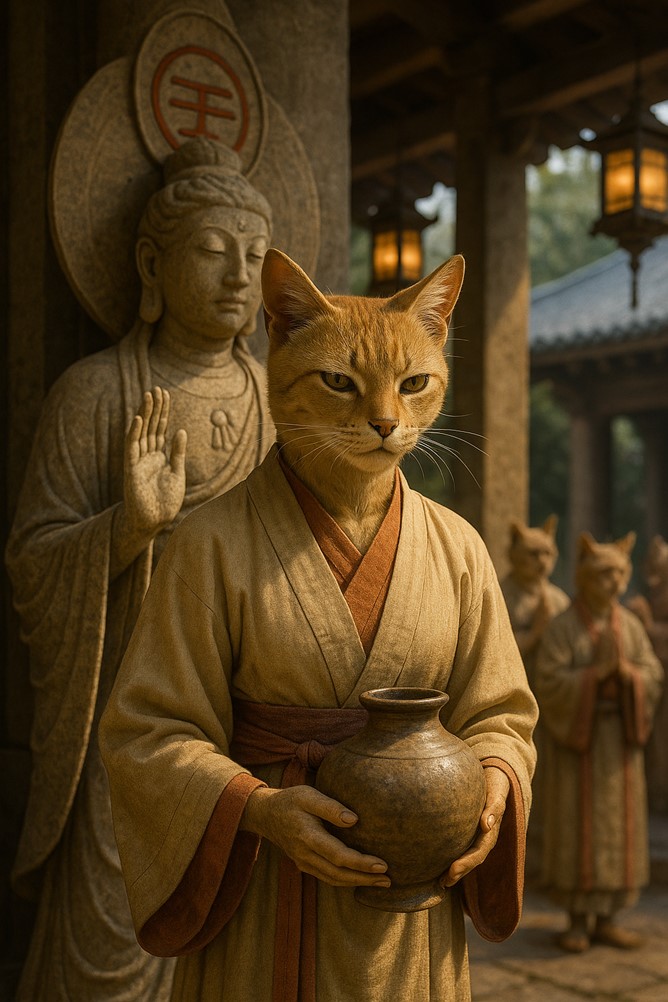
Zhenmu’s divine influence, as understood by her followers in the Way of the Vessel and Horizon, is tied to the symbolism of vessels, horizons, and balance. While her power is generally protective and guiding, it can be invoked for both defense and offense through ritual, ceremonial gear, and items consecrated in her temples.
Defensive Applications:
- Horizon Barrier: Through focused invocation and the proper Yinlian tonal sequences, a worshipper can call on Zhenmu to form a translucent, circular barrier shaped like the rim of a vessel. This shield deflects projectiles and softens impacts, absorbing kinetic force as if caught in clay before dispersing it.
- Containment Seal: Using clay or ceramic shards inscribed with the Horizon Line, enemies or harmful spirits can be trapped temporarily within a confined space—symbolically “placed in the vessel” until they weaken or can be neutralized.
- Memory Guard: By calling Zhenmu’s role as Keeper of Memory, a follower can cloak their mind from intrusion, making it harder for hostile magic to read thoughts or alter memories. This also works to shield allies from fear-inducing enchantments.
- Crane’s Wing Aegis: A ritual dance invoking her sacred crane symbol generates a protective gust that disrupts incoming arrows, light missiles, or thin spell-lines, reducing damage or scattering the attack.
Offensive Applications:
- Overflow Strike: Invoking the vessel’s symbolic “filling past its rim,” the practitioner channels mana into a focused burst—delivered as a wave of concussive force or heated liquid-like energy that surges forward from the hands.
- Shattering Rim: By embodying imbalance, the follower can project a sharp, disc-shaped arc of magical force—mimicking a broken vessel’s shard—capable of slicing through armor or disrupting magical wards.
- Horizon Pull: A targeted offensive invocation that draws a foe toward the caster, symbolizing the horizon’s inevitable reach. This can unbalance or reposition an opponent in battle.
- Memory Weight: The user summons a fragment of the Mother’s Vessel’s stored essence, pressing the burden of countless remembered lives onto an enemy. The effect can slow their movements, cloud their judgment, or cause momentary disorientation.
Rim That Holds the Sky
Long in the time when no lines were drawn between land and cloud, when rivers wandered without mouths and the wind had no place to rest, there was One who walked upon the edge where nothing was yet made. She was Zhenmu, though in the tongue of the first people her name was not said in one breath, for each part of it belonged to a season, and the seasons had not yet agreed to follow one another.
The oldest telling says she came out from the dark-water clay at the hour before hours, carrying in her two hands a round vessel that was not yet fired, not yet full, but already heavy with all that would ever be. The vessel was the shape of the horizon—no bottom, no top, only the line where both would meet. She stepped forward, and with each step, the ground learned to hold shape; she looked upward, and the sky learned to be held in place.
In those days, the beings of the half-light wandered without keeping anything. A meal was eaten, and it was gone. A song was sung, and it was lost to the air. A face was seen, and then it faded from knowing. They had no place to keep their days. So Zhenmu called to them, her voice circling like cranes in the high wind, and said—or so it is guessed—“Come, pour what you are into this.” But the words were strange, and many heard instead, “Give away what you cannot hold.”
Some came. They placed in her vessel the shine of a new river, the laughter of a child, the color of dawn. Others feared, thinking that to give was to be empty. These turned away and followed only their own steps. The ones who gave found, in the next waking, that the vessel returned their gifts to them, brighter, steadier, like water poured from clay that has been smoothed by fire. Those who kept their treasures close found them fading as if rubbed away by unseen hands.
One cycle of the moon later—or perhaps a thousand—there came the Breaking Storm, a wind that wished to be the only thing in the world. It tore the roofs from the first dwellings, bent the mountains like reeds, and drank the rivers until the beds were dust. The beings of the half-light cried out, but their voices were scattered. Zhenmu stood upon the high place where the wind struck hardest, her vessel in her arms, and spoke to the storm in words now lost. She tilted the vessel, and from it poured all the memories and keepsakes she had been given: the shine of rivers, the laughter, the color of dawn, the names of the first children, the weight of promise between friends.
The wind drank these as it had drunk the rivers, but in drinking, it grew heavy, and in growing heavy, it could not lift itself. It fell to the ground, becoming the first still air, and the people could breathe again. Zhenmu set her vessel upon the rim of the horizon so that it touched both the sky and the earth, and said—though in the telling the words are bent—“As long as you pour, I will return; as long as you keep, you will lose.”
From that day, those who remember walk to the high places at the turning of the seasons, bringing water from their homes to pour into her vessel. They believe that each drop finds its way into the true vessel she still carries, somewhere on the rim where her foot never slips. And in the hour between day and night, when the cranes fly low and the sky takes the color of wet clay, the people say they see her shadow bend over the horizon’s line, tilting her vessel back toward them.
Moral: What is given into the keeping of balance is never truly lost; what is kept without sharing slips beyond the horizon.