
Physical Form & Sensory Traits:
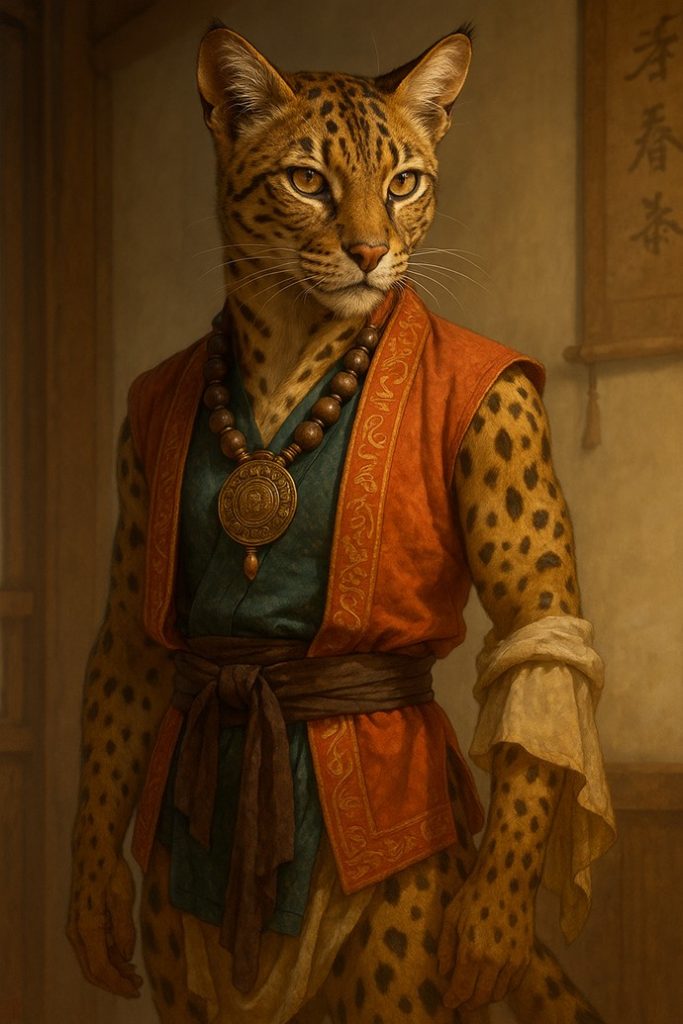
The Huayin are a sleek, digitigrade, furred people with bodies finely tuned for balance, grace, and precision. Their musculature is lean but powerful, built for sudden bursts of speed, climbing, and agile maneuvering in tight spaces. They possess retractable claws on both hands and feet, allowing them to switch seamlessly between delicate manipulation and lethal slashing. Their ears are tall and expressive, capable of rotating independently to pinpoint faint sounds, while their eyes are large, forward-facing, and slit-pupiled, able to shift between sharp daylight vision and acute night sensitivity. The whisker arrays along the muzzle and jawline detect subtle air movements, giving them spatial awareness in darkness or confined spaces. Their vocal range extends well beyond the human spectrum, capable of producing harmonic overtones and subsonic rumbles for private communication among kin.
General Size:
- Height: 4’11” to 5’9”
- Weight: 90 to 150 lbs
- Build: Compact, flexible frames with low bone density for agility but a surprising ability to absorb impacts.
Body Pattern:
Huayin fur ranges from pale gold to deep umber, patterned with broken rosettes or brush-stroke stripes reminiscent of ancient Qijian calligraphy. These markings are unique to each individual, functioning almost like a personal crest. Seasonal changes may slightly shift hue and pattern intensity. In ceremonial contexts, many Huayin ink-paint their fur with Huashu characters for cultural or magical significance, a practice tied to their national identity.
Life Cycle:
- Youth (Kitling): Birth to 12 years; high adaptability, developing coordination, trained in basic climbing, hunting, and etiquette.
- Adolescent (Young Fang): 13 to 20 years; physical peak development, often undergo “Pattern Naming” where their natural markings are formally documented and stylized into personal heraldry.
- Adult: 21 to 65 years; steady physical ability, leadership or trade responsibilities often assumed.
- Elder: 66 to 90+ years; gradual slowing of reflexes but increased sensory finesse, often serving as councilors, judges, and memory keepers.
Huayin age more slowly than many species, retaining full agility well into their seventh decade.
Potential Positives Due to Physical Form:
- Exceptional balance and agility; reduced penalties for unstable or vertical terrain.
- Superior low-light and motion detection vision; can see in dim light without gear assistance.
- Fine tactile sensitivity in hands and whiskers; precision grip for intricate work.
- Natural climbing aptitude; minimal gear required for vertical movement.
- Harmonically complex voice can mimic certain environmental sounds for distraction or coordination.
Potential Negatives Due to Physical Form:
- Lower brute strength compared to bulkier species; less effective at raw lifting or pushing tasks.
- Sensitive ears and whiskers can be overwhelmed by sudden loud noises or turbulent winds, causing temporary disorientation.
- High metabolic rate demands frequent meals; fasting or prolonged hunger quickly reduces performance.
- Fur requires care; if matted or soaked, movement efficiency declines.
Tags: Huayin, Qijia, Feline, Digitigrade, Furred, Retractable Claws, Whiskers, Night Vision, Tonal Language, Agility, Balance, Climbing, Tail Slot, Ear Slot, Whisker Slot, Calligraphy, Noble Lineage
Specialized Item Slots Available:
- Tail Slot: Allows for a balance charm, weighted tail cuff, or expressive ceremonial wrap.
- Ear Slot: Can hold up to two light adornments or signal rings without hindering movement.
- Whisker Slot: Ultra-light sensor beads or magical whisker tips for environmental reading.
- Claw Sheath Slot: Worn over retracted claws for enhanced melee focus or embedded tools.
Environmental Adaptability:
Huayin thrive in warm temperate to subtropical climates, particularly those with dense forests, tiered stone cities, or cliffside dwellings. They are adept at navigating Qijia’s intricate blend of elevated walkways, rope bridges, and vertical architecture. Though not naturally cold-resistant, many Huayin make use of lined garments and enchanted fur oils for adaptation to mountain winters. Their climbing and balance make them excellent in urban, woodland, and shipboard environments, but extended time in barren flatlands can feel disorienting due to the lack of vertical reference points.
Other Information Important to This Race:
The Huayin form the ruling dynasty of Qijia, and their cultural influence permeates the nation’s art, governance, and architecture. Their national language, Jinhuan, is considered most beautiful when spoken by Huayin due to their precise tonal control. In Qijia society, fur patterns are considered hereditary signatures; marriage alliances, noble lineages, and even trade contracts sometimes include ink-rubbings of the individuals’ markings as official seals.
Though the Huayin lack innate magical abilities, their precision of movement and mastery of balance make them favored users of delicate magical gear that requires exact positioning or rhythm to function at full capacity. This has resulted in a long tradition of Huayin artisans designing specialized equipment with fine tolerances suited to their own kind.
Pattern That Climbs the Sky
In the time before the rivers knew their beds, before the stones learned to lie still, there was Huayin-of-No-Name, born under the silent moon that did not yet have light. His fur carried the marks of wandering ink, shapes that bent and broke like the trails of startled fish. His whiskers trembled at things unseen, and his ears drank whispers from distances far past the tallest hills.
It is told—though some say told wrongly—that Huayin-of-No-Name was not born from mother or father, but from the breath of the mountain when it sighed after a long age. He wandered without step-count, crossing forests that bent away from his eyes and seas that curled in circles rather than stretch to horizon. Those he met said his gaze could weigh a man’s soul as a merchant’s scale weighs grain, yet he spoke little, for words in his mouth were like unripe fruit, not ready to fall.
One day, while the air was still young, Huayin-of-No-Name came to a village without name, where the people wore no shoes, for the ground itself knew their feet. The elders asked him, “Do you come to trade?” He said nothing. They asked, “Do you come to fight?” Again, no answer. Then a child said, “He comes to climb.” And this was strange, for no mountains rose near the village.
Following the child’s voice, Huayin walked to the center of the settlement, where a single post stood, carved from a tree that no one remembered planting. The post’s top reached into clouds even the hawks could not pierce. At its base was a pattern—circles within lines within curves—much like the spots upon Huayin’s own fur.
He placed his claws into the first grooves and began to climb. The people watched for three days and three nights. On the first day, the clouds wept. On the second day, the wind sang. On the third day, the sky opened like a jar, and Huayin’s body vanished into it.
It is said that on the fourth day, when the village awoke, patterns had bloomed on the faces of every newborn, each different yet somehow carrying the same curl as Huayin’s vanished tail. From that day forward, the people began to wear their fur-markings like oaths, and the rulers among them bore the deepest, most winding designs.
Some storytellers say Huayin-of-No-Name climbed into the realm of the sky-spirits to bring back the first syllables of the Jinhuan tongue, that the markings on his body were not born but written by the clouds themselves. Others say he never returned because the sky offered no path back down. But the old storytellers, the ones who tap their claws against the floor as they speak, insist he is still climbing, and each dawn’s cloud is the dust from his steps.
Moral: A being’s pattern is not painted in stillness—it is shaped in the climb toward what cannot yet be seen.