
Original Life Forms Used: Goliathus goliatus (Goliath beetle – Insecta), Octopus vulgaris (Common octopus – Cephalopoda), Brachyura (Mangrove crab – Malacostraca), Chelonia mydas (Green sea turtle – Reptilia)
Appearance:
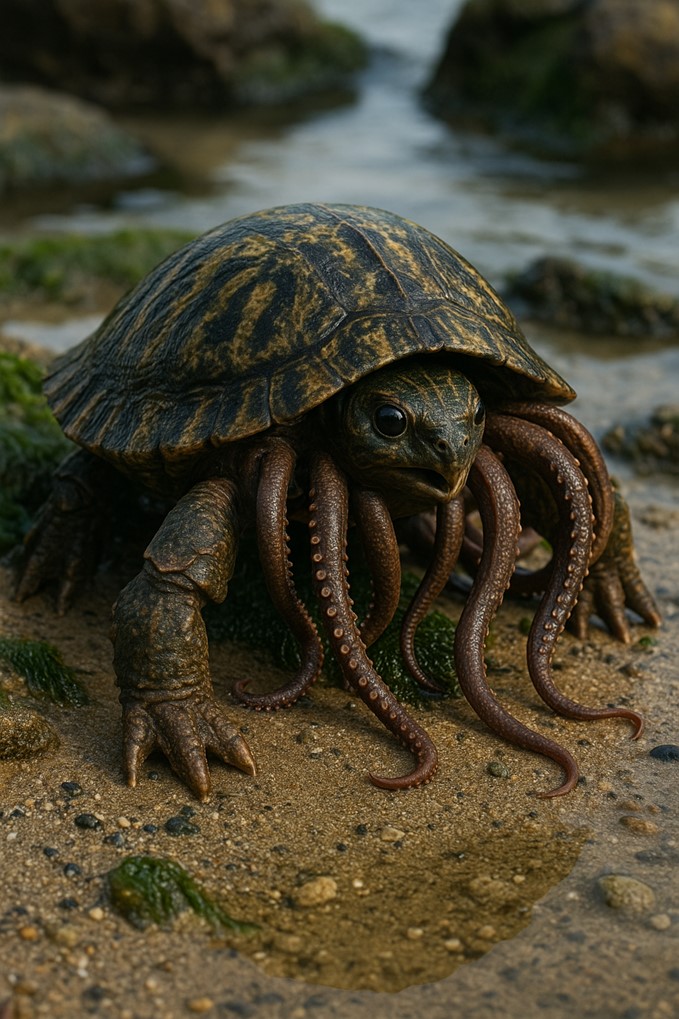
The Strangulvirex 612 is a broad, low-slung creature whose domed carapace resembles the weathered shell of a green sea turtle but is overlaid with the thick, mottled chitin of a Goliath beetle, patterned in interlocking black and bronze stripes. Its four primary limbs are the thick, armored legs of a mangrove crab, each ending in shovel-like claws with a serrated inner edge, ideal for digging and cutting. From beneath the shell emerge six long, muscular octopus tentacles, each covered in short suction cups ringed with keratin spikes, allowing them to grip both prey and terrain. Its head is recessed beneath the front lip of the carapace, bearing large, forward-facing compound eyes with a glossy obsidian sheen and a sharp, beak-like mouth for shearing through shells or tough plant matter. When alarmed, its tentacles retract tightly, and the entire body withdraws partially beneath the beetle-armored shell, presenting only the heavily plated crab limbs as a defensive front.
Size:
- Length: 5.5 ft from claw-tip to rear shell edge
- Width: 4.2 ft at widest point of shell
- Height: 2.8 ft when fully extended
- Weight: ~420 lbs
Speed:
- Land: 25 ft per round (sideways crab scuttle or forward crawl)
- Water: 40 ft per round (octopus propulsion and crab leg swimming)
- Climb: 15 ft per round (tentacle grip and claw hooks)
Stat Modifiers:
- Strength: +3
- Dexterity: +1
- Constitution: +4
- Intelligence: -2
- Wisdom: +0
- Charisma: -3
Skills:
- Athletics (grappling and climbing) +4
- Stealth (camouflage against rocky or reef surfaces) +2
- Survival (foraging coastal plants and trapping prey) +3
- Perception (keen visual detection above and below water) +2
Behavior:
The Strangulvirex 612 is territorial but not needlessly aggressive. It establishes a lair in tidal caves, mangrove roots, or under coastal ledges and defends it with sudden ambush strikes. Tentacles are used to drag prey into striking range of its claws or beak. It is known to “garden” small algae patches and collect shell fragments, stacking them at lair entrances both for camouflage and possibly for display. While solitary most of the year, it engages in brief, violent territorial battles during the warm season, clashing claws until one retreats.
Diet:
Omnivorous opportunist. Consumes fish, crustaceans, bivalves, marine vegetation, carrion, and occasionally seabirds or land animals that stray too close to shore. Uses claws to crack shells and tentacles to deliver food to its beak.
Emotions:
Displays irritation through rapid tentacle flares and shell drumming; curiosity via slow, probing tentacle exploration. Protective over its lair and “gardens,” becoming fiercely defensive if they are disturbed. Not prone to fear—will usually retreat only after suffering significant injury.
Environment Where Found:
- Tidal cave systems and mangrove estuaries
- Rocky coastal zones with abundant marine life
- Occasionally ventures into shallow reefs and submerges to depths of ~60 ft
- Can survive short forays onto beaches or coastal forest floors in humid weather
Tags:
Feral, Amphibious, Armored, Tentacled, Coastal Predator, Ambush Hunter, Omnivore, Crustacean Hybrid, Cephalopod Hybrid, Reptilian Hybrid, Insectoid Hybrid, Territorial, Reef Dweller, Lair Builder, Grappler, Shell Armored, Opportunistic Scavenger, Claw Striker
Life Cycle:
- Hatchling: Strangulvirex 612 begin life as soft-shelled, quarter-sized larvae hatched from clusters of 20–40 eggs buried in wet sand or mud near tidal pools. At this stage, they resemble tiny, translucent crabs with two undeveloped tentacle nubs. They spend the first year hiding in cracks and feeding on plankton and detritus.
- Juvenile: After the first molt, the shell begins to form a dome, and tentacles grow longer. Juveniles are hand-sized and begin hunting small crustaceans and mollusks. Their survival rate increases once the beetle-like chitin starts layering over the shell by the third year.
- Subadult: At around 6–7 years, they reach half their full size and establish small territories in shallow coastal areas. Tentacles are fully functional, enabling advanced climbing and grappling behaviors.
- Adult: Fully grown at 12–15 years, they become strong territorial hunters. Adults may live up to 80 years if not killed by predators, environmental change, or other Strangulvirex.
- Elder: In the final decade of life, they molt less frequently, and shell growth slows. Elders often move to deeper waters or secluded estuaries, becoming more reclusive and defensive.
Mating:
- Mating occurs during the warm season when coastal waters reach peak temperature.
- Males compete through “clash duels,” slamming claws together to create shock vibrations in the water while attempting to flip or pin rivals.
- Females select mates based on claw size, shell condition, and tentacle dexterity—traits seen as indicators of health and survival skill.
- After mating, females bury fertilized egg clusters in damp, concealed sites near their territory. They guard the nesting ground until hatching, fending off intruders with relentless claw strikes and tentacle grapples.
- Males return to solitary life immediately after mating.
Tactics:
- Ambush: Lays still under a layer of sand or rubble, tentacles barely visible until prey wanders into striking range.
- Multi-Angle Attack: Uses tentacles to immobilize prey while claws deliver crushing force from multiple directions.
- Distraction Feints: Will toss shell fragments or debris with tentacles to draw attention away from its true position.
- Lair Defense: Blocks entrances with stacked shells, broken coral, or stones, forcing intruders into a narrow choke point.
Actions (Combat and Utility):
- Tentacle Snare: Wraps up to two tentacles around a target, imposing movement penalties and dragging them closer.
- Crushing Claw: Delivers a powerful pincer strike, capable of cracking bone or heavy carapace.
- Beak Rend: A finishing move that can puncture or shear through hardened material after prey is restrained.
- Ink Cloud (Juveniles & Adults): In water, releases a dense, dark-green ink cloud that obscures vision for a short period, allowing escape or repositioning.
- Shell Slam: Retracts tentacles and thrusts forward with the front of the armored shell to knock back or stun attackers.
Other Interesting Information:
- Tool Use: Strangulvirex are known to place rocks or shells within reach of their lairs, using them to block entrances, weigh down prey, or even hammer open particularly tough shells.
- Shell Gardens: Adults sometimes cultivate algae or barnacle patches on their shells, providing camouflage and attracting small prey.
- Sound Communication: They can create low-frequency drumming by striking claws against their shells, which travels well underwater; used for territory warnings or mating calls.
- Lair Memory: Once a Strangulvirex establishes a lair, it will often return to the same location year after year, even after seasonal migrations.
- Predators: Large sharks, giant eels, and certain high-tier amphibious predators target them, though the shell and claws make most attacks risky for the hunter.
Adventurers in the world of Saṃsāra might seek out or encounter Strangulvirex 612 for several practical, economic, and strategic reasons:
1. Valuable Materials
- Armored Shell Plates: The layered chitin and turtle-like carapace are prized by armorers for crafting hybrid plate-scale armor that is both lightweight and durable.
- Keratin-Spiked Tentacle Rings: Used by enchanters and weapon smiths to create grappling or binding gear with natural mana-conductive properties.
- Beak Shards: When properly treated, the beak can be fashioned into precision cutting tools or ceremonial blades.
2. Culinary & Alchemical Resources
- Tentacle Meat: Considered a delicacy in coastal markets, tender when properly prepared.
- Ink Sacs: Highly sought after for permanent magical inks, camouflage dyes, and stealth enchantments.
- “Garden” Algae: Some Strangulvirex cultivate rare algae on their shells that can be processed into healing salves or underwater breathing potions.
3. Territorial Hazards
- Coastal trade routes, fishing grounds, and tidal cave entrances can be blocked or endangered by a large, aggressive Strangulvirex defending its territory. Clearing or relocating the creature might be necessary for local communities.
4. Quest Targets
- Certain Rim Sanctuaries in Qijia use Strangulvirex shells as ceremonial offering basins; obtaining one may be part of a religious or royal commission.
- A territorial alpha specimen might be disrupting the ecosystem, requiring intervention.
- Rumors of a “deep-shell elder” carrying artifacts encrusted into its carapace could draw treasure-seeking parties.
5. Combat Training & Trophy Hunting
- High-tier coastal militias or naval units sometimes sponsor controlled hunts as a rite of passage, testing an adventurer’s ability to handle amphibious, multi-limbed opponents in both land and water combat.
6. Ecological or Magical Research
- Scholars might hire adventurers to capture a live specimen for study, particularly to understand its lair-building habits or tool use.
- Magical theorists may want to study the interaction between the cephalopod nervous system and the mana-conductive chitin shell for advancements in enchanted prosthetics or hybrid gear.
From a Strangulvirex 612’s corpse, skilled harvesters can recover a wide range of materials beyond its obvious meat and shell, each with distinct applications in crafting, alchemy, or magic:
1. Chitin Layering (Outer Beetle-Plate)
- Use: Lightweight but high-strength armor plating; incorporated into shield faces, gauntlets, or reinforced bucklers. Also used as decorative inlay for ceremonial weapons and temple vessels in Qijia.
- Properties: Naturally mana-conductive, allowing enchantments to adhere more easily.
2. Inner Turtle-Shell Bone
- Use: Carved into protective talismans, charms for safe travel, or structural cores for hybrid armor.
- Properties: Excellent insulator against temperature-based magic, often paired with heat-resistance gear.
3. Tentacle Suction Rings (Keratin-Spiked)
- Use: Incorporated into climbing gear, grappling hooks, and close-combat gloves.
- Properties: Strong grip on multiple surfaces; can be enchanted to temporarily bind a target on contact.
4. Beak Core
- Use: Fashioned into surgical blades, carving knives, or fine-art chisels.
- Properties: Holds an edge unnaturally long; retains a faint cutting bonus against shell, bone, or stone when enchanted.
5. Eye Lenses (Compound)
- Use: Set into precision lenses for spyglasses, crossbow scopes, and arcane focus devices.
- Properties: Naturally filters glare and enhances low-light vision when polished into optical equipment.
6. Ink Sac
- Use: Source of permanent magical inks for scrolls, ward symbols, and tattoos.
- Properties: Holds magical imprints without smudging; also used in stealth potions and smoke bombs.
7. Lair Debris (Shell Gardens)
- Use: Harvested algae and barnacles can be processed into rare medicinal pastes, mana-restorative tonics, or underwater breathing draughts.
- Properties: Algae retains trace magical absorption, making it ideal for spell-component suspensions.
8. Hemolymph (Blue-Tinted Blood)
- Use: Distilled into coagulant serums for field medicine or as a reagent in protective enchantments.
- Properties: Thickens on contact with air, used in crafting quick-setting magical adhesives.
9. Crab-Claw Muscle Fibers
- Use: Dried and braided into reinforced bowstrings or flexible armor joinings.
- Properties: Naturally resists fraying under high tension, maintains elasticity even when exposed to water.
10. Sensory Nerve Cords (Tentacles)
- Use: Integrated into mana-detection rods or magical feedback devices.
- Properties: Retains sensitivity to vibration and directional movement for months after harvest when preserved correctly.
Shell That Grew Gardens
Before the time when tides knew how far to walk, before shells had names, there was a place where the sea climbed into the sky and came down again in the same breath. In that place, the First Shell was born—not from mother, not from father, but from the meeting of deep wave and mountain root. The shell was wide and low, with colors of wet bronze and dark stone, and beneath it lived a creature whose arms were not two, not four, but many, each curling like the smoke of an unseen fire.
It is told, though the telling is uncertain, that the First Shell did not hunt as others did. It wandered slowly between water and air, gathering the soft greens from the rocks, and laying them upon its back. It set tiny shells there too, and the smallest creatures, so that its back became like the tide-pool gardens the spirits make in dreams. The people of the shore, who had no nets then, saw this and said, “The moving rock brings the food to itself.” But none dared take from it, for they saw its claws could close like falling gates, and its beak could shear stone.
One season, the Long Hunger came. The fish fled to the far reefs, the crabs hid deep, and the sea-grass turned black. The people of the shore grew thin. They watched the First Shell, thinking it too would waste away. But instead, it pulled its arms into the sand and brought up strange things from below—roots that tasted of the deep water, small beasts that shone like lanterns, and weeds that could be eaten even when dry. The people took courage and began to follow it, though it struck at them if they came too close.
A bold youth, whose name is forgotten but whose shadow was said to be long, waited until the First Shell slept beneath a cliff. He crept forward, hoping to take from the garden upon its back. But when his hand touched the shell, the creature awoke and wrapped him in its many arms. Some say it dragged him under the waves; others say it placed him upon its back and carried him far away. The old storytellers say he was given a choice—keep what he took and leave hungry tomorrow, or take nothing and be shown where the sea hides her treasures.
What he chose is lost in the cracks between versions, but after that day, the people say the First Shell began to leave pieces of its garden behind in certain tide-pools. Those who took only what they needed found more the next day; those who took everything found the place empty thereafter. The First Shell still lives, the elders say, now larger than a boat, and its back is a floating island of green and shell, guarded by claws that have crushed more than one greedy hand.
Some who meet it in the shallows swear it drums its claws upon its shell before vanishing, as if to warn them, “Take little, and you may return.” Others believe the drumming is laughter, for it knows the shore-people will never find all of its gardens.
Moral: To take without measure is to empty the tide-pool; to take with care is to make it fill again.
Suggested conversions to other systems:
CALL OF CTHULHU 7th EDITION
Name: Strangulvirex 612 – “Garden-Shelled Horror”
STR: 90
CON: 75
SIZ: 70
DEX: 55
INT: 25
POW: 45
HP: 14
Move: 6 (land), 8 (water)
Build: 2
Damage Bonus: +1D6
Armor: 6-point chitin/shell armor (ignores first 6 damage from physical attacks)
Attacks:
- Claw Strike – 45%, damage 1D8+DB, may grapple on a successful hit.
- Tentacle Snare – 40%, on a successful hit target must succeed on STR vs STR roll or be restrained; restrained targets suffer disadvantage on Dodge and can be dragged 1D3 yards per round.
- Beak Rend – 35%, damage 1D10, only usable on restrained targets.
Special: - Ink Cloud (water only) – Can fill a 5m radius with opaque ink for 1D4 rounds, granting it automatic stealth success if it chooses to disengage.
- Shell Withdraw – Gains +20% to Dodge and halves damage from physical sources for 1 round by retracting tentacles and lowering shell.
Skills: Stealth 50% (camouflage), Swim 80%, Listen 60%, Track 40%
Sanity Loss: 0/1D6 SAN when first encountering the Garden-Shelled Horror.
BLADES IN THE DARK
Name: Strangulvirex 612 – “Tide-Claw Ambusher”
Type: Dangerous Beast (Coastal, Amphibious)
Threat: 2
Scale: Large (larger than a person, smaller than a horse-drawn wagon)
Edges: Heavily Armored (6 armor), Multi-limbed Grappler (claws and tentacles can attack separate targets in same round at increased effect)
Harm:
- Heavy Claw Strike (Level 3 Harm: Crushed or Dismembered)
- Tentacle Grapple (Level 2 Harm: Restrained)
- Beak Rend (Level 3 Harm: Pierced)
Special: - Ink Distraction – In water, can create total concealment for itself and allies, counts as increased effect for stealth-related actions.
- Shell Withdraw – Resist rolls against physical Harm have potency (treat as armor) for 1 round.
Drive: Protect its lair and food sources.
Preferred Approach: Lurk in rocky shallows or mangrove roots, ambush prey that strays close.
Weakness: Vulnerable to piercing damage aimed at tentacle bases; easily distracted by large moving bait.
DUNGEONS & DRAGONS 5e
Name: Strangulvirex 612 – “Coastal Lair-Beast”
Large monstrosity, unaligned
Armor Class: 17 (Natural Armor)
Hit Points: 136 (13d10+65)
Speed: 30 ft., swim 50 ft., climb 20 ft.
STR: 18 (+4)
DEX: 12 (+1)
CON: 20 (+5)
INT: 5 (-3)
WIS: 10 (+0)
CHA: 6 (-2)
Saving Throws: Str +7, Con +8
Skills: Athletics +7, Perception +3, Stealth +4
Damage Resistances: Bludgeoning, Piercing, Slashing from nonmagical attacks
Senses: Darkvision 60 ft., Passive Perception 13
Languages: —
Challenge: 7 (2,900 XP)
Traits:
- Amphibious: Can breathe air and water.
- Shell Defense: As a bonus action, retracts into shell, gaining +4 AC and advantage on Strength and Constitution saving throws until it emerges (speed 0 while in shell).
- Multi-Limbed Grappler: Can grapple up to two creatures at once with tentacles (escape DC 15).
Actions: - Multiattack: Two claw attacks and one tentacle attack, or one beak attack against a grappled target.
- Claw: Melee Weapon Attack: +7 to hit, reach 5 ft., one target, Hit: 14 (2d8+4) bludgeoning damage.
- Tentacle: Melee Weapon Attack: +6 to hit, reach 15 ft., one target, Hit: 10 (2d6+3) bludgeoning damage, target is grappled (escape DC 15).
- Beak: Melee Weapon Attack: +7 to hit, reach 5 ft., one grappled target, Hit: 21 (3d10+4) piercing damage.
- Ink Cloud (Recharge 5–6): In water, expels ink in a 20-foot radius. Area becomes heavily obscured for 1 minute or until dispersed by a strong current.
KNAVE (Latest Edition)
Name: Strangulvirex 612 – “Tidal Garden Predator”
HD: 10
AC: 17 (chitinous shell)
Attacks:
- Claw: d8 damage, can grapple on hit (target must save vs STR or be restrained)
- Tentacle: d6 damage, 15 ft. reach, grapple on hit (save vs STR)
- Beak: d10 damage, only against grappled targets
Special: - Amphibious: Functions equally well in water or on land.
- Ink Cloud: Once per fight, fill 20 ft. radius with obscuring ink (all attacks against or by it have disadvantage until end of next turn).
- Shell Defense: Can retreat into shell to halve all incoming damage for 1 turn but cannot attack.
Move: 30 ft. (land), 50 ft. (swim)
Morale: 9
Number Appearing: 1 (rarely 2 in mated pairs)
Treasure: Shell fragments (armor crafting), tentacle keratin (grappling tools), ink (magical writing).
FATE CORE
Name: Strangulvirex 612 – “Tide-Garden Shelllord”
High Concept: Amphibious, multi-limbed coastal predator with armored shell and tentacle reach.
Trouble: Territorial to a fault, will not abandon lair.
Aspects:
- “The Shell is the Fortress” – Can withdraw to maximize defense.
- “Tentacles in Every Direction” – Can engage multiple targets at once.
- “Gardener of the Tides” – Camouflages with living growth on its shell.
Skills: - Athletics +3, Physique +4, Fight +3, Stealth +2, Notice +2, Crafts (Lair Construction) +1
Stunts: - Ink Cloud: Once per scene, create an Obstacle with +2 to Stealth in water environments by filling the zone with obscuring ink.
- Tentacle Grapple: Gain +2 to Create an Advantage when restraining a target with tentacles.
- Shell Defense: Spend a Fate Point to reduce any physical attack’s damage to 0 for one exchange by withdrawing into the shell.
Stress: Physical 4, Mental 2
Consequences: Mild (2), Moderate (4), Severe (6)
NUMENERA & CYPHER SYSTEM
Name: Strangulvirex 612 – “Shellback Reef-Striker”
Level: 6 (18 target number)
Motive: Defend lair and gardens.
Environment: Coastal caves, mangrove estuaries, tidal reefs.
Health: 36
Damage: 8 points (Claw), 6 points (Tentacle), 10 points (Beak vs restrained target)
Armor: 4 (natural shell and chitin)
Movement: Short on land, long in water, short climbing.
Modifications: Athletics and climbing as level 7, stealth in reef terrain as level 7.
Combat: Can attack with two claws or one claw and one tentacle in a round. Tentacles have long range and can immobilize (target must beat level 6 to escape).
Special Abilities:
- Ink Cloud: Once every 10 minutes in water, fills immediate area; all attacks against it are hindered for 1 minute.
- Shell Withdraw: As an action, gain +3 Armor for one round but can’t move or attack.
Interaction: Highly aggressive if approached within 30 ft of lair.
Use: PCs may seek it for rare crafting materials or to clear a dangerous shipping route.
Loot: Chitin plates, keratin suction rings, ink sacs worth 2d20 shins each.
PATHFINDER 2e
Name: Strangulvirex 612 – “Coastal Chitin-Behemoth”
Creature 9
XP: 600
N Large Animal
Perception: +17; darkvision
Skills: Athletics +21, Stealth +17 (+21 in coastal/mangrove environments)
Str: +6, Dex: +2, Con: +5, Int: -2, Wis: +2, Cha: -1
AC: 27; Fort +21, Ref +15, Will +17
HP: 180
Speed: 30 ft., climb 20 ft., swim 50 ft.
**Melee [one-action] Claw +21 (reach 10 ft.), Damage 2d10+8 bludgeoning plus Grab
**Melee [one-action] Tentacle +19 (reach 15 ft.), Damage 2d8+8 bludgeoning plus Grab
**Melee [one-action] Beak +21 (reach 5 ft., only vs Grabbed or Restrained), Damage 3d10+8 piercing
Special Abilities:
- Ink Cloud [two-actions] (aura, visual) Recharge 5–6: The Strangulvirex expels an ink cloud in a 20-foot emanation. This provides concealment to all creatures within and total concealment to creatures outside. Lasts 1 minute or until dispersed.
- Shell Defense [one-action]: Gains +4 circumstance bonus to AC and Fortitude saves until the start of its next turn but is immobilized.
- Multi-Limbed Grappler: Can maintain up to two Grabbed creatures at once.
Rend [two-actions]: If it hits the same target with two Claw attacks in the same turn, deals an extra 2d10+8 bludgeoning damage.
SAVAGE WORLDS (Adventure Edition)
Name: Strangulvirex 612 – “Mangrove Shell-Kraken”
Attributes: Agility d8, Smarts d4, Spirit d6, Strength d12+2, Vigor d12
Skills: Athletics d10, Fighting d10, Notice d8, Stealth d8, Swimming d10
Pace: 6; Parry: 7; Toughness: 14 (4)
Special Abilities:
- Armor +4: Thick chitinous plating and turtle-like shell.
- Aquatic: Pace 10 in water, no penalties for swimming.
- Tentacle Grapple: Reach 3; on a successful hit, can entangle a target (opposed Strength or Athletics to break free). Can grapple up to two targets simultaneously.
- Claw Attack: Str+d8 damage; if both claws hit the same target in a round, deal an additional d6 damage.
- Beak Attack: Str+d10 damage; only against grappled targets.
- Ink Cloud: In water, as an action, creates a Large Burst Template of total concealment for 1d4 rounds.
- Shell Defense: Action to withdraw, gaining +2 Toughness but cannot move or attack until end of next turn.
Edges: Alertness (+2 Notice), Combat Reflexes (+2 to recover from being Shaken).
Hindrances: Territorial (Major), Slow on Land (Minor).
Wild Card: No (typically treated as an Extra, but unique “alpha” specimens may be Wild Cards).
SHADOWRUN 6th WORLD EDITION
Name: Strangulvirex 612 – “Coastal Lair Predator”
Metatype: Paranormal Critter (Aquatic/Terrestrial)
Attributes: BOD 9, AGI 4, REA 4, STR 8, WIL 4, LOG 1, INT 3, CHA 1, EDG 1
Essence: 6
Initiative: 7 + 1D6 (land) / 8 + 1D6 (water)
Movement: 10/20 (land), 20/40 (swim), 6/12 (climb)
Condition Monitor: 12 (Physical) / 10 (Stun)
Armor: 8 (natural shell and chitin)
Skills: Unarmed Combat 8, Perception 6, Sneaking 5, Swimming 8
Powers:
- Amphibious: Can breathe air and water.
- Natural Weapon (Claws): DV 10P, AP –2
- Natural Weapon (Tentacles): DV 8S, AP 0, Reach 2, Entangle (Strength + Net Hits vs target’s Strength + Body to escape).
- Natural Weapon (Beak): DV 12P, AP –3; only against restrained targets.
- Ink Cloud: In aquatic environments, as a Complex Action, create total visual obscurement in 10m radius for 2 Combat Rounds.
- Enhanced Sense (Low-light Vision)
Weaknesses: Territorial (will not willingly abandon lair).
STARFINDER
Name: Strangulvirex 612 – “Tide-Shell Mauler”
CR: 9
XP: 6,400
N Large Animal
Init: +3; Senses: darkvision 60 ft., low-light vision, Perception +18
DEFENSE:
- HP: 145
- EAC: 23; KAC: 25
- Fort: +14; Ref: +11; Will: +9
- Defensive Abilities: Shell Defense (+4 AC for 1 round, no movement/attacks)
OFFENSE: - Speed: 30 ft., swim 60 ft., climb 20 ft.
- Melee: claw +20 (2d10+14 B), tentacle +18 (1d8+10 B, grab), beak +20 (3d10+14 P, only vs grappled)
- Multiattack: 2 claws + tentacle
- Special Attacks: Ink Cloud (30-ft. radius, total concealment for 1 round; usable in water every 1d4 rounds)
STATISTICS: - Str: +7, Dex: +3, Con: +5, Int: –3, Wis: +2, Cha: –2
- Skills: Athletics +20, Stealth +18 (+22 coastal/mangrove), Survival +17
- Feats: Multiattack, Improved Combat Maneuver (Grapple)
ECOLOGY: - Environment: Coastal caves, mangrove estuaries, shallow reefs
- Organization: Solitary or mated pair
- Special Qualities: Amphibious, multi-limbed grappler
TRAVELLER (Mongoose 2nd Edition)
Name: Strangulvirex 612 – “Garden-Shell Ambusher”
Type: Coastal/Aquatic Predator
Hits: 35
Armor: 10 (natural)
Traits: Amphibious, Grappler (tentacles), Shell Defense (halve damage for one round), Ink Cloud (water, total concealment, 1D3 rounds)
Characteristics: STR 14 (DM+2), DEX 8 (DM+0), END 15 (DM+2), INT 3 (DM–1), EDU 0 (DM+0), SOC 0 (DM+0)
Attacks:
- Claw: 3D damage, AP 2
- Tentacle: 2D damage, Reach 3m, Grapple (Opposed STR roll to escape)
- Beak: 4D damage, AP 4; only vs restrained target
Athletics: 1, Stealth 1, Recon 1, Survival 1, Melee (Natural) 2, Seafarer 1
Movement: 6 m (land), 12 m (swim), 3 m (climb)
Behavior: Ambush hunter in shallow coastal zones; aggressively territorial around lairs.
WARHAMMER FANTASY ROLEPLAY 4e
Name: Strangulvirex 612 – “Coastal Shellfiend”
Traits: Beast, Amphibious, Armoured (4), Night Vision, Swamp-strider, Territorial
M: 5 (land), 8 (swim)
WS: 55, BS: 0, S: 60 (SB 6), T: 50 (TB 5), I: 40, Ag: 35, Dex: 30, Int: 14, WP: 40, Fel: 10
W: 38
Skills: Athletics 55, Perception 50, Stealth 45 (Coastal +10), Swim 65
Traits & Attacks:
- Claw (Melee, SB+2, Armour Piercing 1): Two claws per round; if both hit the same target, deal extra +5 damage.
- Tentacle (Melee, SB+1, Entangle): Reach 2 yards; may Grapple as a free action after a successful hit.
- Beak (Melee, SB+3, Armour Piercing 2): Only usable against Grappled targets.
- Ink Cloud: In water, as an Action, creates an obscuring zone 4 yards radius; vision penalties to all within until dispersed.
- Shell Defense: Use an Action to gain +2 Armour and +20 to WS for Parry until next turn, but cannot move.
Behaviour: Aggressive when approached in lair territory; retreats only if heavily wounded.
Special: Hunters value its shell plates for armor crafting; tentacle keratin used in whips and binding ropes.