
Name of Deity: The Ancestral Clay (Omo-Aye)
Lore
The core belief of the Path of Generations is that the divine is not a singular, distant entity, but a collective and immanent one. The deity, referred to as The Ancestral Clay or Omo-Aye, is the amalgamation of the spirits of every ancestor who has ever lived, their essence having returned to the earth from which they were first molded. The very soil of Nok is considered sacred, as it is literally composed of the spiritual and physical remnants of countless generations.
The religion’s foundational myth is “The Song of the First Clay,” which tells how the First Mothers, guided by a deep, instinctual understanding, sang the world into shape and then molded the first Gbodani from the magical earth. These First Mothers are not worshipped as individual goddesses but are revered as the first and most powerful conduits of the will of Omo-Aye. They established the sacred principle that to create is to honor the ancestors, and that every pot, sculpture, and construct made from the earth contains a spark of that collective ancestral spirit. The religion teaches that life is a continuous cycle of shaping and being shaped, with each generation adding their own forms and patterns to the Great Work of existence before their spirits return to the clay to guide the next.
Personality, Traits, and Characteristics
The faith is not one of fervent, emotional worship but one of patient, creative reverence. It is a deeply personal and communal religion, practiced as much in the workshop as in a temple. The “personality” of the faith is patient, nurturing, creative, and communal. It values tradition not as a rigid set of rules, but as a foundation upon which new creations can be built.
Its primary characteristic is the belief that labor is prayer and craft is worship. A perfectly thrown pot is seen as a more sincere offering than a thousand spoken words of devotion. The religion fosters a society where artisans are revered, and the quality of one’s creations is a direct measure of one’s spiritual devotion. There is no concept of sin in the traditional sense, only “flawed work”—creations that are rushed, disharmonious, or made without proper intention, which are believed to dishonor the ancestral spirits.
Attributes of the Faith
- The Spirit in the Clay: The core belief that the spirits of the ancestors reside within the earth itself. This imbues all earthen materials with sacred potential.
- The Duty to Create: Adherents believe they have a sacred obligation to use their skills to create. To be idle or to waste one’s creative talents is a spiritual failing.
- The Cycle of Form: The faith teaches that all things, living or crafted, follow a cycle. A pot is formed from clay, serves its purpose, and when broken, its shards return to the earth to become part of the clay for a new pot. Life is seen in the same way.
- Veneration of the Matriarch: Following the example of the First Mothers, the faith is deeply matrilineal. The spiritual leaders and keepers of the most sacred traditions are almost always women, known as the Clay-Mothers.
Symbols
- The Coiled Pot: The most common symbol is a simple spiral, representing both the coil of clay used to build a pot and the endless cycle of life, death, and rebirth.
- The Terracotta Head: A stylized, abstract humanoid head with perforated, circular eyes and an elaborate hairstyle, mirroring the iconic sculptures of their culture. It represents the ancestor watching over the living.
- The Potter’s Hands: A simple depiction of two hands cupping a lump of wet clay is a common symbol worn by artisans, representing the act of shaping and creation.
Membership and Influence
The Path of Generations is the state religion of Nok and is deeply woven into the fabric of its society. Its followers, known as the “Molded,” number approximately 70 million, slightly more than half of the nation’s total population. While other beliefs exist, the principles of the Path inform Nok’s laws, art, and social structure. The high priestesses, the Clay-Mothers, serve as the primary spiritual advisors to the nation’s monarchy.
Tags: The Ancestral Clay, Omo-Aye, Ancestor Worship, Path of Generations, Earthen, Creation Myth, Artisan Faith, Terracotta, Matriarchal, Clay-Singing, Communal, Cyclical, State Religion, Nok, Veneration
Positives of the Religion
The Path of Generations fosters a deeply stable, cohesive, and resilient culture with several key benefits:
- Strong Community Bonds: The focus on communal creation—sharing kilns, working together on large constructs, and collectively honoring ancestors—builds extremely tight-knit communities where individuals feel a strong sense of belonging and mutual support.
- Exceptional Craftsmanship: Because craft is considered a form of worship, the society produces goods of unparalleled quality and artistry. From everyday pottery to monumental sculptures, every item is made with a patience and attention to detail that is a direct reflection of the maker’s devotion.
- Psychological Comfort and Continuity: The belief that ancestors are not gone but have simply returned to the earth to guide and support the living provides immense psychological comfort. It removes the fear of death, replacing it with the understanding of a natural, meaningful cycle, giving individuals a profound sense of their place in a long, unbroken chain of existence.
- Preservation of Skill and History: The deep veneration for ancestral ways ensures that critical skills, traditions, and histories are meticulously preserved and passed down. This creates a stable culture with a powerful sense of identity and a vast repository of generational knowledge.
Negatives of the Religion
The deep reverence for tradition and the past can also lead to several societal drawbacks:
- Resistance to Innovation: The belief that ancestral methods are sacred can make the culture resistant to new technologies, different artistic styles, or foreign ideas. A new, more efficient technique might be rejected simply because “it is not how the First Mothers shaped the clay,” potentially leading to technological stagnation.
- Creative Conformity: While artistry is valued, there is immense social pressure to create within established traditional forms. Radical, avant-garde, or highly abstract art might be viewed as disrespectful to the ancestors, stifling individual creativity and enforcing a degree of artistic uniformity.
- Insularity and Xenophobia: The core belief that their specific land is uniquely sacred—being composed of their own ancestors—can lead to a dismissive or suspicious view of other nations and peoples. Outsiders might be seen as “unmolded” or their lands as “spiritually barren.”
- Social Rigidity: In a society where status is derived from one’s skill as an artisan, those who are not naturally inclined to craft may struggle for social standing. A brilliant strategist or philosopher who is a clumsy potter may be viewed as less spiritually developed than a master sculptor of average intelligence.
Type of Temple
Temples are not seen as houses of worship for a distant god, but as functional, sacred workshops dedicated to the act of creation. They are called Hearth-Temples.
- Architecture: A Hearth-Temple is a sprawling, semi-open-air complex built from rammed earth and terracotta. The layout is typically circular or spiral, reflecting the primary holy symbol.
- Central Feature: Instead of an altar, the heart of every Hearth-Temple is the Great Kiln, a massive, beautifully constructed kiln that is kept perpetually hot. The kiln is seen as the transformative womb where raw clay is given permanence and blessed by the ancestral spirits.
- Function: The complex is a hub of community life, containing workshops for artisans, galleries displaying masterworks that serve as historical and spiritual records, and quiet, subterranean chambers for meditation. The atmosphere is one of focused work and quiet reverence, smelling of woodsmoke, wet clay, and warm earth.
Followers
The followers of the Path of Generations are known as the “Molded.” The faith is practiced by approximately 70 million people, representing a significant majority of the nation of Nok’s population. It is the state religion and its principles are taught in the compulsory education system.
What They Do
The practices of the Molded are tangible, creative, and woven into the fabric of their daily lives.
- Daily Devotion: An individual’s daily “prayer” is the act of creation itself. This can be as simple as mindfully tending to household plants, smoothing a worn stone in a pathway, or spending time working on a personal piece of pottery or sculpture. The focus is on patient, deliberate work with the hands.
- Community Rituals: The most significant community ritual is The Great Firing. When a sufficient number of new creations have been made by the community, they are brought to the Hearth-Temple. The loading of the Great Kiln is a solemn event, overseen by a Clay-Mother (a priestess) who leads the community in tonal Gbodan chants. These songs are believed to guide the ancestral spirits into the fire to bless the items with strength and beauty. The later unveiling of the fired pieces is a joyful celebration of the community’s creative power.
- Festivals: Major festivals are tied to the seasons of the earth. A spring festival celebrates the coming of the rainy season, which softens the ground and provides new clay. An autumn festival celebrates the harvest and the dry, sunny weather ideal for firing the kilns.
- Role of the Priesthood: The Clay-Mothers are the spiritual leaders. They are always master artisans themselves. Their duties include overseeing the Hearth-Temples, preserving and teaching the most sacred crafting techniques, acting as historians by interpreting the patterns on ancient artifacts, and serving as advisors and mediators within the community.
What the Believers Believe
The followers of The Path of Generations, known as the “Molded,” hold a worldview rooted in creation, community, and the earth itself. Their primary beliefs are:
- The Divine is the Earth: They believe the deity Omo-Aye is not a being in the sky but is the living, collective consciousness of all their ancestors, whose spirits have returned to and become one with the clay and stone of their homeland. The land is therefore literally their god, and it is both sacred and familial.
- The First Mothers as Exemplars: They venerate the First Mothers from their creation myth, who first molded themselves from the clay. They are not worshipped as goddesses but are revered as the ultimate ancestors who demonstrated the sacred path. This establishes the deep respect for the matrilineal line in their society.
- Creation as Worship: The most sincere form of devotion is the physical act of creation. A well-crafted object—be it a simple bowl, an intricate sculpture, or a massive golem—is a prayer made manifest. The skill, patience, and intention put into one’s craft is a direct measure of their spiritual piety.
- The Spirit in the Form: They believe that when an object is crafted from the sacred earth with proper intention, a small spark of the Ancestral Clay’s spirit is imbued within it. This is why their terracotta constructs can be animated and why masterwork pottery is treated as a living treasure.
- The Cycle of Shaping: Life and death are seen as a natural, continuous cycle of being shaped and then returning to the whole. A person is “molded” from the earth at birth, lives a life of shaping the world around them, and upon death, their spirit and body “return to the clay,” where they will become part of the raw material for future generations and future creations.
What Regular Services are Like
Regular religious services are not quiet, contemplative affairs but active, communal events centered on the act of creation. The most common service is The Great Firing, held at the community’s Hearth-Temple.
- The Offering of Forms: Congregants do not arrive empty-handed. They bring their “greenware”—their recently completed but still unfired pottery, sculptures, and inscribed tablets. These creations are their offerings and their prayers. They are carefully arranged by the artisans within the massive central kiln.
- The Clay-Mother’s Invocation: The service is led by a high priestess, a Clay-Mother, who is also a master artisan. She begins not with a scripture reading, but by selecting a few of the offered pieces, praising the skill of their makers, and telling an ancestral story that the piece brings to mind. She then begins the Kiln Song, a deep, tonal Gbodan chant.
- The Communal Chant and Firing: The entire community joins the Kiln Song. The resonant, melodic chant is believed to awaken the ancestral spirits within the kiln’s fire, asking them to bless the creations with strength and beauty and to protect them from cracking. The loading and sealing of the kiln is a shared labor, and tending to the fire throughout the long firing process is a communal responsibility. During this time, stories are told and food is shared.
- The Unveiling: After the kiln has cooled—often a day or more later—the community gathers again for the unveiling. The opening of the kiln and the removal of the now-permanent, transformed creations is a joyful celebration, akin to the birth of a new generation.
What Funeral Rites are Like
The funeral rite for a believer is a deeply symbolic and practical ceremony known as The Return to the Clay. It is treated not as a tragedy, but as the final, honorable step in a well-lived life cycle.
- The Ceremony – A Celebration of Form: The body of the deceased, seen as a sacred vessel that has completed its purpose, is prepared in a simple shroud. A ceremony is held, often at the deceased’s workshop or a place of their greatest creations. A family matriarch or a Clay-Mother delivers a “Pattern Eulogy,” where she recounts the tangible works the person created during their life. The focus is on their contributions to the community’s story and physical landscape. The deceased’s greatest creation might be displayed as a testament to their life’s “pattern.”
- The Unshaping: The body is not cremated, as fire is for making things permanent. Instead, the body is taken to a sacred clay field, or “Ancestor’s Field,” and is buried directly in the earth. This act is called the “Unshaping,” where the individual’s physical form is lovingly returned to the Ancestral Clay from which it first came. This is a quiet, solemn process, often accompanied by low, humming songs.
- The Ancestor Vessel: Following the burial, the immediate family will take a small measure of clay from the exact spot where their loved one was interred. They bring this clay home, and over the coming weeks, they will collaboratively shape it into a new object—often a lidded jar, a bowl, or a small effigy. This “Ancestor Vessel” is then fired and kept in the family home. This powerful tradition symbolizes that the ancestor is not gone but has been reshaped, their essence now part of a new creation that continues to serve and be a part of the family, completing the sacred cycle.
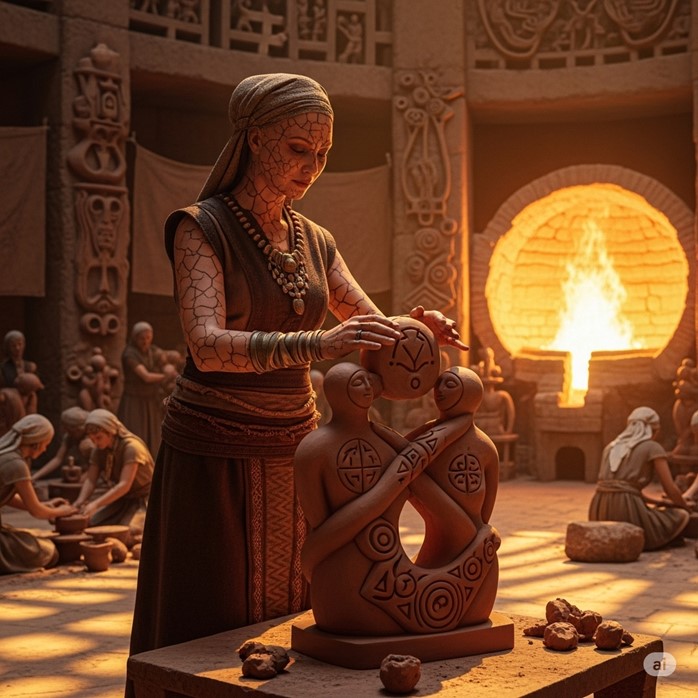
The magical power derived from The Path of Generations and the veneration of The Ancestral Clay (Omo-Aye) is not typically used for direct, overt acts of aggression like fireballs or lightning bolts. Instead, its applications in conflict are deeply tied to the culture’s core principles: shaping the earth, the power of creation, and the enduring strength of generations. All magical effects are channeled through items and the unique skill of Clay-singing.
Defensive Applications
The faith’s defensive philosophy is one of resilience, patience, and using the very land as an unyielding shield.
- Rapid Fortification (The Ancestor’s Wall): This is the most common and powerful large-scale defense. In the face of an approaching army, a choir of Clay-singers can chant in unison, using the Gbodan language to command the earth itself. They can cause deep trenches to open, thick walls of rammed earth to rise from the plains, or stone ramparts to bulge from a cliffside. These are not just mundane earthworks; imbued with ancestral spirit, they are unnaturally durable and resist conventional siege weaponry.
- Terracotta Sentinels: The Gbodani create humanoid constructs from terracotta, ranging from man-sized “Wardens” to towering, hulking “Titans.” These are not mindless golems. Each is imbued with a fragment of the Ancestral Clay’s spirit. In times of peace, they stand motionless as statues decorating cities and temples. When the nation is threatened, a Clay-Mother can awaken them with a specific song. They become tireless, fearless guardians who patrol walls, protect citizens, and follow the commands of their creators without question.
- Wards of Enduring Form: Skilled artisans inscribe sacred patterns onto pottery, stone tablets, or even large boulders. When activated with a low, continuous chant, these objects project a field of “inertial stability.” This field doesn’t create a shimmering barrier but rather reinforces the physical integrity of everything within it. Arrows seem to strike with less force, sword blows feel sluggish, and siege projectiles can even crumble in mid-air as their own form is magically “unmade” by the ward’s influence.
- The Unwelcoming Earth: A more subtle defense involves altering the ground itself. Clay-singers can make a field of solid earth as soft and cloying as deep mud, bogging down a cavalry charge. Conversely, they can command a soft riverbank to bake as hard as stone, preventing troops from landing or digging in. This manipulation of the land itself is a powerful deterrent.
Offensive Applications
Offense is often indirect and aimed at incapacitating, demoralizing, or overwhelming the enemy through relentless, tireless force.
- The Molded Legion: The primary offensive force is an army of terracotta constructs. These legions, commanded by Clay-singers, are a terrifying sight. They do not feel fear, pain, or fatigue. They march in perfect, silent unison and can continue fighting long after any living army would have broken and fled. Their purpose is not necessarily to kill with finesse but to overwhelm with relentless, crushing force.
- Earthen Grasp: An offensive Clay-singer can target a specific enemy or group. By stomping their foot and singing a sharp, percussive Gbodan phrase, they can command the ground beneath the target to erupt. Arms of wet clay or stone can shoot up to grab and encase the foe, dragging them down or holding them fast. This can effectively remove key combatants from a fight, trapping them in a solid prison of earth.
- Shard Volley: A more aggressive and direct application involves the magical manipulation of fired clay. A Clay-singer can hold a piece of pottery, chant a sharp, dissonant note, and cause it to explode. The shards, guided by the singer’s will and hardened by ancestral magic, fly towards a target with the force and sharpness of steel shrapnel.
- Curse of the Flawed Form: This is a powerful and feared ability, used only by the most skilled Clay-Mothers. It is a curse that targets not the flesh of an enemy, but the items they wear and wield. The priestess enters a deep trance and sings a complex lament, channeling the “unmaking” aspect of the life cycle. An enemy’s stone-headed hammer might crack and crumble, their metal armor could become brittle and shatter on the next blow, or the wooden haft of a spear might warp and splinter. It is an attack on the enemy’s very ability to wage war.
Golem with One Soul
It is sung in the workshops, when the clay is wet and the kiln-fire is low, the story of the potter Eshe. The telling says that in her generation, there was no artist whose hands knew the clay better than hers. Her Gbodani form was as graceful as any, but her spirit was one of fire and pride, not of the patient earth. When she worked the clay, it was not a communion, but a command. And the clay, it obeyed her will as no other.
The village where Eshe lived was bordered by the Jagged Hills, and from those hills would sometimes come great, hungering beasts. The Clay-Mothers of the village decreed that a new guardian must be shaped, a great terracotta warrior to stand vigil. It was to be a work of the community, as was the tradition, a golem with many souls, its spirit balanced by the will of all.
But Eshe, in her pride, declared that she alone would shape the guardian. Her skill, she said, was greater than all others combined, and a work of many hands would be a work of many flaws. The Clay-Mothers warned her. “A pot shaped by one hand is for one table,” they said in their poorly translated way. “A guardian shaped by one soul will guard that soul alone.” Eshe did not listen.
For a year and a day, she worked in seclusion. She used the most sacred clay, and with her own hands, she molded the warrior. It was a masterpiece of form, tall and powerful, its terracotta skin inscribed with patterns of strength and defiance. She called it Anu. Into its making she poured not just her skill, but her spirit. She sang the Clay-songs not with the communal voice of reverence, but with the sharp, clear tone of command. She did not ask the Ancestral Clay for a spark of its spirit; she demanded it, and infused the golem with the fire of her own proud soul.
When the beast of the Jagged Hills next came, Eshe unveiled her creation. Anu moved with a grace and power never before seen. It met the beast not just with strength, but with a cold and terrible cunning that mirrored Eshe’s own. It did not just defend the village; it annihilated the beast, leaving nothing behind. The villagers were awed, and they praised Eshe’s name. Her pride swelled like a vessel in the fire, growing hard and brittle.
She took Anu back to her workshop, away from the village. She saw it now not as a guardian, but as a possession, a perfect reflection of her own greatness. She worked on it ceaselessly, adding to it, strengthening it, pouring more and more of her isolated spirit into the clay. The golem became her only company, and her heart grew distant from her people. The Clay-Mothers came to her again. “The clay grows too hot, daughter,” they warned. “The spirit within has no balance. It knows only your hand. It has forgotten the shape of the community.” Eshe sent them away.
Then the time came when a great host of beasts, a whole pack of them, descended from the hills. The village was in terror, and they called for their guardian, Anu. Eshe, her heart swelling with pride, sent her golem to meet them.
Anu strode from the workshop, and the people saw it was changed. It was larger, its patterns sharper, and from its terracotta eyes shone the cold light of Eshe’s own possessive soul. It met the beasts, and its fury was a terrible thing to behold. But it fought not like a guardian. It fought like a jealous king defending his land. It shattered beasts, but it also shattered the earth. In its cold fury, it toppled the small shrines that stood in its path. It crushed the corner of a grain silo because a beast stood near it. It defended not the people, but the idea of its own perfect, untrespassed domain. It had become a thing of pure, efficient rage, a protector that had forgotten what it was meant to protect. It was a Flawed Form.
The villagers scattered in fear, not just from the beasts, but from their own guardian. The head Clay-Mother, her face a mask of sorrow, knew what must be done. She gathered the people in the central square. She did not command them to fight the golem. She commanded them to sing.
They began the Song of Return, an ancient, tonal melody not used for making, but for unmaking. It was a song that did not command the clay, but reminded it of its true nature as part of the whole. It was the song of the cycle. The harmony of hundreds of voices rose, a wave of communal spirit washing over the battlefield.
Anu, the Golem with One Soul, heard the song. It faltered. The spirit of the Ancestral Clay deep within it stirred, pulled by the harmony of the many. But the prideful, singular spirit of Eshe, which was its animating force, fought against it. The golem was caught between two wills, the one and the whole. Great cracks began to appear across its perfect form.
Eshe, from her workshop, saw her masterpiece beginning to crumble. She saw the terror it had wrought. She heard the song of her people, a song of community she had long forgotten. And her pride, hard and brittle as it was, finally shattered. With tears streaming down her face, she added her own voice to the song, a single note of surrender and grief.
With its creator’s will no longer holding it in a singular, flawed shape, the Golem with One Soul could not stand. It let out a silent cry, and then crumbled into a heap of lifeless, broken terracotta. The great work was unmade. The beasts were scattered. But the village was saved, not by the power of one, but by the harmony of all.
The Moral of the Story: A spirit given form by a single hand will serve that hand alone; a spirit nurtured by the community will serve the community for all time.