
The Gbodani, a name that means “The Molded People” in their native tongue, are a race of sentient avatars who form the ruling class and predominant population of the island nation of Nok. Their entire existence—from their physical form to their societal structure—is deeply connected to the earth, particularly clay and stone, and the magical art of shaping it. They are known across Saṃsāra for their patience, grace, and the unnerving, living artistry of their terracotta creations.
Physical Form and Sensory Traits
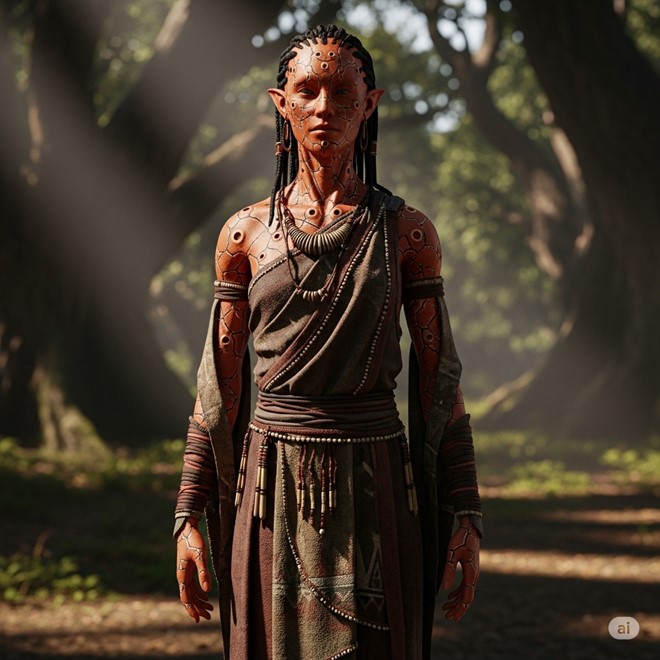
Gbodani possess a tall, slender, and graceful humanoid form, moving with a deliberate elegance that reflects their patient culture. Their skin tones are rich and earthy, ranging through the many shades of fired clay—from warm terracotta and ochre to deep umber and muted charcoal. Their hair is often black or the color of dark, polished wood, and is frequently worn in intricate braids or woven with clay beads. Their most iconic feature is their long, elegantly shaped ears that taper to a gentle point, giving them an alert and perceptive appearance.
Their sensory traits are uniquely adapted to their craft. While their eyesight is sharp, their senses of hearing and touch are exceptionally acute. They can hear the faintest sounds from a great distance, allowing them to detect predators or locate hidden water sources in their savanna home. Their sense of touch is so refined that they can feel minute variations in the texture, density, and moisture content of clay or stone, a non-magical skill that makes them unparalleled sculptors and artisans.
General Size
Adult Gbodani are taller and more slender on average than many other humanoid races. Males typically stand between 1.8 and 2.0 meters (about 6′ to 6’7″) tall, while females range from 1.7 to 1.9 meters (about 5’7″ to 6’3″). Their lean musculature gives them a deceptively delicate appearance, masking a wiry strength and profound endurance.
Body Pattern
The skin of a Gbodani is their most unique physical feature. It is covered in a network of incredibly fine, dark lines that resemble the hairline cracks found on ancient, well-fired pottery. These patterns are not flaws but a natural part of their biology, unique to each individual and family line. Furthermore, their skin features small, symmetrical pits or perforations, often arranged in elegant lines along the spine, joints, and cheekbones, echoing the decorative style of Nok’s famous terracotta sculptures. When a Gbodani channels magic through their gear, these crack-like patterns do not glow, but often darken slightly or become warm to the touch as the magic flows through them.
Life Cycle
The Gbodani are a long-lived people, with a natural lifespan that can span several centuries. This longevity is the source of their legendary patience. They mature slowly, reaching physical adulthood around the age of thirty, which is when their magical potential awakens as per the laws of Saṃsāra. However, cultural adulthood is only granted after an individual completes their “Genesis Piece”—their first masterwork of terracotta art, be it a sculpture, a complex vessel, or a small animated construct. This process is a testament to their skill and patience and can take years to complete. As with all avatars, they become sterile upon being possessed by a character’s memories.
Potential Positives and Negatives
Positives:
- Their graceful, quiet movements and natural camouflage in earthy environments make them exceptional at stealth.
- Their acute hearing gives them a significant advantage in perception and avoiding ambushes.
- The hyper-sensitive touch provides a natural aptitude for any skill requiring fine manipulation, such as enchanting, alchemy, or engineering.
- Their patient and deliberate nature makes them excellent strategists, mages, and artisans.
Negatives:
- Their slender builds, while agile, are not suited for raw, brute force, making them physically less imposing than other races.
- The unique perforations in their skin can be a potential vulnerability, susceptible to fine, wind-blown sand or tiny parasites in foreign environments.
- Their physiology is adapted for warm, dry climates, and they are more vulnerable to extreme cold and dampness than other races.
Tags: Gbodani, Humanoid, Avatar, Nok, Elf-like, Long-Lived, Terracotta Skin, Crackled Pattern, Perforated Skin, Earthen, Clay-Singer, Artisan Race, Ruling Class, Matrilineal, Savanna Dweller, Acute Hearing, Patient
Specialized Item Slots Available
The Gbodani physiology allows for the use of specialized gear that resonates with their earthen nature.
- Earthen Bands (2 Slots): Located on the arms, these are not traditional bracers. They are bands of magically prepared clay or carved stone that are fitted perfectly to the avatar’s skin. They are often “fired” in a low-temperature magical kiln while on the arm, creating a perfect, resonant bond for channeling earth magic and Clay-singing.
- Resonance Heartstone (1 Slot): A specialized chest slot worn over the sternum. It is designed to hold a piece of unfired, magically-attuned clay or a carved talisman that vibrates in sympathy with the tonal magic of the Gbodan language, acting as a powerful focus for their Clay-singing.
- Auditory Filigree (1 Slot): A specialized slot for the ears. This is typically elegant jewelry made of metal or fired clay that follows the contours of their long ears. It serves as both a magical focus and an acoustic device, helping them to better pinpoint faint or distant sounds.
Environmental Adaptability
Gbodani are perfectly adapted to life in warm, dry climates. They thrive in savannas, grasslands, and rocky, hilly terrain. They have an innate talent for geology, able to find the best clay deposits, sources of water, and natural shelters within such environments.
Other Information Important to this Race
The Gbodani are the keepers of the Clay-singing tradition. Their society is structured around a matrilineal monarchy, with the ruling “Clay-Mothers” being the most powerful artisans and mages in the nation. Status in their culture is not gained through wealth, but through the skill, artistry, and magical potency of one’s creations. They believe that to shape clay is to shape reality, and that their creations, especially their terracotta constructs, hold a fragment of the creator’s spirit. When an avatar of this race is possessed, the character inherits this deep, instinctual connection to the earth and the patient, deliberate mindset required to master its power.
Song of the First Clay
It is remembered, in the resonance of the kilns and the quiet strength of the standing stones, the time that was before shape. The telling says that in the beginning, the Gbodani were not a people of flesh, but of will. They were the Unshaped, formless spirits of the savanna, their thoughts like the heat shimmering above the plains, their voices like the whisper of wind through dry grass. They had awareness, but no form; they had presence, but no permanence. The land itself was like them, a raw and untamed thing, a great expanse of fertile earth that had not yet been taught the shapes of mountain or river. It was the First Clay, waiting for the potter.
Among the Unshaped, there was one spirit whose patience was deeper than the bedrock and whose focus was sharper than a shard of obsidian. Her name is spoken now as Iya-Ode, the First Mother. While other spirits danced and dissipated on the wind, she remained, observing. She watched how the sun baked the mud of a drying pool, giving it cracks and permanence. She listened to how the rain fell upon the earth, not with force, but with a steady rhythm that carved new lines into the land. She felt a great and deep longing, not for power, but for form; a desire to make a mark that would not be erased by the next dawn.
And so it was that she, Iya-Ode, began the first and greatest work. She did not use hands, for she had none. She used her voice. She settled her spirit into the raw earth and let out a single, low, resonant tone. It was the first note of the Gbodan tongue, the first act of Clay-singing. The note spread through the land, not as a sound, but as a vibration, a command to the very soil. The chaotic motes of dirt and dust, for the first time, found a rhythm. They cohered.
For an age, she sang. Her song was one of great patience. She sang the shape of the mountains, and with each rising tone, the land swelled and lifted, forming the high peaks that would one day touch the clouds. She sang the course of the rivers, and with each falling melody, channels were carved into the plains, and the waters knew for the first time where they should flow. She sang the stillness of the rocks and the resilience of the clay beds. Through her song alone, she brought order to the formless world. She was the potter, and the whole of the land was her wheel.
When the land was shaped and its pattern was set, Iya-Ode turned her attention to her people. She gathered the other spirits, the formless whispers on the wind, and showed them the great work. She then drew from the riverbank a measure of the new, magic-infused clay—the very First Clay that had learned the lesson of her song.
With a will born of ages of observation, she began to mold. She gave the clay a tall and slender form, for it must be graceful. She shaped long ears that tapered to a point, for it must be able to hear the subtle songs of the earth. She formed long, elegant limbs for deliberate and patient movement. With a fine reed, she drew upon the wet clay the intricate, crack-like patterns of the dry earth, giving it a map of its own origin. She pressed small, symmetrical holes into the form, so it could breathe not just air, but the essence of the world itself. She molded this body in her own spiritual image, a perfect vessel of patience and grace.
When the form was complete, she did the final work. She took her own spirit, her own formless will, and breathed it into the vessel of clay. A great fire, not of wood, but of pure life-force, baked the form, giving it permanence. In that moment, Iya-Ode was no longer a whisper on the wind. She was Gbodani. She was the first of the Molded People, her skin the color of warm terracotta, her eyes holding the wisdom of ages.
Having shaped herself, she then turned to her daughters, the spirits who had watched her work. She did not make bodies for them. She handed them each a measure of the First Clay and taught them the song. One by one, following the pattern she had set, they each molded their own forms. They became the First Mothers, the ancestors of all Gbodani. Their first act, upon gaining their new forms, was to continue the work, molding the beasts of the savanna and the fish of the river from the same sacred clay, populating the world they had helped to shape.
The Moral of the Story: To give form to the world, you must first have the patience to shape yourself.