
The four randomly selected life forms are:
From Class Arachnida: Trapdoor Spider (Idiopidae family)
From Class Gastropoda: Cone Snail (Conus genus)
From Class Aves: Lammergeier (Bearded Vulture)
From Class Chondrichthyes: Sawfish (Pristidae family)
Appearance
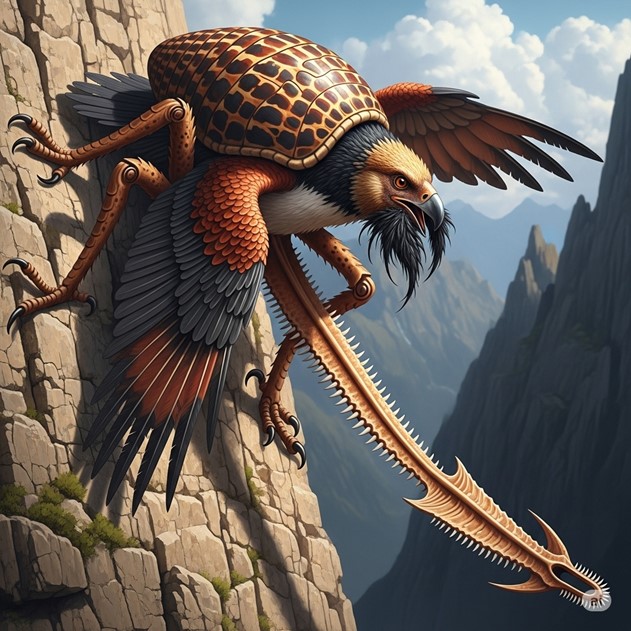
The Conogypa is a fearsome predator with the body and powerful wings of a Lammergeier, covered in mottled reddish-brown and black feathers. Instead of two bird-like legs, its torso is supported by six powerful, multi-jointed arachnid legs that allow it to scuttle across the ground and cling to sheer cliff faces. Its back is covered by a single, massive, beautifully patterned shell reminiscent of a Cone Snail, providing it with exceptional armor. The creature’s head is avian, with the keen eyes and bristly “beard” of a Lammergeier, but below its beak it has a set of powerful, downward-striking chelicerae (fangs) of a Trapdoor Spider. Its most terrifying feature is its tail—a long, flat, bony rostrum like that of a Sawfish, lined with razor-sharp teeth, which it can whip around with incredible speed. The very tip of this saw-tail ends in a hollow, harpoon-like barb.
Size
While its body is compact and dense, its wingspan is impressive. An adult Conogypa has a wingspan of 3 to 4 meters (about 10 to 13 feet) and weighs between 70 and 90 kilograms (roughly 155 to 200 pounds).
Speed
The creature is a versatile hunter, capable of flight, climbing, and ground movement.
- Flight Speed: 50 ft.
- Climb/Walk Speed: 30 ft.
Stat Modifiers
- Strength: +3
- Dexterity: +2
- Constitution: +3
- Intelligence: -4 (Feral)
- Wisdom: +2
- Charisma: -3
Skills
The Conogypa is a patient and perceptive ambush hunter.
- Stealth: +4 (Gains advantage when hiding among rocks or in a burrow)
- Perception: +4
- Acrobatics: +3
Behavior
This creature is a solitary cliff-dwelling ambush predator. It carves out burrows and nests on high, inaccessible cliff faces and canyon walls. A Conogypa will wait patiently for prey to pass below, either clinging silently to the rock face or hidden in its burrow. It attacks by swooping down from above or by using its saw-tail to slash at climbers. It often disables prey with its tail before dispatching it with its powerful fangs. In a unique behavior inherited from the Lammergeier, it will often carry the bones of its kills high into the air and drop them onto the rocks below to shatter them, allowing it to feast on the rich marrow inside.
Diet
The Conogypa is a carnivore with a specialization as an osteophage (bone-eater). It preys on mountain-dwelling beasts, large birds, and unwary travelers. While it consumes the flesh of its victims, it derives its most essential nutrients from the bone marrow.
Emotions
As a feral creature, its emotional range is nearly nonexistent, driven entirely by instinct. It exhibits extreme territorial aggression, a cold predatory focus, and will react with surprising ferocity if its nest or kill is threatened.
Environment Where Found
The Conogypa Pristis 41 exclusively inhabits high-altitude mountains, sheer cliffs, and deep, rocky canyons. It requires a habitat with plenty of vertical terrain for nesting and hunting.
Tags: Feral, Beast, Amalgam, Flying, Mountain Dweller, Ambush Predator, Solitary, Territorial, Venomous, Armored, Osteophage, Arachnid, Avian, Gastropodic, Chondrichthyan, Saw-Tail, Bone-Breaker, Burrower, Cliff-Dweller
Life Cycle
The life of a Conogypa begins in a cliffside burrow. After mating, the female lays a clutch of 1 to 2 large, hard-shelled eggs in the deepest chamber of her nest, which is often camouflaged with rocks and debris like a trapdoor spider’s lair. She guards these eggs fiercely until they hatch.
The hatchlings, known as chicks, are born flightless and covered in a soft grey down. For the first few months, they are completely dependent on their mother, who brings them food. She doesn’t bring them meat, but rather pre-shattered bone fragments, introducing them to their specialized diet from birth.
As the chicks grow into fledglings, their feathers grow in, their back-shell hardens, and their saw-tail becomes a formidable weapon. The mother teaches them to fly, to hunt, and most importantly, the art of the bone-drop. Once a fledgling has successfully hunted and shattered a bone on its own, it is considered a young adult. At this point, the mother’s territorial instinct takes over, and she aggressively drives her offspring away to find and establish its own territory.
Mating
Mating is a rare and spectacular event for these solitary creatures. They do not seek mates annually but only when resources are plentiful. A male Conogypa will claim a vast territory with a prime cliff face and an ideal “ossuary”—a large, flat rock formation used for shattering bones.
To attract a female, the male performs a breathtaking aerial courtship display. He will soar to great heights, carrying the largest, most impressive bone he can find, before dropping it onto his ossuary. He then performs a series of complex acrobatic dives and swoops around the shattering bone. Females flying nearby will observe these displays. They judge a male on his flying skill, the size of the bone he can carry, and the quality of his nesting site. The most impressive male wins the right to mate, after which he plays no further role and the female takes over the nest.
Tactics
The Conogypa is a cunning and patient predator that uses two primary hunting strategies depending on the terrain.
- Aerial Ambush: This is its preferred method. The creature circles high and out of sight, using its keen vision to spot prey. It will then dive silently. In a low-speed pass, it uses its long saw-tail to slash a leg or hamstring, crippling the target and preventing it from escaping. Once the prey is disabled, the Conogypa lands to deliver a fatal bite with its powerful fangs. It then carries the carcass or its largest bones back into the sky to drop them on its ossuary.
- Cliffside Ambush: Emulating its arachnid heritage, the creature will cling motionless to a cliff face near a narrow pass or hide within its camouflaged burrow. When prey like a mountain goat or an unlucky climber gets close, it erupts from its hiding spot. It uses its six legs for a vice-like grip on the rock and its saw-tail to knock the victim off balance or slash at them, often causing them to fall to their doom below.
Actions
In a TTRPG context, a Conogypa Pristis 41 could use the following actions:
- Multiattack: The Conogypa makes two attacks: one with its Fanged Bite and one with its Saw-Tail Slash.
- Fanged Bite: A powerful melee attack with its spider-like fangs.
- Saw-Tail Slash: A melee attack with its long, serrated tail that has Reach.
- Venomous Harpoon (Rechargeable): The Conogypa fires the venomous barb from the tip of its tail at a target within a short range (e.g., 30/60 ft). On a hit, the target takes piercing damage and must make a difficult Constitution save or become Paralyzed by the potent neurotoxin. The barb regrows after a day.
- Bone Drop: If the Conogypa is flying at least 50 feet above a target, it can use its action to drop a heavy object (like a large bone or rock) onto it. The target must succeed on a Dexterity saving throw or take a large amount of bludgeoning damage.
Other Interesting Information
- The Ossuary: Every Conogypa maintains its own personal ossuary. These sites are littered with the shattered, marrow-less bones of its victims and are a clear sign that one of the creatures lairs nearby. Adventurers searching these bone-yards might find durable, non-bone items left behind from past victims, such as armor, weapons, or valuables.
- Feather Dyeing: Like its Lammergeier ancestor, the Conogypa engages in a unique grooming behavior. It will intentionally rub its lighter-colored feathers in iron-rich soil or clay, staining them a dramatic reddish-brown. This is believed to be a display of dominance and territorial control.
- Unique Shells: The shell on the creature’s back, inherited from its Cone Snail lineage, has a unique pattern for every individual. These patterns are as distinct as fingerprints and can be used to identify specific creatures if a scholar has a record of them.
- Fearsome Intellect: While technically a feral beast, the Conogypa displays a high degree of cunning. It learns and remembers the specific migratory paths of its prey and the patrol routes of any creatures that encroach on its territory.
Based on the nature of the Conogypa Pristis 41, a party of adventurers in the world of Saṃsāra could cross its path for a number of compelling reasons, ranging from unfortunate accidents to highly specific quests.
Reasons for an Accidental Encounter
These encounters occur when the party’s primary mission is not the creature itself, but their path forces them into its high-altitude, treacherous domain.
- The Perilous Pass: The most direct route to the party’s objective—be it a lost temple, a hidden city, or another nation—is through a high mountain pass. This pass is the hunting ground of a Conogypa. The adventurers might be attacked while scaling a cliff face, crossing a narrow rope bridge, or making camp on a high ledge.
- Falling Evidence: While traveling through a deep canyon or at the base of a cliff, the party is nearly struck by a shower of shattered bones and mangled equipment raining down from above. Looking up, they might spot the Conogypa on its “ossuary” rock, feasting. They are now aware of a powerful predator above them, which may or may not have noticed them yet.
- Mistaken Sanctuary: The party is caught in a sudden, violent blizzard or thunderstorm high in the mountains. They spot a large, sheltered opening in a cliff face and rush inside for safety. They soon discover it is not a natural cave but a burrow, littered with bones and smelling of ozone and carrion. The owner is out hunting, but it will eventually return.
- A Climbing Disaster: While the party is engaged in a difficult climb, the last person in the line is suddenly snatched by the creature’s whipping saw-tail, which lashes out from a hidden crevice. What was a simple travel challenge instantly becomes a frantic, vertical battle to save their companion from being dragged into the creature’s nest.
Reasons to Deliberately Search
These scenarios are specific quests where the Conogypa or a part of it is the primary objective, sending the adventurers knowingly into its dangerous territory.
- The Master Smith’s Demand: A legendary weaponsmith requires a unique material to forge a masterwork weapon. They proclaim that only the long, serrated edge of a Conogypa’s saw-tail possesses the necessary strength and natural sharpness to create a fabled blade capable of sundering enemy armor.
- The Royal Commission: A mountain-dwelling Jarl or Queen desires a symbol of their station and resilience. They commission the creation of a grand, ceremonial shield or a piece of throne decoration to be made from the massive, beautifully patterned shell of a Conogypa. The party is hired to hunt the beast and bring back the shell as intact as possible.
- The Alchemical Cure: A high-ranking official has been afflicted with a rare petrifying disease that slowly turns bone to brittle stone. The only known counter-agent is a catalyst found within the marrow-digesting enzymes of the Conogypa’s unique stomach lining. The party must hunt the creature and have a skilled alchemist harvest the component before the victim’s condition becomes irreversible.
- Rite of Passage: To be accepted into a prestigious order of mountain rangers or to prove their worth to a local clan, an adventurer must acquire a specific trophy from a Conogypa. This could be its distinctive bristly beard feathers, its powerful trapdoor fangs, or the venomous harpoon-barb from the tip of its tail.
- Retrieval from the Ossuary: A famous explorer carrying a vital map or a powerful artifact was lost in the mountain range months ago. A recent scrying has revealed that the explorer fell victim to a Conogypa. The artifact is believed to be lying amidst the debris of the creature’s ossuary at the base of its cliffside nest. The party must travel to this bone-shattered rock field, sift through the remains of past victims to find the item, and likely confront the beast when it returns to feast.
Beyond the more obvious components like its shell, venom, and saw-tail, a skilled adventurer with knowledge of arcane biology can harvest several other unique and valuable ingredients from the corpse of a Conogypa Pristis.
Additional Harvestable Items and Their Uses
1. Ossifying Acid Gland
Located near the creature’s gizzard is a specialized organ that secretes a hyper-corrosive acid. This acid is specifically evolved to rapidly break down bone, allowing the Conogypa to access the marrow within. The fluid is thick, viscous, and glows with a faint, sickly green light.
- Use: This potent acid is highly sought after by alchemists and saboteurs. When carefully refined, it can be used to create Sovereign Solvent, a liquid capable of dissolving magical glyphs and wards inscribed on stone or bone. In a cruder form, it can be made into Bone-Melt Vials, devastating thrown weapons that severely damage natural armor and bony structures.
2. Ampullary Nerve Cluster
At the base of the saw-tail, near the creature’s body, lies a complex bundle of jelly-filled pores and sensitive nerves. This organ, inherited from its sawfish ancestry, allows the Conogypa to detect the minute bio-electrical fields generated by living creatures, helping it locate prey hiding among the rocks.
- Use: This is a rare component, prized by master artificers. If the delicate nerve cluster is extracted intact, it can be magically preserved and integrated into the construction of a helmet or visor. Such an item, like a Helm of the Living Spark or a Seeker’s Monocle, would grant the wearer the ability to perceive the faint, crackling auras of living beings through solid objects, making it the ultimate tool for tracking or detecting hidden enemies.
3. Prismatic Shell Nacre
The innermost layer of the Conogypa’s massive shell is not mother-of-pearl, but a thin, crystalline substance with incredible light-refracting properties. This nacre is extremely difficult to separate from the main shell without it shattering into dust.
- Use: If successfully harvested and ground into a fine powder, this Prismatic Dust is a powerful ingredient in potions and magical inks. It is the key component in a Potion of Scrambled Sight, which grants resistance to illusion and vision-impairing magic. When mixed with an arcane medium, it creates an ink that appears as a different color to every person who reads it, used for creating coded messages and magical scrolls with multiple, layered effects.
4. Resonant Silk Glands
A vestigial trait from its trapdoor spider heritage, the Conogypa retains a pair of small silk glands near its fangs. It no longer spins webs, but instead uses the silk to line its burrow, reinforcing the rock and dampening vibrations. The silk itself is a silvery, metallic color and emits a low, almost inaudible hum.
- Use: The silk is too rare to be used for ropes or armor. Its true value lies in its resonant properties. A single strand can be used as the string for a masterwork musical instrument, granting it magical qualities. It is also a key material component for spells involving sound or vibration, significantly increasing their power and range. Enchanters weave strands of it into Wards of Silence or use it to create magical tripwires that are both invisible and perfectly silent, instead triggering an alarm directly in the mind of their creator.
Feathered Stone with Teeth of Night
From the crumbling tablets, worn smooth by the winds of forgotten eons, comes the tale of the beast they called the Conogypa, or in the tongue before tongues, the Shard-Winged Hunger. It was said to be a thing stitched together from the nightmares of the high places, a creature that stole its pieces from the wind’s shriek, the mountain’s bones, and the silent hunters of the shadowed crags.
In the time when the peaks scraped the bellies of the gods and the valleys were breaths between giants, the people of the Sky-Clans lived a precarious life. They built their homes on dizzying ledges and followed the thin trails where one wrong step meant a fall into the endless blue. And among the dangers of ice and thin air, the most feared was the Feathered Stone.
They said it had the wings of a death-bringer, wide and black-tipped like the vultures that circled the fallen. But its legs were not the legs of a bird; they were many, jointed like the claws of a burrowing horror, allowing it to cling to the sheerest face of stone as if it were no more than moss. Its body was shielded by a single, great scale, patterned like the swirling storms that trapped the unwary in the high passes, a stony hide that deflected spear and arrow. Its head was avian, sharp-eyed and cruel, but its beak was not for tearing flesh; it was a pair of fangs, black as a moonless night, that dripped with a venom that could still the heart of a mountain goat in a single beat. And from its tail grew a long, flat saw of bone, edged with teeth sharper than any obsidian blade, a thing it lashed with the fury of a trapped whirlwind.
One legend told of the shepherd, Elara, whose flock strayed too high on the slopes of the Whispering Peak. She followed them into a labyrinth of rock and shadow, and there, she heard a sound like the wind whistling through a hollow bone. Then, from behind a jagged spire, the Feathered Stone descended. It did not cry like a bird, but clicked its fangs with a sound like stones grinding together. Elara, fleet-footed and wise to the mountains, scrambled for cover, but the creature moved with a surprising speed on its many legs, clinging to the rock as it pursued her. It did not try to bite her directly. Instead, it lashed its bony tail, and the saw-teeth tore through the air, ripping her woven cloak and leaving a burning sting on her arm. Elara knew then that she could not outrun it. She dove into a narrow crevice, the creature too large to follow. She remained there for days, listening to the clicking of its fangs and the scraping of its claws on the rock above, until hunger finally drove her back down, only to find no trace of her flock, only the chillingly clean-picked bones.
Another tale spoke of the brave hunter, Torvin, who sought the heart-stone of the Feathered Stone, believing it held the secret to unmatched strength. He tracked the beast to its eyrie, a nest built not of twigs but of shattered bones cemented together with a strange, sticky fluid. Torvin, a seasoned climber, scaled the treacherous cliff face. He found the nest empty, but littered with the remains of its kills. As he reached for a particularly large, patterned scale that lay among the bones, the creature returned. It shrieked, a sound like tearing stone, and Torvin found himself facing its fangs. He fought with all his skill, but his spear glanced off its stony hide. Then, the creature’s tail whipped around, catching him off balance, and he tumbled from the ledge, falling into the mists below. His companions found only his broken spear, clutched in a lifeless hand.
The longest story, however, is the lament of the Sky-Clan elder, Lyra, who witnessed the Feathered Stone’s wrath upon her village. A band of foolish young warriors, eager to prove their courage, had tried to steal the eggs from its nest. The creature, enraged, descended upon the village. It did not simply kill; it methodically tore apart their homes, its many legs scuttling through the narrow passages, its fangs tearing through wood and hide. It used its saw-tail to collapse support beams, sending dwellings crashing down the cliff face. Lyra watched as the creature, a feathered terror with a stony heart and teeth of night, reduced her home to rubble and bone. The survivors fled, abandoning their ancestral home to the fury of the Shard-Winged Hunger, a grim reminder of the price of foolish pride and the violation of the mountain’s ancient laws.
The Moral of the Story: Some creatures are woven from the very fabric of a harsh land; to disturb their place is to invite the mountain’s fury itself.
Suggested conversions to other systems:
Dungeons & Dragons 5th Edition
Shard-Wing Amalgam
Large monstrosity, unaligned
Armor Class 17 (Natural Armor) Hit Points 136 (16d10 + 48) Speed 30 ft., climb 30 ft., fly 60 ft.
STR 16 (+3), DEX 14 (+2), CON 17 (+3), INT 3 (-4), WIS 14 (+2), CHA 5 (-3)
Skills Perception +5, Stealth +5 Damage Resistances Poison Senses Darkvision 60 ft., Passive Perception 15 Languages — Challenge 7 (2,900 XP)
Spider Climb. The amalgam can climb difficult surfaces, including upside down on ceilings, without needing to make an ability check.
Bone-Dropper. If the amalgam is flying and drops a creature or a heavy object it is carrying, the fall damage the creature or object takes is maximized.
Actions
Multiattack. The amalgam makes two attacks: one with its Fangs and one with its Saw-Tail.
Fangs. Melee Weapon Attack: +6 to hit, reach 5 ft., one target. Hit: 12 (2d8 + 3) piercing damage.
Saw-Tail. Melee Weapon Attack: +6 to hit, reach 10 ft., one target. Hit: 14 (2d10 + 3) slashing damage.
Venomous Harpoon (Recharge 5–6). The amalgam fires the barb from its tail at one creature it can see within 60 feet of it. The target must make a DC 14 Constitution saving throw. On a failed save, the target takes 22 (4d10) poison damage and is paralyzed for 1 minute. On a successful save, the target takes half as much damage and is not paralyzed. A paralyzed creature can repeat the saving throw at the end of each of its turns, ending the effect on itself on a success.
Call of Cthulhu 7th Edition
The High Crag Horror
An impossible chimera that haunts the most inaccessible mountain peaks. Its form defies all known biology, a nightmarish fusion of bird, insect, and things that should remain in the lightless depths of the sea. Its cry sounds like rockfall, and its appearance is an affront to reason.
STR 75, CON 80, SIZ 70, DEX 60, INT 25, POW 50
HP: 15 Damage Bonus: +1D4 Build: 1 Move: 7 / 10 flying
Attacks Fighting (Fangs) 50%, damage 1D8 + DB Fighting (Saw-Tail) 60%, damage 1D10 + DB Venom Harpoon 30%, damage Impale plus Venom Dodge 30%
Armor: 5-point shell and chitinous plating.
Skills: Stealth 60%, Spot Hidden 55%.
Spells: None.
Sanity Loss: 1/1D8 Sanity points to witness the High Crag Horror’s impossible anatomy.
Game Mechanics:
- Paralytic Venom: A victim impaled by the Venom Harpoon must make a Hard CON roll. On failure, they are completely paralyzed for 1D6 minutes. On a successful roll, they instead suffer a Penalty Die to all actions for the duration.
- Shattering Drop: The Horror can drop a paralyzed victim or a large rock from a great height. Anyone directly below must make a Dodge roll or suffer 2D10 damage from the impact.
- Unnatural Anatomy: The creature’s multi-limbed form and bizarre movements are deeply unsettling. Any investigator engaged in melee combat with it must make a Hard Psychology roll or suffer a Penalty Die on their next action due to hesitation and disgust.
Blades in the Dark
The Shard-Wing Ripper
A whisper among the smugglers and death-land scavengers of the Shattered Isles. They say a crazed noble tried to create the perfect spire guardian, splicing beasts from the sky, the earth, and the void-sea. The result was this horror, a creature that now nests atop the highest, most forgotten towers, its silhouette a terrifying omen against the perpetual twilight.
Threat Level: Vicious, intelligent predator. Tier III Quality, Scale 2 (a single, large beast).
Traits:
- Apex Climber: Can scale any surface with ease.
- Territorial Hunter: Savagely attacks any who intrude upon its high-altitude nest or hunting grounds.
- Shattering Force: Its beak and tail can splinter stone and shear metal. Its favorite tactic is dropping things (or people) from a great height.
- Paralytic Stinger: Its tail carries a potent toxin that freezes the limbs.
Game Mechanics: The Shard-Wing Ripper acts as a force of nature. Its threat is defined by the Position & Effect of the crew’s actions and the use of Clocks.
- Attempting to fight the Ripper on its home turf (a high spire, a rickety rooftop) is always Desperate.
- Its shell provides Armor 1.
- GM Clocks:
- [Clock 6] Lair Discovered: Fill this as the crew makes their ascent, attracting the creature’s attention. When full, it ambushes them.
- [Clock 8] Driven Off or Slain: This clock represents the fight itself. Inflicting harm ticks the clock.
- Consequences:
- Lesser consequence: A character is knocked off balance, drops a piece of gear, or is separated from the group.
- Standard consequence: Suffer Level 2 Harm “Deep Lacerations” from the saw-tail or have a piece of armor destroyed.
- Severe consequence: Suffer Level 3 Harm “Impaled by Stinger” which comes with the added effect of being paralyzed. Or, the Ripper grapples a PC and takes flight, starting a [Clock 4] Dropped from the Sky.
Knave 2nd Edition
Cliff-Glaive
A monstrous, winged horror with six spider-like legs and a serrated, bony tail as long as a spear. It nests on remote cliffs, and its cry is often mistaken for the whistle of wind over a sharp precipice, a mistake travelers only make once.
HD 9 Armor 17 Fangs d8 Saw-Tail d10 Morale 11
Qualities:
- Flight: It can fly.
- Spider Climb: Can climb any surface, even upside down, without a check.
- Reach: Its Saw-Tail has a reach of 10ft.
Game Mechanics:
- Multi-attack: The Cliff-Glaive attacks with both its Fangs and its Saw-Tail on its turn.
- Venomous Stinger: Once per combat, the Cliff-Glaive can fire a barb from its tail at a target within 60ft. This is a ranged attack using its HD as its attack bonus. On a hit, the target takes 1d4 damage and must save versus poison or be paralyzed for 1d6 rounds.
- Shattering Drop: The Cliff-Glaive can use an action to drop a rock or a grappled character while flying. The victim takes 1d6 damage per 10ft fallen.
- Tail Sweep: As an action, the Cliff-Glaive can sweep its tail in an arc. All characters within 10ft must save versus breath weapon or be knocked prone.
Fate Core System
The Bone-Shattering Cliff Horror
This creature works best as a major NPC antagonist built using the Fate Fractal. Its aspects are central to how it interacts with the world and how players can interact with it.
High Concept: Territorial Cliff-Dwelling Amalgam
Trouble: Insatiable Hunger for Bone Marrow
Other Aspects:
- Carapace Harder Than Stone
- Whipping, Serrated Saw-Tail
- Paralyzing Harpoon Stinger
Skills
- Great (+4): Fight
- Good (+3): Physique, Athletics
- Fair (+2): Notice, Stealth
- Average (+1): Provoke (for intimidation)
Stunts
- Saw-Tail Sweep: Once per scene, the Horror can use its Fight skill to attack all targets in its zone as a single action.
- Paralyzing Harpoon: When it Succeeds with Style on a Fight attack using its tail, it can choose to inflict a Paralyzing Venom consequence on the target instead of taking a boost.
- Bone-Dropper: The Horror gets a +2 bonus to Create an Advantage when dropping large objects (or creatures) from a height to intimidate foes or shatter the landscape.
Stress: ▢ ▢ ▢ ▢ Consequences: One Mild (-2), one Moderate (-4)
Numenera & Cypher System
Pristis-Gypaetus Chimera
This creature is a terrifying example of prior-world bio-engineering, a so-called “living weapon” abandoned after a forgotten war. It has since established itself in remote mountain ranges, becoming an apex predator that is dangerously well-adapted to its rocky, vertical environment.
Level: 7 (Target Number for all tasks is 21) Health: 28 Damage Inflicted: 7 points Armor: 3 Movement: Short; Short when climbing; Long when flying.
Modifications:
- Climbs and flies as level 8.
- Perception as level 8 due to keen eyesight.
- Stealth as level 8 when motionless against a rock face.
Combat: The chimera is a brutal and tactical hunter. It uses its environment to its full advantage.
- The chimera can make two attacks as a single action: one with its fangs and one with its saw-tail.
- Its saw-tail has immediate range (up to 10 feet).
- Paralytic Harpoon: When the chimera rolls a 19 or 20 on its attack roll with its saw-tail (and the attack hits), it injects a potent venom. The target must make a Might defense roll. Failure means the target is paralyzed, unable to take any actions for one minute. On a roll of 1, the paralysis lasts for 28 hours.
- Bone Drop: The chimera can drop a large rock (or a paralyzed victim) on a target below as its action. The attack is level 7 and inflicts 7 points of damage to anyone who fails a Speed defense roll.
GM Intrusion: The chimera’s saw-tail shatters a character’s weapon. It swoops down and grabs a character, intending to drop them from a great height on its next turn.
Loot: A saw-tail fragment could be salvaged as a medium weapon with a weird effect. The venom from the harpoon tip might be used to create a single-use cypher that induces paralysis.
Pathfinder 2nd Edition
Cliff-Glaive Horror
Creature 8 N Large Beast Air Perception +18; Darkvision, Acute Vision Skills Acrobatics +17, Athletics +19, Stealth +15 Str +7, Dex +3, Con +5, Int -4, Wis +4, Cha -2
AC 26; Fort +19, Ref +15, Will +16 HP 140 Resistances Piercing 5
Speed 25 feet, climb 25 feet, fly 60 feet Melee [one-action] Fangs +19 (Deadly d10), Damage 2d8+10 piercing Melee [one-action] Saw-Tail +19 (Fatal d12, Reach 15 feet), Damage 2d10+10 slashing Ranged [one-action] Harpoon Barb +15 (Range Increment 30 feet), Damage 1d6+7 piercing plus Cliff-Glaive Venom
Game Mechanics:
- Cliff-Glaive Venom (Poison) Saving Throw DC 26 Fortitude; Maximum Duration 6 rounds; Stage 1 2d6 poison damage and Slowed 1 (1 round); Stage 2 3d6 poison damage and Paralyzed (1 round).
- Bone-Dropper [one-action] The Cliff-Glaive Horror drops a large rock or a grappled creature it is carrying. It makes a ranged Strike against a target directly below it. On a hit, this deals 4d10 bludgeoning damage. On a critical hit, the target is also knocked Prone.
- Snatch [one-action] The Horror makes a Fangs Strike. If it hits, it can immediately attempt an Athletics check to Grapple the target. If it successfully grapples a creature, it can Fly, carrying the grappled creature with it.
Savage Worlds Adventure Edition (SWADE)
Kanyon Klaw
A vicious predator spoken of in hushed tones by prospectors and explorers of the high canyons. They say it can climb sheer rock as fast as a man can run and that its tail cuts the air like a whirl-blade before the venom freezes you solid.
Attributes: Agility d8, Smarts d6(A), Spirit d8, Strength d12, Vigor d10 Skills: Athletics d10, Fighting d10, Notice d8, Stealth d8 Pace: 6; Parry: 7; Toughness: 13 (4)
Edges: Alertness
Special Abilities:
- Armor +4: Heavy, shell-like carapace.
- Climber: The Klaw can climb on vertical surfaces at its full Pace without making an Athletics roll.
- Flight: Flying Pace of 12″.
- Size +4: This is a Large creature.
- Saw-Tail: Str+d8 damage, Reach 2″.
- Venomous Harpoon: The Klaw can make a ranged attack with its tail barb using Athletics at a Range of 3/6/12. If it hits, the victim must make a Vigor roll at -2. Failure means they are Paralyzed (cannot move or take any action, cannot be Shaken) for 1d4 rounds. A Critical Failure means the paralysis lasts for an hour. The barb is a part of its body and can be used repeatedly.
Shadowrun, 6th World
Glimmer-Drake
This paracritter is a terrifying Awakened predator found in magically active swamps and polluted marshlands, such as the Louisiana bogs or the Black Forest of Germany. Its skin ripples with a hypnotic, shifting light that scrambles AR displays and overwhelms the naked eye, a phenomenon deckers have dubbed a “living data-dazzle.” Corporations pay top nuyen for live specimens or viable genetic material.
Attributes Body 8, Agility 3, Reaction 4, Strength 7, Willpower 5, Logic 2(A), Intuition 4, Charisma 3 Edge 2, Essence 6.0, Magic 6 Initiative: 8 + 1D6 Matrix AR: The creature cannot perceive the matrix. Condition Monitor: 12 (Physical), 11 (Stun) Defense Rating: 4 Armor: 12 (Natural)
Skills: Perception 4, Stealth 4, Unarmed Combat 5
Powers: Armor (4), Concealment (Self, in swamps only), Engulf, Venom, Confusion (Visual)
Game Mechanics:
- Attacks: The Glimmer-Drake attacks using Unarmed Combat + Agility (8 dice pool), inflicting 7P DV.
- Hypnotic Display (Confusion Power): As a Major Action, the drake can target one character who can see it. This is an Opposed Test using the drake’s Magic + Charisma (9 dice) against the target’s Willpower + Logic. If the drake wins, the target is affected by the Confusion status effect for a number of turns equal to the net hits.
- Venom: The venom has a Power of 8 with the effect of Paralysis (-4 dice pool penalty to all actions and reduces Initiative by 4). The speed is 1 Combat Turn after the injection (a successful unarmed attack).
- Grappling Spines (Engulf Power): On a successful grapple, the Glimmer-Drake automatically inflicts its Unarmed DV (7P) on the victim at the start of each of its actions.
Starfinder
Vipsepian Strider
CR 6 XP 2,400 N Large magical beast (amphibious) Init +1; Senses darkvision 60 ft., low-light vision, thermosense 30 ft.; Perception +13
Defense EAC 18; KAC 20 HP 90 Fort +10; Ref +10; Will +7 Resistances poison 10
Offense Speed 30 ft., swim 30 ft. Melee beak +16 (1d8+11 P plus Vipsepian Venom) Melee spine +16 (1d6+11 P plus Grab) Multiattack beak +10 (1d8+11 P plus Vipsepian Venom), 2 spines +10 (1d6+11 P plus Grab) Space 10 ft.; Reach 10 ft.
Statistics STR +5, DEX +1, CON +3, INT -4, WIS +2, CHA -1 Skills Athletics +18, Stealth +13
Game Mechanics:
- Ambush Predator: In a surprise round, the Vipsepian Strider can take its full turn, including a standard, move, and swift action.
- Hypnotic Display (Ex): As a standard action, it can flash its skin. All creatures in a 30-ft. cone must succeed at a DC 15 Will save or be fascinated for 1d4 rounds. While fascinated, a creature is flat-footed and takes a –4 penalty to skill checks made as reactions.
- Thermosense (Ex): The strider can sense the heat of living creatures, allowing it to ignore concealment (including invisibility) due to darkness or fog.
- Vipsepian Venom (Ex): Type poison (injury); Save Fortitude DC 15; Track Dexterity; Frequency 1/round for 6 rounds; Cure 2 consecutive saves. The effect will be progressing penalties to Dexterity, eventually leading to paralysis.
Traveller (Mongoose 2nd Edition)
Swamp Amalgam (Vipsepia Rex)
Psionic-Institute Analysis: Classification of this creature is difficult. It exhibits traits from multiple Terran phyla, suggesting genetic tampering or an extremely convergent evolutionary path. Its skin contains light-sensitive cells that can be consciously controlled, producing a disorienting effect on standard optical sensors and organic eyes alike. Field teams should approach with extreme caution and anti-paralytic medkits.
Swamp Amalgam (Tropics, Wetlands) 4/2D 30 STR 9, DEX 5, END B Skills: Stealth-2, Recon-1, Melee(natural)-2 No. Encountered: 1 (solitary) Habitat: Swamp, Jungle Type: Predator Attack: Beak (Crush 3D), Spines (Cut 2D, Grapple) Armor: 4 (Chitinous hide)
Game Mechanics:
- Venom: A character hit by the beak attack must make an Average (8+) END check or be paralyzed for 1D minutes, unable to move but still conscious.
- Hypnotic Display: A character targeted by the display must make a Difficult (10+) INT check. If they fail, they are mesmerized and suffer a DM-2 penalty to all actions for 1D rounds as long as they can see the creature. This is not a psionic effect, but a biological sensory overload.
- Camouflage: Grants a DM+2 bonus to Stealth checks when motionless in its native habitat.
Warhammer Fantasy Roleplay 4th Edition
The Mire-Agog
A foul beast of the deep fens and marshes, the Mire-Agog is a horror that confounds the senses. Scholars of the Empire who have survived encounters claim it is a manifestation of Tzeentch’s chaotic creativity, a creature whose skin ripples with the maddening colors of the raw winds of magic. It is a creature of deep cunning and primal hunger, a true terror of the Border Princes’ swamps.
M 5, WS 55, BS -, S 55, T 60, I 45, Agi 25, Dex -, Int 15, WP 40, Fel 10 Wounds: 30
Traits:
- Amphibious: Can breathe and move in water without penalty.
- Armour: 3
- Bite: +11 (Inflicts S+4=9 Damage, has the Venom quality)
- Fear 2: All who see this unnatural beast must make a Fear Test.
- Size (Large): This creature is significantly larger than a human.
- Swamp-strider: Ignores movement penalties for swampy terrain.
- Weapon: +11 (Spines, inflict S+4=9 Damage, have the Grapple quality)
Game Mechanics:
- Hypnotic Hide: As a Manoeuvre, the Mire-Agog can writhe its skin in a confusing display. Any opponent engaged with it in melee must pass a Challenging (+0) Willpower Test or gain one Stunned Condition.
- Venom: A character wounded by the Bite must make a Difficult (-10) Endurance Test. On failure, they gain the Paralysed Condition for 1d10 rounds. While Paralysed, they may take no actions.
- Grapple: After a successful hit with its Spines, the Mire-Agog may immediately attempt to Grapple its opponent as a free action.