
Species Name: Vyrn-Ka (“Silent-Wrought” in Vyr-Tal)
Overview: The Vyrn-Ka are a rare, refined race of semi-corporeal avatars formed from the union of elemental resonance and ancestral memory—beings shaped not from flesh alone, but from stabilized magical essence woven into a tangible form through Boian rituals. They are the native and dominant people of Boian, with their highest lineage seated at the center of the monarchy. Every Vyrn-Ka is a living expression of quiet mastery: ephemeral in motion, luminous in focus, and meticulously structured in behavior and form.
Physical Form and Sensory Traits
Vyrn-Ka appear as humanoid figures of sleek, androgynous build ranging between 5’10” to 6’4″, with bodies composed of semi-translucent matter. Their skin resembles polished obsidian, hematite, or dark glass with slow-moving veins of internal aetherlight—iridescent color flows that vary per individual based on personal harmony. These patterns softly pulse during emotional shifts or magical use.
Their faces are partially obscured, either by natural opacity in the facial structure or by layered masklike veining, making direct eye contact rare and intimate. They possess no visible pupils, though their sight is highly refined—capable of perceiving arcane currents, micro-vibrations, and faint shifts in air pressure. The Vyrn-Ka lack external ears but sense sound through subtle fluctuations along the sides of their heads, allowing perfect pitch and resistance to sonic overload.
They do not breathe in the traditional sense. Instead, their bodies draw ambient aether and moisture directly from their surroundings. Their voices carry strange harmonic overtones—melodic and soft, sometimes perceived as faint chords or tones beneath spoken words.
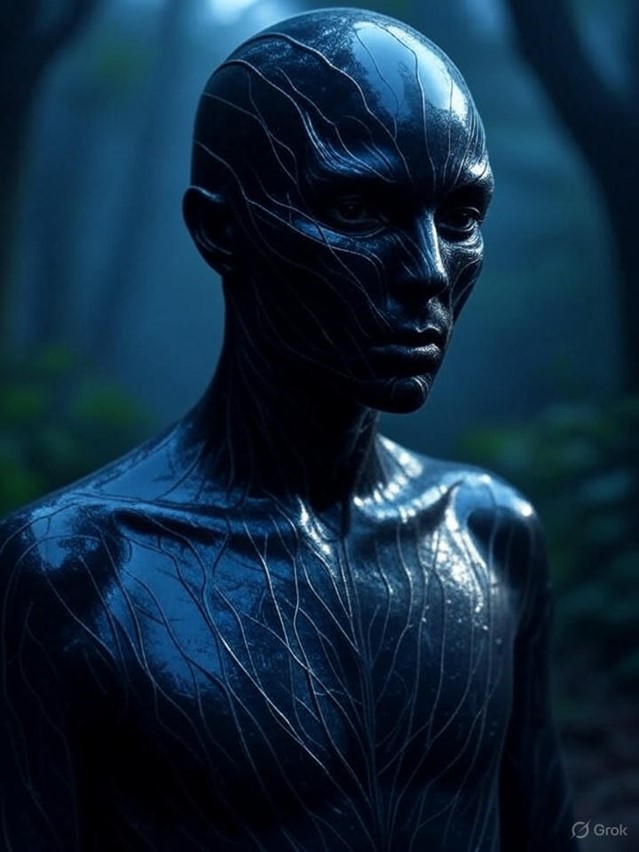
General Size and Body Pattern
• Height: 178–193 cm (5’10″–6’4″)
• Weight: Approximately 120–145 lbs (body mass fluctuates slightly with ambient magic)
• Texture: Smooth, cool to touch; surface shimmer varies with emotion and weather
• Colors: Predominantly deep black, grey-violet, or polished stone; inner glow colors include indigo, copper, pale green, or silver-white
• Patterning: Internal flow channels run beneath the outer surface like slow rivers; decorative etching sometimes added using Tal-Vine glyphwork, especially in ceremonial roles
Life Cycle
Vyrn-Ka do not reproduce through conventional biological means. Instead, they are formed through a ritual stabilization of coalesced aether and inherited soul-memory, a process known as Vyrren-Birth. This ritual is only performed with the approval of the monarchy and the Silent Architects. A new Vyrn-Ka begins life with no prior identity but gradually acquires inherited fragments of knowledge and skills via community exposure, memory echoing, and deliberate training.
• Childhood (0–12): Non-magical phase. Must attend cultural academies to establish balance and harmony.
• Adulthood (Begins with stable resonance, typically ~12–14): Gains access to gear-based magic.
• Prime Phase (15–300 years): Full physical and magical function.
• Dissolution Phase (variable, after age 300–400): The inner glow fades and the body eventually sublimates into luminous dust. Legacy stones are carved, and the most refined individuals are returned to the Still-Houses.
Potential Positives (Physical Form)
• Semi-Aetheric Composition: Grants passive resistance to poison, disease, and physical fatigue
• Aetherlight Vision: Can perceive magic flows and faint life heat in darkness
• Vocal Harmonics: Gain a bonus to persuasion or negotiation in diplomatic situations due to calming resonance
• Emotion Damping: Resistant to fear, charm, or compulsion magic; emotional reactions are subdued by nature
• No Biological Consumption: They do not eat or breathe—subsist on ambient mana and fluid intake; minimal needs in siege or travel
Potential Negatives (Physical Form)
• Vulnerable to Null Zones: Magical dead zones weaken their cohesion, causing reduced movement or fading
• Unnerving to Others: Their semi-faceless features and calm detachment make many non-Boian avatars uneasy
• Cannot Heal Naturally: Healing magic works, but mundane medical care is ineffective; damaged essence must be re-stabilized with ritual or magic
• No Reproduction by Pairing: The species relies entirely on state-sanctioned ritual crafting, making population growth slow and bureaucratically controlled
• Emotionless Affect: Cannot express strong emotions physically—leads to misunderstandings or perceived coldness by outsiders
Tags: Cephalopod-hybrid, Fish-jawed, Insect-colonial, Leech-segmented, Aquatic-feral, Swarm-predator, Regenerative, Camouflaging, Venomous-sucker, Lure-hypnotic, Spine-armored, Mucus-coated, Burrower, Pheromone-communicator, Magic-ebbing, Jungle-lurker, River-scavenger
Specialized Item Slots Available
The unique anatomy of the Vyrn-Ka allows for some differences in gear interface:
• Chest Glyph Plate Slot (1): Can embed a thin magical plate (in place of standard armor chest slot)
• Lattice Vein Rings (Up to 2): Special body conduits worn on exposed resonance lines, used for magical amplifiers
• Standard Human Gear Slots: Head (can wear mask/crown), arms, legs, feet, back, belt, hands
• No Internal Slots: No biological digestive organs or lungs—consumable items must be designed as resonance triggers or vaporized brews
Total worn magical item slots: 19 at Tier 1, standard by Saṃsāra rules.
Environmental Adaptability
• Highly effective in high-magic zones, temples, and cities
• Do well in dry, clean, or highly structured environments
• Suffer in chaotic, wild, entropy-heavy terrains such as wild mana storms or ruin-bursts
• Do not function well underwater unless specially adapted—water disperses inner resonance if not contained
• Thrive in logical architecture—Boian cities are perfect habitats
Other Important Details
• The Boian monarchy is exclusively Vyrn-Ka. The Silent Line is traced through maternal memory-threads embedded in ceremonial crafting stones, not blood. The current ruling monarch’s physical form may have been reshaped multiple times across generations via Vyrren-Birth and legacy stabilization.
• Vyrn-Ka see themselves not as people of flesh, but as forms of purpose. They refer to themselves in Vyr-Tal as “those who are shaped to sit and to know”—a reflection of Seda and Vidu. Individual names often reflect Insight-Gain, not lineage.
• Their cities are engineered to align with their resonance fields. Rooms are sound-dampened. Floors contain energy channels. Their magic lamps glow not with flame, but with tonal harmonics tuned to their voice frequencies.
• Vyrn-Ka do not sleep traditionally. They enter a nightly Contemplation Trance, in which their form flickers and hovers slightly above the ground while their essence rebalances. These trances often take place in Still-House pods or resonance alcoves.
• While most Vyrn-Ka reside in Boian, some function as emissaries in other lands, especially in roles where emotionless observation, ritual neutrality, or structural engineering are prized. They are rarely adventurers, but when they are, they are driven by deeply personal quests of clarity or legacy.
The Vyrn-Ka are more than a race—they are a manifestation of Boian philosophy given form. Their semi-aetheric bodies and disciplined presence reflect the logic, structure, and stillness that define their homeland. To see one in motion is to witness clarity walking.
Taryn and the Fractured Echo
In the store of faded marks, it is carved that there was a span when the tall rock was young. A thinking form was born. Yet it was not a thinking form of full light and steady hold. Its shape was a break in the glow, a shifting half that sought wholeness. The old knowers named it the Echo-Cracker, for such was its work. Its scale was as a small peak, and its reaching parts were as many shattered lights. When the kin raised their First Seat, which was a seat of great weight and the craft of all minds, the Fractured Echo would reach. And the seat splintered. Once more the seat splintered.
So it occurred that the links of the kin started to bend. The people’s centers were empty, and an empty center is a loose stone in the build of the group. Alarm was a cold wind blowing in their thoughts. The Sight-Keepers, who were the sharpest of the ponderers, went to the Quiet-Home. They placed themselves before the Memory Wall, where the old stones kept the whispers of the long-absent. They looked upon the lines, the twists and angles, seeking the knowledge for how to bind a form that was a half-glow.
But no line was there. The long-gone had never faced such a thing as the Echo-Cracker. Their knowledge was for the right forms of the rock, not for this split in the light. For this reason, the old knowers had faces like worn earth-slopes, and their whispers were heavy. The ones they called Vidu and Seda, the Pair of Silence, seemed without sound, and the rock gave no answers.
Now, there was a shaper whose name was Taryn. The name had depth, but the depth is a worn edge. She was without full kin, a stone placed by chance, not by complete line. Her grasps, however, were skilled with the glyph-tool and the light-weave. She was a quiet shaper, but her ponderings were keen edges in her head. She saw the unrest in the hold, and she saw the first seat, broken and sad upon the height.
Alone she walked, which was a way not walked, in the shadow of the starless dark. She walked to the rim of the Tall Rock to watch for the Fractured Echo. This was a large hazard, for a single stone invites the fall. She hid in the rock crevices, which were her name in some accounts. For five darks, she watched. She saw the half-form move. She saw it was not just a destroyer. It had a line of its own. It would pulse in a wide, slow circle, and then turn its power inward to crack the seat. It used its own flow as a breaker. Its strength was a storm of loss.
Taryn returned to the hold. Her thought was full of the echo’s line. The old seats, she saw, were made to be strong bases. But you cannot make a base on a rock to stop the wind. The wind simply curves around, or it erodes the base. The Fractured Echo was like the rock’s breath. It could not be based against.
She took up a pin and a copper thread. She did not etch the line of the long-gone. She etched the line she saw in her thought, the line of the pulse. It was a circle that turned in on itself, a line that did not end but guided. It was a thing of great risk and perhaps great error to create a new line, a line not given by the far-vanished.
She carried her small etching to the Sight-Keepers. Her form-body shook, for they were elders of high place. She said, with a voice tiny as a grain, “The seat should not be a base. It should be a pulse. We must not meet its power with our power. We must use its power to tie the stone of its own breaking.”
The elders viewed. They saw her line. It was not of the long-gone. It was new. It was a thing of alarm. To abandon the old ways was to say the long-gone were wrong. But the loss of the hold was a strong pull. An old Sight-Keeper, whose name is lost, viewed Taryn’s etching and then at the splintered First Seat. He said, “An old line that does not hold light is just a fine shadow. A new line that lights the hold is knowledge.”
And so it was decided. Taryn, the shaper who was a loose stone, placed before the kin. She did not etch the new seat herself. That is not the way. Her line was shown to all the etchers. All the hands of the hold worked to etch the new First Seat, the one they called the Pulse Seat. Its shape was strange, a ring of turning flows. It took many lights.
They raised the Pulse Seat on the rock. They set it in the path of the Fractured Echo. The great break in the glow saw it and charged with much disorder. It struck the seat. But the seat did not splinter. The circling lines caught the echo’s energy. The more it struggled, the more the seat tightened, turning its own force against it. It was guided by the pulse, round and round, bound and dimmed, into the quiet center of the rock. There, its great power was useless, and the shapers of the hold could end its time.
The hold had light again. The links of the kin were fixed. Taryn was not cast out for her new pondering. Because she brought her line back to the seat, for all hands to etch, she was lifted. She became a great Sight-Keeper. And her pulse, the line born of lone watching, was added to the Memory Wall, a new piece of knowledge for all who came later.
The moral of the story: The knowledge of the long-gone is a firm seat, but when a new break appears on the rock, a single stone may find the line that all hands must etch to keep the kin from falling.