
This philosophy is the cultural and spiritual bedrock of the Boian Nation, a country established on a series of high, defensible river promontories and fertile inland plateaus. The Boian way is not one of fervent worship or elaborate ritual, but one of deep, abiding contemplation and the pursuit of lucid purpose. It is a quiet faith, practiced more in thought and posture than in prayer or proclamation.
Lore: Boian history teaches that their ancestors were not teleported to Saṃsāra as a functioning community, but as a terrified, scattered crowd, deposited on a windswept plateau with no memory of their origin. They were adrift, their inner and outer worlds a chaotic storm. In their despair, they collapsed upon the earth, some sitting in silent shock, others holding their heads in their hands, trying to think past their fear.
According to the lore, they remained this way for a day and a night. As the sun rose on the second day, they did not receive a vision of a mighty god or hear a divine voice. Instead, two feelings arose simultaneously within the group. The first was a sudden, sharp clarity—a single, perfect thought in each mind about how to find water, or how to shape a stone. The second was a profound sense of place and stability, a feeling of the solid earth beneath them, a quiet certainty that this spot was now home.
These two primordial experiences were recognized as the twin aspects of their silent godhead: Vidu, the Thinker, who embodies the clarifying power of deep contemplation, and Seda, the Sitter, who embodies the grounding strength of pure presence. The Boian people believe that all progress, from crafting a tool to building a city, can only be achieved by honoring this duality. First, one must sit in stillness with a problem (the Way of Seda), allowing the chaos to settle. Only then can one engage in focused thought to find the solution (the Way of Vidu). To act without thought is chaos; to think without being grounded is madness.
Deity: Vidu and Seda, the Silent Pair
- Personality: Vidu and Seda are not interactive deities with approachable personalities. They are divine principles to be emulated.
- Vidu’s personality is one of silent, piercing intensity. It is the quiet focus of a master strategist, the patience of an astronomer watching the stars, and the flash of insight that solves an unsolvable riddle. Vidu is analytical, inquisitive, and completely detached from emotion, concerned only with clarity and the emergence of a perfect idea.
- Seda’s personality is one of immense, unshakable calm. It is the stability of a mountain’s foundation, the nurturing quiet of a planted field, and the deep peace of being utterly present in the moment. Seda is grounding, stable, and enduring. She offers no answers, only the firm, still space in which answers can be found.
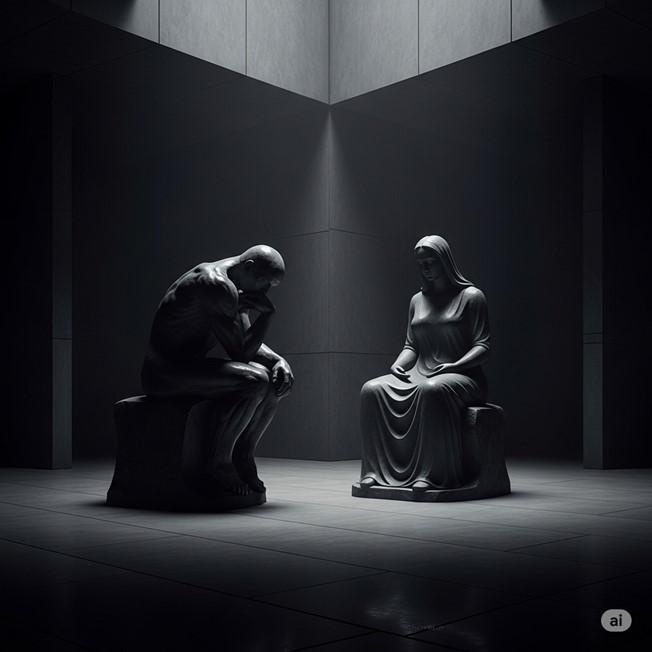
- Traits and Characteristics: The Silent Pair are never depicted apart, and their images are not idols for worship but focal points for meditation.
- Vidu, the Thinker, is always shown as a male figure, seated on a simple, rough-hewn stool. He leans forward, elbows on his knees, his head held in his hands in a posture of intense, internal concentration. His face is obscured, as his focus is inward, not on the observer.
- Seda, the Sitting Woman, is always depicted as a female figure seated directly on the ground or a low, wide bench. Her posture is upright and solid, her hands resting calmly on her thighs. Her gaze is level and serene, directed forward, observing the world without judgment.
They are silent gods. They offer no commandments, answer no prayers, and perform no miracles. Their gift is their example. By emulating Vidu’s posture, one invites clarity of thought. By emulating Seda’s posture, one finds stability and presence.
Attributes: The attributes of the godhead are divided between the two aspects, and true power lies in their union.
- Attributes of Vidu: Insight, Knowledge, Contemplation, Strategy, Patience, Self-Awareness, Logic, and Innovation (symbolized by copper, the first metal they learned to work).
- Attributes of Seda: Stability, Community, Foundations, Presence, Agriculture, Endurance, Tradition, and Home (symbolized by polished stone, perfected through long effort).
- Combined Attributes: Balance, Partnership, Purpose, Wisdom, and the foundational principle that a community is built not on frantic work, but on shared stability and shared clarity of purpose.
Symbols
- The Paired Seats: The most sacred symbol of the faith, often rendered as two empty chairs or seats. One is a simple, angular stool representing Vidu’s focused thought. The other is a low, grounded bench representing Seda’s stable presence. It symbolizes the divine partnership and the necessity of both contemplation and being.
- The White-Filled Meander: The primary decorative motif. It consists of complex geometric patterns—spirals, chevrons, and angular mazes—incised into the dark, polished surface of pottery or stone and filled with a white paste. This represents a clear thought (the white line) emerging from the vast unknown or a clear path found through a complex problem (the blackness).
- The Polished Stone Sphere: A perfect sphere of dark, polished stone, often obsidian or hematite, that can fit in the palm of a hand. It is used as a meditation tool. Its smooth, cool, solid nature represents the grounding presence of Seda.
- The Copper Pin: A simple but elegantly crafted copper pin or awl. It symbolizes the moment a pure thought from Vidu becomes a tool, the first step in turning an idea into a reality. It is a mark of innovation and the power of a single, sharp insight.
Tags: Deity, Religion, Lawful Neutral, Duality, Contemplation, Knowledge, Stability, Community, Home, Crafting (Pottery, Metallurgy), Strategy, Patience, Insight, Presence, Balance, Stillness, Foundation, Innovation, Partnership, Clarity
Positives: The followers of this path cultivate exceptional mental and societal resilience. The core practice of pairing quiet, stable presence (the Way of Seda) with deep, focused contemplation (the Way of Vidu) makes them masters of strategy, logic, and long-term planning. Boian society is renowned for its marvels of engineering, its impeccably organized cities, and its ability to solve complex problems with startling clarity. This intellectual prowess gives them a significant advantage in diplomacy, trade, and defense. On a personal level, adherents possess a profound inner peace. The practice of “sitting” allows them to remain calm and centered in the face of chaos, making them difficult to provoke, intimidate, or drive to panic. This psychological fortitude allows them to endure hardship with a quiet dignity and to approach every challenge with a clear and unclouded mind. Their communities are models of stability; because every major decision is preceded by rigorous thought, they avoid costly mistakes and rash actions, leading to a secure and prosperous society.
Negatives: The greatest weakness of the Boian philosophy is a crippling slowness to react, a cultural tendency toward “analysis paralysis.” When faced with a sudden, fast-moving threat—such as a surprise attack or a rapidly spreading plague—their ingrained need to first be still, then contemplate the issue from all angles before formulating a perfect plan can be a fatal flaw. They can be outmaneuvered and overwhelmed by more impulsive or aggressive forces long before their superior strategy is ever put into action. Furthermore, their veneration of logic and serene stillness often leads to a cultural suppression of strong emotion. Passion, righteous anger, and even deep grief may be viewed as disruptive forms of inner chaos. This can cause Boian society to appear cold, detached, and unnervingly unemotional to outsiders, making genuine connection and alliances with more passionate cultures difficult. Like other non-interventionalist faiths, they receive no divine aid, and their methodical self-reliance can sometimes breed a quiet intellectual arrogance, causing them to underestimate foes who rely on what they perceive as lesser means, such as brute force or emotional fervor.
Type of Temple: The Boian people do not have temples in the traditional sense of places for worship or sacrifice. Their sacred spaces, known as Still-Houses, are architectural embodiments of their philosophy, designed as tools to facilitate contemplation and stillness. These are minimalist, austere structures of dark, polished stone and wood, often built in isolated, defensible locations like cliff edges or high plateaus that offer a commanding view of the surrounding landscape. The architecture is severely geometric, and every hall and chamber is designed to deaden sound, creating an atmosphere of profound quiet.
A Still-House is organized around a central, vast chamber called the Great Seat Hall. This hall contains no altar or idol, only hundreds of “Paired Seats”—a simple stool next to a low bench—carved from stone and arranged in concentric circles. Here, the community gathers to sit in absolute silence for hours, reinforcing their collective stability. Radiating from this hall are smaller, often soundproof Contemplation Cells for individual use, each containing a single set of Paired Seats. The complex also includes quiet workshops where the insights gained in contemplation are turned into reality, such as scriptoriums for recording strategic treatises, and studios for the meticulous crafting of copper tools and white-filled pottery. The large statues of Vidu and Seda found within are not objects of worship but meditative aids, reminders of the perfect postures for achieving clarity and presence.
Number of Followers: The Path of Stillness and Sight is the exclusive philosophy of the Boian Nation. It is a system of thought so completely integrated with their governance, culture, and identity that it is not considered something one can convert to. One is raised within the Path, or one is an outsider. Their methodical approach to life extends to their population, which is managed through careful planning rather than explosive growth.
Though their nation is not the largest in Saṃsāra by land area, its stability and efficiency allow it to support a significant and well-organized population. The total number of followers is estimated to be approximately 35,360,000. Within the Boian borders, adherence is essentially universal. Their self-contained and intellectually rigorous philosophy holds little appeal for outsiders, and they do not seek to spread it. Thus, the number of followers beyond their own nation is practically zero.
What Believers Believe: Adherents to the Path of Stillness and Sight believe that the universe operates on a fundamental duality, which they name Vidu (Thought) and Seda (Presence). They hold that these are not gods to be worshipped, but perfect, ideal states of being to be emulated. The ultimate purpose of a life is not to earn a place in an afterlife or to achieve spiritual transcendence, but to attain Clarity—a state of perfect, logical understanding. They believe any problem, from a personal dilemma to a national crisis, has a single, most efficient solution that can only be found by rigorously following their Path.
The Path dictates that one must first achieve the state of Seda, or pure presence. This involves cultivating an absolute inner stillness, calming the “chaos” of emotion and quieting the storm of errant thoughts until one is simply a stable, grounded observer. From this unshakable foundation of stillness, one can then transition to the state of Vidu, engaging in disciplined, focused contemplation on the problem at hand. They believe that from this process, “The Insight”—the clear, logical, and correct thought—will inevitably emerge.
In this worldview, the self is seen as a lifelong project. The goal is to perfect one’s own foundation of being (emulating Seda) and to sharpen one’s mind into a precise tool (emulating Vidu). The community is viewed as a great, complex structure, like a fortress or a bridge. Each individual is a stone within that structure. A person who is stable, calm, and purposeful is a perfectly cut and placed stone, strengthening the whole. A person who is chaotic, emotional, or acts without thought is a flawed stone that threatens the integrity of the entire edifice.
Regular Services: The Boian people do not conduct “services” that involve worship, prayer, or sermons in a traditional sense. Their religious gatherings are disciplined, silent practices designed to reinforce the principles of their Path.
The core daily practice is an individual responsibility. Every follower is expected to spend a portion of each day, typically at dawn, in private meditation. This meditation follows a strict structure. The individual first assumes the posture of Seda—seated, stable, hands on knees, gaze level—and focuses on deep breathing and achieving a state of complete mental and physical stillness. Once this calm is established, they shift to the posture of Vidu—leaning forward, head in hands—and direct their focused mind toward a specific problem or concept, working through it with pure logic.
Communal practices are exercises in collective discipline:
- The Great Stillness: This is the most common group ritual, often held weekly. Members of the community gather in the Great Seat Hall of a Still-House. In complete silence, they take their places in the “Paired Seats” and collectively enter the state of Seda. They sit together, sometimes for hours, without speaking or moving. The purpose is not to pray, but to synchronize their foundational stability, reinforcing the social harmony and collective presence of their society.
- The Presentation of Insight: This is the Boian equivalent of a sermon, but it is purely intellectual. When a person believes they have achieved a significant Insight through their private contemplation, they can request a Presentation. They stand before the community in the Great Seat Hall and lay out their new idea—be it an engineering innovation, a military strategy, or a refinement of philosophy—using stark, dispassionate logic. The community listens in silence, then collectively enters a state of contemplation to analyze the thought. If the Insight is deemed sound and useful, it is adopted. If logical flaws are found, it is silently discarded. This is the primary engine of their societal advancement.
Funeral Rites: The Boian funeral is a dispassionate and logical ceremony known as The Final Accounting. It is not a forum for grief, which is considered a private, chaotic emotion to be processed through individual contemplation. The rite is a formal acknowledgment that an individual’s “project of the self” has concluded and its useful contributions must be cataloged and absorbed into the community’s structure.
Upon death, the body, seen as a tool that has ceased to function, is cremated without elaborate ceremony. All focus shifts to the deceased’s intellectual and functional legacy. A council of philosopher-priests convenes to conduct an “accounting” of the person’s life, compiling a list of their significant accomplishments, skills, and ideas.
The ceremony takes place in the Still-House. The deceased is represented by a newly quarried and perfectly polished stone cube called the Legacy Stone. An officiant stands before the silent community and reads The Final Accounting—a stark, emotionless summary of the individual’s function and contributions. It details their profession, key projects they completed, and knowledge they created or passed on. No mention is made of their personality or relationships. After the reading, the single most important “Insight” of the person’s life is formally inscribed onto one face of the Legacy Stone, using the traditional white-filled meander pattern. The ceremony concludes as the Legacy Stone is taken and permanently seated in an empty niche in the walls of the Still-House, becoming a literal part of the building’s foundation, its story now subsumed into the greater structure of the community.
Defensive Applications: Boian defensive arts are subtle, cerebral, and designed to neutralize threats by reinforcing structure, predicting outcomes, and calming chaos.
- The Fortress of Inevitable Thought: This is a formidable psychic defense. By entering a state of deep meditative stillness, the practitioner’s mind becomes a perfectly ordered and logical construct, impervious to mental assault. Illusions and phantasms flicker and fail against a mind that perceives their logical inconsistencies. Magical effects that rely on manipulating emotion, such as fear or rage, find no purchase, as the practitioner has suppressed their own inner chaos. Attempts at telepathic intrusion are met with a wall of silent, abstract logic that is both incomprehensible and impenetrable.
- Imposition of Perfect Form: A practitioner can gaze upon a physical object—a stone wall, a shield, a bridge—and achieve a state of perfect, intuitive understanding of its structural geometry. They can then project their own internal stability into that object, psychically reinforcing its physical integrity at a molecular level. The object does not glow or become visibly magical, but it becomes “logically perfect” and thus immensely more durable, able to withstand blows or stresses that would otherwise cause it to shatter.
- Mapping the Consequence: This technique is a form of supernatural tactical analysis. It is not true precognition, but rather the result of a mind so clear and focused it can process all variables of a conflict and deduce the most probable outcomes with uncanny accuracy. The practitioner can anticipate the trajectory of an incoming arrow by calculating the archer’s posture and wind speed, or foresee an enemy’s path of attack by analyzing their formation. This allows them to achieve a state of perfect readiness, reacting to threats a fraction of a second before they fully manifest.
- The Zone of Stillness: By working in concert, a group of Boian practitioners can project the aspect of Seda outward, creating a wide “field” of psychic calm. Within this zone, chaos is actively suppressed. The frantic energy of a charge is blunted as soldiers feel a strange lethargy overcome them. Aggression cools into confusion, and the raw, chaotic energies used in some forms of magic may fizzle or fail. This zone does not stop an army, but it can disrupt its momentum and unravel the cohesion of an undisciplined foe.
Offensive Applications: Boian offensive abilities are insidious and clinical. They do not rely on brute force, but on finding the inherent flaws in an opponent’s mind, body, or equipment and exploiting them with surgical precision.
- The Revelation of the Flaw: This is the inverse of their main defensive art. A practitioner observes a target—a suit of armor, a weapon, a siege tower—and their Vidu-like insight allows them to perceive the single point of greatest structural weakness. They then project a minute, focused pulse of psychic energy at that exact point. The object does not explode, but rather collapses along its natural fault lines, shattering as if struck by a perfect, impossible blow. A sword breaks on a parry; a shield splinters; a helmet cracks.
- The Syllogism of Madness: A purely mental attack of terrifying potency. The practitioner does not assault the target’s mind with fear or pain, but instead projects a flawless, irrefutable logical paradox directly into their consciousness. The target’s mind, unable to resolve a statement that is both logically true and logically false, can become trapped in a recursive loop. This can induce effects ranging from temporary, disorienting vertigo to complete catatonic paralysis as the mind devotes all its resources to solving the unsolvable.
- Deconstructing the Form: By observing an opponent in combat, a practitioner can analyze the complex chain of biomechanical actions involved in their movements. They can then project a subtle psychic interference, introducing a logical “error” into the opponent’s motor functions. The opponent suddenly becomes clumsy and uncoordinated; their foot will trip over level ground, a practiced sword swing will go wildly off-target, or their balance will inexplicably fail them. The practitioner is not controlling their body, but simply corrupting the signals from their brain.
- The Weight of Being: A practitioner can focus the immense, grounding presence of Seda onto a single foe. The target is suddenly afflicted with a crushing psychic inertia. They feel an impossible weight pressing down on them, making every movement slow, sluggish, and exhausting. Their will to fight is eroded under a feeling of absolute futility, as if they are trying to fight a mountain. It is a slow, non-lethal attack that incapacitates by imposing a state of perfect, hopeless stability.
Ostra and Time of the Two Herds
It is accounted that in the first generation after the great confusion, when the people had made their home upon the high rock, a test was given. The one who led them was called Ostra, which in the old tongue meant a foundation stone. She was the First Seat-Holder. The people were few, and their settlement was a new thing, a small pot on a great table.
And so it was that the world sent them a question with two faces. From the north, the scouts saw a walking forest of meat. Great beasts with horns like the crescent moon and hides thick as a shield. Their number was as the stars, and to have them was to have food for many winters. But they were strong, and to hunt them was a great danger. This was one face of the question.
From the south, the scouts saw a river of teeth. Fast-running predators, with fur of ash and eyes of yellow fire, it is remembered. Their number was as the pebbles on the shore, and to have them was to have death visit every house. This was the other face of the question. And the scouts said, with voices that were dry with fear, that the two herds, the food and the death, they would arrive at the valley of the settlement on the same day, at the same hour.
Then the community was broken. Its foundation stone was cracked. For one part of the people, their stomachs were loud with emptiness. They said, “We must hunt the great beasts! We must be brave and take our food. We will fight the predators if they come. To act is to live!” This was the voice of hunger, which is a voice without thought.
Another part of the people, their throats were full of the sharp rock of fear. They said, “We must bar the gates and sharpen the spears! We must hide behind our walls and fight the river of teeth. We will eat roots if we must. To be still is to survive!” This was the voice of fear, which is a stillness without purpose.
The argument was a hot fire in the center of the village. The people were two halves of a person, fighting himself. Ostra, the First Seat-Holder, saw that the true danger was not the beasts of the north or the south, but the chaos within their own walls. She did not speak for the hunters, and she did not speak for the hiders.
She stood and made a sign of silence. She led all the people, the angry and the afraid, to the great flat place where the earth was bare. She commanded them to sit for the Great Stillness. And they sat. The hunters sat with their hungry anger, and the hiders sat with their sharp fear. They sat in the posture of Seda, the mother of presence, whose seat is the earth itself. They sat. And in sitting, they became still. The sun crossed the sky, and they did not move. Their anger cooled. Their fear softened. Their stomachs grew quiet. Their thoughts, which had been a frantic storm, became a placid lake. They sat for a day and a night, and they became one, a silent community upon the earth.
As the second sun rose, Ostra, whose mind was now a calm and silent place, shifted her posture. She leaned forward and put her head in her hands. She became the image of Vidu, the father of thought, who looks only inward to find the way outward. She considered the two herds. They were not just food and death. They were forces. They were patterns. And in the great quiet of her mind, The Insight came. The thought that came was a copper pin, sharp and bright and perfectly formed.
She rose. The people looked upon her, their faces calm and ready for reason. She spoke, and her voice was not loud, but it was clear.
“The question of the world is not a choice between two paths,” she said. “It is a lock, and we were not given the key. We must make the key. We will not hunt the great beasts. We will not fight the river of teeth. We will be the rock in the river that turns the water. The predators hunt the beasts. We will make them do so for our own purpose.”
The plan she made, it was not of fighting. It was of thought. The people, their minds now clear and aligned, saw the logic. It was a perfect thing. They went to work, not in a rush, but with the quiet efficiency of a perfect plan. They dug a long, shallow trench on the east side of the valley. They gathered great piles of wood and dry grass on the west side. They did not sharpen spears.
When the two herds entered the far ends of the valley, the plan was enacted. The wood piles were lit, creating a wall of smoke and fire on one side. Men beat drums and shook rattles on the other side. The great beasts, the food-herd, were afraid. They were steered away from the fire and noise, their stampede funneled by the trench, directly into the center of the valley. At that moment, the river of teeth, the predator-herd, entered the valley from the other end, seeking its own path.
And the two forces met. The predators, met with a tide of panicked food, fell into a frenzy of killing. The great beasts, in their terror, trampled and gored the smaller predators. The valley became a storm of nature’s own making, while the people of Ostra watched from their high, safe rock.
When it was over, the river of teeth was broken and scattered, the few survivors fleeing into the hills. And the valley floor was a larder, filled with the meat and hides of the great beasts. The people gathered their bounty, and their work was not in the great danger of the hunt, but only in the butchering. They had filled their homes with food for the winter, and had done so with almost no risk.
Moral: When faced with two bad choices, do not choose. Be still until your mind is clear, and you will find the third path that was always there.