
From: Forge of the First Spark
Description: Simple, but essential construction materials. While mundane, their consistent quality is valuable.
Distribution:
- Homes & Workshops: Used by local carpenters, builders, and even average citizens for repairs and small projects.
- Bulk Export: Merchants purchase them in large quantities, as most settlements always need these items.
- Supporting Industry: The Forge itself likely uses a lot of its own hardware for renovations and expansion.
Lore: The Strength in the Small
It’s said that an apprentice at the Forge, frustrated by the focus on grand weapons, set out to forge the most perfect nail imaginable. This wasn’t out of mockery, but a genuine desire to master the smallest thing with as much focus as a blade. The result surprised everyone: the nail was near-unbreakable, a testament to skill over pure spectacle.
Tier One Stats
- Resilience +1: Less prone to bending, snapping, or rust.
- Efficiency +1: They’re easier to drive, requiring fewer strikes and holding firm
- Hidden Strength: A structure built with Forge hardware is slightly more resistant to extreme stress (storms, battering, etc.)
Requirements
- Coin: While perhaps less expensive than a fine weapon, they are still a premium item.
- Appreciation: Those who purchase them in bulk are often builders or those who understand the value of a solid foundation.
Tags: Reliable, Forge of the First Spark, “Small but Mighty”
Additional Positives
- Standardization: Forge-made hardware conforms to certain sizes, making replacements easier even years later.
- Longevity: Buildings made with these items require less frequent, time-consuming repairs.
Additional Negatives
- Attractive to Scavengers: In desperate times or ruined settlements, structures with Forge hardware might be stripped for the materials themselves.
- Symbolism (Rare): A tyrant obsessed with control might seek sole access to the Forge’s hardware, seeing it as a way to ensure only their own structures are built to last.
Where They’re Sold
- The Forge’s Outlet: The Forge likely has an attached shop for smaller items, catering to locals and those who made the journey seeking their reliable goods.
- Supply Wagons: Forge-employed wagons might make regular circuits to nearby towns and villages, ensuring a steady supply even for those who can’t reach the Forge itself.
- Merchant Caravans: Independent merchants see the value in buying in bulk from the Forge, transporting the hardware across Saṃsāra to markets eager for quality.
- Bartering Posts: Especially on frontiers, Forge hardware might be exchanged for rare materials, skilled labor, or other goods instead of pure coinage.
Environments of Use
- Homesteads to Hamlets: Every settlement, from a single farmstead to a growing town, needs these basics to build and maintain structures.
- Repairs & Renovations: Existing buildings benefit too; replacing rusted-out hinges or patching a roof can be the difference between comfort and disaster.
- Fortifications: Walls, Gates, and defensive towers rely on sturdy hardware. In dangerous regions, the Forge’s quality could mean life or death.
- Shipwrights: While likely specializing in some components, the Forge’s nails and hinges would find their way onto vessels, ensuring greater endurance in harsh seas.
- Improvisation: In a world with limited technology, nails might be bent into hooks, hinges repurposed as fastenings…necessity sparks innovation.
End Results
- Foundation of Progress: A thriving town often boasts structures that stand tall and strong due to that unseen foundation of well-made hardware.
- Safety & Security: A well-hinged door can keep out bandits, sturdy nails might prevent a roof collapsing in a storm, saving lives.
- Legacy: Structures built with care and the best materials can outlast their creators, and the subtle mark of the Forge may be discovered centuries later during renovations.

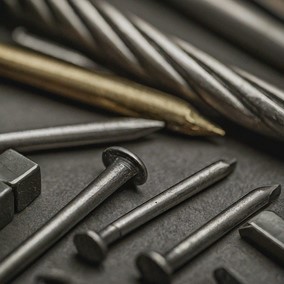
Whispering Iron
In the time of builders before numbers were marked on wood, there lived a smith whose hands were as the storm winds – swift and shaping. Iron was his clay, and from it, he built marvels that pierced the sky, and blades that reaped the harvest. Yet his heart bore a strange emptiness.
One eve, when the fire danced like trapped spirits, he took not a sword’s length of iron, but a fistful only. From this fistful, he drew forth a nail, thin as a starved man’s finger. The air hummed a song that only the echoes of the First Spark could remember. And when it struck wood, it was not with clanging, but a sigh.
Word traveled like birds on the wind, of the smith whose iron whispered. They came not for swords, but nails to hold homes tight, hinges for doors that open and close. The proud ones with purses like swollen toads scoffed, seeing not strength in such smallness.
But then came the season of the hungry winds, when the tallest towers trembled. And in that shaking, the houses held fast by whispering iron stood firm, but the proud ones saw their boasting stones tumble.
And so did the smith learn, and so do we, that it is not in the mountain but in the stone that holds it together where true strength abides.
Moral of the Story: Might lies not in grand displays, but in the unseen bonds that endure.
Comments
One response to “Nails Hinges and Hardware”
[…] Nails, Hinges, and Hardware […]