
From: Forge of the First Spark
Description: Axes, picks, hammers, saws, and other essential tools for construction, forestry, and mining. Made from well-tempered steel that holds an edge and resists wear.
Distribution:
- Domestic Use: Towns and surrounding farms rely on these for everyday tasks and building maintenance.
- Export: Merchants transport these across Saṃsāra, as their quality makes them sought-after in places without a comparable forge.
- Other Industries: Miners and lumberjacks, in particular, require reliable tools, creating local demand.
Lore: The Craftsman’s Legacy
The Forge of the First Spark doesn’t just produce tools, they craft a legacy. Smiths whisper that the first hammer forged within the First Spark carried an echo of the creation that started it all. Thus, a well-made tool from the Forge holds a spark of that determination and mastery within it.
Tier One Stats:
- Durability: +2 (Compared to standard tools, these have higher endurance before needing repair)
- Efficiency: +1 (They work better with less effort, be it chopping or hammering)
- “Spark” Modifier: A small chance (+5%) to complete a task one step faster (e.g., one fewer swings to fell a small tree).
Requirements:
- Purchase: Coin is a simple necessity. The price is higher than mundane tools but considered a worthwhile investment.
- Appreciation: Those truly benefiting from these tools often possess a degree of respect for the craft behind them.
Tags: Reliable, Well-Made, Forge of the First Spark, Craftsmanship
Additional Positives:
- Easier Maintenance: The superior construction makes them easier to sharpen and keep in peak condition.
- Pride of Ownership: Those using a Forge-made tool often feel a sense of connection to the legacy of skilled labor
Additional Negatives:
- Target for Theft: Their reputation makes them attractive to thieves looking for easy profit.
- Potential Misuse: In the wrong hands, even a well-crafted tool can become a weapon.
Where They’re Sold
- The Forge Itself: Likely has a retail area attached. This is ideal for local buyers, and those traveling far seeking the Forge’s reputation. Patrons might even observe the smiths at work, adding to the mystique.
- Market Stalls/Town Squares: Smiths from the Forge might set up temporary stalls on market days, especially in towns that lack their own skilled blacksmith.
- Traveling Merchants: Forge-made tools are a valuable commodity. Merchants would buy them in bulk for transportation and resale in other regions.
- Commission Agents: Wealthy individuals or large-scale operations might send agents directly to the Forge to place orders, ensuring direct access to the best goods.
Environments of Use
- Settlements: From a humble farmstead to a bustling town, these tools are vital. They’re used for building, repairing homes, fences, and essential infrastructure.
- Forestry: Felling trees, chopping firewood, and clearing land all require axes and saws. A reliable tool makes a lumberjack’s life much easier, and safer.
- Mining: Picks and hammers are the heart of a miner’s gear. Superior tools translate to greater ore yield and fewer injuries from broken tools.
- Construction Sites: Whether it’s a new inn or a grand fortification, good tools contribute to a well-built project and ensure timely completion.
- Workshops: Carpenters, wheelwrights, and other craftspeople depend on their tools as a direct extension of their skill. Forge-made tools help them produce finer work.
- Battlefields (Sadly): While not their intended purpose, in desperate times, even the finest tool can be repurposed as a weapon.
End Results
- Progress: These tools facilitate the growth and maintenance of the world itself. Buildings rise stronger, mines yield more resources, and roads are cleared for trade.
- Prosperity: Those who possess superior tools often see better outcomes for their labor, be it a farmer with a bountiful harvest or a craftsman selling sought-after wares.
- Legacy: A well-maintained tool from the Forge can be passed down, becoming a symbol of hard work and the enduring skill imbued within it.
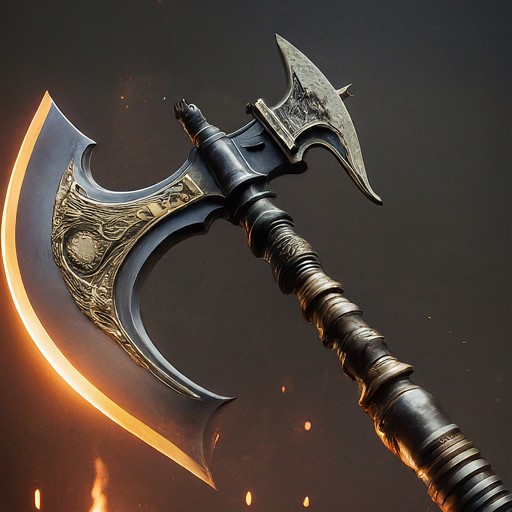
How the high-quality axe from the Forge of the First Spark might be perceived through the senses, including extra-sensory perceptions in line with your world’s concept of the “Mind’s Eye.”
- Sense: Sight Perceived
- Visual Construction: The materials, shape, and overall quality of craftsmanship are immediately apparent.
- Wear and Tear: Reveals the axe’s history, scratches and nicks speaking to its use.
- Subtle Gleam (Mind’s Eye): Experienced users might see a faint aura around the tool, a hint of its imbued potential.
- Description: Well-balanced with a solid weight, the blade is gleaming steel, its edge honed sharp. The handle is smooth, well-worn wood.
- Positives: Allows assessment of the tool’s condition, and hints at its underlying quality.
- Negatives: True mastery can’t be judged visually, it requires interaction.
- Sense: Touch Perceived
- Weight and Balance: How it feels in the hand, if the heft is reassuring or unwieldy.
- Texture: Smoothness of the handle, the coolness of the steel, even minor imperfections.
- Vibration: Striking something gives feedback on the blade’s sharpness and the tool’s overall solidity.
- Description: Feels sturdy but not excessively heavy. Responds well to a knowing grip.
- Positives: Offers a strong sense of the tool’s practicality and potential.
- Negatives: Full understanding of its potential in use requires practice.
- Sense: Sound Perceived
- Ring of Steel: The axe ‘sings’ with a clear note when struck, indicating high-quality metal.
- Impact: The sound of it biting into wood, the cleanness of the cut.
- Resonance: A subtle hum, almost felt rather than heard, may indicate the latent magic. (Mind’s Eye)
- Description: A clear, resonant sound speaks of good forging. The thud of a wood-splitting strike is deeply satisfying.
- Positives: Sound reinforces tactile feedback, giving confidence in the tool.
- Negatives: The subtle hum might be missed by the untrained ear.
- Sense: Smell Perceived
- Metal: The faint tang of the steel itself.
- Wood: The type of wood used in the handle.
- Environment: If used, it might carry the scent of sap, freshly cut wood, or of the forge oils from its creation.
- Description: A clean, metallic smell with subtle hints of its ‘history’.
- Positives: Evoke memories associated with specific crafts and places.
- Negatives: Subtle, and easily masked by stronger scents.
- Extra-Sensory Perception: (Mind’s Eye)
- Perceived Potential: A ‘sense’ of how the axe responds to intent, the ease of guiding the swing, the latent magic waiting to be awakened.
- Legacy (Faint): Experienced users might feel echoes of past owners, the pride that went into its making.
- Description: Difficult to define, more like a feeling of being in tune with the object.
- Positives: The key to unlocking the tool’s full potential.
- Negatives: Requires skill and an open mind to perceive.
Making a high-quality axe at the Forge of the First Spark. Remember, your worldbuilding might have specific ways to represent magical crafting:
- Recipe Title: Echo of the First Spark Axe
- Materials Needed
- High-Carbon Steel Ingot: Sufficient for the desired axe head size.
- Hardwood: Oak, hickory, or similar, for a sturdy handle.
- Leather: For wrapping the grip.
- Sharpening Stones: Several grades, from coarse to fine.
- Quenching Oil: Specific type might be a Forge secret.
- Infusion Reagent: A trace magical material, perhaps finely ground gemstones linked to focus or durability.
- Tools Required
- Master Forge: Capable of reaching exceptional heat.
- Anvil: Large and sturdy.
- Smithing Hammers: Various sizes and weights.
- Tongs, Files, and Chisels: For shaping and refinement.
- Workbench: For handle fitting and finishing.
- Skill Requirements
- Blacksmithing (Mastery): This is not a beginner’s project. Skills include precise forging, balance assessment, and heat tempering.
- Enchantment (Basic): Understanding how to channel intent into an object, and subtle enchantment application.
- Crafting Steps
- The Spark Awakens: Heat the ingot in the heart of the Forge until it glows white-hot. Channel a sense of focus and determination into the metal.
- Shape and Intent: Forge the axe head with powerful strikes, visualizing its intended strength and perfect edge
- Cooling and Tempering: Quench the hot metal skillfully, balancing hardness and resilience for lasting performance.
- Refinement: File and shape the blade for ideal balance. During this stage, the infusion reagent is subtly applied, enhancing the steel’s potential.
- Crafting the Handle: Carefully shape and fit the wood, ensuring a comfortable, strong grip. Wrap it with leather for extra control.
- Honing the Edge: Meticulous sharpening and polishing reveals the axe’s true potential, ready to cut with unmatched ease.
- Echo of Legacy: Hold the finished axe, imbuing it with a final bit of pride and determination, echoing the intent of the First Spark’s makers.
- Notes:
- Ritualistic Element: The Forge might incorporate specific rituals or traditions into the process.
- Success is NOT guaranteed: Even a skilled smith can fail, resulting in a lesser tool or even a ruined piece.
- Materials Needed
Tale of the First Spark’s Axe
In ages dimly lit, before the counting of years as we know them, there was naught but the cold earth, the restless wind, and the all-consuming flame. In this time of untamed things, one did walk who craved not power, but the shaping of will into being.
With hands like gnarled roots, he drew forth a blazing heart from the depths of the flame, beating like a trapped bird. From the cold earth, he took a shard of midnight stone, and with breath stolen from the wind, he sang a song of creation only the ancients might hear.
Days became nights became days again, and from that beating heart, that midnight stone, that stolen breath, arose a thing of beauty and of purpose. Not a blade for spilling blood, but a tool of changing, of making. And it bore an echo, a faint hum like the memory of the first song.
Many tried then to understand. To wield this echo and claim the power of shapers. Yet it was not so, for the tool was no master, but mirror. The greedy heart saw naught but its own reflection. The fearful hand felt only the chill of its touch.
But they whose spirits resonated with that first, true song… they saw within sparks of their own, waiting only for breath and for flame. Thus did the first axe pass down, hand to hand, and with each wielder who understood, who shaped not to conquer, but create, its echo grew a note stronger.
And so it is, even now, that the tools forged with that ancient echo still sing. A song for keen eyes, and hands with the will not to rule…but to build.
Moral of the Story: Might lies not in the tool, but in the strength of the spirit that wields it.
Suggested conversions to other systems:
Call of Cthulhu
Item: Well-Crafted Work Axe (or other tool)
- Sanity Check: At first glance, it’s merely a high-quality tool. However, on a successful Spot Hidden or relevant Craft skill check, an Investigator might perceive a subtle, unsettling resonance.
- Skill Bonus: The tool grants +10% to a relevant skill (Repair, Lumberjacking etc.). However, extended use (especially in stressful situations) might carry a slight Sanity cost (1 or 1D4) as the tool’s otherworldly origin gnaws at the mind.
Blades in the Dark
Item: Forge-Marked Axe (or other tool)
- Quality Tier: Fine. This tool is recognized for its superior construction, and its origin might hold sway in certain circles.
- Downside: Marked. The tool draws attention. Rivals might try to steal it, or authorities become suspicious, assuming a Scoundrel with such gear must be up to no good.
- Legacy Mechanic: Each successful job where the tool plays a vital role increases its Rep. Higher Rep means better rolls when using it, but also makes it a greater target for theft or trouble.
Dungeons & Dragons (5e)
Item: Spark-Touched Axe (or other tool)
- Mechanics: +1 to attack rolls and damage rolls when used for its intended purpose. This bonus only applies for tasks related to its construction (e.g., chopping wood).
- Potential: Using the axe as part of crafting projects might slightly improve the quality of the result. Additionally, a DM could use the tool as a focal point for a side-quest, delving into its origins and possible hidden potential.
Knave
Item: Reliable Work Axe (or other tool)
- Burden: 1 (Standard for tools)
- Utility Die: d8. Roll when using it for its primary purpose. On a 7 or 8, the task automatically succeeds. Below a 7, complications may arise (GM’s discretion).
- Quirk (Optional): The DM rolls a d6 when first introducing it. On a 1, the tool has an oddity to it – a faint hum, a specific smell, or attracts a strange type of insect.
Fate
Item: Axe (or tool) of the First Spark
- Aspect: Crafted with the Legacy of Makers. This Aspect can be invoked or compelled in situations where the tool’s quality or origin is relevant. Examples:
- Invoke for a bonus when felling a tree for an important building project.
- Compel when the axe’s reputation attracts unwanted attention from a greedy rival.
- Potential Stunt: Spark of Creation (Cost: 1 Fate Point). When using the tool as part of a significant crafting project, succeed at a cost to create a temporary Aspect reflecting the item’s superior quality.
Numenera / Cypher System
Item: Spark-Touched Axe (or tool) – Artifact
- Level: 3-4 (Adjust based on campaign power level)
- Effect: +1 Asset to crafting tasks, and to attack rolls if the tool must be repurposed as a weapon.
- Depletion: 1 in 1d10 chance on use of breaking or displaying an unpredictable side-effect (glows brightly, emits a strange sound, etc.) This presents further story potential.
Pathfinder (2e)
Item: Forge of the First Spark Work Axe
- Traits: Crafted, Magical
- Mechanics: +1 Circumstance bonus to Crafting checks, and to damage rolls against objects
- Special: The Magical trait makes the axe slightly more resilient against attempts to sunder/disarm. It also leaves a subtle mark on items it creates, which those knowledgeable in history might recognize.
Savage Worlds
Item: First Spark Axe (or other tool)
- Mechanics: Grants a +2 bonus to relevant skill rolls and to damage against structures.
- Edge (Optional): Craftsman’s Legacy: Once per session, the wielder can re-roll a failed Repair, Survival, or other relevant crafting-related skill check.
Shadowrun
Item: Forge-Marked Work Axe (or other tool)
- Availability: Rare (Likely through special contacts or found as legacy gear)
- Mechanics: +2 Dice Pool modifier for relevant tasks. This subverts the standard tech focus of Shadowrun, rewarding traditional craftsmanship.
- Resonance Signature: The tool possesses a faint magical aura. A skilled mage might perceive its potential, but it is subtle enough to avoid unwanted attention in most tech-dominated areas.
Starfinder
Item: First Spark Work Axe
- Item Level: 2-3 (Adjust for campaign)
- Mechanics: +1 to Engineering checks and damage made against objects.
- Upgrade Slots: The superior construction allows for 1 basic upgrade slot (additional slots may be possible through a skilled mechanic and rare materials). This upgrade could provide an energy field around the blade, heat generation, or similar effects.
Traveller
Item: Forge of the First Spark Work Axe (or other tool)
- Tech Level: Dependent on overall campaign setting’s available tech. The quality and subtle magical elements would likely make the tool a few tech levels above standard for available tools.
- Trade Good: The Forge’s reputation makes this a valuable trade item, especially on worlds with less advanced tech.
- Reliability: Gain an advantage to any Repair/Survival checks related to maintaining the tool or making use of it in difficult survival situations.
Warhammer (Fantasy or 40K)
Item: Forge of the First Spark Work Axe
- Rarity: Master-Crafted quality stands out in the often-crude world of Warhammer.
- Mechanics: +1 to relevant Craft checks, and wounds caused by the weapon are harder to heal (require higher skill checks or specific blessings).
- Warp Taint (Optional): The axe has an unsettling presence. Corruption tests may be necessary for long-term wielders, and psykers find it strangely disturbing.
Comments
One response to “High Quality Tools”
[…] High Quality Tools: The physical anchor and structural base (Tier 1). […]