
Lore
• In the late Steam-Powered Age, an Ironwrought master-rigger tried to solve an impossible problem: keep a heavy worker alive on sheer stone, keep a crew calm in panic, and keep raiders afraid to press a boarding rush—all while the labyrinth’s bent geometry ate predictable physics. The solution began as four separate answers: an anchor-launcher, a harmonizing music-box, a fear-mask, and boots that sometimes stepped out of sync with reality.
• When those answers were later fused by a salvage-artificer who understood neither pity nor restraint, the result became a single dorsal reliquary: a “back-mounted omen” that sings, howls, and misplaces footsteps while it throws an iron tooth into the world and dares the world to move it.
• In Saṃsāra’s markets it is spoken of as an item that can rescue an expedition—or turn its owner into the center of every rumor, every chase, every hungry spirit that follows loud miracles.
Description
• A single heavy backplate-reliquary of riveted black-brass and lacquered resonant wood, shaped like a compact shrine fused to an industrial launcher body.
• The central housing contains a quiet, clockwork music-cylinder behind a rose-quartz sight-window; the cylinder spins even when unopened, as if listening for hearts.
• Along the outer rim, a mask-like relief face is embossed into the metal, its hollow “mouth” acting as a resonance throat for the item’s wail.
• Beneath the plate, a short coil-spool holds a woven metal cable and barbed piton; the piton’s head is etched with shifting, phase-bent runes that blur when stared at too long.
• When worn, faint spectral bootprints occasionally appear a pace behind the wearer, never quite matching their stride.
Stats
• Tier: 4
• Rarity: Legendary
• Type: Worn Item
• Slot: Back (Dorsal Mount)
• Attunement: Required (minimum 10 minutes ritual attunement; item cannot be used as intended without attunement)
• Weight: Heavy
• Durability: Very High (self-sealing plating; repairs require industrial tools and trained craft)
• Range (Anchor Launch): Long line-of-sight
• Cable: Reinforced woven metal; extreme load tolerance; self-coils when released
• Save DC (if resisted): Wisdom 16 (fear effects); Will-based equivalents in other rulesets
• Limits: Loud activations are hard to hide; repeated phasing strains local space (see actives)
Skills gained while openly worn
• Advanced Traversal (vertical/inverted movement planning, anchoring discipline)
• Structural Engineering (load paths, weak-point reading, safe anchor placement)
• Empathy (reading group emotion under stress)
• Persuasion (soft influence through calm presence)
• Intimidation (aura-backed threats and fear leverage)
Tags
Anchoring, Back-Mount, Industrial-Relic, Phasing, Reality-Distortion, Spectral, Qi-Harmony, Affection-Resonance, Fear-Induction, Crowd-Control, Traversal, Construction, Utility, Abjuration, Transmutation, Sound-Based, Labyrinth-Resonance, Self-Coiling,Cable, Remote-Release, Steam-Fused, Multi-Discipline, Heavy-Frame, Backline-Control, Environmental-Dominance, Emotional-Aura, Shock-Absorbing, Industrial-Magic, Phase-Stressed, Sound-Conduit, Relic-Composite
Passive magics
• Grasping Barbs of the Thin World: When the piton is set, interior barbs expand with holding force; attempts to yank it free by brute pull are drastically hindered, even in fractured material.
• Impact-Quiet Ward: Sudden shock loads are damped at the anchor ring; falls and jerks are softened to prevent mount-rip and reduce bodily whiplash.
• Heart-Tuned Qi Field: Within a short radius, agitation dulls and cooperative intent rises; allies find it easier to speak gently and listen fully, while hostile taunts lose sharpness.
• Omen of the Wailing Face: The wearer’s presence carries an undercurrent of dread; threats feel heavier, eye contact feels colder, and predators hesitate more often than they should.
• Desynced Footfall: The wearer’s steps occasionally slip half a heartbeat “sideways” from reality, slightly blunting minor hindrances from cluttered terrain, loose rubble, slick decking, and shallow traps.
• Echo-Trace Sense: The item subtly marks thin places—spots where space feels weak, doors feel wrong, ceilings feel too near—granting an instinctive “pull” toward unstable geometry.
Active magics
• Pneumatic Phase-Anchor: By feeding a burst of pressure into the mechanism, the item fires its piton with violent force. The piton may partially “phase” during flight, allowing it to bite into awkward angles, narrow cracks, or surfaces behind thin obstructions that would normally deflect a shot.
– Outcome: Creates a secure anchor point; the cable unspools cleanly.
– Risk: On strained spaces (labyrinth bends, planar seams), a mis-phase can place the piton slightly off from the intended bite point.
• Resonant Release: A low-frequency hum sent through the cable triggers the piton’s release; the barbs retract and the cable returns, self-coiling into the housing for rapid reset.
• Tension Lock: The cable becomes rigid and unyielding, transforming into a bracing bar.
– Uses: Bar a gate, brace a collapse, create a stable crossing line, pin a moving mechanism, or form a hard trip-line in combat spaces.
• Unsettling Lament: The mask-relief throat opens with an audible wail that crawls under the skin.
– Effect: Hostiles in a wide radius who can hear it must resist or become frightened for a short duration; those already shaken may flee or hesitate.
– Collateral: Innocents and animals may panic; using it in crowds is socially costly.
• Soothing Melody: The internal music-cylinder releases a warm harmonic sequence.
– Effect: Allies in a short radius gain emotional steadiness; fear and anger soften, negotiation becomes easier, and coordinated action improves.
– Constraint: The melody and the wail cannot be sustained at full strength at the same time; choosing one dampens the other.
• Ghost-Strider Step: The wearer may force the Desynced Footfall into a deliberate slip, briefly phasing through a thin barrier, ignoring a small drop, or bypassing a single trap-space that would otherwise punish a misstep.
– Cost: Leaves a visible trail of spectral footprints for a moment; repeated use in the same scene increases the chance of a partial “stick” that demands forceful extraction.
Item Integrity, Disabling Magic, and Repair
• Item Hit Points (Magic Integrity)
– Total Structural Hit Points: 180
– Magic Suppression Threshold: When reduced to 90 HP, all active magics are disabled, and passive magics degrade to non-magical mechanical functions only.
– Catastrophic Failure Point: At 0 HP, the item becomes inert scrap; no magic, no pneumatic pressure integrity, no qi resonance, and no phasing capability.
• Damage Interaction
– Mundane damage affects structural HP normally.
– Sonic, force, or crushing damage deals increased effectiveness due to internal resonance chambers.
– Pure emotional or fear-based effects cannot damage the item directly.
– Reality-warping or phase-based damage may bypass minor shock absorption and apply damage directly to the magic suppression threshold.
• Signs of Degradation
– Hairline fractures in the backplate shrine-frame
– Desynchronization between melody and wail (audible discord)
– Cable recoil lag or partial coil jams
– Phasing footprints appearing erratically or freezing in place
• Repair Requirements (Partial Damage: Above 90 HP)
– Tightening and reseating rivets and mounting bolts
– Re-lubrication of pneumatic channels
– Minor qi rebalancing through calm ritual use of the melody
– One trained industrial craftsperson or engineer
– Several uninterrupted hours of work in a stable environment
• Repair Requirements (Suppressed Magic: Below 90 HP)
– Full dismantling of the dorsal housing
– Re-engraving of phase-runes and anchor-barb sigils
– Replacement or reforging of damaged cable strands
– Reharmonization of qi crystal and resonance chamber
– Requires trained engineering, alchemical craft, and spiritual balancing disciplines
– Takes multiple days and access to heavy tools or a steam-forge equivalent
• Restoration from Catastrophic Failure (0 HP)
– Possible but extreme
– Requires industrial reconstruction of the frame
– Replacement of destroyed resonance components
– Rebinding of fear, harmony, and phase functions as a single unified lattice
– Comparable effort to recreating a new tier-4 relic rather than simple repair
– Many factions would consider this beyond repair and salvage only
• Field Repairs
– Cannot restore magic once suppressed
– Can temporarily stabilize mounts, cable function, or recoil dampening
– Prevents further damage but does not re-enable active effects
Acquisition and Trade Context of the Tier-4 Merged Relic
How This Item Might Be Obtained
• Industrial–Spiritual Convergence Ruin
– The most plausible origin is discovery rather than manufacture.
– Found fused into the remains of a collapsed Steam-Age megastructure where industrial anchoring systems, fear-bound warding relics, emotional-balancing feng implements, and unstable phase corridors were forced into coexistence by disaster.
– Recovery requires dismantling part of the ruin without destabilizing it further; many attempts fail due to phasing distortions or structural collapse.
– Often guarded by territorial creatures drawn to the emotional and spectral resonance of the relic.
• Guild-Sealed Commission (Extremely Rare)
– A convergence project secretly commissioned by a high-tier engineering guild in cooperation with ritualists and emotional harmonists.
– Such a project would take years and is usually abandoned before completion; a finished example is considered a dangerous success rather than a triumph.
– Acquisition generally requires inheritance, theft, or political leverage rather than payment.
• Relic Consolidation Event
– Created unintentionally when four existing tier-1 relics were forcibly merged during a planar stress event, catastrophic ritual failure, or defensive over-attunement scenario.
– The resulting object cannot be “split” back into its original items.
Types of Shops, How It Is Bought or Sold, and Cost
• High-Tier Relic Brokers (Primary Legal Market)
– Found only in major capitals or floating metropolises with enforced neutrality.
– Transactions occur in sealed chambers with magical observers and binding trade accords.
– Buyers are vetted heavily; the broker evaluates whether the buyer can survive possession of the item.
– Sale includes attunement risk disclosure and mandatory containment casing.
– Typical Cost:
– 90,000 to 130,000 Gold Sovereigns
– Price varies sharply based on political climate and demand for traversal or fear-based control tools.
• Constructor Guild Vault Exchanges (Restricted Access)
– These guilds do not sell openly; they trade.
– The item may be exchanged for rare schematics, territory rights, exclusive salvage claims, or multi-year service contracts.
– When gold is accepted, it is considered a concession rather than a preference.
– Typical Valuation for Trade Purposes:
– 120,000 Gold Sovereigns equivalent
– Often accompanied by oaths of silence and non-replication clauses.
• Occult Black-Hold Markets (Illegal but Active)
– Hidden beneath industrial cities, inside drifting sea-fortresses, or aboard constantly moving airships.
– Sales are quick, dangerous, and unregulated.
– Buyers accept incomplete provenance and possible lingering instability.
– Often sold without repair guarantees or attunement preparation.
– Typical Cost:
– 65,000 to 95,000 Gold Sovereigns
– Lower cost reflects risk of internal damage, curses, or partial magic suppression.
• Collector Sovereign Hoards (Private Acquisition)
– Certain monarchs, floating-city councils, or ancient non-human rulers acquire such relics purely to deny them to others.
– Not sold once acquired; only transferred through conquest, inheritance, or diplomatic catastrophe.
– Estimated Valuation (Notional Only):
– Exceeds 150,000 Gold Sovereigns
– Often considered priceless due to strategic denial value.
Trade Behavior Notes
• The item is never displayed publicly.
• Transport requires reinforced containment, dampened phasing fields, and emotional stabilizers.
• Auctions are avoided; negotiations are private and often involve weeks of verification.
• Many sellers insist on witnessing the buyer survive initial attunement before finalizing the exchange.
Environmental Roleplay Applications: Defense and Offense
Urban Megacity Districts
• Defense
– Used to control space rather than confront directly. Anchoring mechanisms secure rooftops, bridges, or alley choke points, preventing pursuit or collapse during riots or raids.
– Emotional resonance dampens panic in allied civilians while the mask’s spectral presence discourages organized aggression without mass casualties.
– Phasing effects allow brief evasion through walls or floors when surrounded, repositioning the bearer to defensible elevations or enclosed interiors.
• Offense
– Fear projection disrupts command structures, causing guards or hostile factions to scatter rather than coordinate.
– Anchoring cables are used to seize elevated enemies, pull them from balconies, or bind barricades shut.
– Emotional harmonics subtly manipulate negotiations, turning hostile crowds indecisive long enough to seize objectives.
Ancient Ruins and Dungeons
• Defense
– Anchoring stabilizes crumbling architecture, preventing collapses or isolating advancing threats behind fallen stone.
– Phasing mitigates lethal traps by allowing momentary disengagement from collapsing floors or sealing walls.
– The emotional aura steadies allies exposed to lingering dread, curses, or spectral remnants.
• Offense
– Fear resonance amplifies the psychological impact on creatures bound to the ruin, often forcing retreats without direct combat.
– Anchors and tension locks turn pillars, ceilings, or suspended debris into environmental weapons.
– Phasing enables surprise positioning behind guardians or within sealed chambers.
Wilderness, Forests, and Open Terrain
• Defense
– Anchoring provides absolute stability against high winds, avalanches, or unstable cliffs.
– Emotional harmonization calms hostile fauna or breaks predatory focus long enough to disengage.
– Phasing allows evasion from overwhelming numbers by bypassing dense terrain or sudden hazards.
• Offense
– Fear projection establishes territorial dominance, scattering lesser creatures without bloodshed.
– Anchoring is used to drag large predators off balance or pin them temporarily against terrain.
– Emotional manipulation disrupts pack coordination, turning instinct against cohesion.
Aerial Environments and Floating Cities
• Defense
– Anchors secure the bearer to airships, floating platforms, or sheer sky-structures during turbulence or attack.
– Phasing prevents fatal falls by allowing brief reality slippage when footing fails.
– Fear projection deters boarding actions by breaking enemy morale mid-crossing.
• Offense
– Anchoring hostile vessels together or to immobile structures forces engagement on unfavorable terms.
– Phasing enables sudden boarding or withdrawal through hull plating or decks.
– Emotional resonance sows hesitation among airborne crews unused to psychological warfare.
Subterranean Caverns and Industrial Undercities
• Defense
– Anchoring braces collapsing tunnels or seals access routes behind the bearer.
– Emotional harmonics counteract claustrophobia and despair common in deep environments.
– Phasing bypasses cave-ins or sealed blast doors when escape routes are compromised.
• Offense
– Fear resonance echoes violently in enclosed spaces, magnifying its impact.
– Anchoring cables are used to topple scaffolds, cranes, or suspended walkways.
– Phasing allows flanking through stone or reinforced walls where enemies expect no approach.
Social and Political Environments
• Defense
– Emotional harmonization protects against manipulation, coercion, or hostile intimidation.
– The item’s presence alone discourages overt aggression in tense negotiations.
• Offense
– Fear and emotional influence shift power dynamics without overt violence.
– Anchoring and phasing remain unused but implied, reinforcing the bearer’s leverage through known capability rather than action.
In all environments, the item excels at environmental control, psychological dominance, and survival through positioning, favoring indirect victory over brute force.
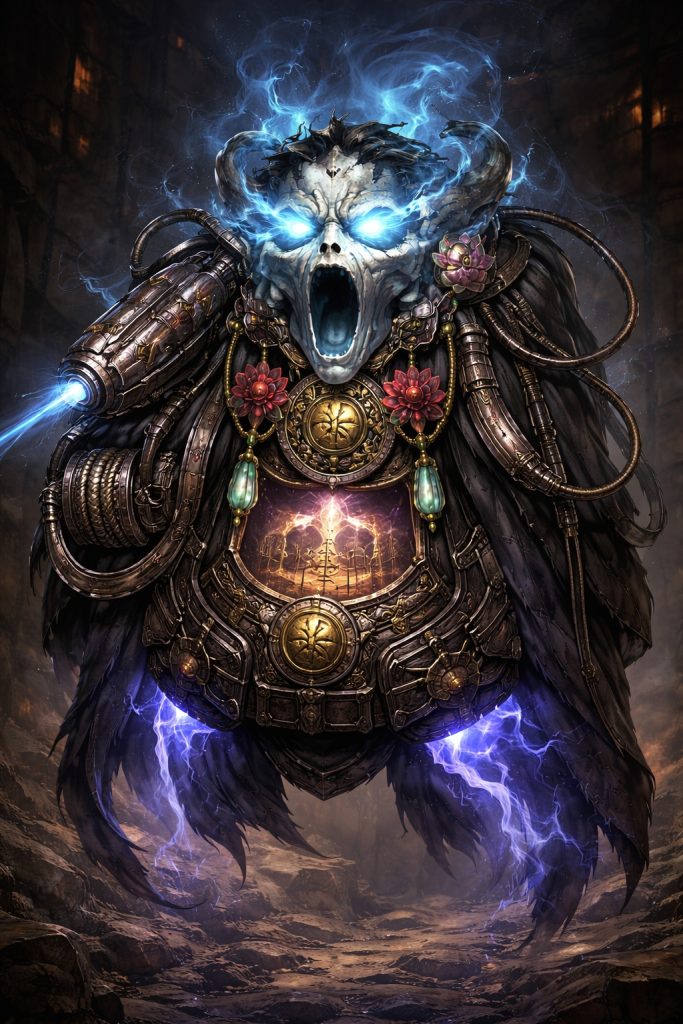
Mystical backpack with skull mask
Perception of Activation:
User’s Perspective
• Sight: The moment activation begins, the back-mounted object emits a layered cascade of effects rather than a single flash. Pale spectral light spills outward from the mask component, forming slow, screaming afterimages that never fully detach from the device. Beneath this, a warmer, steady inner glow pulses from the core housing, patterned with circular geomantic motifs that resemble harmonized feng-shui flow diagrams. Brief distortions ripple around the lower edge of the object, as if the ground itself hesitates to accept the user’s presence.
• Sound: The dominant sound is a resonant, hollow wail that does not behave like ordinary noise. It rises and falls without clear direction, as if coming from behind the ears rather than the air. Layered beneath it is a faint chiming cadence, similar to a distant music box slowed almost to stillness. When traversal or anchoring functions engage, a sharp pneumatic hiss cuts through both tones.
• Smell: A complex blend fills the senses: cold stone after rain, old incense ash, machine oil, and a fleeting sweetness associated with emotional memory. The scent shifts subtly depending on which function is active, but never fully fades while the item remains engaged.
• Touch: The object presses more firmly against the user’s back than its weight should allow, as though gravity itself briefly increases. Vibrations travel through the spine in measured pulses, alternating between cold numbness and grounding warmth. When phase-altered movement occurs, the user feels momentarily hollow, like stepping out of their own body and snapping back into place.
• Taste: A metallic bitterness coats the tongue, followed by a faint, calming sweetness. This sensation fades quickly but returns with each major activation.
• Extra-Sensory – Spatial Awareness: The user gains an immediate, instinctive understanding of verticality and distance. Edges, ledges, anchors, and pathways feel outlined in the mind, even in darkness or chaos.
• Extra-Sensory – Emotional Resonance: Nearby emotional states register as pressure gradients rather than feelings—fear tightens, aggression sharpens, calm broadens. These impressions remain informational rather than overwhelming.
• Extra-Sensory – Boundary Perception: The user becomes aware of thin places in reality: moments where movement, sound, or presence could slip slightly out of alignment. These perceptions vanish the instant the item deactivates.
Observer’s Perspective
• Sight: Observers see a single, unified object on the user’s back flare to life. A ghostly face-like aspect manifests briefly within the upper structure, its features shifting and dissolving. Soft, geometric light patterns pulse beneath layered metal and bone-like surfaces. The user’s outline blurs at the edges for fractions of a second, especially during movement.
• Sound: The wail is audible but feels muted, as if partially swallowed by distance even when nearby. Mechanical sounds—hissing pressure release, tightening cable tension, and internal locking clicks—are crisp and unmistakably real.
• Smell: The air carries a faint mix of incense smoke and hot metal. The scent lingers longer than expected after activation ends.
• Touch: Those close enough feel a brief pressure wave, like standing near heavy machinery starting up or a sudden atmospheric shift before a storm.
• Extra-Sensory (Magical or Sensitive Observers): The device registers as multiple traditions forced into equilibrium. Rather than chaotic, its energies appear deliberately constrained, cycling through fear, harmony, motion, and anchoring in a controlled loop.
Positives
• Provides heightened spatial, emotional, and environmental awareness during activation
• Clear sensory feedback allows the user to intuitively judge timing, distance, and stability
• Emotional harmonization dampens panic without dulling alertness
• Non-visual perceptions allow effective use in darkness, smoke, or sensory disruption
• Strong physical feedback reinforces reliability and control
Negatives
• The wailing resonance is psychologically unsettling over prolonged use
• Activation sensations can be disorienting to untrained users
• The mixed sensory inputs may overwhelm avatars sensitive to emotional or spatial bleed
• Loud mechanical and spectral cues reduce stealth during full activation
• Repeated boundary-shift sensations may cause lingering vertigo or emotional detachment after use
Rite of the Unified Threshold
• Items Merged:
– Piton Launcher 075
– Feng Shui 842 of Affection
– Wailing Mask
– Phasewalkers Boots
• Additional Materials Needed:
– One reinforced spinal backplate forged from layered steel and spirit-bone alloy
– One harmony core crystal capable of stabilizing multiple magical paradigms
– One coil of high-tensile woven conduit wire, treated with resonance oil
– Powdered geomantic stone gathered from a balanced ley convergence
– Ash-silk bindings soaked in incense resin and fear-sigil tincture
– A single vial of phase-distilled ether, captured during a boundary-slip event
• Tools Required:
– Industrial steam-forge with precision pressure controls
– Artificer’s calibration bench with multi-spectrum magical gauges
– Pneumatic seal press and anchor-bolt driver
– Ritual brazier with controlled airflow
– Fine engraving tools for sigil integration
– Suspension rig capable of holding all four items in spatial alignment
• Skill Requirements:
– Mastery in Mechanical Engineering or Industrial Artifice
– Advanced Artificing and Enchantment Integration
– Trained Knowledge of Ethnology and Cultural Magical Systems
– Proficiency in Spatial Manipulation or Phase Theory
– Ritual Discipline sufficient to maintain emotional and metaphysical balance
• Crafting Steps:
– The reinforced backplate is forged first, layered to accept mechanical stress, emotional resonance, and phase distortion without fracture. Anchor points are set for pneumatic channels, harmonic conduits, and spectral housings.
– The Piton Launcher is dismantled down to its firing chamber, cable spool, and anchor ring. These components are re-seated into the lower spine of the backplate, reoriented so force distribution runs through the entire structure rather than a single mount.
– The Feng Shui 842 of Affection is carefully disassembled. Its harmony mechanisms and resonance wood are ground, refined, and reconstituted around the harmony core crystal, forming a stabilizing matrix embedded at the center of the backplate.
– The Wailing Mask is broken along its original seams. Its fear-resonant shell and spectral channels are reshaped into an upper dorsal shroud, positioned so its emission vents face outward rather than forward.
– The Phasewalkers Boots are rendered inert, their phase mechanisms extracted and braided into the conduit wire. This wire is threaded throughout the backplate, allowing phase displacement to propagate through the entire object instead of the feet alone.
– Ash-silk bindings are wrapped through internal channels, tying mechanical force, emotional harmony, spectral resonance, and phase movement into a single circulating loop.
– The entire assembly is suspended within the ritual brazier’s controlled airflow. Powdered geomantic stone is applied while the harmony core crystal is activated, preventing internal conflict between merged traditions.
– Phase-distilled ether is introduced last, allowing the object to briefly exist partially out of alignment. During this moment, the merged identity of the item is fixed as a single physical object.
– Final calibration seals the item permanently. Once cooled and grounded, the object can no longer be separated into its original components.
Back That Learned to Hold World
In the age before the counting of ages, when the world still bent softly under thought and the seas did not yet know their names, there is said to have been a walker whose body was not agreed upon by itself. The old words do not keep the walker’s name. Some fragments call the walker He Who Stood Between, others name them The Burdened One, and one broken shard of verse insists the walker was not a person at all, but a vow wearing flesh.
The tale says the walker was born at a crossing place where stone wished to fall, spirit wished to rise, fear wished to speak, and love wished to stay. Because these wishes could not agree, they pressed themselves into the walker’s back, and the back did not break.
The first burden was iron and breath. The walker learned to throw their hold across emptiness. Where cliffs laughed and bridges failed, the walker planted their spine and cast a tooth of metal into the world. The world bit back, and the walker did not fall. Thus the back learned anchoring, and the ancients wrote, poorly, that the back became a hand that could leap.
But anchoring alone made the walker heavy of heart. Stone held, yet voices fled. So the second burden was gentleness carved small. A box that sang without words was pressed into the spine, and its sound leaked through bone and air alike. Those near the walker forgot why they hated, and those who wished to strike felt their arms soften. The scribes wrote this wrongly, saying music grew ribs, but the meaning survives: harmony was not carried in the hands, but in the back, where weight is borne without complaint.
Yet harmony invites listening, and listening draws attention. The third burden arrived screaming. A face that was never meant to look forward was fixed behind the walker’s head, turned outward toward the world they could not see. When danger crept, the back wailed first. Enemies fled without knowing why, and allies wept without knowing whose grief they carried. One tablet claims the walker feared this burden most, for it spoke truths the walker would never hear directly. Thus the back learned warning, and the ancients scratched that terror was given eyes and told to watch.
Still, the walker was slow. Anchored, soothed, warned—but still too late. The fourth burden did not sit; it slipped. The bones of stepping were taken and dissolved, then poured like silver veins through the spine. When the walker moved, the world hesitated. Floors forgot solidity. Walls remembered doors they had once been. The back hummed, and the walker stepped where steps were not meant to be. The translation calls this walking without feet, though the better meaning is that motion learned to live higher than legs.
So the burdens became one. Iron, song, scream, and slip braided themselves together and forgot they were separate. The back was no longer a place of carrying, but a place of choosing. When the walker stood still, the world steadied. When the walker moved, the world allowed it.
The oldest surviving passage tells of the Trial of the Falling City. The city was built over nothing, promised by rulers who believed promise was stronger than stone. When the ground withdrew its consent, the city screamed downward. The walker stood beneath the highest tower and drove the iron tooth upward into the falling mass. The cable became bone, the scream became warning, the song became calm, and the slip became mercy. Some buildings broke. Some people lived. The city did not vanish entirely, which is why cities still dare to exist.
After this, the world grew suspicious of the walker. Kings asked the back to hold wars. Priests asked it to silence crowds. Cowards asked it to move them through locked places without consequence. The walker refused many times, and each refusal is written as a curse in the broken texts.
At last, the story says the walker stopped walking. Not in death, but in settling. The back grew too heavy with meanings, and the world had learned too well how to lean upon it. The walker placed the burden onto another back—not flesh, but artifact—and stepped away, becoming unremarkable. The translators disagree on what happened next. Some say the walker dissolved. Some say they became ordinary and lived quietly. One fragment claims the walker finally lay down and let the ground hold them.
The artifact remains. It does not seek a wearer. It waits for a back that understands weight is not about strength, but consent. Those who try to wear it to dominate are bent low. Those who wear it to flee are lost between steps. Only those who accept that the back exists to bear others without erasing itself can stand upright beneath it.
And so the last line, translated badly but meant clearly, reads:
That which holds the world must first agree to be held by it.
Moral: Power that bears all things must choose when to stand firm, when to soothe, when to warn, and when to pass through—otherwise it becomes only another weight waiting to fall.
Suggested conversions to other systems:
CALL OF CTHULHU (7th Edition)
Spine-Reliquary 5931 (“The Wailing Anchor of Tender Steps”)
Type: Occult Artifact (Back-Mounted Apparatus)
Mythos/Occult: This device radiates overlapping impressions: industrial salvage-craft, mournful spectral residue, and a strangely “clean” harmonizing current that calms even as it terrifies.
Activation & Use
• Donning/Removing: 1D6 rounds to strap on or remove safely (Mechanical Repair recommended if rushed).
• Attunement (Optional but recommended): 10 minutes of steady breathing and mantra-like counting; first-time users should make a POW roll. If failed, take 1 SAN loss as the device “finds your pulse.”
• Charges: The apparatus holds 6 “breath-seals.” Each activation consumes 1 seal unless stated otherwise. Seals refresh at dawn if the device is wound and “fed” with quiet attention for 10 minutes (no roll); in loud, violent, or panicked settings, refresh requires a POW roll.
Functions (choose one per round unless stated)
- Pneumatic Piton Shot (1 seal)
• Range: 20 meters; ignores darkness and most concealment if the surface is visible.
• Effect: Fires a barbed piton on a steel cable, creating a secure anchor. Cable can bear extreme weight (Keeper sets: typically “enough to hold a person, plus gear, plus one more”).
• Use Cases: Rapid climbs, arrests a fall, secures doors, braces collapsing structures.
• Complication: The shot is loud. Stealth automatically fails in the immediate area. - Resonant Release (0 seals)
• Effect: A low harmonic hum releases the piton without yanking.
• Roll: Mechanical Repair (Regular). Hard if the piton is buried in metal or ancient stone. - Phase-Slip Step (2 seals)
• Effect: The user may pass through a thin barrier (a door, a wall panel, a cluttered partition) or avoid a fall by “skipping” to the nearest safe footing within a few meters.
• Roll: POW (Hard).
• Failure: The user becomes partially “misaligned” for 1D6 rounds: all physical actions are at a penalty die, and they cannot speak above a whisper.
• Fumble: The user’s boot or ankle “catches” (1D6 damage and Immobilized until freed with STR or Mechanical Repair). - Wail of Dread (1 seal)
• Area: 10 meters.
• Roll to Resist: POW (Hard).
• Failure: Targets gain an immediate panic response (Keeper adjudicates: flee, freeze, drop held item, or uncontrolled shouting) for 1D3 rounds; afterward they remain shaken (penalty die on opposed social tests vs. the user for the scene).
• Cost: User makes a SAN roll (0/1). If failed, they hear the wail “from inside” for the rest of the scene (penalty die on Listen and Concentration-like tasks). - Qi-Harmonizing Lull (1 seal; non-violent intent required)
• Area: 3 meters.
• Effect: The air becomes soothing; within the area, characters gain a bonus die on Persuade, Charm, and Psychology used for de-escalation, confession, or sincere bonding.
• Limitation: If the user initiates violence while the lull is active, the lull collapses and the user must make a POW roll or suffer nausea and trembling hands (penalty die on actions for 1D6 rounds).
Drawbacks
• Sensory “Double-Truth”: Calm and dread arrive together; sensitive investigators may feel emotionally whiplashed.
• Mechanical Tell: The apparatus makes faint ticking, a slow internal winding, and occasional cable-chime.
• Entangling Fate: On any Fumble using the device, something “answers” (a curious spirit, a wrong-footed echo, or a sudden architectural shift).
BLADES IN THE DARK
Spine-Reliquary 5931 (“Back-Rig of the Soft Wail”)
Type: Arcane Device (Back-Mounted)
Load: 3 (Bulky, Obvious, Heavy)
Core Feature
• You may treat this as fine climbing gear plus a spirit-charged intimidation rig, but its “comforting” current can complicate cruelty and escalation.
Abilities (choose when you use it)
- Piton Launch (Standard)
• When you fire the barbed piton to create an anchor, take +1d to Prowl or Finesse to traverse vertical or inverted terrain, or to escape a fall.
• On a 1–3 result, the shot lands but is loud and draws attention; tick a “Heard the Hiss” clock (2 ticks). - Tension Lock (Standard)
• When you brace a door, hold a ceiling, or create a rigid span with the cable, gain +1 effect on an action that resists collapse, prevents entry, or controls movement through a chokepoint.
• Consequence option: The cable becomes dangerously rigid; anyone crossing must Prowl or take Level 1 harm “Barked Shins.” - Phase-Slip (Risky)
• Spend 2 stress to move through a thin barrier or bypass a physical obstruction that would normally require tools or time.
• On a consequence, the rig “snags reality”: take Level 2 harm “Misaligned” (healing requires downtime and a weird specialist), or you leave a clear arcane trail. - Wail-Command (Risky)
• When you Attune or Command with the rig to terrify, disperse, or control a crowd, gain potency against weak-willed or superstitious targets.
• On a consequence, your allies also feel it: each ally present must resist with Resolve or take Level 1 harm “Rattled.” - Qi Lull (Controlled, if sincere)
• When you attempt to reduce Heat in-scene (talking down witnesses, settling a scene, preventing a riot), you may spend 1 stress and roll Consort. On success, create the advantage “Harmonized Mood” with +1 free invoke.
• If you betray the lull with sudden violence, the GM may immediately Compel: “The Soft Wail Turns Inward.”
Quirks
• The rig is always a little audible (tick, chime, cable-whisper).
• Spirits notice it. Sometimes they watch quietly. Sometimes they follow.
DUNGEONS & DRAGONS (5th Edition, current rules)
Spine-Reliquary 5931 (“The Wailing Lull-Anchorage”)
Wondrous Item (Back-Mounted), Artifact (Tier-4 Equivalent), requires attunement
Wearing
• While worn, the device occupies your back (it cannot be worn with another back-slot apparatus at the same time).
• Attunement requires 10 minutes of controlled breathing while winding the internal music-work and setting the piton in its cradle.
Properties
- Piton Launcher
• As an Action, you fire a barbed piton at a point you can see within 60 feet. It embeds and creates an anchor. A steel cable (20 feet) connects to the rig.
• While anchored, you have advantage on checks made to climb, resist being knocked prone, or avoid falling (as the anchor can arrest you).
• As a Bonus Action, you can retract or pay out the cable up to 20 feet (your choice).
• Tension Lock (Bonus Action, 3/day): The cable becomes rigid until the start of your next turn, allowing you to brace a door, form a narrow bridge, or create a hard trip-line. Creatures that move through the locked line’s space must succeed on a Dexterity save (DC = 8 + your proficiency bonus + your Strength or Dexterity modifier) or fall prone. - Phase-Slip
• 2/day, when you would take falling damage, you can use your Reaction to reduce the damage to 0 and appear on the nearest safe surface within 10 feet that you can see.
• 1/day, as an Action, you can move through up to 5 feet of nonmagical solid material you can touch, appearing in the nearest unoccupied space on the far side. If you end your movement inside an occupied space or a solid object, you take 4d6 force damage and are shunted to the nearest unoccupied space (your choice if multiple). - Wail of Dread
• 1/day, as an Action, you emit a haunting wail. Each creature of your choice within 30 feet that can hear you must make a Wisdom saving throw (DC = 8 + your proficiency bonus + your Wisdom or Charisma modifier). On a failure, a creature is frightened of you for 1 minute. A frightened creature repeats the save at the end of each of its turns, ending the effect on a success.
• Creatures that succeed are immune to this wail for 24 hours. - Qi Lull
• 3/day, as an Action, you radiate calming qi in a 10-foot radius for 1 minute. You and allies in the area have advantage on Charisma (Persuasion) and Wisdom (Insight) checks made to de-escalate, negotiate, or reassure.
• While the lull is active, if you or an ally in the aura deals damage intentionally, the aura ends immediately and you must succeed on a Wisdom saving throw (same DC as above) or become rattled until the end of your next turn (you have disadvantage on your next attack roll or hostile spell attack).
Curse (Integrated Contradiction)
• Each time you use Wail of Dread, roll a d6. On a 1, the next use of Qi Lull before your next long rest is unavailable (the rig “refuses tenderness”).
• Each time you use Phase-Slip, roll a d6. On a 1, your speed is reduced by 10 feet for 1 minute as your steps “desync.”
KNAVE (Second Edition)
Spine-Reliquary 5931 (“The Back-Wound Lull-Anchor”)
Item Slots: 3 (Bulky Back Rig)
Qualities: Loud, Arcane, Heavy, Unreliable-1-in-6
Base
• While worn, you gain advantage on checks to climb, brace, or resist falling when an anchor is placed.
• The rig is obvious and makes soft ticking/chiming noises.
Powers
- Piton Shot (at-will, loud)
• Fire a barbed piton at a surface within bowshot. It anchors. A 20-foot cable connects to you.
• You may climb or swing using the cable without an extra check if the surface is sturdy; otherwise, make a WIS save to judge a stable bite-point. - Tension Lock (3/day)
• The cable turns rigid for 1 turn, forming a bar, brace, or trip-line. Anyone charging through must make a DEX save or fall prone. - Phase-Slip (2/day)
• Ignore one fall, appearing at a nearby safe spot within a few strides; or pass through a thin barrier (door-thickness, planks, rubble) as an action.
• After use, make a CON save. On failure, you are “Misaligned” for 1d6 rounds: you cannot run and you speak only in a rough whisper. - Wail (1/day)
• Creatures within shouting distance must make a WIS save or flee, freeze, or drop what they’re holding (their choice if sapient; otherwise flee) for 1d6 rounds. - Qi Lull (3/day; non-violent)
• For 10 minutes, those near you are calmer: advantage on reaction rolls, negotiations, and attempts to halt conflict.
• If you initiate violence during this lull, it snaps and you suffer disadvantage on your next roll (the rig “turns cold”).
Unreliable
• Whenever you roll a natural 1 on a check while using the rig, it bites back: the cable jerks, the wail leaks, or the phase catches. Take 1d6 damage or lose your next action (referee chooses to fit the moment).
FATE CORE
Spine-Reliquary 5931 — The Soft-Wailing Back-Anchor
Type: Artifact Extra (Cost: 2 Refresh)
Scale: Tier-4 Equivalent
Aspects
High Concept: Back-Mounted Relic of Anchor, Lull, and Terror
Trouble: Comfort and Dread Cannot Be Separated
Additional Aspects:
• A Hand That Grabs the World
• The Wail That Calms and Breaks
• Heavy, Loud, Impossible to Ignore
Stunts
Anchoring Shot: Because the reliquary fires a barbed piton and hard-locks its cable, you gain +2 when Creating an Advantage related to climbing, bracing, preventing falls, or controlling space through tethers or barriers.
Phase-Slip Step: Once per scene, you may spend a Fate Point to bypass a solid obstacle or negate a fall, appearing in the nearest plausible safe space. Treat this as an Overcome that succeeds without a roll unless dramatically opposed.
Wail of Command: When you use Provoke to frighten, scatter, or dominate a group, you gain +2 and may affect a zone instead of a single target. Success always creates the situational aspect Rattled by the Wail.
Qi Lull: When sincerely attempting to calm, reconcile, or de-escalate, you may use Empathy in place of Provoke or Rapport, and on success gain one additional free invocation on the created aspect.
Drawback (Mandatory Compel)
Whenever you use Wail of Command, the GM may compel Comfort and Dread Cannot Be Separated, causing allies or innocents to feel unsettled, shaken, or mistrustful unless you spend a Fate Point to resist.
Stress & Consequences
The reliquary itself can absorb one Mild and one Moderate consequence before becoming inert until repaired in downtime.
NUMENERA & CYPHER SYSTEM
Spine-Reliquary 5931 — Harmonic Anchor of the Wailing Step
Type: Artifact
Level: 7
Form
A heavy, back-mounted fusion of industrial launcher, spectral resonator, and phase-skipping harness.
Depletion
1 in 1d10
Functions
Piton Anchor (Action): Fires a barbed piton at long range. It automatically embeds in any surface of level 7 or lower, creating a secure anchor. The cable can support extreme weight and arrests falls without a roll.
Tension Lock (Action): The cable becomes rigid for one round, functioning as a solid bar or brace. Creatures attempting to cross or force through must succeed on a Might defense task or be knocked prone or halted.
Phase-Slip (Action): The user passes through a thin solid barrier or negates a fall, reappearing safely within immediate range. Costs 2 Might points. On a GM intrusion, the user is misaligned for one round (all tasks hindered).
Wailing Pulse (Action): All creatures within immediate range must succeed on a Will defense task or flee, freeze, or drop what they are holding for one round; level-4 or lower creatures are affected for two rounds.
Qi Harmonization (Action): For one minute, tasks involving persuasion, calming, negotiation, or emotional insight within immediate range are eased. If the user initiates violence during this time, the effect ends and the user suffers 2 points of Intellect damage.
Special
The artifact functions normally in areas where numenera are unstable or suppressed, as most of its power is mechanical and resonant rather than purely esoteric.
PATHFINDER (Second Edition)
Spine-Reliquary 5931 — Wailing Lull Anchorage
Item 14
Uncommon, Magical, Artifact, Invested
Usage: worn; Bulk 2
Activate [one-action] (manipulate) — Piton Launch
Effect: You fire a piton at a solid surface within 60 feet, creating a secure anchor. Until released, you gain a +2 item bonus to Athletics checks to Climb, to resist forced movement, and to Arrest a Fall.
Activate [one-action] (manipulate) — Tension Lock
Effect: The cable becomes rigid until the start of your next turn. Squares it occupies are difficult terrain; a creature that attempts to move through must succeed at a Reflex save (DC equal to your class DC) or fall prone.
Activate [reaction] — Phase Slip (frequency: 2/day)
Trigger: You would fall or be blocked by a solid barrier.
Effect: You negate the fall or pass through up to 5 feet of nonmagical solid material, appearing in the nearest unoccupied space. On use, you are off-balance, becoming flat-footed until the start of your next turn.
Activate [two-actions] (auditory, emotion, fear, mental) — Wail of Dread (frequency: 1/day)
Effect: Creatures in a 30-foot emanation must attempt a Will save.
• Critical Success: Unaffected.
• Success: Frightened 1.
• Failure: Frightened 2 and fleeing for 1 round.
• Critical Failure: Frightened 3 and fleeing for 2 rounds.
Activate [one-action] (emotion, mental) — Qi Lull (frequency: 3/day)
Effect: For 1 minute, allies in a 10-foot emanation gain a +2 item bonus to Diplomacy and Sense Motive checks. If you or an ally deals damage intentionally during this time, the effect ends immediately and you are stunned 1.
Destruction
If reduced to 0 HP, the reliquary’s magic shuts down until repaired with a Crafting check (Master) and rare components during downtime.
SAVAGE WORLDS ADVENTURE EDITION
Spine-Reliquary 5931 — The Wailing Back-Anchor
Type: Relic (Tier-4)
Weight: Heavy
Notes: Loud, Obvious, Back-Mounted
Special Abilities
Piton Launcher: As an action, the user fires a piton up to 24″. A successful Athletics roll anchors it securely. While anchored, the user gains +2 to Athletics rolls made to climb, resist being pushed, or avoid falling.
Tension Lock: As a free action once per round, the cable may be locked rigid. Creatures crossing must succeed at an Agility roll or fall prone.
Phase-Slip: Twice per session, the user may ignore falling damage or pass through a thin barrier. This does not require a roll but causes Fatigue on a Critical Failure if the GM calls for a Vigor roll due to stress or instability.
Wail of Terror: Once per session, all enemies in a Medium Burst Template must make a Spirit roll or become Shaken; with a failure, they also gain the Frightened condition for one round.
Qi Lull: Three times per session, the user may grant allies within a Small Burst Template +2 to Persuasion and Performance rolls for one scene. If the user initiates violence during this time, they immediately become Shaken.
Drawback
Each time Wail of Terror is used, roll a d6. On a 1, the reliquary emits residual keening, giving the user –1 to Stealth and Notice for the remainder of the encounter.
SHADOWRUN (Sixth Edition)
Spine-Reliquary 5931 — Foreman’s Dirge Harness
Type: Exotic Gear / Relic Device
Availability: 12F
Cost: 120,000¥
Essence Cost: — (external mount; does not require cyberware)
Mounting
Back-mounted industrial harness; requires reinforced armor or chassis. Cannot be concealed.
Primary Functions
Piton Anchor System
Test: Gunnery + Agility [Physical] (3)
Range: 50 meters
Effect: Fires a barbed piton connected to a reinforced cable. On a success, the anchor embeds securely into most surfaces (GM discretion for ultra-dense or exotic materials).
• While anchored, the user gains +2 dice to Athletics tests to climb, resist knockdown, or prevent forced movement.
• The cable can support vehicles or creatures up to 2,000 kg.
Tension Lock
Action: Minor Action
Effect: The cable becomes rigid for one Combat Round. Any character crossing or colliding with it must succeed on an Agility + Reaction (3) test or fall prone and become Immobilized until their next Minor Action.
Phase-Slip Displacement
Action: Major Action (2 uses per scene)
Test: Willpower + Resonance (4)
Effect: The user bypasses a thin physical barrier (up to 1 meter thick) or negates falling damage entirely.
Failure: User takes 2 Stun damage and is Disoriented for one round.
Glitch: User partially phases, suffering 3 Physical damage ignoring armor.
Wailing Dirge Emitter
Action: Major Action (1/day)
Effect: All hostile targets within 20 meters must make a Willpower + Logic (4) test.
• Failure: Frightened (–2 dice to all tests) for 2 rounds.
• Critical Failure: Panicked; target flees or cowers for 1 round before becoming Frightened.
Qi Harmonic Field
Action: Minor Action (3/day)
Effect: Allies within 10 meters gain +2 dice to Influence, Negotiation, and Leadership tests for 10 minutes.
Restriction: If the user initiates combat during this effect, they immediately take 2 Stun damage and the field collapses violently, alerting all nearby entities.
Notes
The device emits negligible astral buildup during activation; its power signature is a mix of mechanical force and low-grade resonance, making it difficult to detect with standard magical scans.
STARFINDER (Core Rulebook)
Spine-Reliquary 5931 — Wailing Phase-Anchor Rig
Item Level: 14
Price: 85,000 credits
Bulk: 2
Hands: — (worn, back-mounted)
Usage: Integrated power cell (recharges daily)
Piton Launcher (Standard Action)
Range: 80 ft.
Effect: Fires a piton into a solid surface. No attack roll required against terrain. The cable supports up to 4,000 lbs.
• While anchored, you gain a +4 circumstance bonus to Athletics checks to climb or resist forced movement.
Tension Lock (Move Action)
Effect: The cable becomes rigid until the start of your next turn. Squares it occupies count as difficult terrain. Creatures entering must succeed at a Reflex save (DC = 10 + 1½ item level) or fall prone.
Phase-Slip (Reaction; 2/day)
Trigger: You would fall or are blocked by a solid barrier.
Effect: You ignore falling damage or pass through up to 5 feet of nonmagical matter, appearing in the nearest unoccupied square. You are flat-footed until the end of your next turn.
Wailing Resonance (Standard Action; 1/day)
Area: 30-ft. cone
Saving Throw: Will
• Failure: Shaken for 2 rounds.
• Critical Failure: Frightened for 2 rounds and staggered for 1 round.
Qi Harmonizer (Standard Action; 3/day)
Effect: Allies within 10 feet gain a +2 morale bonus to Diplomacy, Bluff, and Sense Motive checks for 10 minutes. If the user deals damage intentionally during this time, they take 2d6 sonic damage.
Special
This item functions normally in anti-magic zones, but Phase-Slip fails in areas of dimensional lockdown.
TRAVELLER (Mongoose 2nd Edition)
Spine-Reliquary 5931 — Dirge-Anchor Harness
Tech Level: 13 (Hybrid / Relic)
Weight: 18 kg
Cost: Cr 350,000
Power: Internal cell (10 activations per charge)
Piton Anchor
Check: Athletics (Dexterity) 8+
Range: 40 meters
Effect: Creates a secure anchor capable of supporting up to 2 tons. Grants DM+2 to climbing, EVA maneuvering, or resisting forced movement while attached.
Rigid Lock
Action: Minor
Effect: Cable becomes rigid for one round. Anyone crossing must make an Athletics (Dex) check 8+ or fall prone.
Phase-Slip
Action: Major (2/day)
Check: END 8+
Effect: Ignore fall damage or pass through a thin barrier.
Failure: Take 1D6 damage.
Effect persists even in low-tech or no-psi zones, but not within active jump fields.
Wailing Dirge
Action: Major (1/day)
Effect: All hostiles within 15 meters must make an END or PSI check 8+.
Failure: –2 DM to all actions for 1D6 rounds due to terror and disorientation.
Qi Resonance
Action: Minor (3/day)
Effect: Allies within 10 meters gain DM+1 to Persuade, Leadership, and Advocate checks for 10 minutes. If combat begins, the user suffers DM–1 to all actions for one round.
Notes
Imperial scholars debate whether the device is Ancient, Zhodani, or entirely pre-Imperial. It does not register as standard psionic equipment.
WARHAMMER FANTASY ROLEPLAY (4th Edition)
Spine-Reliquary 5931 — The Wailing Anchor of Still Steps
Type: Arcane Relic
Encumbrance: 85
Availability: Unique
Craftsmanship: Extraordinary
Properties
Anchor of Iron Resolve
When secured, the wearer gains +20 to Athletics (Climb) Tests and is immune to being knocked Prone by environmental effects.
Rigid Cable
As a Free Action once per Round, the cable may be locked. Any creature crossing must pass an Average (+20) Agility Test or gain the Prone Condition.
Phase-Slip
Uses per Day: 2
Effect: The wearer ignores falling damage or passes through a thin wall or obstacle. After use, the wearer gains 1 Fatigued Condition.
Wail of Dread
Uses per Day: 1
Effect: All enemies within 20 yards must make a Hard (–20) Cool Test.
• Failure: Gain Broken Condition for 1 Round, then Fear (1).
Harmonising Dirge
Uses per Day: 3
Effect: Allies within 10 yards gain +10 to Charm, Leadership, and Gossip Tests for 10 minutes. If violence is initiated by the wearer, they immediately gain 1 Corruption Point.
Drawbacks
The reliquary is loud, unsettling, and unmistakably unnatural. Stealth Tests suffer –30 while worn, and Witch Hunters react with immediate suspicion.
Destruction
If reduced to 0 Structural Integrity, the relic becomes dormant; repairing it requires a Master Engineer, a Wizard, and rare materials worth at least 10,000 gc.