
• Rarity: Common
• Tier: 1
• Item Type: Temporal Fire-Making Talisman
• Slot: Utility / Belt-Hung Charm (occupies one worn slot)
• Lore:
- Said to originate from early Saṃsāran hearth-keepers who guarded communal fires in regions where nightfall sometimes arrived early—or twice.
- The talisman was created to ensure flame never failed when it mattered most: during migrations, sieges, storms, and long watches.
- Chronicled accounts describe campfires that refused to go out even when rain fell before it began.
- Elders say the charm does not create fire faster, but persuades the moment of ignition to remember that it already succeeded.
• Description:
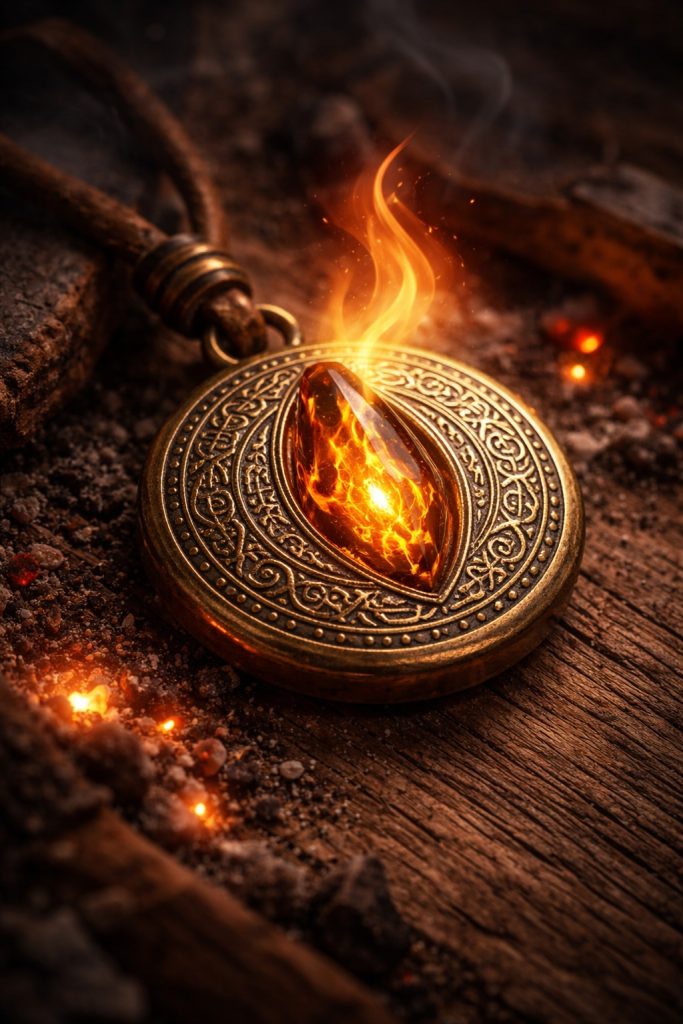
- A small brass disk no wider than two fingers, set with a sliver of amber crystal veined like a frozen flame.
- Fine spiral runes circle the crystal, etched shallow and worn smooth from generations of handling.
- When used, the crystal glows briefly and leaves a faint afterimage of a flame that has not yet fully formed.
• Stats and Mechanics:
- Weight: negligible
- Durability: modest; resistant to heat but vulnerable to crushing blows
- Attunement: required (counts as a worn attuned item)
- Compatible with mundane fire-making methods: flint and steel, tinderbox, bow drill, chemical ignition, or alchemical spark
• Skills Gained While Openly Worn:
- Fire-Making +2
- Survival +1 (limited to warmth, cooking, and campsite preparation)
• Passive Magical Effects:
- Remembered Ignition: The first attempt each scene to start a fire is more reliable, even in wind, dampness, or cold.
- Held Ember: Once a flame is successfully lit, it is harder to accidentally extinguish for the first few moments.
- Spark Sense: The wearer gains an intuitive sense if available materials are sufficient to start a fire before attempting.
• Activable Magical Effects:
- Delayed Kindling (2/day):
- The wearer strikes or sparks as normal, but the flame manifests a heartbeat later.
- This allows fire to appear after exposure to wind or distraction, as if the moment waited.
- Recalled Flame (1/day):
- If a fire was successfully lit within the last minute but failed, the wearer may cause it to reignite instantly from residual heat and memory.
- Held Moment of Heat (1/day):
- The wearer pauses the instant of ignition, allowing careful placement or shielding before the flame fully blooms.
- Particularly useful for stealthy fire-starting or precise cooking heat.
• Roleplay Notes:
- Fires lit with the charm often feel calm and steady, even when small.
- Observers may swear the flame appeared after the spark, not during it.
- Prolonged use can give the wearer a subtle sense of déjà vu when lighting fires.
• Tags:
- Time Magic, Fire-Making, Common, Tier 1, Temporal, Utility, Survival, Attuned, Hearthcraft, Chronal Ember, Ignition Control, Delayed Flame, Spark Recall, Campfire Utility, Heat Timing, Kindling Aid, Elemental Fire, Survival Gear, Temporal Charm, Low-Tier
• Ways the Item May Be Obtained:
- Recovered from abandoned campsites in regions where travelers vanished during sudden storms or temporal disturbances, the fire long gone but warmth still faintly remembered.
- Given as a gift by a hearth-warden, caravan elder, or village fire-keeper after proving respect for communal fires and safe flame use.
- Earned as payment for guiding settlers, traders, or pilgrims through cold, wet, or wind-scoured terrain where fire is life.
- Crafted or assembled as a reward after retrieving stabilized amber crystal or time-touched tinder from an unstable ruin or fractured woodland.
- Found among the personal effects of a deceased avatar whose body dispersed, leaving behind gear arranged neatly around the last place they warmed themselves.
• Types of Shops Where It Is Bought and Sold:
- Hearthcraft and Survival Outfitters:
- These shops specialize in camping gear, survival tools, cooking implements, and weather-resistant equipment.
- The charm is often displayed near fire-starting tools and cold-weather supplies.
- Sellers emphasize reliability rather than spectacle.
- Typical Cost: 8–15 silver
- Temporal Curio Stalls:
- Small, discreet vendors dealing in minor time-touched objects, often operating near old roads, ruins, or chronally unstable regions.
- Fire-making items are considered practical and non-threatening, making them easier to sell.
- Quality and tuning can vary slightly between pieces.
- Typical Cost: 12–20 silver
- Caravan Trade Wagons:
- Mobile merchants traveling between settlements and frontier zones.
- Items are frequently bartered rather than strictly purchased.
- Charms may show signs of use but are trusted by travelers.
- Typical Cost: 6–12 silver or equivalent trade goods
- Village Smiths and Tinker-Hearths:
- Local craftsmen who maintain tools, cookware, and everyday magical utilities.
- The charm may be made or sold alongside tinderboxes and cooking charms.
- Availability depends on access to temporal crystal fragments.
- Typical Cost: 7–14 silver
• Market Behavior and Trade Notes:
- Prices drop in regions where survival magic is common and rise sharply in cold, wet, or high-altitude territories.
- The item is rarely hoarded and frequently passed between travelers.
- Resale value depends on how clearly the delayed ignition effect can be demonstrated in adverse conditions.
- Communities that value shared hearths may restrict sales to trusted outsiders or require service in exchange.
Roleplay in different environments:
• Urban Environments (cities, ports, dense settlements)
- Offense:
- The wearer lights controlled flames in precise moments, such as igniting oil, signal flares, or distraction fires after guards have already looked away.
- Delayed ignition allows a spark to be struck openly, with the flame appearing later behind cover or around a corner.
- Fire is used theatrically rather than destructively, creating fear, confusion, or crowd movement without immediate visible cause.
- Small flames can be timed to coincide with doors opening, bells ringing, or machinery moving, making the fire feel inevitable rather than aggressive.
- Defense:
- Fires can be lit calmly during tense standoffs, projecting control rather than panic.
- Emergency light or warmth can appear after the wearer has already retreated to safety.
- The held ember effect prevents accidental extinguishing when jostled or bumped.
- Observers often hesitate, unsettled by fire appearing slightly after the action that should have caused it.
• Wilderness and Survival Environments (forests, tundra, mountains, swamps)
- Offense:
- Fire is used to drive off beasts by igniting torches or brush at moments that surprise predators.
- Delayed flames can ignite after wind shifts, avoiding premature extinguishing.
- The wearer times fire to appear just as a creature commits to an approach, reinforcing deterrence.
- Small controlled burns may be started precisely to manage terrain or create barriers.
- Defense:
- Fire can be reliably started under rain, snow, or heavy wind when survival depends on it.
- The wearer shields tinder first, knowing the flame will appear afterward.
- Recalled Flame allows recovery from failed attempts without wasting precious materials.
- The calm certainty of ignition reduces stress and panic in life-threatening conditions.
• Underground and Enclosed Spaces (caves, ruins, tunnels)
- Offense:
- Fire appears after sparks are struck, making it difficult for foes to predict when light will bloom.
- Flames can be used to flush creatures or deny passages with carefully timed ignition.
- The delayed glow causes shadows to jump unnaturally, disorienting those relying on darkness.
- Fires lit near fuel sources seem to awaken suddenly rather than gradually.
- Defense:
- The wearer avoids premature lighting that could reveal position.
- Flames can be made to appear only after retreating or repositioning.
- Held Moment of Heat allows precise placement in tight spaces without uncontrolled flare-ups.
- The steady nature of the flame reduces fear in confined, lightless environments.
• Battlefields and Skirmish Zones
- Offense:
- Fire is used tactically to deny ground, destroy supplies, or force movement.
- Delayed ignition allows flames to appear after enemies commit to positions.
- Smoke sources can be ignited at moments that maximize confusion.
- Fire feels like a consequence of poor choices rather than an obvious attack.
- Defense:
- Emergency fires provide light, warmth, or smoke cover at exactly the right moment.
- The wearer can keep embers alive under pressure while retreating.
- Fire can be reignited quickly to prevent loss of morale or visibility.
- The predictable reliability of ignition contrasts with the chaos of combat.
• Stealth, Espionage, and Sabotage Contexts
- Offense:
- Fires are lit after the wearer has already moved away, obscuring responsibility.
- Delayed ignition makes arson appear spontaneous or accidental.
- Small flames can distract guards without exposing the wearer.
- The fire’s appearance feels unconnected to any visible action.
- Defense:
- The wearer avoids lighting flames until the exact moment they are needed.
- Fires can be used to erase tracks, destroy evidence, or create false timelines.
- Recalled Flame prevents failure when only one chance exists.
• Social and Psychological Use
- Offense:
- Lighting a fire that appears late unsettles witnesses and implies control over events.
- A single calm spark followed by a delayed flame carries implicit threat.
- The wearer seems unhurried, as if the outcome is already known.
- Defense:
- The charm reinforces the image of preparedness and composure.
- Fire becomes a tool of reassurance rather than desperation.
- Those familiar with time magic may hesitate, unsure if the flame has already been decided.
• Overall Roleplay Tone
- Fire is not rushed or forced; it is remembered.
- The item favors patience, foresight, and quiet confidence.
- Flames feel less like reactions and more like moments arriving on schedule.
Perception of Activation:
• User’s Perspective:
- Sight: The amber crystal brightens with a warm inner glow, briefly showing a ghostly flame shape hovering just above the disk before the real fire appears.
- Sound: A soft, almost inaudible crackle occurs out of sync with the spark, followed by the true sound of ignition a heartbeat later.
- Touch: The metal feels comfortably warm rather than hot, as if heat is being remembered instead of produced.
- Smell: A clean, dry scent like warmed resin and faint smoke arrives before any actual burning material catches.
- Extrasensory (Temporal Sense): The user experiences a subtle certainty, as though the flame has already been lit and is merely waiting to arrive.
• Observer’s Perspective:
- Sight: The spark is visible, but the flame appears a moment later, giving the impression of delayed cause and effect.
- Sound: Witnesses may hear a faint crackle with no flame, followed by the true sound of fire after a brief pause.
- Motion Perception: The flame seems to bloom smoothly rather than flare, as if unfolding from an already-decided outcome.
- Extrasensory (Ambient Distortion): Those sensitive to magic feel a brief warmth in the air before the fire physically exists.
• Positive Sensory Effects:
- Increased calm and confidence when starting fires under pressure.
- Reduced frustration from failed or extinguished ignition attempts.
- A feeling of control and patience replacing urgency.
- Flames tend to stabilize quickly, producing steady light and heat.
• Negative Sensory Effects:
- Mild déjà vu related specifically to fire-lighting moments.
- Brief disorientation if the charm is activated repeatedly in quick succession.
- A faint lingering warmth in the hands even after the flame is extinguished.
- Occasional difficulty judging the exact instant a flame truly begins immediately after use.
Chronosmith’s Hearthcraft Recipe: Lingering Spark Temporal Fire Charm
Materials Needed:
- A sliver of amber crystal with visible internal flame-like veining
- Refined brass disk blank, no wider than two fingers
- Powdered ember-ash collected from a naturally extinguished fire
- Alchemical binding resin tolerant to repeated heating and cooling
- Fine-grain temporal sand gathered from a time-softened site (such as an old ruin or weather-worn crossroads)
- Distilled elemental water, one small vial
- A personal ignition anchor from the crafter (breath condensed on cooled metal, or a single drop of blood)
Tools Required:
- Small jeweler’s hammer and precision chisels
- Arcane etching needle capable of holding a steady magical flow
- Low-heat alchemical brazier
- Polishing stones of increasing fineness
- Crystal clamp or stabilization frame
- Tongs and fireproof gloves
- Lens magnifier for rune alignment
Skill Requirements:
- Basic understanding of time magic principles
- Fire-making and hearthcraft proficiency
- Fine metalworking or jewelry crafting skill
- Controlled magical flow manipulation
- Patience and steady concentration during prolonged work
Crafting Steps:
- Warm the brass disk slowly over the alchemical brazier until it accepts etching without warping.
- Using the arcane needle, etch shallow concentric spiral runes around the disk’s center, maintaining a slow, even magical flow to avoid time fractures.
- Allow the disk to cool naturally; do not quench, as sudden cooling disrupts temporal memory.
- Secure the amber crystal in the stabilization frame and dust it lightly with ember-ash to awaken its heat memory.
- Gently warm the crystal until it glows faintly, then set it into the center of the brass disk using alchemical binding resin.
- While the resin is still soft, sprinkle a trace of temporal sand around the crystal, letting it settle into the rune channels.
- Seal the assembly and polish the surface until the runes feel worn smooth to the touch.
- Drip distilled elemental water across the disk to wash away excess temporal noise.
- Introduce the personal ignition anchor, binding the charm to the concept of intentional fire rather than raw flame.
- Let the charm rest near a dying fire for several hours so it can absorb the memory of ignition without consuming fuel.
- Test the charm by striking a spark near tinder; a faint afterimage of flame should appear before the fire fully forms.
Failure Conditions and Notes:
- Overheating the amber crystal may cause unstable ignition timing.
- Rushed etching can result in flames that hesitate too long or fail to manifest.
- Each completed charm will carry subtle variations, reflecting the moment in which it learned how to burn.
In the time before time learned how to count itself, there was a place where night sometimes arrived before sunset and left after dawn. In that place lived a keeper of embers whose name is lost, broken into three sounds that no tongue now agrees upon. Some translations call this one a woman, some a man, some insist the keeper was not a person at all but a role that moved from body to body like smoke.
This keeper guarded the village fire, which was said to have been lit once and never truly extinguished. When rain fell, the fire slept. When wind howled, the fire leaned. When the village was abandoned and later returned to, the fire was waiting.
The old text says that one winter came twice. Snow fell, melted, and fell again before the people had finished complaining about the cold. Wood ran low. Sparks failed. Flint struck stone and nothing answered. Fear grew sharp, and sharp fear makes clumsy hands.
The keeper knelt before cold ash and did not hurry.
They struck the stone once, and nothing happened. They struck it again, and still nothing. The people began to whisper, and some turned away. Then, after the stone was already lowered, after the spark had already died, flame appeared. Not large. Not loud. But certain.
The keeper smiled, though the translation says instead “the face remembered warmth.”
The elders asked how this was done. The keeper answered with words that do not survive intact. One fragment says the fire was convinced it had already burned. Another says the moment was delayed so it would not be lost. A third says the flame was shy and needed time to arrive.
The keeper made a small disk of yellow metal and pressed into it a shard of hardened sunset. Around it were cut spirals, though the text argues whether these were runes, prayers, or simply reminders written for time itself. The disk was carried from hearth to hearth. Wherever it rested, flame came when needed, not when demanded.
There are passages describing battles where torches lit after being thrown, forests that burned only after rain passed, and camps where warmth arrived moments after despair. But the words are tangled, and scholars disagree on what truly happened and what arrived later.
The final pages describe the keeper walking into the dark without fire, trusting it would follow. Whether it did is not recorded. The disk remained. It passed through many hands. Some used it wisely. Some tried to rush it. The text says those who rushed were cold longer.
The last surviving line is written unevenly, as if the scribe paused before finishing it, or perhaps finished it before starting.
Moral of the Story:
Fire comes to those who allow the moment to arrive.
Suggested conversions to other systems:
Call of Cthulhu (7th Edition)
Time 6893 of the Lingering Spark (Chronal Fire-Making Charm, Common)
Item Type and Use
• Thumb-sized brass disk with amber crystal; worn charm.
• Attunement: 1 minute of focused handling while preparing tinder and imagining the moment of ignition.
• Only one person may be attuned at a time; a new attunement breaks the old bond immediately. The former attuned user senses the break as a brief chill, like a fire going out behind them.
Mechanical Effects
• While worn and attuned, the user gains:
- Survival: +10% (applies when making shelter, maintaining warmth, tending fires, cooking in the field, and other fire-adjacent survival tasks)
- Natural World: +10% (only for assessing dryness, wind, usable tinder, and burn behavior)
• Spark Sense: The Keeper should give a clear yes/no intuition if local materials are capable of sustaining a flame before the user commits to lighting (no roll; once per scene).
Passive Magical Effects
• Remembered Ignition: The first attempt each scene to light a fire gains a bonus die (if your table uses bonus/penalty dice for relevant Survival or Natural World checks) or a flat +20% to the relevant roll, Keeper’s choice.
• Held Ember: For the first several minutes after a successful ignition, accidental extinguishing from mild wind, jostling, or distraction is avoided once per scene (Keeper adjudication; heavy rain or immersion still kills flame).
Activated Effects
• Delayed Kindling (2/day): Declare before the roll to light a fire. If successful, the flame appears a heartbeat later, after the user has shielded it or stepped into cover. This negates one environmental penalty (wind gust, sudden movement, or momentary exposure) for that ignition attempt.
• Recalled Flame (1/day): If a fire was successfully lit within the last minute and then failed, it reignites without a roll, provided the original fuel and tinder still exist.
• Held Moment of Heat (1/day): For the next minute, any small flame you tend is unnaturally steady. Gain one automatic success on a single Survival-related task involving precise heat control (gentle cooking, cautery, sealing wax/resin, warming hands without smoke bursts), Keeper’s discretion.
Costs and Risks (Optional, Keeper Use)
• If two activations are used in the same scene, make a POW roll. On a failure, the user suffers a brief temporal hitch: one action next round is taken with 1 penalty die (or –10%) as the mind “replays” the ignition moment.
Blades in the Dark
Time 6893 of Lingering Spark (Common Temporal Hearth Charm)
Item
• Brass-and-amber charm worn on belt, cord, or pouch strap.
• Takes no special load beyond the charm itself unless your table tracks small gear tightly.
• Keying: Spend a quiet minute preparing tinder and “setting the second.” Only one person can be keyed at a time.
Passive Benefits (While Keyed)
• Spark Sense: When you survey materials and conditions for a fire, you may ask one direct yes/no question about viability (“Will this catch?” “Is this too damp?”). The GM answers honestly.
• Remembered Ignition: The first time per score you start a fire under pressure, you gain improved position or effect (GM choice) if the main obstacle is timing, wind, dampness, or panic.
Special Abilities
• Delayed Kindling (2 per score): When you create a fire, you may delay the moment it visibly catches until you’re ready. Mechanically: you may avoid or reduce one consequence tied to being exposed while lighting (spotted, harmed, gear ruined, position worsened).
• Recalled Flame (1 per score): If your attempt to start a fire fails, you may immediately retry with +1 effect or improved position; narratively, the flame “remembers” the successful timeline.
• Held Moment of Heat (1 per score): For one scene, your flame stays steady. You gain potency on actions where precise heat matters (safe signaling, careful burning, smoke control, cooking/boiling fast without flare).
Drawbacks (GM Tool)
• If you use two abilities in a single scene, the GM may introduce a subtle tell: delayed crackle, ember-glow arriving early, or a witness unnerved by cause and effect.
Dungeons & Dragons (5th Edition, current core rules)
Time 6893 of the Lingering Spark (Wondrous Item, Common, Requires Attunement)
Worn Item
• A brass disk with an amber crystal, worn on a cord, belt, or pouch strap.
Attunement
• Requires attunement by a creature. Only one creature can be attuned at a time; a new attunement ends the previous one immediately.
Passive Properties (While Worn and Attuned)
• Spark Sense: You have advantage on Wisdom (Survival) checks made to find dry tinder, evaluate burnable materials, or choose a sheltered place to start a fire.
• Remembered Ignition: You can ignite tinder you are holding or touching as an action, as if using flint and steel, even in wind or light rain (DM adjudication). This doesn’t create fuel; it only ensures ignition if fuel is plausible.
• Held Ember: The first time each day that a fire you lit would be snuffed by minor causes (a gust, jostling, brief distraction), it instead remains lit.
Activated Properties
• Delayed Kindling (2/day): When you ignite tinder, you may delay visible ignition for up to 6 seconds, causing the flame to appear at the end of the delay. You can use this to light a fire after you duck behind cover, step into a tent, or move your hands away.
• Recalled Flame (1/day): If a fire you lit goes out within 1 minute, you can cause it to reignite as a bonus action, provided the fuel and tinder are still present.
• Held Moment of Heat (1/day): For 1 minute, the flame you tend burns steady and controlled. During this time you have advantage on any ability checks to cook quickly, signal without excessive smoke, cauterize safely, or keep a small flame alive in poor conditions.
Balance Notes for the DM
• The charm is utility-focused and should not replace stronger magical fire creation; it excels at reliability and control.
Knave (latest edition)
Time 6893 of the Lingering Spark (Common Magic Charm)
Item and Slot Use
• Brass disk with amber crystal; occupies 1 inventory slot when carried.
• When worn openly, it is considered equipped.
Binding
• Hold the charm over tinder and breathe steadily for 1 minute to bind it. Only one binder at a time.
Passive Effects (While Bound and Worn)
• Sure Ember: +1 on checks to start or maintain a fire in poor conditions.
• Spark Sense: Once per scene, the GM must answer truthfully whether available materials can sustain a flame.
Activated Effects
• Delayed Kindling (2/day): Your ignition “waits.” Ignore one situational penalty from wind, dampness, or distraction on a fire-starting attempt.
• Recalled Flame (1/day): If a fire you started went out within the last minute, it reignites automatically (no roll) if fuel remains.
• Held Moment of Heat (1/day): For 10 minutes, your flame is stable and controlled. You gain advantage on tasks needing careful heat (quick cooking, sealing resin, controlled smoke signaling). If your table doesn’t use advantage, treat as +2 to the roll.
Limits and Tone
• The charm does not create fuel or large magical flames; it makes ignition and steadiness behave as if time itself is cooperating.
Fate (Core / Condensed)
Time 6893 of the Lingering Spark (Common Temporal Hearth Charm)
Item Aspect
• “Fire Arrives When It Is Ready”
Attachment and Use
• Worn charm; treated as part of the character’s personal gear.
• Setting the charm requires a quiet minute preparing tinder and focusing on the moment ignition should occur. Only one user may be keyed at a time.
Passive Benefits
• When you Create an Advantage involving starting, sustaining, concealing, or precisely controlling a small fire, gain +1 if the obstacle is timing, wind, dampness, or panic.
• Once per scene, you may treat a failed Overcome action related to lighting or maintaining a small fire as a success with a minor cost (smoke, delay, odd attention, or a faint temporal tell).
Stunts
• Delayed Kindling (1/scene): When you successfully Create an Advantage to light a fire, you may delay the visible ignition until the end of the exchange. Place an aspect such as Waiting Flame or About to Catch with one free invocation.
• Recalled Flame (2/session): After failing a roll to start or keep a fire, you may reroll by spending 1 Fate Point and must keep the new result. This does not count as invoking an aspect.
• Held Moment of Heat (1/session): Before rolling an action involving careful heat control (quiet cooking, signaling, cautery, sealing resin), ignore one source of opposition derived from instability or distraction.
Narrative Cost (GM Tool)
• If two stunts are used in the same scene, the GM may introduce a fleeting temporal complication: delayed crackle, ember-glow before flame, or a witness unsettled by cause and effect.
Numenera & Cypher System
Time 6893 of the Lingering Spark (Common Temporal Utility Mod, Level 2)
Item Type
• Worn utility charm focused on ignition and heat control.
Level
• 2
Passive Effects
• Spark Sense: Once per scene, the GM gives a clear yes/no intuition about whether available materials can sustain a flame.
• Remembered Ignition: Reduce the difficulty of the first fire-starting or flame-stabilizing task each encounter by one step when timing or conditions are the main obstacle.
Activated Effects
• Delayed Kindling (2/day): When you attempt to light a fire, ignore one hindrance related to wind, dampness, or momentary exposure; the flame manifests a moment later after the attempt resolves.
• Recalled Flame (1/day): If a fire you successfully lit within the last minute goes out, it reignites immediately without a roll, provided fuel remains.
• Held Moment of Heat (1/day): For one minute, tasks involving precise heat are eased; treat one relevant task as eased by one step (quiet cooking, controlled smoke, careful cautery).
Depletion
• On a natural roll of 1 during an activation, roll a d20. On a 1–2, the amber clouds and the charm becomes inert until repaired.
GM Notes
• The item improves reliability and control rather than creating large flames or damage.
Pathfinder (2nd Edition)
Time 6893 of the Lingering Spark (Item 1, Invested, Magical, Temporal)
Item Type
• Worn Item (Utility Charm)
Usage and Investment
• Attaching or removing the charm takes 1 minute.
• Requires investment; only one creature can invest the item at a time.
Passive Effects
• Spark Sense: Once per hour, when you assess materials and conditions for a fire, the GM provides a clear yes/no about viability without a check.
• Remembered Ignition: You gain a +1 item bonus to checks to start or maintain a small fire when adverse conditions are primarily timing- or environment-based.
Activations
• Delayed Kindling [one-action] (2/day): Attempt to start a fire. Ignore one circumstance penalty from wind, dampness, or brief exposure; the flame visibly appears at the end of the action.
• Recalled Flame [free-action] (1/day, trigger: a fire you lit within the last minute goes out): The fire reignites if fuel remains.
• Held Moment of Heat [one-action] (1/day): Until the end of your next turn, you ignore circumstance penalties on checks involving careful heat control (quiet cooking, signaling, cautery).
GM Guidance
• The charm smooths low-level variance and avoids catastrophic failure; it does not generate fuel or large magical fires.
Savage Worlds (Adventure Edition)
Time 6893 of the Lingering Spark (Common Temporal Hearth Charm)
Attachment
• Worn charm; no additional gear slot beyond itself.
Passive Effects
• Sure Ember: Gain +1 to Survival or relevant skill rolls made to start or keep a small fire in poor conditions.
• Spark Sense: Once per scene, the GM answers truthfully whether local materials can sustain a flame.
Powers (Item-Based; No Power Points Required)
• Delayed Kindling (2/session): Ignore one situational penalty from wind, dampness, or distraction when starting a fire; the flame appears a moment later after the action resolves.
• Recalled Flame (1/session): If a fire you lit within the last minute goes out, it reignites automatically if fuel remains.
• Held Moment of Heat (1/session): Gain +2 to a single roll involving careful heat control (quiet cooking, controlled smoke, safe cautery).
Optional Side Effects
• Using more than one power in a single scene may produce minor temporal tells: delayed crackle, ember-glow arriving early, or an observer unsettled by the timing.
Tone and Balance
• The charm enhances patience, control, and survival utility without increasing damage or creating large-scale fire effects.
Shadowrun (6th World)
Time 6893 of the Lingering Spark (Temporal Hearth Charm, Common)
Item Type and Use
• Worn utility charm focused on ignition and controlled heat
• Attunement required; 1 minute of calm handling while preparing tinder
• Only one user may be attuned at a time; re-attunement breaks the previous bond immediately, felt by the former user as a brief cold sensation
Passive Effects
• Sure Ember: Reduce environmental penalties by 1 die when attempting to start or maintain a small fire under stress, wind, dampness, or poor conditions.
• Spark Sense: Once per scene, the user may ask the gamemaster whether available materials can realistically sustain a flame; the answer is direct and truthful.
• Held Warmth: The first minor interruption that would snuff a small flame each encounter instead fails, provided fuel remains.
Activated Effects
• Delayed Kindling (2/scene): Declare before attempting to light a fire. The visible ignition occurs moments later, allowing the user to negate one situational penalty related to exposure, movement, or sudden wind.
• Recalled Flame (1/scene): If a fire successfully lit within the last minute goes out, it reignites immediately without a test, as long as fuel remains.
• Held Moment of Heat (1/scene): For one minute, gain +2 dice on tests involving precise heat control such as careful cooking, controlled smoke, sealing resin, or safe cauterization.
Limits and Side Effects
• Using more than one activation in the same scene may produce subtle temporal tells: delayed crackling sounds, warmth before flame, or a brief sense of déjà vu.
Starfinder
Time 6893 of the Lingering Spark (Level 1 Hybrid Item, Temporal, Utility)
Item Type
• Worn accessory; does not consume additional upgrade slots
Usage
• Requires attunement; only one creature may be attuned at a time
Passive Effects
• Remembered Ignition: Reduce the DC of the first attempt each encounter to start or maintain a small fire by 2 if timing or conditions are the primary obstacle.
• Spark Sense: Once per encounter, the user gains immediate insight into whether available materials can support combustion.
• Held Ember: Once per day, a small fire the user lit resists being extinguished by minor environmental effects.
Activated Abilities
• Delayed Kindling (2/day): Ignore one penalty from wind, dampness, or sudden exposure when igniting a fire; the flame appears after the action resolves.
• Recalled Flame (1/day): A fire lit within the last minute reignites instantly if it goes out and fuel remains.
• Held Moment of Heat (1/day): For 1 minute, gain a +2 insight bonus on checks requiring careful heat application.
Notes
• The item enhances reliability and control rather than creating or amplifying destructive fire.
Traveller (2nd Edition)
Time 6893 of the Lingering Spark (Temporal Utility Charm)
Item Type
• Worn charm; attuned to a single user
Passive Effects
• Timing Certainty: Gain DM+1 on Survival or equivalent checks to start or maintain a small fire in adverse conditions.
• Spark Sense: Once per encounter, the referee provides a clear answer on whether local materials can sustain a flame.
• Held Warmth: The first minor failure that would extinguish a fire you started is ignored.
Activated Effects
• Delayed Kindling (2/day): Negate one situational DM penalty from wind, movement, or exposure when starting a fire; the flame manifests moments later.
• Recalled Flame (1/day): If a fire lit within the last minute goes out, it reignites automatically if fuel remains.
• Held Moment of Heat (1/day): For the next minute, gain DM+2 on tasks requiring precise or careful heat use.
Trade and Balance
• Common among scouts, explorers, and frontier settlers
• Does not create fuel or increase destructive potential
Warhammer Fantasy Roleplay (4th Edition)
Time 6893 of the Lingering Spark (Common Magical Hearth Charm)
Item Type
• Worn charm associated with controlled fire and temporal steadiness
• Requires attunement by a single wielder
Passive Effects
• Sure Ember: Gain +10 on tests involving lighting or maintaining a small fire under difficult conditions.
• Spark Sense: Once per scene, the GM confirms whether available materials are sufficient to sustain a flame.
• Held Warmth: The first time per session a fire you lit would be extinguished by minor causes, it instead remains lit.
Activated Effects
• Delayed Kindling (2/session): Ignore one penalty related to wind, dampness, or sudden movement when starting a fire; ignition appears a moment later.
• Recalled Flame (1/session): A fire lit within the last minute reignites automatically if fuel remains.
• Held Moment of Heat (1/session): Gain +10 on a single test involving precise heat control such as careful cooking, smoke management, or cauterization.
Risks and Tone
• Repeated use may cause faint temporal unease or delayed sensory effects
• Emphasizes patience, reliability, and survival utility rather than raw power
Comments
One response to “Time 6893 of the Lingering Spark”
[…] From: Time 6893 of the Lingering Spark […]