
Lore
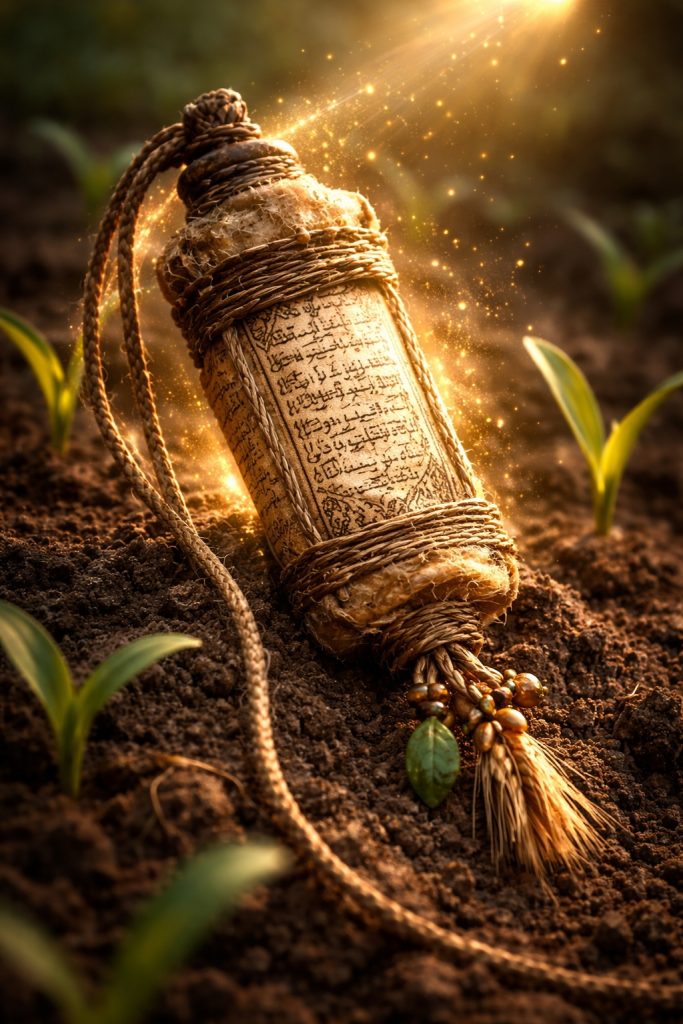
Among the quiet field-villages of Saṃsāra, where ley currents run shallow and the work of survival is slow and faithful, elders taught that land listens best to those who speak gently and often. Taweez 358 of the Blessed Furrow was first woven by agrarian Ruqyah-keepers who believed that soil, like spirit, could suffer affliction: blight, exhaustion, and imbalance. The verses inscribed within this Taweez emphasize patience, gratitude, and stewardship. It is not meant to command the land, but to remind it—and the farmer—that care given steadily returns itself in kind.
Stats
• Tier: 1
• Rarity: Common
• Slot: Neck (Amulet) or Belt Accessory
• Material: Sun-dried vellum inscribed with umber ink, wrapped in braided straw-cord and sealed in beeswax
• Weight: Negligible
• Durability: Light–Moderate (protected from dirt and moisture by wax sealing)
Skills Gained While Openly Worn
• Agrarian Insight (Tier 1): The wearer gains intuitive understanding of soil condition, crop stress, and irrigation needs.
• Steward’s Appraisal: The avatar can identify early signs of blight, pest presence, or spiritual imbalance affecting farmland or stored harvests.
Passive Magics
• Verse of Patient Growth: Crops tended personally by the wearer grow more evenly, reducing yield loss from minor environmental stress or neglect.
• Ruqyah of Settled Earth: The ground within a small working radius around the wearer resists minor spiritual disturbances, preventing taint, rot-spirits, or restless energies from taking hold.
• Scent of Honest Labor: The wearer carries a faint smell of warm soil and grain, granting a small social advantage in dealings with rural folk, laborers, and agrarian guilds.
• Steady Hands, Steady Heart: Repetitive labor does not accumulate fatigue as quickly while the Taweez is worn openly.
Activable Magics
• Recitation of the First Furrow: By softly reciting a Ruqyah verse while touching soil or seed, the wearer may bless a planting area. For the next day, that area is resistant to minor blight, frost-nip, or drought stress.
• Prayer of the Mended Yield: Once per day, the wearer may recite a verse over damaged crops, stored grain, or tools, restoring usability and preventing further deterioration caused by mundane or spiritual factors.
• Invocation of the Resting Field: By hanging the Taweez from a fence post or tool handle overnight, the land or equipment gains a brief spiritual reprieve, clearing lingering exhaustion or contamination by dawn.
Tags
Taweez, Ruqyah, Farmer, Tier-1, Common, Agrarian, Soil-Bound, Growth, Stewardship, Blessing, Rural, Faith, Harvest, Grounded, Sustenance, Crop-Care, Field-Ritual, Earth-Blessed, Seasonal, Patient-Labor, Hearthland, Soil-Wisdom, Rooted-Faith, Yield-Bound, Plow-Sanctified, Gentle-Industry
Ways the Taweez Is Obtained
• Field Blessing Rite:
A novice farmer receives the Taweez after completing their first full planting and harvest cycle without abandoning the land. A local Ruqyah-keeper inscribes the verses at dawn, using soil from the field itself. The rite emphasizes patience, stewardship, and continuity rather than profit.
• Inheritance of the Furrow:
The Taweez is passed down within farming families. It is often rewrapped in new leather each generation, but the vellum and ink are preserved. Receiving it typically coincides with taking responsibility for a plot of land or homestead.
• Rural Shrine Commission:
Small countryside shrines dedicated to sustenance, rain, and protection of labor will commission these Taweez upon request. The farmer must bring a token of their work—grain, seed, or tools—as part of the blessing.
• Seasonal Covenant Work:
In some regions, cooperative farms award the Taweez to workers who remain through harsh seasons (flood, drought, blight). It is seen as a mark of trust rather than a reward.
Shops and Places of Trade in Saṃsāra
• Village Ruqyah Circles (Rural Settlements):
These are not formal shops but open-air gatherings held weekly near wells or granaries. Transactions are quiet and respectful. The Ruqyah-keeper tests the soil on the farmer’s hands before agreeing to sell or re-consecrate a Taweez.
Cost: 8–12 gold, often reduced if paid partly in produce.
• Agrarian Supply Houses (Normal Zones, Market Towns):
Practical stores that sell plows, seed stock, irrigation fittings, and warded tools. The Taweez is sold as a “Field Stability Charm” and kept wrapped in cloth behind the counter. They will buy back undamaged Taweez only during harvest season.
Cost: 12–18 gold.
• Shrines of the Furrowed Word (Sacred Farmland Regions):
Semi-religious institutions devoted to food security and land protection. Items are not sold aggressively; the farmer makes a donation and receives the Taweez after a short recitation over earth and water. Items are rarely bought back, but repairs and re-inkings are common.
Suggested Cost: 10 gold donation.
• Traveling Seed-Scribes (Frontier Farmland):
Wandering Ruqyah practitioners who move between newly settled lands. They barter heavily, preferring seed varieties, maps of arable land, or promises of future shelter over coin.
Cost: 6–10 gold, often reduced through barter.
• Black Market Grain Exchanges (Unsafe Zones):
In regions suffering famine or blight, these Taweez occasionally appear among stolen agricultural charms. Buyers inspect the vellum closely for contamination or false verses. Sellers accept coin quickly but refuse questions.
Cost: 15–22 gold, inflated due to desperation.
In Saṃsāra’s economy, this Taweez is valued not for power or spectacle, but for reliability. Its price reflects the quiet importance of sustained labor, land stewardship, and faith carried through seasons rather than moments.
The Quiet Defense of the Living Field
Open Farmland and Tilled Plains
In wide, cultivated fields, the Taweez is roleplayed as a ward of endurance rather than aggression.
• Defense: The farmer fingers the leather-wrapped charm while walking the rows, softly reciting its verses. The land responds subtly—soil holds moisture longer, pests hesitate, and minor blights fail to take root. Defense here is preservation: protecting crops from rot, exhaustion, and spiritual neglect.
• Offense: When confronted by invasive creatures, cursed weeds, or rival claimants using unnatural means, the farmer presses the Taweez into the soil and invokes a verse of grounding. The land itself resists intrusion—roots entangle, earth hardens, and the offender feels unwelcome, forcing retreat without open violence.
Rural Homesteads and Barnyards
Around homes, pens, and storage sheds, the Taweez becomes a symbol of quiet authority.
• Defense: Hung near a threshold or worn during night watches, it dampens fear and wards against small hauntings or crop-thieves guided by ill intent. The farmer stands firm, not with weapons raised, but with steady presence, trusting the charm to hold the line.
• Offense: When animals panic or a malicious presence disturbs the homestead, the farmer speaks the Ruqyah aloud. The words carry weight, causing disruptive forces to falter or flee, as though scolded by the land itself.
Floodplains, Drought Zones, and Harsh Seasons
In extreme environments, the Taweez emphasizes survival through patience.
• Defense: During floods or drought, the charm is clutched during prayer at dawn and dusk. The farmer roleplays exhaustion tempered by faith; crops may not thrive, but they endure. Tools break less often, and morale holds despite hardship.
• Offense: When a curse or unnatural imbalance worsens the season, the farmer uses the Taweez to mark the ground, naming the land’s right to rest or recover. The act pushes back against the source of imbalance, weakening it enough for others to intervene.
Wilderness Borders and Encroached Fields
At the edges where farmland meets forest, swamp, or ruin, the Taweez mediates boundaries.
• Defense: The farmer walks the boundary lines, reciting protection verses. Spirits, beasts, or creeping corruption slow at these invisible borders, respecting the claimed ground.
• Offense: If hostile entities cross anyway, the farmer drives a wooden stake blessed by the Taweez into the soil. This asserts territorial will, causing the land to resist movement, dulling enemy strength without direct combat.
Urban Markets and Trade Roads
Away from the fields, the Taweez still reflects its agricultural roots.
• Defense: Worn openly, it signals honest labor and grounded intent. The farmer gains respect and avoids predation from con artists or minor spirits feeding on desperation.
• Offense: In disputes over grain, land rights, or supplies, invoking the Taweez’s verses publicly shames those acting unjustly. The charm does not attack, but it exposes imbalance, turning social pressure into a weapon.
Across all environments, the Taweez is not wielded to dominate, but to insist that life—when tended with faith and care—has the right to stand its ground.
Perception of Activation:
User’s Perspective:
Sight:
There is no flash or visible surge. Instead, the soil within arm’s reach subtly darkens and appears richer, as though freshly turned even if untouched. Shadows around plants soften, losing harsh edges. Fine dust motes in the air settle more quickly than expected.
Positives: The land feels calm and receptive, giving confidence that actions taken here will “take root.”
Negatives: The lack of spectacle can cause uncertainty about whether the activation truly occurred, especially for avatars accustomed to overt magic.
Sound:
Ambient sounds become gently muted. Wind through crops lowers to a steady hush, and distant noises feel farther away. The avatar hears their own breathing more clearly, slow and grounded.
Positives: This quiet sharpens focus and patience during careful work.
Negatives: Reduced awareness of distant threats or approaching movement while concentrating on the field.
Touch:
Through boots or bare hands, the earth feels warmer and slightly springy, as if alive and breathing. Tools rest more comfortably in the hands, vibrating faintly with each motion.
Positives: Fatigue eases, and repetitive labor feels sustainable rather than draining.
Negatives: The comforting sensation may encourage overwork or lingering too long in one place.
Smell:
A clean, loamy scent rises—fresh soil, crushed leaves, and faint grain husk. It is subtle but persistent.
Positives: The scent reassures the avatar that the land is healthy and responsive.
Negatives: It can mask warning smells such as smoke, rot, or spoiled water.
Taste:
A mild, earthy dryness coats the tongue, like dust after rain has passed.
Positives: Grounds the avatar emotionally, reinforcing calm resolve.
Negatives: Lingering dryness can be distracting during extended activation.
Extra-Sensory Perceptions (User):
The avatar feels a quiet alignment between intention and outcome, as though the land is listening rather than obeying. Faith feels heavier in the chest but steadier, like a stone anchoring the spirit.
Positives: Strong emotional resilience against fear, despair, or panic.
Negatives: Emotional openness to the land may amplify grief if crops fail or soil is damaged.
Observer’s Perspective:
Sight:
To others, nothing dramatic occurs. Plants nearby may straighten slightly, leaves angling toward light with unusual coordination. The ground appears well-kept even without visible effort.
Positives: The avatar appears competent, composed, and trustworthy.
Negatives: Skeptical observers may dismiss the effect as coincidence.
Sound:
The area around the avatar seems quieter than the surroundings, as if wrapped in a thin veil of calm.
Positives: Creates a sense of peace and safety for nearby allies.
Negatives: The unnatural stillness may feel unsettling to those sensitive to magic.
Touch (Observed):
If another touches the soil or plants nearby, they feel firm, resilient, and oddly warm for the time of day.
Positives: Reinforces the sense of protected, tended land.
Negatives: The warmth fades quickly once the avatar leaves, revealing the effect’s reliance on presence.
Extra-Sensory Perceptions (Observed):
Those with heightened perception sense a low, steady spiritual pressure anchored downward, not outward—faith pressed into the earth rather than projected.
Positives: Difficult to track or disrupt magically.
Negatives: Experienced practitioners may recognize the avatar as spiritually bound to the land, making motives predictable.
Positives of Activation:
- Enhances patience, endurance, and calm during labor and defense of territory
- Creates a subtle protective atmosphere without drawing attention
- Strengthens emotional resilience tied to faith and stewardship
Negatives of Activation:
- Minimal visible feedback may cause doubt or misjudgment
- Reduced situational awareness at long range
- Emotional attachment to the land can deepen loss if harm occurs
Recipe Title: Binding of the Quiet Furrow
Materials Needed:
- Vellum strip cut from lambskin or calfskin, untreated and unbleached
- Umber or earthen-brown ink made from soot, iron salts, and spring water
- Clean beeswax mixed with a pinch of field ash (from burned crop remnants)
- Soft leather wrap or cloth strip taken from workwear worn during harvest
- Natural fiber cord (hemp, flax, or jute), hand-twisted
- A small handful of soil taken from an actively tended field
- Fresh water drawn at dawn
Tools Required:
- Ink quill or reed pen
- Small ceramic or wooden bowl for ink and water
- Flat stone or wooden board for writing surface
- Awl or bone needle (for leather or cloth piercing)
- Low flame source (oil lamp or hearth ember)
Skill Requirements:
- Basic Calligraphy or Script Inscription
- Basic Herbalism or Folk Alchemy
- Faith Practice or Ritual Recitation
- Agricultural Lore or Farming Experience
Crafting Steps:
- Prepare the Space
Choose a quiet area near cultivated land. Place the soil in a small circle before you. Wash your hands in the dawn-drawn water and allow them to air-dry. - Mix the Ink
Combine the soot-based ink with a few drops of the water in the bowl. Stir slowly until the ink darkens evenly. As you stir, recite a short prayer or verse associated with patience, provision, or stewardship. - Inscribe the Vellum
Lay the vellum flat on the stone or board. Using the quill, write compact lines of protective and blessing verses, repeating key phrases rather than spacing them widely. Allow no empty margins. Let the ink dry naturally. - Seal with Wax
Warm the beeswax gently until pliable, not liquid. Rub a thin layer over the vellum to protect it from dampness while murmuring a final line of surrender or gratitude. - Wrap the Taweez
Fold the vellum carefully into a narrow bundle. Encase it in the leather or cloth wrap, piercing it once with the awl or bone needle. Thread the natural cord through and tie it securely. - Grounding the Charm
Press the wrapped Taweez briefly into the soil circle. Leave it there while you remain still for several breaths, focusing on intention rather than outcome. - Completion
Lift the Taweez, shake off excess soil, and hang it near your chest or belt. The item is complete once it feels warm to the touch and settles into its weight.
Furrow That Would Not Close
In the days before the counting of seasons, before the fields were measured and before grain was named by mouth or mark, there lived a man whose name is written three ways and spoken none. The old tablets call him Farmer, the later scrolls call him Keeper, and the most damaged fragments name him only as the one who stayed.
It is said the land where he lived was not poor, but it was uncertain. Rain came when it wished. The soil gave much one year and nothing the next. Neighbors left, following louder promises and brighter roads. The man stayed. He stayed when the roof sagged. He stayed when the well thinned. He stayed when even prayer felt like breath spoken into empty air.
He worked the field each morning, pressing seed into ground that did not answer him. He spoke no great spells and made no bargains. What he had were verses learned from his father, and from his father before him, words spoken without demand. He said them while sharpening tools, while lifting stones, while burying failed seed. The words were not spoken to command the earth, but to remind himself why his hands still moved.
One season, when the sky split and gave nothing for many days, the ground cracked so deeply that the furrows would not close again. Wind passed through the field and lifted dust like ghosts. Travelers came and laughed gently, telling him the land was finished. Even the birds did not land there.
That night, the man took vellum meant for records and cut it smaller than it should have been. He mixed ink from soot and water taken before dawn, and he wrote the verses tighter than was proper, repeating them until there was no empty space left for doubt. He did not ask for yield. He did not ask for rain. He wrote only surrender, care, patience, and the long waiting that does not turn bitter.
He folded the writing, wrapped it in the cloth from his working coat, and tied it with cord pulled from old harness. He pressed it into the broken furrow and waited until the stars shifted. When he lifted it, the ground did not heal. Nothing changed that could be seen. So he tied the small bundle to himself and returned to work.
Seasons passed. The field did not grow rich, but it did not die. Where others saw stubbornness, the man felt weight settle when he doubted, and lighten when he worked without resentment. When raiders came once, they passed the field as though it were already claimed by something patient and unmoving. When blight touched neighboring farms, his crops bent but did not rot.
The man grew old. The furrows learned his hands. When he died, those who returned to the land found the small wrapped verses buried near the center of the field. They tried to sell it once, but it felt wrong in other hands, growing cold and thin. So they buried it again, and the field endured.
The story ends differently depending on who tells it. Some say the land was blessed. Others say the man himself became part of it. The oldest fragment says only this: the earth did not answer because it was never commanded. It listened, because it was treated as something living.
Moral of the Story:
What is tended with faith and patience does not need to be forced to endure.
Suggested conversions to other systems:
—
Call of Cthulhu (7th Edition)
Name: Taweez of the Unclosing Furrow 318 — Field-Surrender Charm
Item Type: Minor Magical Charm (Protective / Blessing)
Rarity: Common (Saṃsāra Tier 1 equivalent)
Wear/Carry: Worn on the body (neck, belt tie, or tucked in a pocket); can also be planted at the edge of a plot
SAN: 0/1 (first time the investigator feels the “weight-shift” when doubt presses close)
Core Principle: The charm does not “create” harvest. It steadies outcomes by resisting spoil, panic, and creeping blight, and by revealing the simplest right action.
Mechanics
Passive — Weight of Doubt, Light of Surrender:
• While worn, gain +10% to any one of the following rolls per scene, chosen when the scene begins: Farm (if you use it), Natural World, or First Aid (for livestock care). If you don’t use optional skills, treat this as +10% to an appropriate Education-based roll involving cultivation, storage, or animal tending.
• When you would suffer a penalty die due to stress, fatigue, or discouragement while performing sustained labor (repairing fences, hauling water, harvesting, treating animals), you may ignore one penalty die once per day.
Passive — The Dry-Warm Vellum:
• The taweez is resistant to dampness and mildew. Once per day, it prevents one instance of spoilage to a small cache (a sack, basket, or small crate) of food or seed that is in the wearer’s possession.
Passive — Quiet Ward Against Pests:
• Within a “small plot” radius (roughly a garden or a single field section) where the taweez has been planted or hung, gain +10% to rolls to notice early signs of infestation, rot, or contamination. This does not repel Mythos creatures; it reveals ordinary, natural problems early.
Activable — Verse of Steady Hands (1/day):
• Spend one full round reciting softly and touching the taweez to a tool, animal tack, or the ground. For the next hour, you gain a bonus die (or +20% if you’re not using bonus dice) on one extended task related to cultivation, harvesting, repair, or animal handling.
• If interrupted during the recitation, you must succeed a POW roll or take 0/1 SAN from the sudden “heaviness” of doubt.
Activable — Ruqyah of the Holding Granary (1/day):
• Over 1 minute of recitation, designate a small stored supply (one barrel, one sack pile, or a small shelf) to be “held.” For the next 24 hours, mundane spoilage, weevils, damp-rot, and souring are reduced; mechanically, one spoilage consequence is negated, or a Keeper may downgrade the severity of spoilage by one step.
• If used on already-tainted stores, the user must pass a CON roll or become nauseated for 1d10 minutes from the “taste of old doubt” (no SAN loss).
Drawback — The Honest Weight:
• When the wearer acts directly against their own professed duty of care (needless waste, deliberate cruelty to animals, burning viable seed in anger), the taweez becomes heavy and unhelpful: all benefits are suspended until the wearer spends 10 minutes making amends (repairing, replanting, feeding, cleaning, or a sincere spoken confession).
—
Blades in the Dark
Name: Taweez of the Unclosing Furrow 318 — The Quiet Reap-Knot
Type: Fine Arcane Charm (Common; counts as 1 Load)
Usage: Worn or planted (tied to a fencepost, hung in a shed, or buried at a field corner)
When you use this taweez, you are not forcing results. You are reducing chaos: panic, spoilage, and creeping small failures.
Passive Effects
• Patient Labor: Take +1d to a long-term project roll when the project is about cultivation, storage, animal care, repair of farm infrastructure, or stabilizing supplies.
• Dry-Warm Bundle: You and your crew treat one “supplies” consequence involving food/seed spoilage as reduced effect (down one level) while the taweez is worn.
• Early Signs: When you Gather Information about pests, rot, contamination, or sabotage of stores/crops, you have improved position (or +1d, at GM discretion).
Activable Abilities
Verse of Steady Hands (1/score):
• Spend 1 Stress and quietly recite while touching the taweez to a tool, grain, or soil. Choose one:
– Gain +1 effect on a Tinker, Study, or Survey roll related to fixing, preserving, or cultivating.
– Or create a Clock called “Work Holds Together” with 4 segments; mark 2 segments immediately. Any ally can use the clock to justify steady progress without cutting corners.
Ruqyah of the Holding Granary (1/score):
• Spend 1 Stress and 1 minute to bless a stash (a crate, a sack pile, a pantry shelf). For the remainder of the score, your crew ignores the first spoilage/ruin consequence that would affect provisions or seed.
Drawback — Honest Weight:
• If you betray your stated duty of care (needless waste, cruelty, or destructive greed), the GM may Compel the taweez: take a Level 1 harm “Heavy Doubt” or lose access to its activations until you perform a concrete act of amends during downtime.
—
Dungeons & Dragons (5th Edition)
Name: Taweez of the Unclosing Furrow 318 — Charm of Steadfast Husbandry
Wondrous Item, common (requires attunement)
Slot/Use: Worn (neck/belt) or hung/placed in a shed, granary, or at a field’s corner
While attuned, the taweez remains dry and warm regardless of weather. It does not glow or flare; its magic is felt as weight and lightness in the hand and chest.
Passive Properties
• Steady Work: You gain a +1 bonus to Wisdom (Survival) checks made to cultivate, harvest, forage sustainably, preserve food, or care for livestock (including spotting illness or poor feed).
• Quiet Ward: You have advantage on Wisdom (Perception) checks to notice early signs of pests, rot, mold, or tampering with food stores, seed, or tools within 30 feet.
• Dry-Warm Bundle: Once per long rest, you can prevent a single day’s worth of mundane spoilage to food or seed you carry (up to 1 cubic foot of supplies).
Activations
Verse of Steady Hands (1/day):
• As an action, you recite softly and touch the taweez to soil, a farming tool, or animal tack. For the next hour, you gain advantage on one ability check you make to cultivate, repair a farm structure, preserve stores, or calm/handle livestock. You can choose to apply this advantage after you roll, but before the DM says whether it succeeds.
Ruqyah of the Holding Granary (1/day):
• Over 1 minute, you bless one small cache of provisions or seed (up to a 2-foot cube). For the next 24 hours, that cache is protected from mundane pests and ordinary spoilage. If the DM would impose a consequence involving that cache (weevils, mold, souring, damp-rot), it instead does not occur. This does not protect against magical corruption unless the DM rules it as “mundane.”
Limitation — Honest Weight:
• If you knowingly waste viable food/seed or act with deliberate cruelty toward livestock, the taweez becomes inert until you spend 10 minutes performing sincere amends (feeding, cleaning, repairing, replanting, or giving away supplies).
—
Knave (2nd Edition)
Name: Taweez of the Unclosing Furrow 318 — The Dry-Warm Charm
Type: Magic Item (Common)
Usage: Worn or planted; takes 1 inventory slot
Passives
• Husbandry Sense: +1 to WIS checks involving farming, preserving food/seed, or caring for animals.
• Early Rot: You automatically notice mundane pests, rot, mold, or spoilage risks before they become severe, if you are within a short walk of the source and have a moment to look.
• Dry-Warm Vellum: The charm cannot be ruined by rain, damp, or ordinary mildew.
Activations
Verse of Steady Hands (1/day):
• Recite for one round while touching the taweez to soil, a tool, or an animal. For the next hour, you roll with advantage on one check related to cultivation, repair, preservation, or animal handling.
Ruqyah of the Holding Granary (1/day):
• Spend 10 rounds (about a minute) reciting over a small stash (a sack pile, crate, or pantry shelf). For the next day, the stash does not suffer mundane spoilage or pest loss.
Drawback — Honest Weight:
• If you commit needless waste or cruelty, the taweez becomes heavy and useless until you perform an act of amends (repair something you broke, feed an animal, replant seed, or give away food) and then rest for a turn in quiet.
—
Fate Core
Name: Taweez of the Unclosing Furrow 318 — Knot of Steady Yield
Type: Aspect-Bearing Item (Common)
Refresh Cost: 1 (or free with GM permission in low-power games)
Item Aspects
• Primary Aspect: Unclosing Furrow, Steady Hands
• Trouble: The Weight of Honest Labor
Permissions
The bearer is recognized by the land and by working folk as someone who tends rather than takes. The taweez functions only while the bearer acts in alignment with care, patience, and stewardship.
Stunts
• Steady Work: Gain +2 when you Overcome with Careful or Patient approaches to tasks involving cultivation, repair of farm structures, food preservation, seed keeping, or animal tending.
• Early Signs: Gain +2 when you Create an Advantage to notice pests, rot, blight, contamination, or subtle sabotage of stores, tools, or fields.
• Dry-Warm Vellum: Once per session, you may declare that a small cache of food or seed you are responsible for does not spoil or degrade due to mundane causes.
Invocations & Compels
• Invoke the Primary Aspect to resist panic, rushed decisions, or scarcity-driven mistakes.
• Compel the Trouble if the bearer wastes viable food, neglects animals, or acts in greed; until amends are made, the taweez cannot be invoked and grants no stunt bonuses.
Activation (Narrative Action)
• Verse of Steady Hands (1/scene): After a brief recitation, gain a free invoke on an aspect related to patient labor (such as “Tools Well Kept,” “Soil Holds Together,” or “Animals Stay Calm”).
• Ruqyah of the Holding Granary (1/session): Place a situational aspect like “Stores Held Against Spoilage” on a location or cache for the remainder of the session.
—
Numenera & Cypher System
Name: Taweez of the Unclosing Furrow 318 — Dry-Warm Charm
Type: Cypher-like Artifact (Common)
Level: 2
Form: Folded vellum charm bound in leather; worn or hung
Depletion: 1 in 1d20 (only checked when an activation is used)
Passive Effects
• Husbandry Sense: The bearer gains an asset on tasks involving farming, food preservation, seed care, or animal handling.
• Early Rot Awareness: The GM should reveal mundane threats to crops or stores (pests, damp, mold) one step earlier than normal.
• Weather-Resistant: The taweez itself is immune to damage from rain, damp, or ordinary rot.
Active Effects
• Verse of Steady Hands (Action): For the next hour, the bearer has an asset on one chosen extended task involving cultivation, repair, or animal care.
• Ruqyah of the Holding Granary (1 minute): Designate a small cache (up to a few sacks or a shelf). For the next day, mundane spoilage is negated or reduced by one step in severity.
Limitation
• Honest Weight: If the bearer knowingly wastes food or mistreats animals, all benefits are suppressed until the bearer performs a meaningful act of care (feeding, cleaning, repairing, replanting).
—
Pathfinder (2nd Edition, Remaster-Compatible)
Name: Taweez of the Unclosing Furrow 318
Item Level: 1
Rarity: Common
Traits: Divine, Invested, Worn, Talisman
Usage: Worn (neck or belt) or affixed to a structure
Bulk: —
Price: 12 gp
Passive Effects
• Steady Husbandry: You gain a +1 item bonus to Nature or Survival checks made to cultivate crops, preserve food, keep seed viable, or care for livestock.
• Early Signs: You gain a +1 item bonus to Perception checks to notice pests, rot, blight, or tampering with stores or tools within 30 feet.
• Dry-Warm Vellum: The taweez and any seed or food you carry in the same container gain resistance to environmental damage from dampness and ordinary mold.
Activate — Verse of Steady Hands [one-action] (concentrate, divine)
Frequency: once per day
Effect: Until the end of your next hour of work, you gain a +2 status bonus to one chosen skill check related to farming, repair of agricultural structures, or animal handling.
Activate — Ruqyah of the Holding Granary [two-actions] (concentrate, divine)
Frequency: once per day
Effect: You bless a small cache of provisions or seed. For 24 hours, the cache is protected from mundane spoilage and infestation.
Limitation
If you deliberately waste viable food or mistreat animals, the taweez becomes dormant until you spend 10 minutes making sincere amends; during dormancy, it provides no bonuses and cannot be activated.
—
Savage Worlds (Adventure Edition)
Name: Taweez of the Unclosing Furrow 318
Type: Wondrous Item (Common)
Weight: Negligible
Passive Abilities
• Patient Labor: Gain +1 to Farming, Survival, or Animal Handling rolls involving crops, food preservation, or livestock care.
• Early Rot: Gain +2 to Notice rolls to detect pests, mold, blight, or spoilage in food, seed, or farm structures.
• Dry-Warm Charm: Mundane environmental effects (rain, damp, mildew) do not damage the taweez or a small amount of food or seed carried by the bearer.
Activable Powers
• Verse of Steady Hands (1/day): Action. For the next hour, the bearer gains a +2 bonus on one chosen Trait roll related to extended labor (harvesting, repairing fences, calming animals, preserving stores).
• Ruqyah of the Holding Granary (1/day): Action with one minute of recitation. One small cache of provisions ignores the first spoilage or pest-loss consequence that would affect it in the next 24 hours.
Drawback — Honest Weight
If the bearer knowingly wastes food or harms livestock without need, the taweez becomes inert. It reactivates only after the bearer performs a meaningful act of care or restitution, at the GM’s discretion.
—
Shadowrun (Sixth World)
Name: Taweez of the Unclosing Furrow 318 — Dry-Warm Faith Charm
Item Type: Magical Focus (Minor, Common)
Availability: 4
Cost: 1,200¥
Essence Cost: 0.1 (only if permanently bonded)
Effects (Passive)
• Patient Stewardship: Gain +1 dice to Outdoors, Survival, or Animal Handling–equivalent tests involving crops, livestock, food storage, or rural maintenance.
• Early Spoilage Sense: Gain +2 dice to Perception tests to detect rot, infestation, mold, water damage, or sabotage affecting food, seed, or farm tools within line of sight.
• Dry-Warm Verse: The taweez and any small cache of food or seed carried with it are immune to mundane environmental degradation (rain, humidity, cold nights).
Active Powers
• Verse of Steady Hands (Minor Action, 1/day): After a short spoken prayer, gain Edge on the next Extended Test involving farming, repair of rural structures, or animal care.
• Ruqyah of the Holding Granary (1/day, 1 minute): Designate a small storage area or container. The first instance of mundane spoilage or infestation affecting it in the next 24 hours is negated.
Limitation — Honest Weight
If the bearer knowingly wastes food or mistreats animals, the taweez goes dormant and provides no benefits until a sincere act of restitution is performed (GM adjudicated).
—
Starfinder (Enhanced / Latest)
Name: Taweez of the Unclosing Furrow 318
Level: 1
Price: 250 credits
Slot: Worn (neck or belt)
Bulk: Negligible
Rarity: Common
Passive Benefits
• Steady Husbandry: Gain a +1 insight bonus to Life Science or Survival checks related to agriculture, food preservation, or animal handling.
• Early Signs: Gain a +2 bonus to Perception checks to notice spoilage, pests, or environmental damage to supplies.
• Dry-Warm Charm: Food and seed carried by the bearer are treated as being in ideal storage conditions against non-magical effects.
Active Abilities
• Verse of Steady Hands (1/day): As a move action, recite the verse. For the next hour, reduce the DC of one chosen ongoing labor task (harvesting, repair, tending) by 2.
• Ruqyah of the Holding Granary (1/day): As a full action, bless a container or small storage area. For 24 hours, it ignores the first failed saving throw against spoilage or infestation.
Limitation
If the bearer causes needless waste, all bonuses are suppressed until they spend 10 minutes performing corrective labor or care.
—
Traveller (Mongoose 2nd Edition)
Name: Taweez of the Unclosing Furrow 318
Tech Level: 7 (Cultural / Religious Artifact)
Cost: Cr2,500
Mass: Negligible
Effects
• Steady Labor: DM+1 to Survival, Animals, or Profession (Farmer) checks involving crops, food storage, or livestock.
• Early Rot Awareness: DM+2 to Recon or Survival checks to detect spoilage, contamination, or infestation before it becomes severe.
• Dry-Warm Protection: Food and seed carried with the taweez do not suffer degradation from normal environmental exposure.
Activation
• Verse of Steady Hands (1/day): After a brief prayer, gain DM+2 on the next Extended Task involving farming, repair, or animal care.
• Ruqyah of the Holding Granary (1/day): Bless a small store; for the next 24 hours, it automatically succeeds at the first check against spoilage or loss.
Restriction
If the bearer acts in deliberate neglect or waste, the taweez ceases functioning until an act of restitution is completed (GM discretion).
—
Warhammer Fantasy Roleplay (4th Edition)
Name: Taweez of the Unclosing Furrow 318
Type: Blessed Charm
Rarity: Common
Encumbrance: 0
Price: 15 gc
Passive Effects
• Patient Steward: Gain +10 to Trade (Farmer), Survival (Rural), or Animal Care Tests involving crops, livestock, or food storage.
• Early Spoilage: Gain +10 to Perception Tests to notice rot, vermin, mold, or sabotage affecting supplies.
• Dry-Warm Vellum: Food and seed carried by the wearer are protected from mundane decay and damp.
Blessed Invocations
• Verse of Steady Hands (1/session): After a short prayer, gain +20 to the next Test made for extended rural labor or husbandry.
• Ruqyah of the Holding Granary (1/session): Bless a small cache of provisions; it ignores the next instance of spoilage, infestation, or loss within 24 hours.
Moral Burden
If the wearer knowingly wastes food or abuses animals, the charm becomes inert and may even attract ill fortune at the GM’s discretion until proper atonement is made.