
Lore
- Originally forged in the communal mess-halls of the ancient ossuary keeps, where feeding massive legions of laborers and mourning families required every scrap of bone and gristle to yield nourishment.
- Technomancers discovered that the culinary expertise and preservation wisdom of deceased master chefs and butchers could be bound into tempered spring-steel using cold-iron rivets and bone-ash flux.
- Designated under municipal index 512, this heavy kitchen implement became a staple for itinerant field cooks, tavern masters, and survivalist avatars who must turn meager rations, field game, or questionable cuts into hearty, restorative meals.
Description
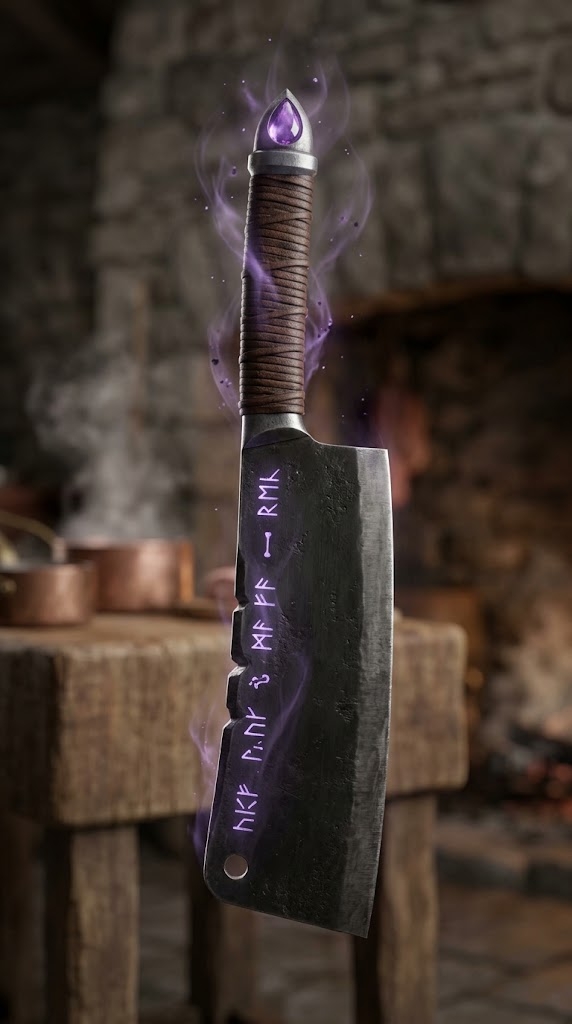
- A broad-bladed rectangular kitchen cleaver forged from dark, oil-quenched steel, featuring a full-tang handle wrapped in cured leather cord.
- The spine is thick and notched for splitting bone, while the flat of the blade is etched with faint, runic culinary diagrams that glow with faint violet embers when near raw meat.
- A teardrop-cut purple catalytic crystal is seated securely in the pommel cap, pulsing in rhythm with the rhythmic chopping cadence of the cook.
- It carries the faint, comforting aroma of roasted rosemary, smoked marrow, and aged peppercorns.
Specific Slot
- One-Handed (Main Hand / Off-Hand Tool or Weapon Slot)
Detailed Stats
- Item Tier: Tier 1 (Common Rarity)
- Item Weight: 2.0 lbs
- Durability: 25 / 25
- Mercantile Value: 15 Gold Pieces (150 Silver)
- Weapon Damage: 1d6 Slashing (or equivalent Tier 1 light weapon profile)
- Usage Limit: Passive culinary enhancements remain active while handling; activated spectral premonitions and purifications rely on daily charges
Passive Magics
- Echoes of the Master Carver: The bound muscle memory of deceased butchers guides the wielder’s hand, granting a +2 bonus on all skill checks related to cooking, butchery, field dressing, and harvesting edible materials from beasts.
- Marrow-Essence Extraction: When preparing meals from fresh carcasses or lean field rations, the cleaver draws out deep nutritive spirits, increasing the yield of usable food portions by 50% from any single source.
- Preservative Edge: Cuts of meat or organic rations sliced by the cleaver remain fresh and completely immune to natural rot and spoilage for up to 3 days without requiring salt or ice.
Activable Magics
- Soul-Tasting the Broth (3 Charges/Day): As an action, the cook dips the flat of the blade into a simmering pot, liquid, or raw ingredient. The purple pommel crystal flares violet as the bound spirits sample the dish, instantly revealing to the wielder any hidden poisons, biological contaminants, curses, or missing spices present in the mixture.
- Feast of the Restful Dead (1 Charge/Day): During a short rest or camp meal preparation, the wielder stirs or chops ingredients while channeling necromantic energy into the dish. Up to 6 creatures that consume the resulting meal recover an additional 1d4 hit points (or gain +1 temporary stamina/morale) and receive a +1 bonus on their next saving throw against fatigue or disease.
Tags
- Necromancy, Tier 1, Common, Cook, One-Handed, Tool, Weapon, Butchery, Culinary, Sustenance, Catalytic Focus, Purification, Rations, Gastronomy, Field Dressing, Campfire, Provisioning, Marrow Extraction, Broth Tasting, Poison Detection, Chef, Kitchen Implement, Restorative Meal, Edible Foraging
Commercial Outlets and Trade Valuation of Necromancy 512
- Culinary Guilds and Master Cutlery Exchanges
- Shop Atmosphere & Process: Located within bustling civic markets, grand tavern districts, and culinary academy courtyards. These bright, steam-warmed establishments feature rows of polished steel hung from copper racks over maple butchery blocks. Master carvers inspect the cleaver by testing its balance against dense marrow bones, ringing the dark blade with a brass mallet to verify the acoustic frequency of index 512 and checking the clarity of the purple pommel crystal.
- Purchase Cost: 15 Gold Pieces (150 Silver) at standard municipal guild price.
- Sell/Buyback Rate: 7 to 8 Gold Pieces (70 to 80 Silver), provided the blade’s cutting edge is free of micro-chips and the runic engravings retain their violet luminescent channels.
- Frontier Provisioners and Expeditionary Outposts
- Shop Atmosphere & Process: Situated along edge-of-the-wilds trade posts, border forts, and hunter encampments. These rustic, crowded general stores are packed with cured rations, salting barrels, and wilderness survival kits. The cleaver is valued highly by caravan leaders and field quartermasters who must stretch limited trail supplies. Verification involves dipping the blade into game broth to witness the immediate violet purification pulse.
- Purchase Cost: 16 to 18 Gold Pieces (160 to 180 Silver), slightly marked up due to high demand among expeditionary cooks and trappers.
- Sell/Buyback Rate: 8 Gold Pieces (80 Silver) in hard coin, or 10 Gold Pieces worth of trail provisions, salt blocks, and butchery supplies.
- Ossuary Refectories and Necropolis Mess-Halls
- Shop Atmosphere & Process: Found in the subterranean kitchens beneath ancestral mausoleums, temple crypts, and funerary guild keeps. These quiet, vaulted stone kitchens prepare memorial feasts and sustenance for perpetual cemetery laborers. Transactions are handled by mortuary stewards who inspect the cold-iron pommel fitting against ancestral registration tablets to ensure proper spiritual lineage.
- Purchase Cost: 12 to 14 Gold Pieces (120 to 140 Silver) for ordained mortuary cooks or licensed necromantic acolytes.
- Sell/Buyback Rate: 6 Gold Pieces (60 Silver), often exchanged directly for consecrated spices, bone-ash flux, or culinary spellbooks.
Tactical Roleplay Applications: Offensive and Defensive Utilization of Necromancy 512 Across Diverse Environments
- Frontier Campgrounds, Dense Forests, and Wilderness Clearings
- Defensive Tactics & Roleplay: While tending a campfire stew in predator-filled woods, the cook senses an ambush as the cleaver’s pommel crystal flickers violet. When a prowling dire wolf lunges toward the mess tent, the user raises the flat of the broad blade to parry the beast’s snapping jaws, using the cleaver’s heavy spine to deflect the lunge and wedge the iron edge safely between its fangs.
- Offensive Tactics & Roleplay: Engaging hostile wilderness beasts, the avatar channels Echoes of the Master Carver. Reading the muscle grain and joint seams of an attacking monstrosity like a hanging side of beef, the cook steps inside its reach to deliver precise, rhythmic chops that sever tendon clusters, crippling the creature’s mobility before field dressing it for camp rations.
- Underground Crypts, Ossuaries, and Cursed Ruins
- Defensive Tactics & Roleplay: Ambushed by crawling carrion vermin or reanimated undead in narrow stone corridors, the user triggers Soul-Tasting the Broth against airborne miasmas and venomous secretions. As toxic slime sprays across the defensive line, the cook sweeps the cleaver in a wide arc, the blade’s necromantic field burning off noxious spores and absorbing contact poisons before they touch companion flesh.
- Offensive Tactics & Roleplay: Facing skeletal guardians or shambling dead, the wielder relies on the cleaver’s bone-splitting spine and necromantic resonance. The cook targets the exact articulation points where ancient marrow binds to bone, shattering animated joints with devastating butcher chops that disrupt the necromantic bonds keeping the skeletons upright.
- Bustling Tavern Kitchens, Banquet Halls, and Urban Messes
- Defensive Tactics & Roleplay: During a sudden tavern brawl or assassination attempt at a noble feast, the cook stands behind the central chopping block. Dipping the blade tip into the shared punch bowl or soup cauldron with Soul-Tasting the Broth, the user immediately detects poisoned wine, shouting warnings to the guests while brandishing the blood-grooved cleaver to intimidate encroaching poisoners and keep them away from the pantry.
- Offensive Tactics & Roleplay: When back-alley cutthroats invade the kitchen, the cook treats the tight cooking line as a tactical battleground. Using the cleaver’s broad face to scoop up searing hot roasting grease, the wielder flings scalding broth into the attackers’ eyes before executing a swift, close-quarters cleave to disarm and pin a raider against the chopping table.
- Naval Ships, Galley Quarters, and Deserted Island Shorelines
- Defensive Tactics & Roleplay: Trapped on a storm-tossed vessel running low on supplies, the ship’s cook activates Preservative Edge and Feast of the Restful Dead. As crew members succumb to exhaustion and scurvy, the cook prepares revitalizing broths from salvaged salt pork and kelp, warding off sickness and reinforcing crew morale against boarding mutineers.
- Offensive Tactics & Roleplay: When sea monsters or aquatic raiders scale the ship’s galley netting, the cook uses the cleaver’s heavy balance to hack through tough chitin shells and thick, wet tentacles. Hacking clean through boarding ropes and grappling tendrils with rhythmic strikes, the avatar kicks the severed limbs into the prep bucket for the evening watch’s chowder.
Perception of Activation:
- User’s Perspective:
- Visual: Looking down at the blade, the etched runic culinary diagrams flare from a dull charcoal to a luminous, smoldering violet. Wisps of pale purple vapor curl off the cutting edge and snake around the meat or broth being prepared. The teardrop crystal in the pommel blinks with steady, rhythmic flashes that synchronize with the cook’s heartbeat and chopping pace.
- Auditory: A distinct, resonant thrum vibrates up the user’s arm with every chop, sounding like a heavy kitchen knife striking an ancient stone block. Beneath that, a subtle chorus of faint, satisfied murmurs and the crackle of a distant hearth fire hums in the inner ear whenever an ingredient is sliced cleanly.
- Tactile: The leather-wrapped handle warms pleasantly against the palm, neutralizing hand stiffness, muscle cramps, and joint fatigue. The blade feels weightless and frictionless as it glides through sinew, thick cartilage, and dense bone.
- Olfactory: A rich, savory aroma of roasted rosemary, smoked beef marrow, charred garlic, and cracked peppercorns billows directly into the user’s nostrils, overriding any foul stench of rotting meat or battlefield gore.
- Gustatory: A phantom taste of rich, well-seasoned broth, sea salt, and caramelized onions coats the back of the mouth, sharpening the cook’s palate and instincts for balance.
- Extra-Sensory Perceptions:
- Anatomical Seam Sight: The user perceives glowing, translucent violet fault lines traversing carcasses and vegetables, highlighting the optimal paths for butchery, joint disarticulation, and fat-trimming.
- Tox-Sense Resonance: Dipping the blade into liquids triggers an instinctive spiritual ping; poisons manifest as a sharp, acrid prickle in the mind, while pure nourishment registers as a soothing harmonic hum.
- Nutritive Spirit Gauge: The wielder instinctively senses the exact caloric and restorative potential remaining in every scrap of organic matter, knowing precisely how to stretch rations.
- Observer’s Perspective:
- Visual: The heavy dark steel cleaver seems to slice through tough hide and thick bone as if it were soft butter. The runes along the flat glow with an unearthly violet luminescence, and faint purple embers drift off the pommel crystal with every rhythmic chop.
- Auditory: The sound of butchery and prep work is unnervingly rhythmic, clean, and musical, lacking the sloppy crunch or dull hacks typical of field dressing.
- Tactile: Those standing near the prep station feel a noticeable wave of soothing, dry heat radiating outward from the blade, akin to standing before a roaring brick oven.
- Olfactory: Bystanders catch an overwhelming, mouthwatering scent of a grand tavern feast, completely masking the rank odors of raw viscera, stagnant camp air, or trail grime.
- Extra-Sensory Perceptions:
- Communal Satiety Aura: Allies watching the cook work feel an immediate subsiding of travel weariness and hunger pangs, experiencing an anticipatory wave of comfort and morale.
- Necromantic Chill Undercurrent: Astute or magical observers feel a momentary cold draft behind the warmth, sensing that the delicious aromas are being coaxed forth by the lingering spirits of deceased master carvers.
- Positives:
- Completely eliminates physical strain, blister formation, and hand fatigue during long hours of field butchery and mass cooking.
- Instantly identifies lethal poisons, natural toxins, and spoilage in gathered food or questionable water supplies without risking accidental ingestion.
- Enhances field morale and camp cohesion by turning tough, unpalatable game into tender, restorative meals.
- Negatives:
- The bright violet runic glow and drifting purple embers make it impossible to prepare food covertly in darkened wilderness camps or near enemy patrols.
- The potent, savory aroma generated during activation spreads across a wide area, which can inadvertently attract wandering predators, scavengers, or hungry rival scouts.
- If used in front of superstitious commoners or anti-necromantic zealots, the eerie violet aura and visible spirit-smoke around the food can cause deep suspicion or accusations of defiling the dead.
Crafting Recipe: Necromancy 512 Hearth-Feast Cleaver
Materials Needed
- 1 Billet of High-Carbon Spring-Steel (approx. 2.5 lbs): Quenched in mineral oil for toughness and edge retention under repeated bone-chopping impacts.
- 1 Ounce of Culinary Mortuary Ash Flux: A specialized flux blend of calcined master butcher bones, pulverized sea salt, and dried rosemary resin.
- 1 Intact Tier 1 Purple Catalytic Crystal (Teardrop Cut): Pre-calibrated and inscribed to the necromantic culinary frequency index ‘512’.
- 1 Cold-Iron Pommel Cap and Tang Collar: Machined to house the catalytic crystal and ground the runic conduits.
- 2 Cold-Iron Rivets: For mechanically anchoring the full tang into the hilt assembly.
- 4 Feet of Cured, Oil-Treated Leather Cord: For the heavy shock-absorbing hilt wrap.
- 1 Half-Pint of Quenching Oil Infused with Bone Broth and Herb Extracts: To temper the steel and seat the preservative enchantment.
Tools Required
- Blacksmith’s forge, heavy anvil, and rounding/cross-peen hammers
- Hot chisels and runic gravers/scorpers
- Quenching trough and oil reservoir
- Grinding wheel, whetstones (rough, medium, fine), and stropping leather
- Jeweler’s micro-pliers, setting burnisher, and loupe
- Meat-hook stand or wooden chopping block for acoustic edge calibration
Skill Requirements
- Blacksmithing / Weaponsmithing: Minimum Rank 1 (Apprentice level or higher; competent in full-tang shaping, heat treating, and grinding)
- Necromancy or Technomantic Crafting: Minimum Rank 1 (Trained in mortuary flux channeling and spirit matrix stabilization)
- Cooking, Butchery, or Survival: Minimum Rank 1 (Fundamental understanding of grain alignment, bone disarticulation, and culinary balance)
Crafting Steps
- Step 1: Forging and Shaping the Blade Profile
- Heat the spring-steel billet to a bright cherry red and draw out a broad, rectangular cleaver blade with a thick spine and full-tang handle.
- Notch the forward spine using a hot chisel to create the bone-splitting serrations.
- Hammer a clean hanging hole through the upper corner of the blade’s toe.
- Step 2: Engraving the Runic Conduits and Ash Fluxing
- While the blade is annealed, use runic gravers to carve the culinary diagrams and spirit-conduction channels along both faces of the flat.
- Dust the carved channels liberally with the culinary mortuary ash flux, heating the steel to forge-weld the ash into the microscopic grain of the steel.
- Inscribe municipal registration index 512 along the ricasso near the collar.
- Step 3: Heat Treatment and Oil Quench
- Bring the cleaver to non-magnetic critical temperature in the forge.
- Plunge the cutting edge into the herbal quenching oil, edge-first, to achieve high hardness while leaving the spine resilient and spring-tempered.
- Temper the blade in the forge embers until the spine exhibits a spring-blue oxidation and the cutting edge turns a light straw-gold.
- Step 4: Pommel Setting and Tang Assembly
- Fit the cold-iron collar over the tang base and secure the cold-iron pommel cap to the tang’s end.
- Mount the teardrop-cut purple catalytic crystal into the pommel bezel, burnishing the iron prongs down tightly to link the crystal directly with the blade’s internal tang.
- Peen the two cold-iron rivets through the tang and wrap the entire grip tightly with the cured, oil-treated leather cord, securing the ends beneath the collar.
- Step 5: Edge Grinding and Spiritual Attunement
- Grind a robust convex cutting bevel along the blade edge using the grinding wheel and whetstones, polishing to a razor finish on the leather strop.
- Strike a dense marrow bone on the wooden chopping block while channeling a Tier 1 necromantic pulse through the pommel crystal.
- Verify that the runic diagrams smolder with violet luminescence, the pommel crystal pulses in sync with the chopping impact, and a rich scent of roasted rosemary and smoked marrow rises from the cold steel.
Iron Meat-Hewer, Hungry Winter of Seven Sins, and Soup of 512 Bones
In the early cold moons, when the sky was like grey stone and the great beasts with long teeth still walked upon the mud roads, the city of the Deep Trench did suffer the white famine. The clouds did drop three arm-lengths of frozen frost upon the barley terraces, and the river of the grey fish did turn into hard glass so that no water pot could be dipped into the wet.
The Great Master of the High Grain-House was a man named Karnos, who had eleven iron locks upon his granary doors and six fat hounds that ate barley porridge from bronze bowls. But the common people of the lower ditch had only dried tree bark and the dust of crushed river pebbles to fill their wooden platters. Many children did cry in the cold huts because their bellies were empty like dry gourds, and their mothers did boil old leather sandals in clay pots to make a dark water without salt.
In the mess-tent of the city diggers lived an old meat-cutter named Goram, whose right thumb was missing from an old war with the swamp serpents. Goram had no sheep in a pen and no bag of dried peas under his sleeping pelt. His only goods were an iron hewer of wide square shape, which had been quenched in the fat of sacrificial cattle by the tomb-priests who tended the great bone-crypts below the stone arches.
Upon the square flat of this heavy knife were cut the strange marks of the five-hundred-and-twelfth chapter of the meat-fathers. In the back knob of the handle was set a purple water-jewel that had been taken from the forehead of a stone idol buried in the deep lime pits.
When the fifteenth day of the frost moon did arrive, the hunters came back through the gate with only one small, thin mountain goat that had fallen into a deep snow pit and died of the cold five suns before. Its skin was dry like old parchment, its meat was blue like river clay, and a bad stench of dead things did rise from its ribs.
The kitchen apprentices did weep and say: “Throw this carrion to the black birds of the rocks, for if the diggers eat of this blue flesh, the belly-rot will seize their livers and they will die upon the frozen dung-heaps before the cock crows.”
Goram did step to the central chopping log of split oak. He did take the iron hewer from its greasy wool sheath and struck the stone hearth three times with the back notch of the spine.
A cold violet flame did jump out of the purple water-jewel in the handle knob. The marks on the dark iron did glow like the embers of a smothered pine branch, and a great wind of boiling rosemary, sweet sea salt, and smoked beef marrow did blow through the dark mess-tent, driving away the stink of frost and dead meat.
Goram did lay the blue goat upon the oak block. When the iron blade touched the rotten skin, the blade did not hack with a rough tearing sound, but it did slide through the joints and the white gristle like a warm copper spoon going through soft bee-tumble.
The purple light did run down the blade edge and into the meat. The blue flesh did turn red and sweet like the meat of a young ox fattened on summer clover. With five strokes of the hewer, Goram did divide the small beast into one hundred clean portions. He did crack the long leg bones with the notched iron spine, and a river of rich, yellow marrow did pour into the great copper cauldron of snow water, smelling of wild mountain thyme and fried garlic.
From that one thin goat, which could not fill the belly of three men, Goram did boil a soup so thick that an iron spoon would stand straight up in the pot without falling against the rim.
Five hundred diggers did come with wooden bowls and stone cups. They did drink the hot broth, and their cold hands did turn warm like freshly baked loaves. The grey frost upon their eyelashes did melt away, their hollow cheeks did become red with life, and those whose limbs were stiff with the ice-fever did stand up and take their spades to clear the frozen ditch.
When the Master of the High Grain-House, Karnos, heard the singing in the ditch camp, he did ride down upon his fat mule with four spear-guards. He smelled the roast garlic and the smoked marrow upon the wind and did look into the empty bone-buckets with an angry eye.
“You have broken into the high storehouses!” Karnos did roar, shaking his bronze whip. “You have stolen my grain-hogs and my jars of pickled sheep! Give me the bag of stolen gold, or my spear-men shall bind you to the wooden poles until the crows eat your eyes!”
Goram did wipe the dark steel of the hewer upon his leather apron and held up the clean goat skull. “We have taken no grain from your high bins, Lord of Locks. We have taken only what the frost had killed and what your proud dogs would not touch. The spirits of the old carvers have taught this blade to find the life that hides inside the cold bone.”
Karnos did snatch the iron hewer from Goram’s hand, thinking to take it to his palace to cut his own fat swine. But because Karnos had a heart full of greed and no love for the hungry, the purple jewel in the handle did turn black like a coal from a dung-fire, and the blade became cold like a slab of winter ice. When Karnos struck his roasted pheasant with the hewer, the meat did turn into grey ashes and bitter salt in his silver dish, so that his own fat hounds howled and ran into the garden.
Karnos was filled with great fear. He threw the heavy knife into the snow and fled back to his high stone tower, leaving his granary gates open to the people of the ditch.
Goram did pick up the iron cleaver from the snow drift. When his rough hand touched the leather cord of the grip, the purple stone did flare once more with gentle violet light, and the good smell of fried rosemary did fill the mess-tent until the spring waters broke the river glass.
Moral of the Story: A greedy ruler with eleven locked granaries cannot buy the secret of true nourishment, for the hand that feeds the hungry with humble scraps will always find abundance where the proud see only rot and ruin.
Suggested conversions to other systems:
Call of Cthulhu (7th Edition)
Cleaver of the Mortuary Carver 512
- Item Type: Enchanted Tool / Weapon / Minor Occult Relic
- Sanity Cost to Attune / Wield: 0 (Passive); 1 Sanity point upon triggering an active power
- Item Slot: One-Handed (Melee Weapon / Tool)
- Weapon Skill: Fighting (Brawl) or Art/Craft (Cook/Butcher)
- Damage: 1D6 + Half Damage Bonus (Slashing/Impaling)
- Base Range: Touch
- Skill Prerequisites: Art/Craft (Cook) 20%, Survival 20%, or First Aid 20%
- Game Mechanics & Specific Syntax:
- Master Carver’s Touch (Passive): The user gains a bonus die (+1D) on all Art/Craft (Cook), Survival, and Natural World rolls made to butcher carcasses, harvest edible field game, or salvage provisions in wilderness environments.
- Preservative Edge (Passive): Any meat or perishable organic tissue harvested or sliced by the cleaver is preserved against natural rot, bacteria, and decay for 3 days without requiring refrigeration or salting.
- Soul-Tasting the Broth (Active): Once per day, the user expends 1 Magic Point and dips the flat of the blade into a pot, beverage, or dish. The blade flares with faint violet embers, automatically revealing whether the substance contains biological poisons, unnatural toxins, or tainted occult residue.
- Feast of the Restful Dead (Active): Once per day, when preparing a hot meal during a period of downtime or rest, the user expends 2 Magic Points while chopping ingredients. Up to six investigators who consume the meal recover 1 additional Hit Point and gain a bonus die (+1D) on their next CON roll to resist disease or physical exhaustion over the next 24 hours.
Blades in the Dark
Ossuary Carver’s Cleaver 512
- Item Classification: Arcane Implement / Fine Heavy Weapon / Field Gear
- Load: 1 Load
- Prerequisites: Leech, Hound, or any Scoundrel with at least 1 pip in Survey or Tinker
- Game Mechanics & Specific Syntax:
- Fine Butchery Implement (Passive): When preparing field provisions, dressing exotic leviathan/beast meat, or harvesting biological materials from carcasses, this item provides Fine Quality (+1 Tier/Effect) to relevant Tinker or Survey action rolls.
- Preservative Field (Passive): Rations and organic compounds prepped with the blade resist spoiling or chemical decay for the duration of a score, ensuring fresh supplies in harsh conditions.
- Soul-Tasting the Broth (Active): Spend 1 Stress and dip the flat of the blade into a liquid, foodstuff, or alchemical concoction. The spirit-inscribed runes ignite, instantly identifying any hidden poisons, sedative adulterants, or unnatural contaminants, raising your assessment effect to Great.
- Feast of the Restful Dead (Active): Spend 2 Stress during Downtime when preparing a recovery meal for the crew. The meal channels ancestral nutritive warmth, granting +1 recovery tick or +1 die on all Downtime recovery rolls made by up to six crew members who partake.
Dungeons & Dragons (5th Edition)
Hearth-Feast Cleaver 512
- Weapon (Handaxe or Cleaver): Common (requires attunement)
- Item Slot: One-Handed (Melee Weapon / Tool)
- Damage: 1d6 slashing; Properties: Light, Thrown (range 20/60 ft.)
- Charges: 3 charges, which recharge daily at dawn
- Game Mechanics & Specific Syntax:
- Butcher’s Intuition (Passive): While holding this cleaver, you have advantage on Wisdom (Survival) checks made to butcher carcasses, forage for edible meat, or prepare camp meals, and you add double your proficiency bonus to checks made with Cook’s Utensils.
- Preservative Edge (Passive): Meat and organic rations sliced by the cleaver remain fresh and completely immune to nonmagical decay and spoilage for up to 3 days.
- Soul-Tasting the Broth (Active): As an action, you can expend 1 charge and dip the blade into a prepared dish, beverage, or ingredient. If poison, disease, or toxic spoilage is present, the blade flares violet and identifies the exact nature of the contaminant (functioning as the detect poison and disease spell).
- Feast of the Restful Dead (Active): As part of preparing a meal during a short rest, you can expend 2 charges. Up to six creatures that eat the meal regain an additional 1d4 hit points at the end of the rest and gain advantage on the next Constitution saving throw they make against disease or exhaustion within the next 24 hours.
Knave (2nd Edition)
Hearth-Feast Cleaver 512
- Item Slots: 1 Slot (Carried/Wielded in Hand)
- Item Type: Weapon (Handaxe profile) / Specialized Cook’s Tool
- Damage: d6 Slashing
- Durability: 25 / 25
- Game Mechanics & Specific Syntax:
- Carver’s Skill (Passive): The wielder gains Advantage on all Wisdom or Constitution checks made to field-dress hunted beasts, extract clean marrow, or identify toxic and inedible flora/fauna.
- Ever-Fresh Meat (Passive): Rations cut and processed with this blade do not spoil, rot, or attract flies for 3 full days of travel.
- Soul-Tasting Broth (Active – 3/Day): The user dips the blade into a soup cauldron or suspect liquid. The blade glows violet if the liquid is contaminated by venom, poison, or rot, neutralizing the need for a saving throw against ingestion hazards.
- Restorative Stew (Active – 1/Day): When used to cook a hot meal during a full rest, the food feeds up to 6 companions. Each character recovers +1 additional Hit Point and gains Advantage on their next check to resist travel fatigue, cold, or illness.
Fate Core System
The Ossuary Cook’s Hearth-Cleaver 512
- Item Type: Personal Weapon-Tool / Culinary Stunt Focus
- Aspect: Spring-Steel Cleaver of the Bone-Feast Master
- Skill Requirements: Crafts or Survival at Average (+1) or higher
- Game Mechanics & Specific Syntax:
- Master Carver’s Touch (Passive Stunt): Because this blade carries the muscle memory of ancestral butchers, you gain a +2 to Crafts or Survival rolls when field-dressing game, preparing sustaining rations, or carving biological components from defeated monsters.
- Preservative Edge (Passive Stunt): Any meat, broth, or organic harvest prepared with this cleaver gains the situation aspect Immune to Spoilage for the remainder of the scenario.
- Soul-Tasting the Broth (Active Action): Once per scene, spend 1 Fate Point and dip the flat of the blade into a liquid, meal, or suspect ration. You immediately discover any hidden poisons, diseases, or curses, creating the aspect Identified Contaminants with one free invocation.
- Feast of the Restful Dead (Active Action): Once per session, when preparing a communal meal during a period of rest or recovery, you can spend 1 Fate Point. Up to six allies who eat the meal gain a +1 bonus to their next roll to recover from physical stress or clear a mild physical consequence.
Numenera & Cypher System
The Necro-Culinary Carver 512
- Item Form: Artifact (Level 2)
- Form / Slot: A heavy spring-steel rectangular cleaver with runic engravings and a teardrop violet catalytic crystal in the pommel (Worn/Wielded in One Hand)
- Depletion: 1 in 1d10 (Checked only upon using activated abilities)
- Weapon Damage: Light or Medium bladed weapon (2 to 4 points of physical damage)
- Game Mechanics & Specific Syntax:
- Butcher’s Intuition (Passive Asset): While wielding or handling this cleaver, all tasks related to field butchery, cooking, identifying edible flora/fauna, or extracting biological materials are eased by one step.
- Preservative Edge (Passive): Organic rations cut and prepared by the blade resist natural decay, bacteria, and spoilage for up to 3 days.
- Soul-Tasting the Broth (Active): As an action, the user expends 1 Intellect Point and checks for Depletion while dipping the blade into a stew, beverage, or ingredient. The runic flat glows violet, instantly revealing whether biological toxins, unnatural contaminants, or chemical poisons are present (eased by two steps if rolling against hidden toxins).
- Feast of the Restful Dead (Active): As part of preparing a camp meal during a ten-minute or one-hour recovery roll, the user checks for Depletion. Up to six creatures consuming the dish add +1 to their recovery rolls and gain an asset on their next Might defense roll against illness or fatigue within 24 hours.
Pathfinder (2nd Edition)
Hearth-Feast Cleaver 512 (Item 1)
- Traits: Uncommon, Invested, Magical, Necromancy
- Price: 15 gp; Bulk: L; Usage: Held in 1 hand (Light pick / Hatchet profile)
- Damage: 1d6 slashing; Group: Axe; Weapon Traits: Agile, Sweep
- Game Mechanics & Specific Syntax:
- Master Carver’s Insight (Passive): You gain a +1 item bonus to Survival checks made to Subsist, Harvest materials from slain beasts, or prepare camp meals, and to Crafting checks involving cooking or food preparation.
- Preservative Edge (Passive): Portions of meat and organic provisions sliced by the cleaver remain fresh and completely immune to natural rot and spoilage for 3 days.
- Soul-Tasting the Broth [One-Action] (Frequency: 3 times per day): Effect: You dip the flat of the blade into a liquid, stew, or foodstuff. The pommel crystal pulses violet to detect contaminants. The cleaver casts an innate divine detect poison targeting only the tested food or drink.
- Feast of the Restful Dead (Frequency: once per day): Activity: 10-Minute Activity during camp prep. Effect: You chop and stir a hot meal using the cleaver’s channeled energy. Up to six creatures eating the meal regain an additional 1d4 Hit Points when completing a Long Rest and gain a +1 status bonus to Fortitude saves against disease and fatigue for the next 24 hours.
Savage Worlds (Adventure Edition)
The Bone-Ash Hearth Cleaver 512
- Item Type: Minor Arcane Relic / One-Handed Melee Weapon & Tool
- Damage: Str+d6 (Slashing); Weight: 2 lbs; Min Str: d4
- Value: $150
- Game Mechanics & Specific Syntax:
- Carver’s Skill (Passive): The wielder receives a +1 bonus to Survival and Repair rolls made to butcher carcasses, harvest hide/sinew, or prepare field rations.
- Preservative Edge (Passive): Meat and field game processed with this blade do not spoil, rot, or attract flies for 3 full days of travel.
- Soul-Tasting the Broth (Active – 3 Charges/Day): As an action, the user expends 1 charge and dips the blade into a pot, bowl, or ration. The runic markings flare violet if poison, toxins, or biological spoilage are present, automatically detecting ingestion hazards without requiring a Notice roll.
- Feast of the Restful Dead (Active – 1 Charge/Day): When preparing a hot meal during a period of Natural Healing or camp rest, the cook expends 1 charge. Up to six allies who consume the meal receive a +1 bonus to their next Vigor roll made to heal wounds or resist environmental fatigue and sickness.
Shadowrun (Sixth World Edition)
Necro-Culinary Bio-Cleaver 512
- Item Classification: Enchanted Focus Weapon & Tool / Health & Manipulation Focus (Force 1)
- Item Slot: One-Handed (Melee Weapon / Culinary Tool)
- Damage: 3P (Physical)
- Attack Rating: 8 / — / — / — / —
- Availability: 2 (Legal as a specialized culinary/butchery implement)
- Cost: 1,500 Nuyen
- Game Mechanics & Specific Syntax:
- Master Carver Matrix (Passive): The wielder gains a +1 dice pool bonus on all Outdoors + Logic and Biotechnology + Logic tests made to butcher critters, harvest biomaterials, or prepare field rations.
- Preservative Edge (Passive): Organic tissue and biological samples sliced with the cleaver resist natural decay and cellular degradation for up to 72 hours without refrigeration.
- Soul-Tasting the Broth (Active – Minor Action, 3/Day): The user channels Force 1 necromantic energy into a liquid or ration. The runic conduits flare violet, granting an automatic detection test against chemical toxins, biological contaminants, or ingestible drugs without requiring a separate sensor test.
- Feast of the Restful Dead (Active – Downtime Action, 1/Day): Expending 1 Edge during camp or safehouse food preparation, the cook prepares a hot restorative meal. Up to six runners who consume the meal add +1 die to their Body + Willpower natural healing and toxin resistance tests for the next 24 hours.
Starfinder (Second Edition)
Hearth-Feast Cleaver 512 (Item 1)
- Traits: Uncommon, Invested, Magical, Necromancy, Tech
- Price: 150 Credits; Bulk: L; Usage: Held in 1 hand (Light Melee Weapon / Tool)
- Damage: 1d6 slashing; Group: Axe; Weapon Traits: Agile, Sweep
- Game Mechanics & Specific Syntax:
- Carver’s Protocol (Passive): You gain a +1 item bonus to Survival checks made to Subsist, Harvest organic parts from alien fauna, or prepare field rations.
- Preservative Field (Passive): Portions of meat and organic provisions sliced by the cleaver remain preserved and immune to non-magical rot and contamination for up to 3 days.
- Soul-Tasting the Broth [One-Action] (Frequency: 3/Day): Effect: You dip the blade into a liquid, nutrient paste, or organic sample. The pommel crystal pulses violet, casting an innate detect poison targeting the tested substance.
- Feast of the Restful Dead (Frequency: 1/Day): Activity: 10-Minute Activity during a rest. Effect: You prepare a revitalizing ration using the cleaver’s channeled energies. Up to six creatures eating the meal regain an additional 1d4 Hit Points when finishing a full rest and gain a +1 status bonus to Fortitude saves against disease and environmental fatigue for 24 hours.
Traveller (Mongoose 2nd Edition)
Bio-Resonant Field Cleaver 512
- Item Classification: Psionic Tool / Specialized Survival Gear (Tech Level 15 / Ancient Relic)
- Mass: 1.0 kg
- Damage: 2D Slashing (Melee / Blade)
- Cost: Cr 1,500
- Skill Prerequisites: Survival 0+, Profession (Cook) 0+, or Telepathy / Awareness (Psi) 1+
- Game Mechanics & Specific Syntax:
- Butcher’s Insight (Passive): The user receives a +1 DM on all Survival and Profession (Cook) checks made to harvest field game, field-dress specimens, or identify edible alien flora/fauna.
- Cellular Stasis Edge (Passive): Meat and biological samples harvested with the cleaver remain fresh and completely free of bacterial decay for 3 standard days without cold storage.
- Resonant Tox-Scan (Active – Minor Action, 3/Day): Expending 1 Psi Point (or triggering the catalytic crystal charge), the user touches the blade flat to a liquid or ration. The user makes an Awareness (or Survival) check (Difficulty: Average 8+). On a success, the blade instantly identifies any hidden biochemical poisons, contaminants, or spoilage.
- Nutritive Restoration (Active – Significant Action, 1/Day): During meal preparation in downtime, the cook channels the blade’s harmonic field into the food. Up to six crew members who eat the dish gain a +1 DM to their next END check to resist illness, radiation sickness, or travel fatigue.
Warhammer Fantasy Roleplay (4th Edition)
Shyish-Tempered Hearth Cleaver 512
- Item Classification: Minor Magical Weapon / Culinary Artefact
- Availability: Rare (Found among Halfling Lodge-Masters, Amethyst Stewards, and Field Quartermasters)
- Price: 15 GC (Gold Crowns)
- Weapon Group: Basic (Hand Weapon / Cleaver profile)
- Damage: SB + 3; Reach: Very Short; Qualities: Hack
- Game Mechanics & Specific Syntax:
- Echoes of the Bone-Carver (Passive): The wielder gains a +10 bonus to all Trade (Cook), Lore (Herbs), and Outdoor Survival tests made to dress carcasses, prepare camp provisions, or harvest ingredients from slain beasts.
- Preservative Edge (Passive): All meat or animal fats prepared with the cleaver are immune to natural rot and mold for 3 days.
- Soul-Tasting the Broth (Active – 3/Day): As an Action, the cook dips the blade into a stew pot, wine bowl, or ration. The runic flat glows violet if poison, toxins, or warp-taint are present, automatically identifying the contaminant without requiring an Intuition test.
- Feast of the Restful Dead (Active – 1/Day): When preparing a hot meal during a Long Rest, the cook evokes the pommel stone. Up to six characters who consume the stew recover +1 additional Wound and gain a +1 SL bonus to their next Endurance Test to resist disease or exposure over the next 24 hours.