
Lore While common folk search for the mythical fern flower on Kupala Night in hopes of gaining wealth or wisdom, the dedicated botanists and green-witches of Saṃsāra seek it for a different purpose. They believe the flower’s true gift is not a wish, but its potent, life-giving pollen. In a quiet ritual away from the main bonfire, they collect the morning dew from the leaves of divinatory herbs like mugwort and yarrow. Into this solstice dew, they stir the golden pollen of a freshly bloomed fern flower. They then take a simple, clear quartz lens and spend an hour polishing it with this mixture, holding it up so the light of the distant bonfire filters through it. This process doesn’t enchant the lens with powerful magic, but rather awakens its ability to perceive the hidden life force and secret needs of the botanical world.
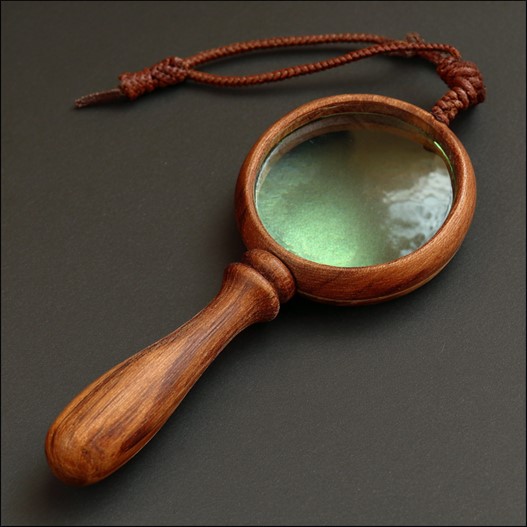
Description This item is a simple, handheld magnifying lens, about the size of a hand mirror. The handle is typically carved from polished rowan or birch wood, with a leather thong for wearing it around the neck. The lens itself is a disc of clear, smoothly polished quartz. Under normal observation, it appears to be a mundane, if high-quality, tool. However, when you look through it, the very edges of the lens seem to shimmer with a faint, verdant green light. The item often carries a faint, pleasant scent of fresh dew and night-blooming flowers.
Slot Neck Slot
Detailed Stats Tier: 1 Durability: The lens is as durable as a normal piece of quartz and a wooden handle. Its magic is permanent. Combat-Related Bonuses: None Resistances: None
Passive Magic Veridian Sight: When looking at any plant life through the lens, the user perceives a faint, colored aura surrounding it that indicates its general state of health. A vibrant green aura signifies a healthy, thriving plant; a murky brown or black aura indicates disease, poison, or decay; a dry, yellow aura suggests a lack of water or nutrients. Unusually powerful or magical plants may display entirely different colors, such as silver, gold, or soft blue.
Seed-Sense: Even when worn and not actively in use, the lens will become faintly warm to the touch against the user’s chest when they are within approximately 15 feet of a rare, magical, or otherwise noteworthy plant seed. This passive sense helps a botanist locate important specimens that may be hidden in the soil or otherwise go unnoticed.
Activable Magic Solstice Growth: Once per day, the user can focus natural sunlight (or a source of magical light) through the lens onto a single seed or small seedling for one full minute. For the next hour, the plant’s growth cycle is magically accelerated, causing it to undergo the equivalent of a full 24 hours of natural growth. This allows for the rapid cultivation of herbs or the quick study of a plant’s development.
Whispers of the Leaf: Twice per day, the user can observe a living plant through the lens and activate the item’s divinatory magic. For a brief moment, the user receives a direct, psychic impression of the plant’s essential nature and most immediate need. This is not a spoken language, but a rush of sensory data—the “feeling” of thirst, the “taste” of rich soil, the bitter “sensation” of a blight deep within its leaves, or the sweet, potent “feeling” of a magical property reaching its peak.
Tags Common, Tier 1, Roleplay, Kupala Night, Neck Slot, Divination, Nature, Utility, Herbalism, Magical, Tool, Wearable, Organic, Folk Magic, Growth, Analysis, Detection, Light
The Kupala 8 of the Seed-Seeker’s Lens is a specialized, though common, magical tool. Its market is not the general public but rather a focused clientele of botanists, herbalists, alchemists, and professional gardeners. As such, it is sold in places that cater to those who work with the natural and magical flora of Saṃsāra. Transactions are often based on a mutual understanding of the craft, and the currency can be as much in rare seeds as it is in coin.
The Herbalist’s Market Stall
This is the most common place to find a Seed-Seeker’s Lens, direct from a local practitioner. These stalls appear at town market days and seasonal festivals, especially in the weeks following the summer solstice.
- How It’s Sold: The stall is typically laden with bundles of dried herbs, strange-looking roots, folk charms, and poultices. The lens itself would not be displayed openly among the common charms. A buyer would need to show genuine interest in the herbalist’s trade or ask for such a tool specifically. The transaction would be a quiet conversation between two people who understand plants, with the seller perhaps offering a bit of advice on its use. Bartering is highly encouraged, but the herbalist would prefer a trade for rare herbs, unusual seeds, or information on a hidden grove over simple coin.
- Cost: The price here is closest to the item’s base value. A lens would typically cost between 2 and 3 Silver Shards.
The Urban Apothecary & Alchemist’s Supplies
In the major cities, from the steam-powered towers to the floating markets, there are dedicated shops that supply the magical artisans of the metropolis. These establishments are the primary urban source for tools of the trade.
- How It’s Sold: The Seed-Seeker’s Lens would be found in a locked glass case, displayed alongside fine crystal mortars and pestles, enchanted distillation coils, and jars of preserved monster glands. The shopkeeper is a professional who understands the lens’s value as a crucial tool for identifying and sourcing potent ingredients for potions and elixirs. The sale is a professional transaction, and the buyer is expected to know what they are buying.
- Cost: The price reflects the convenience of finding such a specialized tool in a city center, as well as the shopkeeper’s markup. The cost would be a firm 5 Silver Shards.
The Gardeners’ Guildhall or University Greenhouse
Large, formal organizations dedicated to botany and agriculture often produce or commission these lenses for their own members. They may sometimes sell surplus stock from a small, attached storefront.
- How It’s Sold: The transaction is formal and often restricted to members of the guild or students of the university. A buyer would need to present their credentials. The lens is sold as a standard, quality-controlled tool of the trade, perhaps even bearing the guild’s insignia etched into the handle. Sales to the general public are uncommon and may require a special writ or permission from a guild master.
- Cost: The price is standardized. For a guild member, the cost may be subsidized, running about 4 Silver Shards. If an outsider is granted the rare privilege of buying one, the price would be significantly higher, perhaps 8 to 10 Silver Shards, partly to encourage them to simply join the guild instead.
The Wandering Naturalist’s Caravan
These are not general merchants but specialized travelers who make their living by charting remote wilderness, collecting exotic plants, and trading rare woods. Their airship or steam-wagon is a mobile conservatory of Saṃsāra’s wonders.
- How It’s Sold: This merchant uses a Seed-Seeker’s Lens as a tool of their own trade, but they often carry a few spares to sell or trade. The transaction would be a conversation between two experts of the natural world. The merchant would be far more interested in what the buyer has to offer than in their coin purse. They would eagerly trade a lens for a viable seed from a rare carnivorous plant or a detailed map leading to a grove of luminous Ghostwood trees.
- Cost: If a buyer insisted on using currency, the wandering naturalist would likely charge a premium for a tool of their trade, perhaps 7 Silver Shards. However, a successful barter for an item or piece of information of equivalent rarity would be the preferred method of exchange.
The Seed-Seeker’s Lens is a tool of study and cultivation, not of conflict. Its use in “defense” and “offense” is a testament to a botanist’s ingenuity, requiring them to use their knowledge of the natural world to manipulate the environment, create obstacles, or turn seemingly harmless plants into potent, non-lethal weapons.
In a Deep, Uncharted Jungle
In a wilderness teeming with life, every plant can be an obstacle or an opportunity. The lens allows an avatar to command this environment.
Roleplaying for Defense: You are being relentlessly pursued by hostile trackers through the thick, suffocating jungle. You reach the edge of a wide, unfordable river that blocks your escape. There is no time to build a raft. Using your Veridian Sight, you spot a cluster of Iron-Root saplings near the riverbank, their auras glowing with a silver light that signifies immense strength. You use Solstice Growth, focusing the dappled sunlight through your lens onto the saplings. The roots surge with magical energy, twisting and growing at a startling rate, weaving together across the river to form a sturdy, living bridge. After you scramble across, you use Whispers of the Leaf on the newly formed bridge and get an impression of “brittle” and “snap.” You strike a weak point with an axe, and the bridge collapses into the river, leaving your pursuers stranded on the other side. Your defense was to grow your own escape route, then destroy it.
Roleplaying for Offense: You need to neutralize the guards at a hidden encampment without raising an alarm. Scouting the perimeter, you use your lens. The Seed-Sense grows warm, alerting you to a patch of dirt that looks empty but contains dormant seeds. Focusing on the seeds with Veridian Sight, you see a faint, soporific blue aura. You’ve found seeds of the notorious Slumber-Poppy. Waiting for the wind to shift towards the camp, you use Solstice Growth. The poppies erupt from the soil, bloom, and release a massive, unexpected cloud of sleep-inducing pollen directly into the camp. The guards, caught completely by surprise, slump to the ground, unconscious. Your offense was not an attack, but the targeted cultivation of a natural sedative.
In an Ornate Noble’s Greenhouse
In a controlled environment of rare and delicate plants, the lens can be used to create chaos or uncover secrets with surgical precision.
Roleplaying for Defense: You have been discovered snooping in a noble’s private greenhouse and the guards are closing in, blocking the only exit. You are trapped among rows of exotic flowers. You spot several large, potted “Sun-Burst Ferns,” known for their enormous, rapidly unfurling fronds. You activate Solstice Growth, focusing the light from the greenhouse’s glass ceiling through your lens. In a startling display, the ferns explode outward, their massive fronds creating a sudden, dense wall of foliage between you and the guards. Using this momentary cover, you break line of sight, allowing you to slip out a side window while the guards are still fighting their way through the unexpected jungle.
Roleplaying for Offense: Your rival is set to win the annual floral competition with their “perfect” Azure Rose, a flower of immense value and prestige. To sabotage them without leaving a trace, you approach the rival’s section of the greenhouse. You can’t get to the rose itself, but you use Whispers of the Leaf on a nearby, mundane-looking vine. You get a psychic “taste” of “thirst” and “invasive.” You’ve found a water-leeching weed. You aim your lens at the soil near the prize-winning rose and use Solstice Growth on the weed’s roots. Overnight, the weed’s roots grow at an incredible pace, silently draining all the water from the soil around the Azure Rose. The next morning, the rival awakens to find their perfect flower inexplicably withered and dying, while you appear to have done nothing at all.
In a Dark, Subterranean Cavern
Far from the sun, life adapts in strange ways. The lens becomes a key to survival and a tool for manipulating bizarre, subterranean ecosystems.
Roleplaying for Defense: You are lost deep underground, your food gone and your last torch sputtering. The darkness is absolute. In desperation, you pull out your lens. The Seed-Sense begins to glow with a faint warmth, leading you to a damp patch of wall. There is nothing there to the naked eye. Trusting the lens, you focus the last of your torchlight through it, activating Solstice Growth. A tiny, dormant spore begins to swell and grow into a large, bioluminescent mushroom, flooding the cavern with a soft, steady light. You then use Whispers of the Leaf on the new mushroom and get a psychic impression of “safe to eat.” The lens has provided you with both light and sustenance, defending you from the darkness and starvation.
Roleplaying for Offense: You must sneak past a monstrous, blind cave-dweller that guards a narrow passage, hunting by its incredibly sensitive hearing. Using your lens and a small light source, you scan the cavern walls. Veridian Sight reveals a patch of moss with a vibrating, irritating aura. You use Whispers of the Leaf and get a psychic “taste” of “loud noise” and “vibration.” You’ve found Shrieker Moss. Carefully, you move to a far-off side tunnel. You use Solstice Growth on a patch of the Shrieker Moss there. It rapidly matures and lets out a series of deafening, high-pitched shrieks. The blind creature, enraged by the painful noise, charges off down the wrong tunnel to attack the source of the sound, leaving its post unguarded for you to slip past. Your offense was to weaponize the cave’s natural soundscape.
Perception of Activation:
Sight
- User’s Perspective: When you channel magic into the lens, the faint green shimmer around its edge brightens considerably and appears to flow like a tiny, luminous vine. If activating “Solstice Growth,” a visible beam of gentle, green-tinted light projects from the lens. If activating “Whispers of the Leaf,” the plant you are observing becomes outlined in this same vibrant green aura for a moment.
- Observer’s Perspective: The effect is clearly visible. An observer would see the edge of the user’s magnifying lens flash with green light and would see the focused beam of light it projects. They would also notice the target plant glowing faintly green for a moment.
- Positives: The visual effect is beautiful and provides unambiguous confirmation that a natural magic has been used. The projected light from “Solstice Growth” is easy to aim.
- Negatives: The activation is overt and cannot be hidden. It immediately reveals the user as a magic-wielder and makes their actions obvious to anyone watching.
Sound
- User’s Perspective: You hear a soft, rushing, organic sound that seems to come from the lens itself. It is the sound of life accelerated—like hearing a flower bloom, a root spread, and leaves unfurl all in a split second.
- Observer’s Perspective: In a quiet environment, an observer standing very close might hear a faint, strange rustling or whispering sound with no apparent source, like the wind blowing through leaves where there is no wind.
- Positives: The sound is natural and gentle, unlikely to cause alarm or be noticed in a noisy environment.
- Negatives: It provides very little feedback in loud surroundings and cannot be used as an audible signal.
Smell
- User’s Perspective: You are hit with a powerful, concentrated burst of natural aromas. It is the scent of a greenhouse after a fresh rain—the smell of rich, damp earth, blooming flowers, and the clean, ozone-like scent of rapid photosynthesis.
- Observer’s Perspective: Anyone standing within several feet of the user will notice a sudden and distinct smell of a lush, vibrant garden, even if they are deep underground or in a desert.
- Positives: The aroma is universally pleasant, fresh, and life-affirming, clearly marking the magic as beneficial and natural.
- Negatives: The potent and distinctive smell makes the use of magic undeniable to anyone nearby with a working sense of smell.
Touch
- User’s Perspective: The moment you activate the magic, the polished wooden handle in your hand feels as though it has come alive. It grows warm and thrums with a gentle, steady pulse, like the slow, strong heartbeat of an ancient tree. The quartz lens itself remains cool.
- Observer’s Perspective: There is no perceivable effect unless the observer is physically holding the handle of the lens during activation, which would be a very strange and startling sensation for them.
- Positives: The tactile feedback is unique and gives the user a clear, physical confirmation that the life-magic is flowing.
- Negatives: If an ally or enemy were to grab the tool while it was being activated, the “living” pulse would immediately reveal its magical nature in a very shocking way.
Taste
- User’s Perspective: The activation leaves a clean, green, and distinctly “vegetal” taste on your tongue. It is the flavor of life itself—like tasting a drop of pure sap, a fresh blade of grass, and clean spring water all at once.
- Observer’s Perspective: There is no perceivable effect.
- Positives: The taste is a unique and unambiguous sensory cue for the user.
- Negatives: While not unpleasant, the raw, “green” flavor can be a bit strange and off-putting for those not accustomed to it.
Extra-Sensory: Magical (Mind’s Eye)
- User’s Perspective: Through your “Mind’s Eye,” the magic feels like a surge of pure, verdant life-force. You feel as though you are channeling vitality from the world around you, focusing it through the lens, and pouring it into your target. The energy feels gentle, nurturing, vibrant, and completely aligned with the principles of growth and nature.
- Observer’s Perspective: A magically-attuned observer would perceive a bright, grass-green aura blooming around the lens. The magical signature is unmistakable, clearly identifying it as natural, druidic, or “green” magic, focused on growth and vitality.
- Positives: The magic is easily identifiable as helpful and non-hostile, making it safe to use without causing alarm among other magic users.
- Negatives: Its unique and clear signature makes the user’s specific magical affinity immediately obvious to any other spellcaster, leaving no room for ambiguity about their talents.
Extra-Sensory: Botanical Empathy
- User’s Perspective: When activating “Whispers of the Leaf,” your human senses are momentarily supplanted by the “sensation” of being the plant you are observing. You do not see or hear, but you feel the sun on your leaves, the moisture in the soil around your roots, the presence of a pest on your stem, or the strength of your own woody trunk. It is a moment of profound and complete, non-human empathy.
- Observer’s Perspective: There is no perceivable effect, though the user might seem momentarily dazed or unfocused.
- Positives: This ability provides an unparalleled and deeply intuitive understanding of a plant’s health, needs, and nature, far beyond what simple observation could provide.
- Negatives: The sensory shift is deeply disorienting. For a split second, the user loses their own human perspective, which could be dangerous in a perilous situation. Experiencing a plant’s “pain” from a severe blight or injury could also be psychically unpleasant for the user.
Making The Lens of Verdant Sight:
Materials Needed
- One Flawless Quartz Disc: A disc of clear, unblemished quartz, roughly two inches in diameter. It will be ground and polished into the final lens.
- A Handle of Rowan Wood: A piece of seasoned rowan wood, chosen for its historical connection to protection and divination.
- Pollen of the Solstice Fern: A pinch of golden, luminous pollen collected from the rare Fern Flower, which blooms only during the peak hours of Kupala Night. This is the primary life-attuning ingredient.
- Kupala Night Dew: Several drops of dew collected at dawn on the morning after the festival. The dew must be gathered from the leaves of a yarrow plant, which is believed to open one’s senses to subtle energies.
- A Soft, Untreated Chamois Cloth: For the final, magical polishing.
- A Leather Thong: For wearing the finished lens.
Tools Required
- Lapidary Grinding and Polishing Kit: A set of fine grits and a polishing wheel to shape the raw quartz disc into a perfect, convex lens without scratches or imperfections.
- Woodcarving Tools: Knives and rasps to shape and smooth the rowan wood handle.
- A Small Crystal Vial: To collect and mix the dew and pollen.
Skill Requirements
- Gemcutting or Lapidary (Practiced): The creator must be skilled enough to shape and polish quartz into a functional, optically clear magnifying lens. A flawed or improperly shaped lens will not hold the magic correctly.
- Herbalism (Proficient): The crafter must possess the knowledge to identify the elusive Fern Flower during its brief blooming period on Kupala Night and to distinguish yarrow from other common plants for dew collection.
- Woodworking (Novice): Basic skill is needed to carve a functional and comfortable handle.
- Mind’s Eye (Sensitive): The ability to sense and channel the flow of natural life force is essential for the final enchantment step.
Crafting Steps
- Preparation of the Body: Before Kupala Night, the mundane work must be completed. The artisan uses their lapidary tools to painstakingly grind and polish the quartz disc into a perfect lens. Separately, they carve the rowan wood into a handle designed to comfortably hold the finished lens.
- Gathering the Soul: This step is time-sensitive. During the height of the Kupala Night festivities, the crafter must venture away from the bonfires to find a blossoming Fern Flower and carefully collect a pinch of its glowing golden pollen in the crystal vial. At the first light of dawn the next morning, they must find a yarrow plant and use it to collect the magically charged dew, adding it to the pollen in the vial.
- Creating the Life-Polish: The crafter gently swirls the crystal vial, mixing the pollen and dew together. The mixture will take on the pollen’s faint, golden luminescence, creating a magical polishing paste.
- The Verdant Enchantment: This is the final and most critical step. The creator takes the lens, the handle still separate, and sits in the morning sun. They apply a small amount of the Life-Polish to the chamois cloth. They then begin to polish the lens, but with a specific focus: they must angle the lens so that the morning sun shines through it as they polish. While doing so, they must close their mundane eyes and open their Mind’s Eye, focusing all their will and connection to the natural world—the feeling of growing things, the flow of water, the strength of trees—and channel that life-force into the lens. The light passing through the lens will slowly take on a greenish tint as the magic is successfully imbued.
- Final Assembly: Once the lens glows with a faint, permanent verdant shimmer around its edge, the enchantment is complete. The crafter then carefully fits the lens into its polished rowan wood handle and attaches the leather thong. The Seed-Seeker’s Lens is now ready to perceive the secrets of the green world.
Glass That Saw the Seed’s Heart
It is told that in the valley of the Singing Stream, there was a woman whose eyes were dark to the world, but whose heart was full of light. Her name was Mother Anya, and she was a great tender of green things. Her gardens were famous. But time had stolen the sight from her eyes, and she knew her plants only by their touch and their smell.
Her apprentice was a young man named Ren. Ren’s eyes were sharp, and his back was strong. He could see a beetle on a leaf from twenty paces. But he saw only the leaf; he did not see the life within the leaf. He grew impatient with Mother Anya, who would speak to her plants as if they were children.
One season, a sickness came to the valley. It was a silent hunger. The leaves of the great trees turned yellow, and the flowers in the gardens drooped their heads and died. Ren saw the dying, and he worked hard. He brought water. He tilled the soil. But the sickness was not of the soil or the water, and his work was for nothing.
Mother Anya, in her darkness, put her hands on the sick plants. She felt a coldness that did not belong to nature. “This is not a sickness of the body,” she said, her voice like the rustling of dry leaves. “It is a sickness of the spirit. A blight from a dark thought. Our eyes cannot see it, so we must make a new eye.”
She remembered an old story, a story from her own master, poorly told. It spoke of a glass, made on Kupala Night, that could see the soul of a plant. She knew it was their only hope. She told Ren what must be done.
“You must carve a handle from the wood of the Rowan-tree, the tree that watches,” she instructed. “Then you must take a clear quartz stone, a stone that holds sunlight, and grind it into a perfect circle, a new eye.”
Ren did not believe. He thought it was the foolishness of an old, blind woman. But he respected her, and so he did the work. He carved the handle. He ground the stone until it was a flawless lens.
When the night of the Kupala festival came, the air was thick with magic. Mother Anya, who could not see, led Ren into the forest. “The Fern Flower blooms now,” she said. “I cannot see its light, but I can feel its warmth. Find it.” Ren, with his sharp eyes, found the flower, glowing with a soft, golden light. He collected the pollen, which was like the dust of a dream.
The next morning, at the rising of the sun, she told him, “Gather the dew from the yarrow leaves. The dew of this morning holds the memory of the night’s magic.”
He did these things. He brought the pollen and the dew to her. In a small bowl, they mixed them. The mixture shimmered. “Now,” Mother Anya said, “the work is yours. Take the stone eye. Polish it with this liquid. But do not use your hands alone. You must use your heart. Think of the life of the green things. Feel the sap rising. Feel the flower opening. Pour that feeling into the stone.”
Ren began to polish the lens. He thought it was foolish. But he tried. He thought of the first seed he had ever planted. He thought of the joy of seeing the first green shoot. He thought of his love for the beauty of the garden. He polished with a prayer of green things in his mind. And as he did, a light began to form. At the very edge of the stone lens, a soft, verdant green light began to shimmer. He had made it. He had made the new eye.
He looked through the lens at the garden. A wonder was shown to him. The few healthy plants glowed with a bright, strong green light, their life-force visible. But the sick plants… they were covered in a creeping, ugly blackness, a web of shadow with a violet heart that pulsed with sickness. He could see the blight.
His heart filled with both fear and hope. He searched the garden with the lens, looking for a defense. He saw a small, humble herb that he had always ignored. Its own green aura was very bright, and it was pushing back against the black threads of the blight. It was fighting.
He used the lens again, focusing the sun upon the seeds of this small herb. He used the lens’s magic, pouring life into them. They grew with great speed. He gathered the brave herbs and made a poultice, a medicine. He and Mother Anya took the medicine to the plants of the valley. Where it was placed, the green light of life grew stronger, and the dark sickness receded.
They saved the valley. Ren, whose eyes had once been sharp but blind, could now truly see. He carried the lens always, not just to look at the world, but to understand it.
Moral of the story: What is essential is invisible to the eye.
Suggested conversions to other systems:
Call of Cthulhu
The Glass of Giles
A seemingly innocuous magnifying glass with a polished rowan wood handle. It was once the property of a reclusive botanist from Arkham who specialized in cross-breeding mundane flora with specimens retrieved from other worlds. The lens is a strange, perfectly clear quartz that feels unnervingly cold to the touch.
Game Mechanics: This tool allows an Investigator to analyze strange plant life, but at a potential cost to their sanity.
- Unnatural Analysis: The user gains one Bonus Die on any Science (Botany) or Biology roll made to analyze a plant specimen.
- Insight into the Alien: When used to examine truly alien or Mythos-related flora, the lens reveals its entire life cycle and properties with a horrifying, intuitive clarity that a normal human mind should not possess. This forces an immediate Sanity roll (1/1d4 SAN loss) as the user comprehends a completely non-terrestrial form of life.
- Accelerated Growth: Once per investigation, the user can focus sunlight through the lens onto a seed or cutting. The plant grows to maturity in one hour. Using this power on a Mythos plant is possible, but the resulting mature specimen may grow in a monstrous or hostile fashion, at the Keeper’s discretion.
Blades in the Dark
The Verdant Loupe
A finely crafted magnifying glass with a silver-inlaid handle and a flawless crystal lens. It is a prized tool among the city’s most exclusive apothecaries, alchemists, and the Spiders who cultivate rare, mind-altering plants in their hidden rooftop gardens. It takes up 1 Load.
Game Mechanics: This is a Fine tool that provides a distinct advantage when working with plants and alchemical reagents.
- Expert Analysis: When you Tinker with plants, herbs, or alchemical ingredients to create a concoction, you get +1d to your roll.
- Accelerated Cultivation: When you work on a long-term project to cultivate a rare plant (such as a Black Lotus, a Ghost-Orchid, or a Spark-fly Orchid), you may mark one additional tick on the project clock whenever you succeed on your action roll.
- Read the Essence: You can use this loupe to Study a plant and understand its hidden properties. This allows you to Gather Information about a plant’s magical nature or potential uses, even if you have no prior knowledge of it. This might reveal, for instance, that a specific flower’s pollen can put a ghost to sleep, a fact you could not have known otherwise.
Dungeons & Dragons
Gardener’s Lens Wondrous item, common
This simple magnifying glass has a handle carved from pale birch wood. When you look through the lens, a faint green light seems to shimmer at its edge.
Game Mechanics:
- While holding this lens, you have advantage on any Wisdom (Nature) or Intelligence (Investigation) check you make to identify a plant or determine if a plant is diseased, poisoned, or suffering from some other affliction.
- Once per day, you can use an action to touch this lens to a single nonmagical seed or seedling. For the next 24 hours, that plant grows at twice its normal rate, provided it has sufficient water and nutrients.
Knave
The Green-Lens
Item Slot: 1
A simple magnifying glass with a smooth wooden handle. When you look through it, living plants are outlined in a faint green aura that indicates their vitality.
Game Mechanics:
- Plant Diagnosis: You can automatically tell if a plant is healthy, sick, or poisoned just by looking at it through the lens.
- Seed Finder: The handle of the lens grows warm if you are within 10 feet of a rare or magical plant seed, even if it is buried.
- Instant Sprout: Once per day, you can focus sunlight through the lens onto a seed for one minute. The seed will immediately sprout and grow into a small, healthy seedling.
- Plant-Tongue: Once per day, you can look at a specific plant through the lens and ask the GM for its primary useful property. The GM will give you a simple, one-word answer (e.g., “healing,” “poison,” “food,” “rope,” “hallucination”).
Fate
The Glass of Green Secrets
This simple magnifying glass is more than a tool; it is a key to understanding the hidden language of the natural world. For a character focused on nature or alchemy, it serves as a powerful Item Aspect.
Aspect: Sees the Life Within
Game Mechanics: A character with this lens can use its aspect in several ways:
- Invoke: A player can spend a Fate Point to invoke Sees the Life Within for a +2 bonus or a reroll. This is ideal for Lore checks to identify a rare plant, Investigate checks to find a hidden herb in the wilderness, or Empathy checks to understand the needs of a sentient plant.
- Compel: A GM can offer a Fate Point to compel the aspect. For example: “When you look at the beautiful flower, your lens shows you that its ‘life’ is actually a swarm of parasitic insects. You are so startled you drop it, alerting the guards. That’s a complication because you can See the Life Within.”
Stunts Granted by the Lens:
- Rapid Growth: Because I have The Glass of Green Secrets, once per session, I can use my Lore skill to Create an Advantage by rapidly growing a small plant from a seed. This can create aspects like Sudden Concealment, A Tangle of Thorny Vines, or A Patch of Slippery Moss on the scene.
- Whispers of the Leaf: Because I have The Glass of Green Secrets, I can use Investigate to understand the specific properties of any plant I am observing. This allows me to ask the GM a single question about the plant’s nature, needs, or primary magical property, which the GM must answer honestly.
Numenera & Cypher System
The Vitae-Scanner
This appears to be a simple magnifying lens set in a petrified wood handle, but it is actually a diagnostic tool from a previous civilization that had mastered bio-engineering. The lens is a crystal composite that analyzes and interacts with the life energy, or vitae, of flora.
Level: 4 Form: A handheld lens with a polished, petrified wood handle. Effect: The user is considered trained in all tasks involving the identification, analysis, or cultivation of plants. When looking through the lens, the user can visually perceive the life-energy aura of plants, immediately discerning their health (healthy, sick, poisoned, etc.).
The artifact has two active functions:
- Accelerate: Once per day, by focusing ambient light through the lens onto a seed or plant for one minute, the user can trigger a burst of accelerated growth. The plant undergoes the equivalent of one full day of growth in the following hour.
- Analysis: By performing a detailed scan of a plant (an action taking one round), the user learns its primary properties, its immediate needs (water, sunlight, specific nutrients), and any potential dangers it possesses (such as poisons, caustic sap, or sharp thorns).
Depletion: 1 in 1d20 (Check only when using the Accelerate function).
Pathfinder
The Herbalist’s Loupe Item 2 Uncommon, Divination, Magical Price 30 gp Usage worn or held in 1 hand; Bulk —
This magnifying glass is set in a simple but elegant rowan wood handle and can be worn on a leather thong. It is a common tool for herbalists, alchemists, and Pathfinders on expeditions into untamed wilderness. The edge of the lens shimmers with a soft green light.
Game Mechanics: Passive: You gain a +1 item bonus to Nature checks to identify plants and to Recall Knowledge about them. When you look at a plant through the loupe, you get a general sense of its health.
Activate [one-action] Interact; Frequency once per hour; Effect You study a single plant through the loupe to understand its needs. For the next 10 minutes, any Medicine checks you make to Treat Wounds on that plant (if it is a plant creature) or any Crafting checks made to cultivate it gain a +1 circumstance bonus.
Activate [10 minutes] Interact; Frequency once per day; Effect You focus sunlight through the loupe onto a single non-creature seed or seedling. For the next hour, the plant grows at ten times its normal rate, effectively achieving over a day of growth.
Savage Worlds
The Green-Seeker’s Glass
A simple magnifying glass with a well-worn wooden handle. Those who wander the wilds swear by it, claiming it can find life-saving herbs in the most barren landscapes and coax them from the soil.
Game Mechanics:
- Botanist’s Eye: The wearer gains a +1 bonus to all Survival or Healing rolls that involve finding, identifying, or preparing plants.
- Find the Green: The wearer can always tell the general direction of the nearest edible or potable plant within a 100-yard radius.
- Quick Sprout: Once per day, the user can focus sunlight through the lens onto a single seed. The seed immediately sprouts and grows into a small, healthy seedling that possesses a single, usable part (such as one leaf, one berry, or one root) that can be harvested instantly. This allows the user to gain a single “dose” of an herbal remedy or a small bite of food without waiting for the plant to mature.
Shadowrun
The Gaia Lens
A high-quality optical lens set in a handle of polished, magically treated wood, often with a subtle tribal or eco-anarchist etching. This focus is popular among shamans following a nature-based tradition and corporate bioscience researchers alike. It allows the user to perceive and interact with the life-force, or “mana,” of the world’s flora.
Game Mechanics:
- Type: Enchanting Focus (Optical)
- Force: 2
Abilities:
- Botanical Analysis: The lens provides a deep, intuitive understanding of plant life. The user gains a +2 dice pool bonus on all Biotechnology or Survival tests related to identifying plants, diagnosing plant diseases, or determining the properties of herbal reagents.
- Aura Sight: When looking through the lens, the user can clearly perceive the health of a plant as a faint aura (bright for healthy, murky for sick, black for toxic). With a successful Assensing (1) test, they can determine if a plant is magically active or under the influence of a spirit.
- Accelerated Germination: Once per run, the user can focus natural sunlight through the lens onto a fertile seed for one minute. The seed immediately sprouts and grows into a viable seedling, ready for transplanting or analysis.
Starfinder
The Xenobloom Analyzer Level 3; Price 1,500 credits Slot none; Capacity 20; Usage 1/scan, 5/growth Bulk L
This handheld device consists of a crystal-composite lens attached to a handle with a small power cell and micro-computer. It is a standard-issue tool for xenobotanists exploring newly discovered worlds, allowing for rapid analysis and cultivation of alien flora.
Game Mechanics:
- Passive Analysis: The device’s passive sensors provide real-time information to the user. You gain a +2 circumstance bonus on all Life Science checks made to identify a plant or its general properties.
- Active Scan (1 charge): As a standard action, you can perform a detailed scan of a single plant. The analyzer gives you a full report on its health, atmospheric needs, chemical composition, and any known toxic or beneficial properties.
- Growth Ray (5 charges): As a full action, you can project a beam of concentrated, nutrient-rich energy at a single plant seed or seedling. The plant experiences the equivalent of 24 hours of natural growth over the course of the next minute. The device’s power cell recharges 1 charge per hour when exposed to direct UV light.
Traveller
The Bio-Scanner (TL-12)
A standard piece of equipment for any Imperial Scout Service survey team or university-funded xenobotany expedition. The Bio-Scanner appears to be a simple magnifying lens but contains a sophisticated suite of sensors, a microscopic chemical analyzer, and a database linked to the user’s hand-comp.
Game Mechanics:
- Tech Level: 12
- Analysis Mode: When a plant is viewed through the lens, the device projects a small holographic overlay detailing the plant’s known species, health, and any toxic or edible properties present in the Imperial database. This grants DM+2 on any relevant Science (Biology, Botany, or Xenology) check.
- Growth Stimulator: The handle contains a reservoir holding 3 doses of a universal plant growth hormone. One dose, when applied to a plant, will cause it to grow at twice its normal rate for one week. The reservoir can be refilled at any facility with a TL-10+ laboratory.
- Seed Detection: The device will vibrate gently when it passes within one meter of a viable, uncatalogued seed, alerting the user to a potential new discovery.
Warhammer Fantasy Roleplay
The Jade Glass
This is not mere glass, but a lens ground from a sliver of solidified Jade magic, the Wind of Ghyran. The handle is carved from wood taken from the Athel Loren forest and feels faintly alive. These rare items are sometimes gifted by Wood Elves to humans who have shown great respect for the natural world.
Game Mechanics:
- Encumbrance: 0
- Qualities: Magical, Elven Craft
Effects:
- Sight of Life: When looking through the glass, you can see the vitality of all plants. Dead or diseased plants stand out clearly from healthy ones. You gain a +10 bonus to all Perception Tests made to find plants and a +10 bonus to all Herbalism Tests made to identify them or successfully harvest their ingredients.
- Whispers of the Wood: Once per day, you may spend 10 minutes observing a single plant through the glass. At the end of this time, you automatically learn its primary properties and any non-magical afflictions it may have, as if you had succeeded on a Hard (-20) Herbalism Test.
- A Touch of Spring: Once per week, you can focus the morning sun through the glass onto a single dying plant. The plant is immediately cured of any non-magical disease and appears healthy and vital within one hour.