
Lore In the wilder communities and hunter-clans of Saṃsāra, bowmen have their own unique traditions on Kupala Night. While others leap the bonfire for courage, these archers seek clarity of vision and a bond with the spirit of the arrow. They craft simple leather bracers, and on the eve of the solstice, they soak them in water infused with yarrow, an herb believed to grant true sight. As the main bonfire rages, they do not leap it, but instead hold the bracer up, letting the rising heat and smoke wash over the leather. During this time, they visualize a single, perfect shot—an arrow loosed from their bow that flies an impossible distance to strike an unseen target. This focused meditation, combined with the magic of the night, is believed to imbue the bracer with a sliver of divination, guiding the wearer’s hand and eye for the coming year.
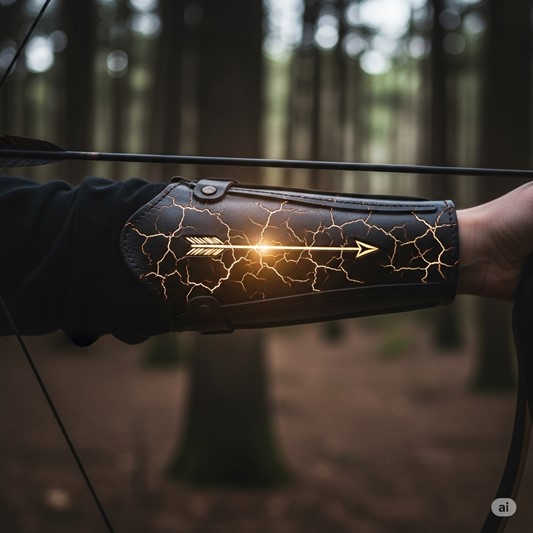
Description This is a simple but sturdy archer’s bracer made from a single piece of thick, smoke-darkened leather. The surface of the leather is covered in a network of fine, heat-induced cracks from its creation in the bonfire’s radiant heat. It is otherwise unadorned, though some owners may tool a simple arrow or eye symbol into the surface. The bracer is secured with a simple leather thong and smells faintly but perpetually of woodsmoke and oiled leather. When the wearer draws a bow, the bracer feels faintly warm against their arm.
Slot Wrists
Detailed Stats Tier: 1 Durability: It is a sturdy leather bracer, resistant to wear and tear. Its magic is permanent. Combat-Related Bonuses: None Resistances: None
Passive Magic Instinctive Arc: The wearer develops a subtle, intuitive understanding of their arrow’s flight path. They can better judge distances, account for wind, and anticipate the arc of their shot. While this does not make them more accurate on a single shot, it allows them to learn from a near miss with uncanny speed, making their follow-up shots more effective.
Effortless Draw: The bracer’s magic creates a sympathetic bond with the bowstring. When drawing a bow, the string seems to glide more smoothly over the bracer’s surface. The physical strain of holding the bow at full draw feels lessened, reducing fatigue and allowing the bowman to hold their aim for longer without trembling.
Activable Magic Divining Shot: Once per day, before drawing their bow, the user can touch the bracer and clear their mind. For a brief moment, their “Mind’s Eye” is guided to the most opportune target in their field of view. This may not be the largest or most immediate threat, but the most strategic one—a fleeing enemy leader, a frayed rope holding up a heavy object, a keystone in a crumbling wall, or the bell in a watchtower. The vision simply draws the user’s focus, it does not grant any bonus to the shot itself.
Smoke-Scented Fletching: Twice per day, the user can touch the bracer to the fletching of a single arrow. For the next minute, the arrow is imbued with the magic of the bonfire smoke. When fired, the arrow leaves a thin, visible trail of fragrant, white smoke in its wake. The trail lingers for about a minute before dissipating. This can be used to signal other archers, mark a specific target, or help locate where a shot landed in dense terrain. The smoke is not thick enough to provide concealment.
Tags Common, Tier 1, Roleplay, Kupala Night, Wrists, Divination, Ranged, Utility, Magical, Leatherwork, Wearable, Tool, Support, Folk Magic, Guidance, Tracking, Buff, Organic
The Kupala 13 of the Sooth-Sayer’s Bracer is a practical and common piece of folk magic, highly valued by anyone who makes their living with a bow. Its trade is common in areas where archery is a part of daily life, from frontier towns and military barracks to the specialized workshops of great cities. Transactions are usually straightforward, with its value being well-understood by those in the know.
The Frontier Town Market
This is where the bracer is most commonly made and sold by the hunter-clans and wilderness folk who first created the tradition. These markets are found at the edge of vast forests and in the shadow of mountains.
- How It’s Sold: The bracer is sold from a rustic stall or wagon, often alongside animal pelts, bundles of seasoned wood, and other hunting supplies. The seller is typically a hunter, not a professional merchant, and will speak of the item in practical terms: “It helps you feel the shot before you loose it,” or “Good for marking a trail your partners can follow.” The sale is often a bartering process, where the bracer might be traded for a set of quality knife-steel, a coil of good rope, or a pouch of rare medicinal herbs.
- Cost: At its source, the price is at its lowest. The bracer is a common tool here, not an exotic artifact. It would typically cost between 60 and 80 Bronze Shards.
The Fletcher and Bowyer’s Workshop
In larger towns and cities, specialized artisans who craft bows and fletch arrows run dedicated workshops. These are the premier urban retailers for all archery-related goods.
- How It’s Sold: The bracer would be displayed alongside high-quality quivers, specialized arrowheads, and bowstrings waxed with rare resins. The shopkeeper, a master fletcher or bowyer, is an expert who can explain the bracer’s magical properties in detail. They might say, “This won’t add power to your bow, but it will add wisdom to your eye.” They may even have a small practice range where a serious customer can try a few shots while wearing the bracer to “get a feel for it.” The transaction is a professional one between a knowledgeable seller and a dedicated customer.
- Cost: The price here reflects the expertise of the seller and the convenience of finding such a specialized item in the city. A Sooth-Sayer’s Bracer would sell for around 1 Silver and 50 Bronze Shards.
The City Watch or Military Quartermaster
The armories that supply military forces or a city’s watch are constantly seeking practical advantages for their soldiers. A tool that improves a marksman’s consistency and allows for signaling is highly valuable.
- How It’s Sold: This is not a public shop. The quartermaster would either purchase these bracers in bulk from frontier suppliers or have a few on hand acquired through other means. A watchman or soldier with a good record might be able to purchase one from the quartermaster’s stores, often having the cost deducted from their pay. An outsider would likely not be able to acquire one here, unless they were doing a specific, sanctioned service for the watch and it was issued as part of their equipment.
- Cost: The price is institutional and fair, as the organization benefits from its use. The cost would be a standardized 1 Silver Shard.
The Adventurer’s Emporium
This is the catch-all shop that buys and sells used armor, weapons, and adventuring gear. These shops are common in any city that sees a regular flow of travelers and mercenaries.
- How It’s Sold: The Sooth-Sayer’s Bracer would be found hanging on a hook among other assorted pieces of leather armor. The shopkeeper may or may not be aware of its specific magical properties. If they are unaware, they will sell it as a “masterwork leather bracer, very tough.” If they know it’s magical, they will pitch its more esoteric features directly to a potential adventurer: “This? They say it lets you see where to shoot, and you can fire a smoke-arrow to signal your friends. Very useful in a dungeon, I hear.”
- Cost: The price here is highly variable. If the shopkeeper is ignorant of the magic, a savvy buyer could get it for the price of a normal bracer, perhaps only 40 Bronze Shards. If the shopkeeper knows its true nature, they will see an adventurer as a wealthy customer and ask for as much as 2 Silver Shards, though they can likely be haggled down.
The Sooth-Sayer’s Bracer is not a tool of raw power, but of perception and precision. Its role in offense and defense is played out not through enchanted, explosive shots, but through tactical cunning—turning the environment into a weapon, directing allies with pinpoint signals, and outlasting foes through superior stamina and insight.
On the Rooftops of a Crowded Metropolis
In the vertical, cluttered environment of a city, a bowman’s advantage comes from controlling sight lines and creating opportunities where none exist.
Roleplaying for Defense: You are being pursued by members of a thieves’ guild across the city’s rooftops. You reach a wide gap between buildings, with no way across and your pursuers closing in. Below the gap hangs a large, heavy wooden sign for a tavern, held by two thick ropes. You activate Divining Shot. Your focus is drawn away from the thieves and locks onto the frayed, worn section of the rope holding the sign’s far side. You draw and loose an arrow, severing it. The sign swings down violently, slamming against the far wall and creating a precarious, swinging bridge. You scramble across. Once on the other side, you fire a second arrow to sever the remaining rope, sending the sign crashing into the alley below and cutting off the pursuit completely.
Roleplaying for Offense: You are providing overwatch for your allies on the street below, who are trying to corner a nimble and evasive political target. The target is ducking through crowds and weaving between stalls, making it impossible for your allies to maintain line of sight. You activate Smoke-Scented Fletching. You don’t shoot at the target, but at the awnings and walls just above and behind them. Your first arrow leaves a plume of white smoke from a rooftop. Your second leaves another from a cloth awning 50 feet further down the street. You are “painting” the target’s path, creating a perfect, visible trail of smoke signals that your allies on the ground can follow, allowing them to perfectly anticipate the target’s movements and set up an ambush.
On the Walls of a Fortress Under Siege
In the chaos of a large-scale battle, a single, well-placed arrow can be worth more than a hundred fired blindly. The bracer turns a bowman into a strategic asset.
Roleplaying for Defense: You are one of several archers defending a section of wall from an oncoming siege ladder assault. The battle is long, and your arm is growing weary. Your fellow archers are firing as quickly as they can, their arms trembling with fatigue. Thanks to your Effortless Draw passive, you remain steady. You can hold your bow at full draw for twice as long as the others, waiting patiently for the chaos to present the perfect shot. You don’t fire at the mass of soldiers; you wait until the heavily armored officer leading them raises his visor to shout a command, and then you let your arrow fly. Your defense is one of endurance and efficiency, making every single shot count when others are wasting their energy on panicked volleys.
Roleplaying for Offense: The enemy has deployed a powerful siege engine, protected by a tall wooden mantlet, that is battering your fortress gate. The machine seems impenetrable. You activate Divining Shot. Your vision pierces the chaos, and instead of highlighting a soldier, it shows you a single, crucial structural point on the machine itself—a large cog in the winch mechanism, visible for only a second as the machine reloads. You take the shot. Your arrow shatters the cog. The machine doesn’t explode, but its loading mechanism grinds to a halt, jammed and useless. You have neutralized the greatest threat to the gate with a single, perfectly aimed, divinely guided arrow.
In a Thick, Misty Forest
When visibility is low and the enemy could be anywhere, the bracer becomes a tool of guidance, tracking, and unerring instinct.
Roleplaying for Defense: Your party has been ambushed by a rival hunting party in a dense, foggy wood. In the initial chaos, your group was scattered, and you can no longer see your allies. To prevent them from being picked off one by one, you need to establish a rallying point. You activate Smoke-Scented Fletching and fire an arrow straight up into the air. The arrow, trailing its plume of white smoke, creates a temporary vertical line hanging in the mist—a clear beacon visible above the fog layer. Your allies see the signal and are able to navigate through the disorienting mist back to your position, allowing your group to reform and present a unified defense.
Roleplaying for Offense: You are hunting a rare, swift-moving beast that uses the fog as cover. You catch a glimpse of it dashing between trees and loose a quick shot, which misses. However, your Instinctive Arc passive gives you a perfect “feel” for the error; you know you aimed too low. The beast, thinking it is safe, pauses behind a large oak. Though you can no longer see it, you remember its exact position. Trusting the bracer’s feedback, you aim slightly higher and fire a second arrow through the dense fog. The arrow, flying on pure instinct and correction, finds its mark. The offense comes not from raw power, but from the bracer turning a missed shot into perfect data for the next one.
Perception of Activation:
Sight
- User’s Perspective: When you activate the bracer’s magic, the network of fine, heat-induced cracks on the leather’s surface glows for a split second with the soft, warm orange light of a dying ember. If using “Smoke-Scented Fletching,” you see a tiny, almost imperceptible wisp of grey smoke get drawn from the bracer’s surface into the feathers of the arrow.
- Observer’s Perspective: The visual effect is extremely subtle. An observer would need to be staring directly at the bracer in dim lighting to notice the faint, momentary glow, and would likely dismiss it as a trick of the eye. The transfer of smoke to the arrow is invisible to an observer.
- Positives: The extreme subtlety of the visual cue allows the user to activate the magic in plain sight without alerting enemies or prey to their intent.
- Negatives: There is no clear visual confirmation of activation for allies, and even the user might miss the faint glow if they are not paying attention.
Sound
- User’s Perspective: The moment of activation is marked by a sudden, internal “sound” of perfect silence. It is as if the ambient noise of the world holds its breath for a single heartbeat. This is immediately followed by the faint, mental impression of a perfectly tuned bowstring being released with a sharp thrum.
- Observer’s Perspective: The activation is completely silent.
- Positives: Silent operation is essential for a bowman who relies on stealth for hunting or combat. It does not give away their position.
- Negatives: The lack of an audible cue means it cannot be used as a signal, and the user receives no feedback in a loud or chaotic environment like a battlefield.
Smell
- User’s Perspective: The familiar scent of woodsmoke and oiled leather from the bracer intensifies dramatically for a brief moment. It is accompanied by a sharp, new scent—the smell of freshly struck flint or the metallic tang of ozone in the air just before a lightning strike.
- Observer’s Perspective: There is no perceivable odor unless an observer’s nose is physically pressed against the bracer at the exact moment of activation.
- Positives: This provides a strong and distinct sensory confirmation that is entirely personal to the user.
- Negatives: There are no significant negatives, as the scent is too localized and fleeting to be detected by others.
Touch
- User’s Perspective: A sharp, focused point of heat flares on your arm directly beneath the bracer. It is not a painful burn but a sudden, insistent heat, like a hot coal being pressed against the leather for a single second. It is impossible to ignore.
- Observer’s Perspective: There is no effect. An observer cannot perceive the temperature change.
- Positives: This provides clear, powerful, and unambiguous tactile feedback to the user, letting them know the magic is ready to be used.
- Negatives: The sudden, sharp sensation of heat, if unexpected, could cause the user to flinch, potentially spoiling their aim at a critical moment.
Taste
- User’s Perspective: Activation leaves a phantom taste of ash and iron on your tongue. It is the primal, metallic taste of blood mixed with the bitterness of campfire smoke—the flavor of the hunt.
- Observer’s Perspective: There is no perceivable effect.
- Positives: It serves as another unique layer of sensory confirmation for the user.
- Negatives: The taste is grim and somewhat visceral, which may be unsettling or unpleasant for some users.
Extra-Sensory: Magical (Mind’s Eye)
- User’s Perspective: Through your “Mind’s Eye,” the magic feels like a sudden, sharp narrowing of your perception. The chaotic details of the world seem to fall away, and your focus is drawn into a single, unwavering line of intent. It is a feeling of supreme, uncluttered clarity, as if the path between you and your target has become the only thing in existence.
- Observer’s Perspective: A magically-attuned observer would perceive a very brief and highly directed “pulse” of Divination magic emanating from the user. It is not a sustained aura, but a quick, sharp “ping” of focused intent, like a sonar echo, making it difficult to trace or analyze unless the observer was already concentrating on the user.
- Positives: The magic is incredibly fast and difficult for other magic-users to detect or identify. For the user, it provides an unparalleled sense of focus.
- Negatives: This intense, narrow focus can result in tunnel vision, potentially causing the user to be unaware of a different threat approaching from their periphery.
Extra-Sensory: Precognitive Guidance
- User’s Perspective: When activating “Divining Shot,” you do not see the future, but you feel it. Your consciousness briefly experiences the emotional outcome of a perfect shot. Your eyes might be drawn to an enemy commander, and you will feel a powerful wave of satisfaction and victory. Your focus might shift to a rope holding a chandelier, and you will feel a flash of chaotic glee. The bracer guides you not with images, but with the emotional reward of choosing the most opportune target.
- Observer’s Perspective: There is no perceivable effect, although the user may seem to hesitate for a split second before drawing their bow.
- Positives: This is an incredibly intuitive form of guidance, bypassing complex visual data and providing a simple, compelling emotional imperative to aim at the correct target.
- Negatives: The precognitive feeling is a strong compulsion. It is difficult to ignore the divined target in favor of a more logical one. The sudden, unearned flash of a future emotion can be disorienting.
Binding the Unerring Shot
Materials Needed
- One Rectangle of Hardened Leather: A piece of thick, high-quality leather, large enough to be cut into a bracer that fits the creator’s forearm.
- The Spirit Arrow: This is a ritually crafted arrow that will be sacrificed. It must be made with a shaft of straight-grained yarrow wood, fletched with a primary feather from a hawk (for day-sight) or an owl (for night-sight), and tipped with a flint or obsidian arrowhead.
- A Handful of Fresh Yarrow Flowers: Gathered on the eve of Kupala Night. Yarrow is a plant often associated with both divination and the staunching of wounds.
- Embers and Smoke from a Kupala Night Bonfire: The fire must be a true communal bonfire, not a simple campfire.
- A Leather Thong: For lacing the finished bracer.
- Beeswax and Tallow Salve: A mixture of rendered animal fat and beeswax, used to condition and seal the leather.
Tools Required
- Leatherworking Tools: A sharp knife for cutting the leather, an awl for punching lace holes, and an edge beveler for finishing.
- A Wooden or Ceramic Bowl: Large enough to hold the bracer and water.
- Fire-Tongs: For handling the hot embers.
- A Burnishing Tool: A smooth, polished piece of antler or bone used for working the salve into the leather.
Skill Requirements
- Leatherworking (Practiced): The creator must be skilled in cutting, shaping, and finishing leather to create a functional and durable bracer.
- Fletching (Novice): A basic understanding of arrow-making is required to craft the Spirit Arrow. The arrow does not need to be a masterwork, but it must be properly made with intent.
- Mind’s Eye (Focused Intent): The most crucial skill is the ability to hold a single, unwavering thought. During the ritual, the creator must be able to visualize a single, perfect, impossible shot—an arrow flying true to a target they cannot see.
Crafting Steps
- Mundane Preparation: In the days leading up to Kupala Night, the creator first crafts the two physical components. They use their leatherworking tools to cut and shape the bracer, punching the holes for the lacing but leaving it otherwise unfinished. Separately, they craft the Spirit Arrow, taking care to ensure it is straight and well-balanced.
- The Yarrow Infusion: As the sun sets on Kupala Night, the creator places the handful of fresh yarrow flowers in the bowl and covers them with cool, clean water. The mixture is left to sit under the open sky, absorbing the magical energies of the twilight. After an hour, the bracer is submerged in this yarrow-infused water to soak.
- The Sacrifice: At the height of the festival, the creator approaches the raging bonfire. They take the Spirit Arrow and, holding the image of the “perfect shot” in their mind, they cast the arrow directly into the heart of the flames. They must watch as it is consumed by the fire.
- Catching the Spirit: As the Spirit Arrow burns, the creator removes the soaked bracer from the yarrow water. Holding it with the fire-tongs, they pass it repeatedly through the thick smoke rising from the spot where the arrow is burning. They are not cooking the leather, but “smoking” it, allowing the spirit and intent of the sacrificed arrow to be captured in the smoke and infused into the damp leather. This process continues until the bracer is smoke-darkened and dry.
- Sealing the Magic: While the bracer is still hot from the fire, the creator places it on a flat stone. They take a few hot embers from the fire with their tongs and place them directly onto the surface of the bracer, creating the network of fine, heat-induced cracks. After brushing the embers away, they apply a generous amount of the beeswax and tallow salve. Using the burnishing tool, they vigorously rub the salve into the hot, cracked leather, sealing the magic, conditioning the bracer, and giving it its final, dark finish. Once cool, they thread the leather thong, and the bracer is complete.
Bracer of the Unseen Mark
And it came to be in the village of high peaks, where the wind is born, there was a contest of bowmen. This contest was held on the night of Kupala, when the world was full of fire and magic.
In the village lived a young man, Kaelen. His eyes were like hawks, but his heart was like a loud drum, full of pride. He could shoot the feather from a flying goose. He could shoot the apple from the branch while riding a fast horse. He was the best of the young archers, and he said to all, “This is the year I defeat the old master.”
The old master was Valerius. His eyes were like milk glass with age, and his hands were knotted like the roots of an old oak. He had been the village champion for fifty years. He no longer shot with his eyes, for they were dim. He shot with a knowledge that lived deeper than sight. He heard Kaelen’s boasts, and he smiled a quiet smile.
The contest began. There were many tests. There was the test of distance, and Kaelen’s arrow flew straight and true, farther than all others. There was the test of speed, and Kaelen’s arrows flew like angry bees from the hive, more than all others. In all the tests of sight and strength, Kaelen was the victor. Valerius, the old master, shot his arrows well, but not with the fire of youth. He seemed to be listening to the world as he shot, and his face was calm.
Then came the final test, the test that mattered most. It was the Trial of the Unseen Mark. Far across the valley, in a ravine filled with the night’s mist, a single silver bell was hung from a branch. It could not be seen. The wind in the ravine was a liar, moving this way and that. The trial was to loose one arrow into the mist and make the bell ring. It was a test of spirit, not of eyes.
Before the trial, the great bonfire of Kupala was lit. Valerius, the master, approached the fire. He showed Kaelen a simple bracer of smoke-darkened leather that he wore. It was old and cracked. “A bowman has two eyes in his head,” Valerius said, his voice quiet like the wind. “But the arrow must have an eye of its own.”
Valerius took a perfect arrow he had made, with a feather from an eagle and a head of black flint. He called it the Spirit Arrow. He held it up to the fire, and he spoke to it, but Kaelen could not hear the words. Then, he cast the arrow into the heart of the great bonfire. As the arrow was eaten by the flame, Valerius held his leather bracer in the rising smoke. His eyes were closed. He stood like a statue, as if listening. He was catching the ghost of the arrow in his bracer.
Kaelen scoffed at this ritual. “Magic is for those without skill,” he thought. He trusted his sharp eyes and his strong arm. He stepped to the firing line. He looked at the mist. He judged the wind. He calculated the fall of the arrow in his mind. He drew back his mighty bow, aimed with all his great skill, and let the arrow fly. It flew like a perfect line into the white blanket of the ravine. And then there was only silence.
The village was quiet. Kaelen’s face was a stone. His arrow was lost.
Then Valerius stepped to the line. He nocked his own arrow. He did not seem to look at the ravine. His eyes were nearly closed, and he seemed to be looking at something far away, or deep inside himself. He drew back his bow. Kaelen, standing near, saw a strange thing. The old, cracked bracer on the master’s arm began to glow with a soft, warm light, like the embers of a dying fire. Valerius held the bow drawn for a long time, his head tilted as if hearing a distant song. Then, with a soft sigh, he released the string. The arrow flew into the mist and vanished.
The village held its breath. A long moment passed. And then, faint and pure and clear, a single note came from the heart of the ravine. Ting. The sound was a silver seed in a field of silence. The bell had been struck.
Kaelen’s pride was a broken cup. He went to the old master and bowed his head. “How?” he asked. “My eyes are the best in the village. My aim is true. How did you hit a mark that cannot be seen?”
Valerius took the warm bracer from his arm and gave it to Kaelen. “I did not shoot the arrow,” the old master said. “The spirit of the arrow we gave to the fire shot it for me. Its ghost flew true because it was unburdened by eyes. This bracer only remembered the path. It told my heart where to aim.”
Kaelen took the bracer. He understood. He had learned that the hardest target to hit is the one you can see, because it makes you forget to trust the feeling within.
Moral of the story: Sometimes you must close your eyes to see the target.
Suggested conversions to other systems:
Call of Cthulhu
The Vambrace of Unseen Paths
A primitive-looking archer’s bracer made of hardened leather, darkened by smoke and covered in fine cracks. It was recovered from the belongings of a “solitary hunter” in the backwoods of Massachusetts, who was rumored to be able to make impossible shots in the dead of night. The bracer feels strangely warm when a bow is drawn.
Game Mechanics: An Investigator wearing this vambrace finds their archery skills guided by an unnerving, otherworldly intuition.
- Supernatural Instinct: When making a Firearms (Bow) roll, the Investigator may choose to fire by instinct alone, closing their eyes and trusting the bracer’s guidance. If they do so, they may ignore all environmental penalty dice for darkness, fog, or cover. However, if this roll is fumbled, the arrow flies at an unintended target, determined by the Keeper, which may include another Investigator.
- Divining Shot: Once per investigation, the user can touch the bracer and focus on a visible target. They must spend 1d4 Sanity points as a disturbing, non-Euclidean understanding of causality floods their mind. For their next shot against that target only, they are considered to have rolled an Extreme success.
Cost to Sanity: The bracer attunes the wearer’s mind to impossible geometries. Prolonged use may lead the Keeper to introduce a new phobia or mania related to angles, trajectories, or the fear of unseen things.
Blades in the Dark
The Ghost-Arrow Vambrace
A stiff, smoke-blackened leather bracer, laced with gut-string. They say these are made by the reclusive hunters of the Deathlands, who learn to hunt the spectral beasts that roam the wastes. The vambrace is said to guide an arrow through fog, darkness, and even the veil between worlds. It takes up 1 Load.
Game Mechanics: This is a Fine piece of mystical gear, prized by Hounds who favor a bow.
- Unerring Aim: When you Hunt or Skirmish with a bow, you can make shots that others cannot. You can ignore all penalties to your Effect level that would be caused by poor visibility or a target having cover.
- Ghost-Light Arrow: Once per score, you can fire an arrow that leaves a trail of silent, silvery-white smoke. This smoke is only visible to you and anyone you designate, allowing you to mark a target or path for your crew without alerting your enemies.
- Patient Hunter: When you perform a Setup action to steady your aim before a shot, you may take +1d to your subsequent ranged attack roll.
Dungeons & Dragons
The Archer’s Guide Wondrous item, common
This simple leather bracer is stained dark by woodsmoke. It feels warm to the touch whenever the wearer draws a bowstring across it.
Game Mechanics:
- As a bonus action on your turn, you can steady your aim. If you have not used any of your movement this turn, you can gain advantage on the next ranged weapon attack you make with a bow or crossbow before the end of your turn.
- Once per day, you can use an action to touch the fletching of an arrow or a crossbow bolt to the bracer. For the next minute, if that ammunition is fired, it leaves a visible trail of harmless white smoke that lingers in the air for 1 round, clearly marking its trajectory.
Knave
The Smoked Bracer
Item Slot: 1
A simple archer’s bracer made of tough leather, stained black by bonfire smoke. It feels comfortable and allows you to hold a drawn bow for an impossibly long time.
Game Mechanics:
- Effortless Aim: You do not suffer any penalties or fatigue for holding a bow at full draw for multiple rounds.
- Soothsayer’s Shot: Once per day, before making a shot, you can ask the GM, “What is the most opportune target?” The GM will give you a short, truthful answer (e.g., “The captain,” “The rope,” “The left guard”).
- Signal Arrow: Once per day, you can cause one of your arrows, when fired, to leave a thick trail of white smoke that hangs in the air for a minute.
Fate
The Archer’s Intuition
This simple leather bracer is more than protection; it is a focus for the archer’s will, allowing them to make shots that defy normal explanation. It is best represented as an Item Aspect that a character possesses.
Aspect: An Arrow Knows the Way
Game Mechanics: A character with this bracer can use its aspect in several ways:
- Invoke: A player can spend a Fate Point to invoke An Arrow Knows the Way for a +2 bonus or a reroll on a Shoot check, especially when attempting a difficult or seemingly impossible shot (e.g., through cover, at an unseen target, or in a high wind).
- Compel: A GM can offer a Fate Point to compel the aspect. For example: “The bracer gives you a powerful hunch that the real threat is the gargoyle on the rooftop, not the guards in front of you. You feel compelled to take that risky shot, leaving your friends exposed for a moment. That’s a complication because An Arrow Knows the Way.”
Stunts Granted by the Bracer:
- Divining Shot: Because I have The Archer’s Intuition, once per session, I can ask the GM, “What is the most opportune target in this scene?” I gain a +2 bonus to my Shoot roll when I attack that specific target on my current turn.
- Smoke Signal: Because I have The Archer’s Intuition, I can declare that any arrow I fire leaves a trail of harmless smoke. I can use this to Create an Advantage for my allies, creating aspects like Target Marked or Follow the Smoke Trail.
Numenera & Cypher System
The Ballistic Soothsayer
This device appears to be a simple archer’s bracer made of a dark, leather-like material. In reality, it is an artifact from a previous world, a wearable targeting computer that interfaces directly with the user’s nervous system. The “cracks” on its surface are micro-fine telemetry sensors.
Level: 5 Form: A sleek, dark bracer that bonds comfortably to the wearer’s arm. Effect: The bracer constantly calculates wind speed, distance, humidity, and हजारों of other variables. Any ranged attack the user makes with a thrown weapon or a simple projectile weapon (like a bow) is eased.
The artifact has two active functions:
- Targeting Oracle: Once per day, the user can designate a single target within sight. The bracer spends one round performing a complex scan of the target and its environment, then feeds a perfect firing solution to the user’s mind, highlighting weak points or opportune ricochet angles. The user’s next attack roll against this target is eased by two steps.
- Tracer Nodule: The bracer contains three small, adhesive nodules. When attached to a projectile, the nodule leaves a glowing trail of ionized particles in its wake that is visible for one minute.
Depletion: 1 in 1d20 (Check only when Targeting Oracle is used).
Pathfinder
The Soothsayer’s Vambrace Item 3 Uncommon, Divination, Magical Price 50 gp Usage worn bracers; Bulk L
This well-worn leather bracer is dark from woodsmoke and covered in fine, heat-induced cracks. It is a favored tool of rangers and scouts who rely on their bows in the wild.
Game Mechanics: Passive: The bracer helps you steady your body and mind for the perfect shot. You gain a +1 item bonus to attack rolls made with bows if you use the Hunt Prey action before you Strike.
Activate [one-action] Envision; Frequency once per day; Effect You quiet your mind and allow the bracer’s magic to guide your senses. The GM identifies one target in your line of sight that is the most tactically advantageous for you to attack (this could be a creature, an object, or a specific part of a larger foe). Your first Strike against that target before the end of your next turn deals an additional 1d6 precision damage.
Activate [free-action] (Trigger: You make a Strike with a bow); Frequency twice per day; Effect You cause the arrow you just fired to leave a trail of harmless white smoke. The trail lasts for 1 minute or until dispersed by a strong wind, clearly marking the arrow’s path.
Savage Worlds
The Hawkeye Bracer
A rugged leather bracer, stained dark from countless campfires. Hunters who wear it swear it lets them feel the path of the arrow before it’s even fired, guiding their hand to make shots that defy logic.
Game Mechanics:
- Steady Hand: The wearer of the bracer ignores the Unstable Platform penalty when firing a bow.
- Opportune Shot: Once per session, the wearer can ask the GM to point out the most tactically advantageous target in a scene (e.g., the enemy leader, the weak support beam, the guard with the alarm horn). The character gets a +2 bonus to their Shooting roll against that specific target for one round.
- Smoke Signal: Twice per session, the character can choose to fire a “smoke arrow.” The arrow leaves a thick trail of white smoke, clearly marking its path and destination. Allies making a ranged attack against a target who is at or near the smoke arrow’s landing point gain a +1 bonus to their Shooting rolls for one round.
Shadowrun
The True-Shot Vambrace
This appears to be a simple, well-worn leather bracer, often favored by urban tribal archers and practitioners of nature-based magical traditions. In truth, it is a Weapon Focus, specifically attuned to the meditative and instinctual art of archery, helping to guide the user’s hand and arrow with preternatural accuracy.
Game Mechanics:
- Type: Weapon Focus
- Force: 2
- Attunement: Bows only
Abilities:
- Focused Aim: When used with any type of bow, this Weapon Focus adds its Force (2) as a dice pool bonus to the user’s Archery + Agility attack tests.
- Divining Shot: Once per run, as a Minor Action, the user can activate the vambrace’s divinatory power. For their next attack action with a bow, they may ignore all negative dice pool modifiers from environmental conditions such as wind, rain, or poor visibility.
- Smoke Signal: The vambrace holds 3 charges, which replenish after a 12-hour period. As a Minor Action, the user can expend a charge to touch an arrow. When fired, that arrow leaves a thick trail of harmless, colored smoke (the user chooses the color when activating). This can be used to mark a target or signal allies.
Starfinder
The Seeker’s Vambrace Level 4; Price 2,000 credits Slot wrists; Bulk L
This high-tech bracer is crafted from reinforced leather interwoven with micro-circuitry and a small targeting projector. It is a hybrid of ancient archery principles and modern targeting technology, favored by bounty hunters and elite security forces who prefer the silence of a bow.
Game Mechanics:
- Targeting Link: This vambrace grants a +1 insight bonus to attack rolls with bows.
- Oracle Shot (Hybrid, Divination): Once per day, as a move action, you can activate the vambrace’s targeting oracle. It scans the battlefield and highlights the most tactically vulnerable enemy currently in your line of sight. Your next attack made against that specific enemy before the end of your turn deals an additional 1d6 damage.
- Tracer Nodule (Technology): The vambrace can apply a small, adhesive bioluminescent nodule to an arrow as part of the action of drawing it. This can be done 3 times per day. When fired, the tracer arrow leaves a bright green trail that lasts for 1 minute, making its trajectory and landing point easy to see.
Traveller
Ballistic Prediction Unit (BPU-1)
A military-grade vambrace (TL-13) designed for use with non-powered projectile weapons. The BPU-1 contains a sophisticated sensor suite that tracks atmospheric conditions and target movement, feeding predictive data to a micro-display on the user’s wrist to ensure unparalleled accuracy even with primitive weapon systems.
Game Mechanics:
- Tech Level: 13
- Predictive Aiming: The BPU’s real-time analysis of range, wind, and target movement grants the user DM+1 on all skill checks made to attack with a bow or other archaic projectile weapon (typically Heavy Weapons (Launchers) or Gunnery depending on the weapon’s classification).
- Priority Target Designation: Once per combat encounter, the user can use an action to command the BPU to scan for a priority target. The device will highlight the enemy with the most dangerous weapon or highest rank, providing DM+2 on the user’s first attack against that specific target.
- Tracer Magazine: The BPU contains a small, internal magazine of 5 chemical tracer rounds that can be automatically applied to an arrow as it is drawn. When fired, the tracer leaves a bright, visible trail. The magazine can be refilled at a TL-10+ facility.
Warhammer Fantasy Roleplay
The Taal’s Eye Bracer
A thick bracer made from the hide of a Drakwald stag and stained with the smoke of sacred bonfires. These are crafted by the reclusive hunters who worship Taal, the God of Nature and Wild Places, and are believed to grant the wearer a small portion of the wild god’s unerring sight.
Game Mechanics:
- Encumbrance: 1
- Qualities: Magical
Effects:
- Hunter’s Instinct: The wearer gains a +10 bonus to all Ranged (Bow) Tests. Additionally, they do not suffer any penalties for firing at a target at Long Range (though they still cannot shoot beyond Extreme Range).
- God’s Guidance: Once per session, the user can whisper a quick prayer to Taal (a Free Action). For their next shot with a bow, they are guided to a weak point in their target’s defenses. If the Ranged (Bow) Test is successful, they add +2 Success Levels to the result.
- Scent of the Arrow: Twice per day, the user can touch an arrow to the bracer. When fired, the arrow is followed by a thin trail of scent that only the user and any animal companions they have can smell. This allows them to track the arrow’s flight path and find where it landed, even in thick undergrowth.