
Original Life Forms Referenced:
• Strix aluco (Tawny Owl – Class Aves)
• Pandinus imperator (Emperor Scorpion – Class Arachnida)
• Python regius (Ball Python – Class Reptilia)
• Macropus rufus (Red Kangaroo – Class Mammalia)
Appearance:
The Strigocorpythynmus 642 is a startling amalgamation of four distinct evolutionary legacies. Its primary body shape is elongated and muscular like a python, covered in matte, scale-feather hybrid plating—dark umber and deep gold with subtle iridescence that glints in moonlight. The torso and forequarters carry the robust musculature and upright posture of a kangaroo, with long, springing hind legs ending in talon-like claws capable of gripping or raking. The front limbs are short but heavily armored, ending in two pincer-like claws derived from the scorpion, glossy and black, with a faint violet sheen. A segmented scorpion tail emerges from the lower spine, curling over the back with a thick, barbed stinger that drips a faintly luminous toxin. The head is dominated by a forward-facing facial disc of owl feathers that frame piercing amber eyes, a sharply hooked beak, and a flexible python-like jaw capable of dislocating for larger prey. Along its sides, thin mantling feathers aid in silent movement through brush or along rocky terrain.
Size:
Length: 2.5–3.2 m from snout to tail tip (including the scorpion stinger)
Height: ~1.4 m when upright on hind legs
Weight: 180–230 kg
Speed:
• Ground: 35 km/h in bounding hops, 18 km/h in stealth approach
• Climbing: moderate, using claws and tail for anchoring
• Silent glide-hop: up to 6 m from a single leap
Stat Modifiers:
• Strength: +3
• Dexterity: +2
• Constitution: +3
• Intelligence: −1
• Wisdom: +1
• Charisma: −2
Skills:
• Stealth (proficient; silent feathered movement + scale-camouflage)
• Athletics (proficient; springing leaps, grappling with coils)
• Perception (advantage in low-light; owl eyes)
• Survival (skilled; ambush hunting, burrow detection)
Behavior:
Ambush predator that uses silence and sudden power. Typically crouches motionless in shadow until prey approaches, then lunges in a rapid bounding strike, attempting to entangle prey with its python coils while delivering a venomous sting. Displays territorial threat behavior—pincers raised, tail arched, feathers flared around the head. Mates seasonally in secluded burrows; young are born live but require parental guarding for the first month.
Diet:
Obligate carnivore; prefers small to medium vertebrates, but can overpower larger prey with persistence. Has been observed eating carrion during scarcity. Stinger venom partially digests tissues before consumption.
Emotions:
Primarily driven by instinct, but displays curiosity toward moving objects and caution toward unknown scents. Can show territorial rage when provoked, and an eerie stillness before an attack.
Environment Where Found:
Semi-arid rocky uplands, forest edges, and scrubland valleys of mid-latitude island interiors. Prefers mixed terrain with boulders for cover and open spaces for hopping attacks. Active primarily in twilight and early night hours.
Tags:
Feral, Predator, Ambush, Venomous, Silent-Movement, Nocturnal, Hybrid, Territorial, Apex-Hunter, Camouflage, Leaper, Coiler, Clawed, Armored, Feathery, Scaled, Desert-Edge, Bioluminescent, Burrower, Pack-Loner, Heat-Sensing, Ritual-Mating, Crepuscular, Apex-Scavenger, Threat-Display, Venom-Luminescence, Cliff-Dweller
Life Cycle
The [unique species name] [random number] begins life as soft-shelled, translucent hatchlings emerging from a clutch buried deep in the substrate of cliffside or high-ledge burrows. Eggs incubate for approximately one Saṃsāra month, their shells absorbing minerals from the surrounding rock, which determines early shell coloration patterns. Hatchlings are fully mobile within hours but remain near the birth burrow for the first two weeks, relying on heat-sensing to detect small prey. By three months, their armor plates harden, and they are capable of scaling vertical cliffs. Adolescence is reached within one Saṃsāra year, during which rapid bioluminescent changes signal health and status. Adults live between 15–20 years in the wild, though apex individuals in safer environments have been recorded surpassing 30 years.
Mating
This species engages in ritual-mating, occurring only during the dimming weeks of the Helmus month, when the eclipse shadow encourages collective gatherings on high, narrow ledges. Males and females both produce synchronized luminescent pulses in complex rhythmic patterns to signal compatibility. Physical contests are rare; instead, mates compete in intricate cliffside display runs, darting back and forth in dangerous terrain to show agility and stamina. Pair bonds often last several years, though not always for life, and both parents participate in egg guarding and burrow maintenance.
Tactics
The species relies on stealth followed by sudden explosive movement. Using heat-sensing pits, they locate prey hidden in shadows or crevices, approaching slowly before launching into a rapid, clawed grapple. Their bioluminescent organs can suddenly flare into dazzling bursts, disorienting predators or prey. When threatened by larger creatures, they prefer bluff tactics—facing the intruder, extending threat-display frills, and flashing alternating colors to appear larger and more aggressive. In open terrain, they will flee to vertical surfaces, climbing or clinging out of reach.
Actions
- Hunting – Silent stalking on rocky ledges, blending with cliff colors until in striking range.
- Burrow Excavation – Using strong foreclaws to dig into cliff faces, forming chambers for nesting or temporary refuge.
- Heat Scanning – Remaining motionless while sensing heat signatures from hundreds of feet away.
- Display Running – Fast, risky runs along cliff edges during mating season.
- Predator Bluffing – Bioluminescent threat displays and high-pitched vocalizations.
- Cleaning Rituals – Rubbing against mineral-rich outcroppings to remove parasites and maintain shell condition.
Other Interesting Information
- Cliff burrows often become long-term structures reused by multiple generations.
- Their venom-luminescence is both a defense and a hunting tool, as the venom glows faintly in prey wounds, making escapees easy to track.
- They exhibit pack-loner behavior—hunting alone but nesting in loosely connected colonies for safety.
- Young are trained by parents through “mock hunts” against small, harmless cliff lizards.
- Some cultures in Saṃsāra consider their shells sacred, carving bioluminescent inlays into ceremonial items.
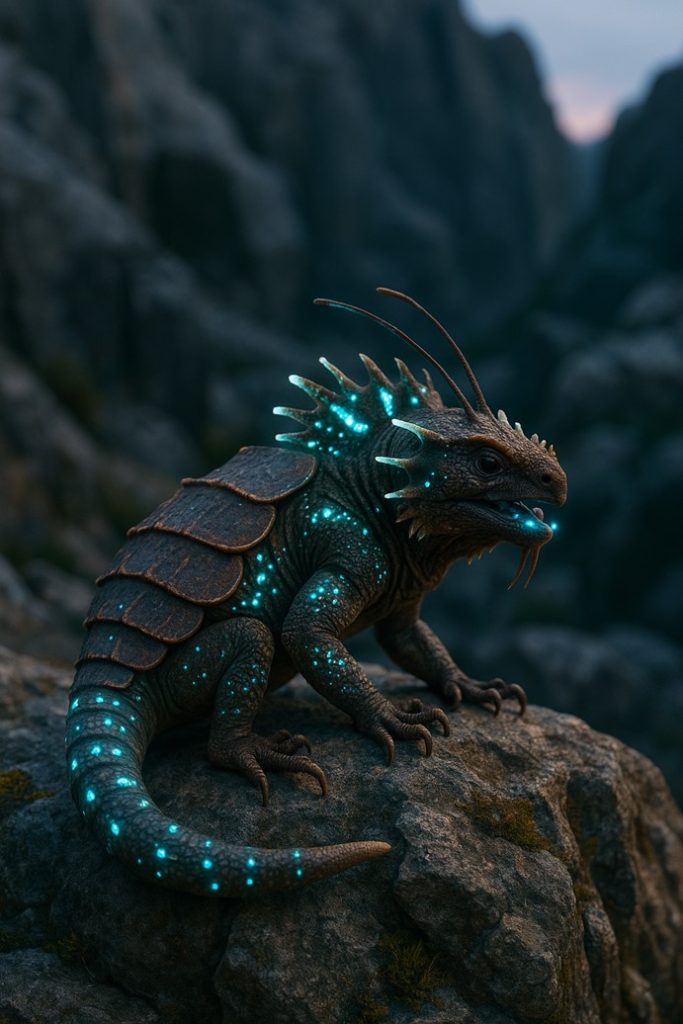
Adventurers in Saṃsāra might encounter or actively seek the Ecliptocarvus 611 for a variety of practical, economic, and mystical reasons, often woven into the flow of local politics, magical theory, or regional survival concerns.
1. Rare Alchemical Components
The creature’s luminous crest membranes, bioluminescent ventral sacs, and the chitinous plates of its forelimbs are prized in potion-making and magical device construction. Crest membranes hold naturally aligned light-refraction patterns, making them ideal for scrying lenses, while ventral sac fluids maintain their glow for years, acting as both light source and catalyst in enchantment rituals.
2. High-Value Trade Goods
Across Saṃsāra, caravans and sea traders seek Ecliptocarvus-derived materials, especially its patterned dorsal feathers which shimmer in shifting lunar hues. These feathers are woven into prestige garments or banners, often used by nobles to signal divine favor or arcane lineage. Capturing even a few plumes without killing the beast can be worth a fortune.
3. Disruption of Rural or Magical Areas
While not inherently malicious, Ecliptocarvus migrations sometimes devastate crops, deplete herb-groves, or drain ambient mana in a region due to their energy-dense diet. Villages or mage enclaves may hire adventurers to divert, capture, or relocate them before the damage forces entire communities to relocate.
4. Sacred Quests or Religious Trials
In certain island faiths, the Ecliptocarvus is seen as a messenger of eclipses and cosmic change. Capturing one alive during the Darkness Week of the Saṃsāra calendar, or even following it across its migration path, is considered a rite of passage for aspirants to priesthood or for avatars seeking political favor with temple councils.
5. Arcane Study of Eclipse-Bound Biology
Scholars of the Path of the Painted Dawn, among others, believe Ecliptocarvus 611’s internal organs adjust their magic absorption in rhythm with Saṃsāra’s eclipses. Adventurers might be contracted to obtain live specimens or detailed observations, often requiring long expeditions into remote marsh-forest transition zones where these creatures thrive.
6. Dangerous Encounters in Uncharted Territories
The Ecliptocarvus’ preferred habitats—dense wetland thickets bordering deep-forest canopies—are often on the fringes of mapped lands. Adventuring parties exploring these areas for unrelated reasons (ruins, lost caravans, leyline mapping) may find themselves in conflict with a territorial or protective individual, especially during nesting cycles.
7. Tournament or Hunting Proving Grounds
In more martial cultures, capturing or besting an Ecliptocarvus without killing it is a test of skill, agility, and teamwork. Seasonal contests sometimes drive adventurers to seek one out for public hunts or arena exhibitions.
When an Ecliptocarvus 611 is slain or dies naturally, almost every part of its body can be recovered for some form of economic, magical, or cultural value. Skilled field dressers, alchemists, and tanners can ensure that none of its rare materials are wasted, and in Saṃsāra, these recovered resources often form the backbone of lucrative trade contracts.
1. Luminous Crest Membranes
- Properties: Thin, semi-translucent skin stretched over bone-like ridges along the head and neck, shot through with mana-conductive capillaries.
- Uses: Ground into powdered form to make Eclipse Ink for enchanted scrolls; when whole, can be crafted into magical veils or light-dispersing lens plates for scrying mirrors.
2. Bioluminescent Ventral Sac Fluid
- Properties: Thick, milky-gold liquid that retains its glow for decades after extraction.
- Uses: Fuel for perpetual lanterns; critical reagent for Illumination Draughts used in night exploration; applied to weapons for limited-duration “glow-strike” effects in darkness.
3. Dorsal Feather Fan
- Properties: Rigid, scale-feather hybrids that shift color according to ambient mana flows.
- Uses: Sewn into prestige robes for royalty and high-ranking mages; cut into thin slivers for Mana Drift Charms that help stabilize spellcasting in unstable magic weather.
4. Chitinous Forelimb Plates
- Properties: Hardened, moon-patterned armor plates that grow along the primary striking limbs.
- Uses: Forged into curved knife blades prized for their strength-to-weight ratio; powdered form used in alchemical wards that repel certain nocturnal predators.
5. Crescent Beak and Jaw Hooks
- Properties: Keratin-like material, unnaturally sharp, with a pale silver sheen under moonlight.
- Uses: Fashioned into ceremonial daggers for eclipse festivals; powdered beak filings serve as catalysts in binding rituals to trap light-based elementals.
6. Eclipse Gland (Located near the spine)
- Properties: A small, dense organ that regulates the creature’s light-absorption cycles.
- Uses: Infused into Eclipse Rings that grant the wearer enhanced night vision during Darkness Week; potent but volatile ingredient in time-disruption experiments.
7. Tail Quill Spines
- Properties: Long, hollow, fibrous spikes from the tail’s defensive fan, tipped with a mild paralytic toxin.
- Uses: Used whole as light yet deadly crossbow bolts; toxin extracted for Stasis Poison in non-lethal capture weapons.
8. Mana-Dense Bone Marrow
- Properties: Pale green, gel-like marrow found in the largest limb bones.
- Uses: Refined into Resonance Elixirs that temporarily increase mana boost; in powdered form, serves as a potent mana battery for artificers’ constructs.
9. Heart of the Eclipse (rare find — only in elder specimens)
- Properties: A black-gold crystalline core formed from layers of calcified mana deposits.
- Uses: Often mounted as a focal gem in high-tier staves or protective wards; when crushed, can serve as the anchor point in a large-scale light-dispersal ritual.
10. Lunar Patterned Hide
- Properties: Thick skin with intricate, natural eclipse markings; naturally water-resistant and mildly mana-conductive.
- Uses: Fashioned into ceremonial cloaks that subtly glow under moonlight; ideal for crafting flexible armor with minor magic-dampening qualities.
Tale of Moon-Hunger Wing
In the long-before time, when the lights in sky had not learned their proper walking, the Moon was shy and the Sun was proud, and all the lands had too much bright or too much dark. The people, beasts, and spirits cried for balance, but none could carry both day and night in same breath. It is told that in those tangled days, there was born the first of the Moon-Hunger Wing, whom the ancients called He-Who-Swallows-and-Spits-Light, though the name in the older tongue has since crumbled away like dry reed.
The first Moon-Hunger was neither bird nor beast nor crawler of rock, but all these at once. Its body was woven with light and shadow, its feathers made of night-glow rivers, and its beak bent like the sickle-moon. The ancients say it climbed from the mouth of the Horizon Serpent, that endless coil at the world’s edge, when the Serpent spat out its swallowed moon. This creature drank the moonlight greedily, storing it in a belly-sac that glowed like milk and fire. Then, when the world was too dark, it would open its throat and pour light back to the lands.
But the Moon-Hunger was also made of hunger—too much hunger. It began to taste not just the moonlight, but the fire of camp lamps, the shimmer in crystal jars, the glint in newborn’s eyes. Villages woke to find their night lanterns dead and the stars themselves dimmed in the sky. Great hunters were sent, yet when they drew close, the Moon-Hunger spread its feather-fan and melted into the color of wind and stone. Spears struck only empty air, and arrows followed false shadows.
One season, when the Blooming Weeks began but flowers refused to open for lack of warmth, the people of the Hill-Rivers gathered their shamans. They spoke in the half-tongue of the Sky Fathers, calling to the Moon-Hunger with promises of sweet shining. They placed in the valley a great bowl carved from glacier bone, filled with the distilled glow of seven nights’ moon, mixed with the laughter of children and the shimmer of polished silver. Drawn by the richest glow it had ever known, the Moon-Hunger descended, folding its wings and dipping its beak into the offering.
But the shamans had stirred the light with threads of bound wind, and as the creature drank, the wind wrapped around it, heavy as iron. The Moon-Hunger struggled, snapping its tail quills and shattering the bone bowl, yet the wind-net held until the shamans could speak the Binding of Equal Sky. This binding did not kill the Moon-Hunger, but it tied its hunger to the needs of the land—when the world lacked light, it must give; when the world lacked dark, it must take. Thus, the balance of days and nights was stitched into the bones of the creature and all its kin that would follow.
Even so, the Moon-Hunger’s descendants sometimes wander beyond the binding, driven by the echo of the first one’s greed. Travelers in the deep forest tell of sudden darkness swallowing their path at noon, or a full moon dimming to a sliver as great wings pass overhead. Wise folk leave an offering of bright water or a single silver coin under a moonlit stone, for the Moon-Hunger still tastes such things and may leave the giver unharmed.
The oldest storytellers claim that when the last Moon-Hunger dies, the balance of day and night will break again, and the sky will tumble into either endless noon or bottomless night. For this reason, even warriors who slay other beasts will not kill the Moon-Hunger without cause—its heart, the Heart of the Eclipse, is too precious to lose entirely, for it beats in time with the turn of the sky.
Moral: Balance is not won by force nor kept by greed; it is fed by both giving and taking in measure.
Suggested conversions to other systems:
CALL OF CTHULHU (7th Edition)
Name: The Moon-Hunger Wing
STR 100 (5d6×5)
CON 80 (4d6×5)
SIZ 100 (5d6×5)
DEX 60 (3d6×5)
INT 60 (3d6×5)
POW 90 (4d6+6×5)
HP: 36
Move: 14 (flying), 6 (ground)
Build: 3
Damage Bonus: +2d6
Armor: 10 (shadow-feather hide)
Attacks:
• Beak Strike 65%, 2d8+db piercing.
• Light-Drain Gaze 50%, opposed POW vs. target POW; on success, target loses 1d6 Magic Points and suffers −20% to all sight-based skills for 1d4 rounds.
• Wing Buffet 40%, 2d6+knockback (STR vs. STR).
Special Abilities:
• Eclipse Shroud: Once per hour, can plunge a 50-meter radius into magical darkness for 1d6 rounds; normal light sources fail, electrical lights dim by 80%.
• Moonlight Storage: Absorbs bright light to heal 1d4 HP per absorbed source; sunlight heals 2d4 HP.
Sanity Loss: 1/1d6 on sight; 1d8 if targeted by Light-Drain Gaze.
BLADES IN THE DARK
Name: Nightfeather Eclipse Beast
Threat: 4 (Terrifying)
Description: A massive, moon-drinking winged predator that hunts light and shadow in equal measure.
Edges: Shadow-meld (Blend into any darkness), Light-Drain, Silent Flight.
Harm:
• Beak Lunge (4-harm, messy)
• Wing Slam (3-harm, forceful, area)
• Light-Drain Gaze (special, disorienting, drain stress/magic)
Armor: Heavy (shadow-feather)
Special:
• Eclipse Pulse: Spend 1 special ability use to darken entire area scene for a few minutes, blinding normal vision and nullifying mundane light.
• Resists harm from mundane weapons; fine arcane or lightning gear needed to harm effectively.
Clock to Defeat: 12-segment clock (injury threshold high).
XP Trigger: Facing this creature forces a desperate action in stealth or combat.
DUNGEONS & DRAGONS (5e)
Name: Moon-Hunger Wing
Gargantuan monstrosity, neutral
Armor Class: 19 (natural armor)
Hit Points: 285 (30d12+90)
Speed: 40 ft., fly 80 ft.
STR 23 (+6), DEX 15 (+2), CON 17 (+3), INT 12 (+1), WIS 18 (+4), CHA 16 (+3)
Saving Throws: Dex +7, Con +8, Wis +9
Skills: Perception +9, Stealth +7, Arcana +6
Damage Resistances: nonmagical bludgeoning, piercing, and slashing; radiant; necrotic
Condition Immunities: blinded, charmed, frightened while in magical darkness
Senses: darkvision 240 ft., passive Perception 19
Languages: understands Celestial and Sylvan but cannot speak
Challenge: 15 (13,000 XP)
Traits:
• Shadow-Meld. In dim light or darkness, the Moon-Hunger Wing can take the Hide action as a bonus action.
• Light-Drain Aura. Any creature starting its turn within 30 ft. must succeed on a DC 17 Con save or have disadvantage on attack rolls and Perception checks relying on sight until the start of its next turn.
• Eclipse Shroud (Recharge 5–6). Creates a 120-ft.-radius area of magical darkness for 1 minute; only this creature can see through it.
Actions:
• Multiattack. Two Beak Strikes and one Wing Buffet.
• Beak Strike. Melee Weapon Attack: +11 to hit, reach 10 ft., one target. Hit: 26 (4d8+6) piercing.
• Wing Buffet. Melee Weapon Attack: +11 to hit, reach 15 ft., each creature in a 20-ft. cone. Hit: 18 (3d6+6) bludgeoning; DC 18 Str save or be knocked prone.
• Moonlight Drain (Recharge 4–6). Targets one creature within 60 ft.; DC 17 Con save or take 45 (10d8) radiant damage and be blinded for 1 minute (save ends at end of turns).
Legendary Actions (3/round):
• Detect. Makes a Wisdom (Perception) check.
• Tail Lash. Melee Weapon Attack: +11 to hit, 2d10+6 slashing.
• Wing Move (Costs 2 Actions). Flies up to half its speed without provoking opportunity attacks.
KNAVE (Latest Edition)
Name: Moon-Hunger Wing
HD: 18
HP: 162
AC: 18 (natural armor)
Attacks:
• Beak: 2d10 damage
• Wing Slam: 2d8 damage, knock prone on failed STR save
Special:
• Eclipse Field: Can shroud battlefield in magical darkness; mundane light useless; torches, lanterns extinguished.
• Light Drain: Once per encounter, drains 1d6 STR from target for 1d6 turns (restored after).
• Shadow Step: Teleports between areas of darkness within 100 ft. as a Move.
Morale: 11
Speed: 60 ft. fly, 30 ft. land
Treasure: Heart of the Eclipse (legendary crafting component), Shadow-Feather Cloak material, Moonlit Eye gem.
Tactics: Opens with Eclipse Field, strikes with hit-and-run aerial assaults, targets strongest light sources first.
FATE CORE
Name: Eclipse-Wing of the Moon Hunger
High Concept: Predator of shadow and light, feared across the darkened skies
Trouble: Drawn to the brightest lights — even those meant to destroy it
Aspects:
• Silent Hunter of the Eclipse
• Drinker of Moonlight, Devourer of Lanterns
• Darkness Is My Element
Skills:
• +4: Fight
• +3: Athletics, Notice
• +2: Stealth, Physique, Will
• +1: Lore, Provoke, Crafts, Empathy
Stunts:
• Eclipse Shroud — Once per scene, spend a Fate Point to create a scene aspect “Total Magical Darkness” with two free invokes.
• Light Drain Gaze — When succeeding with style on a Fight attack, may reduce damage by one shift to also create the aspect “Blinded” on the target.
• Shadow Step — Gain +2 to overcome obstacles with Athletics when moving through areas of dim light or darkness.
Stress: Physical (4), Mental (3)
Consequences: Mild (2), Moderate (4), Severe (6)
NUMENERA & CYPHER SYSTEM
Name: Moon-Hunger Wing (Level 7)
Level: 7 (21 target number)
Health: 42
Damage Inflicted: 8 points (Beak Strike), 6 points + knockdown (Wing Buffet)
Armor: 3
Movement: Long (flying), Short (ground)
Modifications: Perception 9; Stealth 8 in dim light/darkness; Intellect defense 6 vs. fear effects
Combat:
• Eclipse Field — Once per day, creates an area up to a very long distance in radius in magical darkness for ten minutes; light sources fail unless they are artifact-tier.
• Light Drain — Targets in a short range must succeed on an Intellect defense roll or lose 2 Intellect points and be blinded for one minute.
• Shadow Strike — If attacking from complete darkness, gains +4 damage.
Interaction: Aggressive toward any creature carrying light; retreats only if severely wounded or daylight breaks.
Use: A dangerous roaming predator in high-tier wilderness or void-lit ruins.
Loot: Shadow feathers (worth 2d6×100 shins), crystalline Moonlit Eye (cypher component), fragments of shadow cartilage (artifact crafting).
PATHFINDER 2e
Name: Moon-Hunger Wing — Gargantuan Beast
Perception +21; darkvision, scent (imprecise) 60 ft.
Languages: understands Sylvan and Celestial but can’t speak
Skills: Acrobatics +17, Stealth +23, Athletics +20, Arcana +15
Str +7, Dex +5, Con +5, Int +2, Wis +4, Cha +3
AC 32; Fort +20, Ref +19, Will +18
HP 280; Immunities blinded, dazzled while in darkness; Resistances physical 10 (except magical), radiant 10, negative 10
Speed 40 ft., fly 80 ft.
Melee: beak +24 (reach 15 ft.), Damage 3d12+13 piercing
Melee: wing +22 (reach 20 ft., sweep), Damage 2d10+13 bludgeoning
Ranged: light-drain gaze +20 (30 ft., magical), Damage 6d8 negative + blinded 1 minute (Fort DC 30 negates)
Special Abilities:
• Eclipse Shroud (1/day) — Creates a 120-foot burst of magical darkness for 1 minute; only Moon-Hunger Wing can see within.
• Shadow Step (2 actions, teleportation, conjuration) — Teleports up to 100 ft. between areas of dim light/darkness.
• Sky Terror — On a critical hit with a wing attack, can push target 20 ft. and knock prone.
SAVAGE WORLDS (Adventure Edition)
Name: Moon-Hunger Wing
Attributes: Agility d8, Smarts d6, Spirit d8, Strength d12+2, Vigor d10
Skills: Athletics d8, Fighting d10, Notice d10, Stealth d10 (+2 in darkness)
Pace: 6; Flying Pace: 16 (Climb 2); Parry: 7; Toughness: 13 (3)
Special Abilities:
• Beak Strike (Str+d8) — AP 2, Heavy Weapon.
• Wing Buffet (Str+d6, Cone Template, Knockback) — Targets in cone make Strength roll or are pushed back and fall prone.
• Eclipse Field — Once per encounter, creates a Large Burst Template of magical darkness for 1d4+1 rounds; all sight-based attacks are −4 unless they have darksight/magical vision.
• Light Drain — Target hit by gaze attack must make Vigor roll at −2 or suffer Fatigue (from Bumps & Bruises) and −2 to all sight-based rolls for 1d4 rounds.
• Shadow Step — Teleports between two darkness areas within 12” as a free action once per round.
• Fear −2 — Those seeing it must make Fear checks at −2.
• Armor +3 — Shadow-feather hide.
Edges: Alertness, Combat Reflexes.
Hindrances: Bloodthirsty, Vengeful (Major).
SHADOWRUN (6th Edition)
Name: Moon-Hunger Wing (Critter)
Attributes: BOD 9, AGI 6, REA 7, STR 11, WIL 7, LOG 3, INT 6, CHA 4, ESS 6, M 7
Initiative: 13 + 3d6
Movement: 20/60 (Flying)
Armor: 6 (natural shadow-feather hide)
Condition Monitor (Physical): 13; (Stun): 10
Skills: Unarmed Combat 9, Perception 8, Sneaking 10, Flight 8, Intimidation 7
Powers:
• Eclipse Field (Magical Power, Complex Action, 12m radius) — Creates magical darkness for Magic minutes; visual Perception suffers –6 unless equipped with thermographic vision or equivalent.
• Light Drain Gaze — Opposed Magic + Willpower vs. target’s Willpower + Logic; net hits inflict –2 dice penalty to all vision-based actions for 1 minute and 3S unresisted damage.
• Fear (Critter Power) — As per core rules; Magic + Willpower vs. target’s Willpower + Logic.
• Flight — As per critter rules; max speed triple movement.
• Shadow Step — Instant teleport between two dim/dark areas within 20m once per Combat Turn.
Weaknesses: Allergy (Sunlight, Mild), Compulsion (Attack bright light sources).
STARFINDER (2nd Edition)
Name: Moon-Hunger Wing — CR 13
XP: 25,600
Type: Gargantuan Magical Beast
Init: +5; Senses: darkvision 120 ft., blindsense (light) 60 ft.; Perception +24
DEFENSE:
HP 245; EAC 29; KAC 31; Fort +18, Ref +17, Will +16
Immunities: blinded, dazzled while in darkness; Resistances: physical 10 (except magical), cold 10, fire 10
OFFENSE:
Speed 40 ft., fly 100 ft. (average)
Melee: beak +27 (4d10+18 P, AP 10)
Melee: wing buffet +25 (3d8+18 B, knockdown)
Ranged: light-drain gaze +25 (60 ft.; 5d12 cold & blinding, Fort DC 26 negates blindness)
Special Abilities:
• Eclipse Field (1/day) — Creates a 120-ft.-radius sphere of magical darkness lasting 10 rounds; only the Moon-Hunger Wing can see normally.
• Shadow Step (move) — Teleports up to 60 ft. between two dim/dark areas within line of sight.
• Fear Aura (30 ft.) — Creatures in aura must succeed at Will DC 24 or be shaken for 1 minute.
TRAVELLER (Mongoose 2nd Edition)
Name: Moon-Hunger Wing
Type: Animal (Flying Predator)
Size: Very Large (6–10 m wingspan)
Hits: 38
Traits: Armor +8 (shadow-feather hide), Darkvision, Stealthy (DM+2 to Stealth in dim light/darkness), Light Drain, Eclipse Field, Fear Aura
Attacks:
• Beak Strike — 4D damage, AP 6
• Wing Buffet — 3D damage + knockdown (opposed Athletics check)
• Light Drain Gaze — Special attack; target makes END check (DM–2 in dim light), failure blinds for 1D rounds and takes 2D damage
Movement: 10 (flying), 5 (ground)
Behavior: Aggressive aerial hunter, targets illuminated creatures first.
Special: Eclipse Field — Once per day, creates an area of darkness with no visibility beyond 3m for 1D×10 minutes.
WARHAMMER FANTASY ROLEPLAY (4th Edition)
Name: Moon-Hunger Wing
Species: Monstrous Beast
M WS BS S T I Ag Dex Int WP Fel W
8 65 — 70 60 45 40 20 25 50 10 75
Traits: Armour (3), Bite (SB+8), Flight (80), Night Vision 50 yds, Terrifying, Magical Creature, Size (Enormous), Swift, Dark Vision, Immunity (Blindness from Darkness)
Skills: Perception 65, Stealth (Urban, Rural) 60, Intimidate 60
Talents: Frightening, Hardy, Menacing
Special Rules:
• Eclipse Shroud — Once per day, envelops an area up to 100 yards in magical darkness for 10 minutes; only the Moon-Hunger Wing can see.
• Light Drain Gaze — Opposed Cool vs. WP; failure blinds for 1D10 Rounds and inflicts 10 Wounds ignoring Armour/TB.
• Wing Buffet — All creatures within 4 yards must pass a Hard (–20) Dodge or Athletics Test or be knocked prone.
• Shadow Step — Teleports to any visible shadow within 30 yards as a free action once per Round.