
Deity Name: Suiren-no-Mikoto (Keeper of Wells and Tides)
Lore:
The Path of Still Waters Rising teaches that all life began in the quiet pools between the tides, where the sky first met its reflection and the breath of the moon warmed the waters. Suiren-no-Mikoto, said to be born from the first rain that touched a salt pool, is revered as both a giver and taker of fortune. She is believed to watch over the flow of resources, the fertility of fields and families, and the tides of conflict. Followers say her domain is neither land nor sea but the mirror between them, where she may judge the worth of those who gaze upon themselves without fear. The religion holds that the rise and fall of water mirrors the fortunes of a nation—predictable in cycle, but influenced by those who understand its patterns. The ruling house of Yayoi claims direct descent from the first tide-priests of Suiren, and the monarch is considered her “Living Vessel” on land.
Personality of the Deity:
Suiren-no-Mikoto is calm in manner yet unyielding when her balance is disrupted. She is patient, watching lives unfold like ripples in a pond, but can withdraw her blessings swiftly if hubris or greed disturbs the natural order. She values humility, long-term thought, and the ability to act decisively when the tide turns.
Traits & Characteristics:
- Appears in vision as a tall, graceful figure clad in water-woven silk that shifts from deep indigo to pale pearl, crowned with reeds and shells.
- Often depicted standing ankle-deep in still water with no ripples, even as wind blows around her.
- Associated with cyclical renewal, calculated patience, and hidden strength.
- Said to speak in layered meanings—every blessing carries a warning, every warning a hidden blessing.
Attributes:
- Domains: Water, Reflection, Fertility, Trade, Diplomacy, Fate Cycles.
- Magical Influence: Water divination, calming storms, revealing hidden truths in reflective surfaces, strengthening pacts and treaties.
- Symbols:
- Primary: A perfectly round still-water mirror pool.
- Secondary: A moonlit tide line, a knotted rope representing pacts, a stalk of rice bending over water.
- Colors: Pearl white, indigo, silver-green.
- Animal Emblems: Crane, koi, moon jellyfish.
- Favored Offerings: Rice wine poured into tide pools, polished shells, knots of woven silk left floating in quiet water.
Tags:
Water-Born, Tidal-Balance, Reflection-Rites, Fertility-Guard, Pact-Binder, Moon-Watcher, Patience-Keeper, Truth-Revealer, Calm-Storm, Renewal-Cycle, Diplomacy-Rooted, Rice-Blessing, Mirror-Lore, Treaty-Weaver, Tide-Divination, Coastal-Shrine, Ruling-House-Faith
Positives:
- Strong cultural unity between coastal and inland communities, as all are linked by the same water-cycle symbolism.
- Promotes patience, negotiation, and long-term stability in governance, making internal conflicts rare.
- Improves diplomatic standing with neighboring nations through ritualized pact ceremonies witnessed by tide-priests.
- Seasonal agricultural blessings, particularly in rice cultivation, credited with increasing yield stability.
- Tide-divination rituals provide early warnings of natural disasters, storms, and resource shortages.
Negatives:
- The emphasis on patience and slow action can delay responses to rapidly changing threats.
- Some rulers use the “Living Vessel” status as justification for rigid hierarchy, stifling dissent.
- Interpreting Suiren-no-Mikoto’s layered messages can lead to factional disputes over meaning.
- Outsiders sometimes see the religion as insular, with an air of superiority toward non-believers.
- Ritual obligations to maintain “mirror purity” at temple pools can become resource-draining during droughts.
Type of Temple:
Temples are called Shisui-no-Miya (“Palaces of Still Water”), always constructed near a body of water—either a natural tide pool, a constructed still-water basin, or a slow river bend. Architecture is open-sided with polished wood platforms overhanging the water. Central to each temple is the Moon Basin, a perfectly circular pool lined with polished shell fragments, kept utterly still except during ceremonial offerings. Large temples have tiered walkways over the water for processions and viewing rites.
Number of True Followers:
Of the 32,409,425 total population of the Yayoi nation, slightly over half—approximately 17,045,000—are full practitioners. True followers are those who not only attend major festivals but also participate in daily water-offering rites and uphold pact rituals.
What They Do:
- Daily Rites: Offer a small amount of fresh or salt water into a basin at home or at the nearest shrine.
- Seasonal Ceremonies: Celebrate the First Flood and Last Drain to mark agricultural cycles.
- Diplomatic Functions: Tide-priests serve as neutral witnesses in treaty signings, using water mirrors to “seal” agreements.
- Fate Observance: Certain followers are trained in Suimancy, the reading of ripples and reflections for omens.
- Civic Involvement: Followers assist in maintaining clean waterways as part of religious duty.
- Funerary Rituals: The dead are placed in shallow ceremonial barges and floated into still coves, where the tide slowly carries them to sea over the course of three days.
What the Believers Believe:
Followers of Suiren-no-Mikoto hold that all life is born of still waters and that ripples—both literal and metaphorical—determine the course of fate. They believe Suiren-no-Mikoto exists as both a single divine being and a shifting reflection, showing different aspects of truth to each viewer. The deity’s essence resides in the Moon Basin at the heart of the world, and every true body of water is an echo of this original source. Believers see themselves as “Living Vessels,” temporary bearers of divine water that will one day return to the source. Every action, word, and choice creates a ripple, which will eventually reach the deity, who weighs it in the slow tides of judgment. They teach that peace is not the absence of action but the mastery of stillness before acting.
Regular Services:
Services are typically held at dawn on Conjursday (the first weekday of the Saṃsāra week), when the air is calm and water is most still. Worshippers gather barefoot on the temple’s overwater platforms, wearing plain garments in muted blues, greens, or whites. The service begins with the Quiet Pouring, where each person pours a ladle of water into the Moon Basin, watching the ripples until they fade completely before speaking or moving. Tide-priests then perform Reflection Chants—measured, low-toned phrases spoken so slowly that each word aligns with a specific ripple pattern in the basin. The service ends with The Still Breath, a communal moment of total silence in which all present hold their breath for a single long count, believed to unite their spirits with the stillness of Suiren-no-Mikoto. On major holy days, mirror-offerings—small discs of polished metal or shell—are placed into the water as symbolic pledges.
Funeral Rites for Believers:
Upon death, the believer’s body is bathed in moonlit water gathered during the Helios Down hour on the day of passing. They are dressed in plain, unadorned robes of water-reed fiber and laid upon a small ceremonial barge or raft decorated with shell and pearl inlays. A single polished water-mirror is placed upon their chest, facing upward, to “show their final ripple to the sky.” Over the course of a three-day vigil, the barge rests in a still inlet or temple basin, surrounded by floating candles and low chanting. At dawn on the third day, the tide-priests loosen the moorings, and the barge drifts slowly toward the open sea or a sacred river mouth. Believers hold that the departing vessel will eventually find its way to the Moon Basin, carrying the final essence of the deceased to be welcomed by Suiren-no-Mikoto.
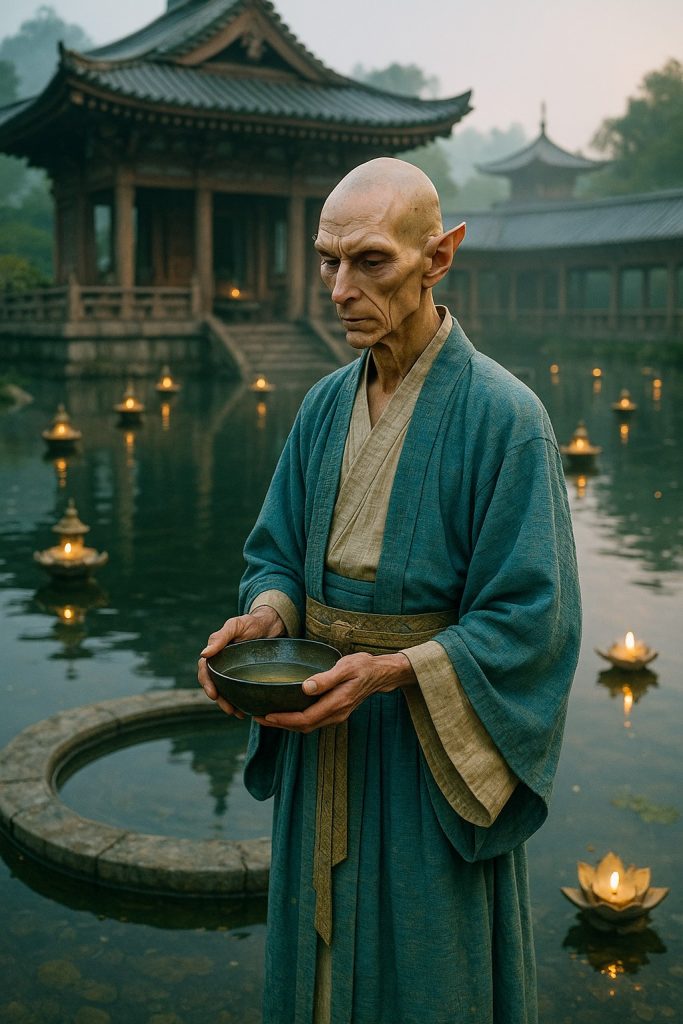
The magical power of Mizuho-no-Kami in the Yayoi Island Nation is rooted in balanced manipulation of water, harvest, and ancestral memory, and in Saṃsāra it manifests with both protective and destructive applications that reflect the deity’s duality of nurturing and wrathful tide.
Defensive Applications
• Tideward Veil – A sudden curtain of suspended seawater, infused with shimmering motes of ancestral mana, rises to intercept physical and magical projectiles. The density can be tuned so that arrows are slowed, firearms are rendered harmless, and some spells dissipate.
• Shell of Still Waters – Followers may conjure a dome-like barrier of placid, mirror-smooth water that absorbs kinetic force and muffles sound, preventing enemies from hearing troop movements or spellcasting chants.
• Harvest’s Blessing – Ritual invocation can accelerate plant growth to create living thickets, crop-walls, or rice-reed barriers that block sightlines and movement while subtly draining hostile magic that passes through.
• Memory Current – The god’s blessing channels the flow of ancestral recollection, allowing defenders to inherit the instinctive skills of warriors long past, increasing tactical coordination and reaction times without spoken orders.
• Low Tide Passage – A controlled recession of water from canals, ponds, or moats to create dry channels for safe retreat or repositioning without drowning hazards.
Offensive Applications
• Drowning Surge – A fast-rising wall of churning seawater that slams into enemy lines, knocking foes from their footing, sweeping them away, or smashing them into fortifications.
• Salt-Bloom Curse – Summons seawater to soak the ground and then rapidly evaporate it, leaving corrosive salt crusts that weaken armor, weapons, and siege engines.
• Tide’s Grasp – Water in the immediate environment is shaped into serpentine coils or humanoid forms that seize enemies and pull them under, suffocating or immobilizing them.
• Harvest Withering – The reverse of the nurturing magic; fields can be made to rot in hours, turning food into foul sludge to starve or demoralize opposing forces.
• Moon-Draw Pull – By aligning with Helios’s position and Saṃsāra’s moon currents, combat priests can generate a sudden lateral tide shift, toppling siege towers, capsizing ships, or dragging opponents toward drowning depths.
Song of Rice Tide
In the days when the waters still wandered without banks, and the sky forgot to tell the seasons when to turn, there was a village that ate its shadow before it ate its grain. The fields were flat like the back of a sleeping carp, but they bore no green, only the dry sigh of soil. The people spoke to the air, but the air did not answer. They spoke to the ground, but the ground did not move. They spoke to the water, and the water laughed.
Then came a figure along the edge where the salt met the sweet. They were neither man nor woman, nor fish nor fowl, but something in between, cloaked in reeds and crowned with the pale crescent of the moon’s reflection. They said their name was lost but that the waves whispered it in the old tongue: Mizuho-no-Kami, the Keeper of the Rice Tide. Their eyes were twin lanterns of deep green, and their voice poured like warm rain.
“Why do you bow to the ground with empty hands?” they asked.
“Because the ground has forgotten us,” the elders said.
“Then you must remind it,” the god replied.
With a gesture, they drew a circle in the sand, and water from both the sea and the mountain streams crept toward it, meeting in the center. From that mingling rose stalks of rice taller than a grown hunter, heads heavy with gold and silver grain. But the god warned: “This gift is not yours to take alone. For every grain you eat, another must return to the water.”
The people obeyed for many seasons, casting back seed into the tide, singing the Song of the Rice Tide at every planting. The waters stayed calm, and the land grew rich. But in the seventh season of the seventh year, a new chief rose who wore coral in his hair and spoke with the voice of ambition. “Why throw food to the sea when men grow hungry? Let us keep all, and the water will still come, for water has no mind.”
So the village kept the harvest for themselves. The seed that should have returned to the tide was piled in the chief’s storehouse. That night, the Helios light shone too pale, and the moon’s reflection sank deep into blackness. In the morning, the tide had crept far inland, swallowing fields and homes alike. The water was no longer calm—it bore teeth of foam and hands of current.
The people cried out, but only the old priestess remembered the circle in the sand. She waded into the raging tide, carrying the last handful of golden seed. She sang the Song, though the words broke in her mouth like shells. The waves lifted her and took her far from sight, and in her place, the waters sank back to their banks. Where the circle had been, a single reed grew, crowned with moon-pale grain.
The villagers replanted from that reed, and though the harvest was smaller, it endured. The coral-haired chief was gone, carried away to where the current forgets all names. And the people carved into stone the shape of a crescent over water, to remember the bargain. They sang the Song not only to the tide but to their children, so that forgetting would be harder than remembering.
Some say the priestess walks still beneath the shallow moonlight, scattering seed into the dark water, so that the god will not grow lonely. And some swear that when the seed splashes, the waves laugh again, but more softly.
Moral: When the gift and the giver are one, to keep the gift for yourself is to lose both.