
Physical Form and Sensory Traits
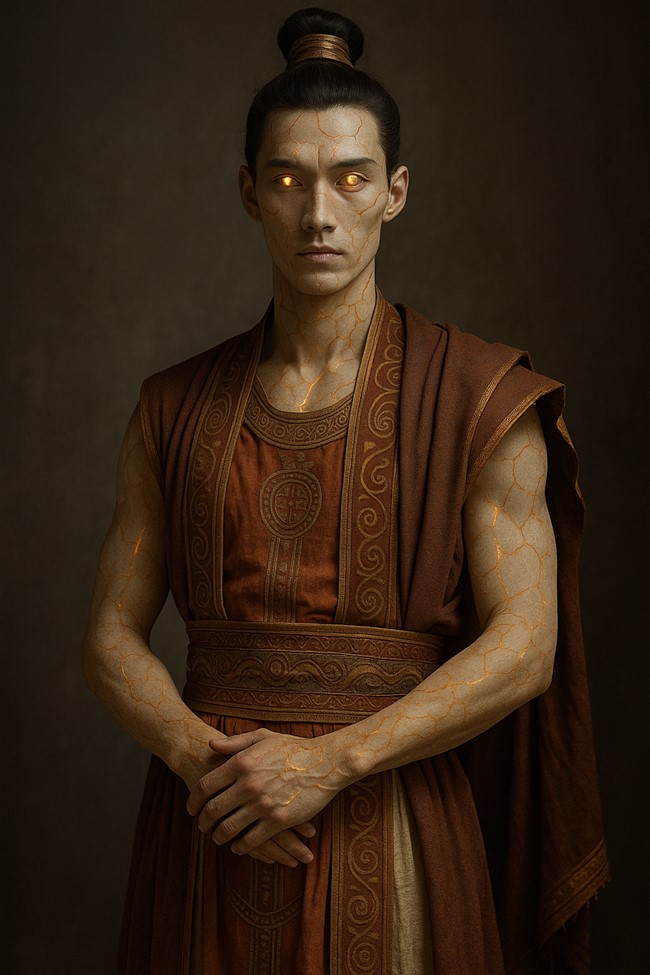
The Zhaolun appear as tall, lithe humanoids whose skin carries the faint, translucent luster of burnished ceramic, as though their bodies were sculpted from clay and then infused with blood and light. This sheen is broken by thin, branching fissures beneath which an inner glow pulses slowly—usually gold or red, though rare individuals display silver or pale blue luminescence. Their hair, when present, grows in fine strands of silk-like fiber, often dyed or woven into intricate topknots that echo the traditional aesthetics of Yangshao artistry. Their eyes are entirely dark, glossy spheres—no visible sclera or pupil—yet they see as clearly in night as in daylight.
Their sensory reach extends beyond the common five senses. Zhaolun can perceive faint “after-echoes” of movement in the air and ground, allowing them to track footsteps even in silence. They also detect faint impressions left behind by strong emotions, particularly in places where sorrow, triumph, or rage linger, a perception they call xinwei (“heart scent”).
General Size
Average height for adults is between 1.85 m and 2.05 m, with a weight of 75–105 kg, though the ceramic-like density of their bodies makes them deceptively heavy for their build. Their movements are measured and deliberate, lending them an aura of patience and control.
Body Pattern
Their skin coloration varies from warm earthen reds and browns to pale ivory and faint stone-grey, always with the underglow visible through hairline fractures in the skin. These fissures follow symmetrical, flowing patterns unique to each individual, akin to river deltas or leaf veins, and deepen in brightness during heightened emotional states or while channeling magic through worn gear.
Life Cycle
Zhaolun are born in the same manner as other humanoid races but mature slightly slower, reaching physical adulthood around 25 years. They can live for several centuries, though their bodies show minimal aging until the final few decades of life. Death is marked by the extinguishing of their inner glow and the slow cooling of their ceramic-like flesh. Burial traditions involve submerging the body in mineral-rich clay pools so the shell may dissolve and feed the land.
Potential Positives and Negatives Due to Physical Form
Positives
- Naturally resistant to blunt trauma due to the density and semi-rigid structure of their skin.
- High tolerance for extremes of heat and cold.
- Ability to see in full darkness without light.
- Emotional-resonance sense (xinwei) allows detection of concealed or hidden presences under certain conditions.
Negatives
- Their heavier-than-average bodies tire more quickly in constant high-speed travel.
- The inner glow can be difficult to conceal in absolute darkness, making stealth more challenging without specialized gear.
- Extreme vibrations or sonic shockwaves can cause micro-fracturing in their ceramic-like skin, leading to long-term brittleness if not treated.
Tags: Undying, Ethereal, Ancestral, Regal, Pale-Veined, Tiered, Arcane-Linked, Moonlit, Yangshao-Born, Hollow-Breath, Silken-Robed, Rune-Marked, Bone-Shadowed, Soul-Bound, Court-Dweller, Twilight-Gazed, Spirit-Anchored
Specialized Item Slots Available
In addition to the standard humanoid item slots, Zhaolun have a unique Lattice Slot—a recessed channel network across their upper back and shoulders that can host “lattice gear,” magical or mechanical frameworks that integrate with their glow patterns to amplify certain magical functions. This slot does not interfere with worn cloaks or armor but counts toward overall slot capacity.
Environmental Adaptability
Zhaolun thrive in temperate river-valley climates, the heartlands of Yangshao, but are equally capable in high mountain passes and dry steppes due to their body’s thermal stability. Prolonged deep-ocean immersion, however, causes mineral leaching from their ceramic layers, which can weaken their structural integrity unless they carry restorative gear.
Other Information Important to This Race
Zhaolun heritage ties deeply into the rulership of Yangshao; the current royal dynasty claims direct descent from the First Molded, a mythical progenitor shaped by the “potter-gods” from clay of the island’s riverbeds. Many Zhaolun see their bodies as both vessel and tool, taking great care to maintain physical perfection with ritual polishing and mineral treatments.
Their cultural philosophy emphasizes continuity—both in governance and in personal legacy—leading to a strong sense of duty toward community and lineage. While most Zhaolun are capable of living far from Yangshao, the majority feel a deep pull toward their homeland’s rivers and ancestral clayfields, believing these lands feed their inner light as much as food or magic does.
Veins that Bind the Moon’s Shadow
It is said in the time when the Yangshao hills were still young and the rivers had not yet chosen their beds, there walked a being not born, not dead, but kept between. The elders call him Shun-Gai, though the name has changed many times like the stone worn by water. His skin bore the pale marks of moonlight veins, and in his eyes were the hollow fires of stars too far to see.
Shun-Gai came not from a mother’s breath, nor from the dust of the ancestors’ garden, but from a forgotten vow spoken when the air was cold and the ground was without footprints. He walked into the courts of the first kings and spoke without moving his lips, and the words struck the hearts of rulers like hammers on bronze. He told them that he could not die until the debts of a thousand-thousand spirits were paid, yet he did not say what the debt was, for he had forgotten, or perhaps the debt itself had forgotten him.
It is told he wore robes woven from light that falls through willow branches, each thread hiding a name. Sometimes, in the dark of the evening when Helios crouched low, the names on his robes would burn faint gold, and the air would thicken as if the world itself was leaning closer to listen. He walked with the ruling family, not as servant and not as master, but as the shadow that knows the step before the foot falls.
Once, in the season of Blooming in the month of Tyrus, when the river Kaen broke its banks and carried away the stone granaries, Shun-Gai walked into the flood. The water was cold enough to split skin, but he did not sink. Instead, the pale veins in his arms spread their light through the current, and fish long thought gone returned to swim in the fields. The people rejoiced, yet when they came to thank him, he was sitting on the palace roof, his robes dry, staring toward the mountains where no path had been cut.
Another telling says he was challenged in the court of emerald tiles by the Warrior of Eight Blades, a champion who had never been struck. The duel was to end when blood met stone. The Warrior moved with the speed of hawks, but each strike fell through Shun-Gai as though the air itself had swallowed it. When at last Shun-Gai lifted his own hand, the Warrior’s blades rusted to dust, and his memory of the duel faded like chalk in rain.
Yet, there is also the darker song, sung low by the river barges at night. They say Shun-Gai, bound to neither life nor death, sometimes walked alone into the groves of red stone where no birds sing. There, he would kneel, pressing his pale fingers into the soil until the ground darkened and roots withered. Those who saw it claimed the shadows of his robe stretched far beyond the light, and in that moment, he remembered the debt and hated it.
In the final chapter of his known days, he stood upon the high gate of the capital during the Warming week of Helmus. Enemies from across the sea had come with sails black as coal. The court prepared fire and iron, but Shun-Gai simply opened his hands. From them came a wind of silver breath that struck the enemy fleet silent. No sails burned, no men fell—yet every ship drifted backward, far into the mist, until they were gone. He left that same night, walking eastward into the shadow of the moon. Some say he still walks, waiting for the one who can name the true debt.
Moral: The path between life and death is not for the living to envy, nor for the dead to regret, for in the middle lies a weight heavier than either side.