
Original Life Forms Referenced:
- Class Arachnida: Funnel-web Trapdoor Spider (Idiopidae family)
- Class Chondrichthyes: Largetooth Sawfish (Pristis pristis)
- Class Gastropoda: Geography Cone Snail (Conus geographus)
- Class Amphibia: Reticulated Glass Frog (Hyalinobatrachium valerioi)
Appearance: The Pristidion 41 is a bizarre and unsettling creature. Its primary body is that of a large arachnid, with eight powerful, multi-jointed legs. Instead of a soft abdomen, a beautiful and ornate conical shell, like that of a giant cone snail, is fused to its back. The creature can retract its legs and head partially into this shell for protection. The front of its cephalothorax is dominated by a long, flat, bony rostrum edged with sharp, tooth-like denticles, identical to that of a sawfish. Its mouthparts are hidden beneath this saw, but a venomous, harpoon-like proboscis can be fired from this area. The creature’s skin, particularly on its legs and underside, is smooth, moist, and semi-translucent like a glass frog’s, revealing the faint, eerie glow of its pulsating internal organs.
Size: This is a stout, heavy-bodied creature. An adult Pristidion 41 has a leg span of 8 to 10 feet, and its shell can be up to 4 feet tall at its peak. The saw-like rostrum typically adds another 4 to 5 feet to its forward length. It weighs between 400 and 600 pounds, much of which is its dense shell.
Speed: The Pristidion 41 is not built for speed. On the surface, it moves with a slow, deliberate scuttling motion. Its primary methods of movement are powerful digging and short, explosive bursts of energy when attacking from its burrow. It is not capable of chasing prey over any significant distance.
Stat Modifiers:
- Strength: Very High
- Perception: Low (Relies on non-visual senses)
- Intellect: Low (Instinct-driven)
- Agility: Low
- Charisma: Very Low
- Endurance: Very High
Skills: The Pristidion excels at skills related to its unique ambush strategy. It is a master of Excavation, using its saw-rostrum to dig vast burrows in a short amount of time. It possesses an expert-level Stealth skill, but only when concealed within its burrow. Its primary “perception” skill is not sight or hearing, but a form of Electrolocation that allows it to detect the bio-electric signatures of creatures moving above it.
Behavior: The creature is a patient, subterranean trap-setter. It spends the majority of its life in a self-excavated burrow, often with a camouflaged “trapdoor” made of silk, soil, and debris. It lies dormant, sensing the world above through the bio-electric fields of other life forms. When prey of a suitable size walks over or near the burrow, the Pristidion bursts from the earth, slashing wildly with its saw to maim and disorient. It will then fire its venomous harpoon to paralyze the target before dragging it back down into its lair to be consumed. It is extremely territorial and will attack anything that disturbs its trap.
Diet: The Pristidion 41 is a carnivore. Its diet consists of any creature whose electrical signals attract its attention. This includes large herd animals, wandering monsters, and unfortunate adventurers. The potent neurotoxin it uses does not kill prey but induces total paralysis, allowing the creature to keep its food “fresh” within its burrow.
Emotions: As a feral life form, its emotional capacity is nearly nonexistent. It operates on the dual instincts of hunger and territorial defense. It displays no fear, even when injured, unless its protective shell is cracked or compromised. If this happens, its territorial aggression is replaced by a frantic, instinctual drive to escape and dig a new burrow.
Environment Where Found: This creature is found in any environment with a deep layer of soft substrate suitable for burrowing. It is most common in sandy deserts (where it lurks beneath the dunes), muddy riverbeds, coastal tidal flats, and the deep, loamy soil of ancient forests. It avoids mountainous regions and areas with hard, rocky ground.
Tags: Ambush Predator, Burrower, Feral, Solitary, Venomous, Neurotoxin, Armored Shell, Electrolocation, Trap-setter, Subterranean, Bioluminescent, Territorial, Chimeric, Saw-Rostrum, Venom Harpoon, Arachnoid, Paralytic Toxin, Translucent Skin, Carnivore
Age: The Pristidion 41 has a remarkably long lifespan, a trait owed to its low-energy lifestyle and formidable defenses. They can live for 80 to 100 years, with their life marked by slow, deliberate growth.
- Larva: Pristidions do not lay eggs, but give live birth to a dozen or so small, grub-like larvae within the safety of their burrow. These larvae are born with a soft, primordial shell and immediately begin to burrow, feeding on subterranean worms and insects.
- Nymph: For the first decade of its life, the creature is considered a nymph. It remains entirely underground, molting its skin and adding new, larger layers to its conical shell. It is during this time its saw-rostrum and venom harpoon develop.
- Juvenile: After 10 to 15 years, the juvenile is large enough to hunt on the surface. It will dig its first shallow “practice” burrows, testing its ambush techniques on medium-sized wildlife. Its venom is potent, but not yet at its peak lethality.
- Adult: A Pristidion is considered a full adult at 20 years. It has reached its full size, and its shell is a thick, hardened fortress. It establishes a permanent territory, digging a complex burrow that will be its home for the rest of its life.
- Ancient: A Pristidion that lives beyond 80 years is a legendary force of nature. Its shell becomes immense, often encrusted with minerals from the surrounding soil, making it look like a natural geological formation. It can enter long periods of hibernation, waiting months or even years between meals, its patience honed to a supernatural degree.
Mating: Mating is a strange, slow, and rare event for these solitary, territorial creatures. Pristidions are hermaphroditic, possessing both male and female reproductive organs. When the territories of two mature individuals happen to intersect, one may cautiously approach the other’s burrow. The courtship is conducted entirely underground through vibrations and electro-reception. For days, the two will send subtle tremors through the earth, communicating their age, size, and fitness. They may gently tap their saw-rostrums together, “tasting” the other’s chemical signature. If the courtship is successful, they will briefly meet in a subterranean tunnel to exchange gametes. Both individuals can become fertilized from a single encounter. After this tense congress, they retreat to their own lairs to gestate, eventually giving birth to their live young.
Tactics: The Pristidion is a master of a single, highly effective combat philosophy: the subterranean ambush.
- The Earthen Trap: Its primary tactic is the creation of a pitfall trap. It uses its saw-rostrum to excavate a deep burrow, then conceals the entrance with its own shelled back, which it covers with silk-like mucus, soil, and local debris. It then waits, perfectly still, sensing the world above through the bio-electric fields of nearby creatures.
- The Saw-Burst Eruption: The attack begins with a violent explosion of earth. The Pristidion erupts from the ground with its saw leading the way, making wide, horizontal sweeps intended to cripple the legs of its prey and knock multiple targets off balance. This initial chaos creates the opening for its true weapon.
- The Paralytic Harpoon: Once a target is downed or disoriented by the initial assault, the Pristidion will focus and fire its venom harpoon. This single, fleshy projectile is attached to the creature by a strong, retractable sinew. The goal is not to kill, but to deliver a potent neurotoxin that causes near-instantaneous paralysis.
- The Shell Fortress: If faced with overwhelming force, its primary defensive tactic is to retract its legs and head into its shell. In this state, it is almost impervious to physical damage, willing to wait out any threat until it passes.
Actions: In a combat scenario, a Pristidion 41 can perform several distinct actions:
- Erupt: An initial attack made when bursting from its burrow. It moves from its hidden position to the surface and may immediately perform a Saw Sweep action. Creatures nearby must make a Perception check to avoid being surprised.
- Saw Sweep: The creature makes a sweeping melee attack with its rostrum, targeting all creatures in a frontal arc.
- Venom Harpoon (Rechargeable): A single-target ranged attack with its projectile tooth. On a hit, it deals minimal piercing damage but injects a powerful paralytic toxin, requiring a very difficult Endurance or Constitution save to resist paralysis.
- Retract: The creature pulls into its shell, gaining a massive bonus to its armor and becoming immune to certain effects like being knocked prone. It cannot move or attack while retracted.
- Drag Below: The creature uses its action to drag a paralyzed or grappled victim into its burrow entrance, removing them from the immediate combat.
Other Interesting Information
- Living Geological Record: The layers of an ancient Pristidion’s shell can be read like tree rings. Each band tells a story about the soil, magic, and environment of its territory during a specific year. Alchemists and geologists will pay dearly for fragments of an ancient’s shell.
- Bioluminescent Lure: The faint glow from its internal organs, visible through its translucent skin, is caused by symbiotic phosphorescent bacteria. In the darkness of a cave or on a moonless night, a Pristidion may intentionally leave its trap slightly ajar to use this faint, pulsating light as a lure for curious creatures.
- The Lair’s Trove: The bottom of a Pristidion’s burrow is a grim treasure trove. It is littered with the indigestible remains of its victims—armor, enchanted weapons, gems, coins, and skeletons—all jumbled together in a macabre pile.
- Silk-Mucus Adhesive: The substance it secretes to help construct its trapdoor has unique properties. When wet, it is one of the strongest biological adhesives known. It dissolves harmlessly in water but becomes incredibly brittle when fully dried in open air. This makes it a difficult but valuable reagent for alchemists trying to create powerful, temporary bonding agents.
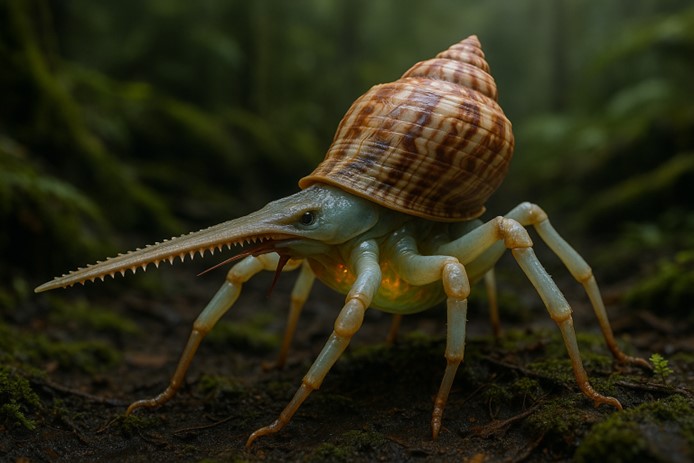
Shown in the photos are different sub-species of this critter in different environments.
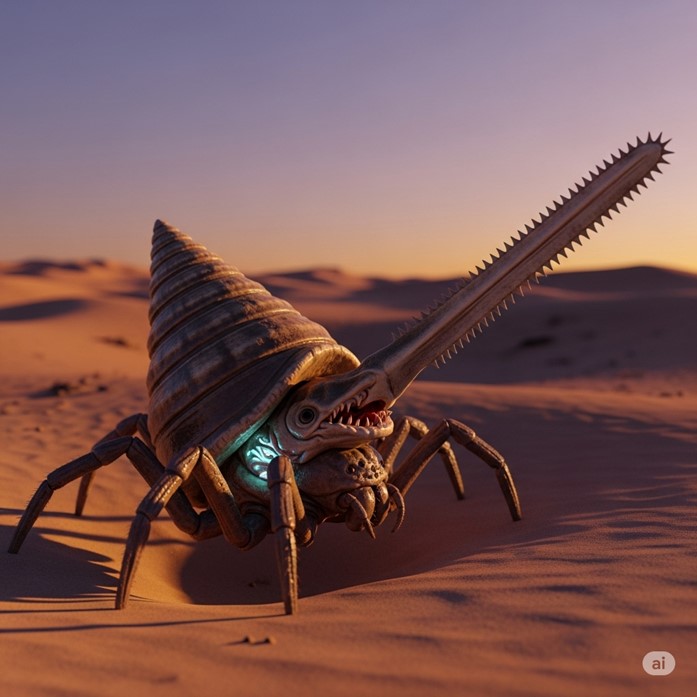
Adventurers would rarely stumble upon a Pristidion 41 by sheer chance, as the creature is a master of concealment. Instead, encounters are almost always the result of a deliberate search for the creature, a desperate need for what it possesses, or a fatal misstep into its well-hidden territory. These scenarios typically fall into several distinct categories.
The Specialist’s Commission: Hunting for a Client
The unique and potent biology of the Pristidion 41 makes its parts exceptionally valuable to a very specific clientele. Wealthy patrons, powerful guilds, and secretive scholars will pay handsomely for adventurers willing to undertake the perilous hunt.
- The Alchemist’s Panacea: The creature’s venom is a powerful neurotoxin that causes near-instantaneous paralysis without killing the victim. This makes it a priceless reagent for master alchemists seeking to create surgical anesthetics, non-lethal capture poisons, or, paradoxically, the only known base for an antidote to other deadly paralytic venoms. A quest may involve retrieving the venom gland and harpoon mechanism intact.
- The Geologist’s Chronicle: The conical shell of an ancient Pristidion is a living record of the land. Each layer added over its long life absorbs minerals and magical essences from the soil. A geologist or sage might hire a party to hunt a legendary specimen—an “Ancient”—to acquire its shell, which can be studied to reveal centuries of geological history, discover hidden ore deposits, or understand the flow of magical energy in the region.
- The Artisan’s Centerpiece: The creature’s saw-rostrum is a formidable piece of natural weaponry, made of bone harder than steel. A master weaponsmith might commission a party to bring one back, intending to use it as the core for a legendary two-handed sword or polearm. Similarly, the ornate, incredibly durable shell is a prize for armorers seeking to create a masterwork shield or suit of armor.
The Personal Quest: A Desperate Need
Sometimes, the driving force is not gold, but survival or power. The adventurers themselves may require something that only this specific creature can provide.
- An Essential Crafting Component: In a world where power is tied to gear, a character might discover the plans for a high-tier item that requires a “Pristidion’s Paralyzing Stinger” or the “Bioluminescent Heart” of the beast. The quest becomes personal, a necessary step in their own journey to gain strength.
- The Only Antidote: A party member or a crucial ally may have been struck by a rare, fast-acting neurotoxin. A healer might determine that the only way to synthesize the antivenom in time is with the venom of the Pristidion 41 itself. This creates a desperate, time-sensitive race to hunt one of the most dangerous creatures imaginable.
- Retrieval Mission: The party might be searching for an object lost long ago—the signet ring of a noble, a powerful artifact, a map—that was carried by someone who fell prey to a Pristidion. The quest is not to kill the beast, but to survive long enough to search the “graveyard” of indigestible items in its subterranean lair.
The Unwitting Trespass: A Fatal Misstep
The most common and terrifying encounter with a Pristidion 41 is entirely accidental. The adventurers have no idea the creature is there until it is far too late.
- The Ambush: The party is traveling across a desert, a muddy floodplain, or a wide, sandy cavern floor. One of them steps on what appears to be solid ground, but is actually the creature’s camouflaged trapdoor. The world erupts in a spray of earth and a slash of its saw-rostrum. The encounter is not a hunt, but a sudden, chaotic struggle for survival against a predator in its ideal element.
- A Shelter in the Storm: Caught in a flash flood or a blinding sandstorm, the party spies a small cave opening and rushes inside for shelter. They soon realize the “cave” is the entrance to a Pristidion’s burrow. They are now trapped in the lair with its creator.
- The False Treasure: An old map leads the party to a “buried treasure” in a barren wasteland. They find the location and begin to dig, only to strike the hard shell of the creature, waking it from its slumber and triggering its violent territorial instincts.
The Territorial Menace: Clearing the Way
Though solitary, a Pristidion’s choice of territory can sometimes bring it into direct conflict with the inhabitants of Saṃsāra, forcing them to hire adventurers to solve the problem.
- The Blocked Route: A Pristidion has established its burrow directly in the path of a vital trade route, a newly discovered ruin entrance, or a strategic mountain pass. Its presence makes the area impassable, as its electro-receptive senses detect any caravan or explorer that tries to cross. A merchant guild or archaeological society would post a substantial bounty for its extermination.
- The Oasis Guardian: In a vast desert, a single oasis might be the only source of water for hundreds of miles. If a Pristidion makes its lair at the edge of this oasis, it effectively holds the entire region hostage. Local settlements would hire a party to slay the beast and reclaim the vital water source for all.
Beyond the more obvious components like its shell, saw, and venom, the unique chimeric biology of a Pristidion 41 offers a wealth of rare and powerful ingredients to adventurers skilled enough to harvest them.
- Ampullary Nerve Clusters The saw-rostrum is lined with hundreds of small pores containing nerve bundles that grant the creature its electro-receptive sense. When carefully extracted and preserved in an alchemical solution, these clusters are a core component for advanced sensory equipment. An artificer can embed them into the visor of a helmet, granting the wearer a form of “bio-sense” that allows them to perceive the location of living creatures through solid objects, though it cannot detect constructs or undead.
- Translucent Hide of the Glass-Frog The smooth, semi-transparent skin on the creature’s underside and legs is not durable enough for traditional armor, but its magical properties are highly prized. When tanned through a specialized alchemical process, it becomes the “Skin of Revelation.” When used as a panel on a pouch or backpack, it allows the owner to see the contents within as a ghostly image. When incorporated into magical robes, it can be enchanted to grant the wearer a shimmering, partially ethereal quality, making them harder to hit with physical attacks.
- The Venom Harpoon and Radula Sinew The creature’s venom-delivery tooth is a single, sharp, hollow barb of chitin. This “harpoon” can be used as a potent dart tip that guarantees delivery of any applied poison. More valuable, however, is the incredibly strong and elastic “Radula Sinew” that attaches it to the creature. This sinew can be harvested to create self-retracting grappling lines or as a key component in enchanted gauntlets that allow the user to project and recall a chain or whip with supernatural speed.
- Crystallized Neurotoxin While the liquid venom is potent, if the venom sac is left to cure for several days in a magically-stabilized environment, the toxin within solidifies into a beautiful, amber-like crystal. This crystallized form is stable and far safer to transport. It can be ground into a fine powder used as a powerful paralytic dust. A skilled gem-cutter can also facet the crystal and set it into a weapon; on a critical hit, the weapon has a chance to release a small sliver of the crystal into the target’s bloodstream, inflicting paralysis.
- Symbiotic Bioluminescent Culture The faint glow from the creature’s organs comes from a unique strain of phosphorescent bacteria living in its flesh. A skilled alchemist can take a live culture from the corpse. This culture can be cultivated in a nutrient broth to create “cold light” potions that cause the drinker to glow faintly without producing heat. The bacteria can also be used to create luminous inks for writing scrolls that can be read in absolute darkness.
- Burrower’s Silk Glands The Pristidion produces a thick, silk-like mucus from glands near its mouthparts, which it uses to reinforce the walls of its burrow and construct its trapdoor. This “subterranean silk” is incredibly strong and adhesive when mixed with soil or sand, but dissolves in clean water. If harvested, the raw secretions can be used to create powerful, single-use adhesives or fast-hardening mortars for emergency repairs to stonework.
Spire in the Sands
It is said in the memory of the tribes that in the great dune sea, there was a place the children were forbidden to walk. They called it the place of the Sunken Spire, for there, a great and beautiful shell of spiraling shape would sometimes show itself from the shifting sands, catching the light of the sun like a lost temple. The elders, whose faces were cracked like the desert floor, said that this was the home of the Sand-That-Sleeps, and they warned that its silence was a hungry silence.
There was a youth of the tribe named Kael, and his heart was full of the fire of youth, and his courage was a sharp but brittle blade. A child, chasing after a desert hare, ran heedless of the warnings and vanished near the Sunken Spire. The tribe mourned, for the desert takes what it will. But Kael’s heart would not be still. He declared to the elders that a beast, if it is a beast, can be slain by the hand of a warrior. He would not let the spirit of the child rest in the belly of a monster.
The eldest of the tribe touched Kael’s spear. “You see a spire to conquer,” the old man rasped. “I see only the roof of a tomb. The Sand-That-Sleeps does not offer battle. It offers only a grave. Do not go.”
Kael, blinded by his pride and his grief, did not listen. He took up his shield and his spear and walked toward the Sunken Spire. He saw it from afar, a thing of impossible beauty in the desolate wastes. He remembered the elder’s words and did not approach with haste. He laid himself upon a high dune to watch, for he was a hunter, and he knew the value of sight. For a day and a night, he watched the spire, but it was as still as the bones of the world.
He thought to lure the beast out. He slew a great dune-lizard and dragged its bleeding carcass near the spire, leaving it as bait upon the sand. He waited again. The sun beat down, and the wind carried away the scent of blood, but the spire remained still. Kael grew impatient. He saw now that the beast did not hunger for the dead; it hungered only for the foolishness of the living.
A plan formed in his mind, a plan of a warrior’s making. He would spring the trap himself, and in the moment the beast revealed its form, he would strike. He found a great, heavy stone and tied to it a long rope of hide. He swung the stone in a great circle and crashed it down upon the sand near the beautiful shell, making a tremor like the footstep of a giant.
The earth did vomit forth its hidden horror. In a violent spray of sand, the creature erupted. It was a thing of too many legs, with a great, toothed cutting-tool of bone where its face should be. Kael was fast, and he threw himself back from the scything sweep of the saw, the wind of its passage hot on his face. He landed on his feet, his shield raised, his spear ready. He had seen the beast, and his courage did not fail. He would fight it now, in the light of the sun.
But as he prepared his thrust, he saw the creature’s true method. It was not the saw. From beneath the great cutting-tool, a thing like a fleshy dart shot forth, tethered by a glistening thread. It was faster than a striking snake, faster than a thrown spear. Kael could not dodge. He took the strike upon his shield. The harpoon, made of a single shard of chitin, pierced the thick leather and wood as if it were parchment.
And then a wrongness spread from the point of impact. A venom, not of death but of stillness, seeped into his shield. The leather grew hard and tight, the wood became as brittle as ancient bone. With a great crack, his shield, his defense against the world, shattered in his grip. The creature began to reel in the line, pulling the ruined shield and the venomous harpoon back toward its hidden mouth.
In that moment, Kael understood. The saw was but a distraction, a storm to make you look away from the single, silent drop of poison that is the real danger. The shield was meant to be his life, and the beast had taken it. He did not wait for it to take him as well. He dropped the remnants of his shield, turned, and ran. He did not look back, but he could feel the silence as the creature, its trap sprung and its offering claimed, sank back beneath the sands to wait once more. He returned to his tribe with no trophy, no proof of a kill, only the shame of his broken shield and the terrible weight of a new wisdom.
The moral of this telling is thus: True courage is not in facing the storm, but in knowing which storms cannot be faced. A trap is not defeated by the sharpness of the spear, but by the wisdom of the feet that walk around it.
Suggested conversions to other systems:
Dungeons & Dragons 5th Edition
Dune-Reaper Large monstrosity, unaligned
Armor Class 17 (natural armor) Hit Points 136 (13d10 + 65) Speed 20 ft., burrow 30 ft.
STR 20 (+5), DEX 8 (-1), CON 20 (+5), INT 2 (-4), WIS 14 (+2), CHA 3 (-4)
Senses Blindsight 60 ft. (blind beyond this radius), Passive Perception 12 Languages — Challenge 8 (3,900 XP) Proficiency Bonus +3
Earthen Ambush. If the dune-reaper surprises a creature when bursting from underground, any attack it makes against that creature during the first round of combat has advantage.
Tunneler. The dune-reaper can burrow through loose sand, earth, and mud. While burrowing, it leaves a 5-foot-diameter tunnel in its wake.
Actions
Multiattack. The dune-reaper makes one Saw-Rostrum attack and one Venom Harpoon attack.
Saw-Rostrum. Melee Weapon Attack: +8 to hit, reach 10 ft., one target. Hit: 18 (2d12 + 5) slashing damage.
Venom Harpoon. Ranged Weapon Attack: +8 to hit, range 30/60 ft., one target. Hit: 7 (1d4 + 5) piercing damage, and the target must succeed on a DC 16 Constitution saving throw or be paralyzed for 1 hour. The target is attached to the dune-reaper by a filament. As a bonus action, the dune-reaper can reel in a paralyzed target 20 feet. The filament can be attacked (AC 15, 5 HP).
Shell Defense (Bonus Action). The dune-reaper retracts into its shell. Until it emerges, its AC increases to 21, its speed becomes 0, and it cannot make attacks. It can emerge from its shell as a bonus action.
Call of Cthulhu 7th Edition
The Sunk-Spire Horror A creature of deep desert and forgotten coastline, what appears to be a beautiful, fossilized shell is merely the lure of a living trap buried beneath the sand.
Characteristics STR 95, CON 90, SIZ 90, DEX 30, INT 25, POW 50
HP: 18 Damage Bonus: +2d6 Build: 3 Move: 4 / Burrow 6
Attacks Attacks per round: 1 Fighting (Saw-Rostrum) 60% (30/12), deals 1d10 + damage bonus. Any investigator struck must make a DEX roll or be knocked from their feet. Fighting (Venom Harpoon) 40% (20/8), deals 1 point of damage and injects a potent neurotoxin. The victim must make a Hard CON roll. Failure results in total paralysis for 1d6 hours. The victim is helpless.
Skills: Stealth (When Burrowed) 90%. Armor: 8-point conical shell. Firearms of .38 caliber or less are ineffective against it. Spells: None.
Sanity Loss: 1d4/1d10 Sanity points to witness the creature erupt from the earth.
Blades in the Dark
The Dust-Trap A living geological feature of the Deathlands, a beautiful spire that promises treasure but delivers only a swift, paralytic end from the unseen depths below.
Threat Level: 4 (A massive, horrifying, supernatural entity)
Description: An ancient horror that wears a giant, ornate shell as both its armor and its lure. It lives beneath the earth, sensing the living above, and erupts in a shower of debris to slash with its saw-like jaw and fire a paralytic stinger.
Drives: To consume the living, to remain buried and patient, to drag all things into its subterranean lair.
Instinct: To strike from unseen depths.
Moves:
- The ground gives way: The Dust-Trap erupts from beneath the crew, changing the terrain, creating pits and obstacles, and separating individuals.
- Fire a paralyzing stinger: A single character is hit with a venomous barb. They are rendered helpless. The GM starts a clock like “The victim is dragged beneath the earth.”
- Scythe with a serrated jaw: The creature makes a wide, sweeping attack that inflicts severe harm (Level 3, “Mangled Legs”) on anyone caught in its arc.
- Retreat into its living fortress: It retracts into its impenetrable shell. It cannot be harmed by conventional means, forcing the crew to change their tactics or flee.
Knave 2nd Edition
Saw-Shell Spider HD 8; Armor as Plate (17); Morale 11; Attack Saw-Rostrum (d12)
Description: A hulking, eight-legged creature with a giant, conical shell on its back and a long, toothed saw where its head should be. It lies in wait beneath the soil.
Qualities: Patient, Territorial, Ambusher.
Reactions (d6): 1-2: Erupt and attack with saw. 3: Fire Venom Harpoon. 4: Retreat into shell. 5: Attempt to drag a target underground. 6: Erupt and then immediately burrow to a new position.
Special Abilities:
- Burrow: Can move through sand, loose soil, and mud at half its normal speed. It cannot be targeted while fully burrowed.
- Earthen Ambush: When attacking by bursting from the ground, its first attack against a surprised target deals double damage.
- Venom Harpoon: Once per combat, it may fire its harpoon at a single target within 30 ft. The target must save vs Poison or be paralyzed for 1d4 hours.
- Shell Defense: The creature can use its turn to retract into its shell. While retracted, its Armor is increased to 20 and it is immune to critical hits, but it cannot move or attack.
Pathfinder 2nd Edition
Dune-Saw Creature 8
N Large Beast Amphibious
Perception +18; Tremorsense (imprecise) 120 feet, no vision Languages — Skills Athletics +19, Stealth +20
Str +7, Dex +4, Con +6, Int -4, Wis +4, Cha -3
AC 27; Fort +20, Ref +16, Will +14 HP 140 Hardness 5 (shell only)
Burrowing Ambush [reaction] Trigger A creature walks on the ground within 10 feet of the Dune-Saw’s burrowed location; Effect The Dune-Saw Burrows to the surface and makes a Saw-Rostrum Strike against the triggering creature. The target is flat-footed against this attack.
Shell Defense [one-action] The Dune-Saw retracts into its shell, gaining a +2 circumstance bonus to AC and Resistance 5 to physical damage. It cannot take any other actions except to emerge, which also costs one action.
Actions
[one-action] Saw-Rostrum Melee Strike +20, Damage 2d12+10 slashing. [one-action] Venom Harpoon Ranged Strike +18 (range increment 30 feet), Damage 1d6+7 piercing plus Dune-Saw Venom.
Dune-Saw Venom (incapacitation, poison) Saving Throw DC 26 Fortitude; Maximum Duration 1 hour; Stage 1 flat-footed and clumsy 1 (1 round); Stage 2 paralyzed (1d4 rounds); Stage 3 paralyzed for 1 hour.
Fate Core
The Spire That Waits A living landmark of the deep deserts and silent mudflats. It appears as a beautiful, geological treasure, but it is only the spire of a patient, waiting tomb.
High Concept: Patient Subterranean Trap-Setter Trouble: Nearly Invulnerable When Retracted in its Shell Other Aspects: I Sense Your Living Heartbeat in the Earth; A Saw-Jaw That Erupts from Below; One Sting, Then Stillness
Skills Great (+4): Physique Good (+3): Fight, Stealth Fair (+2): Notice, Athletics Average (+1): Will
Stunts Shell Fortress: Because I can retract into my nigh-impenetrable shell, once per scene, I can ignore the stress from a single physical attack. Paralytic Harpoon: Because my sting delivers an absolute neurotoxin, when I succeed on a Fight attack using my harpoon, I don’t inflict stress. Instead, I attach the Situation Aspect Utterly Paralyzed to the target with one free invocation. Earthen Eruption: Because I strike from below, I get a +2 to my Fight skill when I attack a target that is unaware of my presence.
Stress [1] [2] [3] [4] Consequences Mild (2): Moderate (4): Severe (6):
Numenera & Cypher System
The Geologic Predator A chimerical creature of the Ninth World that disguises itself as part of the landscape. Its beautiful, spiraling shell often juts from the earth like a fossilized treasure, luring collectors and explorers into its trap.
Level: 7 Health: 21 Damage: 7 points Armor: 3 (When retracted in its shell, its Armor is 5) Movement: Short; can also move through soft earth or sand as its movement. Modifications: Stealth as level 9 when burrowed and motionless. Senses bio-electric fields through the ground as level 8.
Combat: The Geologic Predator erupts from the ground to attack. Its primary attack is its Saw-Rostrum, a massive, toothed appendage that inflicts 7 points of damage. Its secondary attack is a Venom Harpoon. Instead of inflicting immediate damage, a character struck by the harpoon must make a level 7 Might defense task. On a failure, the character is paralyzed and unable to take physical actions. The character can attempt a new Might defense task each round to end the effect.
GM Intrusion: The GM can spend 1 XP to have the predator:
- Erupt from directly beneath a character. The character is thrown prone, taking 3 points of damage from the debris, and the predator gets a free attack against them.
- Fire its harpoon at a character who thought they were safe. The harpoon has a longer range than expected, and the attached filament is incredibly strong.
- Use its saw to collapse the ground. The attack misses, but the force of the blow shatters the earth, creating difficult terrain or separating the party.
- Retract completely. After taking a significant hit, the predator pulls into its shell. The shell is immune to all damage for one round while it reorients.
Savage Worlds Adventure Edition
Sand-Saw A monstrous burrowing creature that uses its shell as the lure for a deadly trap. It waits patiently beneath the sands for the vibrations of the living, only to burst forth in a shower of earth and bone-toothed fury.
Attributes: Agility d6, Smarts d4 (A), Spirit d8, Strength d12, Vigor d12 Skills: Athletics d10, Fighting d10, Notice d8, Stealth d10 Pace: 4; Parry: 7; Toughness: 14 (6)
Special Abilities:
- Armor +6: Dense, conical shell.
- Burrow: Pace 4. The Sand-Saw can move through sand, soil, or mud and cannot be attacked while fully burrowed.
- Eruption: When emerging from being burrowed, opponents within a Medium Burst Template must make an Agility roll or become Vulnerable.
- Paralytic Venom: The Sand-Saw’s harpoon attack is a Fighting roll. If it hits, instead of damage, the target must make a Vigor roll at –2. Failure means the target is paralyzed and cannot take any actions. They may attempt a new Vigor roll at the start of their turn to end the effect.
- Saw-Rostrum: Str+d10, AP 4, Mega Damage (when attacking objects or structures).
- Shell Defense: The Sand-Saw may use its action to retract into its shell. Its Armor increases to +10, but it may not move or take any other actions until it emerges.
- Size 4 (Large): Its Toughness is increased by 4.
- Tremor Sense: The Sand-Saw can automatically detect any living creatures in contact with the ground within a Large Burst Template centered on itself.
Shadowrun, 6th World
Sand-Saw A heavily armored paracritter that has flourished in the toxic badlands and desert exclusion zones. Its shell, often mistaken for industrial refuse or strange rock formations, serves as the lure for its trap. Corporate survey teams and smuggler caravans tell tales of the ground itself opening up to swallow people whole.
Attributes Body: 8 Agility: 3 Reaction: 4 Strength: 8 Willpower: 5 Logic: 1 Intuition: 4 Charisma: 1 Edge: 3 Essence: 6.0 Magic: 6
Derived Stats Initiative: 8 + 1d6 Physical Condition Monitor: 12 Stun Condition Monitor: 11 Overflow: 8 Movement: 6/12 Armor: 14 (Natural Armor)
Skills Athletics 3, Perception 4, Stealth 6, Unarmed Combat 4
Critter Powers Enhanced Senses: Tremor Sense (50m). Natural Weapon (Saw-Rostrum): Damage Value 10P, AP -3. Injection Harpoon (Paralytic Toxin): As a ranged attack (Agility + Unarmed Combat, 60m range), this attack deals no damage but delivers a potent toxin. Paralytic Toxin: Toxin, Vector: Injection; Speed: Immediate; Power: 10; Effect: Stun damage, Paralysis. (A character taking any stun damage must make a Body + Willpower (3) test or be physically paralyzed for 1 combat turn per net hit the toxin achieves). Armor: The creature’s shell provides its natural armor rating. Burrowing: The Sand-Saw can move through sand and loose earth at half its normal movement rate.
Starfinder
Geode Burrower Creature 8 XP 4,800 N Large magical beast Init +2; Senses Blindsense (vibration) 120 ft., sightless; Perception +16
Defense HP 125 EAC 20; KAC 22 Fort +12; Ref +10; Will +7 Defensive Abilities Shell Defense
Offense Speed 20 ft., burrow 30 ft. Melee Saw-Rostrum +19 (2d8+14 S) Ranged Venom Harpoon +16 (1d4+8 P plus paralysis) Offensive Abilities Earthen Eruption
Statistics STR +6; DEX +2; CON +4; INT -4; WIS +4; CHA -2 Skills Athletics +16, Stealth +21
Ecology Environment Deserts, badlands, or geologically active areas with soft substrate Organization Solitary
Special Abilities Earthen Eruption (Ex) When the geode burrower emerges from the ground as part of a surprise round, all its attacks made that round gain the benefit of the Staggering Critical hit effect (Fortitude DC 16). Shell Defense (Ex) As a move action, the geode burrower can retract into its shell, increasing its KAC by 4 until the beginning of its next turn. It cannot attack while using this ability. Venom Harpoon (Ex) The geode burrower’s harpoon is a ranged attack with a range increment of 60 ft. A creature hit by the harpoon must succeed at a DC 16 Fortitude save or be paralyzed for 1d4 rounds.
Traveller (Mongoose 2nd Edition)
Subterranean Ambush Predator (Pristidion geologicus) UPP: D6D200 Armor: Heavy Shell-8 Attacks: Saw-Rostrum (Slashing, 4d6) or Venom Harpoon (Piercing, 1d6 + Paralysis) Skills: Stealth-4 (when burrowed), Athletics (Digging)-2 Behavior: Burrower, Ambush Predator, Carnivore, Trap-setter.
Description: A large, arachnoid lifeform with a massive, mineralized conical shell and a formidable, saw-toothed rostrum. Discovered on desert worlds and in the muddy estuaries of unsettled planets, this creature creates subterranean traps, lying in wait for days or weeks. It uses a hyper-sensitive tremor sense to detect prey walking on the surface above. Its initial attack is a violent eruption from the ground, followed by a targeted strike with a biological harpoon that delivers a powerful paralytic agent. Its shell is incredibly dense, capable of deflecting most personal small arms fire. Travellers are advised to map and avoid known nesting sites, as engaging this creature without anti-armor weaponry is considered suicidal.
Warhammer Fantasy Roleplay, 4th Edition
Shell-Maw A foul beast of the deep deserts and blasted wastes, the Shell-Maw is spoken of in terrified whispers by prospectors and caravan masters. They say it does not hunt, but merely sets a trap of beautiful, spiraled rock and waits for greed and curiosity to bring it a meal. To stumble upon its lair is to be already in its gullet.
Shell-Maw Profile WS 60, BS —, S 70, T 65, I 40, Agi 25, Dex —, Int 15, WP 50, Fel 5 Wounds: 36
Traits: Armour (6), Bite (Saw) +13, Fear (2), Hardy, Size (Large), Territorial, Tunneling (Sand and Soil) Skills: Perception 60 (Tremors), Stealth (Burrowed) 80
Special Abilities: Erupting Ambush: When a Shell-Maw emerges from the ground to attack, any character within 2 yards must make a Challenging (+0) Agility Test or gain the Prone Condition. The Shell-Maw’s first attack against a Surprised target automatically inflicts a Critical Hit. Venomous Harpoon: Once per round, as a special action, the Shell-Maw can make a ranged attack with a range of 4 yards against a single target. This is a Challenging (+0) Weapon Skill Test. A target hit takes no Damage but must make a Very Hard (-30) Endurance Test or gain the Paralysed Condition for 1d10 rounds, unable to perform any actions. Shell Defence: The Shell-Maw can spend its turn retracting into its shell. While retracted, its Armour value increases to 10 and it gains the Immunity to Psychology Trait. It cannot take any actions while retracted.