
Species
The Aureate are a race of radiant, reptilian humanoids who embody the Aurignacian ideals of beauty, legacy, and light. They are the primary inhabitants and the ruling lineage of the island nation, and their unique physiology is inextricably linked to the magically luminous environment they call home. Far from being cold and pragmatic, the Aureate are a passionate, artistic people whose emotions are expressed not through facial contortions, but through the shifting, iridescent colors of their scales. They see their own bodies as living canvases and their lives as a performance to be added to the grand tapestry of their ancestors.
Physical Form and Sensory Traits
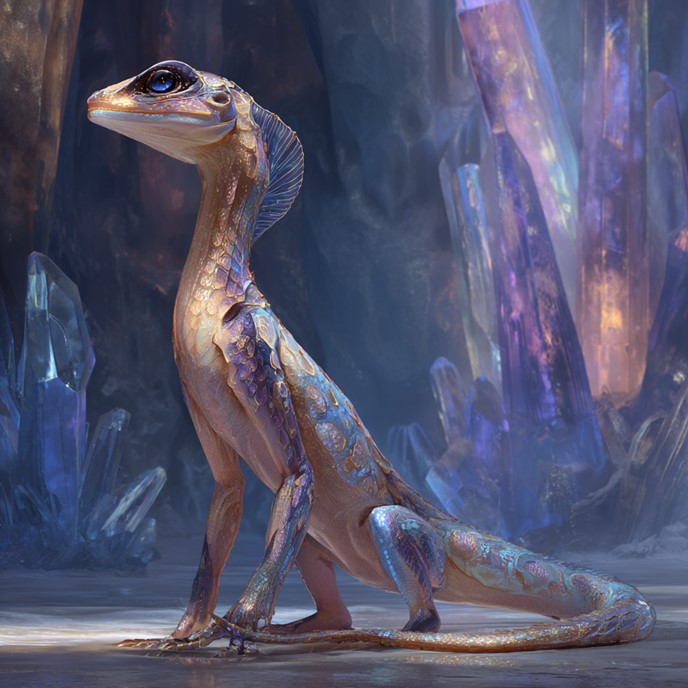
Aureate are tall, slender, and graceful humanoids with fine, shimmering scales covering their entire bodies. They possess a lean build with long limbs, dextrous three-fingered hands with a single opposable thumb, and plantigrade feet, allowing for an elegant, upright posture. A long, tapering tail provides them with exceptional balance. Their heads are smooth and sculpted, with large, expressive eyes protected by nictitating membranes. Perhaps their most striking feature is a delicate, fan-like crest of skin and cartilage that runs from the back of their head down their neck, which can be flared for communication and ceremonial display.
Their sensory traits are uniquely adapted to their environment and artistic culture. Their large eyes can perceive a broader spectrum of light than most other races, including near-ultraviolet frequencies. This allows them to see intricate patterns and colors in crystals, flora, and even the air itself that are invisible to others. They also possess a forked tongue which they use to “taste” the air, granting them a highly acute sense of smell and the ability to track others by scent.

Shown in the photos are Male and Female examples of the Aureate
General Size and Body Pattern
Adult Aureate typically stand between 6 and 7 feet tall but are light for their height, weighing between 150 and 200 pounds. They do not have patterns like spots or stripes; their entire body is the pattern. Their fine, opalescent scales constantly shift in color and intensity based on their emotional state, health, and the ambient light. A calm, contented Aureate might shimmer with soft golds and blues, while one experiencing joy might flash with vibrant, warm yellows and oranges. Anger or fear can cause their colors to deepen to violets and crimsons or even fade to a dull, stony grey in moments of profound sadness. This living iridescence is their primary mode of non-verbal communication.
Life Cycle
The Aureate hatch from pearlescent, crystalline eggs that are cared for in communal, geothermally warmed hatcheries. A hatchling, known as a “Glimmer,” has scales of a pale, uniform white. Their colors begin to emerge as they reach adolescence. They reach adulthood around the age of 25, which is when their colors achieve their full vibrant potential and their magical abilities awaken. Aureate have a long lifespan, often living for 200 years.
Periodically, an Aureate will shed its entire skin in one complete, translucent piece. This “ghost skin,” which retains the shimmering patterns of the individual at that moment in their life, is a sacred object. These sheds are carefully collected, preserved, and displayed in family archives, forming a tangible record of an individual’s legacy and emotional journey through life.
Potential Positives and Negatives due to their Physical Form
Positives:
- Their fine scales provide a degree of natural protection, equivalent to thick leather.
- Their enhanced visual spectrum gives them an advantage in perceiving magical auras, hidden details, and the true nature of their luminous environment.
- Their grace and balance make them excellent climbers and acrobats.
- Their color-shifting scales allow for a profound and deeply honest form of emotional communication amongst their own kind.
Negatives:
- Heliothermic Dependence: The Aureate are fundamentally cold-blooded. They are reliant on external sources of warmth and light to maintain their metabolism and vitality. In cold or dark environments, they become sluggish, their colors dull, and their movements laboured. This makes them vulnerable and almost entirely dependent on their specialized gear or the light of their home caverns.
- Their emotional displays, while clear to other Aureate, are often misinterpreted by other races, leading to social misunderstandings. A flash of ceremonial crimson might be mistaken for aggression, for example.
Tags: Aureate, Reptilian, Heliothermic, Iridescent, Color-Shifting, Luminous, Cavern-Dweller, Crystal-Dweller, Artist, Performer, Graceful, Crested, Light-Worshipper, Aurignacian, Expanded Spectrum Vision, Legacy-Keeper, Core-Crystal Dependent
Specialized Item Slots Available
To compensate for their heliothermic nature and to integrate with Saṃsāra’s gear-based magic system, the Aureate have a unique biological and cultural need for a specialized item that fits into a Core-Crystal Slot. This is typically a harness, amulet, or diadem that holds an enchanted, magically-warmed crystal close to the body’s core.
- A Tier 1 Core-Crystal might be a simple, magically heated stone that keeps an Aureate active in a cool room.
- A Tier 5 legendary Core-Crystal, known as a “Heart of Luminara,” would not only provide perfect temperature regulation in even the coldest environments but also channel light magic, allowing the wearer to emit pulses of healing light, create dazzling displays, or power other crystal-based gear.
Environmental Adaptability
Aureate are masters of their specific environment: the warm, well-lit surface of their island and its magically luminous cavern systems. They thrive in the ambient glow of their crystal cities. However, they are poorly adapted to cold climates or the true, unlit darkness of other subterranean realms. An Aureate adventuring in a frozen tundra or a dark dungeon without a powerful Core-Crystal would be at a severe disadvantage.
Other Information Important to this Race
The Aureate’s entire culture is built around their biology. Their art is filled with colors and patterns that only they can fully perceive. Their architecture is designed to capture and refract light in aesthetically pleasing and functional ways. The Matriarchal Monarchy is comprised of a lineage said to have the most vibrant and complex color-shifting abilities, seen as a direct blessing from their deity, Luminara. The great libraries of Crystalspire are not filled with books, but with halls of preserved “ghost skins,” allowing scholars to study the legacies and emotional lives of ancestors stretching back thousands of years.
Carver of the Inner Light
It is sung, in the epics of the Lyr-Kwe, that in every century there was a Great Contest to choose the Voice of the Age, an artist whose soul-fire burned so brightly they would earn the honor of carving the Heart-Crystal, which was a piece of Luminara’s own radiance given to the world.
In the time of the Seventh Queen, two artists rose above all others. The first was Silara, a sculptor whose form was a wonder. Her scales were a shifting river of jewel-tones, her crest a fan of captured dawn, and her works were of such perfect artifice that they seemed more real than the things they portrayed. The second was Lyren, a carver whose hands were blessed with a savant’s grace, yet whose own scales were the color of dull river stones, a muted grey that held no light. For this, his color-truth, he was pitied, though his art was revered.
The day of choosing came, and the Matriarch declared that both Silara and Lyren were worthy. They would journey together to the Grotto of the Uncarved Heart, deep in the Still-Dark of the lower caverns where the city’s light did not reach. There, they would each carve a single facet upon the great crystal, and the Heart itself would judge which artist possessed the truer legacy.
So they began their pilgrimage into the cold and the dark. They left the radiant city behind, and with each step, the world grew dimmer. Here, far from the glowing veins of the upper caverns, their very natures were tested. For the Aureate are children of light, and in the deep cold, their inner fires gutter and fail. They must carry with them a Core-Crystal, a borrowed sun worn close to the breast to keep their spirit from freezing.
Silara, who had always lived in praise of her own brilliant skin-song, wore a Core-Crystal that was small and decorative, a mere ornament. In the profound chill of the deep paths, its meager warmth was consumed. The vibrant colors of her scales faded to a sickly, mottled grey, and a great sluggishness took hold of her limbs. She stumbled, her spirit growing dim.
Lyren, whose dull scales had never earned him praise, had long ago learned to rely not on outward beauty but on inner strength. His Core-Crystal was not beautiful, but large and powerful. Seeing Silara falter, he stopped. His rival, who had so often looked upon him with scornful pity, was now but a shivering, colorless shape in the dark. Lyren, whose heart was warmer than his skin, unclasped his own Core-Crystal and held it out to her. He shared his inner sun, and its vital warmth flowed into Silara, bringing a faint blush of color back to her scales and the strength to finish the journey.
They came at last to the grotto. Before them, the Heart-Crystal floated in the silence, pulsing with a soft, internal luminescence. This was the final test. Silara, her strength returned but her pride wounded, went first. With movements of flawless precision, she carved upon one face of the crystal an image of a perfect, blazing star, a thing of cold and distant beauty. The facet, when she was finished, glowed with a sharp, white light. It was brilliant, but it gave no warmth.
Then Lyren, the dull one, approached the Heart-Crystal. He did not look to the heavens for his subject. He looked into his own recent memory. With slow, deliberate movements, he began to carve. He did not carve a star, nor the sun, nor any icon of celestial grandeur. He carved the image of a hand, his own, holding forth a simple, glowing crystal to a frail, colorless figure huddled in the dark. He carved the moment of his compassion.
As his tool finished the final line, the facet he had worked upon did not just glow; it burst forth with a warm, golden radiance. The light was not sharp or cold but soft and profound, and it filled the entire grotto with the feeling of a new dawn. This living light washed over Lyren, and for a moment, his own dull, grey scales shimmered with the brilliance of a thousand sunsets. The Heart-Crystal had shown its judgment not of the hand’s skill, but of the soul’s intent. Lyren was the true Voice of the Age.
The moral of this telling is thus: The brightest gleam of a soul is not shown in the colors it wears, but in the warmth it gives when all other lights have faded. True legacy is not in the beauty you possess, but in the beauty you share.