
The original life forms merged into this single feral life form are the fire salamander from class Amphibia, the stag beetle from class Insecta, the brown hydra from class Hydrozoa, and the emperor scorpion from class Arachnida.
Appearance
The Hydrabeet Scorsalam 655 is a grotesque yet elegantly adapted chimeric creature that embodies the fused traits of its originating life forms, resulting in a body that appears as a nightmarish amalgamation suited to the high-magic realms of Saṃsāra. Its core frame resembles an elongated salamander torso, sleek and moist with glistening, amphibian skin that shifts in color from deep crimson reds evocative of fire salamander patterns to iridescent blacks and browns mimicking the chitinous sheen of a stag beetle’s exoskeleton. This skin is partially armored with segmented, beetle-like plates along the back and flanks, providing rigid protection while allowing flexible movement through undergrowth or water. From the head sprout multiple writhing tentacles, derived from the brown hydra’s predatory appendages, each tipped with stinging cells that pulse with a faint magical glow, capable of extending up to twice the creature’s body length to ensnare prey. The head itself features compound eyes borrowed from the stag beetle, multifaceted orbs that grant panoramic vision, set above powerful mandibles that snap with the force of beetle jaws. Eight arachnid-inspired legs protrude from the sides, the front pair enlarged into scorpion-like pincers for grasping and crushing, while the rear legs end in webbed feet for amphibious propulsion. A curled scorpion tail arches over the back, ending in a venomous stinger that drips with a paralytic toxin infused with magical essence, and the entire form is dotted with regenerative polyps from the hydra influence, small bud-like growths that heal wounds rapidly in the presence of moisture or magical flows. In Saṃsāra’s bubbling magic weather, these polyps can shimmer and expand temporarily, giving the creature a swollen, pulsating silhouette during high-magic ebbs. The overall aesthetic evokes a living relic from forgotten ruins, where ancient civilizations might have experimented with soul fusions from multiversal arrivals, blending smooth, slimy textures with hard, clicking joints and tentacular fluidity, making it both repulsive and fascinating to avatars who encounter it in the wild.
Size
The Hydrabeet Scorsalam 655 typically measures between two to three feet in length from head to tail tip, with a body width of about six to eight inches, comparable to a large domestic cat or a small monitor lizard in overall bulk. Its weight ranges from ten to fifteen pounds, light enough for agile leaps and swims but substantial due to the dense beetle plating and scorpion exoskeletal reinforcements. Juveniles start at half this size upon hatching from gelatinous egg clusters, growing rapidly in moist environments where magical nutrients accelerate development, reaching full size within a year if resources are abundant. In regions with intense magic flows, such as near riverine villages or jungle hot springs, specimens can grow up to four feet long, their regenerative polyps allowing for oversized appendages that enhance their predatory reach without compromising mobility.
Speed
On land, the Hydrabeet Scorsalam 655 moves with a scurrying gait using its eight legs, achieving bursts of speed up to twenty miles per hour in short dashes for ambushes or escapes, akin to a scorpion’s rapid scuttle combined with a salamander’s undulating crawl. In water, it propels itself with webbed feet and tentacle-assisted strokes, swimming at a steady ten miles per hour, though it prefers shallow depths where it can leverage bottom traction. Climbing is facilitated by sticky pads on its legs derived from beetle adaptations, allowing vertical ascents at five miles per hour on rough surfaces like tree bark or cave walls. Magical ebbs in Saṃsāra can temporarily boost its speed, with flows of elemental water granting fluid acceleration or fire essences igniting brief, explosive sprints that leave trails of steaming vapor.
Stat modifiers
The Hydrabeet Scorsalam 655 benefits from a balanced set of stat modifiers reflecting its merged physiology, making it a versatile feral threat in TTRPG encounters on Saṃsāra. It gains +3 to Constitution due to hydra-inspired regeneration and resilient beetle plating, allowing it to withstand prolonged battles and recover from injuries mid-combat when exposed to moisture or magic. Dexterity receives +2 for the agile scorpion legs and tentacle precision, enhancing evasion and strike accuracy. Strength is boosted by +1 from the powerful pincers and mandibles, useful for grappling or crushing gear. However, as a feral creature lacking higher cognition, it suffers -2 to Intelligence, making it predictable in patterns and vulnerable to clever traps or illusions. Wisdom takes a -1 penalty, reflecting impulsive predatory instincts over strategic awareness, while Charisma remains neutral at 0, as its chimeric form inspires fear rather than allure or leadership. These modifiers scale with the creature’s tier level in Saṃsāra’s gear-dependent system, where captured specimens might be outfitted with enchanted collars by avatars to alter stats for domestication attempts.
Skills
Trained through instinctual survival in Saṃsāra’s wilds, the Hydrabeet Scorsalam 655 excels in a suite of skills honed from its composite origins, requiring no formal classes but emerging naturally upon reaching adulthood. It possesses proficiency in Stealth, using its color-shifting skin and low profile to blend into jungle foliage or riverbed silt, often ambushing prey with a surprise tentacle lash. Athletics is another forte, enabling high jumps up to ten feet vertically via salamander-like hind legs, combined with climbing prowess from scorpion grips. Survival skills include innate tracking through vibrational senses inherited from arachnid traits, detecting vibrations up to fifty feet away in earth or water. Poison crafting is instinctual, as it can milk its own stinger venom for defensive secretions, and Regeneration allows passive healing of minor wounds at a rate amplified by nearby magic bubbles. Perception is heightened by compound eyes and sensory tentacles, granting advantage on detecting hidden foes or resources like clay deposits. In combat, it has expertise in Grapple, using pincers and tentacles to restrain targets, and Sting Attack, delivering paralytic venom that imposes debuffs like slowed movement. These skills must be practiced in the wild, with older specimens demonstrating advanced combinations, such as using regeneration during prolonged hunts in labyrinthine caves.
Behavior
As a feral life form in Saṃsāra, the Hydrabeet Scorsalam 655 exhibits pack-oriented behavior reminiscent of social insects like ants or beetles, forming loose colonies of ten to twenty individuals in moist territories, where they communicate via vibrational clicks and chemical pheromones released from hydra-like polyps. They are ambush predators by nature, lying in wait beneath leaves or submerged in shallow pools, using tentacles to sense approaching vibrations before striking with pincers and stingers in coordinated assaults. Territorial disputes with other monsters or beasts are resolved through ritualistic displays of tentacle waving and tail arching, avoiding lethal conflict unless resources are scarce. During magical flows, they become more active, migrating to ebbing areas to bask in regenerative energies, sometimes forming temporary alliances with riverine creatures like fish-folk for mutual protection. Reproduction involves laying clusters of eggs in protected mud nests, guarded collectively until hatching, after which juveniles are taught basic hunting through mimicry. In encounters with avatars, they are wary but opportunistic, avoiding higher-tier gear-wearers unless provoked, and can be tamed with quests involving alchemical baits that mimic pheromone signals, though their feral instincts make them unreliable mounts or companions without constant training.
Diet
The Hydrabeet Scorsalam 655 is primarily carnivorous, sustaining itself on a varied diet of small prey that reflects its merged predatory adaptations in Saṃsāra’s ecosystems. It hunts insects, small fish, and crustaceans with its tentacles and mandibles, injecting scorpion venom to paralyze victims before consuming them whole, digesting through a hydra-like acidic internal system that breaks down chitin and flesh efficiently. Supplemental nutrition comes from amphibian-inspired foraging, licking algae or fungi from rocks for trace minerals, and during lean periods, it scavenges carrion or raids bird nests for eggs, using beetle strength to crack shells. In high-magic zones, it absorbs ambient elemental energies, particularly water and earth flows, which enhance regeneration and reduce the need for solid food. Captive specimens in avatar settlements might be fed minced meats infused with potions to maintain health, but overfeeding on magical residues can cause erratic growth of extra tentacles.
Emotions
Despite its feral nature, the Hydrabeet Scorsalam 655 displays a range of primal emotions that influence its interactions in Saṃsāra’s dynamic world, often telepathically sensed by avatars with appropriate gear. Aggression dominates when territory is invaded, manifesting as tail-thrashing and tentacle flaring, driven by scorpion instincts to defend nests or hunting grounds. Curiosity emerges during exploratory phases, with compound eyes fixating on novel stimuli like floating airships or glowing ruins, leading to cautious approaches that can turn deadly if threatened. Fear is rare but evident in rapid retreats to water when facing larger predators or fire-based magic, a holdover from salamander vulnerabilities. Contentment appears in post-hunt basking, where regenerative polyps hum softly in magical flows, fostering a communal calm within packs. Loyalty develops in tamed individuals toward feeders or trainers, expressed through protective circling, though betrayal triggers vengeful stings. These emotions ebb and flow with Saṃsāra’s magic weather, amplifying aggression during stormy elemental surges or inducing lethargy in dry spells.
Environment where found
The Hydrabeet Scorsalam 655 thrives in the humid, transitional environments of Saṃsāra, particularly along the banks of slow-moving rivers and in verdant jungles where moisture supports its amphibian and hydra traits, while dense undergrowth provides cover for arachnid ambushes. It is commonly encountered in the Banpo Isles, clustering near clay-rich floodplains and mangrove swamps that echo the ancient village placements, where magical bubbles from the Great River enhance its regeneration. Forgotten ruins in backwoods or hidden caves serve as nesting sites, with the creature delving into dark megastructures to hunt echo-beasts or scavenge relics. Smaller uncharted islands that appear sporadically host isolated populations, adapted to labyrinthine reefs and levitating forests via climbing skills. In underwater population centers or floating cities, submerged variants lurk in shallows, preying on fish schools, while highland jungles with steam vents offer warmed habitats to mitigate cold sensitivity. Political intrigue in trade routes sometimes involves these creatures as natural hazards or summoned guardians, with packs migrating during griffon racing events to exploit disturbed prey.
Tags
Amphibious, Arachnid-hybrid, Beetle-armored, Carnivorous, Chimeric, Colonial, Feral, Hydra-regenerating, Jungle-dweller, Magic-sensitive, Pack-hunter, Poisonous, Regenerative, Riverine, Scorpion-tailed, Small-predator, Tentacled, Venomous, Vibration-sensing.
Life Cycle
The Hydrabeet Scorsalam 655 progresses through a complex life cycle shaped by its chimeric origins and the magical ebbs of Saṃsāra, beginning with the laying of egg clusters in damp, sheltered mud nests along riverbanks or within the shadowed crevices of forgotten ruins. These eggs, numbering up to sixty, are encased in a sticky, hydra-like gel infused with beetle chitin fragments for protection, absorbing moisture and magical flows to incubate over three weeks, their surfaces glowing faintly like fire salamander embers during high-magic nights. Hatching yields larval forms, tiny aquatic creatures with rudimentary tentacles and webbed feet, breathing through salamander gills and feeding on plankton with stinging cells, growing for five months in shallow waters where regeneration repairs predator nips. Transition to the juvenile phase occurs as legs strengthen, allowing land movement at six months, with juveniles forming small packs to hunt insects, their beetle plating hardening and scorpion tails budding, reaching one foot in length by year’s end in magic-rich zones like Banpo’s floodplains. Adulthood emerges at eighteen months, marked by full venom gland development and vibrant scale patterns, with individuals growing to two to three feet, their polyps enabling rapid healing or budding clones in moist conditions. Lifespan averages six years in the wild, extended to eight in steam-vent areas with magical sustenance, with elders slowing as regeneration fades, retreating to nests to guard eggs until death, their bodies dissolving into slime that nourishes new clutches. In uncharted islands, low-magic periods induce cocooning within chitin shells, preserving colonies for months until flows revive them, reflecting a cycle resilient to Saṃsāra’s shifting landscapes.
Mating
Mating for the Hydrabeet Scorsalam 655 is a seasonal ritual tied to Saṃsāra’s magical surges, blending hydra budding, beetle combat, and scorpion courtship, occurring near river deltas or jungle springs during elemental water peaks. It starts with pheromone emissions from polyps, carried by vibrations or river currents, drawing packs into gatherings of five to seven individuals to ensure diverse traits from multiversal influences. Males, with brighter iridescent plating, perform aggressive displays—clashing mandibles and arching tails—mimicking stag beetle duels, while waving tentacles in hypnotic hydra patterns to assert dominance. Females, larger with more regenerative buds, test suitors with non-lethal tentacle spars, selecting mates based on pincer strength; successful pairs lock mandibles in a euphoric venom exchange, a scorpion-inspired bond, before copulating in mud hollows for hours, fertilizing internally with magical essence that may mutate offspring. Post-mating, the group builds nests with algal weaves and chitin, laying eggs collectively under female supervision, reflecting matrilineal echoes from Banpo culture. Asexual budding supplements this, with isolated individuals growing clones from polyps under stress, aiding survival on vanishing islands. Avatars near Shu-Van occasionally disrupt mating with gear-lures for capture, creating hybrid variants with enhanced traits, altering pack dynamics.
Tactics
The Hydrabeet Scorsalam 655 employs a multifaceted tactical approach, leveraging its chimeric traits for survival in Saṃsāra’s wilds, where pack coordination and regeneration dominate. It favors ambush tactics, camouflaging in river silt or jungle foliage with color-shifting skin, then striking with tentacle lashes to paralyze prey before pincers crush, using compound eyes for 360-degree vigilance. In packs, it executes flanking maneuvers, with some members thumping tails to mimic larger threats as decoys while others encircle, exploiting beetle-derived strength and scorpion speed. Defensively, it curls into a plated ball, exposing only the venomous tail for counterstrikes, or releases pheromones to summon colony aid, turning solo encounters into swarms. Regenerative tactics include sacrificing tentacles as distractions, which bud into clones over time, enhanced by magical ebbs for faster recovery. Against airships or griffons, it burrows into mud with webbed feet, emerging for underbelly strikes, while in labyrinth races, it herds exhausted participants into traps with coordinated clicks. Exploration involves detaching polyps as sensors, relaying vibrations through magical links to navigate caves or reefs, adapting to avatar encounters by targeting gear with acidic venom to disrupt tier advantages, scavenging urban waste for alchemical boosts.
Actions
The Hydrabeet Scorsalam 655’s actions reflect its instinctual prowess, enhanced by Saṃsāra’s magic without innate slots, though relics may amplify effects. Tentacle Lash extends stinging appendages to grapple or paralyze at range, followed by Pincer Crush with scorpion-like clamps to dent armor or crush bones, often paired with Mandible Bite injecting digestive enzymes. Regenerative Budding heals wounds passively or detaches polyps as decoys, while Tail Sting delivers paralytic venom causing spasms, its potency tied to diet. Burrow Escape digs into earth for shelter or ambush, and Vibrational Sense detects movements up to fifty feet, alerting packs to threats. Pheromone Broadcast summons allies or signals mating, Colonial Guard rotates nest watches with panoramic vision, and Algae Lick forages nutrients for regeneration. In magic bubbles, Energy Absorption boosts actions like fiery stings or enhanced leaps. Combat chains sense, lash, crush, sting, then regenerate while burrowing, with tamed versions trained for Fetch Relic or Scout Ahead, responding with clicks to avatar commands.
Other Interesting Information
The Hydrabeet Scorsalam 655 captivates Saṃsāra with its chimeric lore, viewed by Banpo’s Wen-Tal as a clay-born guardian from ancestral experiments, its venom varying by habitat—neurotoxic in jungles, corrosive near vents—making it a trade resource. Colonies form matrilineal hierarchies, with polyp-rich “queens” leading, budding prolific offspring, while bioluminescent storms attract airship riders, sometimes hitching rides for dispersal. They hoard shiny relics in nests, prompting avatar quests, but disturbance triggers swarms; diet shapes iridescence, with carnivorous reds or fungal browns aiding camouflage. Bonds form with fish-folk for protection, and nobles breed assassin variants with custom poisons for intrigue. In races, they’re hazards pacified by telepathic gear, while alchemists extract polyp essence for regeneration potions, fueling black markets. Sentience debates arise, with monsters seeing them as kin, and urban adaptations include scavenging megacity waste, dodging steam hazards with vibration sense. Cave navigation preys on echo-beasts, and torpor in low-magic periods preserves colonies, balancing ecosystems by controlling insects in floodplains.
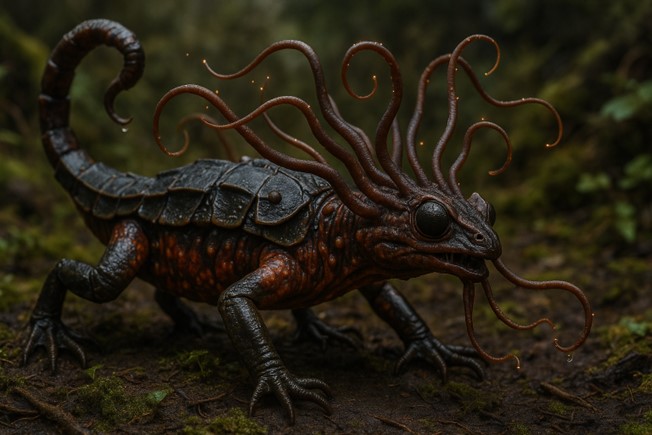
A party of adventurers in the world of Saṃsāra might encounter or actively search for a Hydrabeet Scorsalam 655 for a variety of compelling reasons tied to the creature’s unique traits, the island nation’s cultural context, and the high-magic environment that shapes their quests. One primary motivation arises from the creature’s regenerative polyps and venom, which hold significant alchemical potential. Apothecaries or alchemists in Banpo’s urban centers, such as Shu-Van, might commission adventurers to capture a live specimen or harvest its essence, seeking to craft potions that grant temporary regeneration or potent poisons for trade or defense against rival island nations. The venom’s variable composition—neurotoxic in jungles or corrosive near steam vents—adds urgency, as specific environmental variants could yield rare concoctions prized in political intrigue or megacity black markets, prompting quests with rewards in platinum or enchanted gear to attract skilled parties.
Another reason stems from the creature’s role as a guardian or hazard in forgotten ruins and uncharted islands, where its hoarding of shiny relics draws treasure seekers. Avatars, particularly those at higher tiers seeking upgrades to boost their magical capabilities, might venture into these perilous sites to retrieve artifacts the Hydrabeet Scorsalam 655 has amassed, believing them to be remnants of ancient civilizations or soul-infused relics from pre-Placement eras. The challenge lies in navigating its ambush tactics and pack coordination, making it a test of skill and gear attunement, with successful retrievals offering prestige or tier advancements within Banpo’s matrilineal society.
Encounters could also occur during griffon racing events or trade route expeditions, where the creature’s opportunistic predation disrupts schedules or endangers participants. Adventurers might be tasked by the monarchy or trade councils to clear nests along labyrinthine paths or protect zeppelin shipments, especially as the creature adapts to urban fringes by scavenging alchemical scraps. This aligns with the monarchy’s tax-funded infrastructure goals, providing adventurers with communal support or gear rewards, while the creature’s presence adds a dynamic threat to otherwise routine travel across the 838,205,714-acre island.
Cultural and magical curiosity further drives searches, as the Wen-Tal of Banpo view the Hydrabeet Scorsalam 655 as a clay-born guardian spirit tied to Xiwang’s weaving. Pattern-Keepers might enlist parties to study its vibrational sense or bioluminescent displays during magic storms, seeking to incorporate its patterns into sacred pottery or wards, enhancing communal harmony. This quest could involve negotiating with riverine beast civilizations that consider it kin, requiring diplomacy alongside combat skills, and offering insights into ancestral wisdom as payment.
Accidental encounters are common in the creature’s habitats—riverbanks, jungles, or cave systems—where adventurers exploring for clay deposits, hunting monsters, or fleeing political rivals might stumble upon its nests. Its speed, stealth, and regenerative abilities make it a formidable foe, forcing parties to adapt with trained skills and tiered gear, potentially turning a random clash into a survival challenge or a chance to earn reputation by subduing it for local praise. In a world where magic flows like weather and perspectives blur between people and beasts, the Hydrabeet Scorsalam 655 becomes both a resource and a rite of passage, drawing adventurers through necessity, ambition, and the promise of Saṃsāra’s endless mysteries.
Additional items or ingredients:
- Regenerative polyps can be carefully excised from the corpse of a Hydrabeet Scorsalam 655, appearing as small, bud-like growths clustered along the flanks and underbelly, each about the size of a thumbnail and pulsating faintly even after death if harvested within hours of the kill. These polyps contain a viscous, hydra-derived fluid rich in magical essence that promotes cellular regrowth, and in Saṃsāra’s alchemical workshops, they are ground into pastes or infused into potions that grant temporary healing effects, such as mending wounds during combat or accelerating recovery from debilitating curses. Artisans in Banpo’s Loom-Houses incorporate them into gear like woven bandages or inscribed amulets, allowing lower-tier avatars to access minor regenerative abilities without advanced equipment, though overuse risks uncontrolled budding that could lead to parasitic growths on the user. Traders value them highly for export to other island nations, where they fetch prices in gold or electrum, fueling the economy through steam-powered distillation factories that produce elixirs for public utilities or military rations.
- Venom sacs from the scorpion tail stinger yield a potent toxin, a translucent amber liquid that drips from the curved barb and can be milked postmortem using specialized glass vials to avoid corrosion. This venom varies by the creature’s habitat—neurotoxic variants from jungle specimens cause paralysis and hallucinations, while those near steam vents incorporate acidic properties that erode metals and enchantments. Alchemists refine it into poisons for coating single-shot firearms or weaving into net threads for trapping beasts, enhancing defensive wards in Banpo villages against invasive monsters. Higher-tier Pattern-Keepers use it in rituals to inscribe flaw patterns on enemy gear, creating vulnerabilities during political skirmishes, and it serves as a key ingredient in antidotes distributed through the monarchy’s tax-funded public works, protecting citizens from similar feral threats. In trade, diluted forms are bartered for rhodium in underwater markets, where divers employ it to deter predatory fish-folk.
- Iridescent beetle plating, segmented armor-like shells covering the back and flanks, can be pried off the corpse with chisels or enchanted tools, each plate measuring several inches across and exhibiting a shimmering chitin that reflects light in crimson and black hues. These plates are durable yet lightweight, ideal for crafting reinforced gear components such as scale inlays for Wen-Tal avatars’ specialized slots or embedding into pottery for protective wards that deflect minor magical projectiles. In Banpo’s steam factories, they are ground into powders for alchemical glazes that harden ceramics against breakage, used in sacred vessels that house ancestral spirits or in public park sculptures that channel environmental magic flows. Adventurers harvest them to upgrade their own equipment, boosting constitution modifiers when attuned at mid-tiers, and they command silver prices in megacity auctions, where artisans compete to integrate them into lavash costumes for enhanced camouflage during griffon races through labyrinths.
- Writhing tentacles, derived from hydra influences, remain flexible postmortem and can be severed at the base from the head, each up to a foot long with stinging cells that retain mild potency for days if preserved in clay jars. These tentacles are versatile in crafting, braided into whips or nets that deliver paralytic strikes when enchanted with Shu-Wen chants, serving as tools for fishers in the Great Haul rituals or as components in telepathic gear that amplifies sensory links among pack-hunting parties. Alchemists extract the stinging nematocysts for inks used in Shu-Glyph scripting, creating documents or maps that ward against tampering, and in Banpo’s educational systems, they are dissected in schools to teach juveniles about chimeric biology before adulthood awakens their magic. Traders ship them to floating cities for use in levitation harnesses, where the tentacles’ natural grip enhances stability, fetching nickel or electrum in exchanges that support the monarchy’s infrastructure projects.
- Powerful mandibles from the beetle-jawed head snap with crushing force even after death and can be extracted whole, resembling oversized pincers with serrated edges that retain sharpness for tools. These are forged into cutting implements for pottery wheels or weaving shuttles in Loom-Houses, allowing precise inscription of ancestral patterns that channel Xiwang’s protection. Warriors adapt them into claw caps for Wen-Tal avatars, providing strength boosts in grapple actions during conflicts with river beasts, and alchemists pulverize them into supplements that enhance bite-based attacks for tamed griffons in racing events. In the broader trade networks, they are valued for their durability in mechanical power transmission systems, ground into abrasives for gears and pulleys in steam factories, commanding copper prices and contributing to public utilities like enchanted bridges.
- Sensory compound eyes, multifaceted orbs that provide panoramic vision, can be gouged from the skull and preserved in alchemical fluids, each eye a gem-like structure with beetle facets that capture heat signatures. These are incorporated into scrying gear or visors for avatars, granting infrared detection to spot hidden ruins or magical springs in jungles, useful for quests retrieving lost artifacts. Pattern-Keepers embed them into sacred pottery as divination aids, interpreting heat patterns as ancestral guidance during Kiln Lighting vigils, and in military applications, they enhance wards on zeppelins for spotting aerial threats. Traders export them to cave megacities for lantern components that illuminate dark systems without fire, fetching silver in deals that fund the monarchy’s road networks.
- Vibrational sensory pads from the arachnid legs, small nerve clusters under the feet, can be peeled and dried into membranes that detect ground tremors. These are woven into boots or belts for gear slots, allowing avatars to sense approaching monsters or steam machinery vibrations, boosting perception skills in dense urban centers or during explorations of disappearing islands. Alchemists infuse them into potions for temporary heightened awareness, used by guards in public parks to prevent ambushes, and they serve as components in musical instruments like clay drums that resonate with communal chants.
- Acidic digestive enzymes from the internal gut, a slimy residue with hydra properties, can be siphoned from the abdomen and bottled, breaking down chitin and flesh efficiently. This enzyme is refined into cleaning agents for alchemical labs or as etchants for Shu-Glyph inscriptions on metal gear, preventing corrosion in humid environments. In Banpo’s factories, it aids in processing textiles by dissolving impurities, and adventurers use it to dissolve barriers in ruins, with diluted forms traded for nickel in underwater enclaves for coral carving.
- Chitinous tail segments from the scorpion appendage, jointed rings leading to the stinger, can be disassembled into flexible links for chains or belts in mechanical systems, resistant to wear from steam power. These are integrated into pulley mechanisms in workshops or as reinforcements for nets in fishing rituals, enhancing durability against river currents. Traders value them for export to airship builders, where they form lightweight rigging, commanding copper in exchanges that support public works.
- Gelatinous egg remnants, if the corpse is a gravid female, provide nutrient-rich sacs that can be collected from the reproductive tract, serving as fertilizers for magical agriculture in floodplains or as bases for growth elixirs that accelerate juvenile training in schools. Alchemists brew them into tonics for boosting constitution in lower-tier avatars, and they are used in rites to nurture ancestral patterns in pottery, fostering communal bonds.
Weaver Anu and River’s Twisted Spawn
In the vault of old whispers, it is etched that there was an era when the Wide Flow was angered. A creeping thing arose. But it was not a creeping thing of true limbs and honest hide. Its shape was a tangle of wrongs, a wriggling shadow that hungered without cease. The wise ones called it the Coil-Breaker, for that was its deed. Its bulk was as a coiled vine in the depths, and its grasping ends were like broken reeds in multitude. When the kin cast their Grand Web, which was a web of much esteem and the toil of all fingers, the Twisted Spawn would lunge. And the web tore. Again the web tore.
So it came that the bonds of the kin began to slacken. The folk’s innards were hollow, and a hollow innard is a frail loop in the weave of togetherness. Dread was a slick crawler slithering in their inners. The Mark-Guardians, who were the deepest knowers of the shapers, went to the Strand-Dwelling. They stood afore the Elder Partition, where the vintage urns held the breaths of the far-gone. They peered at the marks, the curling paths and square knots, hunting the knowing for how to snare a crawler that was a knot of chaos.
Yet no mark was there. The elders had never met such a beast as the Coil-Breaker. Their knowing was for the right crawlers of the flow, not for this mess of limbs in the murk. For this cause, the wise ones had visages like cracked earthbeds, and their breaths were weighty. The one they named Xiwang, the Thread-Molder, seemed mute, and the flow offered no riddles.
Now, there was a crafter whose call was Anu. The call had weight, but the weight is a frayed cord. He was kinless in part, a loop knotted by fate, not by full blood ties. His grips, though, were clever with the shaping wheel and the sting-thread. He was a still crafter, but his thinkings were sharp thorns in his skull. He saw the fright in the hamlet, and he saw the grand web, rent and mournful on the shore.
Alone he strode, which was a path not trod, in the gloom of the lightless night. He strode to the brink of the Wide Flow to spy for the Twisted Spawn. This was a heavy risk, for a single cord beckons turmoil. He hid in the flow weeds, which were his call in some tellings. For four nights, he spied. He beheld the twisted thing shift. He beheld it was not just a savage. It had a mark of its own. It would dart in a wide, fierce ring, then twist its might inward to rend the web. It wielded its own surge as a blade. Its force was a whirl of greed.
Anu came back to the hamlet. His mind was stuffed with the spawn’s mark. The old webs, he discerned, were built as firm walls. But you cannot raise a wall in a flow to stop the rush. The rush just bends around, or it smashes the wall. The Twisted Spawn was like the flow’s push. It could not be walled.
He seized a needle and a night cord. He did not bind the mark of the elders. He bound the mark he spied in his mind, the mark of the whirl. It was a spiral coil, a mark that bent in on itself, a mark that did not halt but led. It was a thing of dire peril and maybe dire madness to forge a new mark, a mark not granted by the long-vanished.
He bore his small binding to the Mark-Guardians. His form-shell quaked, for they were seniors of lofty rank. He spoke, with a tone small as a gnat, “The web must not be a wall. It must be a whirl. We must not meet its force with our force. We must harness its force to knot the loop of its own ruin.”
The seniors inspected. They saw his mark. It was not of the elders. It was fresh. It was a thing of terror. To leave the aged ways was to say the elders were false. But the greed of the hamlet was a strong driver. An aged Mark-Guardian, whose call is forgotten, inspected Anu’s binding and then at the torn Grand Web. He spoke, “An aged mark that does not snare crawlers is just a fine echo. A fresh mark that feeds the hamlet is knowing.”
And so it was settled. Anu, the crafter who was a slack loop, stood afore the kin. He did not bind the new web alone. That is not the path. His mark was shown to all the binders. All the fingers of the hamlet worked to bind the new Grand Web, the one they named the Coil Web. Its form was odd, a funnel of twisting cords. It took many suns.
They hauled the Coil Web to the flow. They flung it in the way of the Twisted Spawn. The great tangle in the murk saw it and rushed with vast fury. It lunged at the web. But the web did not tear. The coiling cords seized the spawn’s vigor. The harder it fought, the tighter the web squeezed, turning its own might against it. It was led by the coil, round and round, snared and weary, into the thin waters by the brink. There, its vast force was useless, and the crawler-hunters of the hamlet could end its span.
The hamlet had sustenance anew. The bonds of the kin were mended. Anu was not banished for his fresh thinking. Because he brought his mark back to the web, for all fingers to bind, he was honored. He rose to a grand Mark-Guardian. And his coil, the mark born of lone spying, was added to the Elder Partition, a fresh shard of knowing for all who came after.
The moral of the tale: The knowing of the elders is a firm web, but when a new beast rises in the flow, a lone cord may uncover the mark that all fingers must bind to keep the kin from unraveling.
Suggested conversions to other systems:
Call of Cthulhu: Hydrabeet Scorsalam Horror STR 60 CON 70 SIZ 40 DEX 65 INT 25 POW 40 HP 11 MP 8 Damage Bonus: +1D4 Move: 8 (land), 6 (water), 4 (climb) Armor: 3 points (beetle plating) Skills: Stealth 70%, Hide 60%, Track 50%, Grapple 65%, Sting 55% Attacks: Tentacle Lash 70%, damage 1D6 + paralyze (CON roll or immobilized 1D6 rounds), Pincer Crush 60%, damage 1D8 + grapple, Tail Sting 55%, damage 1D4 + venom (POT 14 poison, CON roll or -20% to all skills for 1D4 hours), Mandible Bite 50%, damage 1D6 + digestive enzyme (reduces armor by 1 point per hit) Sanity Loss: 0/1D6 Special Abilities: Regeneration (restores 1D6 HP per round in moist or magical environments, unless fire or acid damage), Budding (detaches a tentacle as a decoy, requiring a successful attack roll to hit instead, regrows in 1D4 days), Vibrational Sense (detects movement within 50 feet, +20% to Spot Hidden in darkness) Description: A chimeric horror from Saṃsāra’s rivers and jungles, this creature blends amphibian, insect, hydrozoan, and arachnid traits into a nightmarish form. Investigators encountering it may face its ambush tactics in forgotten ruins or trade routes, where its regenerative polyps and venomous stings pose a threat to sanity and survival. Balance adjustments include capping regeneration in combat to prevent overuse and limiting budding to once per encounter to maintain challenge.
Blades in the Dark: Hydrabeet Scorsalam Stalker Tier: 1 Quality: 2 Attributes:
- Resistance: 2 (regeneration and plating)
- Harm: 2 (pincers and sting)
- Armor: 1 (beetle chitin)
- Special: 2 (tentacle range, venom) Stress: 6 Harm Capacity: 6 (3/6 boxes) Load: 0 Clocks: Ambush (4 segments), Regeneration (6 segments) Actions:
- Skirmish: 2 (pincer crush, 2 harm close)
- Hunt: 2 (vibrational sense, +1d to track)
- Prowl: 2 (stealth camouflage, +1d to hide)
- Wreck: 1 (mandible bite, 1 harm close, reduces target armor by 1) Special Abilities:
- Tentacle Lash (2 stress): Lash out with tentacles (range), 2 harm + immobilize (resist with Resolve), limited to once per scene.
- Venom Sting (1 stress): Tail sting inflicts 1 harm + POT 14 poison (resist with Resolve or take -1d to actions for scene).
- Regenerate (1 stress): Heal 1 harm box if in moist/magical area, resets clock; max once per downtime. Description: This feral stalker haunts Banpo’s riverbanks and jungles, a chimeric threat with pack tactics and regenerative prowess. Crews may face it during heists or downtime in trade routes, its ambush clock challenging stealth operations. Balance is maintained by stress costs and clock limits, ensuring it’s a tough but manageable foe for Tier 1-2 crews, with venom effects scaled to narrative impact.
Dungeons & Dragons 5th Edition: Hydrabeet Scorsalam Medium Monstrosity, Unaligned Armor Class 14 (natural armor) Hit Points 52 (8d8 + 16) Speed 30 ft., swim 20 ft., climb 15 ft. STR 14 (+2) DEX 16 (+3) CON 15 (+2) INT 6 (-2) WIS 10 (+0) CHA 8 (-1) Saving Throws Dex +5 Skills Stealth +5, Perception +2 Damage Resistances Poison Condition Immunities Poisoned Senses Darkvision 60 ft., Tremorsense 30 ft., Passive Perception 12 Challenge 2 (450 XP) Traits:
- Regeneration. The hydrabeet scorsalam regains 5 hit points at the start of its turn if it has at least 1 hit point and is in moist or magical terrain (stopped by fire or acid damage).
- Tentacle Budding. When reduced to half hit points, it can use a bonus action to detach a tentacle, which acts as a decoy (AC 10, 10 HP) for 1 minute or until destroyed, regrowing in 1d4 days.
- Vibrational Sense. The hydrabeet scorsalam can detect vibrations within 30 feet, ignoring invisibility. Actions:
- Multiattack. The hydrabeet scorsalam makes two attacks: one with its tentacle lash and one with its pincer crush.
- Tentacle Lash. Melee Weapon Attack: +5 to hit, reach 10 ft., one target. Hit: 7 (1d8 + 3) bludgeoning damage, and the target must succeed on a DC 13 Constitution saving throw or be paralyzed for 1 minute (repeat save at end of turn).
- Pincer Crush. Melee Weapon Attack: +4 to hit, reach 5 ft., one target. Hit: 9 (2d6 + 2) bludgeoning damage, and the target is grappled (escape DC 13).
- Tail Sting. Melee Weapon Attack: +5 to hit, reach 5 ft., one target. Hit: 6 (1d6 + 3) piercing damage plus 7 (2d6) poison damage, and the target must succeed on a DC 13 Constitution saving throw or be poisoned for 1 hour.
- Mandible Bite. Melee Weapon Attack: +4 to hit, reach 5 ft., one target. Hit: 6 (1d8 + 2) piercing damage, and the target’s armor or natural armor is reduced by 1 until repaired. Description: This monstrosity prowls Saṃsāra’s rivers and jungles, a fusion of amphibian, insect, hydrozoan, and arachnid traits. Parties may encounter it in Banpo ruins or during trade quests, its regeneration and venom challenging low-level groups. Balance adjustments include limiting regeneration triggers and capping tentacle decoys to maintain encounter difficulty for levels 3-5.
Knave: Hydrabeet Scorsalam Brute Level 2 HP 16 AC 13 (natural beetle plating) Attack +3 (1d6+1 pincer crush or 1d4+1 tail sting) Speed 30 ft. (swim 20 ft., climb 15 ft.) Abilities:
- STR 14 (+2) DEX 15 (+2) CON 13 (+1) INT 6 (-1) WIS 10 (+0) CHA 8 (-1)
- Regeneration: Regains 1d4 HP at start of turn in moist/magical areas (negated by fire/acid), once per combat.
- Tentacle Grapple: +3 to hit, reach 10 ft., restrains target (STR save DC 12 to escape), 1d4 bludgeoning damage.
- Venom: Tail sting applies poison (CON save DC 12 or -1d4 to next action roll, lasts 1 hour).
- Vibrational Sense: Detects movement within 30 ft., +2 to awareness checks in darkness. Inventory: None (feral, no gear slots) Description: A chimeric brute roaming Banpo’s wilds, this creature combines salamander agility, beetle armor, hydra tentacles, and scorpion venom. Knave parties might face it while scavenging ruins or guarding trade routes, its regeneration and grapple posing risks. Balance is ensured by limiting regeneration to once per fight and scaling damage to Level 2 threats, fitting for 1st-3rd level adventurers with trained skills.
Fate: Hydrabeet Scorsalam Predator Aspects:
- High Concept: Chimeric River Ambusher with Regenerative Tentacles
- Trouble: Vulnerable to Fire and Dry Spells
- Aspect: Pack Hunter with Vibrational Awareness
- Aspect: Venomous Tail Stinger Skills:
- +4: Stealth, Athletics
- +3: Fight, Notice
- +2: Physique, Provoke
- +1: Lore, Rapport Stunts:
- Regenerative Burst: Once per scene, spend a fate point to recover 2 stress or clear a mild consequence if in moist/magical terrain.
- Tentacle Grapple: Gain +2 to create an advantage with Fight when using tentacles to restrain a target.
- Venom Strike: On a successful Fight attack with tail sting, add a “Poisoned” situation aspect (requires a Physique roll at +2 difficulty to resist, -2 to actions for a scene). Stress: [1][2][3][4] Consequences: [2] [4] [6] Description: This predatory fusion of amphibian, insect, hydrozoan, and arachnid traits haunts Saṃsāra’s rivers and jungles, posing a threat to Fate parties with its ambush tactics and regenerative prowess. Encounters in Banpo ruins or trade routes challenge players to leverage aspects and stunts, with balance maintained by limiting regeneration to once per scene and scaling venom effects to narrative flow, suitable for a mid-tier threat.
Numenera & Cypher System: Hydrabeet Scorsalam Lurker Level: 3 Motive: Hungers for flesh and magical energy Health: 12 Damage Inflicted: 4 points Armor: 2 (beetle plating) Movement: Short (land), Short (water), Short (climb) Modifications: Stealth and perception tasks as level 4 due to camouflage and vibrational sense Combat:
- Tentacle Lash: 4 damage, range short, target must succeed on a Might defense roll (difficulty 3) or be immobilized for 1 round.
- Pincer Crush: 4 damage, melee, target is grappled (Might defense roll to escape, difficulty 3).
- Tail Sting: 4 damage + 3 poison (Might defense roll, difficulty 3, or lose next action).
- Mandible Bite: 3 damage, melee, reduces target’s armor by 1 until repaired. Special Abilities:
- Regeneration: Regains 1d6 health at the start of its turn if in moist/magical terrain (negated by fire or acid), once per 10 minutes.
- Budding Decoy: Uses an action to detach a tentacle (4 health, level 1) as a decoy, regrows in 1d4 days.
- Vibrational Sense: +2 to perception rolls to detect hidden foes within immediate range. Loot: Possible cypher (regeneration salve, level 2) or oddity (iridescent scale fragment). Description: A lurker from Saṃsāra’s wilds, this level 3 creature blends multiple animal traits into a regenerative threat. Numenera parties might encounter it in Banpo jungles or ruins while seeking cyphers, with balance adjusted by capping regeneration frequency and decoy use to maintain challenge for 2nd-4th tier characters.
Pathfinder 2nd Edition: Hydrabeet Scorsalam Stalker Creature 3 Medium Monstrosity Perception +7 (darkvision, tremorsense 30 feet) Languages None Skills Acrobatics +9, Athletics +8, Stealth +9, Survival +7 STR +2, DEX +3, CON +2, INT -2, WIS +1, CHA +0 AC 18 (natural armor); Fort +9, Ref +10, Will +6 HP 45; Immunities poisoned; Resistances poison 5 Speed 30 feet, swim 20 feet, climb 15 feet Regeneration 5 (deactivated by fire or acid, triggers in moist/magical terrain) Tentacle Budding Reaction (healing); Trigger Reduced to half HP; Effect Detaches a tentacle (10 HP, AC 15) as a decoy for 1 minute or until destroyed, regrows in 1d4 days. Vibrational Sense The stalker senses vibrations within 30 feet, ignoring concealment. Melee [one-action] Tentacle Lash +11 (reach 10 feet), Damage 1d8+4 bludgeoning plus Grab Melee [one-action] Pincer Crush +11 (agile), Damage 1d10+4 bludgeoning plus Grapple Melee [one-action] Tail Sting +11, Damage 1d6+4 piercing plus 1d6 poison, DC 18 Fortitude save or slowed 1 for 1 minute (save each round) Melee [one-action] Mandible Bite +9, Damage 1d8+2 piercing, reduces target’s AC by 1 until repaired Description: This stalker prowls Banpo’s rivers and jungles, a chimeric monstrosity with regenerative and venomous traits. Pathfinder parties might face it in ruins or trade quests, with balance ensured by limiting regeneration to specific conditions and scaling damage for a Level 3 encounter, challenging parties of levels 2-4.
Savage Worlds Adventure Edition: Hydrabeet Scorsalam Ambusher Wild Card: No Attributes: Agility d8, Smarts d4, Spirit d6, Strength d8, Vigor d8 Skills: Fighting d8, Notice d6, Stealth d10, Swimming d6, Climbing d6 Pace: 8; Parry: 6; Toughness: 8 (2) Special Abilities:
- Armor +2: Beetle plating provides natural protection.
- Bite: Str+d6, reduces target’s armor by 1 until repaired.
- Claws: Str+d6.
- Regeneration: Natural healing roll every round in moist/magical terrain (negated by fire/acid), max once per combat.
- Tentacle Lash: Fighting +2, reach 2, 2d4 damage, may grapple (+2 to resist).
- Venom Sting: Fighting, 2d4 damage + poison (Vigor -2 or Shaken, lasts 1 hour).
- Vibrational Sense: +2 to Notice rolls to detect movement within 30”. Gear: None Description: This ambusher roams Saṃsāra’s wilds, a chimeric threat with pack tactics and regeneration. Savage Worlds parties might encounter it in Banpo jungles or during trade missions, with balance maintained by limiting regeneration to once per fight and scaling damage to fit a Wildcard-level threat for Novice to Seasoned ranks, adjustable by GM fiat for party size.
Shadowrun 6th Edition: Hydrabeet Scorsalam Riverfiend B 4 A 5 R 4 S 3 C 2 I 3 L 2 W 3 EDG 1 ESS 6 INIT 7+1D6 Physical Limit 5, Mental Limit 4, Social Limit 4 Armor 6 (beetle plating) Qualities: Regeneration (regains 1 Physical box per Combat Turn in moist/magical areas, negated by fire or acid), Venom (tail sting, Vector: Injection, Speed: Immediate, Power: 8, Effect: Physical Damage, Paralysis), Low-Light Vision, Tremorsense (30 meters) Skills: Close Combat 5, Perception 4, Sneaking 6, Swimming 4 Powers: Grapple (tentacles, +2 dice to clinch), Natural Weapon (Pincer Crush: DV 6P, AP -1), Natural Weapon (Mandible Bite: DV 5P, AP -2, reduces target armor by 1), Natural Weapon (Tail Sting: DV 4P + Venom) Description: This riverfiend stalks Saṃsāra’s shadows, a chimeric critter blending amphibian slime, insect chitin, hydra tentacles, and scorpion venom, ideal for urban sprawl or jungle ops in Banpo. Shadowrunners might tangle with it guarding ruins or as a corporate bio-experiment gone wild, its regeneration challenging street-level teams. Balance tweaks include limiting regeneration to once per scene in non-magical zones and capping venom power against high-Essence targets.
Starfinder 2nd Edition: Hydrabeet Scorsalam Voidstalker Level 3 Medium aberration Perception +9; darkvision, tremorsense (imprecise) 30 feet Languages none Skills Acrobatics +9, Athletics +8, Stealth +9, Survival +7 Str +2, Dex +3, Con +2, Int -2, Wis +1, Cha +0 AC 18; Fort +9, Ref +10, Will +6 HP 45; Immunities poison; Resistances poison 5 Speed 30 feet, swim 20 feet, climb 15 feet Regeneration The voidstalker regains 5 HP at the start of its turn if in moist or magical terrain (deactivated by fire or acid damage). Tentacle Budding [reaction] Trigger Reduced to half HP; Effect Detaches a tentacle minion (AC 15, HP 10) that distracts for 1 minute or until destroyed, regrows in 1d4 days. Melee tentacle lash +11 (reach 10 feet), Damage 1d8+4 bludgeoning plus Grab Melee pincer crush +11 (agile), Damage 1d10+4 bludgeoning plus Grapple Melee tail sting +11, Damage 1d6+4 piercing plus 1d6 poison (Fortitude DC 18 or slowed 1 for 1 minute) Melee mandible bite +9, Damage 1d8+2 piercing (reduces target’s AC by 1 until repaired) Description: A voidstalker lurking in Saṃsāra’s stellar fringes, this aberration fuses multiple traits for predatory efficiency. Starfinder crews might hunt it for cyphers in Banpo asteroid ruins or during trade hauls, its venom and regeneration testing level 2-4 parties. Balance adjustments limit regeneration triggers and scale poison DCs for group size.
Traveller 2nd Edition (2022 Update): Hydrabeet Scorsalam Swarmbeast Type: Pouncer Terrain: Jungle/River Number Encountered: 2d6 (pack) Weight: 15 kg Hits: 2d6+2 Armor: Jack +1 (chitin plating) Wounds: 3d6 (tentacles/pincers), Venom (tail sting: 2d6 damage + paralysis for 1d6 rounds, resisted by Endurance 8+) Weapons: Claws (pincer crush: +1 DM, 2d6 damage), Teeth (mandible bite: +0 DM, 1d6 damage, reduces armor by 1), Sting (tail: +2 DM, 1d6 + venom) Behavior: Ambush predator, uses stealth (8+) to surprise, grapples with tentacles (Athletics 8+ to escape), regenerates 1d6 hits per day in moist areas Pack: 6 Description: This swarmbeast infests Saṃsāra’s worlds, a chimeric pouncer with regenerative and venomous traits, perfect for planetary hazards or bio-threats in Traveller campaigns. Scouts might encounter packs blocking trade paths in Banpo-like colonies, its pack tactics challenging 2-4 crew members. Balance via adjusting number encountered and limiting regeneration to post-combat recovery.
Warhammer Fantasy Roleplay 4th Edition: Hydrabeet Scorsalam Warpfiend M 5 WS 40 BS 0 S 35 T 35 W 12 I 30 A 2 LD 10 INT 15 WP 20 FEL 5 Traits: Armour 2 (beetle plating), Bite +6 (mandible, reduces enemy armour by 1), Grapple (tentacles, +10 to hit, restrains until Strength test SL 2+), Poison (tail sting, Toughness test or Stunned for 1d10 rounds), Regeneration (regains 1d10 Wounds per round in moist/magical areas, negated by fire or acid), Size (Average), Weapon +7 (pincer crush) Skills: Dodge 40, Perception 40, Stealth (Jungle/River) 50, Swim 45 Talents: Ambush, Hardy, Strike to Stun Description: A warpfiend twisted by Saṃsāra’s chaos, blending beastly forms into a regenerative horror stalking Banpo’s grim wilds. Warhammer parties might slay it for alchemical bounties or during ruin delves, its venom testing low-career groups. Balance by capping regeneration rounds and scaling attacks for 1st-2nd tier foes.
Comments
One response to “Hydrabeet Scorsalam 655”
[…] From: Hydrabeet Scorsalam 655 […]