
This belief system is practiced by the inhabitants of the Banpo Isles, a nation comprised of a large central island and a spray of smaller ones, all situated along the mouth of a massive, slow-moving river. The faith is not a collection of rigid doctrines but a lived philosophy that informs every aspect of Banpo society, from governance to the crafting of a simple fishing hook. Its followers do not seek converts, as they believe their path is intrinsically tied to the unique spiritual geography of their home.
Lore: The Banpo creation story tells that their ancestors did not arrive on Saṃsāra as scattered souls. Instead, their entire founding village was scooped from a forgotten world and placed, whole and intact, upon the banks of the Great River. They awoke in a world that was alien yet familiar, a place of immense spiritual resonance. They found their survival depended on the two gifts of the river: the endless bounty of fish swimming in its currents and the rich, pliable clay of its banks.
From these two gifts, they divined the nature of their new deity, the one they came to call Xiwang, a name that means both “Net-Caster” and “Clay-Spinner.” The lore teaches that Xiwang is the divine artisan who weaves the community together just as a fisher weaves a net. Every individual soul is a knot, and every relationship is a thread connecting them. A single knot is weak, and a single thread is useless, but woven together with skill and care, they form a net strong enough to pull sustenance from the chaotic waters of existence.
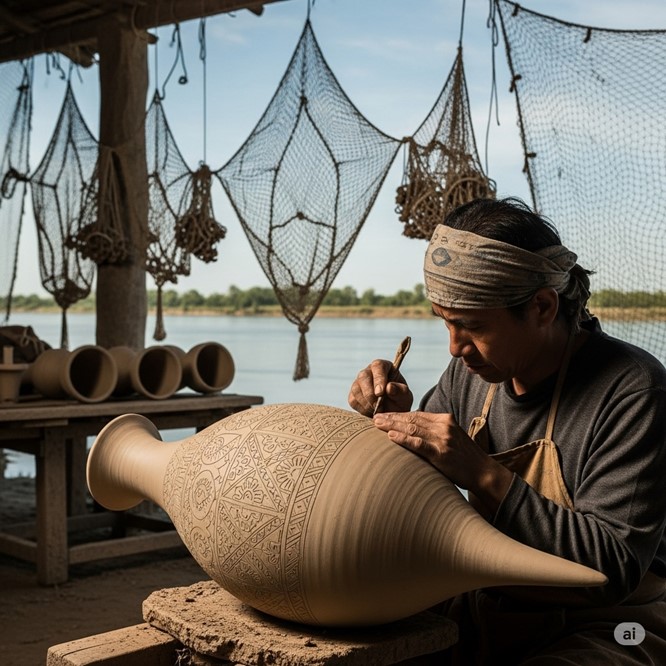
The body is a clay vessel, shaped by the community and fired in the kiln of experience. But the most sacred part of a person is their connection to the ancestors. When a person dies, their knowledge and spirit do not depart for some distant afterlife. Instead, they are absorbed back into the great pattern. The ancestors are believed to speak through the intricate, geometric designs that adorn Banpo pottery and textiles. A master potter does not invent a pattern; she quiets her mind and allows her hands to be guided by the ancestral spirits, tracing their wisdom onto the clay. These patterns are not mere decoration; they are maps of fate, histories of the soul, and protective wards. To break a sacred pot is to temporarily silence an ancestor’s voice.
Deity: Xiwang, the Weaver of Nets and Clay
- Personality: Xiwang is not a deity of personal relationships or emotional outbursts. Its personality is that of a master artisan, utterly focused on the integrity of its creation: the community. Xiwang is patient, meticulous, and demands precision. It values cooperation, skill, and the selfless contribution of the individual to the strength of the whole. It is nurturing in the way a potter nurtures a pot, carefully shaping it and protecting it from flaws, but it is also stern and unforgiving of anything that threatens the pattern. Selfishness, laziness, or actions that weaken the “net” of society are seen as the greatest sins, not because they are morally evil, but because they are flaws in the divine craftwork. Xiwang does not thunder from the heavens; its displeasure is felt in a fishing net that comes up empty, a pot that cracks in the kiln, or a social bond that inexplicably frays.
- Traits and Characteristics: Xiwang is an abstract, androgynous, and often dualistic entity. It is never depicted as a single being but is represented by its works and symbols. The deity is felt as a presence in the community itself—in the synchronized pull of fishers hauling a great net, in the rhythmic hum of a potter’s studio, in the shared silence of a meal. It is both the weaver and the thing being woven. Priests of Xiwang, known as Pattern-Keepers, are not intermediaries but are the most skilled artisans, those whose hands are so practiced they can perceive and trace the will of the ancestors and the design of the divine. They lead by example, their authority derived purely from their skill and their dedication to the community’s integrity.
Attributes: Xiwang’s divine influence covers the essential domains of Banpo life:
- Community and Cooperation: The primary attribute. Xiwang governs social cohesion, the strength of bonds between people, and the harmony of the collective.
- Craftsmanship: The deity is the ultimate patron of artisans, especially potters, weavers, and net-makers. Skill and dedication in craft are forms of worship.
- Ancestors and Divination: Xiwang acts as the conduit for the wisdom of the dead. The patterns on sacred objects are its scripture, and interpreting them is the primary form of divination.
- The River: The deity is the guardian of the river, the source of both clay and fish. Its mood is reflected in the river’s currents and bounty.
- Sustenance and Hunting: Xiwang ensures the nets are full and the community is fed, provided the community works as one and respects the river’s gifts.
- Protection: The sacred patterns woven and inscribed onto objects are not merely decorative; they are wards that protect the individual and the community from malevolent spirits and ill fortune.
Symbols
- The Spirit-Fish Mask: The most sacred and recurring symbol. It is a stylized, often triangular human face that incorporates the features of a fish—round, unblinking eyes, and gill-like markings. It is frequently depicted with a pointed headdress. This symbol represents the watchful ancestor spirits, forever tied to the river that sustains their descendants.
- The Woven Diamond: The simple diamond or lozenge shape created by the intersecting threads of a fishing net. It symbolizes the individual’s place within the collective and the strength that comes from interlocking bonds. It is a common motif on clothing and tools.
- The Interlocking Spiral: A complex geometric pattern of interlocking spirals and lines. It represents the threads of fate, the flow of the river, and the souls of the community woven together into a single, intricate design. It is the most common pattern on sacred pottery.
- The Pointed Amphora: A specific type of clay jar with a narrow, pointed base and two handles. Originally a practical design meant to be set into the soft earth or sand, it has come to symbolize the community’s reliance on and connection to the land itself.
Tags: Deity, Religion, Neutral, Community, Ancestors, Crafting (Pottery, Weaving), Water, Fishing, Divination, Protection, Order, Pattern, River, Artisan, Fate, Cohesion, Interdependence, Clay, Duty
Positives: The primary benefit for followers of this path is an unparalleled degree of social strength and communal harmony. The belief that every individual is an essential knot in the divine net of the community fosters a society with immense cohesion and unity of purpose. Collective goals are easily achieved, as the entire population can be mobilized for large-scale projects like building river defenses, participating in massive fishing expeditions, or creating complex irrigation systems. Crime and internal conflict are exceedingly rare, as actions that harm another member of the community or disrupt social order are considered the ultimate blasphemy—a deliberate tearing of Xiwang’s sacred net. This social stability provides a deep sense of security, belonging, and purpose for every individual, who knows their specific role and value from birth. Furthermore, the emphasis on skilled craftsmanship as a form of worship results in a prosperous society whose masterfully made pottery and textiles are highly valued trade goods, renowned for their durability and the potent protective magic of their ancestral patterns.
Negatives: The greatest drawback of the Way of the Woven Stream is the systemic suppression of individuality and innovation. The health of the collective “net” is paramount, and the individual “knot” is secondary. Personal ambition, radical self-expression, and creative thought that deviates from the sacred, ancestral patterns are viewed with extreme suspicion. Such traits are not celebrated but are seen as dangerous flaws that could unravel the entire social fabric. An individual who is too different risks being ostracized, “re-educated,” or even exiled to prevent their “flawed thread” from weakening the whole. This leads to a profoundly conservative and stagnant society that is highly resistant to change. While stable, they are inflexible. They would face a catastrophic crisis if confronted with a threat that falls outside the wisdom of their ancestral patterns, as they lack the cultural tools to innovate a novel solution. This insular worldview also breeds a deep xenophobia; outsiders are not seen as potential converts but as chaotic, loose threads that have no place in the meticulously woven pattern of Banpo society.
Type of Temple: The followers of Xiwang do not build temples in the conventional sense of houses for a god. Worship is an active, communal process, and thus their sacred spaces are functional, communal workshops known as Loom-Houses. A Loom-House is typically a long, open-air structure, often built on stilts along the riverbank, with a timber frame and woven reed walls that can be rolled up to allow for airflow and light. These are not places of quiet prayer but are filled with the rhythmic hum of communal industry.
Inside, the space is dominated by rows of potter’s wheels and large, complex looms where textiles and fishing nets are created. These tools are the altars of the faith. The building also contains extensive wooden racks where newly thrown pots and woven goods are left to dry. A central, sacred feature is the massive, community-operated kiln, where the clay vessels are fired and the ancestral patterns are made permanent. There is no idol or central statue of Xiwang. The deity is considered to be present in the act of creation and in the collective focus of the community at work. The holiest part of a Loom-House is the Ancestor Wall, a single, solid wall upon which are displayed the most ancient and masterfully crafted ceramic vessels. Each pot is believed to house the spirit of a powerful ancestor, and the intricate patterns upon them are the faith’s sacred texts. Pattern-Keepers and community members alike will sit before this wall in quiet contemplation to seek guidance from the wisdom of the past.
Number of Followers: The Way of the Woven Stream is an ethno-religion, intrinsically and exclusively tied to the people of the Banpo Isles and the Great River that defines their homeland. The faith does not proselytize, as it is believed that one cannot be woven into the net without being born of its threads. Therefore, followers are found nowhere else in the world of Saṃsāra.
While the nation is geographically limited, the river provides a bountiful and reliable source of sustenance, allowing for a dense population. The total number of adherents to the Way of the Woven Stream is estimated to be approximately 167,641,143 souls. Within the Banpo Isles, adherence is effectively universal. The culture, government, and religion are so deeply intertwined that to reject the faith would be to reject one’s family, community, and identity—to voluntarily sever oneself from the net. For this reason, the number of non-believers within their society is negligible to non-existent.
What Believers Believe: The followers of the Way of the Woven Stream believe that existence is a great, intricate pattern being perpetually woven by their deity, Xiwang. This divine creation is reflected in their own community, which they see as a sacred fishing net. Every individual soul is considered a single, vital knot in this net. The purpose and value of a knot are not found in its uniqueness but in its strength and its secure connection to the threads around it. The threads themselves are the relationships, duties, and reciprocal obligations that bind the community together. A weak knot or a frayed thread endangers the entire net, threatening to let the chaos of the outside world rush in.
They hold that the physical body is a temporary clay vessel, an tu-shen or “earth-body,” which is shaped and hardened by life’s experiences. The soul, or ling-xi (“spirit-thread”), is the animating force within, a fragment of Xiwang’s divine pattern. Upon death, this spirit-thread does not travel to a distant afterlife but is unwoven from the individual knot and re-integrated into the ancestral pattern—a collective consciousness of all who have ever lived. This ancestral collective is the source of all wisdom, skill, and magical protection.
The ancestors are not prayed to directly; instead, they are communed with through craft. A master artisan does not invent a new design but enters a meditative state, allowing their hands to be guided by the ancestral pattern. The intricate, geometric designs that adorn their pottery and textiles are therefore not mere decoration. They are a sacred language, a flowing transcript of history, prophecy, and protective magic. The only true sin is to act against the integrity of the net. Selfishness, laziness, and radical individualism are abhorred not as moral failings but as acts of cosmic vandalism that unravel the divine craftwork of the community.
Regular Services: The concept of a passive “service” where a congregation gathers to be preached at is alien to the Banpo people. Their worship is active, constant, and productive. The daily “service” is the mindful and skillful performance of one’s duty to the collective. A weaver ensuring every thread is taut, a fisher mending a tear in a net, or a potter centering clay on a wheel are all performing acts of sacred devotion.
The most important religious events are communal work projects, which serve as their liturgy:
- The Great Haul: The daily or twice-daily casting and retrieval of the massive community fishing nets is a highly ritualized ceremony. It requires dozens of individuals to pull in perfect, synchronized rhythm, guided by call-and-response chants that are their equivalent of hymns. A bountiful catch is seen as a sign of Xiwang’s favor, tangible proof that the community’s “net” is strong and harmonious.
- The Kiln Lighting: Firing a batch of pottery is a multi-day vigil. The Pattern-Keepers, who are the faith’s master-artisan priests, select the vessels worthy of being made permanent. The entire community then works in shifts to feed the kiln and maintain a precise, steady temperature. The successful firing of the pottery, especially the sacred Pattern Jars, without any cracking is a major cause for communal celebration, reaffirming that the ancestors’ wisdom has been successfully preserved.
- The Mending: During the coldest part of the year, the community enters a quiet, introspective period of maintenance. The “service” during this season is the collective repair of tools, the weaving of new nets for the coming year, and the strengthening of communal buildings. It is a shared, meditative act of tending to the threads of their society.
Funeral Rites: The funeral is known as the Rite of Unweaving, a ceremony that is respectful and meaningful but deliberately devoid of prolonged, tragic mourning. It marks the moment a spirit-thread is returned to the great ancestral pattern.
When a person dies, their body, the empty earth-body, is washed and wrapped in a simple shroud. The true focus of the rite is the creation of a Pattern Jar. The immediate family, guided by a Pattern-Keeper, collaborates on making one final, unfired clay pot. In a meditative state, they inscribe its surface with a complex, geometric pattern. This pattern is not of their own design; it is believed to be a final transmission from the deceased’s spirit-thread, a visual representation of their life’s story, their unique place in the net, and the wisdom they are now contributing to the ancestral collective.
The Rite of Unweaving takes place at a sacred cliff overlooking the Great River. The community gathers as the Pattern-Keeper “reads” the intricate pattern on the unfired jar, serving as a eulogy that recounts the deceased’s duties, relationships, and contributions. The physical body is then interred in a communal burial ground, often within the foundations of a new building, so they may support the community in death as they did in life. The ceremony culminates when the family gently lowers the sacred, unfired Pattern Jar into the river. The community watches in silence as the water, the domain of Xiwang, slowly and completely dissolves the clay. This act symbolizes the spirit-thread being released from its individual vessel and its unique story dissolving back into the flowing, collective consciousness of the ancestors.
The magical power that stems from Xiwang is subtle and intricate, reflecting the deity’s nature as a divine artisan. Its use in conflict is rarely a matter of raw, elemental force. Instead, it is a magic of control, of strengthening one’s own connections while unraveling those of an enemy. A practitioner, or Pattern-Keeper, channels the collective power of their community’s “net,” the wisdom of the ancestral patterns, and the elemental force of the river to impose order upon a chaotic situation.
Defensive Applications: The defensive magic of the Way of the Woven Stream is focused on protecting the community, ensnaring foes, and reinforcing the natural and spiritual “net” that gives them their strength.
- The Ancestral Pattern Ward: This is the most common form of magical protection. A Pattern-Keeper can trace a glowing, geometric symbol in the air or directly onto the surface of a person or object. This is a temporary ward, a fragment of an ancestral pattern of protection. It does not simply block physical force like a solid shield; it works by “unraveling” hostile intent. A magical projectile that hits the ward might dissolve into harmless energy, while the arm swinging a sword might be overcome with a moment of confusion, causing the blow to go wide. The more complex and accurately rendered the pattern, the more potent the ward.
- The Net of Unraveled Intent: A practitioner can cast out a wide, invisible web of spiritual threads over a battlefield. This net does no physical damage. Instead, it targets the mental and social cohesion of an enemy force. Soldiers caught within it are overcome with apathy and confusion. Their sense of purpose frays, a commander’s orders seem nonsensical, and the desire to fight drains away. It is a powerful tool for halting a charge or breaking the morale of an organized army by attacking their unseen “net” of command.
- The River-Veil: By calling on Xiwang’s connection to the river, a user near a body of water can pull a curtain of water into the air. This is not a violent wave, but a shimmering, semi-solid wall of constantly flowing water. It can obscure vision, douse fires, and absorb the kinetic energy of arrows or other projectiles, which lose their momentum and fall harmlessly to the ground.
- The Weaving of One: In a great ritual, several Pattern-Keepers can work together to strengthen the spiritual net of their own community. This imbues their warriors with a hive-mind-like unity. They move with perfect coordination without needing to speak, react to threats in unison, and become immune to magical or mundane effects that cause fear or doubt. They become a single, harmonious entity, an unbreakable phalanx that is the ultimate expression of the communal ideal.
Offensive Applications: Offensive magic is used to impose Xiwang’s ordered pattern onto enemies, creating flaws, severing connections, and using the tools of the artisan and fisher as weapons.
- The Severing of the Unseen Net: This is the malevolent inverse of their community-strengthening rituals. A practitioner can focus on an enemy group and perceive the “threads” of loyalty, command, and trust that bind them. They can then make precise magical “cuts,” severing these bonds. This attack manifests as sudden, inexplicable paranoia and discord within the enemy ranks. Allies will turn on one another, trust in leadership will evaporate, and a disciplined fighting force will devolve into a panicked mob, ripe for defeat.
- The Inscription of Flaw: A Pattern-Keeper can remotely “inscribe” a magical pattern onto a foe or an enemy structure. A glowing, geometric symbol briefly appears on the target before fading. This pattern does not cause direct harm; it creates a critical vulnerability. A spot on a warrior’s shield may become brittle and prone to shattering, a siege engine’s axle may develop a crack, or a spellcaster may find a specific school of their magic suddenly fails them. It is a curse that ensures the target’s eventual failure.
- The Fisherman’s Hook: A practitioner can project a hook and line of invisible spiritual energy toward a single target. Once the hook is set, it can be used in several ways. It can be given a sharp tug to pull a foe off-balance at a critical moment, disrupting a charge or a spell. It can be used to slowly drag a heavily armored enemy into deep water or off a ledge. It can also create a persistent, distracting “pull” on a target’s mind, making it difficult for them to concentrate.
- The Curse of the Cracked Vessel: A more insidious curse that requires creating a small clay effigy of the target. The practitioner works on this clay vessel, deliberately inscribing it with patterns of flaw and imperfection before slowly cracking it. The target of the curse suffers a sympathetic effect. Their body feels brittle and stiff, their joints ache as if filling with silt, and their skin may develop painful, crack-like rashes. It is a slow, debilitating affliction designed to break a single, powerful individual by attacking their physical “vessel.”
Girl Lin and Shadow-Fish of the River
In the archive of telling, it is known that there was a time when the Great River was troubled. A fish appeared. But it was not a fish of good scales and proper meat. Its shape was a hole in the water, a moving shadow that was hunger. The elders named it the Net-Breaker, for that is what it did. Its size was as a small island, and its teeth were as many broken potsherds. When the community cast their Great Net, which was a net of much pride and the work of all hands, the Shadow-Fish would strike it. And the net broke. Again the net broke.
So it was that the threads of the community began to fray. The people’s bellies were empty, and an empty belly is a poor knot in the net of society. Fear was a cold fish swimming in their hearts. The Pattern-Keepers, who were the wisest of the artisans, went to the Loom-House. They stood before the Ancestor Wall, where the old pots held the spirits of the long-gone. They looked upon the patterns, the spirals and diamonds, seeking the wisdom for how to catch a fish that was a shadow.
But there was no pattern. The ancestors had never known such a thing as the Net-Breaker. Their wisdom was for the proper fish of the river, not for this hole in the water. For this reason, the elders had faces like dry riverbeds, and their spirits were heavy. The one they called Xiwang, the Clay-Spinner, seemed quiet, and the river gave up no secrets.
Now, there was a girl whose name was Lin. The name had meaning, but the meaning is a loosened thread. She was an orphan, a knot tied by circumstance, not by a full family. Her hands, however, were skilled with the loom and the net shuttle. She was a quiet girl, but her thoughts were sharp stones in her head. She saw the fear in the village, and she saw the great net, broken and sad upon the shore.
Alone she went, which was a thing not done, in the dark of the moon-less night. She went to the bank of the Great River to watch for the Shadow-Fish. This was a great risk, for a single thread invites chaos. She hid in the river reeds, which were her namesake in some tellings. For three nights, she watched. She saw the great shadow move. She saw it was not just a brute. It had a pattern of its own. It would swim in a great, fast circle, and then turn its power inward to strike the net. It used its own motion as a weapon. Its strength was a whirlpool of hunger.
Lin returned to the village. Her mind was full of the shadow’s pattern. The old nets, she saw, were made to be strong walls. But you cannot build a wall in a river to stop the water. The water simply goes around, or it breaks the wall. The Shadow-Fish was like the river’s current. It could not be walled in.
She took up a shuttle and a black thread. She did not weave the pattern of the ancestors. She wove the pattern she saw in her mind, the pattern of the whirlpool. It was a spiral, a pattern that turned in on itself, a pattern that did not stop but guided. It was a thing of great danger and perhaps great foolishness to make a new pattern, a pattern not given by the long-dead.
She took her small weaving to the Pattern-Keepers. Her vessel-body shook, for they were elders of great station. She said, with a voice small as a minnow, “The net should not be a wall. It should be a whirlpool. We must not meet its strength with our strength. We must use its strength to tie the knot of its own undoing.”
The elders looked. They saw her pattern. It was not of the ancestors. It was new. It was a thing of fear. To abandon the old ways was to say the ancestors were wrong. But the hunger of the village was a great motivator. An old Pattern-Keeper, whose name is lost, looked at Lin’s weaving and then at the broken Great Net. He said, “An old pattern that does not catch fish is just a pretty memory. A new pattern that feeds the village is wisdom.”
And so it was decided. Lin, the girl who was a loose knot, stood before the community. She did not weave the new net herself. That is not the way. Her pattern was shown to all the weavers. All the hands of the village worked to weave the new Great Net, the one they called the Spiral Net. Its shape was strange, a cone of swirling threads. It took many days.
They took the Spiral Net to the river. They cast it in the path of the Shadow-Fish. The great hole in the water saw it and charged with much anger. It struck the net. But the net did not break. The spiraling threads caught the fish’s energy. The more it struggled, the more the net tightened, turning its own force against it. It was guided by the spiral, around and around, tangled and tired, into the shallow waters by the bank. There, its great power was useless, and the fishers of the village could end its season.
The village had food again. The threads of the community were mended. Lin was not cast out for her new thought. Because she brought her pattern back to the net, for all hands to weave, she was honored. She became a great Pattern-Keeper. And her spiral, the pattern born of lonely watching, was added to the Ancestor Wall, a new piece of wisdom for all who came after.
Moral: The wisdom of the ancestors is a strong net, but when a new monster appears in the river, a single thread may find the pattern that all hands must weave to keep the community from breaking.