
see: Lineage 6274 of Qosqo Pacha
• Slot: Chest
• Tier: 1 (Common)
• Armor Check: +3
• Item Health Points: 10 plus the avatar’s maximum health points (resilience 10)
• Attunement: Simple (1 minute)
• Weight: 4 pounds
• Suggested Value: 85 silver
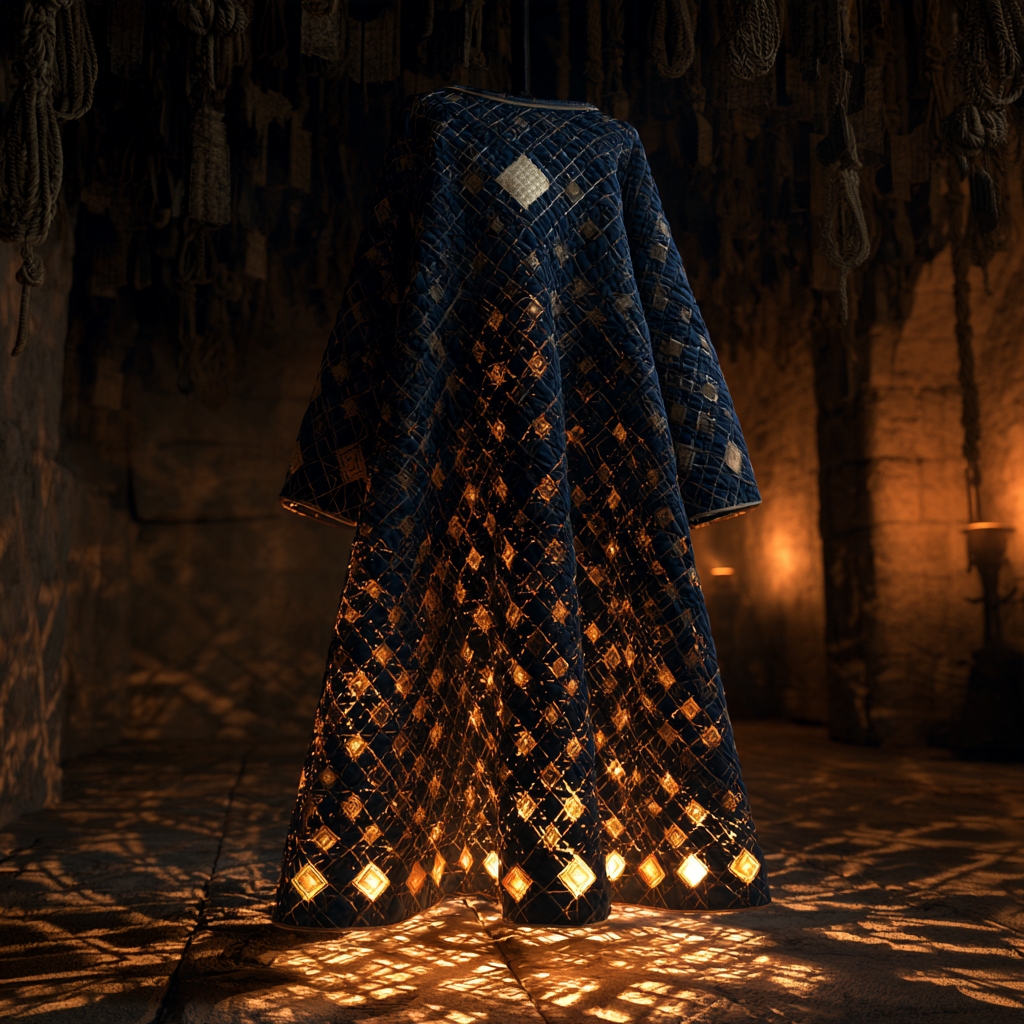
• Appearance: A knee-length, close-fitted tunic of deep indigo highland wool, densely embroidered with rows of small geometric squares in ochre, crimson and verdigris. Thin layers of knotted cord are quilted between the wool layers, forming a flexible lattice that hardens on impact.
• Properties:
• Knotted Lattice: The quilted cords tighten when struck, spreading the force of blows across the garment. This is the source of its Armor Check.
• Reader’s Focus: Grants +1 temporary skill point to Library Research while worn and attuned.
• Cordlight (spell, 3 charges, recharges at dawn): As an action, the wearer makes the embroidered squares glow with soft ochre light, lighting a 20-foot radius for up to one hour. A ritual chant over 6 seconds can tint the light indigo, which makes faded dyes and worn knots easier to read and gives advantage on one reading or research roll during that hour.
Lore:
Junior readers of the Archive-Terraces of Hanan-Pacha receive tunics of this pattern when they are first allowed into the deep cord-vaults. The embroidered squares record the wearer’s rank and family line. Illari’s tunic carries seven small gold squares at the hem, marking her descent in the seventh generation from Mama Ch’aska Khipurana.
The pattern of the Reader’s Tunic dates from the earliest years of the Archive-Terraces of Hanan-Pacha, before the archive had royal patronage or a name of its own. During her eleven seasons in the Rockfall scar, Mama Ch’aska Khipurana and her daughters wrapped their bodies in layered wool to protect themselves from falling stone and the bitter mountain cold. Between the layers they stuffed spare cord left over from their work, partly as padding and partly so they never had to climb out of the scar for supplies. Over time they found that the knotted cord padding tightened under impact and spread the force of a falling rock across the whole garment. The weavers of Hanan-Pacha later refined these makeshift wrappings into the quilted knotted lattice that gives the tunic its protective strength.
The geometric embroidery was added in the generation after Ch’aska. Her eldest daughter, the first Keeper of the Long Cord, wanted a way to tell, at a glance in dim vault light, which reader had the right to handle which records. She borrowed the old highland custom of embroidering status and lineage into tunics in rows of small squares, and adapted it into a visual cipher drawn from Qosqo-Khipu. Each square’s color, position and inner pattern encodes part of the wearer’s rank, the vaults they may enter, their apprenticeship master and their family descent. A senior reader can read another reader’s whole archive standing from across a hall. Wearing a tunic that claims rank or access the wearer does not hold is considered among the gravest offenses in the Archive-Terraces. Those caught doing it lose their cords, their braids and their place in the archive forever.
Junior readers receive their tunics in a ceremony called the Descent of Threads. It is held during the week of Dimming, as VaporSphere begins to eclipse Helios and the archive’s lamps are lit early. The new reader kneels at the threshold of the deep cord-vaults while the Keeper of the Long Cord reads aloud the knots of the reader’s lineage. Then the reader’s own family places the tunic over their shoulders. Tradition requires that the tunic’s dyes come from the reader’s own household when possible, so that the garment carries the work of the family’s hands into the vaults.
Illari’s tunic was dyed by her mother, Wayta Khipurana. Wayta spent most of a season preparing the indigo, steeping and re-steeping the wool in the archive’s geothermal vats until it reached the deep, almost black shade that marks the Khipurana line. The ochre, crimson and verdigris threads came from the same dye-works, and Wayta tied a small hidden knot of her own design into the lattice beneath the left breast, where only she and Illari know to look. The seven gold squares at the hem were embroidered by the Keeper herself. In Qosqo-Khipu they record Illari’s descent through seven generations of the female line from Mama Ch’aska, from Ch’aska to Illari.
The tunic has gained marks of its own since the ceremony. A faint scorch along the right cuff comes from a reading lamp that tipped during the spring flood in the lower vaults, while Illari was carrying water-damaged cords to safety. After her reading on the Night of the Long Cord, an elder reader added a single small pale-gold square above her heart. This rare honor marks a reader whose voice has carried a Turrath record to the living. Illari has worn the tunic every day since leaving Hanan-Pacha. Readers who see the gold square of the Long Cord near her heart often treat her with more respect than her age or rank would otherwise earn, and those who believe the rumors about the lost bundle treat it as an insult to the archive.
Item Values
• Item Name: Seventh Cord Reader’s Tunic 3184
• Specific Slot: Chest (covers chest, abdomen and back to the knee; counts only as a chest slot)
• Tier: 1 (Common)
• Armor Check: +3
• Item Resilience: 10
• Item Health Points: 10 plus the avatar’s maximum health points
• Attunement: Simple (1 minute)
• Weight: 4 pounds
• Suggested Value: 85 silver
Tier One Stats (while openly worn and attuned)
• Intelligence: +1
• Wisdom: +1
• Armor Check: +3
• Saving throws against cold exposure: +1
Skills Gained (temporary skill points, while openly worn and attuned)
• Library Research: +1
• Qosqo-Khipu Knot Reading: +1
• History (Andean and Turrath Records): +1
Passive Magic
• Knotted Lattice: The quilted cords between the wool layers tighten on impact and spread force across the garment. This provides the tunic’s Armor Check and prevents the wearer’s chest and back from being pierced by small falling debris such as gravel, dust or small stones.
• Rank Embroidery: The rows of embroidered squares are linked to the wearer’s Mind’s Eye. When another creature views the wearer with passive Mind’s Eye, it sees the wearer’s archive rank and lineage (Junior Reader, House Khipurana, seventh generation of Mama Ch’aska) in its own primary language. The display cannot be altered by the wearer and will not show false rank.
• Dust-Ward Weave: The tight weave resists dust, cord fibers and fine grit. The wearer’s clothing stays clean in archives, ruins and dusty vaults, and the wearer has advantage on saving throws against dust, smoke and airborne particles that would cause coughing or choking.
• Mother’s Knot: The hidden knot Wayta tied beneath the left breast holds a faint warmth. Once per day, when the wearer would become Frightened, they may choose to become Shaken instead, as the warmth reminds them of home.
• Archive Memory: Text, knots or glyphs the wearer reads while attuned to the tunic are recalled more easily. The wearer has advantage on rolls to recall the exact wording of anything they have read while wearing the tunic within the past seven days.
Activatable Magic
• Cordlight (spell, 3 charges, recharges at dawn): As an action, the embroidered squares glow with soft ochre light in a 20-foot radius for up to one hour. A ritual chant longer than 6 seconds shifts the glow to indigo. For that hour, faded dyes, worn knots and eroded glyphs stand out clearly, and the wearer has advantage on one reading or research roll.
• Lattice Brace (reaction, 1 charge, recharges at dawn): Trigger: the wearer is hit by an attack. The quilted cords lock rigid for an instant, reducing the damage from that hit by the wearer’s tier die (1d4 at tier 1). The tunic’s embroidery flashes crimson as the brace takes effect.
• Thread of Return (spell, 1 charge, recharges at dawn): As an action, the wearer pulls a loose verdigris thread from the hem and speaks a Pacha-Qosqo phrase. The thread unravels into a faintly glowing line, invisible to everyone but the wearer, that marks the path they walk for up to 8 hours or 2 miles, whichever comes first. The wearer can follow it back to the starting point without error, even through darkness, mist or confusing passages. The thread rewinds itself into the hem when the effect ends.
• Vault Hush (spell, 2 charges, recharges at dawn): As an action, the wearer runs a hand over the gold squares at the hem and whispers the names of the seven foremothers. For 10 minutes, sounds the wearer makes, including footsteps, the rustle of cloth and the handling of objects, are muffled. The wearer gains advantage on Stealth checks that rely on sound. Speech and chanting are not muffled, and casting a spell above a whisper ends the effect.
• Gold Square of the Long Cord (spell, 1 charge, recharges each week on the first day of the week): As an action, the wearer lays a hand over the pale-gold square above their heart and speaks a recorded line from a Turrath cord. For 1 minute, the wearer’s voice carries clearly to every listener within 60 feet regardless of background noise. The wearer has advantage on one Diplomacy roll to make listeners hear them out before they decide how to respond.
Tags
Chest Slot, Tier 1, Common, Quilted Cord Armor, Archive-Terraces, House Khipurana, Rank Embroidery, Indigo Wool, Cordlight, Lattice Brace, Seventh Generation, Knotted Lattice, Mama Ch’aska Legacy, Descent of Threads, Hanan-Pacha Weave, Qosqo-Khipu Cipher, Mother’s Knot, Thread of Return, Vault Hush, Dust-Ward Weave, Gold Square of the Long Cord, Renaissance Scholar Garb
Acquiring the Seventh Cord Reader’s Tunic 3184
How This Item Might Be Obtained
• Granted at the Descent of Threads:
• The usual way to get a Reader’s Tunic is to earn the rank of Junior Reader in the Archive-Terraces of Hanan-Pacha. The tunic is presented in the Descent of Threads ceremony during the week of Dimming.
• The archive pays for the embroidery and the quilted lattice. The reader’s family traditionally provides the dyed wool, so there is little or no cost to the reader. The real price is three or more years of Cord-Apprenticeship and the approval of the Keeper of the Long Cord.
• Inherited Through the Female Line:
• When a reader of House Khipurana or another archive family retires or dies, their tunic may pass to a daughter, niece or granddaughter who has earned reading rank. The heir’s family re-embroiders the lineage squares and the Keeper adds or adjusts the rank squares. Re-embroidering a gold square of the Long Cord is forbidden; it must be removed and earned anew.
• An inherited tunic carries the older dyes and lattice knots of its former owner, and many readers believe it carries some of their luck or wisdom.
• Recovered from a Fallen Avatar:
• When a possessed avatar dies, it vaporizes and leaves its crystal and items behind. A Reader’s Tunic may be found among the belongings of a reader who died on an expedition into ruins, the Rockfall scar or the high passes.
• Custom and law in Andean expect anyone who finds one to return it to the Archive-Terraces. Those who do often receive a reward and the archive’s gratitude. Those who keep or sell it risk being named thieves of the dead.
• Quest Reward from the Archive:
• The Archive-Terraces sometimes hire outside adventurers to recover lost cords, escort readers through dangerous terrain or investigate forgeries and thefts. An adventurer who performs exceptional service may be offered an honorary tunic of this pattern, embroidered to show honorary standing rather than reading rank.
• An honorary tunic has the same magic, but its Rank Embroidery displays “Honorary Friend of the Archive” in place of a reader’s rank.
• Commissioned from a Hanan-Pacha Weaver:
• A buyer with the archive’s written permission can commission the tunic from one of the family weaving shops of Hanan-Pacha that hold the archive’s pattern rights. The archive grants such permission rarely, mostly to scholars of other island nations working with the archive or to readers who need a replacement.
• A commissioned tunic takes about one season to complete and is embroidered only with ranks and lineages the archive has confirmed.
• Crafted by a Skilled Avatar:
• An avatar with high enough skill in weaving, embroidery and Rune Inscription, and with the pattern recipe, can make the tunic: indigo-dyed highland wool, ochre, crimson and verdigris dyed thread, quilting cord, a tier 1 magic crystal as catalyst, and fluid from a geothermal spring drawn with a Fluid Collector to fix the dyes.
• A crafter who makes the tunic without the archive’s permission cannot make the Rank Embroidery show any archive standing. The squares display nothing until the archive confirms the wearer.
• Gained Through Possession:
• When a soul successfully possesses an avatar, the soul gains the items that avatar was carrying. A soul that possesses a Junior Reader of the Archive-Terraces gains that reader’s tunic along with the avatar’s body and memories, and inherits the reader’s standing, debts and enemies too.
• Bought Secondhand or Through the Black Market:
• Tunics sometimes leave the archive through debt, desertion or theft and reach secondhand clothiers or black-market dealers. A buyer who acquires one this way receives the full magic of the garment. Its Rank Embroidery displays “No Archive Standing” to any viewer’s Mind’s Eye, which makes the wearer stand out in Andean as someone carrying a reader’s garment they did not earn.
Shops Where This Item Might Be Bought and Sold
The world of Saṃsāra has no large institutional stores. Each of the shops below is a small family business or a single specialized crafter who fills a particular niche. Prices are suggested only: it is a sellers’ market, buyer beware, and costs vary with distance, availability and the reputation of buyer and seller. All prices below assume the suggested value of 85 silver (8 gold and 5 silver), before negotiation.
• The Archive-Terraces Thread Hall (Hanan-Pacha):
• Type of Shop: The archive’s own small wardrobe and repair workshop, staffed by two families of weavers in service to the Keeper of the Long Cord.
• How It Is Bought and Sold:
• Tunics are never sold openly here. They are granted to new readers at the Descent of Threads, replaced for readers whose tunics are destroyed, or issued as honorary garments to approved outsiders.
• The Thread Hall buys back tunics from retiring readers or the families of fallen readers, paying a small gratitude fee rather than market price.
• Repairs to the quilted lattice and embroidery are available to readers in good standing.
• Cost:
• New Junior Readers: no charge, with the family providing the dyed wool.
• Replacement for a reader in good standing: about 40 silver, covering embroidery and lattice materials.
• Honorary tunic for an approved outsider: typically granted as a quest reward. When sold outright, about 120 silver, paid to the archive’s treasury.
• Buy-back price paid to families: about 20 to 30 silver, offered as a gratitude fee.
• Repair of a broken tunic (at or below half its health points): about 8 to 15 silver depending on the damage.
• Family Weavers and Dye-Works of Hanan-Pacha:
• Type of Shop: Small family weaving and embroidery shops in the upper terraces, many attached to the dye-works where the archive’s colors are mixed. Some, like the household of Wayta Khipurana, are within the extended family of the archive lines.
• How It Is Bought and Sold:
• These shops make tunics only on commission and only with the archive’s written permission.
• A buyer gives the weaver the permission scroll, measurements and a deposit. The weaver dyes the wool, quilts the lattice and embroiders the squares as the archive directs. The Thread Hall then confirms the rank squares before the tunic is delivered.
• These shops rarely buy finished tunics, but they will repair or re-dye an existing one for its owner.
• Cost:
• Full commission with archive permission: about 110 to 150 silver, plus the cost of a tier 1 magic crystal if the buyer does not supply one.
• Sales tax inside the city of Hanan-Pacha: 3% of the value, or 6% for foreign citizens.
• Re-dyeing or refreshing faded embroidery: about 10 to 20 silver.
• Secondhand Clothiers and Pawn-Weavers of Peakhold:
• Type of Shop: Small family shops in the central city that buy and resell used garments and gear, including magical clothing pawned by people in need of coin.
• How It Is Bought and Sold:
• A Reader’s Tunic appears here only rarely, usually pawned by a reader in debt or sold by the heir of a reader who left the archive.
• The shopkeeper uses Mind’s Eye to check the Rank Embroidery. Garments showing “No Archive Standing” are treated with suspicion, and the shopkeeper keeps a written log of who brought them in.
• Buyers who are members of the relevant guild or faction may receive the standard member discount.
• The shopkeeper deposits payment for sold items into the seller’s World Bank account.
• Cost:
• Buying: about 85 to 110 silver depending on condition, plus 3% city sales tax, or 6% for foreign citizens.
• Buying as a tier 1 guild or faction member: about a 10% discount, around 77 silver before tax.
• Selling to the shop: the shopkeeper haggles around 10% of the item’s value times the seller’s tier level, offering a tier 1 seller about 75 to 80 silver for a tunic in good condition. Damaged or broken tunics bring much less.
• World Bank fee: 1% of the transaction, paid by the account holder.
• Scholar’s Outfitters in Foreign Port Cities:
• Type of Shop: Small outfitters in the port cities of other island nations that cater to visiting scholars, archivists and treasure-hunting adventurers, selling clothing, lenses, cord satchels and research tools from many lands.
• How It Is Bought and Sold:
• Andean goods reach these shops by merchant ship. Sea travel is cheapest heading west and costs about twice as much heading east, so prices depend on the outfitter’s position relative to Andean.
• A Reader’s Tunic in a foreign shop is almost always secondhand, imported through a trader of uncertain reputation. Its Rank Embroidery shows either “No Archive Standing” or the standing of a reader who is no longer its owner.
• Some outfitters sell them as curiosities to scholars who value the Cordlight and Archive Memory magic and care nothing for Andean’s archive customs.
• Cost:
• Buying: about 150 to 250 silver, reflecting rarity, transport and tariffs across borders.
• Goods crossing a state border on the way: taxed at 5% of the value, or 1% if passing through a central city.
• Selling to the shop: around 60 to 90 silver, with the shopkeeper citing the difficulty of reselling a garment so closely tied to Andean.
• Black-Market Dealers:
• Type of Shop: Unlicensed dealers working from back rooms, cave markets, docks and caravan camps. They trade in stolen and unquestioned goods.
• How It Is Bought and Sold:
• Tunics taken from fallen readers, stolen from the Thread Hall or deserted by disgraced readers often end up here.
• Black-market dealers accept and pay only physical coin, preferably gold, and never use the World Bank.
• They keep no logs and will not say where an item came from. In Andean, though, any garment showing “No Archive Standing” will still draw attention once worn in public.
• Cost:
• Buying: always at full suggested value or more, typically 100 to 170 silver, paid as 10 to 17 gold coins.
• Selling: about what a merchant would offer, around 75 to 85 silver in gold coin. A dealer who has a buyer waiting might pay up to twice that, around 150 to 170 silver.
• Risks: the Archive-Terraces quietly pay informants to report Reader’s Tunics that pass through black markets. Possessing a stolen tunic can bring legal trouble, the hostility of House Khipurana and the attention of guards who frown on characters bearing marks of crime.
Roleplay of the Seventh Cord Reader’s Tunic 3184 in Defense and Offense
The tunic is armor, not a weapon, so its offensive uses are indirect. It lights targets, covers approaches, carries the wearer’s voice and secures retreats so that Illari’s sling, dagger and living khipu, and her allies’ weapons, can strike more effectively. Its defensive uses are direct: the knotted lattice, the bracing reaction, the warmth of the Mother’s Knot and the social protection of the Rank Embroidery.
The Deep Cord-Vaults of the Archive-Terraces
• Setting: Narrow aisles between hanging curtains of knotted cord, low lamplight, stone floors and the constant risk that a single spark or careless blow could destroy irreplaceable records.
• Defense:
• When an intruder bursts from behind a cord-rack with a blade, Illari turns her shoulder into the blow. The Lattice Brace locks her tunic rigid with a crimson flash, and she says through gritted teeth, “Not here. Not near the cords.”
• The Dust-Ward Weave lets her stay calm and breathe steadily when a struggle shakes centuries of dust from the racks, while her attacker coughs and stumbles.
• When guards rush in and see two readers struggling, Illari raises her chin so they can read her Rank Embroidery. The squares show her standing as Junior Reader of House Khipurana, and the guards turn on the intruder, whose own embroidery shows no archive standing at all.
• Offense:
• Illari activates Vault Hush and moves silently down a parallel aisle, slipping between the hanging cords to come up behind an intruder and draw her Knot-Cutter’s Dagger with no sound but the brush of wool.
• She ignites Cordlight in its full ochre glow at the end of an aisle. The light floods the space between racks and silhouettes the intruder for her allies, who strike while the intruder squints into the glare.
• She uses Archive Memory to recall exactly which shelf records were moved during the last inspection, then leads her pursuer into an aisle she knows was emptied for cleaning, where there is nowhere left to hide.
The Rockfall Scar and the Ruins of Turrath
• Setting: Broken terraces, unstable rubble slopes, half-buried buildings, scattered fragments of the great quarry Vorzul, falling gravel and the oppressive silence of the scar.
• Defense:
• As she climbs a loose slope, a shower of gravel and small stones rains down from above. The Knotted Lattice hardens and sheds the debris from her chest and back. She mutters a prayer to Intayra, keeps both hands on the rock and keeps climbing.
• When the ground gives way and she slides into a rubble pit, she uses the Lattice Brace to soften the impact of a falling stone slab, crawls free and calls up to her allies that she is unhurt but shaken.
• When the oppressive silence and the echo of the Turrath dead begin to unnerve her, the warmth of the Mother’s Knot spreads across her chest. She becomes Shaken instead of Frightened, presses her hand over the hidden knot and whispers her mother’s name to steady herself.
• Offense:
• Before descending into a cracked chamber of the old city, she draws a verdigris thread from her hem and activates Thread of Return. When a guardian construct awakens, she retreats along the glowing thread through the collapsed passages, drawing the construct into a narrow choke-point where her allies wait.
• She ignites Cordlight in its indigo shade to read faded warning knots tied into the doorways of Turrath. She learns which passages the old Stonegrowers rigged to collapse, and she lures pursuers into those rigged passages while she and her allies take the safe ones.
The High Passes and Icy Peaks of Northern Andean
• Setting: Thin air, biting wind, ice-glazed rock, narrow ledges, rope bridges over mist-filled gorges and the danger of avalanches and rockslides.
• Defense:
• The tunic’s wool and its stat bonus against cold help Illari endure the freezing wind. She still pulls her Lampwool Mantle tight and complains through chattering teeth that the archive was warmer than this.
• When a mountain bandit charges her on a narrow ledge, she braces the lattice to absorb the blow without being thrown from the edge, and keeps her feet planted so she is not driven back.
• In a sudden snow-squall, she activates Thread of Return before the visibility fails, so she can find her way back to camp no matter how thick the snow becomes.
• Offense:
• At night she climbs to a high outcrop and activates Cordlight, holding her arms out so the glowing embroidered squares shine like a beacon. Bandits waiting in ambush below turn toward the light, exposing themselves to her allies hidden along the ridge.
• She uses Vault Hush to cross a rope bridge without a sound, so a sentry on the far side does not notice her until she has her sling spinning.
• She uses the Gold Square of the Long Cord to carry her voice across the wind to bandits on a facing ledge, calling out that the Archive-Terraces know their faces and that anyone who walks away now will not be named in the records.
Cave Systems, Mines and Underground Megacities
• Setting: Darkness broken by geothermal glow and crystal lamps, echoing tunnels, mining dust, steam-vent hazards and the parallel civilizations of beasts and monsters.
• Defense:
• In a tunnel filled with mining dust and steam, the Dust-Ward Weave lets Illari keep breathing and fighting while foes choke on the haze.
• When a cave-in begins, she shields her head with her arms and lets the Knotted Lattice take the small falling rocks across her back. She uses the Lattice Brace when a larger stone strikes her.
• When negotiating with a monster clan that controls a mining tunnel, she shows the Rank Embroidery to prove she is a scholar of the Archive-Terraces and not a guild prospector come to claim their stone. This defuses the tension before blades are drawn.
• Offense:
• She dims Cordlight to its softest ochre glow and lowers it behind her, so pursuers see only a faint shape moving in the dark. Then she flares it to full brightness when they turn a corner, catching them in the light for her allies’ attacks.
• She uses Vault Hush to move silently through echoing tunnels toward a monster lair, so her allies can set an ambush before the creatures realize anyone is near.
• With Archive Memory she recalls a cave map she read days earlier, guiding her party through side passages to strike a guarded chamber from an unexpected direction.
City Streets, Markets and the Courts of Peakhold
• Setting: Crowded terraced streets, steam-lifts, markets full of costumed avatars, guild halls, political intrigue and guards who watch for trouble.
• Defense:
• When a guild enforcer tries to provoke her into a fight in a public market, she calmly lets the crowd see her Rank Embroidery. Most bystanders recognize the gold square of the Long Cord near her heart and murmur that she is the reader who carried the Turrath child’s prayer. Many of them turn hostile toward the enforcer.
• In a back-alley ambush, she braces the lattice against a cudgel blow, staggers but keeps her footing, and uses the Mother’s Knot to steady herself against the fear of being cornered.
• When questioned by city guards about the lost bundle, she uses Archive Memory to repeat word for word the testimony she gave to the Keeper. Her consistency defends her credibility against accusations.
• Offense:
• In a crowded guild hall, she uses the Gold Square of the Long Cord to carry her voice over the noise, reciting a line from a recovered Turrath cord that names an elder’s betrayal. Every listener turns to face her, and the guild master she is confronting loses the room before he can answer.
• At dusk she uses Vault Hush to tail a suspect through busy streets, keeping her footsteps silent and her movements unnoticed until she can corner him in a quiet courtyard with her allies.
• When a suspect flees into the twisting terraced alleys, she uses Thread of Return at the start of the chase. If the pursuit goes wrong, she can lead her allies straight back to a safe house rather than becoming lost in an unfamiliar quarter.
Steamships, Docks and the Open Sea
• Setting: Rolling decks, rigging, cargo holds, hissing steam engines, storms and pirates or rival agents.
• Defense:
• During a storm, crates break loose and slam across the deck. Illari braces the lattice against a crushing blow, clings to the rigging and shouts for the crew to secure the hold.
• When steam bursts from a ruptured pipe below decks, the Dust-Ward Weave helps her breathe through the scalding haze long enough to reach the ladder.
• When pirates board, she shows her Rank Embroidery and identifies herself as an archive scholar, not a merchant with cargo. This sometimes persuades raiders that she is worth more to them alive and unharmed than as loot.
• Offense:
• At night she activates Cordlight on the stern, lighting the water around the ship so the crew can see approaching raiders’ boats and strike them with harpoons and slings before they can board.
• She uses Vault Hush to creep through a cargo hold where pirates are counting stolen goods, getting close enough to cut a captive loose or catch the pirate captain by surprise.
• With the Gold Square of the Long Cord she calls across the water to a pursuing ship, demanding in the name of the Archive-Terraces and the Andean crown that they break off pursuit or be entered into the records as raiders of the realm.
Jungle Ruins at the Lower Elevations
• Setting: Overgrown ruins of forgotten civilizations, humid heat, thick vines, ancient guardian constructs and toxic magical flora.
• Defense:
• The quilted lattice catches thorns, lashing vines and the strikes of small jungle beasts, sparing her skin from cuts that could carry plant toxins. The heat is oppressive in the thick wool, though, and she sweats and grumbles that the tunic was made for cold vaults, not jungles.
• When she loses her bearings in the dense undergrowth, Thread of Return guides her back to the trail before the jungle swallows the path.
• When an ancient construct reaches for her, she twists aside and the Lattice Brace absorbs most of the force of its grasping stone hand, leaving her bruised but able to break free.
• Offense:
• She uses the indigo Cordlight to read eroded glyphs on a ruined doorway, discovering the command word that halts the ruin’s guardian construct for a single breath. That is long enough for her allies to strike its exposed core.
• She moves silently under Vault Hush through the ruins’ upper galleries, then flares the ochre Cordlight above a band of rival treasure-hunters below. They are briefly disoriented as her allies surround them.
Perception of Activation:
User’s Perspective
• Sight:
• When an effect activates, the user sees the embroidered squares across their own chest and arms light up one row at a time. The colors are ochre for Cordlight, deepening to indigo with a chant, crimson for the Lattice Brace, verdigris for the Thread of Return, muted gold at the hem for Vault Hush, and bright gold over the heart for the Long Cord.
• The user’s own bioluminescent veins shift color to match the activated effect, so they see their hands and forearms glowing in the same shade as the tunic.
• With the indigo Cordlight, faded dyes, worn knots and eroded glyphs within 20 feet seem to rise out of their surfaces with a faint inner shimmer. Altered or re-tied knots look duller, like shadows beside the original work.
• With the Thread of Return active, only the user can see the glowing pale-green line trailing behind them, weaving exactly along the path they have walked.
• Hearing:
• As Cordlight activates, the user hears a faint, rising hum, like a cord pulled taut and plucked, coming from inside the tunic.
• When the Lattice Brace triggers, they hear a sharp creak like rope snapping tight, followed by a softer groan as the knots relax.
• Under Vault Hush, the world becomes strangely muffled around them. The user can still hear others clearly, but their own footsteps, breathing and the rustle of their clothing fall almost silent, which feels eerie, like walking underwater.
• With the Long Cord active, the user hears their own voice echo slightly, as if spoken under a high stone vault.
• Touch:
• Activation sends a warm tingle through the wool against the user’s skin, starting where their hand touches the embroidery and spreading across the garment.
• The Lattice Brace makes the tunic suddenly rigid against their body, like being clasped by a tight frame of cords. It is briefly constricting, then the garment eases loose again.
• The Mother’s Knot spreads a small, gentle warmth beneath the left breast, like the pressure of a hand laid over the heart.
• Pulling the Thread of Return from the hem gives a faint, steady tug at the cloth while the thread unwinds, like a kite string drawing gently in the wind.
• Smell:
• When Cordlight activates, the user smells warm wool and a faint mineral scent of geothermal spring water, the steam used to fix the archive dyes.
• Under the indigo Cordlight, a sharper scent of old dye and dry cord fiber rises from any records in the light, like opening an ancient storage chest.
• Taste:
• When the Lattice Brace triggers, the user may taste a brief tang of metal and stone dust, like biting down hard in surprise.
• When chanting the ritual for the indigo Cordlight or the names for Vault Hush, the user tastes a faint dryness on the tongue, like the air of the deep vaults.
• Mind’s Eye:
• As each effect activates, the user’s Mind’s Eye briefly shows the name of the effect, its remaining charges and its duration in their own language, as words floating at the edge of their vision.
• Under the indigo Cordlight, the Mind’s Eye flags faded or altered records in view with a faint outline, the same sense of “wrongness” that the indigo light shows.
• Vibration Sense (Qosqo-Pacha Ears):
• When the Lattice Brace triggers, the user feels the shock of impact as a deep vibration through the lattice, rippling outward and fading in a pulse they can feel in their elongated ears.
• Under Vault Hush, the user’s ears still catch the vibrations of other people’s footsteps through the floor, even while their own steps fall silent.
Observer’s Perspective
• Normal Sight:
• Observers see the tunic’s embroidered squares glow in sequence, ochre, indigo, crimson, verdigris or gold depending on the effect, with matching light in the wearer’s bioluminescent veins.
• In the ochre Cordlight, observers see patterned outlines cast on nearby walls and floors, as if the wearer stood inside a lantern woven from knots.
• The Lattice Brace shows as a single crimson flash racing outward from the point of impact, with the hard lattice of knots briefly pressing against the cloth like ribs under skin.
• The Thread of Return is invisible to observers. They see only a faint shimmer at the hem as the thread unwinds and rewinds.
• Under Vault Hush, observers see the gold squares at the hem holding a muted glow while the rest of the embroidery dims.
• When the Long Cord activates, observers see the gold square over the heart blaze between the wearer’s fingers, and a golden glow spreading across the chest and throat.
• Darkvision:
• Observers with Darkvision see the glowing tunic as a bright patch of pale gray against darker gray surroundings. The infrared warmth of the Mother’s Knot and the heated lattice under the Lattice Brace show as small, brighter spots.
• True Sight:
• Observers with True Sight see the whole tunic radiating ultraviolet light from the magic woven into the embroidery and lattice. Each effect has a distinct hue: Cordlight in amber, the indigo variant in deep violet, the Lattice Brace in sharp crimson-white, Vault Hush in softened gold, and the Long Cord in brilliant gold.
• To True Sight, the Thread of Return is visible as a thin, faint ultraviolet line trailing behind the wearer, much dimmer than the tunic’s glow but clearly traceable.
• True Sight also shows the hidden Mother’s Knot as a small, steady point of light beneath the left breast, glowing whenever its warmth is active.
• Blind Sight:
• Observers using echolocation-based Blind Sight perceive the Lattice Brace as a sudden change in the tunic’s echo, the soft returns of wool becoming hard, ridged returns like rope or wicker for an instant.
• Under Vault Hush, the wearer’s own sounds are muffled, so Blind Sight users receive fewer echoes from the wearer’s movement. The wearer appears as a dim, quiet shape rather than a sharp one, harder to track as they move.
• Tremorsense:
• Creatures with Tremorsense feel the wearer’s footsteps through the ground normally under most effects. Vault Hush softens them, so the wearer feels lighter and harder to pinpoint, like a small animal moving carefully.
• The Lattice Brace sends a short, sharp pulse through the ground when it absorbs a heavy blow, felt by nearby Tremorsense creatures as a brief jolt.
• Soul Sight:
• Observers with Soul Sight see the wearer’s soul flare in color when the tunic activates, as if the garment were drawing on the wearer’s own essence. The hidden Mother’s Knot appears to soul-sight as a faint second presence, a warm trace of another soul’s care woven into the cloth.
• Under the Long Cord, observers see a ghostly echo of voices overlapping with the wearer’s as they speak a line from a Turrath cord, faint shades of the dead whose words are being carried.
• Radar:
• Constructs using radar detect the Lattice Brace as a momentary increase in the tunic’s density and reflective strength. The wearer’s chest and back briefly return a sharper signal before softening again.
• Hyper Focus:
• An observer using Hyper Focus toward the wearer during activation sees every glowing square and knot in exact detail. They can read the Qosqo-Khipu cipher of the embroidery from a distance, but afterward they suffer the dull headache and reduced perception in other directions for a minute.
• God-Enhanced Sight:
• Divine sight shows the full weave of magic in the tunic: the lattice, the rank cipher, the hidden knot and each effect’s flow, with perfect clarity. A deity watching through divine sight might also perceive Intayra’s faint blessing in the geothermal water that fixed the dyes.
• Mind’s Eye:
• Any observer using passive Mind’s Eye during activation sees the Rank Embroidery words “Junior Reader, Archive-Terraces of Hanan-Pacha, House Khipurana, Seventh Generation of Mama Ch’aska” rise from the squares, and the name of the active effect appears beside the wearer.
• Hearing:
• Observers hear the faint, taut-cord hum of Cordlight, the creak and groan of the Lattice Brace and the resonant, echoing voice of the Long Cord.
• Under Vault Hush, observers find the wearer unnervingly silent. They see the wearer move without hearing them, which can be disorienting at close range.
• Smell:
• Observers near the wearer catch the scent of warm wool and spring-water minerals when Cordlight activates, and a whiff of old dye and dry cord near records under the indigo light.
Positives
• The user receives clear sensory confirmation of each effect through color, sound and touch, which makes timing and duration easy to judge in tense situations.
• The user’s private Mind’s Eye display of each effect’s charges and duration helps them manage the tunic’s limited uses.
• The indigo Cordlight gives the user a distinct visual and olfactory sense of old and altered records, sharpening their research and forgery detection.
• Only the user can see the Thread of Return in normal sight, keeping their escape route hidden from most pursuers.
• Vault Hush leaves the user’s own hearing and vibration sense unaffected while muffling their sounds, so they keep their awareness while becoming harder to detect.
• To observers, the Rank Embroidery and the golden glow of the Long Cord reinforce the wearer’s authority and identity, which can calm guards, impress allies and intimidate opponents who respect the archive.
• The sudden crimson flash of the Lattice Brace can startle attackers, showing them their blow was absorbed rather than landing cleanly.
• The ochre Cordlight’s patterned glow can draw allies’ attention to the wearer’s position in darkness or chaos.
Negatives
• Most activations announce themselves with bright, colorful light that observers can easily see. This makes it hard for the wearer to use Cordlight, the Lattice Brace or the Long Cord without revealing where they are.
• Observers with True Sight can see the faint ultraviolet trail of the Thread of Return, so the wearer’s path is not hidden from them.
• Vault Hush muffles only sound. Its muted gold glow at the hem can still be spotted in dim light by sharp-eyed observers, and creatures with Darkvision or True Sight may still track the wearer.
• The Lattice Brace briefly constricts the wearer’s body and leaves a metallic taste and a jolt of vibration that can be unsettling or distracting in the middle of a fight.
• The Mother’s Knot reveals itself to True Sight and Soul Sight, exposing a deeply personal family secret to anyone who can perceive it.
• Soul Sight users perceive the echoes of the Turrath dead in the Long Cord’s voice, which may lead religious observers, especially Stonegrowers from Turrath-descended families, to see its use as disrespectful or dangerous.
• The Rank Embroidery’s floating words are visible to any observer’s Mind’s Eye, so the wearer’s identity, lineage and standing are exposed to enemies as easily as to allies.
• The muffling of Vault Hush can feel disorienting to the wearer if used for long periods, like being cut off from part of their own presence in the world.
Crafting Recipe: Seventh Cord Reader’s Tunic (Archive-Warden Pattern)
Materials Needed
• Highland Wool: 6 pounds of undyed highland wool, carded and cleaned, from llama-like terrace beasts of northern Andean.
• Indigo Dye: Enough concentrated indigo dye to steep the wool to the deep, almost black shade of an archive family line. Traditionally prepared in the archive’s geothermal dye-vats.
• Embroidery Thread: Small skeins of ochre, crimson, verdigris and pale-gold dyed thread, about 200 yards of each color.
• Quilting Cord: 300 yards of fine, tightly twisted cord for the knotted lattice, spun from highland wool and plant fiber, left undyed or lightly dyed in the wearer’s family colors.
• Geothermal Spring Water: 2 pints drawn with a Fluid Collector from a geothermal spring near a Peakshrine or the Archive-Terraces. Used to fix the dyes and bind the lattice’s magic.
• Tier 1 Magic Crystal: One crystal about the size and weight of a coin, used as the catalyst that binds the tunic’s magic. Higher-quality crystals that have grown longer yield a more stable enchantment.
• Lantern or Candle (sacrificial ingredient): One small magical reading lantern or ever-burning candle, consumed during crafting to pass its light into the embroidery for the Cordlight effect.
• Muted Bell or Silenced Chime (sacrificial ingredient): One small enchanted bell or chime that cannot ring, consumed to pass its silence into the gold squares for the Vault Hush effect.
• Guide’s Cord (sacrificial ingredient): One short, enchanted pathfinder’s or guide’s cord, consumed to pass its sense of direction into a verdigris thread for the Thread of Return effect.
• Knotted Leather Strap (sacrificial ingredient): One sturdy enchanted leather strap or buckle that once held armor plates together, consumed to strengthen the lattice for the Lattice Brace effect.
• Archive Dust: A small pinch of fine dust swept from the floors of a cord-vault, blessed by an archive elder. Used in the Dust-Ward weave.
• Family Knot: A single knot tied by a close family member of the intended wearer, usually the mother or another relative in the female line, using thread they have dyed themselves. Needed for the Mother’s Knot effect.
• Archive Permission Scroll: A written scroll from the Keeper of the Long Cord or another authorized archive elder confirming the intended wearer’s rank and lineage. Needed for the Rank Embroidery to show archive standing.
• Optional, Gold Square of the Long Cord: A pale-gold square of embroidery thread that can be added only by an archive elder, and only for a reader who has carried a Turrath record aloud on a Night of the Long Cord. It cannot be bought or crafted independently.
Tools Required
• Dye Vat: A heated dye vat, ideally geothermal, for steeping the wool in indigo and fixing it with spring water.
• Spinning Wheel and Drop Spindle: For spinning the wool into yarn and the quilting cord into fine, tight strands.
• Highland Loom: A backstrap or upright loom for weaving the dyed yarn into close, dense wool cloth.
• Knot-Pick Roll: Fine bone and bronze knot-picks for tying and adjusting the small knots of the quilted lattice.
• Embroidery Needles and Frame: Fine needles and a wooden frame for stitching the geometric squares in their exact cipher pattern.
• Obsidian Etching Stylus: For inscribing tiny Khipu-Glyphs on the inside of the hem and collar, where they anchor the magic.
• Fluid Collector: For drawing geothermal spring water at the source.
• Brass Reading Lenses or Similar Magnifier: For checking the precision of knots and embroidery and confirming the cipher is correct.
• Ritual Space: A quiet chamber with a stone floor and access to a mountain ley line, preferably within the Archive-Terraces, a Peakshrine or a family weaving house in Hanan-Pacha.
Skill Requirements
• Weaving and Textile Crafting: Skill level 5 or higher.
• Embroidery: Skill level 4 or higher.
• Qosqo-Khipu Knot Reading: Skill level 5 or higher, to tie the lattice knots correctly and stitch the rank cipher.
• Rune Inscription: Skill level 3 or higher, for the Khipu-Glyphs inside the hem and collar.
• Alchemical Dyeing: Skill level 3 or higher, to prepare the indigo and fix it with geothermal spring water.
• Magical Crafting (Enchantment): Skill level 4 or higher, to bind the crystal’s power and the sacrificial ingredients’ magic into the finished tunic.
• Pacha-Qosqo Language: Skill level 3 or higher, to perform the binding chants in the proper tones.
• Crafter’s Tier: The crafter must be tier 1 or higher. A higher-tier crafter can make the tunic, but the finished item remains tier 1.
Crafting Steps
• Step 1: Gather and Prepare the Wool
• Card, clean and sort the 6 pounds of highland wool, removing coarse fibers and debris.
• Set aside about 1 pound of the finest wool for the quilting cord and lattice.
• Approximate time: 3 days.
• Step 2: Draw the Spring Water
• Travel to a geothermal spring near a Peakshrine or the Archive-Terraces and use the Fluid Collector to draw 2 pints of spring water.
• Store the water in a sealed clay jar. Some crafters keep it in Extradimensional Storage so it stays at its drawn temperature.
• Approximate time: 1 day, depending on travel.
• Step 3: Dye the Wool Indigo
• Prepare the indigo dye in the heated dye vat. Steep the wool, then lift it into the air to darken, repeating until it reaches the deep, near-black shade of the archive lineage.
• Fix the color by rinsing the wool in a bath of warm water mixed with half of the geothermal spring water.
• Make a Skill Check for Alchemical Dyeing. On failure, the indigo is uneven and must be stripped and re-dyed, adding 3 days.
• Approximate time: 7 to 10 days.
• Step 4: Spin the Yarn and Quilting Cord
• Spin the dyed wool into fine, even yarn for weaving.
• Spin the reserved fine wool and plant fiber into tight, strong quilting cord for the knotted lattice.
• Approximate time: 5 days.
• Step 5: Weave the Tunic Cloth
• On the highland loom, weave the dyed yarn into two panels of dense, close-woven wool cloth, one for the outer layer and one for the inner lining.
• While weaving, sprinkle the blessed archive dust lightly across the threads and chant a short Pacha-Qosqo phrase of protection to start the Dust-Ward weave.
• Make a Skill Check for Weaving and Textile Crafting. On failure, the cloth has gaps or irregular tension and must be partly rewoven, adding 4 days.
• Approximate time: 10 days.
• Step 6: Tie the Knotted Lattice
• Using the knot-pick roll, tie the quilting cord into a continuous lattice of small, interlocking knots that will sit between the two layers of wool. The pattern follows a protective Qosqo-Khipu formula of knots that tighten together under pressure.
• Lay the consumed knotted leather strap across the finished lattice and chant the binding phrase. The strap dissolves into the cords, passing its strength into the lattice.
• Make a Skill Check for Qosqo-Khipu Knot Reading. On failure, some knots are misplaced and the lattice does not harden evenly, and the crafter must untie and retie that section, adding 3 days.
• Approximate time: 7 days.
• Step 7: Quilt the Lattice Between the Layers
• Lay the inner lining flat, place the knotted lattice over it, then lay the outer indigo layer on top.
• Stitch the layers together along the lattice lines so the knots are held firmly in place yet can still tighten on impact.
• Approximate time: 4 days.
• Step 8: Embroider the Rank and Lineage Squares
• Mount the quilted tunic in the embroidery frame. Following the Archive Permission Scroll, embroider rows of small geometric squares in ochre, crimson and verdigris that encode the wearer’s rank, vault access, apprenticeship master and lineage.
• Embroider the seven gold squares at the hem, each marking a generation of the wearer’s female line back to its founding foremother, or the number of generations appropriate to the wearer.
• If an archive elder is present and the wearer has earned it, the elder alone stitches the pale-gold square of the Long Cord above the heart.
• Make a Skill Check for Embroidery. On failure, the cipher contains errors, the Rank Embroidery displays only “No Archive Standing,” and the faulty squares must be unpicked and restitched, adding 4 days.
• Approximate time: 10 days.
• Step 9: Weave in the Family Knot
• Have a close family member of the wearer tie a single knot of their own design, using thread they dyed themselves, into the lattice beneath the left breast.
• The crafter stitches over the knot so it is hidden but held securely. This becomes the Mother’s Knot.
• Approximate time: 1 day.
• Step 10: Inscribe the Anchoring Glyphs
• Using the obsidian etching stylus, inscribe tiny Khipu-Glyphs along the inside of the hem and collar, naming each effect the tunic will hold: Cordlight, Lattice Brace, Thread of Return, Vault Hush, and the Long Cord if present.
• Make a Skill Check for Rune Inscription. On failure, the glyphs must be carefully ground away and re-inscribed, adding 2 days.
• Approximate time: 2 days.
• Step 11: Bind the Sacrificial Ingredients
• In the ritual space, lay the tunic flat on the stone floor over a mountain ley line.
• Place the magical lantern or candle on the embroidered squares and chant the Pacha-Qosqo phrase for light. The lantern dissolves into ochre light that sinks into the embroidery, creating Cordlight.
• Place the muted bell over the gold squares at the hem and whisper the names of the wearer’s foremothers. The bell fades into silence that settles into the gold thread, creating Vault Hush.
• Draw the guide’s cord through the hem and chant a phrase of returning. The cord dissolves into a single verdigris thread at the hem, creating Thread of Return.
• Approximate time: 1 day.
• Step 12: Infuse the Magic Crystal Catalyst
• Place the tier 1 magic crystal at the center of the tunic’s chest, over the lattice.
• Sprinkle the remaining geothermal spring water across the tunic in a spiral, from the hem upward to the collar, while chanting the binding chant in Pacha-Qosqo for at least one full minute.
• The crystal’s power flows into the lattice, embroidery and glyphs. Its glow spreads across the tunic as each row of squares lights in turn, then fades.
• Make a Skill Check for Magical Crafting (Enchantment).
• On success, the crystal is consumed and the tunic’s magic is fully bound.
• On failure, the enchantment does not hold. The crystal and sacrificial ingredients are consumed without effect, and the crafter must provide a new crystal and new sacrificial ingredients to repeat Steps 11 and 12.
• A roll of 1 on the d20 portion of the check means the binding backlashes and the tunic loses 10 health points of damage, which must be repaired before the binding can be attempted again.
• A roll of 20 on the d20 portion of the check means the binding exceeds expectations. With the Guide Manager’s (GM’s) approval, the tunic may gain a minor extra trait fitting its theme.
• Approximate time: 1 day.
• Step 13: Confirm the Rank Embroidery
• Present the finished tunic to the Archive-Terraces’ Thread Hall or an authorized archive elder, who checks the Rank Embroidery with their Mind’s Eye against the Archive Permission Scroll.
• Once confirmed, the elder touches each row of squares and speaks the wearer’s name. This locks the cipher so the Rank Embroidery shows the wearer’s true archive standing and cannot be falsified.
• Without this step, the tunic works fully, but the Rank Embroidery shows only “No Archive Standing.”
• Approximate time: 1 day, depending on the archive’s schedule.
• Step 14: Final Attunement by the Wearer
• The intended wearer puts on the tunic, smooths it across their chest and traces the embroidered squares for one full minute to complete simple attunement.
• The squares ripple with ochre, crimson and verdigris light from collar to hem, and the tunic becomes the Seventh Cord Reader’s Tunic of its new owner.
• Approximate time: 1 minute.
Total Approximate Crafting Time: 50 to 60 days of focused work, not counting delays from failed skill checks or waiting for the archive to confirm the rank cipher.
First Wrapping of Cords
Which Is Told Also as Garment of Daughter Who Read in Dark Place
This is the telling, as the old knots give it, of the first garment of the readers. Those who carried it say it came from a speech older than the speech of the knots. Those who tied it say they did not understand all of it, only that it must be tied. So it is tied here. Where the cord was broken, the telling is broken also. Where two meanings sit in one knot, both are given, and the hearer must choose.
In the days after the days of the falling (the old word is “the-stone-that-judges,” but it may be “the-stone-that-is-tired”), the place of Turrath was a wound in the mountain, and nobody went down into it. The Stonegrowers said: whoever goes down into the wound, the mountain will remember them, and the remembering of the mountain is heavy. So the people did not go down. They walked around the wound the long way, three days around, and they did not look inside. If a child looked inside, the mother covered the eyes of the child with her hand, and the child’s eyes were covered.
But there was a woman of the knots. Her name was Ch’aska, which means the star that is first in the morning, or perhaps the star that is first to be lost, for the knot is the same knot. She was a keeper of small cords, cords of grain, cords of how many llama-beasts, cords of who owes who the copper. Not a great keeper. A small keeper. Her hands were long and her eyes were gold, and her hair was bronze like a bell that is not yet rung.
Ch’aska had a dream. In the dream she stood at the edge of the wound of Turrath, and from below came a sound, and the sound was not crying and was not singing but was the sound of cords rubbing on cords, as when the wind moves through a hanging archive. In the dream a voice said, “We are tied and nobody reads us.” Or the voice said, “We are tied and nobody hears us.” The knot here is worn and both are true.
She woke and said to her daughters: “I will go down.”
Her daughters were four, or her daughters were five. Some cords say four and some cords say five and one cord says seven, but that cord is thought to be tied later by someone who was proud. The eldest daughter was named Sisa, which means flower, and Sisa said, “Mother, the mountain will remember you.” And Ch’aska said, “Then let the mountain remember. I will remember the mountain also, and we will see who remembers better.”
So they went down, the mother and the daughters, into the wound.
The going-down was hard. The stones of the wound were not still. They moved like sleeping animals. Little stones fell all the day and the night, small like teeth, and sometimes bigger stones fell, big like the heads of children, and these big stones killed (the knot says “killed,” but there is a softer knot beside it that says “made quiet”) one of the helpers, a man who carried water, on the third day.
The daughters were afraid. Ch’aska was afraid also, but she said, “We have wool.”
For they had brought wool, much wool, the wool of the highland beasts, to wrap themselves against the cold, because the wound of Turrath was cold at night like the inside of a stone. And they had brought cords, many cords, spare cords for tying the records they hoped to find. Sisa took the wool and the cords and she did a strange thing. She wrapped her mother in wool, one layer, and between that layer and another layer she stuffed the spare cords, all knotted, all tangled, like a bird’s nest is tangled. And she said, “Mother, if the stone falls on you, let it fall first on the cords.”
Ch’aska laughed, for it looked foolish, like a woman wearing a basket. But on the next day a stone fell. It was as big as two fists together, and it fell on Ch’aska’s back as she bent over a buried cord. The cords inside the wool pulled tight together, all at once, like many hands catching, and the stone bounced away, and Ch’aska was bruised but not broken. She stood up and she looked at her eldest daughter. In the old knot here there is a word that means “she looked,” and also “she understood,” and also “she was ashamed for laughing.” All three are tied together.
After that all of them wore the wrappings of cords. They tied the cords better every day, learning which knots caught and which knots slipped. At night by the small lamp they practiced new knots, and the knots grew small and close and many, until the wrapping was not a basket anymore. It was a cloth that was soft when you were still and hard when you were struck. They called it “the wrapping that holds.” Later it was called the lattice. Later still it was called by the readers a name that cannot be said aloud here, because that name is for the vaults.
Now in the wound there was no light. The sky over the wound was narrow, like looking up from inside a well. The lamp of the daughters was small, a lamp of the old kind that burned oil from the fat of animals, and the oil was little. Ch’aska worried, for the buried cords had colors, and the colors were faded, and without light the colors could not be read. A cord without its colors is a cord that lies.
So Ch’aska took the lamp and she spoke to it. The knot says she “spoke to it,” but the knot also could say “she argued with it.” She told the lamp that it would die soon, when the oil was gone, and she asked it where its light would go. The lamp did not answer, for a lamp does not answer. But Ch’aska took the lamp and pressed it against the wrapping of her eldest daughter, against the place where Sisa had begun to stitch small squares of colored thread to mark the days they had spent in the wound. She said the words of light that her own grandmother had taught her, and the lamp went out. The squares on Sisa’s wrapping began to glow, soft, like the color of grain at the end of the day.
From that night the wrapping gave light when it was asked, and the light was the color of ochre, the color of the earth that is warm. And when Ch’aska sang longer, a long chant in the old tones, the light went deep, deep, into the color of the night just after the sun is gone, and in that deep light the faded colors of the buried cords rose up and showed themselves. Ch’aska could read them. She wept, because the first cord she read in the deep light was a list of children’s names, and beside each name a knot that meant “sent away to safety before the falling,” and the list was long.
But not every cord was like that. There were other cords. There were cords of the elders, the ones who built the great quarry. Their cords spoke of stone and iron and the drawing of power from the deep veins, and they spoke of names. Many names. Names of houses that still were living. And Ch’aska read these, and she was quiet for a long time.
In the wound there was also the sound. Not the sound of the dream, but a different sound, a sound of the dead (or of the stones; the knot is the same). When the daughters walked, their feet scraped the stones, and the stones answered, and the answer went down and down into the deep of the wound, and from the deep things came up. What things, the knot does not say. It says only “things that listen.” Perhaps they were beasts. Perhaps they were the guardians of the quarry, waking. Perhaps they were only fear. But when the daughters made sound, the things came closer. And when the things came closer, the daughters could not work.
So Ch’aska took a bell. The bell was from the ruined Peakshrine of Turrath. They had found it in the rubble, cracked, a bell that could not ring anymore. Ch’aska held it and said, “You are silent now. Teach us to be silent.” And she pressed the bell against the hem of her own wrapping, against the place where her daughters had stitched a row of gold squares, one for each of them. As she pressed it she said the names of her mothers: her mother, and her mother’s mother, back as far as she knew. The bell faded like water into sand. After that, when she touched the gold squares at her hem and whispered the names, her steps made no sound, and her breath made no sound, and the things that listened did not come.
One cord here says that from this came the custom of the gold squares, one square for each mother of the line, and that the readers whisper the mothers’ names when they walk in the vaults. But another cord, tied later, says the gold squares came first and the bell only blessed them. The tellers argue about this even now.
The wound of Turrath was not a straight place. It was a place of turnings. Rubble fell in the night and closed the paths of the day. More than once a daughter went to fetch water or to look in a far corner and did not come back by dark, and the mother went searching with the small lamp and called in a whisper, because she could not call loud.
It was the youngest daughter, whose name the knot does not keep (the knot here is cut, perhaps on purpose, perhaps by the teeth of an animal), who was lost the longest. She was gone two days. Ch’aska did not sleep. On the third day the youngest came back, thin and dusty, and in her hand she held the end of a green thread. The thread stretched behind her into the dark, glowing a little, a pale green like the green on old copper.
“Where did you get this thread?” the mother said.
“An old man gave it to me,” the daughter said. “He was sitting on a stone. He said he was a guide of the high passes before the falling, and that he lost his way also once, and he did not want me to lose my way. He gave me his cord, and he said, ‘Tie this to your hem, and it will remember the way you walked.’ So I tied it to my hem, and I walked back along the way the thread remembered.”
“Where is the old man?” said the mother.
“He was not there when I looked back,” said the daughter.
The tellers say the old man was a soul of Turrath, waiting under the stone for someone to read his name, and that by giving the thread he was set free. Or the tellers say he was Intayra, the Sentinel, wearing the shape of an old guide. Or the tellers say the youngest daughter was lying and found the cord in the rubble, and it was only an enchanted guide’s cord of the old kind. The knot here has three branches, and each branch says something different, and it is not known which branch is the trunk.
But the green thread was sewn into the hem of all the wrappings after that, and from then on the readers who walked in dark places could pull the thread, and it would remember their path.
They stayed in the wound eleven seasons. Some cords say twelve, but most say eleven. In those seasons Ch’aska became old. Her hair, once bronze like an unrung bell, became bronze like a bell that has rung too many times, dull and scratched. Her back bent from bending over the cords. But she read. She read everything. She read the children’s names and the names of the elders and the names of the stones, and she tied her readings into new cords and carried them up out of the wound.
On the last night in the wound, Ch’aska was very tired. She sat by the small light of her daughter’s wrapping, and she was afraid, the knot says, though she had never said so before. Afraid that the mountain remembered her too much. Afraid that the names she had read would bring the anger of living houses upon her daughters. Afraid that she had done wrong to go down.
Sisa, the eldest, saw her mother’s fear. She took a thread, a thread she had dyed herself in the dye of the vats of their home before they ever came down, and she tied it into a knot of her own making, a knot that did not exist in any of the old lists of knots. She tied this knot into the wrapping of her mother, under the left breast, over the heart, and she stitched over it so it could not be seen.
“What is this knot?” said Ch’aska.
“It is my knot,” said Sisa. “It means what I want it to mean. It means I am here. When you are afraid, it will be warm.”
And Ch’aska put her hand over the place, and it was warm. She was afraid, but she was not as afraid. The knot here says “fear became small,” or perhaps “fear became a child.” Both are tied the same.
From this comes the custom of the hidden knot: that the mother or the sister or the grandmother of a reader ties a secret knot beneath the heart of every reader’s garment, and that knot is warm when the reader is afraid.
When they came up out of the wound, the people of the high terraces did not believe. They said Ch’aska had gone mad in the dark. They said the cords were false. The Stonegrowers came and said, “You have disturbed the remembering of the mountain, and the mountain will punish you.” The houses whose names were in the elders’ cords came with their own words, and their words were sharp.
But the queen of that time heard of it. She was a woman who loved records, for records are a kind of power, and power was what the queen loved second-most after her daughters. She summoned Ch’aska to the high court, and Ch’aska came in her wrapping of cords, bent and old and dusty. The court laughed at her clothing. A noble lord said, “The keeper of small cords comes to court dressed in a bag of string.”
And Ch’aska said nothing. She touched the squares on her chest and said the words of the long light. The deep color of night-after-sun filled the court. In that light, the faded cords of Turrath rose up and showed their names, and among those names was the name of the noble lord’s own great-grandfather, tied in the knot that means “the one who drew the deepest vein.”
The court did not laugh again.
The queen gave Ch’aska a hall in the high terraces. It was the first hall of the Archive-Terraces of Hanan-Pacha, though it was very small then. The queen gave Ch’aska’s eldest daughter, Sisa, the office of the one who keeps the long cord, which is the cord of all the records, and said this office would go from mother to daughter as the crown goes from mother to daughter. Sisa became the first Keeper.
Now Sisa, being the Keeper, had to know which reader could touch which cord, for the records were many and some were dangerous. In the dark of the vaults, faces could not be seen well, and readers could lie about who they were. So Sisa took the old custom of the highlands, of stitching squares onto garments to say who a person was. She made a secret way of stitching, a cipher of colors and positions, so that the squares on a reader’s wrapping told their rank, their teacher, their mother’s line, the doors they could open. She made the wrappings of all the readers in the pattern of the wrapping of her mother, the wool and the cord-lattice and the light and the hush and the thread and the hidden knot, and on each she stitched the squares that told who that reader was.
And she made it so the squares could not lie. The knot says she “asked the mountain” to make them not lie, or the knot says she “commanded the mountain,” and the tellers fight over which. Either way, from then on, when someone looked at a reader with the inward eye, the squares spoke the reader’s true name and standing, and if a person wore squares they had not earned, the squares spoke nothing at all, or spoke “no standing,” and everyone knew.
Ch’aska lived some more years. She lived to see the first Descent of Threads, when the first young readers were given their wrappings at the threshold of the vaults, and their families laid the wool upon their shoulders. On that day Ch’aska stood at the threshold, very bent, very old, wearing her own first wrapping, now patched and faded and scorched in many places. She said to the young readers:
“This garment will hold you when the stone falls. It will give you light when there is no light. It will hide your steps when the dark listens. It will remember your way when you are lost. And under your heart there will be a knot that someone who loves you has tied, so that when you are afraid, you are not alone. But the garment will not make you brave. The garment will not make you true. Only reading makes you true. Read everything. Read what shames the great. Read what shames yourself. Then you are a reader.”
The tellers say Ch’aska’s own wrapping, the first wrapping, the one Sisa made in the wound of Turrath, is kept still in the deepest vault of the Archive-Terraces, folded on a shelf of stone, and that its hidden knot is still warm. They say that once each year, on the Night of the Long Cord, the Keeper unfolds it and lays a hand over the heart of it, and that the Keeper has never been afraid on that night, not once, in all the generations.
Others say the first wrapping was lost long ago, stolen or burned or buried again in some new falling. They say what lies in the deep vault is only a copy, made by careful hands. But the readers who say this do not say it loudly, and they do not say it near the Keeper.
Here the knots of the telling end. After the last knot there is one more cord, short and undyed. The tellers say it was tied by Sisa herself. It has one knot only, and that knot is the old knot that means “mother.” Or it means “beginning.” The two are tied the same way, and nobody has ever been able to untie them apart.
The moral of the story is that no garment, however cleverly made, can protect the one who will not look into the dark. True protection comes from the courage to read what others fear to see, and from the love of those who tie their hearts into the cloth we carry.
Suggested conversions to other systems:
Call of Cthulhu (7th Edition)
The Indigo Knot-Reader’s Quilted Tunic
• Item Type: Enchanted Artifact (Clothing and Armor)
• Armor: 1 point (as heavy leather jacket or quilted coat). It reduces damage from each successful physical attack by 1, including falling debris and thrown or blunt objects. It does not protect against Mythos entities’ supernatural attacks unless the Keeper rules otherwise.
• Encumbrance: Light. Can be worn under a coat without notice.
• Era Appearance: A knee-length, deep indigo quilted wool tunic covered in rows of small embroidered geometric squares in ochre, crimson, verdigris and pale gold. To an untrained eye it passes as an eccentric scholar’s coat or a museum-quality Andean textile.
• Skill Bonuses (while worn):
• Library Use: one bonus die when researching written, knotted or embroidered records, once per scenario.
• History: +5% while worn.
• Stealth: no penalty for wearing the tunic.
• Passive Effects:
• Knotted Lattice: Grants the 1 point of armor above. When struck by small falling objects (gravel, small stones, plaster), the wearer takes no damage from those objects at all.
• Dust-Ward Weave: One bonus die on CON rolls to resist choking smoke, dust or airborne particles.
• Archive Memory: One bonus die on INT (Idea) or EDU (Know) rolls to recall the exact wording of any text read while wearing the tunic within the last seven days.
• Rank Embroidery: Scholars, librarians and archivists who make a successful Anthropology, Art/Craft (Textiles) or Library Use roll recognize the tunic as a mark of genuine scholarly rank. The wearer gains one bonus die on Credit Rating, Persuade or Charm rolls made with such individuals.
• Activated Effects (Magic Points):
• Cordlight (1 MP, lasts up to 1 hour): The embroidery glows with soft ochre light, illuminating a 6-yard (20-foot) radius as a lantern. By chanting for one full round, the wearer shifts the light to indigo. While indigo, faded inks, worn knots and eroded inscriptions become legible, and the wearer gains one bonus die on one Library Use or Spot Hidden roll to detect forgery or tampering in a document.
• Lattice Brace (2 MP, once per day, reaction): When the wearer is hit by a physical attack, they may spend 2 MP to increase the tunic’s armor by 1D4 against that attack only.
• Thread of Return (3 MP, lasts 8 hours): A faint, glowing green thread unravels from the hem, visible only to the wearer, marking the path walked. While following it back, the wearer automatically succeeds at Navigate rolls to retrace their exact route, even in darkness or fog.
• Vault Hush (2 MP, lasts 10 minutes): The wearer’s footsteps, breathing and clothing make almost no sound. Gain one bonus die on Stealth rolls where sound would reveal the wearer. Speaking above a whisper ends the effect.
• Gold Square of the Long Cord (2 MP and 0/1 SAN, once per day, lasts 1 minute): The wearer recites a recorded line of the dead. Their voice carries clearly to all within 20 yards over any noise, and the wearer gains one bonus die on one Persuade, Fast Talk, Charm or Intimidate roll made during that minute. The wearer hears the faint overlapping voices of the dead whose words are carried, which costs Sanity as listed.
• Special:
• Mother’s Knot (once per scenario): When the wearer must make a Sanity roll due to fear or horror, they may take one bonus die on that roll as a hidden warmth spreads beneath the heart.
• Keeper’s Notes:
• The tunic’s Magic Point costs may be adjusted to suit campaign lethality.
• In a Mythos-heavy campaign, the Keeper may rule that repeated use of the Gold Square of the Long Cord slowly increases the Sanity cost, or attracts the attention of entities that hunger for the voices of the dead.
• Acquisition: A unique heirloom, not purchasable. It may be found in a private collection, inherited, or recovered from a deceased scholar’s estate. Appraisers with Appraise skill value it as a rare ethnographic textile worth several hundred dollars in the classic 1920s era, though collectors who recognize its properties may pay far more.
Blades in the Dark
The Lamplit Archivist’s Indigo Coat
• Item Type: Fine Armor (Special Item)
• Load: 1 (fine; counts as standard Armor at a reduced load because of the cleverly quilted lattice)
• Quality: Fine (+1 quality where applicable)
• Armor: When you wear the Indigo Coat, you have an Armor box. You may mark it to reduce or avoid harm from a physical consequence, as with standard Armor.
• Special Armor: The coat also has a Special Armor box. Mark it to reduce or avoid harm from falling debris, cave-ins, choking smoke and dust, or fear-induced harm (terror, panic) without making a resistance roll.
• Appearance: A knee-length coat of near-black indigo wool, quilted over a lattice of knotted cord and covered in rows of small embroidered squares in ochre, crimson, verdigris and gold. Scholars recognize the squares as a cipher of rank and lineage.
• Features:
• Cordlight: The coat functions as a light source equal to a lantern. It requires no load and no oil, and lights at will.
• Indigo Reading: When you Study faded documents, coded records or forgeries by the coat’s indigo light, take +1d.
• Vault Hush: Take 1 stress to gain +1d to Prowl when stealth depends on silence. The effect lasts for the current action.
• Thread of Return: Once per score, when you need to retrace your exact route out of a location, the GM may not complicate your path back through confusion or getting lost. You also gain +1 effect on Prowl or Finesse actions to escape along the route you came.
• Archive Memory: When you take a flashback to recall the exact wording of a document, letter or inscription you read during the current score, reduce the stress cost of that flashback by 1 (minimum 0).
• Gold Square of the Long Cord: Once per score, when you Command or Sway by invoking a true record of the dead, take +1d. Afterward, the GM may tick a two-segment “Restless Dead” clock that, when filled, draws the attention of ghosts or spirit-wardens.
• Mother’s Knot: Once per score, when you make a resistance roll against fear, horror or despair, reduce the stress cost of that resistance roll by 1.
• Rank Embroidery: The coat counts as a credential among scholars, archivists and academic institutions. Take +1d to Consort or Sway with such individuals, as long as they believe the rank is genuine.
• Acquisition:
• Acquire Asset (quality 2) during downtime, if the crew has connections to scholars or archives.
• Or, as a long-term project: Tinker with an 8-segment clock, requiring rare indigo dye, quilting cord and a small electroplasmic or arcane catalyst to bind the coat’s features.
• GM’s Notes: If the coat’s Special Armor or features prove too strong in your game, limit Special Armor to a single use per score.
Dungeons & Dragons (2024 Rules)
Vault-Reader’s Knotted Tunic
• Armor (Studded Leather), Uncommon (Requires Attunement)
• Weight: 13 lb.
• Value: 400 GP (suggested; uncommon magic item)
• Appearance: A knee-length tunic of deep indigo wool quilted over a lattice of knotted cord. The outer layer is covered in rows of small embroidered geometric squares in ochre, crimson, verdigris and pale gold.
• Armor: While wearing this armor, your base Armor Class is 12 + your Dexterity modifier. This armor doesn’t impose Disadvantage on Dexterity (Stealth) checks.
• Charges: The tunic has 6 charges and regains 1d4 + 2 expended charges daily at dawn.
• Properties (while attuned):
• Knotted Lattice: You have Resistance to Bludgeoning damage from falling rocks, debris and similar unaimed falling objects.
• Dust-Ward Weave: You have Advantage on saving throws to avoid or end the Poisoned condition caused by inhaled smoke, dust or spores.
• Archive Memory: You have Advantage on Intelligence (History or Investigation) checks made to recall the exact wording of any text you read while attuned to the tunic within the past 7 days.
• Rank Embroidery: A creature that casts Identify or Detect Magic on the tunic learns the wearer’s scholarly rank and lineage as recorded in the embroidery. A creature wearing the tunic without having earned that rank shows “No Standing.”
• Mother’s Knot: Once per Long Rest, when you fail a saving throw against the Frightened condition, you can choose to succeed instead.
• Activated Abilities:
• Cordlight: As a Bonus Action, you can cause the embroidery to shed Bright Light in a 20-foot radius and Dim Light for an additional 20 feet, or extinguish the light. While the light is shining, you can expend 1 charge as a Magic action to shift it to indigo for 1 hour. During that time, you have Advantage on Intelligence (Investigation) checks to read faded writing or detect forgeries, and you can cast Comprehend Languages from the tunic without expending a spell slot or another charge, targeting written material only.
• Lattice Brace: When you are hit by an attack roll, you can take a Reaction and expend 1 charge to reduce the damage you take from that attack by 1d10.
• Thread of Return: As a Magic action, you can expend 1 charge to unravel a glowing green thread visible only to you. For 8 hours, you always know the exact path back to the point where you activated this ability, and you can’t become lost while following it.
• Vault Hush: As a Magic action, you can expend 2 charges. For 10 minutes, you have Advantage on Dexterity (Stealth) checks that rely on sound, and creatures relying on hearing alone have Disadvantage on Wisdom (Perception) checks to detect you. Casting a spell with a Verbal component ends this effect early.
• Gold Square of the Long Cord: As a Magic action, you can expend 2 charges. For 1 minute, your voice can be heard clearly by all creatures within 60 feet regardless of background noise, and you have Advantage on Charisma (Persuasion) and Charisma (Intimidation) checks.
• DM’s Notes: For a lower-magic campaign, reduce the tunic to 4 charges and remove the Comprehend Languages casting.
Knave (2nd Edition)
The Cord-Reader’s Quilted Coat
• Item Type: Magic Armor (Gambeson-equivalent)
• Armor: +1 (as gambeson)
• Slots: 1
• Quality: 3. Each time the coat is damaged by a critical hit or narrative destruction, it loses 1 quality. At 0 quality it is destroyed. Repairs cost half the coat’s value per point of quality.
• Value: 400 coins (suggested, as a minor magic item; adjust to match your table’s economy)
• Appearance: A knee-length coat of deep indigo wool, quilted over knotted cords and covered in tiny embroidered squares of ochre, crimson, verdigris and gold.
• Passive Properties:
• Knotted Lattice: Ignore damage from small falling debris such as gravel, small stones and plaster.
• Dust-Ward Weave: Advantage on CON saves against choking smoke, dust and airborne spores.
• Archive Memory: Advantage on INT checks to recall the exact wording of anything read while wearing the coat within the last 7 days.
• Rank Embroidery: Scholars and archivists recognize the embroidered squares as a mark of rank. When making a reaction roll with such individuals, add +2 to the result.
• Daily Powers (each usable once per day, refreshing at dawn):
• Cordlight: The embroidery glows as a lantern for 4 hours. By chanting for one round, the light can be shifted to indigo, granting advantage on INT checks to read faded writing or spot forgeries for the remainder of the duration.
• Lattice Brace: When you take damage from an attack, reduce it by d4.
• Thread of Return: For 8 hours, a glowing thread visible only to you marks your path. You can always find your way back along it.
• Vault Hush: For 10 minutes, your movements make no sound. Advantage on DEX checks to sneak when sound would give you away. Speaking above a whisper ends the effect.
• Gold Square of the Long Cord: For 1 minute, your voice carries clearly to everyone within 60 feet, and you have advantage on CHA checks to persuade, rally or intimidate listeners.
• Mother’s Knot: When you fail a WIS save against fear, you may reroll it.
• Referee’s Notes:
• In a lower-magic Knave game, reduce the coat to three daily powers chosen at creation, or make each power usable only once per week.
• As with all Knave items, the referee may adjust Armor, slots or quality to fit the table.
Fate (Fate Core System and Fate Condensed)
The Indigo Mantle of the Lamplit Archive
• Extra Type: Item Extra (garment), represented by an aspect and three stunts
• Cost: 2 refresh. The aspect is free with the character’s high concept or background; each stunt beyond the first costs 1 refresh. Adjust to match your table’s refresh budget.
• Aspect: Indigo Mantle of the Lamplit Archive
• Invoke: when shielding yourself from falling debris, reading faded or forged records, moving silently through archives or ruins, proving your scholarly standing, or steadying yourself against fear.
• Compel: when the embroidered rank squares give away your identity, when rivals of the archive recognize you, when the glow of the mantle exposes your position, or when your duty to report records conflicts with your goals.
• Additional Situational Aspects (created with Create an Advantage):
• Cordlight Glow: The embroidery glows ochre, lighting the scene.
• Indigo Reading Light: The embroidery glows indigo, revealing faded inks and tampered knots.
• Vault Hush: The wearer’s movements make no sound.
• Thread of Return: A glowing thread, seen only by the wearer, marks the path back.
• Voice of the Long Cord: The wearer’s voice rings clearly across the scene.
• Stunts:
• Lamplit Reader: Because my tunic’s indigo light reveals faded and altered marks, I get +2 when I use Investigate to overcome obstacles involving faded writing, coded records or forgeries.
• Knotted Lattice: Once per scene, when I take physical stress from an attack, falling debris or collapse, I can reduce the stress by 2 shifts as the lattice locks rigid.
• Hushed Steps: Because the gold squares at my hem muffle sound, I get +2 when I use Stealth to overcome or create an advantage where silence matters.
• Optional Stunts (purchase separately, or swap with the above):
• Thread of Return: Once per session, when I need to retrace my route out of a location, I automatically succeed at overcome rolls to find my way back. If I choose to roll, I succeed with style on a tie.
• Voice of the Long Cord: Once per session, when I speak a true record of the dead aloud, I may invoke Voice of the Long Cord for free on a Rapport or Provoke roll, and everyone in the scene hears me clearly regardless of noise.
• Mother’s Knot: Once per session, when I would take a mental consequence from fear or horror, I may clear a mild mental consequence instead, as warmth spreads beneath my heart.
• Archive Memory: I get +2 on Lore rolls to recall the exact wording of anything I have read during the current scenario.
• Optional Armor Rating (if using weapon and armor ratings): Armor:1 against physical attacks.
• GM’s Notes: If the mantle feels too strong, restrict the Knotted Lattice stunt to once per session.
Numenera and Cypher System (Cypher System Rulebook; compatible with Numenera Discovery and Destiny)
The Lattice-Woven Reader’s Shroud
• Item Type: Artifact (light armor)
• Level: 1d6 + 2
• Form: A knee-length tunic of deep indigo synth-wool, quilted over a lattice of knotted cords and covered in rows of tiny embroidered squares in ochre, crimson, verdigris and pale gold. The squares glow faintly in sequence when the shroud is active.
• Armor: +1 (light armor). Can be worn by characters without armor training, at no cost to Speed Effort.
• Passive Effects:
• Knotted Lattice: The wearer suffers no damage from small falling debris such as gravel or loose stones.
• Dust-Ward Weave: Eases Might defense tasks against inhaled smoke, dust and airborne spores by one step.
• Archive Memory: Eases Intellect tasks to recall the exact wording of anything read while wearing the shroud within the last seven days by one step.
• Rank Embroidery: Scholars, archivists and those who study ancient records recognize the shroud’s cipher. Eases interaction tasks with such individuals by one step, as long as they believe the rank is genuine.
• Mother’s Knot: Once per day, eases one Intellect defense task against fear, horror or panic by two steps.
• Activated Effects (each is an action unless noted):
• Cordlight: The embroidery sheds light to short range for up to one hour. The wearer may shift the light to indigo, which for the remainder of the duration eases tasks to read faded writing, decode records or identify forgeries by one step.
• Lattice Brace: Once per day, when the wearer would take damage from an attack, they may reduce that damage by 3 as the lattice locks rigid. This is not an action.
• Thread of Return: A glowing thread visible only to the wearer unwinds from the hem, marking their path for up to ten hours. The wearer cannot become lost while following it back.
• Vault Hush: For ten minutes, the wearer’s movements make no sound. Eases stealth tasks that depend on silence by two steps. Speaking louder than a whisper ends the effect.
• Gold Square of the Long Cord: For one minute, the wearer’s voice carries clearly to long range regardless of noise, and persuasion or intimidation tasks are eased by one step.
• Depletion: 1 in 1d20. Check each time Cordlight, Thread of Return, Vault Hush or the Gold Square of the Long Cord is used. On depletion, the shroud keeps its Armor and passive effects but its activated effects no longer function.
• Value: Expensive (in Numenera, roughly 75 to 100 shins, if a seller can be found)
• GM Intrusion Suggestions:
• The shroud’s glow reveals the wearer’s position to a hidden enemy.
• A rival recognizes the Rank Embroidery and treats the wearer with hostility.
• The Gold Square of the Long Cord carries not only the wearer’s voice but the faint whispers of the dead, unsettling allies or attracting something that hungers for those voices.
Pathfinder (Second Edition Remaster: Player Core and GM Core)
Knot-Lattice Archivist’s Coat
• ITEM 3
• Traits: Invested, Magical, Uncommon
• Price: 60 gp
• Usage: worn armor
• Bulk: 1
• Base Armor: Leather armor (light armor; AC Bonus +1; Dex Cap +4; Strength —; Check Penalty —; Speed Penalty —; Group leather)
• Appearance: A knee-length coat of deep indigo wool, quilted over a lattice of knotted cords and covered with tiny embroidered squares in ochre, crimson, verdigris and pale gold.
• Description: Archivists of a remote highland order wear these coats when they descend into deep vaults and ruins. While wearing the coat, you gain a +1 item bonus to Society checks to Recall Knowledge about written records, histories and lineages. You also gain a +1 circumstance bonus to saving throws against inhaled poisons, smoke and dust.
• Activate—Cordlight [one-action] (concentrate, light)
• Effect: The coat’s embroidery sheds bright light in a 20-foot radius (and dim light to the next 20 feet) for 1 hour, or until you Dismiss the activation.
• Activate—Indigo Reading [one-action] (concentrate)
• Requirements: Cordlight is active.
• Frequency: once per day
• Effect: The light shifts to indigo for the rest of its duration. You gain a +2 circumstance bonus to checks to Decipher Writing and to Recall Knowledge or Seek checks to detect forgeries and altered records within the light.
• Activate—Lattice Brace [reaction] (concentrate)
• Frequency: once per day
• Trigger: A Strike would deal physical damage to you.
• Effect: The knotted lattice locks rigid. You gain resistance 5 to bludgeoning, piercing and slashing damage against the triggering Strike.
• Activate—Vault Hush [two-actions] (concentrate, manipulate)
• Frequency: once per day
• Effect: For 10 minutes, your movements make no sound. You gain a +2 status bonus to Stealth checks to Sneak or Avoid Notice, and creatures relying on hearing as an imprecise sense have difficulty locating you. If you take an action with the auditory trait above a whisper, the effect ends.
• Activate—Thread of Return [one-action] (concentrate, manipulate)
• Frequency: once per day
• Effect: A glowing thread visible only to you unwinds from the hem, marking your path for 8 hours. You automatically succeed at Survival checks to retrace your route along this path, and you can’t become lost while following it.
• Activate—Voice of the Long Cord [two-actions] (auditory, concentrate, linguistic)
• Frequency: once per day
• Effect: You recite a line from a record of the dead. For 1 minute, your voice can be heard clearly by all creatures within 60 feet regardless of background noise, and you gain a +1 status bonus to Diplomacy and Intimidation checks.
• Activate—Mother’s Knot [reaction] (emotion, mental)
• Frequency: once per day
• Trigger: You would gain the frightened condition.
• Effect: Reduce the value of the frightened condition you would gain by 1 (minimum 0).
• Craft Requirements: You must provide a set of leather armor and a length of knotted cord dyed with indigo, ochre, crimson and verdigris, and you must be trained in Society.
• GM’s Notes: For a higher-level version (item 8), add a +1 armor potency rune and increase Lattice Brace’s resistance to 8.
Savage Worlds (Adventure Edition)
The Quilted Cord-Coat of the Vault Readers
• Item Type: Arcane Armor (Relic)
• Armor: +2
• Coverage: Torso, arms and upper legs
• Min Str: d6
• Weight: 10
• Cost: 400 (magic item; adjust to your setting’s currency)
• Notes: Light armor; no penalty to Stealth rolls.
• Appearance: A knee-length coat of deep indigo wool, quilted over a lattice of knotted cords and covered with tiny embroidered squares in ochre, crimson, verdigris and pale gold.
• Passive Properties:
• Knotted Lattice: Damage from small falling debris (gravel, small stones, loose plaster) is ignored entirely.
• Dust-Ward Weave: +2 to Vigor rolls to resist inhaled smoke, dust and spores.
• Archive Memory: +2 to Common Knowledge and Research rolls to recall the exact wording of anything read while wearing the coat within the last seven days.
• Rank Embroidery: +1 to Persuasion rolls with scholars, archivists and keepers of records who believe the rank is genuine.
• Mother’s Knot: +2 to Fear checks.
• Arcane Device:
• Activation: The wearer makes an arcane skill roll using Spirit, with no penalty for the device.
• Power Points: 10. The coat regains 1 Power Point per hour of rest.
• Powers:
• light/darkness (light only): Cordlight. 2 PP. Light in a Large Blast Template centered on the wearer. With the Indigo Light modifier (+1 PP), the wearer also gains +2 to Notice and Research rolls to read faded writing or detect forgeries within the light.
• protection: Lattice Brace. 1 PP. +2 Armor, or +4 Armor with a raise, for one round. May be activated as a free action once per day when the wearer is hit.
• sound/silence (silence only): Vault Hush. 2 PP. The wearer is silenced for 5 rounds, or 10 minutes outside combat. +2 to Stealth rolls where sound would give them away.
• sound/silence (sound only): Voice of the Long Cord. 1 PP. The wearer’s voice carries clearly to everyone within 12 inches (24 yards) for 5 rounds, and they gain +1 to Persuasion and Intimidation rolls during that time.
• Thread of Return (special, no PP cost, once per day): A glowing thread visible only to the wearer marks their path for 8 hours. The wearer automatically succeeds on Survival rolls to retrace their route along the thread.
• GM’s Notes: In a low-magic campaign, reduce the coat to 5 Power Points or remove one of the arcane powers.
Shadowrun (Sixth World Edition)
Weave-Lattice Archivist’s Longcoat
• Item Type: Enchanted armored clothing, with a bonded Qi focus woven into the embroidery
• Defense Rating: +3 (comparable to a lined coat)
• Capacity: 9 (accepts standard armor modifications)
• Concealability: Passes as an eccentric academic’s longcoat. No visible armor plating.
• Availability: 6(L)
• Cost: 4,500¥ for the mundane armored coat. The bonded focus adds 3 × the focus cost for a Force 3 qi focus under your table’s focus pricing.
• Focus Rating: Force 3. Bonding requires the Karma cost for a qi focus of Force 3. The focus counts against the wearer’s focus limit, and its aura is visible on the astral plane as a soft ochre and indigo glow.
• Appearance: A knee-length longcoat of deep indigo synth-wool, quilted over a lattice of knotted monofilament cord, with rows of tiny embroidered squares in ochre, crimson, verdigris and pale gold.
• Passive Properties (while bonded and worn):
• Knotted Lattice: Damage from small falling debris (gravel, ceiling plaster, loose stone) is ignored entirely.
• Dust-Ward Weave: +2 dice on Toxin Resistance tests (Body + Willpower) against inhaled toxins, smoke and dust.
• Archive Memory: +2 dice on Memory tests (Logic + Intuition) to recall the exact wording of documents read while wearing the coat within the past seven days.
• Rank Embroidery: When dealing with academics, archivists or librarians who accept the coat’s credentials, gain 1 Edge on Influence tests.
• Mother’s Knot: +2 dice on Composure tests (Willpower + Charisma) against fear and horror.
• Activated Abilities (each requires a Minor Action unless noted):
• Cordlight: The embroidery sheds light in a 6-meter radius, negating darkness penalties for the wearer and allies in that area. Shifting to indigo light is a second Minor Action. While indigo, the wearer gains +2 dice on Perception or appropriate Knowledge tests to read faded writing or detect forged or altered documents.
• Lattice Brace (once per combat, Anytime action, no action cost): When hit by a physical attack, add +3 dice to the Damage Resistance test (Body) against that attack.
• Vault Hush (once per scene, Major Action): For 10 minutes, the wearer moves silently. Gain +2 dice on Stealth tests where noise would reveal them. Creatures and sensors relying solely on audio take −2 dice on Perception tests to detect the wearer.
• Thread of Return (once per day, Major Action): A thread visible only to the wearer, and on the astral plane, marks their route for 8 hours. Outdoors (Navigation) tests to retrace that route automatically succeed.
• Voice of the Long Cord (once per scene, Major Action): For 1 minute, the wearer’s voice carries clearly to everyone within 20 meters regardless of ambient noise, and the wearer gains 1 Edge on Influence tests.
• GM’s Notes: If the coat proves too strong, reduce the focus to Force 2 and restrict Lattice Brace to once per scene.
Starfinder (Second Edition)
Lamplit Lattice Reader’s Suit
• ITEM 3
• Traits: Comfort, Invested, Magical, Uncommon
• Grade: Commercial
• Price: 600 credits (adjust for your campaign’s economy)
• Usage: worn armor
• Bulk: L
• Armor Category: Light armor
• AC Bonus: +1
• Dex Cap: +4
• Strength: —
• Check Penalty: —
• Speed Penalty: —
• Group: Composite
• Upgrade Slots: 1 (one slot is pre-filled with the integrated lattice weave described below; the other upgrades are built in)
• Appearance: A knee-length suit-coat of deep indigo synth-wool, quilted over a lattice of knotted smart-cord, covered with rows of tiny embroidered squares in ochre, crimson, verdigris and pale gold that glow softly when active.
• Description: Archivists of a remote highland culture wear these suits when they descend into deep vaults, ruins and derelict archives. While wearing the suit, you gain a +1 item bonus to Society checks to Recall Knowledge about written records, histories and lineages, and a +1 circumstance bonus to saving throws against inhaled poisons, smoke and dust.
• Activate—Cordlight [one-action] (concentrate, light)
• Effect: The suit sheds bright light in a 20-foot radius, and dim light to the next 20 feet, for 1 hour, or until you Dismiss the activation.
• Activate—Indigo Reading [one-action] (concentrate)
• Requirements: Cordlight is active.
• Frequency: once per day
• Effect: The light shifts to indigo for the remainder of its duration. You gain a +2 circumstance bonus to Decipher Writing checks and to Recall Knowledge or Seek checks to detect forgeries and altered records within the light.
• Activate—Lattice Brace [reaction] (concentrate)
• Frequency: once per day
• Trigger: A Strike would deal physical damage to you.
• Effect: The knotted lattice locks rigid. You gain resistance 5 to bludgeoning, piercing and slashing damage against the triggering Strike.
• Activate—Vault Hush [two-actions] (concentrate, manipulate)
• Frequency: once per day
• Effect: For 10 minutes, your movements make no sound. You gain a +2 status bonus to Stealth checks to Sneak or Avoid Notice. If you take an action with the auditory trait louder than a whisper, the effect ends.
• Activate—Thread of Return [one-action] (concentrate, manipulate)
• Frequency: once per day
• Effect: A glowing thread visible only to you marks your path for 8 hours. You automatically succeed at checks to retrace your route along this path, and you can’t become lost while following it.
• Activate—Voice of the Long Cord [two-actions] (auditory, concentrate, linguistic)
• Frequency: once per day
• Effect: For 1 minute, your voice is heard clearly by all creatures within 60 feet regardless of background noise, and you gain a +1 status bonus to Diplomacy and Intimidation checks.
• Activate—Mother’s Knot [reaction] (emotion, mental)
• Frequency: once per day
• Trigger: You would gain the frightened condition.
• Effect: Reduce the value of the frightened condition you would gain by 1 (minimum 0).
• Craft Requirements: Supply a set of commercial light armor and a length of indigo, ochre, crimson and verdigris smart-cord; you must be trained in Society.
• GM’s Notes: For higher-level play, increase the grade to tactical or advanced and scale Lattice Brace’s resistance accordingly.
Traveller (Mongoose Traveller Second Edition, 2022 Update)
Archive-Weave Lattice Jack
• Type: Armour (Jack variant, relic-tech)
• TL: 8 (relic of an unusual non-standard culture; replicas require TL12 smart-fabric techniques)
• Protection: +2 (+4 against falling debris and collapse)
• Rad: —
• Kg: 2
• Cost: Cr3500 (as a curiosity; collectors who understand its functions may pay three times as much)
• Required Skill: none
• Appearance: A knee-length coat of deep indigo wool-weave, quilted over a lattice of knotted smart-cord and covered in rows of tiny embroidered squares in ochre, crimson, verdigris and pale gold. Microscopic filaments woven through the embroidery give the coat its unusual functions.
• Built-In Features:
• Integrated Light (Cordlight): The embroidery provides light equivalent to a hand torch for 1 hour per activation, illuminating a 6-meter radius. Switching to the indigo spectrum grants DM+1 on Investigate, Electronics (sensors) or Science (history) checks to read faded documents or detect forgeries.
• Reactive Lattice (Lattice Brace): Once per combat, as a Reaction when hit by a physical attack, increase Protection to +6 against that attack. As with other Reactions, the wearer suffers DM−1 to their next action.
• Dampening Weave (Vault Hush): Once per day, for 10 minutes, the coat suppresses the wearer’s movement noise. DM+2 on Stealth checks where sound would give the wearer away.
• Path-Memory Filament (Thread of Return): Once per day, the coat records the wearer’s route for 8 hours, displayed through a faint filament glow visible only to the wearer. Navigation checks to retrace the route automatically succeed.
• Voice Projection (Voice of the Long Cord): Once per day, for 1 minute, the wearer’s voice carries clearly to 20 meters regardless of ambient noise. DM+1 on Persuade, Leadership or Carouse checks to address a crowd.
• Filtered Weave (Dust-Ward): DM+2 on END checks to resist inhaled smoke, dust and airborne irritants.
• Embroidered Credentials (Rank Embroidery): DM+1 on Persuade or Diplomat checks with scholars and archivists who recognise the coat’s cipher.
• Hidden Knot (Mother’s Knot): Once per session, DM+2 on one check to resist fear, panic or psychological stress.
• Archive Memory: DM+1 on INT or EDU checks to recall the exact wording of documents read while wearing the coat within the past week.
• Referee’s Notes: If the coat feels too advanced for the campaign’s Tech Level, reduce it to Protection +1 and keep only the Integrated Light, Reactive Lattice and Dampening Weave features.
Warhammer Fantasy Roleplay (Fifth Edition, using Fourth Edition-compatible syntax)
The Knot-Warded Scholar’s Doublet
• Armour Type: Soft Leather equivalent (quilted wool and cord)
• Price: 8 GC (as quilted armour); 40 GC or more as an enchanted heirloom
• Encumbrance: 1
• Availability: Exotic
• Penalty: —
• Locations: Body, Arms
• APs: 1
• Qualities: Flexible
• Flaws: None
• Appearance: A knee-length doublet of deep indigo wool, quilted over a lattice of knotted cord, embroidered with rows of tiny squares in ochre, crimson, verdigris and pale gold.
• Passive Properties:
• Knotted Lattice: Damage from small falling debris such as gravel, roof tiles and loose stones is ignored.
• Dust-Ward Weave: +10 to Endurance Tests to resist inhaled smoke, dust and spores.
• Archive Memory: +10 to Intelligence Tests to recall the exact wording of documents read while wearing the doublet within the past week.
• Rank Embroidery: +10 to Charm Tests with scholars, archivists and university folk who recognise the doublet’s cipher.
• Mother’s Knot: +10 to Cool Tests to resist Fear and Terror.
• Activated Properties:
• Cordlight (Action, once per hour): The embroidery sheds light as a lantern for 1 hour. With a further Action, the light shifts to indigo, granting +20 to Research and Perception Tests to read faded writing or detect forged or altered documents.
• Lattice Brace (once per encounter, no Action required): When hit by a melee or missile attack, the lattice locks rigid, adding +2 APs to the location struck against that attack.
• Vault Hush (Action, once per day): For 10 minutes, the wearer’s movements make no sound. +20 to Stealth (Urban, Rural or Underground) Tests where noise would reveal them.
• Thread of Return (Action, once per day): A glowing thread visible only to the wearer marks their path for 8 hours. Navigation or Outdoor Survival Tests to retrace the route automatically succeed with +1 SL.
• Voice of the Long Cord (Action, once per day): For 1 minute, the wearer’s voice carries clearly to everyone within 24 yards. +10 to Charm, Leadership and Intimidate Tests during that time.
• Corruption Note: This doublet is not inherently Chaotic. A GM who treats its magic as a dangerous relic of unknown origin may require a Willpower Test on each use of the Voice of the Long Cord. On failure, the wearer gains 1 Corruption Point as the overlapping voices of the dead whisper through them.
• GM’s Notes: If the doublet’s bonuses prove too strong, reduce each +20 to +10, and limit Lattice Brace to once per day.