
See: Qosqo Pacha Race of island nation of Andean
Lore
In the Renaissance of Saṃsāra, Andean rediscovered its own history. In the highland city of Hanan-Pacha, a Qosqo-Pacha line of knot-keepers rose from obscure archivists to some of the most sought-after minds of the age. In Pacha-Qosqo they call themselves the Khipu-Willaq, “Those Who Tell the Knots.” Other peoples simply call them the Cord-Readers.
The line began with Mama Ch’aska Khipurana, a knot-keeper whose bioluminescent hands were said to burn like lanterns when she read. Stonegrowers had long forbidden digging into the Rockfall scar, believing that disturbing the ruins of Turrath would bring back Intayra’s judgment. Ch’aska went in anyway. For eleven seasons she worked in the cold debris with a small team of daughters and apprentices, pulling up bundles of colored cord preserved under the rubble. These were the lost Qosqo-Khipu archives of the old city: tax records, prayers, trade pacts and the elders’ own notes on building the great quarry Vorzul. Ch’aska spent the rest of her life untying the history of Turrath knot by knot. Her translations showed that the Rockfall was not only divine punishment. It was also the result of specific, recorded decisions by named elders, some of whose descendants still held seats in the guilds of Peakhold.
The discovery made the line famous and gave it enemies. The queen of Andean, who wanted any record that could strengthen her court against the guilds, granted Ch’aska’s daughters the hereditary office of Keeper of the Long Cord. Like the crown itself, this office passes through the female line. Under royal patronage the Khipu-Willaq founded the Archive-Terraces of Hanan-Pacha. These are cavernous libraries cut into the mountainside, where thousands of knotted cords hang in rows like curtains and lamplight replaces the dark of the deep mines. Scholars from across the island nations came to study there. The Archive-Terraces became central to Andean’s Renaissance, as artisans, rune-carvers and lens-grinders built on the records the Cord-Readers recovered.
Over many generations of lamplit study, the line changed in body as well as culture. Saṃsāra’s magic shapes the living toward the work they do, much as Gaialilith’s menagerie adapted to the land it was given. The Khipu-Willaq’s fingers grew longer and finer, and the webbing between them receded to the first knuckle so they could tie and read the smallest knots. Their eyes developed a second, clear inner eyelid that protected them from the dust of the archives and softened the glare of reading lamps. Their metallic hair began to grow in small, hard nodules spaced like knots on a cord. Children of the line learn to braid these nodules into patterns long before they reach adulthood. The braids are mundane, since children have no magic, but they become living records of family history.
The line is closely tied to the soul-possession that shapes Saṃsāra. Souls who were scholars, librarians, historians, scribes, cartographers or keepers of forbidden knowledge in past lives often feel drawn to Khipu-Willaq avatars when they first fall into the world. The line considers it a high honor when such a soul chooses one of its members. A possessed avatar is sterile, so the bloodline continues through unpossessed sisters, cousins and daughters. Families sponsor and celebrate each new possession, then teach the newcomer to read the cords their new body’s memories half-remember.
During the Renaissance, the Cord-Readers are deep in the Web of Foes. Older Stonegrower families resent them for exposing their ancestors’ guilt. The guilds of Peakhold suspect them of serving as the queen’s spies. Foreign ambassadors pay heavily to have treaty-cords read, or quietly re-tied. The line keeps one ritual above all others, the Night of the Long Cord. It is held during the week of Darkness each month, while VaporSphere eclipses Helios. By lamplight, the Keeper of the Long Cord reads aloud one rediscovered record from Turrath. The faithful of Intayra treat the reading as a warning. To the Khipu-Willaq it is also a promise that nothing tied into a cord is ever truly lost.
Appearance
• Height ranges from 5’4″ to 5’11” and weight from 120 to 165 pounds. They are slighter and narrower in the shoulders than most Qosqo-Pacha, with the posture of people who spend long hours at reading tables and cord-racks.
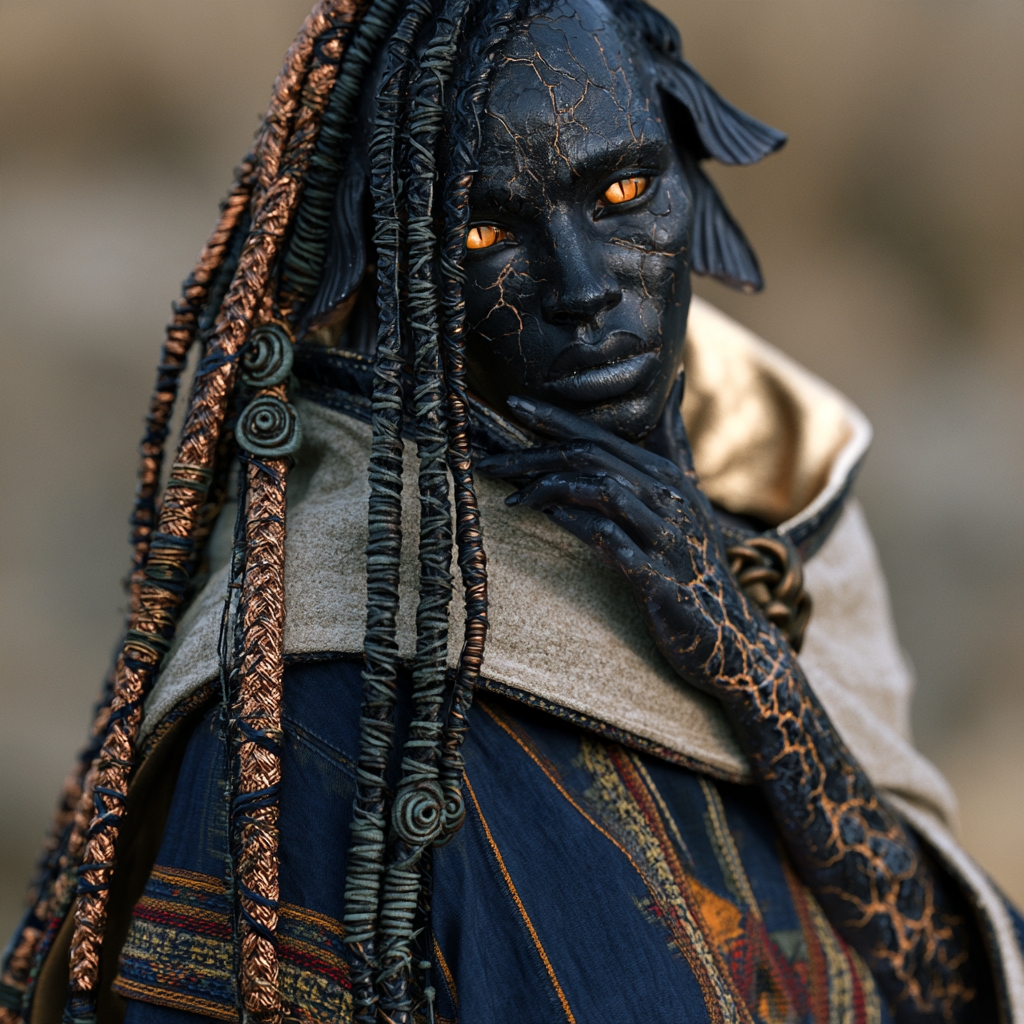
• Their skin is obsidian-dark with a smoky, slightly translucent sheen, like volcanic glass held up to a lamp. The cracked-stone patterns typical of the Qosqo-Pacha run in long parallel lines down the arms and back, like hanging cords. They grow more branched and intricate with age and magical use.
• Their bioluminescent veins are concentrated in the hands, wrists and forearms. The light shifts through the traditional khipu colors (ochre, indigo, crimson, verdigris and pale gold) depending on mood and on the magic flowing through their gear.
• Their eyes are large and luminous, from deep amber to bright silver, with slit pupils. A clear inner eyelid slides across the eye in dust, smoke or harsh light, giving the gaze a brief glassy shimmer.
• Their metallic hair is mostly copper-bronze, with occasional strands of silver or gold in elders. It grows with small, hard nodules every few inches. Members of the line braid it into long cords, often adding colored threads and grain spiral beads that record personal and family history.
• Their ears are elongated and finely ridged along the outer edge, and very sensitive to vibration. Many Cord-Readers say they can hear a cord tighten before they see it move.
• Their fingers are long and dexterous, webbed only to the first knuckle. Their claw-like nails are short and kept filed smooth so they don’t fray delicate cords.
• Their dress follows Renaissance highland fashion: layered woven tunics covered in geometric squares of embroidered color, high-collared mantles, knot-hung belts, brass-framed reading lenses, quill cases and cord satchels. Like all gear on Saṃsāra, these are worn openly and lavishly, so a gathering of Cord-Readers looks like a procession of costumed scholars.
• Their long cord-braids give the line a body-based Braid slot. It can hold a single knotted cord, bead-string or small hair ornament as worn gear, in addition to the standard slots.
Positives
• Their long, fine fingers suit knot-tying, rune inscription, lockwork, fine crafting and handling delicate gear, which helps with crafting, merging and gear enhancement.
• The inner eyelid protects their eyes from dust, smoke and glare. This greatly reduces the bright-light discomfort that troubles most Qosqo-Pacha, so they function well in sunlit cities and lamplit libraries as well as caves.
• Like the rest of their people they keep strong low-light vision, which suits archives, mines and night travel.
• Their vibration-sensitive ears can pick up the creak of mechanisms, the shift of stone and footsteps in quiet halls.
• The Braid slot gives every avatar of the line one extra body-based slot for cord, bead or hair gear.
• The Archive-Terraces of Hanan-Pacha and royal patronage give them a cultural tradition of library research and access to rare records. This helps with research tied to the Mind’s Eye, true names, lost histories and forgotten prophecies.
• The office of Keeper of the Long Cord and the royal court’s reliance on Cord-Readers for treaty and tax records give them social standing and political openings.
• Souls who were scholars in past lives settle easily into this line. Their remembered expertise fits the line’s trades, which speeds training in research, languages, history and inscription skills.
• They are respected and in demand among scholars, guilds, ambassadors and adventurers throughout the island nations, which opens doors for quests, employment and renown.
Negatives
• The reduced webbing and slighter build make them weaker climbers than other Qosqo-Pacha, so cliffs, terraces and rope bridges take more effort.
• Their lean, narrow frames leave them vulnerable in close combat unless they wear dependable armor.
• Older Stonegrower families and some guild lineages in Peakhold hold grudges against the line for exposing the guilt behind the Rockfall, which can lead to cold receptions, sabotage or hidden foes.
• Foreign courts and guilds often assume every Cord-Reader is a royal informant, which complicates trust, diplomacy and trade.
• Members of the line are expected to report significant records, histories and true names they discover to the Keeper of the Long Cord. This creates divided loyalties when party secrets or personal ethics conflict with family duty.
• Their prominent cord-braids and hair ornaments are easy for enemies to grab, cut or target in combat. Losing a family braid is a deep personal and cultural shame.
• Like all Qosqo-Pacha, they rely heavily on mountain ley lines, and their gear feels weaker and less responsive in regions where magic flows thin.
• Their lean bodies have little insulation, so cold peaks and icy archives require heated gear and careful preparation.
• The line’s devotion to recovering the past can turn obsessive. Members sometimes chase a single lost record into ruins, forbidden vaults or Fae Portal regions without weighing the danger.
• Their striking appearance makes them stand out abroad, where people unfamiliar with Andean may regard them with suspicion, curiosity or open hostility.
Tags
Qosqo Pacha, Khipu-Willaq, Cord-Readers, Renaissance Scholars, Knot-Keepers, Archive-Terraces, Hanan-Pacha, Keeper of the Long Cord, Female Line Heredity, Royal Patronage, Rockfall Records, Turrath Archives, Night of the Long Cord, Obsidian Skin, Smoky Translucent Sheen, Cord-Line Skin Patterns, Khipu-Hued Bioluminescence, Luminous Eyes, Inner Eyelid, Knotted Metallic Hair, Braid Slot, Elongated Ridged Ears, Long Fine Fingers, Reduced Webbing, Low-Light Vision, Vibration Sensitivity, Fine Dexterity, Rune Inscription, Library Research, Lost Histories, True Name Seekers, Political Intrigue, Web of Foes, Stonegrower Rivalry, Guild Suspicion, Scholarly Isekai Souls, Lean Frame, Cold Vulnerability, Ley Line Dependence, Intayra Faithful, Pacha-Qosqo Speakers, Qosqo-Khipu Script, Andean Highlands
Example Name
• Illari Ch’aska Khipurana, called “Illari of the Seventh Cord,” a great-great-granddaughter in the direct female line of Mama Ch’aska Khipurana.
Tier 1 Stat Modifiers (10 points distributed)
• Strength: +0
• Dexterity: +3
• Constitution: +1
• Intelligence: +4
• Wisdom: +2
• Charisma: +0
Skills (trained levels, tier 1 maximum of 6 per skill)
• Qosqo-Khipu Knot Reading: 6
• Pacha-Qosqo Language: 6
• Library Research: 5
• History (Andean and Turrath Records): 5
• Rune Inscription: 4
• Lockwork and Fine Mechanisms: 3
• Perception (Vibration and Hearing): 3
• Diplomacy and Court Etiquette: 2
• Stealth: 2
• Light Blades (Dagger): 2
• Climbing: 1
Age
• 24 years old. She reached adulthood and magical awakening at 17 and has spent the years since as a junior reader in the Archive-Terraces of Hanan-Pacha.
Height
• 5 feet 7 inches
Weight
• 138 pounds
Speed
• 30 feet per turn on open ground.
• 15 feet per turn when climbing, reduced by the lineage’s limited finger webbing.
Motivation
Illari was in the Archive-Terraces on the night a sealed bundle of Turrath cords disappeared from the vault of the Keeper of the Long Cord. She was the last reader to handle it. The Keeper never accused her, but the whispers among the families of Hanan-Pacha have not stopped. Before the bundle vanished, Illari had read only its first strand, and it named a living guild lineage in Peakhold as heirs to one of the elders who built Vorzul. She believes the theft was meant to bury that name for good. She has left the archives to track the missing cords through Andean’s guilds, ports and ruins, and beyond its shores if she has to. Her goal is to clear her own standing and to make sure the record is read aloud on a future Night of the Long Cord, whoever it shames. She also hopes to find any other lost Turrath archives still buried in the Rockfall scar or scattered by the survivors who fled.
Gear of the Seventh Cord: Illari’s Archive-Warden Armor
Seventh Cord Reader’s Tunic 3184
• Slot: Chest
• Tier: 1 (Common)
• Armor Check: +3
• Item Health Points: 10 plus the avatar’s maximum health points (resilience 10)
• Attunement: Simple (1 minute)
• Weight: 4 pounds
• Suggested Value: 85 silver
• Appearance: A knee-length, close-fitted tunic of deep indigo highland wool, densely embroidered with rows of small geometric squares in ochre, crimson and verdigris. Thin layers of knotted cord are quilted between the wool layers, forming a flexible lattice that hardens on impact.
• Properties:
• Knotted Lattice: The quilted cords tighten when struck, spreading the force of blows across the garment. This is the source of its Armor Check.
• Reader’s Focus: Grants +1 temporary skill point to Library Research while worn and attuned.
• Cordlight (spell, 3 charges, recharges at dawn): As an action, the wearer makes the embroidered squares glow with soft ochre light, lighting a 20-foot radius for up to one hour. A ritual chant over 6 seconds can tint the light indigo, which makes faded dyes and worn knots easier to read and gives advantage on one reading or research roll during that hour.
• Lore: Junior readers of the Archive-Terraces of Hanan-Pacha receive tunics of this pattern when they are first allowed into the deep cord-vaults. The embroidered squares record the wearer’s rank and family line. Illari’s tunic carries seven small gold squares at the hem, marking her descent in the seventh generation from Mama Ch’aska Khipurana.
Hanan-Pacha Lampwool Mantle 7426
• Slot: Shoulder
• Tier: 1 (Common)
• Armor Check: +2
• Item Health Points: 10 plus the avatar’s maximum health points (resilience 10)
• Attunement: Simple (1 minute)
• Weight: 3 pounds
• Suggested Value: 70 silver
• Appearance: A high-collared mantle of undyed, cream-colored highland wool, lined in pale gold and clasped at the throat with a bronze brooch shaped like a closed knot. The collar stands stiff enough to shield the neck and lower ears.
• Properties:
• Warmth of the Archive Lamps: Woven with threads soaked in geothermal spring water, the mantle keeps the wearer comfortably warm in cold highland weather and icy archives, offsetting the lineage’s lack of insulation. Saving throws against cold exposure are made with advantage.
• High Collar Guard: The stiff collar adds to the wearer’s Armor Check, as listed above.
• Mist of the Peaks (spell, 1 charge, recharges at dawn): As an action, the wearer pulls the mantle around them and speaks a Pacha-Qosqo phrase. A swirling mist spreads in a 15-foot radius around the wearer for 1 minute. Attacks against creatures inside the mist from outside it are made with disadvantage.
• Lore: Archive-Terrace readers who travel into the high passes to recover cords from remote shrines wear Lampwool mantles. Ch’aska’s daughters first wove them to keep their mother warm during her eleven seasons in the Rockfall scar. The bronze knot-clasp is a closed knot, which in Qosqo-Khipu means “a record kept safe.”
• Slot: Arms (Left and Right, worn as a single matched pair)
• Tier: 1 (Common)
• Armor Check: +3
• Item Health Points: 10 plus the avatar’s maximum health points (resilience 10)
• Attunement: Simple (1 minute)
• Weight: 2 pounds
• Suggested Value: 90 silver
• Appearance: Fitted forearm bracers of dark tooled leather reinforced with thin, overlapping plates of polished obsidian. Each plate is etched with a tiny Khipu-Glyph, and the plates glow faintly in time with the wearer’s bioluminescent veins. Narrow loops along the wrist edge hold small knot-picks.
• Properties:
• Obsidian Plates: The overlapping obsidian plates deflect glancing blows and slashes aimed at the arms, adding to the wearer’s Armor Check.
• Steady Hands: Grants +1 temporary skill point to Lockwork and Fine Mechanisms while worn and attuned.
• Snag Ward (reaction, 2 uses, recharges at dawn): Trigger: an attacker announces that it is targeting one of the wearer’s worn or carried items, including the cord in her Braid slot. The wearer flicks a bracer into the path of the strike, adding the wearer’s tier die to that item’s Armor Check against the attack.
• Lore: Cord-Readers handle fragile, irreplaceable records, and rival guild agents have more than once tried to cut cords from a reader’s hands or hair. The Knot-Guard bracers were designed after an attack in the Archive-Terraces in which an assassin slashed a Keeper’s braids to destroy the family knots woven into them. Each pair is fitted to its wearer’s forearms in a short ritual before it is first attuned.
• Slot: Feet (Left and Right, worn as a single matched pair)
• Tier: 1 (Common)
• Armor Check: +2
• Item Health Points: 10 plus the avatar’s maximum health points (resilience 10)
• Attunement: Simple (1 minute)
• Weight: 2 pounds
• Suggested Value: 65 silver
• Appearance: Soft, close-fitting boots of dark, oiled leather that rise to mid-calf. The thin, flexible soles are layered with pressed felt and lined with fine woven cord. The shafts are reinforced with stitched leather bands embossed with grain spirals.
• Properties:
• Reinforced Shafts: The stitched leather bands guard the shins and ankles, adding to the wearer’s Armor Check.
• Hushed Step: Grants +1 temporary skill point to Stealth while worn and attuned.
• Cord-Grip Soles: Grants +1 temporary skill point to Climbing while worn and attuned. This partly offsets the reduced finger webbing of the Khipu-Willaq lineage.
• Floor-Listener (passive): Through the thin soles, the wearer feels vibrations in stone and wooden floors more clearly. Perception checks to notice approaching footsteps, moving mechanisms or shifting stone within 30 feet are made with advantage while the wearer stands still.
• Lore: The Archive-Terraces forbid hard-soled footwear in the cord-vaults, since footsteps echo off the stone and stir dust onto fragile records. Readers wear Archive-Hush boots so they can move silently between the hanging rows. Illari’s pair was resoled by her mother before she left Hanan-Pacha, with a single knotted thread sewn into each heel as a family blessing for safe travel.
Combined Armor Check from these four slots: +10
Combined temporary skill points from these four items:
• Library Research +1
• Lockwork and Fine Mechanisms +1
• Stealth +1
• Climbing +1
Arms of the Seventh Cord: Illari’s Archive-Warden Weapons
• Weapon Type: Light Blade (Dagger)
• Held Slot: One hand. Stored in a sheath on the waist belt when not in use.
• Tier: 1 (Common)
• Required Training: Light Blades
• Attunement: Handheld (instant when held)
• Attack Roll: d20 + tier die + 1 (item bonus)
• Base Damage: 1d4 piercing + tier die (1d4 at tier 1)
• Range: Melee, or thrown, Extended (20/40)
• Item Health Points: 10 plus the avatar’s maximum health points (resilience 10)
• Weight: 1 pound
• Suggested Value: 60 silver
• Appearance: A slender, single-edged blade of dark volcanic steel about 9 inches long. Near the tip is a small hooked notch for catching and cutting cord. The handle is wrapped in tightly knotted cord in the family colors of ochre, indigo and verdigris, and the pommel is a polished obsidian bead etched with a single Khipu-Glyph.
• Properties:
• Balanced Edge: Grants +1 to attack rolls made with this dagger.
• Hooked Notch: When the wielder attacks a foe’s worn or carried item using the targeted item rules, the dagger’s attack bonus increases to +2 for that attack.
• Precise Cut (spell, 2 charges, recharges at dawn): After a hit is confirmed, the wielder may spend a charge to channel a thin line of geomantic force along the edge, adding 1d4 piercing damage to that hit.
• Lore: Every Cord-Reader carries a Knot-Cutter, because a reader may need to free a cord from rubble or cut an imperiled record loose from a falling rack. Traditionally the knife is never used to cut a record cord itself. To do so is considered a betrayal of the archive. Illari’s dagger was carried by her grandmother, and the knotted grip still holds her grandmother’s family knots beneath Illari’s own.
• Weapon Type: Sling
• Held Slot: One hand while in use. Coiled and tied to the belt when stowed.
• Tier: 1 (Common)
• Required Training: Slings
• Attunement: Handheld (instant when held)
• Attack Roll: d20 + tier die
• Base Damage: 1d4 bludgeoning + tier die (1d4 at tier 1), plus any damage listed on the ammunition
• Range: Extended (60/120)
• Ammunition: Sling stones or shaped obsidian bullets, carried in a pouch. One unit is used per attack. After combat, 50% of standard ammunition used can be recovered by searching the battle area.
• Item Health Points: 10 plus the avatar’s maximum health points (resilience 10)
• Weight: 0.5 pounds (sling only)
• Suggested Value: 45 silver
• Appearance: A highland sling about 6 feet long, braided from colored llama-wool cord in ochre, crimson, indigo and verdigris. The diamond-shaped stone cradle is woven in a tight geometric pattern. The release end finishes in a small knotted loop, and the retained end in a finger loop braided from strands of Illari’s own copper-bronze hair, cut at her first reading ceremony.
• Properties:
• Braided Record: The sling’s braid patterns encode a short Qosqo-Khipu record of each notable shot made with it. A reader skilled in Qosqo-Khipu Knot Reading can read the braid like a journal, and the knots shift subtly on their own after significant hits.
• Mountain Whirl (spell, 1 charge, recharges at dawn): As part of an attack with this sling, the wielder chants a short Pacha-Qosqo phrase and spins the sling in a widening arc. The stone strikes with a resonant crack of earth magic. On a hit, the target makes a Strength saving throw or is knocked prone.
• Cord Lasso (free action): Uncoiled, the sling can be used as a light cord for tying, climbing aids or securing a bundle. It cannot be used as a weapon while in this form.
• Lore: The huaraca is one of the oldest weapons of the highland peoples of Andean and is still carried by shepherds and terrace-guards. The Khipu-Willaq adopted it because it is light, fits easily in a cord satchel and reads like a record. Illari’s sling bears the name “Long Cord” after the office of the Keeper she serves.
Living Khipu of the Turrath Echo 1739
• Weapon Type: Spell Focus (Knotted Cord)
• Held Slot: One hand. Coiled around the wrist or carried in the cord satchel when stowed.
• Tier: 1 (Common)
• Required Training: Spell Cords (Qosqo-Khipu Focus)
• Attunement: Handheld (instant when held)
• Attack Roll: d20 + tier die
• Base Damage: 1d6 piercing (earth) + tier die (1d4 at tier 1)
• Range: Simple (40)
• Item Health Points: 10 plus the avatar’s maximum health points (resilience 10)
• Weight: 0.5 pounds
• Suggested Value: 95 silver
• Appearance: A main cord about 3 feet long, braided of dark indigo fiber, with seven pendant cords hanging from it in ochre, crimson, verdigris, pale gold, slate grey, copper and black. Each pendant cord carries a cluster of knots that glow softly when the wielder’s bioluminescent veins brighten. A small chip of grey stone from the Rockfall scar is bound into the knot where the pendants join the main cord.
• Properties:
• Stone Needle (spell, at will): As an action, the wielder pulls one pendant cord taut and speaks a Pacha-Qosqo phrase. A needle of compacted stone forms from the knots and flies at a target within range, dealing the base damage listed above. Damage changes with casting style:
• Silent: no words, 25% less damage.
• Normal (Somatic): a few spoken words with a flourish, standard damage.
• Ritual: chanting for more than 6 seconds, up to 25% more damage.
• Echo of Turrath (spell, 1 charge, recharges at dawn): As an action, the wielder chants the recorded name of a fallen Turrath elder knotted into the black pendant cord. A brief shimmer of crumbling stone and dust rises around one creature within 30 feet. That creature makes a Wisdom saving throw or becomes Shaken until the start of the wielder’s next turn.
• Knot Archive (passive): The pendant cords act as a working record. The wielder may tie up to seven short notes, names or numbers into the cords and recall them exactly later, as long as the knots remain untouched.
• Lore: Illari tied this cord herself during her apprenticeship, copying the knot-patterns of a damaged Turrath fragment as a training exercise. When she fixed the last knot, the cord grew faintly warm and began to glow with her veins. The archive’s elders declared it a living khipu, a cord that had taken on magic through faithful reproduction of a record. The stone chip at its heart was a gift from the Keeper of the Long Cord. Some readers think the cord still carries echoes of the voices of Turrath, and that it hums faintly whenever Illari stands near anything connected to the lost city.
Instruments of the Seventh Cord: Illari’s Archive-Warden Apparatuses
Brass Reading Lenses of the Deep Vaults 6093
• Tool Type: Optical Apparatus (Reading and Identification Lenses)
• Carried Location: On a braided cord around the neck. The neck cord is the lenses’ own fastening and does not take a separate slot.
• Tier: 1 (Common)
• Required Training: Library Research or Qosqo-Khipu Knot Reading
• Attunement: Handheld (instant when held to the eyes)
• Item Health Points: 10 plus the avatar’s maximum health points (resilience 10)
• Weight: 0.5 pounds
• Suggested Value: 110 silver
• Appearance: Folding brass-framed reading lenses with two round lenses of clear, faintly amber-tinted crystal ground in the workshops of Hanan-Pacha. A third, smaller lens on a hinged arm can swing down in front of either eye for close magnification. Tiny Khipu-Glyphs etched around the rims glow faintly indigo when the lenses are in use. The hinges are worked into small closed-knot shapes.
• Properties:
• Identify Focus: The lenses serve as the item focus needed for the active use of the Mind’s Eye. With an action and a few minutes of concentration, the holder can identify an item, creature or inscription, revealing deeper stats and properties than a passive glance. Shielded or falsified stats may still mislead.
• Close Magnifier: The hinged third lens magnifies fine detail. The holder gains +1 temporary skill point to Qosqo-Khipu Knot Reading while holding the lenses and examining an object.
• Dye-Truth Tint (spell, 2 charges, recharges at dawn): As an action, the holder twists the rims until the lenses glow fully indigo. For 10 minutes, faded dyes, worn knots, hidden glyphs and later re-tied or altered knots stand out clearly. Attempts to detect forged or tampered records are made with advantage.
• Lore: Hanan-Pacha’s lens-grinders began making reading lenses during the Renaissance, when the Archive-Terraces grew too deep for even the luminous eyes of the Qosqo-Pacha to read the smallest knots in lamplight. Junior readers receive a pair when they are entrusted with their first original Turrath fragment. The Keeper of the Long Cord gave Illari these lenses personally. She has used them to find two forged cords in the archive, which many believe made her enemies before the sealed bundle vanished.
Knot-Pick Roll of Mama Ch’aska 3528
• Tool Type: Fine-Work Kit (Knot-Picks, Etching Styluses and Repair Tools)
• Carried Location: Rolled and tied in a leather case on the waist belt. A few individual picks ride in the wrist loops of the Knot-Guard Bracers. The roll counts as a single carried item.
• Tier: 1 (Common)
• Required Training: Lockwork and Fine Mechanisms or Rune Inscription
• Attunement: Handheld (instant when a tool from the roll is held)
• Item Health Points: 10 plus the avatar’s maximum health points (resilience 10)
• Weight: 1.5 pounds
• Suggested Value: 80 silver
• Appearance: A long roll of soft, dark leather tied with a crimson cord, which opens to show rows of slender instruments in small woven pockets. They include bone and bronze knot-picks of several hooked and pointed shapes, fine obsidian etching styluses, tiny cord-clamps, a small spool of undyed repair fiber and a set of thin bronze tension wires. The inside of the roll is stitched with the Qosqo-Khipu name of Mama Ch’aska Khipurana, who first assembled the pattern.
• Properties:
• Knot and Lock Work: The picks and tension wires work on both knots and mechanical locks. The holder gains +1 temporary skill point to Lockwork and Fine Mechanisms while working with tools from the roll.
• Rune Etching: The obsidian styluses can inscribe Khipu-Glyphs and simple runes into leather, wood, bone, stone or soft metal. The holder gains +1 temporary skill point to Rune Inscription while using them, provided they have the materials and time the work requires.
• Cord Mending (spell, 1 charge, recharges at dawn): As a 10-minute ritual, the holder chants in Pacha-Qosqo while working the repair fiber into a damaged cord, braid or woven item. The ritual restores 1d4 + tier die health points to that item, up to its maximum. Items reduced to half their health points or less are no longer broken once mended above that threshold.
• Untie the Bind (free action, once per turn): When the holder is restrained by rope, cord, netting or similar woven bindings, they can work a pick into the binding. Attempts to escape or slip the binding are made with advantage.
• Lore: This kit’s pattern dates back to Mama Ch’aska’s eleven seasons in the Rockfall scar, where she needed tools fine enough to free crushed cords from stone without breaking a single strand. The Archive-Terraces still make every Knot-Pick Roll to her original layout. The oldest instrument in Illari’s roll, a bone pick yellowed with age, is said to have been carved by Ch’aska herself, and passed down through the female line to whichever daughter showed the steadiest hands.
Illari Ch’aska Khipurana: Resume and Personal History
Resume
• Full Name: Illari Ch’aska Khipurana, called “Illari of the Seventh Cord”
• Lineage: Lineage 6274 of Qosqo Pacha (Khipu-Willaq, the Cord-Readers), seventh generation in the direct female line of Mama Ch’aska Khipurana
• Homeland: Hanan-Pacha, northern Andean
• Age: 24
• Tier: 1
• Current Status: On leave from the Archive-Terraces of Hanan-Pacha, investigating the disappearance of a sealed bundle of Turrath cords
• Languages:
• Pacha-Qosqo (native, fluent in speech and chant)
• Qosqo-Khipu (fluent, knot script)
• Khipu-Glyph (fluent, written glyph script)
• Qosqo-Script (fluent, trade script)
• Old Turrath dialect of Pacha-Qosqo (reading knowledge only, partial and fragmentary)
• Education:
• Compulsory schooling, Hanan-Pacha Lower Terrace School, childhood to age 17: Pacha-Qosqo language, Andean history, terrace agriculture, theory of geomancy, the teachings of Intayra and mundane knot-tying.
• Family knot instruction in the Khipurana household, from early childhood: memorizing family braids, color meanings and the basic knot alphabet of Qosqo-Khipu. Mundane practice only, before magical awakening.
• Cord-Apprenticeship, Archive-Terraces of Hanan-Pacha, ages 17 to 20: formal training in Qosqo-Khipu reading, cord preservation, dye analysis, archive organization and the handling of fragile records.
• Positions Held:
• Cord-Apprentice, Archive-Terraces of Hanan-Pacha, ages 17 to 20:
• Sorted, cleaned and catalogued common archive cords, including crop tallies, tax records and trade agreements from the upper terraces.
• Assisted senior readers in restoring water-damaged cords after a spring flood in the lower vaults.
• Tied the Living Khipu of the Turrath Echo as her final apprenticeship exercise. It was declared a living khipu by the archive elders.
• Junior Reader, Archive-Terraces of Hanan-Pacha, ages 20 to 24:
• Was granted access to the deep cord-vaults and received the Brass Reading Lenses of the Deep Vaults from the Keeper of the Long Cord.
• Translated a set of recovered Turrath tax-cords, which showed which terraces supplied labor and stone for the building of Vorzul.
• Identified two forged cords in the archive. They had been altered to change names in old guild membership records connected to families in Peakhold.
• Read treaty and tax cords as an assistant during two minor sessions of the royal court’s records office.
• Served as one of four readers assigned to the sealed Turrath bundle during its initial preservation. Hers was the last hand to touch it before it disappeared.
• Affiliations:
• Archive-Terraces of Hanan-Pacha (Junior Reader, on leave)
• House Khipurana (Khipu-Willaq line of the Keeper of the Long Cord)
• Andeanism, the Faith of Intayra (lay member; regular attendant at the Hanan-Pacha Peakshrine)
• World Bank (account holder since adulthood)
• Notable Accomplishments:
• Creator of a living khipu, a rare honor for an apprentice.
• Discoverer of two archive forgeries.
• Translator of the Turrath labor-and-stone tax-cords.
• Selected to read one minor Turrath record aloud at a Night of the Long Cord at age 22, the youngest reader in her generation to do so.
• References:
• Keeper Sumaq T’ika Khipurana, Keeper of the Long Cord and her mother’s elder cousin
• Senior Reader Amaru Quispe, her apprenticeship master in the Archive-Terraces
• Stonegrower Mallku Wari, priest of the Hanan-Pacha Peakshrine
• Known Rivals and Suspicions:
• Guild families of Peakhold named in the forged and recovered records
• Several Stonegrower households descended from the elders of Turrath
• A small group of archive readers who believe she was careless, or complicit, in the loss of the sealed bundle
• Titles: None held. Titles of Power and Skill become active only from tier 2.
Personal History
Illari was born in Hanan-Pacha during the week of Illumination, which her family took as a good omen for a future reader. Her mother, Wayta Khipurana, is a cord-dyer who mixes the archive’s ochres, indigos and verdigris in vats heated by the city’s geothermal springs. Her father, Rumi Saywa, is a terrace-mason who maintains the stone walls and steam-lifts of the upper agricultural terraces. Illari grew up between the smell of dye vats and the rumble of steam-lifts, and learned early that both color and stone could carry meaning.
From the time she could hold a cord, her grandmother, Kusi Khipurana, taught her the family braids. Each evening Kusi undid and re-braided Illari’s hair while reciting the names of their foremothers back to Mama Ch’aska, tying a knot for each name. Illari still wears that pattern in her first braid. Kusi died when Illari was twelve, and her bone-handled knot-pick, said to have been carved by Ch’aska herself, passed to Illari. It is now the oldest tool in her Knot-Pick Roll.
As a mundane child, Illari attended the Lower Terrace School with other children of Hanan-Pacha. She was a quiet student who excelled at history and language but struggled in physical lessons, especially climbing exercises on the practice cliffs. Her lineage’s reduced finger webbing made her slower than classmates of other Qosqo-Pacha lines, and the teasing she endured made her stubborn and private. She spent her free hours in the public reading rooms of the Archive-Terraces, where children were allowed to look at copies of old cords but not touch originals.
Her magic awakened at 17, during the festival of Terracelight. That same season the Archive-Terraces accepted her as a Cord-Apprentice under Senior Reader Amaru Quispe, a demanding teacher who made her retie the same practice knot hundreds of times until her hands stopped shaking. Under his guidance she learned cord preservation, dye analysis and the careful reading of damaged records. Her apprenticeship ended when she copied a fragile Turrath fragment knot by knot and the copy came alive with magic in her hands. The elders named it the Living Khipu of the Turrath Echo, and many readers began to watch her closely.
As a Junior Reader, Illari quickly earned a reputation for precision and for refusing to leave a discrepancy unexplained. Her translation of the Turrath tax-cords was praised by scholars and resented by some Stonegrower households, whose ancestors appeared among the suppliers of stone and labor for Vorzul. A year later she found the two forged guild records. Their altered knots would have quietly erased certain family names from Turrath’s history. The Keeper of the Long Cord took the forgeries to the royal court’s records office, but no culprit was ever named. Illari has since noticed that some guild visitors to the archive address her with exaggerated courtesy or none at all.
At 22, Illari was chosen to read a minor Turrath record aloud on a Night of the Long Cord, the youngest reader of her generation to do so. The record was a short prayer by a Turrath child for her mother’s safe return from the quarry, and the hall fell silent as Illari read it. The event made her known across Hanan-Pacha and attracted attention from people in Peakhold.
Six weeks ago, a sealed bundle of newly recovered Turrath cords was brought up from the Rockfall scar and assigned to Illari and three other readers for preservation. Illari read only the first strand before the bundle was returned to the Keeper’s vault for the night. It named a living guild lineage in Peakhold as direct heirs of one of the elders who built Vorzul. The next morning the bundle was gone. The vault’s seals were unbroken, and no record of anyone entering remained. The Keeper refused to accuse anyone, but the archive split into whispered factions, some of which named Illari as the careless or complicit party.
Illari asked the Keeper for leave to pursue the missing cords herself, and the Keeper granted it with a warning that the truth might cost more than it was worth. Illari’s mother resoled her boots with a knotted thread sewn into each heel for safe travel. Her father gave her a small stone from the first terrace wall he ever built, now carried in her cord satchel. She left Hanan-Pacha with her tools, her weapons, a modest World Bank account and the name from the first strand of the missing bundle, which she has told no one.
Illari Ch’aska Khipurana: Relationships
Community
• Hanan-Pacha at Large:
• Many people in Hanan-Pacha know Illari as the young reader who read the Turrath child’s prayer on the Night of the Long Cord. Terrace-workers, dyers and shopkeepers who heard it still greet her warmly and sometimes ask her to read old family cords for free. She usually agrees, because it reminds her why the archive matters.
• Since the sealed bundle disappeared, some of that warmth has cooled. Rumors in the markets range from carelessness to bribery. A few neighbors avoid her eyes, and some shopkeepers now ask for payment in coin rather than trusting her World Bank transfers. She feels the shift sharply but does not argue with gossip. She would rather let the truth answer for her when she finds it.
• The Archive-Terraces:
• The archive is the center of Illari’s life, and she feels more at home in its lamplit vaults than anywhere else. Senior readers have long respected her precision. Apprentices look up to her as proof that a reader from a modest branch of House Khipurana can rise on skill alone.
• The loss of the bundle has split the archive. One faction believes she is innocent and is being used as a scapegoat. Another suspects she helped someone inside the archive or in Peakhold remove the cords. A third keeps quiet, waiting to see which way the Keeper leans. Illari has trouble trusting anyone in the vaults now, and that isolation hurts her more than the accusations.
• The Hanan-Pacha Peakshrine:
• Illari attends the weekly Peakharvest services at the city’s Peakshrine. She takes part in the communal stone-shaping, though she is much better at polishing than carving. She is quietly devout, but her faith is complicated: she believes Intayra’s judgment fell on Turrath for the elders’ greed, and she also believes the Stonegrowers have spent generations using that story to protect certain families’ reputations.
• Stonegrower Mallku Wari, a priest at the shrine, has been kind to her and treats her questions as honest rather than heretical. Other Stonegrowers, especially those from families descended from Turrath, see the Khipu-Willaq as tomb-robbers who dig up the guilt of the dead for political gain. They are polite in public and cold in private.
• The Royal Court and Peakhold:
• Through her assistance in the royal records office, Illari has had brief, formal contact with court officials. They value her skill and see her as a useful tool against the guilds, but she knows that usefulness can be withdrawn the moment she becomes inconvenient.
• In Peakhold, the guild families named in her forged and recovered records regard her with wary hostility. A few have sent polite messages through intermediaries “inviting” her to discuss her research privately. She has declined every invitation.
Family
• Wayta Khipurana (Mother):
• Wayta is a cord-dyer in the archive’s dye-works, warm, practical and fiercely protective. She is proud of her daughter’s success but has always worried that the archive would put Illari in the middle of conflicts she cannot control. She sees the disappearance of the bundle as that fear come true.
• Their relationship is close and affectionate, with frequent disagreements. Wayta wanted Illari to clear her name through the Keeper rather than leave Hanan-Pacha. When Illari decided to go anyway, Wayta resoled her boots and sewed the blessing knots into the heels without another word of argument, which Illari understood as her mother’s full support.
• Rumi Saywa (Father):
• Rumi is a terrace-mason who maintains the stone walls and steam-lifts of the upper agricultural terraces. He married into House Khipurana and does not read cords, but he understands stone the way his daughter understands knots. He is quiet and steady and speaks more through his work than his words.
• Illari has always found peace in his company. As a child she sat beside him while he repaired terrace walls, asking what each stone “remembered.” He gave her the small stone from the first wall he ever built so she would carry part of home with her. She keeps it in her cord satchel and holds it when she cannot sleep.
• Kusi Khipurana (Grandmother, deceased):
• Kusi was Illari’s first teacher and the person who shaped her most. She taught Illari the family braids and the names of their foremothers, and passed down the bone knot-pick said to have been carved by Mama Ch’aska.
• Illari still feels her grandmother’s absence keenly. Kusi died when Illari was twelve, and Illari has never quite stopped hoping to find Kusi’s name somewhere in the archive’s deeper records, tied to some story she never told.
• Keeper Sumaq T’ika Khipurana (Mother’s Elder Cousin, Keeper of the Long Cord):
• Sumaq T’ika is head of House Khipurana’s senior line and holds the hereditary office of Keeper of the Long Cord. She is respected, politically skilled and difficult to read. She personally gave Illari the Brass Reading Lenses and has quietly advanced her career.
• Since the bundle vanished, their relationship has been strained. The Keeper refuses to accuse Illari publicly but has not openly defended her either. Illari cannot tell whether her silence is political caution, private doubt, or a deliberate move in a game Illari does not yet understand. The Keeper’s parting warning, that the truth may cost more than it is worth, keeps coming back to her.
• Tika Khipurana (Younger Sister, age 14):
• Tika is still a mundane child in compulsory schooling and adores her older sister. She has already started copying Illari’s braid pattern and practices knot-tying every evening, hoping to become a Cord-Apprentice herself.
• Illari is protective of Tika and was especially worried about leaving her while the rumors about the bundle were spreading. She writes to her sister in Qosqo-Script, with small knotted cords tucked inside each letter as secret messages only the two of them can read.
• The Wider House Khipurana:
• The senior and junior branches of House Khipurana are closely bound by their shared descent from Mama Ch’aska, but they also compete over positions in the archive and favor with the Keeper. Some cousins in the senior line have long seen Illari’s rapid rise as a threat. A few of them were among the first to suggest she was careless with the bundle.
Friends
• Qori Yupanqui (Fellow Junior Reader):
• Qori entered the Cord-Apprenticeship the same season as Illari. He is the closest friend she has in the archive: cheerful, quick-witted and a little reckless, with a talent for reading damaged dye that rivals her own.
• He was also one of the four readers assigned to the sealed bundle. He has defended Illari loudly, sometimes to the point of starting arguments in the vaults. She appreciates his loyalty but cannot entirely set aside the thought that he had the same access she did. She feels ashamed of that doubt and has never spoken it aloud.
• Senior Reader Amaru Quispe (Mentor):
• Amaru was Illari’s apprenticeship master. He is strict, demanding and sparing with praise, and he made her retie the same knot until her hands stopped shaking. Over the years, his rare approval came to mean more to her than any public honor.
• Since the bundle vanished, Amaru has said almost nothing to her, but he left a fresh spool of repair fiber in her Knot-Pick Roll the night before she departed. She took it as a sign that he believes in her, or at least that he wants her to succeed.
• Waman Ch’uqi (Childhood Friend, Griffon Courier):
• Waman grew up two terraces above Illari’s family home. He was one of the few children who never teased her about her clumsy climbing and often helped her up the practice cliffs at school. He became a griffon courier, carrying messages and small cargo between the cities of Andean.
• He is her best source of news from beyond Hanan-Pacha, and the person she most often turns to when she needs to laugh. He has offered to carry her messages and quietly ask questions in Peakhold on her behalf. She accepted, though she worries about putting him in danger.
• Stonegrower Mallku Wari (Priest and Confidant):
• Mallku Wari is an older priest at the Hanan-Pacha Peakshrine and one of the few Stonegrowers who openly respects the work of the Khipu-Willaq. He and Illari have spent long evenings debating the meaning of the Rockfall and the balance between truth and mercy.
• He has given her blessings for her journey. He has also privately warned her that some Stonegrower households would rather see the missing cords destroyed than read aloud in any hall.
• The Other Two Bundle Readers:
• Chaska Mamani, a meticulous senior reader known for her loyalty to the senior line of House Khipurana, and Inti Huallpa, a quiet junior reader newly transferred from the archive’s Peakhold branch, were the other two readers assigned to the sealed bundle.
• Illari has never been close to either of them. Since the disappearance, Chaska has been coldly formal, and Inti has avoided her entirely. She does not count them as friends, but she watches them carefully.