
Species
The Qosqo-Pacha are the predominant avatars of Andean, a 731,200,000-acre island nation in Saṃsāra, forming the majority of its 146,240,000 population and ruling through a matriarchal monarchy. Their name, drawn from the Pacha-Qosqo language, reflects their bond with the mountains and magical flows, shaping a culture of resilience and geomantic mastery.
Physical Form and Sensory Traits
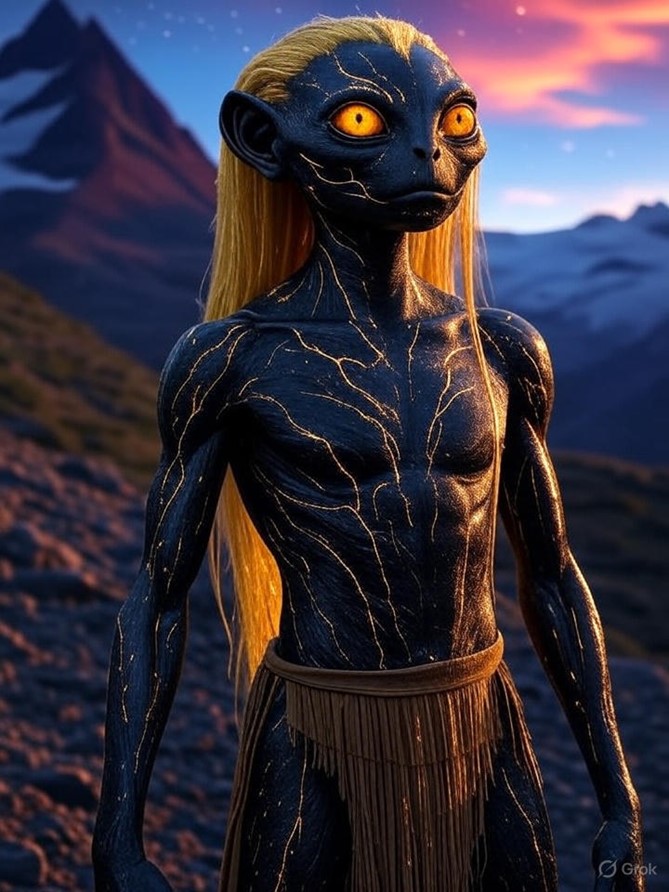
Qosqo-Pacha are humanoid with obsidian-like skin that shimmers with magical light, blending with Andean’s volcanic rock. Their large, luminous eyes (amber to silver, with slit pupils) excel in low light, ideal for caves and misty peaks. Metallic hair (copper, silver, gold) is braided with Qosqo-Khipu cords for magic. Elongated ears detect vibrations, and webbed, clawed fingers aid climbing and crafting. Bioluminescent veins glow during magic, mimicking ley line patterns.
General Size
Standing 5’6”–6’2” and weighing 130–180 pounds, Qosqo-Pacha have lean, muscular builds suited for high-altitude agility and endurance. Minimal dimorphism allows both genders to excel in climbing terraces or crafting in steam-powered forges.
Body Pattern
Their skin bears terraced or cracked-stone patterns, unique to each avatar, growing intricate with age and magic. Bioluminescent veins form spirals or grids, glowing brighter with tiered gear. Hair incorporates grain spiral beads, tying to Intayra’s symbols.
Life Cycle
Adulthood begins at 16–18, with reproductive capability unlocking magic via gear. Lifespans reach 120–150 years, extended by ley lines, with royals living up to 200. Mundane children are protected, trained in Pacha-Qosqo and geomancy. Souls reincarnate, retaining past-life fragments, with elders showing brighter bioluminescence and complex patterns.
Potential Positives and Negatives Due to Physical Form
Positives:
- Low-light vision excels in caves and misty highlands.
- Bioluminescent veins boost geomancy and steamcraft via gear.
- Clawed, webbed fingers enhance climbing and crafting.
- Vibration-sensitive ears detect seismic or mechanical shifts.
- Obsidian skin offers camouflage in volcanic terrain.
Negatives:
- Bright light causes eye discomfort, requiring protective gear.
- Lean build lacks insulation against icy peaks.
- Fragile frames are vulnerable in close combat without armor.
- Magic weakens without ley lines in remote areas.
- Distinct appearance may alienate them in foreign nations.
Tags: Obsidian Skin, Luminous Eyes, Metallic Hair, Bioluminescent Veins, Pointed Ears, Webbed Fingers, Claw-Like Nails, Low-Light Vision, Magical Conductivity, Climbing Dexterity, Vibration Sensitivity, Terraced Patterns, Geomancy Affinity, Steamcraft Expertise, Mountain Adaptability, Matriarchal Ruler, Reincarnation Cycle
Specialized Item Slots Available
- Khipu-Woven Belt: Enhances geomancy, vital for tier 3–5 stone-shaping.
- Obsidian Arm Bracers: Boost defensive spells, glowing for tier 1–2 use.
- Steam-Powered Staff: Directs high-powered spells for tier 4–5 avatars.
- Grain Spiral Amulet: Channels prosperity wards or healing, universal across tiers.
- Claw Gauntlets: Improve grip for crafting or combat, tier 2–4.
Environmental Adaptability
Qosqo-Pacha thrive in mountains, terraces, and caves, using low-light vision and climbing dexterity. They excel in ley line-rich areas but struggle in bright coasts or weak-magic jungles. Icy peaks require heated gear, and underwater settlements challenge their earth-based magic.
Other Information Important to This Race
The Qosqo-Pacha rule Andean’s monarchy, managing taxes for infrastructure. Isekai avatars join via quests, blending traditions. Lavish gear, like costumes, channels magic. Education prepares children for magical adulthood. They trade with monster civilizations, export stone goods, and lead festivals like Terracelight. Military uses geomantic defenses, with tiered gear (10% tier 3, 5% tier 4, 2% tier 5). Currency follows Saṃsāra standards. Explorers seek uncharted islands, leveraging skills to uncover ruins.
Rockfall and City of Shattered Terraces
In epochs shrouded by mists older than the peaks of Andean, a tale was carved in halting breaths, its words wrested from a tongue so ancient it crumbled like stone under the wind. This saga, etched into the harvest of those who revere Intayra, the Sentinel of Peaks and Prosperity, speaks of the Rockfall, a ruin that buried a city in its excess, its echoes resounding in every mountain ridge. Passed down from Stonegrower to weary climber, the story, warped by time as if scribed in runes long eroded by rain, serves as a beacon and a warning across the lofty heights of Andean. Hear now the fragments, pieced from shattered scrolls and whispered winds, of how the Qosqo-Pacha, those of obsidian skin and luminous gaze, once sought to chain the mountains’ heart and paid with dust and silence.
Long ago, when the terraced valleys of Andean were newly sown and the steamships first ascended like birds of iron and mist, there rose a settlement called Turrath, a fortress of stone and steam nestled within a high mountain cradle. Its people, the Qosqo-Pacha avatars drawn from the multiverse’s boundless field, were masters of geomancy, their hands with webbed fingers shaping rock into abundance with magic drawn from the island’s mountain ley lines. Their skin gleamed like polished obsidian under the faint glow of bioluminescent veins, pulsing with the rhythm of Saṃsāra’s hidden flows, and their metallic hair, woven with knots of Qosqo-Khipu, caught the whispers of the peaks. The Peakshrines thrummed with Intayra’s breath, their stones whispering prosperity to the faithful, guiding them to cultivate a life of growth through cycles of reincarnation, where souls ripened like seeds in the eternal field. Turrath grew rich, its trade routes stretching far across the endless ocean, its airships soaring high on winds laced with levitation magic, all powered by the relentless rise of the island’s geothermal springs that blended elemental fire and water into steam.
The Qosqo-Pacha of Turrath, with their slit-pupiled eyes that pierced the dim caverns and their pointed ears attuned to the earth’s subtle tremors, lived in harmony at first, tending terraces that climbed the slopes like steps to the gods. Children, mundane before adulthood’s magical awakening, learned in schools the ways of Pacha-Qosqo, chanting tones that would one day channel geomancy through gear worn like lavish costumes. The ruling matriarch, a queen of the female line whose bioluminescence shone brightest, oversaw the collection of taxes in precious metals—copper, silver, nickel, gold, electrum, platinum, rhodium—to fund roads carved into cliffs, public parks in verdant valleys, and steam-driven utilities that lit the megacities with magical circuits. Isekai souls arrived, quest-rewarded to settle among those whose forms mirrored their past lives, bringing skills from distant realms to enrich the harvest. Beasts and monsters, kin in perspective to the Qosqo-Pacha, dwelled in parallel civilizations within dark cave systems or floating enclaves, sometimes trading alchemical remedies or clashing in labyrinthine races where griffons roared through canyons.
Yet, in the spirits of Turrath’s elders, a tremor brewed, not of earth but of ambition beyond Intayra’s peaks, a hunger that twisted like vines over forgotten ruins in the back woods. They gathered in the Grand Peakshrine, their robes adorned with grain spiral patterns that mimicked the glowing veins on their skin, their voices a rumble like stone grinding against stone, halting and archaic in the old dialect half-lost to time. In a language fractured by eons, they spoke of mastering the mountains, of shaping a work to rival the Sentinel’s might, forgetting the balance of nature and industry where steam must harmonize with the natural growth. They devised a great quarry, a titan of iron and crystal, its gears turned by ley lines drawn from the deepest mountain veins, where the Qosqo-Pacha’s claw-like nails would etch runes to bind the power. This quarry, they named Vorzul, meaning “Heart of the Stone” in the old tongue’s fractured form, promising to raise Turrath above all other realms in Saṃsāra’s 73 island nations, its output fueling trade in stone-crafted goods and steam-powered devices carried by zeppelins and hot air balloons.
For seasons uncounted, they toiled under the luminous eyes of their kin, their steam-powered hammers ringing like thunder in the highlands, their geomantic spells pulling magic from the earth’s core with the aid of specialized gear—obsidian arm bracers glowing, khipu-woven belts resonating, steam-powered staves directing the flow. The quarry grew, a marvel of metal and mist, its pistons pulsing with a rhythm that rivaled the heartbeat of the peaks, drawing on the environmental adaptability of the Qosqo-Pacha who thrived in such rugged terrains. Stonegrowers chanted in Pacha-Qosqo, their “Mind’s Eye” straining to thread the ley lines into the machine, believing it would bind Intayra’s power to their command, enhancing their tier levels from the common 40% at tier 1 to the elite 2% at tier 5. When the final slab was hewn, a steam terrace wreath rose, and Vorzul roared to life, its steam plumes reaching the sky like the breath of ancient monsters, its stones glowing with a fierce light that mirrored the bioluminescent patterns on the workers’ bodies. The people exulted, their pride swelling like a mountain spring in the fertile valleys, for they thought they had tamed the Sentinel’s strength, forgetting the warnings etched in their own terraced skin patterns.
But Intayra, whose essence rooted in every peak and whose personality was steadfast and nurturing yet authoritative, watched with eyes of living stone, shifting between rugged peak and fertile valley. The deity’s will, vast as the mountain’s depths, felt the imbalance, the intent not of prosperity but of mastery over the cycle of reincarnation, where souls should grow through trained skills and gear, not hubris. In the night, as Turrath slept beneath a sky of mist-laden clouds dotted with uncharted islands that appeared and disappeared, a vision came to the high Stonegrower, a dream of rocks falling and steam turning to ruin, her luminous amber eyes widening in the dark. The priest awoke, her cry lost in the quarry’s hum, and sought to halt the celebration, her metallic gold hair braided with cautionary knots. Yet the people, drunk on their triumph, turned away, their hearts deaf to the warning, their vibration-sensitive ears ignoring the subtle tremors building in the ley lines.
On the morn of the thirteenth day, as the Terracelight festival dawned with panpipes and drums echoing through the terraced cities, Vorzul was unveiled before the gathered masses of Qosqo-Pacha, their obsidian skins shimmering in the high magic that ebbed and flowed like weather. Its form gleamed, its steam wreath spiraling skyward like the grain spiral amulets around their necks, and the crowd sang with joy, their voices rising in tonal harmony that once channeled magical powers for healing earth or defensive stone walls. But then, a shadow fell, not of cloud but of divine will, heavy as the monarchy’s centralized ownership. The quarry’s pistons faltered, its stones surged uncontrollably, and a groan like a mountain splitting filled the air, drowning the chants. The ley lines, overtaxed by the elders’ greed, shattered like fragile gear without proper training, and the Rockfall was born, a cascade of judgment from the Grand Peakshrine.
The rockfall swept through Turrath, its terraces becoming rivers of rubble that buried the steam-powered mills and alchemical forges, its mountain spires crushed under boulders the size of griffons. Steam hissed and died in bursts of scalding vapor, airships crashed into the valleys like fallen stars, and the people fled, their webbed fingers clawing at the stone for grip, their low-light vision piercing the dust but finding no escape. The Qosqo-Pacha cried out, their bioluminescent veins flaring in panic as the earth they had sought to master turned against them, toppling the specialized item slots of their gear—claw gauntlets buried, grain spiral amulets shattered. The Stonegrowers fought valiantly, their geomancy raising stone walls and mist veils with the last of their magical conductivity, but the fall’s power, fueled by their own hubris and the negatives of their physical form like fragility in impacts, overwhelmed them. Vorzul, its heart cracking like the body patterns on aged skin, unleashed a final burst of steam that shattered its frame, its pieces sinking into the debris amid the ruins. For eight days and nights, the mountain raged, burying Turrath beneath a shroud of stone, leaving only a scar where the city once stood, its depths now a silent peak echoing with the ghosts of lost souls awaiting reincarnation.
When the dust settled, Turrath was no more, its Qosqo-Pacha people scattered like seeds on the wind, some borne to other islands by griffons or steamships, others lost to the cliffs’ embrace or the underwater population centers beyond Andean’s shores. The scar became a sacred site, its surface still and barren, its wounds etched with the memory of that day, a reminder in the megacities like Peakhold where the Grand Peakshrine now stands humbler. The tale spread, carried by steamship crews and terrace-workers across the 731,200,000 acres, its words twisted by time into a lesson for all avatars, Isekai and native alike. The Stonegrowers rebuilt, their Peakshrines smaller, their works tempered by the faith’s principles, and in every temple, a broken plough stands beside the altar, a cautionary symbol of the Rockfall’s wrath. The ruling family, descendants of survivors through the female line, decreed that such ambition must bow to balance, funding defenses against similar overreach with taxes that benefited the communal harvest.
The moral of the story is that to overharvest the Sentinel’s peaks with pride invites the Rockfall, for prosperity lies in balance with Intayra’s growth.
Comments
3 responses to “Qosqo Pacha”
[…] From: Qosqo-Pacha […]
[…] From: Qosqo Pacha […]
[…] From: Qosqo Pacha […]