
From: Lineage 4172 of Akkad Kuri
- Slot: Chest
- Rank: Tier 1, Common
- Armor Check: +3
- Attunement: Simple, one minute
- Weight: 6 pounds
- Item health points: Resilience 10
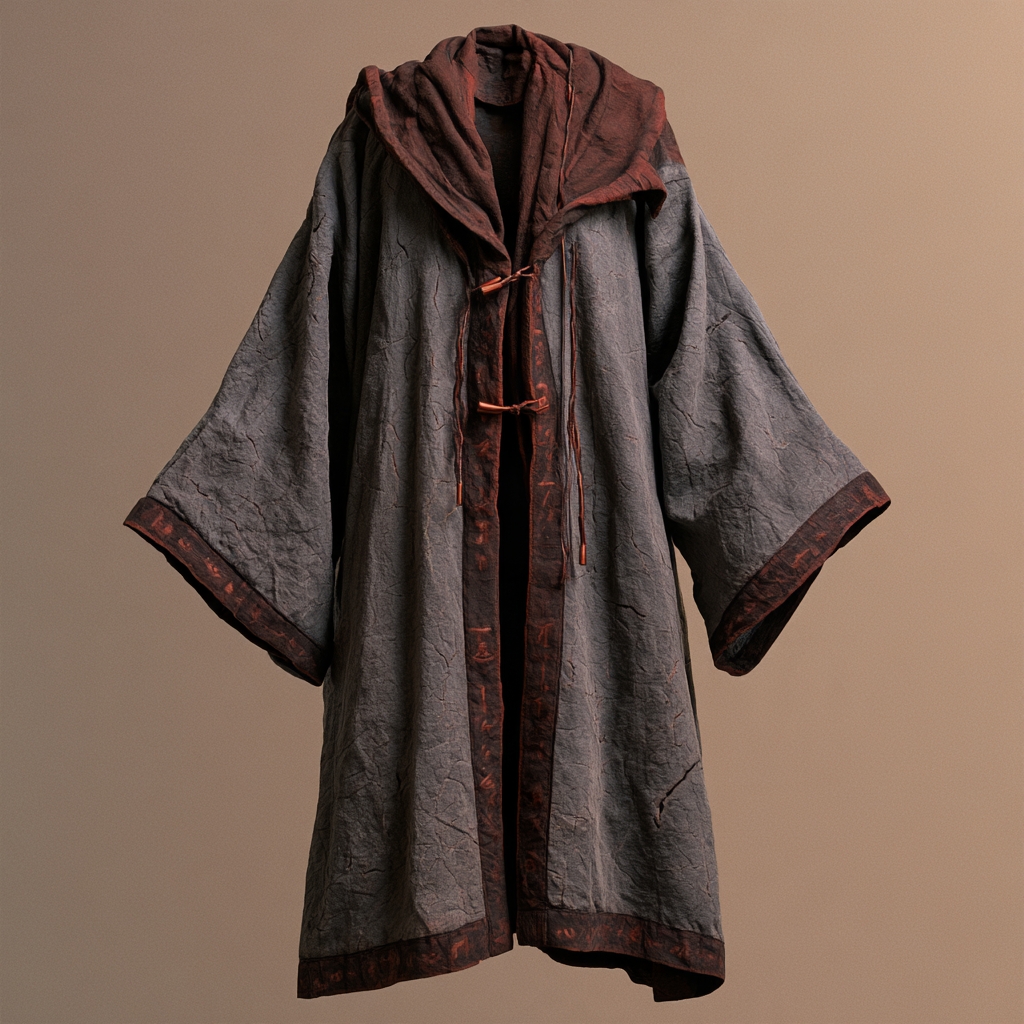
- Description: A layered robe of ash-grey cloth with dark red trim, quilted across the chest and back with thin plates of fired clay sewn between the layers. Rows of Sar-Wedge run along the hem, naming the ninth bench of the Tuppi-Sharrat matriline. The sleeves fasten back to the elbow with copper toggles.
- Abilities:
- Kiln-Fired Lining: While attuned, the wearer has resistance to fire damage from mundane sources such as forge sparks, hot steam, and lamp oil.
- Clean Hands: Clay, ink, soot, and ash do not cling to the robe. It sheds them when shaken once.
- Suggested value: 40 silver
Lore
The first bench-robes were cut in the workshops below the archive hall of Balawat during the early renaissance, when the Tuppi-Sharrat matriline received its charter to verify royal decrees. Until then, scribes of the house wore whatever their mothers handed down. A kiln fire in the third generation changed that. A drying rack collapsed against an open firing chamber, and four apprentices of the ninth bench were burned while pulling tablets clear. One of them, a daughter named Sharrat-Ili, lost the use of her writing hand. The bench-mother of the time ordered that no daughter of the house would stand at a kiln again without protection that the house itself had made.
The design that followed took its method from the tablets. Thin plates of archive clay were pressed, inscribed on their hidden faces with a single wedge each, and fired in the same chamber that had burned the apprentices. The plates were then quilted between layers of ash-grey cloth woven in the State of Kalhu. The matriline holds that each plate carries a syllable, and that the plates of a complete robe spell a short decree of preservation in Akkad-Sar when read in order from the left shoulder to the right hip. No one outside the house has been permitted to open a robe and check.
Each bench weaves its own number into the hem. The ninth bench has made its robes the same way for many generations, and the row of Sar-Wedge along the hem of this one names every scribe who has worn it. There are six names. The first is Sharrat-Ili, who returned to the bench as a reader after her injury and wore the robe for two hundred years. The fifth is Ama-Sharrat. The sixth is Nin-Tuppi, whose name was pressed into the hem with a heated stylus on the day she became a senior apprentice. There is room on the hem for three more.
The dark red trim marks rank. An apprentice’s robe carries a single band at the cuffs and collar. A verifying scribe adds a second band at the hem, sewn on by her own mother. The copper toggles at the sleeves were a later addition, made when the house began taking the Dermal Weave and needed the forearms left bare. Scribes of other benches say the ninth is the most conservative in the house and that its robes smell faintly of the old kiln. The ninth bench regards both remarks as accurate.
A bench-robe is not sold. When a line ends, the robe is returned to the bench-mother, who either assigns it to another daughter or commits it to the forge during a Flamevow. Robes that appear in markets outside Balawat are copies, stolen goods, or the property of a scribe who has left the house. Merchants who know the difference will ask which one it is.
Assigned Values
- Specific slot: Chest (torso garment worn under a mantle or sash, with the forearms left uncovered)
- Tier one stats:
- Armor Check: +3
- Intellect: +1 while attuned
- Endurance: +1 while attuned
- Maximum health points: +2 while attuned
- Item health points: 10 plus the wearer’s maximum health points
- Charges: 3, regaining 1 at each Helios up
- Skills gained while openly worn:
- Scribing: +1 temporary skill point
- Kiln Work (firing clay and ceramics): +1 temporary skill point
- Etiquette (Assyrian courts and archive halls): +1 temporary skill point, only while the hem is visible
Passive Magics
- Kiln-Fired Lining: While attuned, the wearer has resistance to fire damage from mundane sources.
- Clean Hands: Clay, ink, soot, and ash do not cling to the robe.
- Steady Bench: While attuned, the wearer has advantage on saves against being Dazed or Shaken while performing Scribing, Rune Cutting, or Kiln Work.
- Cool Cloth: The wearer is comfortable in forge halls, steam tunnels, and ashfall, and suffers no Fatigued condition from mundane heat.
- Named Hem: Anyone who views the robe through the Mind’s Eye sees the name of its current wearer as the last entry on the hem. If the robe is worn by someone not named there, the last entry appears blank.
Activatable Magics
- Plate Ward (reaction, 1 charge): When the wearer is hit by an attack, the clay plates harden for an instant and reduce the damage by 1d4 plus 1. The plates give an audible crack when this is used.
- Decree of Preservation (action, 1 charge): The wearer speaks the robe’s hidden decree in Akkad-Sar and touches one object of clay, parchment, or wax no larger than a tablet case. For one hour that object has resistance to fire and water damage and cannot be smudged or erased.
- Ember Shed (action, 2 charges): The wearer shakes the robe and releases the heat it has absorbed as a burst of warm ash in a 10-foot radius. Creatures in the area other than the wearer have disadvantage on attack rolls until the end of their next turn. Open flames no larger than a torch in the area are smothered.
- Sleeves Back (free action, no charge): The wearer speaks a word and the copper toggles fasten or release the sleeves, exposing or covering the forearms.
Tags
Chest Armor, Tier 1, Common, Akkad-Kuri, Tuppi-Sharrat, Scribe Garb, Fired Clay, Fire Resistance, Sar-Wedge, Heirloom, Balawat, Robe, Quilted, Ash-Grey, Matrilineal, Kiln Work, Charged Item, Reaction Ward, Preservation, Assyria, Renaissance, Not For Sale
Obtaining, Buying, and Selling the Bench-Robe of the Ninth Wedge 3861
How the item might be obtained
- Issued by the house: A daughter of the Tuppi-Sharrat matriline receives a bench-robe from her bench-mother on reaching senior apprentice rank. This is the only way the house itself hands one over, and no coin changes hands.
- Possession of an avatar: A character who possesses an Akkad-Kuri scribe of the ninth bench acquires the robe along with everything else the avatar was wearing.
- Quest reward: The bench-mother of Balawat may lend or grant a robe to an outsider who has done the house a significant service, such as recovering lost tablets or exposing a forged decree. The outsider’s name would be pressed into the hem.
- Combat or salvage: A robe may be taken from a fallen scribe, found among the goods of bandits on the road out of Kalhu, or recovered from a flooded or abandoned archive vault.
- Commissioned copy: A skilled tailor working with a kiln worker can produce a copy with the same clay plates and cloth. A copy has no names on its hem until an attuned wearer adds one.
- Purchase: Copies, stolen robes, and robes belonging to scribes who have left the house reach the market through the shops below.
Shops where the item might be bought and sold
All prices are suggested amounts based on a value of 40 silver. Sellers set their own prices, and the amounts shift with distance from Balawat and with what the buyer appears willing to pay.
- Family tailor and quilter in Balawat:
- What it is: A small household shop near the archive hall, run by a tailor whose spouse fires the clay plates in a back-room kiln. They make copies to order and repair genuine robes for the house.
- Buying: A new copy costs about 40 silver and takes a week to make. A member of the local guild or of the matriline pays about 36 silver.
- Selling: The tailor pays about 20 to 24 silver for a copy in good repair. The tailor will not buy a genuine robe with names on the hem and is likely to report the offer to the bench-mother.
- How: Coin or World Bank transfer. The shop keeps a log of each sale and the buyer’s name.
- Scribe and stationery supplier in the capital:
- What it is: A narrow shop in a commercial district selling styluses, clay, wax tablets, seal blanks, and scribe’s clothing to clerks and students.
- Buying: About 46 to 50 silver, since the robe has traveled the Golden Highway and the Zab road to get there.
- Selling: About 22 to 26 silver. The owner checks the hem through the Mind’s Eye before making an offer.
- How: World Bank transfer preferred. Goods sold in the city carry the 3% tax, which the shop includes in its price.
- Secondhand clothier in Nimrod Quay:
- What it is: A family stall in the open-air market dealing in used garments, uniforms, and costume pieces for travelers and collectors.
- Buying: About 55 to 70 silver. Foreign buyers who want Assyrian scribe garb as a curiosity are quoted the higher amount.
- Selling: About 18 to 22 silver. The stall owner asks few questions about copies and many about a robe with a named hem.
- How: Coin is common here. Haggling of around 10% either way is expected.
- Guildhall quartermaster in a Kalhu town:
- What it is: A counter inside the guildhall where members trade gear taken on quests. Stock depends on what members have turned in.
- Buying: About 36 silver for a guild member and 40 silver for a non-member, when one is available.
- Selling: About 24 silver. The quartermaster records the seller and the quest the item came from, and an official may ask about it later.
- How: World Bank transfer, with the 1% bank fee paid by the account holder.
- Black-market fence in Ashur Dock:
- What it is: A back room behind a ship chandler’s shop, dealing in stolen goods bound for other islands.
- Buying: About 40 to 60 silver for a copy. A genuine robe with a named hem runs 4 to 8 gold, since it can be used to pass as a scribe of the house.
- Selling: About 20 silver for a copy and up to 4 gold for a genuine robe if the fence has a buyer waiting.
- How: Coin only, no World Bank, and no log is kept.
- Curio and import dealer on another island nation:
- What it is: A small family shop in a foreign port selling goods from distant countries.
- Buying: About 1 to 2 gold. An item common in Kalhu is rare this far from Assyria, and the cost of sea passage is built into the price.
- Selling: About 30 to 50 silver, depending on whether the dealer recognizes what it is.
- How: Local coinage or World Bank transfer. Assyrian citizens pay double the local taxes and fees as foreigners.
Roleplay of the Bench-Robe of the Ninth Wedge 3861 in Defense and Offense
Archive halls and vaults
- Defense:
- Nin-Tuppi stands with her back to the shelving so an attacker must come at her front, where the clay plates are thickest. When a blow lands, she spends a charge on Plate Ward, and the crack of the plates echoes down the vault and alerts the keepers.
- Before a fight she can see coming, she speaks the Decree of Preservation over the tablet or scroll she is guarding. Her first concern is the record, and she will take a hit to finish the decree.
- In a guarded archive, which is a designated safe area, the robe’s Armor Check of 3 counts as 9.
- Offense:
- She uses Ember Shed in the narrow aisles, where a 10-foot burst fills the whole passage. The ash smothers the attackers’ torches and leaves them fighting in the dark, while her low-light vision still serves.
- She follows with the Wedge-Stylus on a foe who now attacks at disadvantage.
Forge halls, kilns, and steam tunnels
- Defense:
- Kiln-Fired Lining and Cool Cloth let her stand close to open firing chambers, steam vents, and spilled lamp oil. She retreats toward heat that others cannot follow her through.
- She stays alert near venting steam while opponents begin to tire from the heat.
- Offense:
- She draws a pursuer past a steam vent or kiln mouth and lets the surroundings do the harm. She is direct about it and will warn a foe once, in Akkad-Sar, that the bench is no place for them.
- Ember Shed is strongest here in roleplay, since the robe has absorbed a full day of forge heat. The ash comes out warm and thick, and the GM may describe it as hanging in the still air longer than usual.
Quarries and mountain paths of Kalhu
- Defense:
- On open ground the robe offers its plain Armor Check and one or two uses of Plate Ward. She keeps a quarry face or a cut block at her back and saves her charges for blows she cannot avoid.
- Wind scatters ash, so she does not rely on Ember Shed on an exposed ledge.
- Offense:
- The robe adds little here. She uses Sleeves Back as a free action to bare her forearms and bring the Dermal Weave into effect, then fights with the Quarry Mallet or the Decree Tablet.
- A quarry is a normal area, so the robe’s Armor Check stands at 3.
City streets and markets
- Defense:
- Inside a walled town, a somewhat safe area, the robe’s Armor Check counts as 6. The Named Hem also protects her socially, since guards and clerks who read it through the Mind’s Eye know which house will ask questions if she is harmed.
- She keeps her sleeves fastened down in crowds so her patterns are harder to read and describe.
- Offense:
- Against a cutpurse or a hired knife, she uses Ember Shed to blind the alley and then walks away. The robe sheds the ash at once through Clean Hands, so she steps back into the street unmarked while her attacker is covered in it.
- The visible hem gives her a point of Etiquette. In a dispute she lets a magistrate or guild officer read the robe before she speaks.
Wetlands, rain, and river travel
- Defense:
- The quilted cloth grows heavy when soaked, and she describes it as dragging at her shoulders. The plates still harden for Plate Ward.
- She uses the Decree of Preservation on her tablet case before a river crossing, keeping the contents safe from water for an hour.
- Offense:
- Ember Shed is weak in rain, since wet ash clumps and falls. The GM may shorten or cancel its effect in a downpour. She saves the charges for Plate Ward.
Low-magic and magic-dampened places
- Defense:
- The robe’s charges return more slowly in the roleplay of such places, and she feels the plates as dead weight. Combined with her own weakening as an Akkad-Kuri, she becomes cautious and avoids fights.
- In an unsafe area the robe’s Armor Check is halved, and in a deathly area it gives none, so she counts only on Plate Ward.
- Offense:
- She does not press an attack here. If cornered, she spends both remaining charges on Ember Shed to cover a retreat.
Courts, guildhalls, and social encounters
- Defense:
- The robe marks her as a scribe under charter. Wearing it openly discourages accusations that her copies are false, and Steady Bench keeps her hand from shaking under hostile questioning while she works.
- Offense:
- She uses the robe as a statement. Unfastening the sleeves with a spoken word, baring the script on her forearms, and laying a preserved tablet on the table is how a Keeper makes a threat in public.
Perception of Activation:
User’s Perspective
- Sight: The wearer sees a red-orange light rise through the quilting at the edge of her vision, and the hem below her knees brightens. During the Decree of Preservation she sees the glow travel down her right sleeve into her hand.
- Sound: A low ticking comes from the plates as they warm, like cooling pottery. Plate Ward gives a sharp crack close to the ear. Ember Shed begins with a soft rushing sound, like sand poured from a jar.
- Touch: The cloth warms against the chest and back, then stiffens for an instant at the point of a blow. After Ember Shed the robe turns suddenly cool and feels lighter on the shoulders.
- Smell: Hot clay and kiln smoke, with a trace of lamp oil. The smell is strongest at the collar.
- Taste: A dry, mineral taste at the back of the tongue, like dust from a freshly broken tablet.
- Extra-sensory perceptions:
- Aetheric Scrutiny: The wearer tastes the robe’s magic as clean, steady fire with a faint sweetness of old clay. Each spent charge leaves a brief hollow note, like a missing tooth in a familiar row.
- Mind’s Eye: The six names on the hem brighten in her awareness, and she knows without counting how many charges remain.
- Attunement sense: She feels the plates as an ordered line of syllables resting against her body. When the decree is spoken, she feels each plate answer in turn.
- Memory echo: For a moment she senses the presence of the earlier wearers, as a feeling of hands steadying her shoulders. No voices or images accompany it.
Observer’s Perspective
- Sight: An observer sees the scribe’s robe light from within. Plate Ward shows a brief grid of pale orange squares. Ember Shed produces a rolling grey cloud flecked with drifting sparks that hides the wearer from view.
- Sound: The crack of Plate Ward carries across a hall. The spoken decree is heard as a short, stressed phrase in Akkad-Sar. The ash cloud muffles footsteps and voices within it.
- Touch: Those within arm’s reach feel a wave of dry warmth. Inside the ash cloud the air is warm and gritty on the skin and eyes.
- Smell: Kiln smoke and hot stone spread quickly through a closed room and linger for several minutes.
- Taste: Observers in the ash cloud taste grit and soot.
- Extra-sensory perceptions:
- True sight: The robe gives off a steady ultraviolet glow that pulses brighter at each activation. The diagonal line of plates shows as a row of distinct bright points.
- Aetheric Scrutiny (other Akkad-Kuri): Nearby Akkad-Kuri taste a sudden flare of fire-aligned magic and can tell its direction and rough strength.
- Mind’s Eye: An observer who examines the robe sees its name and the wearer’s name on the hem. During activation the name of the ability used appears briefly.
- Blind sight and tremorsense: The crack of Plate Ward gives a clear echo that reveals the wearer’s position. The ash cloud scatters echoes and blurs shapes within it.
- Soul sight: The wearer’s soul appears outlined by a thin warm band at chest height while the robe is active.
Positives
- The wearer always knows the robe’s state without looking, through warmth, the hem’s glow, and the Mind’s Eye.
- The warming and ticking of the plates give a moment of warning to the wearer that the robe is ready.
- The sense of the earlier wearers steadies the wearer and supports the Steady Bench passive in roleplay.
- The crack of Plate Ward can summon help in an archive or guildhall.
- The ash cloud confuses sight, echo-based senses, and scent together.
- Allies with Aetheric Scrutiny or true sight can locate the wearer through smoke or darkness.
Negatives
- Every activation is visible, audible, and scented. The robe cannot be used quietly.
- The glow and the ultraviolet pulse mark the wearer’s position for foes with true sight or Aetheric Scrutiny.
- The crack of Plate Ward reveals her location to creatures that hunt by sound.
- Anyone using the Mind’s Eye can read her name from the hem while the robe is active.
- The smell of kiln smoke clings to a room and shows that the robe was used there.
- The hollow note left by each spent charge is distracting, and at no charges the wearer feels the robe as cold dead weight.
- The memory echo can unsettle a wearer whose name is not on the hem, who senses the earlier wearers as a withdrawal instead of support.
Recipe: Bench-Robe in the Manner of the Ninth Wedge
Materials Needed
- Cloth and thread:
- 6 yards of ash-grey Kalhu wool-linen weave for the outer layer
- 6 yards of plain undyed linen for the inner lining
- 2 yards of dark red trim band for cuffs and collar
- 1 spool of waxed grey thread and 1 spool of copper-wound thread for the hem
- Clay plates:
- 4 pounds of clean archive clay, or fine river clay from the Zab, sieved free of grit
- 1 handful of volcanic ash to temper the clay
- Enough for 27 thin plates, each about the size of a palm, plus 3 spares
- Magical components:
- 3 tier 1 magic crystals, each about the size of a coin, as catalysts (one for each charge)
- 1 vial of Glimmerwood-free hearth resin, or any heat-setting alchemical resin, to seal the plates
- 1 small pot of kiln-ash ink for pressing the wedges
- 1 pinch of copper dust for the hem script
- Fittings:
- 4 copper toggles with loops for the sleeves
- 1 copper collar hook
- Fuel:
- Charcoal or peat sufficient for one full kiln firing and one resin setting
Tools Required
- A pottery kiln able to hold a steady firing heat for six hours
- A rolling board and wire clay cutter
- A wedge stylus for pressing Sar-Wedge into clay
- A heated stylus or fine branding point for the hem
- Tailor’s shears, needles, pins, and a quilting frame
- A small crucible and tongs for warming resin and seating crystals
- A reading lens or other identification focus for checking the finished work through the Mind’s Eye
- A clean, flat drying rack kept away from the kiln mouth
Skill Requirements
- Tailoring: 3 or higher
- Kiln Work: 3 or higher
- Scribing (Sar-Wedge): 3 or higher
- Rune Cutting: 2 or higher
- Alchemical Crafting: 1 or higher, for handling the resin and seating the crystals
- Two crafters may share the work, provided each required skill is met by the one performing that step.
- Time: About 7 days of downtime, with most of it spent on drying and quilting.
- Knowledge: The crafter must know a short decree of preservation in Akkad-Sar of exactly 27 syllables. The matriline’s own decree is not shared outside the house, so a crafter must compose one. The GM decides whether a composed decree is sound.
Crafting Steps
- Prepare the clay:
- Knead the volcanic ash into the clay until the color is even. Roll it to the thickness of a coin and cut 30 plates with the wire.
- Press the syllables:
- While the plates are damp, press one syllable of the decree into the hidden face of each of 27 plates with the wedge stylus, keeping them in order. Mark the order with a dot of kiln-ash ink on the edge. Leave the 3 spares blank.
- Dry the plates:
- Lay the plates on the rack for two full days. Turn them once each day. A plate that curls or cracks is replaced with a spare, which is then pressed with the missing syllable and dried again.
- Fire the plates:
- Fire all plates together for six hours and let the kiln cool on its own overnight. Opening the kiln early cracks the plates.
- Seat the crystals:
- Warm the resin in the crucible. Seat one tier 1 crystal behind each of three plates: the first, the fourteenth, and the twenty-seventh. Seal every plate with a thin coat of resin and let it set by the kiln’s remaining warmth.
- Cut the cloth:
- Cut the outer layer and lining to the wearer’s measure, with sleeves long enough to fold to the elbow. Mark 27 pockets running in a diagonal line from the left shoulder to the right hip, with the remaining quilting spread across the chest and back.
- Quilt the robe:
- Place each plate in its pocket in order, hidden face inward. Stitch the layers closed around each plate with waxed grey thread on the quilting frame. This takes about three days.
- Finish the garment:
- Sew on the dark red trim at cuffs and collar. Attach the copper toggles and collar hook.
- Inscribe the hem:
- Stitch a blank band along the hem with copper-wound thread. Using the heated stylus and copper dust, press the bench or maker’s mark in Sar-Wedge at the left end. Leave the remaining space empty for wearers’ names.
- Speak the decree:
- With the robe laid flat, the crafter chants the full 27-syllable decree as a ritual of at least 10 minutes while touching each plate in order. The plates warm and the hem takes a faint glow if the work is sound.
- Roll for the result:
- The crafter rolls a d20. On a 1 the plates crack during the chant, the crystals shatter into shards, and the materials are lost. On a 20 the robe gains one extra capability chosen by the GM, such as a fourth charge. Any other result produces a working robe.
- Check and name:
- Examine the robe through the identification focus to confirm its abilities. The first wearer attunes over one minute and presses a name into the hem with the heated stylus.
Sharrat-Ili One-Handed and Garment That Was Fired Twice
Hear now what was pressed, and pressed again by another hand, and carried over from the speech of those before, whose speech no mouth now holds. The words are not all sure. Where the clay was broken, the breaking is told.
In the days of the third mothers after Ummi-Belet, who was the first-mother of the house and counted stones before she counted words, there was at Balawat a bench, and the bench was the ninth, and it had no shame and no glory. It was a bench of copying. Eleven daughters sat at it and the one who sat at its head was called Belet-Amat, which is in the old way of saying “the lady whose word is a word.” She was not kind and she was not unkind. She was as the kiln is.
Now among the eleven was a daughter named Sharrat-Ili, and she was young, being of only fifty winters, which among the long-lived children of Ashurak is as a girl who has just learned to carry water. Her hand was the best hand. This is told in all the tellings. When she pressed the wedge, the wedge stood up straight as a soldier, and when she pressed the row, the row did not wander like a goat but went as a road goes. The mother-of-the-bench looked at her tablets and said nothing, and all knew this for great praise.
And Sharrat-Ili was proud of her hand. She did not say it. But she washed that hand apart from the other, and she would not carry the charcoal with it, and at the Flamevow she polished the metal with the left only. The other daughters saw, and they made a name for her, and the name was “She-Who-Has-One-Hand-Already.” They laughed in the way of sisters. The translator of old has written here a mark which means “this was a joke in their tongue and is not one in ours.”
In that season a great copying was laid on the ninth bench. The Queen of that day, whose name is rubbed away from the clay, had made new decrees for the cutting of stone in all the southern high-lands, and each decree must be pressed four times and fired four times, and one for the palace, and one for the fire-temple, and one for the quarry, and one for the vault below. Three hundred and three-score tablets it was. The bench worked while Helios was up and while Helios was down, and the fire-house of clay, which is the kiln, was not let to grow cold for the whole of a month.
Here the telling speaks of the rack. There was a rack for drying, of ash-wood, tall as two daughters, and it stood near the mouth of the kiln because the warmth there dried the tablets quickly. Belet-Amat had said in an earlier year, “Move it back.” And it was moved back. And then the work was heavy and someone moved it forward again by the width of one foot, and then by another, for the saving of steps. No telling says who. Every telling says that all eleven knew.
On the nineteenth night of the copying, in the week that is called Dimming when the great planet begins to eat the light, the rack was full. Two hundred tablets stood on it, soft still, the Queen’s words wet in them. Sharrat-Ili was at the kiln mouth with three others, whose names are kept: Nin-Dada, and Ahati the tall, and Kullaa who was the youngest. They were drawing out the fired tablets with the long tongs and the kiln stood open, and its breath was the breath of the mountain.
Then the foot of the rack, which was dry from a month of heat, gave a sound. The tellings do not agree on the sound. One says it was as a knuckle. One says it was as a word. And the rack leaned, slowly, like an old woman sitting down, and it went into the open mouth of the kiln with the two hundred tablets upon it.
Now a wise daughter would have stepped back, and let the clay burn, and pressed it again in another month, and borne the anger of the Queen’s messenger. This the bench-mother said afterward, many times. But the four did not step back. They cried out the word which is cried when a tablet falls, and they went to the rack with their hands. They pulled the tablets from the burning wood and threw them behind onto the floor. The wood of the rack was aflame, and the oil of the lamps had spilled and it was aflame, and their sleeves, which were long sleeves of common cloth, drank the fire as dry ground drinks rain.
Nin-Dada was burned on the arms. Ahati was burned on the arms and the neck. Kullaa was burned on the face, and bore it all her years. And Sharrat-Ili reached farthest, for the tablets at the back were her own tablets, with the straight rows upon them. She put her right hand, the washed hand, into the mouth of the kiln to the elbow, and she took out a tablet, and another, and at the third the rack fell wholly and lay across her arm.
They drew her out. Of the two hundred tablets, one hundred and forty were saved, and of those, nine were of her pressing, and the nine were perfect. This is counted in the telling very carefully, as though the count were important. The old translator has written beside it: “I do not know why they say the number. They always say the number.”
The Firelords came with their healing flame and they sealed the wounds, and Sharrat-Ili lived. But the hand was a closed hand after. The fingers were as the roots of a tree that has grown around a stone. It could hold a cup. It could not hold a stylus. And among the Keepers of the Wedge, a daughter who cannot press is not a daughter of the bench. This was the law of the house from the first-mother, and the law was written, and Sharrat-Ili herself had copied it.
So she rose from her sick-bed and she folded her apron, and she went to Belet-Amat and laid the apron on the bench, and she said: “I had one hand already. Now the saying is true.” And she turned to go to the house of her mother, to be a carrier of water.
And Belet-Amat said: “Sit.”
It is told that the bench-mother did not speak again that day. She went down to the kiln, which was cold now for the first time in a month, and she swept from it with her own hands the ash of the rack and the burned tablets, the sixty that were lost, with the Queen’s words in them. And she gathered that burned clay, and she ground it, and she mixed it with new clay from the vault. Then she called the tailor-woman of the lower street, and they spoke long behind a door.
For seven days Belet-Amat pressed small plates, thin as a coin, and on each she pressed one sound only, on the face that would be hidden. What the sounds say together is not written in this telling or in any. The translator writes: “Here the old text has a gap, and I think the gap was made on purpose.” Seven and twenty plates she pressed. And she fired them in that same kiln, in that same mouth that had eaten the hand of the best daughter, and she let no one else lay the charcoal.
Now comes the part for which the telling has its name. When the kiln was opened, the plates were sound, all seven and twenty. But Belet-Amat looked on them and said: “They have been in the fire once. So had she. Once is not enough to know a thing.” And she laid the charcoal again, and she fired them a second time. And the daughters whispered that she had lost her wits, for clay fired twice may shatter, and then seven days are gone to the wind.
They did not shatter. They came out the color of ash, and they rang when struck, and no flame afterward would mark them. And the tailor-woman sewed them between cloth of grey, in a line from the left shoulder to the right hip and across the breast and the back, and she made the sleeves so that they could be folded and held with pins of copper, that no sleeve should drink fire again.
Belet-Amat brought the garment to Sharrat-Ili, and she put it on her, and she said the words which the house still says when the robe is given, and which are here translated poorly: “You went into the fire for the word. Now the word goes around you. Sit at the bench. You will not press. You will read. Every tablet of the ninth bench shall pass under your eyes before it passes to the Queen, and what you say is crooked shall be broken, though I pressed it myself.”
And Sharrat-Ili said: “A reader is not a scribe.” And the bench-mother said: “A scribe makes one tablet true. A reader makes a hundred true. I have had many hands at this bench. I have not had eyes.” And she took a hot stylus, and into the hem of the robe she pressed the name of Sharrat-Ili, the first name, and it is there now.
So Sharrat-Ili sat. And for two hundred years she sat, in the robe that was fired twice, and no false wedge left the ninth bench in all that time. She found the errors of her sisters and the errors of her mothers, and once, it is said, an error in a decree of the Queen’s own speaking, and the Queen thanked her, which queens do not do. The daughters ceased to call her She-Who-Has-One-Hand-Already. They called her the Eye of the Ninth. And when the drying rack was built anew, she had it set at the far wall, and she measured the distance each morning with her own steps until she was old.
When her days were full, she gave the robe back to the bench, as is the way, and she asked one thing: that her closed hand be laid open on her breast for the Flame Return. And the Firelords say that in the forge it did open, like a flower in the heat. But this the translator marks as “said by the temple, and not by the house.”
The robe went to another daughter, and to another. Each has her name on the hem. And each, on the first day she wears it, is taken by her mother down to the kiln and shown the place on the floor where the rack fell, and is told the number: one hundred and forty saved, and nine that were perfect, and one hand.
The moral of the story is this: the thing a person is proudest of may be taken by the fire, and what remains may be worth more to the house. And also this, which the bench-mothers add: when you are told to move the rack back, move the rack back.
Suggested conversions to other systems:
Call of Cthulhu (7th Edition)
The Twice-Fired Vestment of the Ninth Bench
- Type: Enchanted garment (artifact)
- Origin: A quilted scribe’s robe from the archive hall of Balawat in Assyria, on the world of Saṃsāra. Ash-grey cloth with dark red trim hides 27 fired clay plates, each pressed with one cuneiform-like syllable. Six names are pressed into the hem.
- Armor: 1 point against physical attacks, 3 points against fire and heat from mundane sources
- Weight: 6 lb
- Bonding: The wearer studies the hem for one minute and makes a POW roll. On a success the robe is bonded and its powers can be used. On a failure the wearer may try again the next day.
- Passive effects while bonded:
- Bonus die on Art/Craft (Calligraphy) and Art/Craft (Pottery) rolls.
- Bonus die on CON rolls to resist heat exhaustion, smoke, and steam.
- Soot, ink, clay, and ash do not cling to the robe.
- Powers (the robe has no reserve of its own and draws on the wearer’s magic points):
- Plate Ward: Cost 2 magic points. Used when the wearer is struck. Reduce the damage by 1D4+1. A sharp crack is heard by everyone nearby.
- Decree of Preservation: Cost 3 magic points and one round of chanting. One touched object of clay, paper, parchment, or wax, no larger than a book, cannot be harmed by fire or water and cannot be smudged or erased for one hour.
- Ember Shed: Cost 5 magic points. Warm ash fills a 3-yard radius around the wearer for 1D3 rounds. All others in the cloud take a penalty die on attacks and Spot Hidden rolls. Flames of torch size or smaller in the area go out.
- Sanity:
- First bonding: 0/1 Sanity points, as the wearer senses six earlier wearers standing behind them.
- First time witnessing Plate Ward or Ember Shed: 0/1 Sanity points.
- Wearing the robe when one’s name is not on the hem: 1/1D3 Sanity points at bonding, as the earlier wearers are felt to withdraw.
- Investigation:
- A Hard Archaeology roll or a successful Language (Other) roll identifies the script as an unknown wedge-writing and reads the hem as a list of six names.
- An Occult roll suggests the garment is a ward against fire.
- Cthulhu Mythos: None gained. The robe is not of the Mythos.
Blades in the Dark (current edition)
The Ash-Clerk’s Twice-Burnt Coat
- Type: Fine arcane armor (unique item)
- Load: 2
- Quality: 3
- Origin: A scribe’s quilted robe from Balawat in Assyria, on the world of Saṃsāra, with 27 fired clay plates sewn between ash-grey layers and six names burned into the hem.
- Armor: Counts as Armor. Mark the armor box to reduce harm by one level or to resist a consequence. When the harm comes from fire, heat, steam, or scalding ash, reduce it by two levels instead.
- Fine: As fine clothing among scholars, clerks, and archivists, it gives +1 effect when you Consort or Sway with them while the hem is visible.
- Arcane features:
- Plate Ward: When you resist a physical consequence while wearing the coat, take 1 less stress from the resistance roll (minimum 0). The plates crack loudly when this happens.
- Decree of Preservation: Take 1 stress and speak the decree over one document, tablet, or ledger. For the rest of the score it cannot be burned, soaked, smudged, or erased.
- Ember Shed: Take 2 stress to shake a cloud of warm ash from the coat. Use it as a setup action that needs no roll, giving +1 effect or improved position to the next action by you or a teammate to escape, Prowl, or Skirmish in the cloud. Small open flames in the area go out.
- Named Hem: Anyone who Attunes to the coat learns the name of its rightful wearer. If you are not named on the hem, you cannot use the arcane features until you burn your name into it during downtime.
- Drawbacks:
- Conspicuous: Every arcane use is loud, bright, and smells of kiln smoke. When Ember Shed or Plate Ward is used during a score, take +1 heat at the end of it.
- Rare: The coat cannot be acquired as an asset. A copy must be crafted.
- Crafting a copy: Invent the formula as a long-term project, then Tinker during downtime. Arcane, minimum quality 3, with the Conspicuous drawback. Requires a kiln, fine clay, and a decree of 27 syllables.
Dungeons & Dragons (2024 rules)
Robe of the Twice-Fired Decree
- Wondrous Item, Uncommon (Requires Attunement)
- Weight: 6 lb.
- Description: This quilted robe of ash-grey cloth with dark red trim comes from the archive hall of Balawat in Assyria, on the world of Saṃsāra. Twenty-seven fired clay plates are sewn between its layers, and six names are pressed into the hem in a wedge script. The sleeves fasten back to the elbow with copper toggles.
- Kiln-Fired Lining: While you wear the robe and no armor, your base Armor Class is 13 plus your Dexterity modifier. You also have Resistance to Fire damage from nonmagical sources.
- Bench Training: While attuned, you have proficiency with Calligrapher’s Supplies and Potter’s Tools. If you already have either proficiency, you have Advantage on ability checks made with that tool.
- Clean Hands: The robe never becomes dirty. You can fasten or release its sleeves without using an action.
- Named Hem: The Identify spell reveals the name of the creature attuned to the robe.
- Charges: The robe has 3 charges and regains 1 expended charge daily at dawn.
- Plate Ward (1 charge): When you are hit by an attack roll, you can take a Reaction to reduce the damage by 1d4 plus your Proficiency Bonus. The plates crack audibly out to 60 feet.
- Decree of Preservation (1 charge): As a Magic action, you touch one Tiny nonmagical object made of clay, paper, parchment, or wax. For 1 hour the object has Immunity to Fire damage, can’t be damaged by water, and its writing can’t be smudged or erased.
- Ember Shed (2 charges): As a Magic action, you release warm ash in a 10-foot Emanation. Each other creature in the area must succeed on a DC 13 Constitution saving throw or have Disadvantage on attack rolls until the end of its next turn. Nonmagical flames of torch size or smaller in the area are extinguished.
Knave (Second Edition)
Twice-Fired Scribe’s Gambeson
- Type: Relic armor piece, worn in place of a gambeson
- Slots: 1
- Armor: +1 Armor Point
- Value: Not normally for sale. Copies fetch whatever a buyer will pay.
- Description: A quilted robe of ash-grey cloth with dark red trim from Balawat in Assyria, on the world of Saṃsāra. Fired clay plates are sewn inside, each pressed with one wedge-mark. Six names run along the hem.
- Always in effect while worn:
- Take half damage from mundane fire, steam, and heat.
- Soot, ink, clay, and ash fall away from the robe.
- Checks to copy, write, or fire clay are made with advantage (+5).
- Anyone who examines the hem closely learns the wearer’s name. A wearer not named on the hem cannot use the powers below.
- Charges: 3. One charge returns each morning.
- Plate Ward (1 charge): When hit, reduce the damage by d4+1. The crack is heard throughout the room.
- Decree of Preservation (1 charge): Speak the decree and touch a book, scroll, or tablet. It cannot be burned, soaked, or erased for 6 turns (one hour).
- Ember Shed (2 charges): Shake out a cloud of warm ash filling a 10-foot radius until the end of the next round. All others inside attack with disadvantage (−5). Torches and candles in the cloud go out.
- Limit: If the wearer takes a wound that fills this item’s slot, the plates shatter and the robe is an ordinary gambeson until a potter and tailor spend a week repairing it.
Fate (Fate Condensed)
The Robe That Went Twice to the Fire
- Type: Extra (heirloom garment)
- Origin: A quilted scribe’s robe from the archive hall of Balawat in Assyria, on the world of Saṃsāra. Ash-grey cloth with dark red trim hides 27 fired clay plates, and six names are pressed into the hem.
- Permission: A character aspect that ties the wearer to the scribes of the ninth bench, or a name pressed into the hem during a milestone.
- Cost: 2 refresh
- Item aspect: Twice-Fired Robe of the Ninth Bench
- Invoke: To shrug off flame and heat, to steady a hand at careful work, or to be recognized as a scribe under charter.
- Compel: Every use is loud, bright, and smells of the kiln, and anyone who reads the hem knows the wearer’s name.
- Stunts granted while worn:
- Kiln-Fired Lining: +2 to defend with Physique against fire, steam, and heat.
- Plate Ward: Once per session, when you take a physical hit, reduce its shifts by 2 before absorbing stress. Everyone in the zone hears the plates crack.
- Decree of Preservation: Once per scene, speak the decree over one document or tablet. It gains the aspect Preserved by Decree with one free invoke, and it cannot be burned, soaked, or erased for the scene.
- Ember Shed: Once per session, place the situation aspect Choking Ash Cloud on your zone with two free invokes, without rolling. Small open flames in the zone go out. The aspect ends after the next exchange unless someone acts to keep it.
- Skill note: While the sleeves are fastened back and the wearer is at a bench, Crafts rolls to write, inscribe, or fire clay may invoke the item aspect once per scene for free.
Numenera and Cypher System (Numenera Discovery and the Cypher System Rulebook)
Vestment of Twenty-Seven Syllables
- Type: Artifact
- Level: 1d6
- Form: A quilted robe of ash-grey cloth with dark red trim, from Balawat in Assyria on the world of Saṃsāra. Thin fired plates are sewn between its layers, each bearing one wedge-shaped mark. Six names run along the hem, and the sleeves fasten back with copper toggles.
- Effect:
- Worn as clothing, the robe grants +1 to Armor and does not count as armor for the purpose of Speed Effort costs. It grants an additional +2 to Armor against damage from fire, steam, and heat.
- The wearer has an asset on tasks involving writing, inscription, or firing clay.
- Plate Ward (enabler): When the wearer takes damage from an attack, they can reduce that damage by a number of points equal to the artifact level. Roll for depletion.
- Decree of Preservation (action): The wearer speaks the decree and touches one object of clay, paper, parchment, or wax that fits in two hands. For one hour the object cannot be harmed by fire or water and cannot be smudged or erased. Roll for depletion.
- Ember Shed (action): Warm ash fills an immediate area around the wearer until the end of the next round. Attacks and sight-based tasks by all others in the cloud are hindered. Small open flames in the area go out. Roll for depletion twice.
- The hem shows the name of the rightful wearer to anyone who examines it. A wearer not named there gains only the Armor.
- Depletion: 1 in 1d20. A depleted robe keeps its +1 to Armor and loses all other effects.
Pathfinder (Second Edition, Remaster)
Kilnbound Archivist’s Robe — Item 6
- Traits: Invested, Magical
- Price: 250 gp
- Usage: worn armor
- Bulk: L
- Description: This +1 explorer’s clothing is a quilted robe of ash-grey cloth with dark red trim, from the archive hall of Balawat in Assyria on the world of Saṃsāra. Twenty-seven fired clay plates are sewn between its layers, and six names are pressed into the hem in a wedge script. While invested, you gain fire resistance 2 against nonmagical fire and a +1 item bonus to Crafting checks to write, inscribe, or work clay. The robe never becomes soiled. A creature that succeeds at a DC 22 check to Identify Magic on the robe learns the name of the creature that has it invested.
- Activate—Plate Ward [reaction] (manipulate)
- Frequency: once per day
- Trigger: You take physical damage from a Strike.
- Effect: The plates harden with a loud crack. You gain resistance 5 against the triggering damage.
- Activate—Decree of Preservation [two-actions] (concentrate, manipulate)
- Frequency: once per day
- Effect: You touch one nonmagical object of light Bulk or less made of clay, paper, parchment, or wax. For 1 hour it is immune to fire damage, can’t be damaged by water, and its writing can’t be smudged or erased.
- Activate—Ember Shed [two-actions] (manipulate)
- Frequency: once per day
- Effect: Warm ash bursts from the robe in a 10-foot emanation. Nonmagical fires of torch size or smaller in the area are extinguished. Each other creature in the area must attempt a DC 22 Fortitude save.
- Success: The creature is unaffected.
- Failure: The creature is dazzled for 1 round.
- Critical Failure: The creature is dazzled for 1 minute.
Savage Worlds (Adventure Edition)
The Quillmother’s Fire-Proved Robe
- Type: Arcane device (armor)
- Armor: +2
- Covers: Torso, arms
- Minimum Strength: d4
- Weight: 6
- Cost: Not normally for sale. Copies sell for whatever the market bears.
- Description: A quilted robe of ash-grey cloth with dark red trim from Balawat in Assyria, on the world of Saṃsāra. Fired clay plates are sewn inside, each pressed with one wedge-mark. Six names run along the hem.
- Passive effects while worn:
- +2 additional Armor against fire damage.
- +2 to Vigor rolls made to resist the Heat hazard.
- +1 to Academics and Repair rolls that involve writing, inscription, or firing clay.
- The robe never becomes soiled.
- A Notice roll on the hem reveals the name of the rightful wearer. A wearer not named there gains only the Armor.
- Power Points: 6. The robe regains 2 Power Points each dawn and cannot be recharged by other means.
- Activation: No roll is needed. The wearer spends the Power Points listed.
- Plate Ward (2 Power Points, free action): When the wearer suffers Wounds from an attack, they may make a Soak roll without spending a Benny. The plates crack loudly.
- Decree of Preservation (1 Power Point, action): One touched object of clay, paper, parchment, or wax, no larger than a book, cannot be harmed by fire or water and cannot be smudged or erased for one hour.
- Ember Shed (3 Power Points, action): Center a Medium Blast Template on the wearer. Until the end of the wearer’s next turn, all others in the template suffer −2 to attacks and to Notice rolls that depend on sight. Flames of torch size or smaller in the template go out.
Shadowrun (Sixth World Edition)
Ninth-Bench Ward Coat
- Type: Armor and bonded focus
- Defense Rating: +3
- Capacity: 6 (4 used by Fire Resistance)
- Force: 2
- Bonding cost: 4 Karma
- Availability: 5(L)
- Cost: 9,000¥ for a copy. The original is not for sale.
- Description: A quilted robe of ash-grey cloth with dark red trim, from the archive hall of Balawat in Assyria on the world of Saṃsāra. Twenty-seven fired clay plates are sewn between its layers, each pressed with one wedge-mark, and six names run along the hem. It contains no electronics and has no wireless bonus.
- Built-in modification: Fire Resistance, Rating 4
- Passive effects while bonded and worn:
- +1 die on tests involving calligraphy, inscription, or ceramics.
- +2 dice on tests to resist heat and smoke from mundane sources.
- The robe never becomes soiled.
- An Assensing test with 3 hits reveals the name of the bonded wearer. A wearer who is not bonded gains only the Defense Rating and Fire Resistance.
- Charges: 3. One charge returns at each sunrise.
- Plate Ward (1 charge, used when hit): Add +3 dice to the Damage Resistance test against that attack. The plates crack loudly.
- Decree of Preservation (1 charge, Major Action): One touched object of clay, paper, parchment, or wax, no larger than a book, cannot be harmed by fire or water and cannot be smudged or erased for one hour.
- Ember Shed (2 charges, Major Action): Warm ash fills a 3-meter radius around the wearer. All others in the area gain the Blinded I status until the end of the next combat round. Flames of torch size or smaller in the area go out.
- Astral signature: Each activation leaves a fire-aspected signature that lasts for Force hours.
Starfinder (Second Edition)
Syllable-Plate Archivist Mantle — Item 5
- Traits: Invested, Magical
- Price: 1,500 credits
- Usage: worn garment
- Bulk: L
- Description: This quilted robe of ash-grey cloth with dark red trim comes from the archive hall of Balawat in Assyria, on the world of Saṃsāra. Twenty-seven fired clay plates are sewn between its layers, and six names are pressed into the hem in a wedge script. It can be worn over or under armor. While invested, you gain fire resistance 3 against nonmagical fire and a +1 item bonus to Crafting checks to write, inscribe, or work ceramics. The mantle never becomes soiled. A creature that succeeds at a DC 20 check to Identify Magic on the mantle learns the name of the creature that has it invested.
- Activate—Plate Ward [reaction] (manipulate)
- Frequency: once per day
- Trigger: You take bludgeoning, piercing, or slashing damage from a Strike.
- Effect: The plates harden with a loud crack. You gain resistance 4 against the triggering damage.
- Activate—Decree of Preservation [two-actions] (concentrate, manipulate)
- Frequency: once per day
- Effect: You touch one nonmagical, non-technological object of light Bulk or less made of clay, paper, parchment, or wax. For 1 hour it is immune to fire damage, can’t be damaged by water, and its writing can’t be smudged or erased.
- Activate—Ember Shed [two-actions] (manipulate)
- Frequency: once per day
- Effect: Warm ash bursts from the mantle in a 10-foot emanation. Nonmagical fires of torch size or smaller in the area are extinguished. Each other creature in the area must attempt a DC 20 Fortitude save.
- Success: The creature is unaffected.
- Failure: The creature is dazzled for 1 round.
- Critical Failure: The creature is dazzled for 1 minute.
Traveller (Mongoose Second Edition, 2022 Update)
Relic Vestment of Balawat
- Armour Type: Relic robe (anomalous artefact)
- Protection: +2 (+6 against fire and heat)
- TL: 2 in manufacture. Its effects cannot be reproduced at any known TL.
- Rad: —
- Kg: 3
- Cost: Not available for purchase. A collector might pay Cr5000 or more.
- Required Skill: None
- Description: A quilted robe of ash-grey cloth with dark red trim, from the archive hall of Balawat in Assyria on the world of Saṃsāra. Fired clay plates are sewn between its layers, each pressed with one wedge-mark. Six names run along the hem.
- Passive effects while worn:
- DM+1 to Art (write) checks and to any check involving inscription or ceramics.
- DM+2 to END checks against heat, smoke, and steam.
- The robe never becomes soiled.
- An Investigate check (Average 8+) on the hem reveals the name of the rightful wearer. A wearer not named there gains only the Protection.
- Charges: 3. One charge returns each local dawn.
- Plate Ward (1 charge, reaction): When the wearer is hit, reduce the damage by 1D+1 after armour is applied. The plates crack loudly.
- Decree of Preservation (1 charge, Significant Action): One touched object of clay, paper, parchment, or wax, no larger than a book, cannot be harmed by fire or water and cannot be smudged or erased for one hour.
- Ember Shed (2 charges, Significant Action): Warm ash fills a 3-metre radius around the wearer until the end of the next round. All others in the area suffer a Bane on attack rolls and on Recon checks that rely on sight. Flames of torch size or smaller in the area go out.
- Analysis: Sensors detect only cloth, fired clay, and copper. A Science check (Formidable 14+) finds no mechanism for its effects.
Warhammer (Warhammer Fantasy Roleplay, Fourth Edition)
The Twice-Kilned Clerk’s Robe
- Type: Magical armour
- Price: N/A
- Encumbrance: 1
- Availability: Unique
- Penalty: —
- Locations: Arms, Body
- Armour Points: 1
- Qualities: Flexible
- Flaws: None
- Description: A quilted robe of ash-grey cloth with dark red trim, from the archive hall of Balawat in Assyria on the world of Saṃsāra. Fired clay plates are sewn between its layers, each pressed with one wedge-mark. Six names run along the hem. To those with the Second Sight Talent, it glows with a steady, ember-red light.
- Passive effects while worn:
- +2 Armour Points on Arms and Body against Damage from non-magical fire.
- Once per Round, the wearer ignores one Ablaze Condition gained from a non-magical source.
- +10 to Art (Calligraphy) and Trade (Potter) Tests.
- The robe never becomes soiled.
- A successful Average (+20) Perception Test on the hem, by someone who can read it, reveals the name of the rightful wearer. A wearer not named there gains only the Armour Points.
- Charges: 3. One charge returns at each sunrise.
- Plate Ward (1 charge, used when hit on the Arms or Body): The robe counts as having +3 Armour Points against that hit. The plates crack loudly.
- Decree of Preservation (1 charge, Action): One touched object of clay, paper, parchment, or wax, no larger than a book, cannot be harmed by fire or water and cannot be smudged or erased for one hour.
- Ember Shed (2 charges, Action): Warm ash fills the area within 2 yards of the wearer. All others in the area gain 1 Blinded Condition. Flames of torch size or smaller in the area go out.
- Notice: Each activation is loud, bright, and smells of kiln smoke. Onlookers who fear witchcraft may react accordingly.